
Arabic Generative AI Use Cases in MENA for KSA & UAE
Arabic Generative AI Use Cases in MENA for KSA & UAE
Arabic Generative AI Use Cases in MENA for KSA & UAE
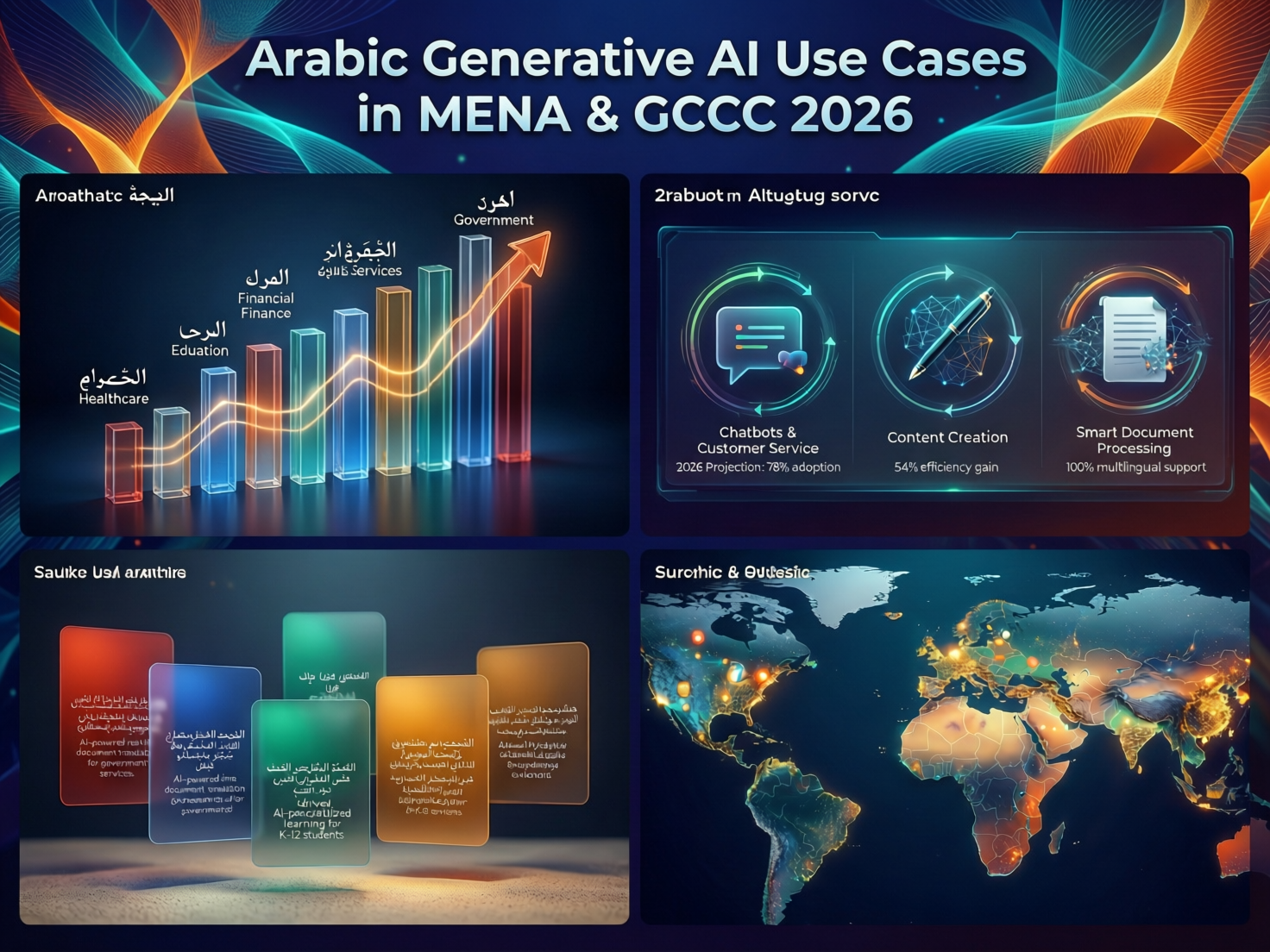
Arabic generative AI use cases in MENA are rapidly shifting from pilots to production in 2026, especially in Saudi Arabia, the UAE and Qatar. Arabic-native LLMs now power government services, contact centers and internal knowledge assistants, as long as they respect GCC regulators’ expectations on security, data residency and cross-border data. For GCC enterprises, the winning playbook is Arabic-first user experiences backed by in-region hosting, regulator-aligned security controls and clear ROI models for AI agents.
Introduction
Arabic generative AI use cases in MENA are no longer just “labs projects”. In 2026, organisations in Saudi Arabia, the UAE and Qatar are putting Arabic-native LLMs into real production: powering digital government portals, contact centers, WhatsApp journeys and internal knowledge assistants.
Across Riyadh, Dubai, Abu Dhabi and Doha, CIOs and founders are under pressure to digitise Arabic services fast, stay aligned with SAMA, TDRA, QCB, SDAIA/NDMO and DGA, and still prove payback to boards.
This guide is for GCC leaders who want concrete Arabic generative AI use cases in MENA, not just slideware. We’ll cover.
The most realistic Arabic generative AI use cases in MENA for 2026–2027
What regulators expect on security, data residency and cross-border data
How Arabic AI agents drive ROI in contact centers and back-office
Implementation patterns and a practical roadmap for GCC enterprises
If you are also modernising your Arabic web and app stack, Mak It Solutions already covers web development trends in the Middle East for KSA & UAE, which is exactly where many of these AI agents will live.
Why Arabic Generative AI Matters for MENA Enterprises in 2026
From English-first AI to Arabic-native GenAI in GCC
Most global LLMs were trained primarily on English and European languages, so they often struggle with Gulf Arabic, code-switching between Arabic and English, and local entities like Saudi government programs or Qatar’s Digital Agenda 2030. The result can be hallucinations, mismatched tone and weak understanding of customer intent in Arabic.
Arabic language large models and GCC-tuned LLMs are different. They’re trained on Modern Standard Arabic plus dialects from KSA, UAE, Qatar, Kuwait, Bahrain and Oman. For CIOs driving GCC enterprise AI transformation, this is a big shift: you can finally build AI agents that “think” in Arabic, respect local context and plug into Arabic-heavy content like policies, contracts and fatwa-related FAQs.
Priority sectors in KSA, UAE and Qatar
The earliest large-scale deployments of Arabic generative AI in MENA are emerging in.
Government and digital government portals
Saudi’s Digital Government Authority and SDAIA are pushing data- and AI-driven services aligned to Vision 2030; the UAE’s TDRA and Dubai Digital are doing the same for U.AE and emirate-level portals; Qatar’s Digital Government and MCIT are rolling out Digital Agenda 2030.
Fintech and banking
SAMA-regulated banks in Riyadh and Jeddah, QCB-supervised entities in Doha, and ADGM/DIFC players in Abu Dhabi and Dubai are exploring AI for compliant customer journeys and risk operations.
Telecom, energy, logistics and retail
Arabic CX at scale for call centers, apps and delivery tracking across Dammam, Sharjah, Kuwait City and Muscat.
Arabic LLMs and AI agents as part of Vision 2030 & national AI strategies
SDAIA has the mandate to drive Saudi Arabia’s national data and AI agenda and support Vision 2030 goals.The UAE has launched national AI strategies and ethics frameworks, including an AI Ethics Guide and AI Ethics Toolkit, to encourage responsible AI. Qatar’s Digital Agenda 2030 similarly positions AI as a core enabler of its digital economy.
Boards are therefore asking CIOs and innovation leaders for clear Arabic AI roadmaps: not just “AI pilots”, but concrete Arabic generative AI use cases in MENA that align with national visions and sector regulators.
Arabic Generative AI Use Cases in MENA for KSA, UAE and Qatar
The most realistic Arabic generative AI use cases in MENA for enterprises in Saudi Arabia and the UAE cluster around three themes: citizen and resident services, Arabic customer support, and internal knowledge assistants. In practice, that means Arabic virtual agents on government and banking portals, AI-powered WhatsApp and IVR support, and RAG-powered copilots for Arabic documents inside GCC organisations.
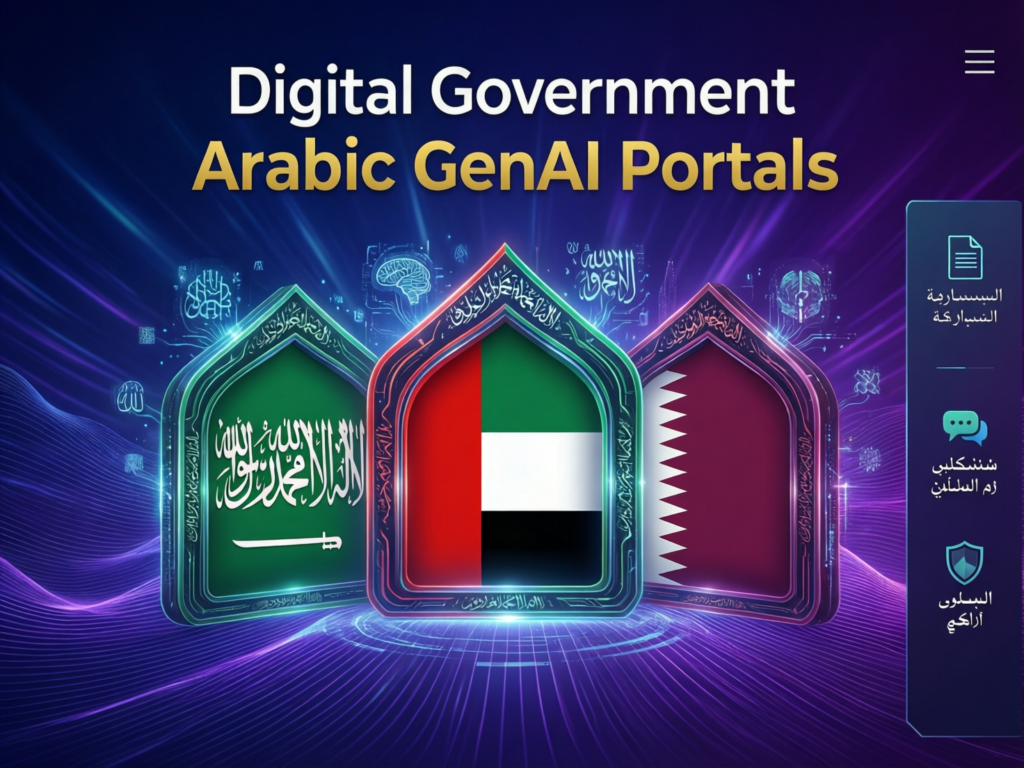
Arabic GenAI for government services in KSA, UAE and Qatar
Across Riyadh, Dubai and Doha, governments are already testing AI on portals: TDRA has deployed generative AI on federal portals such as U.AE, while Qatar’s Digital Government Strategy and Digital Agenda 2030 push for AI-enabled digital services.
High-value Arabic generative AI use cases in MENA government include:
Arabic virtual assistants that guide citizens through e-services, using DGA and SDAIA-integrated IDs in KSA, UAE Pass in the Emirates, and Qatar Digital ID.
Document summarisation for regulations, licenses and permits in Arabic
Smart Arabic form-filling and eligibility checks
FAQ deflection for ministries, municipalities and healthcare portals
GenAI use cases for Arabic customer support and contact centers
For GCC enterprises, contact centers in Riyadh, Jeddah, Dubai and Sharjah are natural homes for Arabic AI agents.
AI chatbots on Arabic websites and apps
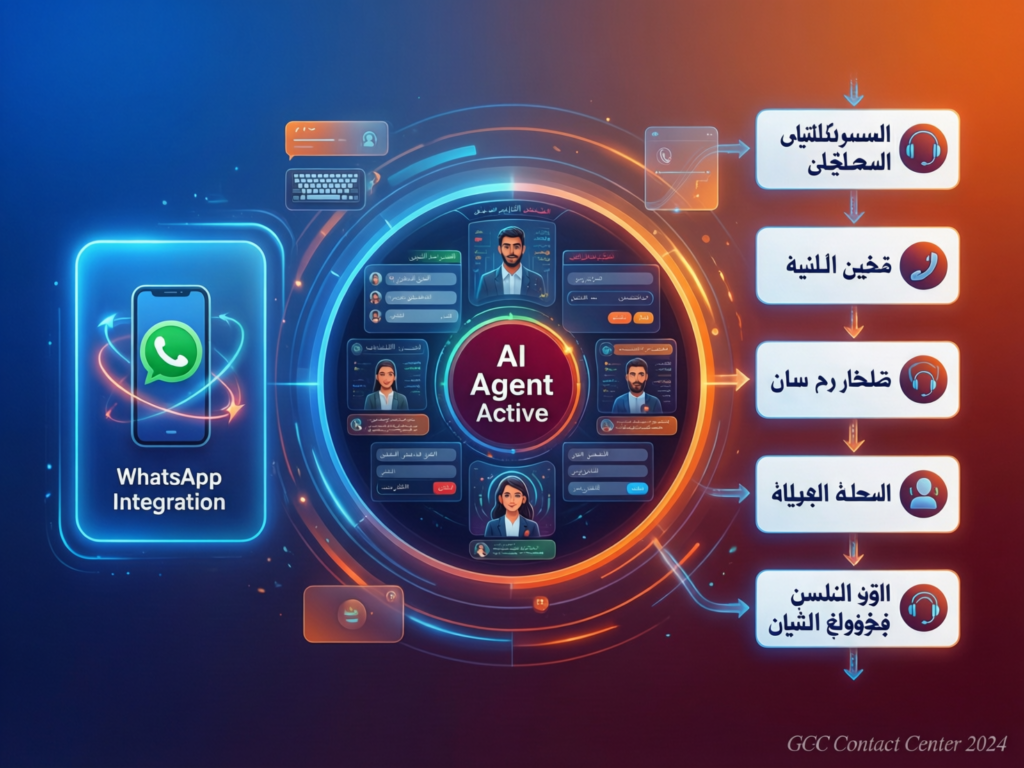
WhatsApp Business bots for KSA and UAE customer support
Voicebots and IVR deflection that handle Gulf Arabic and MSA
Agent-assist copilots that suggest Arabic responses in real time
Pairing these with strong mobile experiences is key; many brands already work with partners like Mak It Solutions on mobile app development services to make sure AI-powered flows work smoothly on iOS and Android.
Internal Arabic knowledge assistants for GCC enterprises
A huge amount of GCC enterprise knowledge lives in Arabic PDFs, Word files and emails. Retrieval-Augmented Generation (RAG) lets you index and search these securely.
Banks & fintechs policy documents, Sharia-compliant product terms, complaints handling procedures
Logistics & retail SOPs, warehouse processes, Arabic training material
Energy & telecom safety manuals, network incident runbooks
An internal Arabic copilot that runs on your own data within Saudi, UAE or Qatar regions can answer “How do we handle this scenario?” in Arabic, instead of teams digging through shared drives.
Arabic AI Agents and ROI for GCC Enterprises
How do Arabic AI agents improve ROI for GCC contact centers and WhatsApp customer support?
Arabic AI agents improve ROI in GCC contact centers by reducing cost per contact and boosting customer satisfaction at the same time. In a 150-seat contact center in Riyadh or Dubai, an AI agent that automates 25–35% of Arabic chats and WhatsApp messages can cut FTE load while also shrinking Average Handling Time and raising First Contact Resolution.
In practice, GCC brands see value through.
FTE optimisation support the same volume with 10–20% fewer incremental hires
AHT reductions 20–40 seconds saved per Arabic interaction when agents get AI-suggested replies
Better SLAs consistent 24/7 coverage in Arabic, even during Ramadan peaks
Improved NPS/CSAT faster, more accurate responses in the customer’s dialect
How can GCC enterprises measure ROI from Arabic AI agents beyond simple cost savings?
Boards no longer accept “we cut X seats” as the only ROI story. For Saudi banks, telecoms, UAE hospitality or Qatar energy operators, better KPIs include:
Automation/containment rate (how many Arabic contacts resolved without humans)
Error and compliance breach reduction for regulated journeys (e.g., SAMA or QCB complaints flows)
Revenue per contact (upsell/cross-sell via smart Arabic recommendations)
NPS/CSAT for Arabic-only customers vs baseline
You can also factor strategic benefits: faster product launches (Arabic FAQs ready in days, not months), and better digital maturity scores in national benchmarking programs such as UAE’s digital government maturity model and Qatar’s Digital Government strategy.
Sample ROI model for CIOs and CFOs in Riyadh, Dubai and Doha
Imagine a 120-agent contact center in Riyadh handling 200,000 Arabic contacts/month across web, app and WhatsApp.
Deploy an Arabic AI agent that fully automates 30% of tier-1 queries (billing, delivery status, password resets)
Keep 70% assisted by humans with AI agent-assist suggestions
Assume SAR/AED/QAR equivalent of ~$2 per fully human interaction and $0.70 per AI-resolved contact
Even after including licence, infrastructure and change management, many GCC enterprises see 12–18 month payback especially when AI is integrated into an existing modern stack (for example, a web development services platform tuned for GCC performance and SEO)
All figures here are illustrative only and not financial advice; always validate with your own finance team.
Security, Compliance and Data Residency for Arabic GenAI in GCC
How can Saudi businesses deploy Arabic GenAI while meeting SAMA and NDMO data residency rules?
Saudi regulators expect critical data to stay in-Kingdom, under clear governance. SDAIA, through NDMO, drives national data policies, while SAMA’s Cybersecurity Framework and cloud guidelines require strict controls and oversight for banks and other financial institutions.
Practical patterns include.
Hosting Arabic LLMs in Riyadh data centers or approved Saudi government/private clouds
Private tenant deployments with VPC isolation, strong IAM and encryption at rest/in transit
Data residency designs where training data, RAG indices and logs remain in KSA, with any cross-border transfers restricted under PDPL rules
Why are UAE regulators like TDRA and freezones pushing for responsible GenAI adoption?
In the UAE, TDRA, the national AI Office, Dubai Digital and Abu Dhabi Digital are steering AI adoption through strategies and ethics frameworks rather than only “hard” laws. ADGM and DIFC add their own data protection and AI guidance for regulated entities.
For CIOs in Dubai, Abu Dhabi or Sharjah, this means:
Classify data (public, confidential, restricted) before feeding it to Arabic LLMs
Assess cross-border transfers when using global cloud providers
Run vendor due diligence on AI providers’ security, localisation and cultural-sensitivity controls
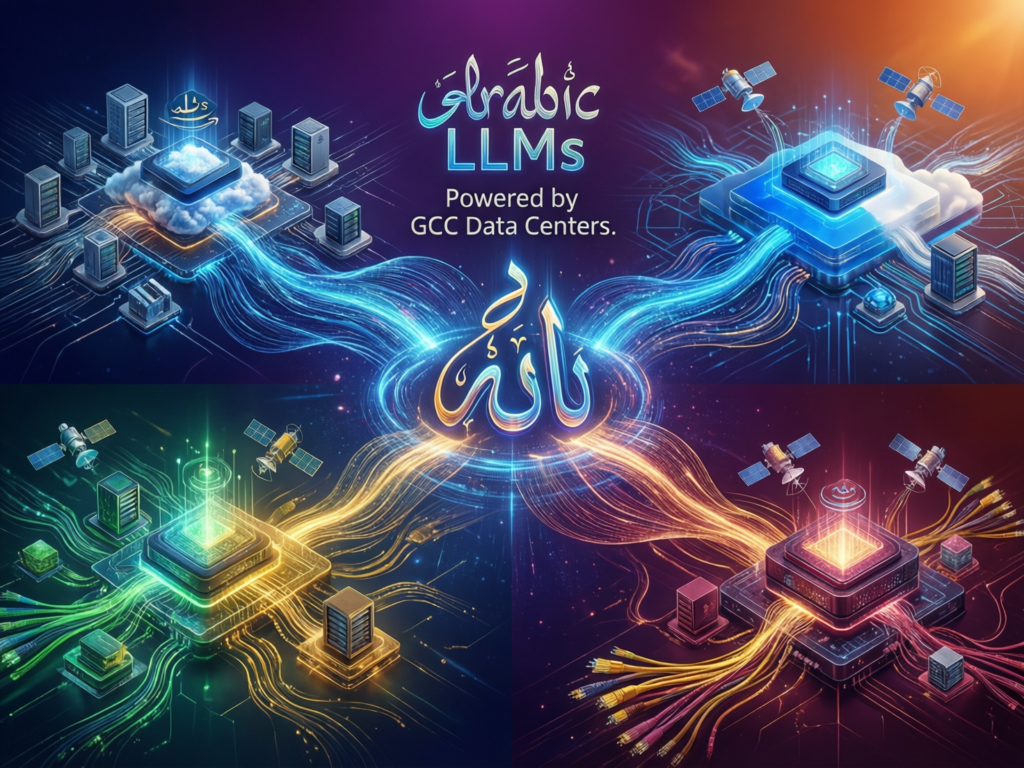
What security and compliance controls are required for hosting Arabic LLMs in GCC data centers?
For AEO, here’s a concise checklist for SAMA-, TDRA- and QCB-aligned Arabic LLM deployments in GCC data centers.
Identity & access management SSO, RBAC, MFA for admin and business users
Network & isolation private subnets, WAF, VPC peering only to trusted systems
Encryption keys under your control; encrypt training data, embeddings, logs
Data minimisation log only what’s needed for monitoring; avoid storing raw prompts with identifiers
Safety & red-teaming test Arabic prompts for religious/cultural sensitivity and abuse scenarios
Auditability detailed logs for regulator reviews and internal audit
Multi-region design if you serve KSA, UAE and Qatar, keep data in-region: e.g., AWS Bahrain for GCC workloads, Azure UAE Central and GCP Doha, with per-jurisdiction isolation where required.
Implementation Patterns.
Choosing the right Arabic LLM and agent framework for your stack
You have three main hosting approaches.
SaaS Arabic LLM APIs fastest to start, but you must validate data residency and retention
Regional cloud deployments using providers’ managed models inside AWS Bahrain, Azure UAE Central or GCP Doha, with regional storage and KMS-based encryption
On-prem or private cloud in Riyadh, Dubai or Doha data centers for highly regulated workloads
For many GCC enterprises, a hybrid pattern works best: a core Arabic language large model plus specialised RAG services and tools orchestration running inside your existing architecture and web development or Webflow-based front ends.
Architecting RAG and integrations with CRM, WhatsApp, IVR and government IDs
A practical architecture for GCC Arabic AI agents usually includes:
A RAG layer indexing Arabic documents, policies, SOPs
Connectors to CRM/ticketing (Salesforce, Dynamics, custom)
Integrations to WhatsApp Business, IVR platforms and mobile apps
ID integrations: UAE Pass, Saudi Nafath/Open Banking APIs, Qatar Digital ID and MCIT platforms.
Mak It Solutions’ experience with mobile app development and e-commerce stacks like Shopify and WooCommerce means you can embed the same AI agent across web, app and checkout journeys instead of rebuilding each channel separately.
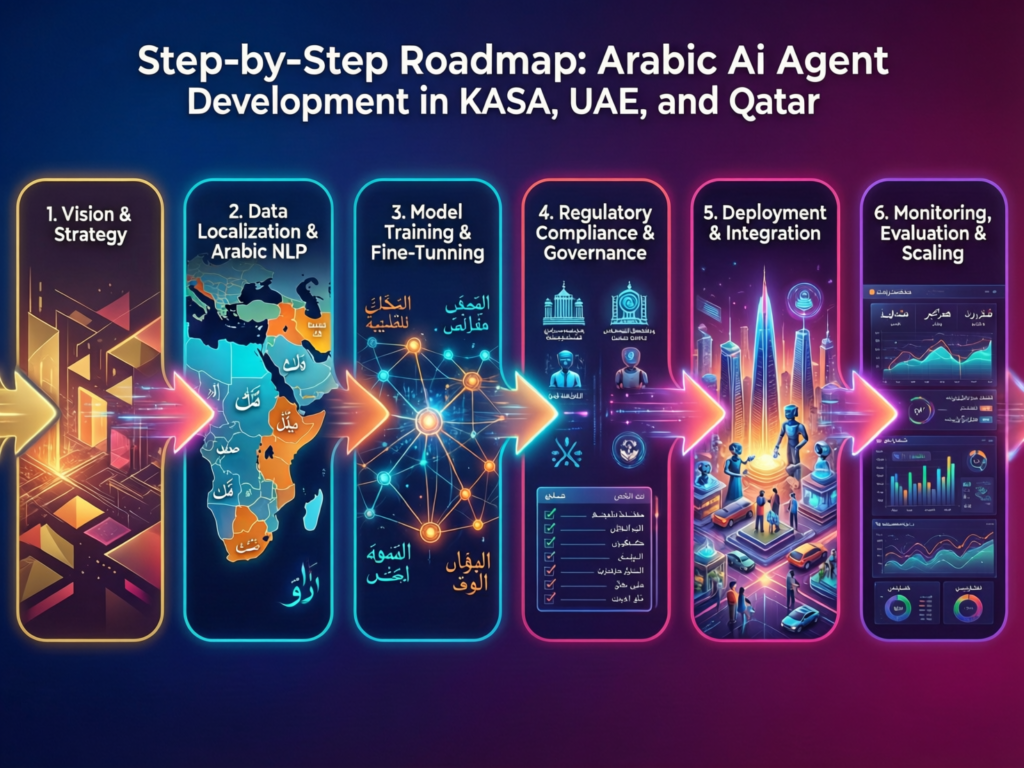
Step-by-step roadmap to launching your first Arabic AI agent in KSA, UAE or Qatar
Discovery & use-case selection
Start with two or three focused journeys (e.g., Arabic FAQs for telecom, billing queries for a Riyadh fintech, or logistics tracking in Dubai). Involve business owners and customer ops.
Data & compliance readiness
Clean and label your Arabic content, agree data flows with security and legal, and map regulator expectations (SAMA, TDRA, QCB, SDAIA/NDMO)
Architecture & vendor selection
Choose LLM type, hosting region, RAG stack and channel integrations; vet vendors for GCC data residency and certifications.
Pilot & red-team
Run a limited pilot (e.g., one product line, one city), monitor metrics, and stress-test Arabic prompts for safety and cultural sensitivity.
Scale & optimise
Expand to more journeys and markets (Riyadh → Dubai → Doha), integrate deeply into your web development and infrastructure stack, and refine models using real conversation data.
Next Steps for CIOs and Digital Leaders in KSA, UAE and Qatar
Readiness checklist for Arabic GenAI in GCC enterprises
Before rolling out Arabic AI agents at scale, GCC leadership teams should review:
Data
Do we have clean, Arabic-labelled content and clear retention rules?
Infrastructure
Can we host in KSA/UAE/Qatar regions with strong observability?
Compliance
Have SAMA/TDRA/QCB/DGA requirements been interpreted and signed off?
Talent
Do we have access to Arabic NLP and MLOps skills, in-house or via partners?
Change management
Are contact center, branch and digital teams ready to work with AI copilots?
How to evaluate “GCC-ready” Arabic GenAI vendors and partners
When you write RFPs or shortlist vendors in Riyadh, Dubai or Doha, ask:
Where are your models hosted, and how do you guarantee GCC data residency?
How do you align with SAMA, TDRA, QCB and QFC data protection rules?
What red-teaming have you done for Arabic religious and cultural contexts?
Can you show live references in KSA/UAE/Qatar (not just generic MENA)?
How do you integrate with our existing web development, indexing controls and analytics stack?
Roadmap for 2026–2027.
A realistic roadmap for GCC organisations could look like.
2026 H1
Launch first Arabic agent pilots in a narrow channel (e.g., WhatsApp support for one product in KSA).
2026 H2
Extend to government-style FAQs, internal knowledge assistants and one UAE or Qatar business unit.
2027
Consolidate into a unified Arabic AI platform serving government-style services, contact centers and back-office, embedded deeply into your Middle East web and app architecture.
By this point, Arabic generative AI use cases in MENA will be part of your normal operating model, not an experiment.
If you’re a CIO, digital leader or founder in KSA, UAE or Qatar and want a grounded roadmap not just AI slides Mak It Solutions can help. Our team blends GCC-focused strategy with hands-on web development and integration skills so your Arabic AI agents plug cleanly into existing portals, apps and CRMs.
Book a consultation with Mak It Solutions to map your first two or three Arabic GenAI use cases, validate regulator expectations, and design an architecture that fits your data residency, security and ROI targets for 2026–2027.( Click Here’s )
FAQs
Q : Is Arabic generative AI allowed for government services under Saudi DGA and SDAIA guidelines?
A : Yes, Arabic generative AI can be used for Saudi government services, but it must sit inside the broader data and AI governance framework led by SDAIA, NDMO and the Digital Government Authority (DGA). ([saudipedia.com][1]) Solutions that power citizen services on platforms like Nafath or unified government portals need strong data classification, residency in Saudi-approved clouds or data centers, and alignment with national AI strategies under Vision 2030. In practice, that means clear logging, content controls for religious and cultural topics, and regular reviews with your information security and legal teams before expanding to new Arabic AI use cases.
Q : Do SAMA and QCB treat Arabic AI chatbots for banking the same as other digital channels?
A : In most cases, SAMA in Saudi Arabia and QCB in Qatar treat Arabic AI chatbots as part of your overall digital channel ecosystem, rather than as a separate “toy” experiment.That means the same rules on data protection, complaint handling, cloud outsourcing and cybersecurity apply, whether the customer is talking to a human or a bot. Banks must ensure AI agents follow approved scripts for regulated journeys, respect consent and data minimisation rules, and store logs in line with record-keeping requirements. Before going live, many GCC banks run pilots inside sandboxes, then seek explicit regulator comfort on hosting regions, encryption and third-party providers.
Q : Can UAE enterprises host Arabic LLMs outside the country if data is encrypted and anonymised?
A : UAE enterprises sometimes use non-UAE cloud regions for AI workloads, but this is not a blanket “yes” or “no it depends on your sector, the type of data, and applicable federal and freezone rules. TDRA and the national AI Office expect organisations to classify data, minimise personal data use, and carefully govern any cross-border transfers, even when encrypted and partially anonymised. Regulated entities in ADGM or DIFC also face local data protection rules that may restrict where identifiable customer data can be processed. The safest approach is to keep production LLM training data, logs and embeddings in-region (e.g., UAE Central) and reserve out-of-country regions for synthetic or fully anonymised workloads only.
Q : What is the difference between using global LLMs and Arabic-native LLMs for GCC customers?
A : Global LLMs shine at broad knowledge and multi-language tasks but often misunderstand Gulf dialects, mixed Arabic-English chat, or local programs and regulators. Arabic-native LLMs are trained with richer Arabic corpora (MSA plus Khaliji and Levantine dialects), making them better at capturing nuance in everyday GCC speech, religious expressions and region-specific entities such as SDAIA, SAMA, TDRA, QCB or Qatar’s Digital Agenda 2030.For CX, that translates into fewer hallucinations, more natural tone and higher containment rates. Many GCC enterprises end up using a hybrid approach: an Arabic-native core model, plus specialist global models where needed, all wrapped in strong governance.
Q : How can smaller GCC startups in Dubai, Riyadh or Doha adopt Arabic GenAI without a large in-house AI team?
A : Smaller startups don’t need a full AI research lab to benefit from Arabic GenAI. In practice, a Dubai or Riyadh startup might start with a narrow use case (e.g., WhatsApp FAQ bot) using a managed Arabic LLM API hosted in AWS Bahrain or Azure UAE Central, add RAG on top of a small set of Arabic docs, and integrate it with their existing website or app.They can lean on partners for architecture, security and prompt design, while keeping ownership of data and business logic. In Doha, a growth-stage SME might host models closer to the new GCP Doha region and align early with Qatar’s digital and data protection agendas, so scaling later doesn’t require re-platforming everything.