


Arabic to English AI Translation for Saudi & UAE
Arabic to English AI Translation for Saudi & UAE
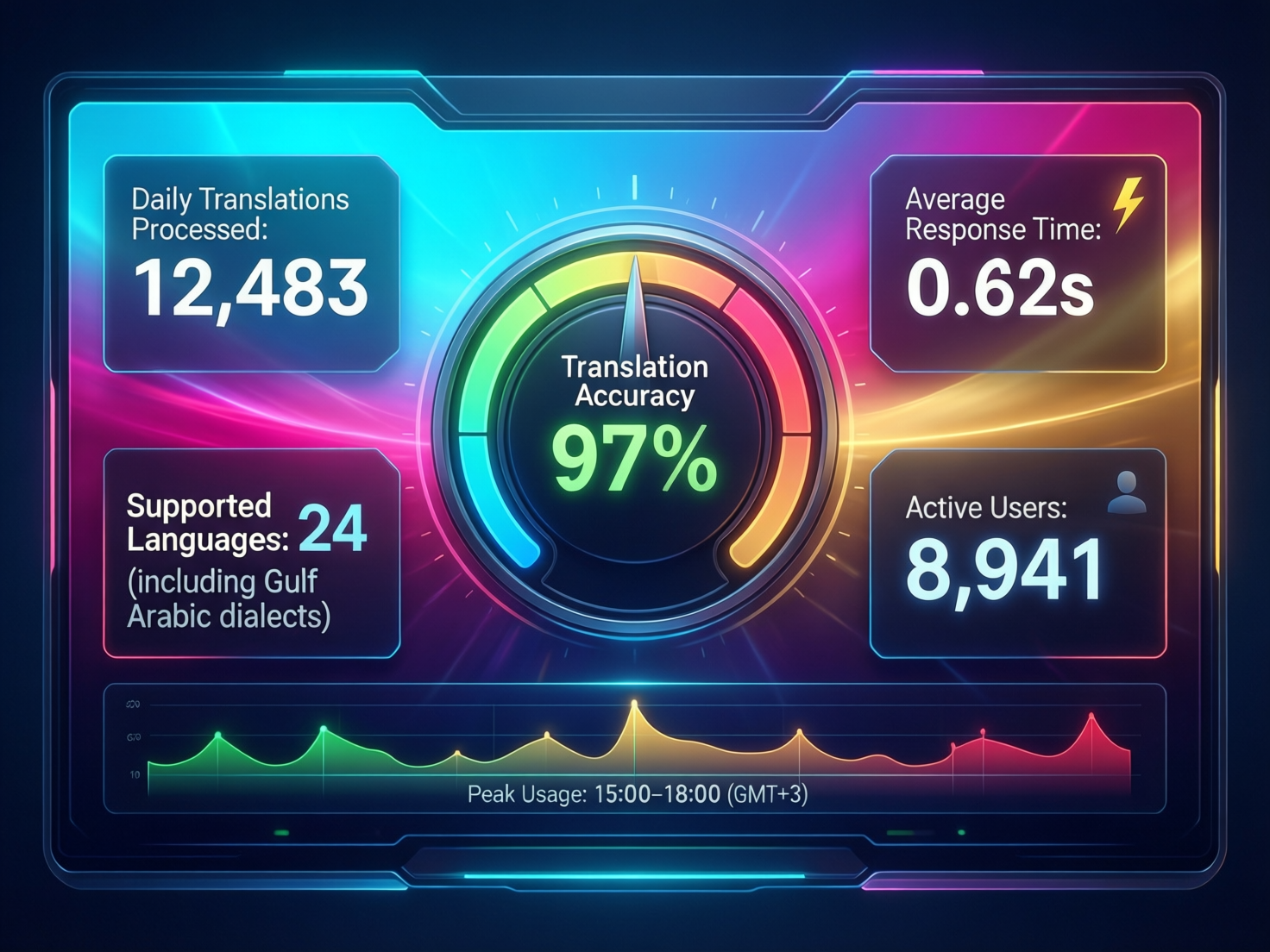
Arabic to English AI Translation for Saudi & UAE
Arabic to English AI translation lets Saudi, UAE and Qatar organisations move from slow, manual translation to fast, AI-assisted workflows while still protecting culture, compliance and data. The best GCC setups combine Arabic-aware models (like Falcon, Allam and JAIS) with human review, clear policies and local cloud regions in Riyadh, Dubai, Abu Dhabi, Doha and beyond for secure, high-quality results.
Introduction
Across Riyadh, Dubai and Doha, teams in government, fintech, healthcare and logistics are under pressure to launch Arabic and English content at the same time: websites, apps, customer journeys, portals, contracts and FAQs. Arabic to English AI translation is now a serious operational topic because leaders want scale and speed without losing religious nuance, legal accuracy or Gulf identity.
For many Saudi, UAE and Qatar organisations, “AI tarjama Arabic to English online for GCC users” is no longer an experiment it’s becoming part of daily workflow.
The GCC pain point: English-first goals vs Arabic reality
Vision 2030, Dubai’s D33 agenda and Qatar Vision 2030 all push global, English-friendly brands but real operations still run largely in Arabic. Content teams juggle mixed Arabic/English drafts, Gulf dialect comments, regulatory wording and manual translation bottlenecks.
Gulf Arabic dialects and translation complexity grow when you add Jeddah slang, Sharjah social posts or customer chat from Manama and Muscat. Legal and banking teams worry about one wrong term in a SAMA or QCB-regulated document, while marketers just need app copy ready before the next campaign.
How AI translation is finally bridging Arabic & English
Modern neural machine translation (NMT) for Arabic plus Arabic large language models (LLMs) like Falcon, Allam and JAIS are finally giving GCC teams usable first drafts instead of broken, literal translations.
The most successful organisations treat Arabic to English AI translation as a bridge: AI for speed and consistency, human post-editing for culture, law and religion, all wrapped in GCC-aware security and data residency rules.
Breakthroughs in Arabic to English AI Translation for Gulf Users
From classic machine translation to neural MT for Arabic
Older phrase-based systems struggled with Arabic morphology, gender, plurals and flexible word order, so English outputs often sounded robotic or wrong. Neural machine translation (NMT) for Arabic learns patterns from massive bilingual corpora, giving far better handling of long sentences, context and reordering.

Today’s NMT engines can translate complex MSA paragraphs from a Riyadh policy memo into readable English while preserving meaning, then adapt style for marketing vs legal drafts. Over time, custom glossaries and fine-tuning make the output feel much closer to human work, especially for repetitive government and banking content.
Arabic large language models.
Arabic large language models move beyond sentence-by-sentence MT to full-document reasoning. Falcon Arabic and Falcon-H1 Arabic, developed in Abu Dhabi’s Technology Innovation Institute, now top open Arabic LLM leaderboards and are tuned for regional culture and dialects.
In Saudi Arabia, SDAIA’s ALLaM family powers Humain Chat, focusing on Islamic values and Arabic-first experiences. JAIS, a bilingual Arabic–English LLM trained on hundreds of billions of tokens, adds strong cross-lingual reasoning that is ideal for Arabic to English AI translation across legal, technical and marketing domains.
AraBench, Tarjama-style test sets for Arabic English
GCC teams no longer have to rely on English-centric BLEU scores. AraBench benchmarks dialectal Arabic English MT, including Gulf-style text, making it easier to measure progress on “real” regional language, not just textbook MSA.
New test suites like Tarjama-25 stress-test models on longer, domain-balanced Arabic ↔ English content, with 5,000 expert-reviewed pairs across sectors. For GCC buyers, these benchmarks mean you can ask vendors for hard numbers on Gulf performance, not just generic English metrics.
GCC Business & Government Use Cases for AI Translation
Government documents, banking and Vision 2030 content
In Saudi Arabia, ministries and authorities translate circulars, guidelines and Vision 2030 reports into English for investors while keeping Arabic as the legal reference. Under the NDMO data management framework, government entities must classify and protect data across its lifecycle, which shapes how AI translation engines are deployed in KSA cloud or local data centres.
SAMA-regulated banks use AI translation for FAQs, product pages and KYC help text, but keep contracts, open banking and SADAD/Mada technical specs under strict human-in-the-loop review. This “AI-assist plus human sign-off” model is becoming the norm for regulated Saudi sectors.
Dubai startups, free zones and event translation
In Dubai and Abu Dhabi, startups in ADGM and DIFC turn to AI translation Arabic English for Dubai startups and free zones to localise apps, dashboards and investor decks quickly while complying with ADGM and DIFC data protection rules that are broadly GDPR-aligned.
Event organisers in Dubai, Sharjah and Abu Dhabi plug live speech translation into conferences so audiences can choose Arabic or English captions. E-commerce players tie AI-powered localisation for the Middle East into their web and mobile platforms, often hosted in Azure UAE Central or AWS Middle East (UAE) for low latency and better data control.
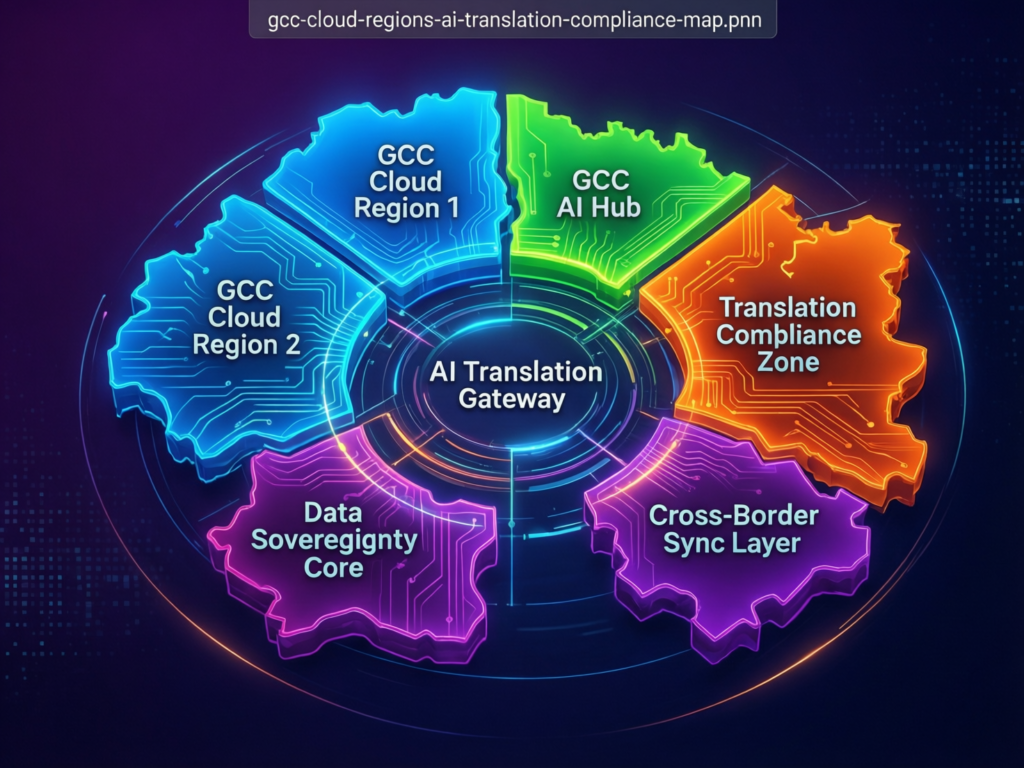
Qatar and wider GCC: tourism, FIFA legacy and e-government portals
Doha’s post-FIFA tourism push relies on fast, consistent Arabic ↔ English content for campaigns, hotel listings and experience guides, supported by the Google Cloud Doha region that offers in-country compute for sensitive workloads.
Qatar Digital Government (Hukoomi) portals need AI translation for forms, instructions and notifications, while ensuring anything under QCB supervision like banking and payments follows stricter controls.
GCC-wide logistics and retail platforms connecting Kuwait City, Manama and Muscat use shared AI translation pipelines so operations teams can work in Arabic, while partners and dashboards stay in English.
Quality, Culture & Dialects.
Modern Standard Arabic vs Gulf dialects.
Today’s models handle Modern Standard Arabic (MSA) far better than before, especially in structured government, banking and e-commerce content. But Gulf Arabic dialects are still tricky: Saudi TikTok captions, Emirati voice notes or Qatari slang in support chats can confuse even advanced LLMs.
Many GCC teams route social media and call-centre transcripts through AI for draft translation, then ask bilingual agents to fix tone, idioms and implied meanings. That keeps turnaround times low while protecting brand voice in Arabic and English.
Formality, religious terms and legal nuance for GCC audiences
For Riyadh, Dubai and Doha audiences, the difference between “may” and “must”, or between a neutral phrase and a Qur’anic reference, is not a small detail. AI can mis-render religious terms, waqf concepts or zakat wording, or pick English synonyms that are too casual for royal court, regulator or court documents.
That’s why high-risk content Shariah-compliant finance brochures, healthcare consent forms, HR policies, court filings still needs expert human translators who understand local jurisprudence and government style guides. AI can help with drafts and terminology suggestions, but humans remain responsible for final wording.
Human + AI workflows.
The sweet spot for many GCC teams is translation quality evaluation and post-editing. AI provides fast drafts; human linguists in Riyadh, Dubai, Doha or Manama score quality, fix errors and feed corrections back into glossaries.
Over time, you get consistent terminology for key Arabic to English AI translation phrases from “beneficial owner” in compliance to “customer journey” in marketing while cutting cost and turnaround times. Agencies and in-house teams increasingly sell “AI + human” packages instead of pure human or pure machine translation.
Compliance, Security & Data Residency in Saudi, UAE and Qatar
Data residency and NDMO guidelines for Saudi AI translation
In KSA, NDMO standards require public entities and their partners to manage data across 15 domains, including classification, quality and security. For many AI translation setups, that means:
keeping sensitive government and financial data inside KSA or approved regions,
logging where text is processed, and
avoiding consumer tools that store prompts overseas.
Some organisations rely on AWS Bahrain, Google Cloud’s Dammam region or local Saudi data centres to keep workloads close and under Saudi legal jurisdiction.
This is what secure Arabic to English AI translation compliant with SAMA rules looks like in practice: data-classified, monitored and audited.
TDRA, ADGM and DIFC expectations for UAE organisations
In the UAE, TDRA issues guidelines for telecom and cloud service providers, emphasising data privacy, sovereignty and security for digital services, including cloud AI.
ADGM’s Data Protection Regulations 2021 and DIFC’s Data Protection Law No. 5 of 2020 align closely with GDPR, setting strict rules for cross-border data transfers and processor obligations.
Any AI translation vendor used by ADGM/DIFC entities needs clear data-processing agreements, auditability and options to host in UAE regions (for example, Azure UAE Central or AWS me-central-1)

Banking & public sector rules.
SAMA and QCB supervise financial stability and regulate banks and payment providers in Saudi Arabia and Qatar, so anything that touches customer data, credit information or monetary policy must follow stricter controls. (Saudi Central Bank) In practice, this often means:
AI-only for marketing, FAQs and low-risk help articles,
AI + human review for T&Cs, KYC questionnaires and product sheets,
human-only for contracts, regulatory submissions and disputes.
Public-sector entities in Riyadh, Jeddah, Abu Dhabi, Sharjah, Doha and beyond follow similar patterns for citizen data, often guided by NDMO, UAE IA Regulations and local cloud security policies. (SDAIA)
Skills, Careers & Workflows for GCC Translators and Content Teams
New skills for Arabic–English translators in Riyadh, Dubai and Doha
GCC translators are moving from “pure linguist” roles into hybrid profiles: MT post-editing specialists, prompt engineers for Arabic LLMs, terminology managers for multilingual glossaries, and quality leads who design scoring frameworks.
In Riyadh, Dubai and Doha, these skills are now valued not only in translation firms but also inside fintechs, government agencies, hospitals and logistics players who run their own AI translation stacks.
How content, legal and marketing teams can collaborate with AI
For GCC companies, the most successful AI setups look like cross-functional teams:
Content/marketing choose tone, channels and localisation priorities.
Legal/compliance set rules for which content can use AI, under what risk level.
IT/data select vendors, manage cloud regions and security controls.
Translation/Arabic specialists design prompts, evaluate outputs and own glossaries.
This model works whether you are a Dubai SaaS startup, a SAMA-regulated fintech in Riyadh, or a Doha government authority modernising its citizen portals.
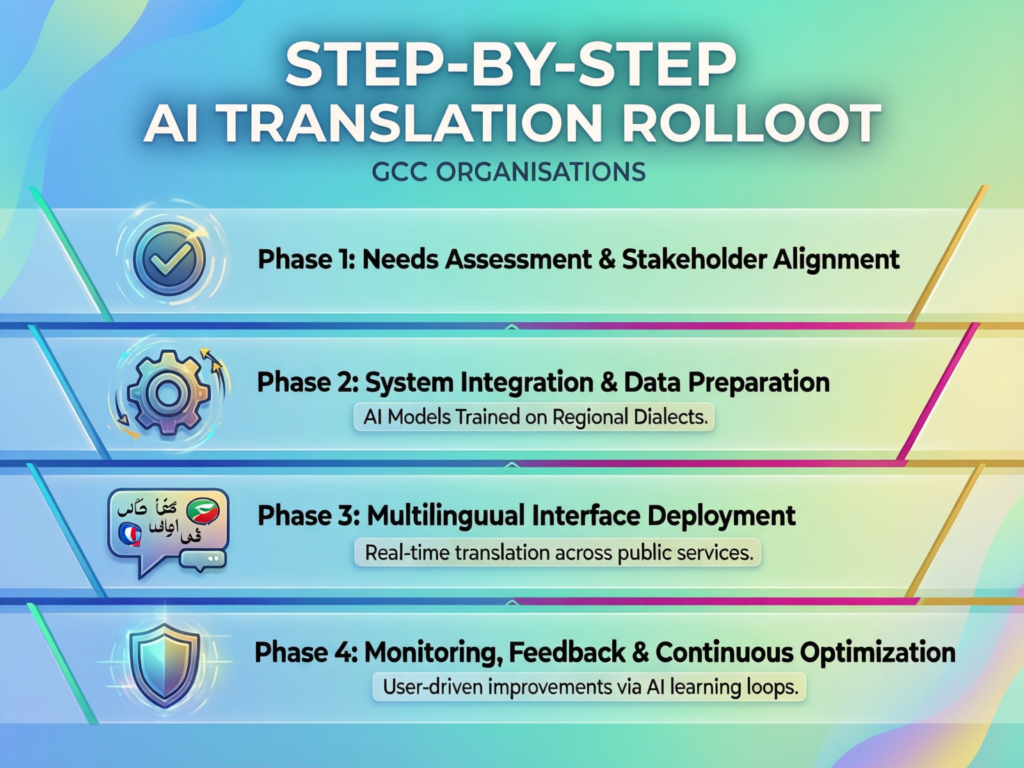
Step-by-step plan to roll out AI translation in your GCC organisation
Map your content & risk levels
List all Arabic/English content types: marketing, product, legal, support, government notices. Tag each as low, medium or high risk.
Choose initial use cases and languages
Start with low-risk MSA content (FAQs, blog posts, app UI) in Saudi Arabia, UAE and Qatar, plus Gulf English.
Select tools and hosting locations
Shortlist engines using Arabic LLMs and NMT, and decide where they run: AWS Bahrain, Azure UAE Central, GCP Doha, or on-prem according to NDMO, TDRA, ADGM/DIFC, QCB or SAMA expectations.
Build glossaries and style guides
Define preferred Arabic and English terms for products, regulators, religious concepts and legal phrases, plus do-not-translate items.
Train translators and reviewers
Teach teams how to prompt models, post-edit efficiently and log issues, with special focus on religious and legal sensitivity.
Launch a pilot and measure KPIs
Run a 4–8 week pilot, tracking speed, cost per word, quality scores and number of corrections needed.
Scale and integrate with your stack
Once KPIs are stable, connect AI translation to your CMS, CRM, helpdesk and mobile apps, and expand to more dialects and sectors.
Concluding Remarks
Arabic to English AI translation has moved from “nice idea” to a practical tool for Gulf businesses and governments. Breakthroughs in NMT, Arabic LLMs and benchmarks have improved quality dramatically, but culture, religion and legal nuance mean AI must be guided by people who understand the region.
Comparing Saudi, UAE and Qatar paths to AI-powered translation
Saudi Arabia is building a sovereign AI and data governance stack around NDMO, SAMA and national AI players like Humain. The UAE is pushing Falcon and world-class cloud regions to attract global developers via Abu Dhabi and Dubai.
Qatar is catching up fast with the Doha cloud region and national AI/energy strategies. For Kuwait, Bahrain and Oman, regional cloud and SaaS tools provide a shortcut to the same capabilities.
Practical next steps: pilot projects, vendor shortlists and internal training
Start with a small, low-risk AI translation pilot in one department for example, marketing in a Dubai free-zone company or support content for a Riyadh fintech. Shortlist vendors that clearly explain data residency, Arabic model capabilities and compliance with SAMA, TDRA, ADGM/DIFC and QCB requirements.
Then invest in training for translators, legal and content teams so that AI becomes a trusted co-pilot, not a risky black box.
If you’re a Saudi, UAE or Qatar organisation and you’re unsure how to turn AI translation into a safe, scalable workflow, you don’t have to figure it out alone. The team at Mak It Solutions can help you design GCC-ready workflows, choose the right Arabic-aware models and connect them to your existing web, app and portal stack.
Explore our services overview and let’s build a secure, compliant Arabic to English AI translation strategy tailored to your sector and regulations.
FAQs
Q : Is Arabic to English AI translation acceptable for Saudi legal contracts under SAMA or NDMO rules?
A : In Saudi Arabia, neither SAMA nor NDMO forbids using AI for translation, but they do require strong controls over how financial and government data is processed and stored. In practice, that means you can use AI to draft translations of contracts, policies or KYC documents, but final legal texts especially for SAMA-regulated entities should be reviewed and approved by qualified human lawyers and translators. Many KSA institutions treat AI output as a starting point only, keeping humans fully accountable for the final Arabic and English versions.
Q : Can Dubai legal translation firms rely on AI tools for court documents in the UAE?
A : Dubai-based firms operating in onshore UAE, DIFC or ADGM must respect local data protection laws and court expectations. AI tools can assist with first drafts, terminology consistency and bilingual research, but court documents and notarisations still require human translators with recognised qualifications. Firms should ensure AI engines are hosted in compliant regions (for example Azure UAE Central), sign proper data-processing agreements, and avoid feeding confidential case data into public chatbots. UAE regulators increasingly expect documented policies showing when and how AI is used in legal workflows.
3. How secure is AI translation for Qatar government portals and e-services content?
Security depends on where and how you run the AI. For Qatar Digital Government/Hukoomi portals, best practice is to keep citizen data and internal drafts within Qatar or trusted GCC regions, using providers like Google Cloud’s Doha region or tightly governed cross-border setups. The Qatar Central Bank already supervises sensitive financial data, so any payment or banking text flowing through AI must respect QCB rules on confidentiality. Most Qatari entities therefore restrict AI translation to anonymised or low-risk content, with strong access controls, logging, encryption and human review for anything touching personal or financial information.
Q : Which types of Arabic English content in Riyadh, Dubai or Doha are safe to translate with AI only?
A : AI-only translation is usually acceptable for low-risk, non-personal content: marketing blog posts, general FAQs, product highlights, public press releases, non-sensitive documentation and internal drafts. For example, a Dubai startup localising a landing page, or a Riyadh logistics company translating generic tracking messages into English, can safely rely on AI-only if quality is monitored. High-risk content legal, medical, banking, HR or religious material should stay under AI + human or human-only control, especially where NDMO, SAMA, TDRA, ADGM/DIFC or QCB might review your practices during audits.
Q : Do Gulf Arabic dialects from Kuwait, Bahrain and Oman need human review even with advanced AI translation?
A : Yes. Even though models like Falcon, Allam and JAIS are getting better at dialects, they’re still weaker on informal Gulf Arabic from Kuwait City, Manama or Muscat compared to MSA or formal Saudi/UAE usage. Dialect phrases, humour, sarcasm and indirect politeness can easily be misinterpreted when translated into English for global stakeholders. A practical approach is to let AI handle speed and structure but require human review for dialect-heavy content social media, chat logs, community campaigns especially when it might affect brand reputation, regulatory communication or cross-border partnerships.