


Best Adobe Commerce Development Company in the US & EU
Best Adobe Commerce Development Company in the US & EU
Adobe Commerce Development Company Guide for US, UK & Germany
In simple terms, an Adobe Commerce development company is a specialist agency that plans, designs, builds, migrates and optimizes Adobe Commerce (Magento) stores for growing retailers and B2B brands. You should bring one in when you’re launching a new enterprise store, replatforming from legacy Magento or another platform, or planning major performance and conversion improvements across multiple regions.
Introduction
If you’re still running a legacy Magento build, fighting slow page loads, clunky checkout flows and fragile integrations, you’re not alone. Across the US, UK, Germany and wider EU, many ecommerce teams are stuck on “good enough” storefronts that can’t keep up with modern B2B and B2C expectations.
That’s exactly where a specialist Adobe Commerce development company comes in. Instead of just “building a website”, they architect a cloud-ready, compliant, multi-store commerce stack that can handle complex pricing, B2B workflows, and integrations with your ERP, CRM and PIM.
This guide will help you understand what these agencies actually do, how Adobe Commerce differs from Magento Open Source, what services to expect, how much enterprise projects typically cost in the USA, UK and Germany, and how to shortlist the right partner for your next build or migration.
What Does an Adobe Commerce Development Company Do?
An Adobe Commerce development company is a specialist agency that plans, designs, builds, migrates and optimizes Adobe Commerce stores for mid-market and enterprise brands. In practice, that means combining platform expertise, cloud architecture and integrations so your commerce stack can grow across US, UK and European markets without constant fire-fighting. Adobe for Business
These agencies usually work as long-term partners, not one-off developers. They help you shape your ecommerce roadmap, deliver releases safely, and keep performance, security and compliance under control as your store scales.
Definition: Adobe Commerce vs Magento Open Source
Adobe Commerce (formerly Magento Commerce) and Magento Open Source share the same core, but they’re not the same product.
Magento Open Source
Free to license, self-hosted, and highly customizable.
You (or your agency) are responsible for hosting, scaling, security hardening and most advanced features.
Adobe Commerce (paid)
Licensed, with advanced B2B tools, customer segmentation, visual merchandising, built-in BI and promotions out of the box.
Adobe Commerce on cloud infrastructure (Adobe Commerce Cloud)
A managed, PaaS platform running primarily on AWS and Azure, with pre-provisioned PHP, MySQL, Redis, RabbitMQ, OpenSearch and Git-based CI/CD pipelines.
For mid-market and enterprise brands, an Adobe Commerce development company understands these differences deeply. They’ll advise whether you should stay on Open Source with curated extensions, move to Adobe Commerce, or adopt Adobe Commerce Cloud for managed hosting and DevOps.
AEO micro-answer (repeatable)
An Adobe Commerce development company is a specialist agency that plans, designs, builds, migrates and optimizes Adobe Commerce stores for mid-market and enterprise brands.
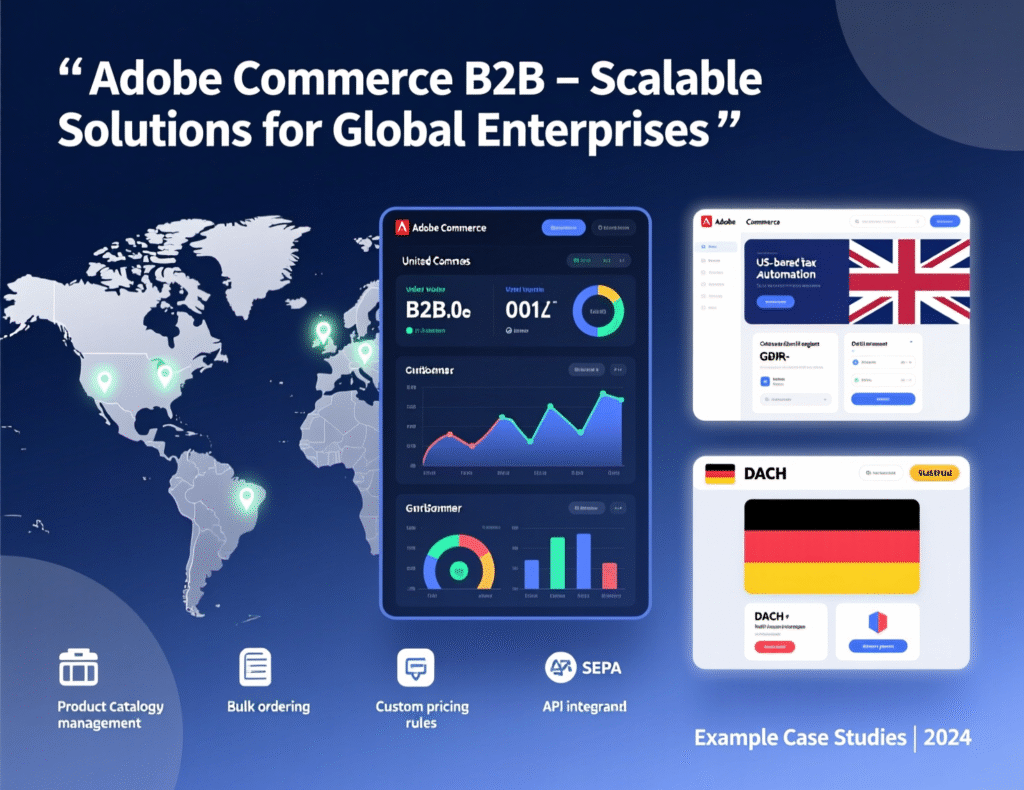
Core responsibilities of an Adobe Commerce development company
A serious Adobe Commerce (Magento) development partner typically covers the full lifecycle.
Strategy & solution architecture
defining your commerce roadmap, multi-store strategy, data model, and integration approach.
User experience & design
UX research, conversion-focused UI, mobile-first flows and accessibility.
Back-end development
Catalog structure, configurable products, pricing rules, B2B features, tax/VAT logic, order workflows.
Front-end and headless builds
Classic Magento Luma/Hyvä style front ends or headless Adobe Commerce development with React/Vue PWAs using PWA Studio and GraphQL.
Integrations
ERP (SAP, Microsoft Dynamics, Oracle), CRM (Salesforce), PIM (Pimcore, Akeneo), PSPs and shipping carriers.
DevOps & Adobe Commerce Cloud
CI/CD pipelines, multi-environment setup, observability and autoscaling.
QA & test automation
Functional, regression, performance, security testing.
Support & optimization SLAs, incident response, Core Web Vitals and release management.
In New York, London, Berlin or Amsterdam, Adobe Commerce agencies often use similar team structures: solution architect, Adobe-certified back-end and front-end developers, QA engineers, DevOps, business analysts and project managers. Many also add Adobe Experience Cloud specialists for AEM, Adobe Analytics and Adobe Target integrations.
When you actually need a specialist agency vs freelancers
You definitely need a specialist Adobe Commerce development company when:
You run multi-store, multi-language, multi-currency setups (e.g., US + UK + DACH).
You’re rolling out B2B portals with corporate accounts, custom catalogs and approval workflows.
You rely on complex pricing rules, negotiated contracts or customer-specific discounts.
You must integrate deeply with ERP, PIM, CRM and marketplaces.
You have strict compliance obligations (GDPR/DSGVO, UK-GDPR, PCI DSS, HIPAA-adjacent, BaFin, NHS suppliers).
In contrast, a freelancer or very small Magento shop can be enough for:
A single-region SMB storefront on Magento Open Source.
Relatively simple catalogs and flat pricing.
Limited integrations (e.g., payment + shipping + one CRM connector).
But once you’re dealing with enterprise scale, regulated industries or aggressive growth targets across US, UK and Germany, an enterprise-grade partner with proper processes, security and 24/7 support quickly becomes essential.
Adobe Commerce vs Magento: Why Your Choice of Development Company Matters
Adobe Commerce is the enterprise evolution of Magento, and your choice of partner determines how well you can use that power. Adobe Commerce is effectively “Magento for enterprises” with advanced capabilities; many agencies still call themselves Magento agencies while delivering modern Adobe Commerce work.
Is Adobe Commerce the same as Magento?
Adobe Commerce is built on the Magento 2 codebase and is often branded “Adobe Commerce (Magento)”, but it’s the licensed, feature-rich version with optional managed cloud hosting, whereas Magento Open Source is the free, self-hosted edition. That distinction matters because you want a partner that has real experience with both Magento 2 and Adobe Commerce Cloud.
Magento → Adobe Commerce evolution in the US & Europe
The platform journey looks roughly like this.
Magento 1 (pre-2015) Hugely popular open-source ecommerce platform.
Magento 2 architectural overhaul for better performance and scalability.
Adobe acquisition in 2018 Magento Commerce became part of Adobe Experience Cloud.
Rebranding to Adobe Commerce
The commercial editions were rebranded and tightly integrated with Adobe’s marketing and analytics stack.
In the US and Europe, many long-standing agencies (WebFX, Krish Technolabs, Iflexion, magic42, Atlantis DX, dotSource and others) still use “Magento agency” for brand recognition, while delivering Adobe Commerce and Adobe Commerce Cloud builds behind the scenes.
When you’re shortlisting partners, look for recent Adobe Commerce case studies, not just generic “Magento 2” badges.
Skills to look for: Magento 2 + Adobe Commerce Cloud expertise
At minimum, your Adobe Commerce development company should be able to show:
Adobe certifications
Adobe Certified Professional, Expert and Master credentials for:
Adobe Commerce Developer (back-end)
Adobe Commerce Front-End Developer
Adobe Commerce Business Practitioner / Solution Specialist
Adobe Commerce Cloud experience
CI/CD pipelines, Starter/Pro architectures, staging and production workflows, observability and autoscaling.
Security and performance
Hardening, WAFs, caching, CDNs, observability and regular patch management (critical after high-profile issues like the “SessionReaper” vulnerability).
Agencies like WebFX, Krish Technolabs, magic42, Atlantis DX, dotSource, Atwix, Codilar and Iflexion use these credentials to demonstrate that they’re enterprise Magento 2 / Adobe Commerce experts, not just generalist web shops.
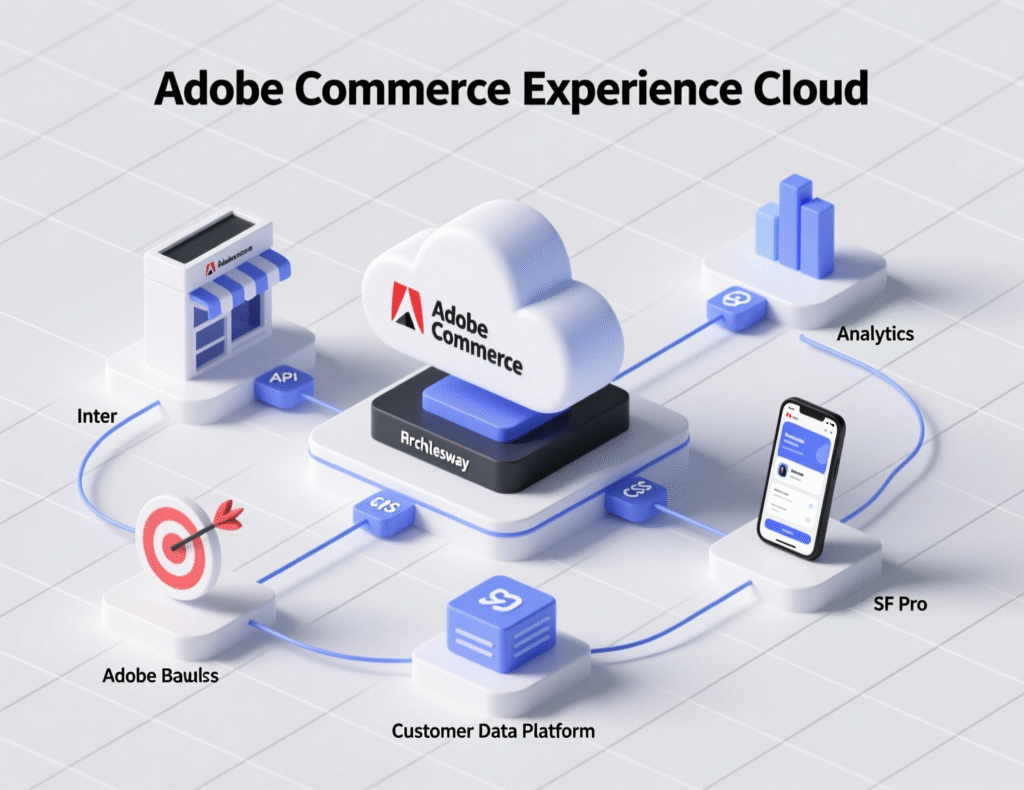
Modern architectures: headless Adobe Commerce & Adobe Experience Cloud
Modern enterprise builds increasingly use headless Adobe Commerce development:
Adobe Commerce as the transaction engine, accessed via GraphQL and REST APIs.
React/Vue storefronts or PWA Studio for fast, app-like experiences.
AEM (Adobe Experience Manager) as a headless CMS, integrated with Adobe Analytics and Adobe Target for testing and personalization.
A strong Adobe Commerce development company will be comfortable with both classic coupled Magento themes and composable, headless stacks, so you’re not locked into yesterday’s architecture.
Core Services Offered by an Adobe Commerce Development Company
At a high level, Adobe Commerce development companies deliver full-cycle ecommerce implementations: from discovery and UX design through development, integrations, launch and ongoing support. For US, UK and EU brands, this usually includes multi-region setup, localization and compliance baked into every phase.
New builds, replatforming & Adobe Commerce Cloud implementations
A typical full-cycle Adobe Commerce implementation includes discovery, UX/UI, architecture, development, integrations, data migration, performance tuning, security hardening and launch, followed by support.
Common scenarios.
Greenfield builds launching a new digital channel for a manufacturer, distributor or D2C brand.
Replatforming from legacy stacks like Shopify Plus, SAP Commerce, Salesforce Commerce Cloud or WooCommerce.
Adobe Commerce Cloud development services implementing Adobe’s managed PaaS with automated builds and multi-environment CI/CD.
For multi-region retailers, agencies set up.
Multi-storefront structures (e.g., US, UK, Germany, Nordics).
Localized languages and content.
Currency, tax and payment methods appropriate to each market.
Migration & upgrade services from Magento to Adobe Commerce
Most mature agencies have a structured playbook for Magento → Adobe Commerce migration, including:
Magento 1 to Adobe Commerce or Magento 2.
Magento 2 to Adobe Commerce Cloud.
Product, customer, order history and CMS content migration.
Extension and customization audit (what to keep, refactor or drop).
Done badly, migration can destroy your SEO. That’s why good partners focus on:
URL mapping, redirects and canonical strategy.
Preserving metadata, structured data and tracking tags.
Testing SERP impact post-launch.
This is where long-tail queries like “magento to adobe commerce migration services uk”, “migrate magento 2 store to adobe commerce cloud in usa” or “magento zu adobe commerce migration dienstleister deutschland” typically lead searchers straight into these specialized migration offerings.
Support, performance optimization & 24/7 monitoring
After go-live, a serious Adobe Commerce development company offers support and maintenance packages, often with 24/7 on-call coverage for critical US, UK and DACH retailers.
Typical components:
Adobe Commerce support and maintenance
Security patches, version upgrades, extension updates.
Performance optimization
Varnish, Redis, CDN configuration, image and asset optimization, Core Web Vitals tuning.
Proactive monitoring
Uptime checks, alerting, error tracking, log analysis and capacity planning.
GEO-specific patterns.
US retailers
24/7 support with on-call engineers and incident SLAs.
UK brands
UK-based support desks for business hours plus global coverage overnight; packaged “Adobe Commerce support and maintenance packages UK”.
DACH
German-language support, DACH time-zone coverage, and knowledge of local hosting and compliance expectations.
B2B & Enterprise Adobe Commerce Development for US, UK & DACH
B2B brands in the US, UK and Germany choose Adobe Commerce because it combines a powerful B2B feature set with deep integration options and robust multi-store capabilities. When paired with an Adobe-certified development company, it can support complex corporate buying journeys across many countries from a single platform.
B2B features: corporate accounts, complex pricing & workflows
Adobe Commerce includes a native B2B toolkit designed for manufacturers, wholesalers and distributors:
Company and corporate account hierarchies.
Shared catalogs and customer-specific price lists.
Negotiated quotes, approval workflows and purchase limits.
Quick order forms, CSV order uploads and requisition lists.
That’s why search terms like “adobe commerce b2b development” and “enterprise Magento 2 / Adobe Commerce experts” are popular among industrial, automotive, electronics and healthcare suppliers.
AEO micro-answer Why do B2B brands choose Adobe Commerce over other platforms?
B2B brands pick Adobe Commerce because it combines native corporate account features, complex pricing options and workflows with strong integration support and multi-store capabilities, all in a single enterprise-ready platform.
Deep integrations: ERP, PIM, CRM & marketplaces
Enterprise B2B commerce is really about integrations
ERP
SAP, Microsoft Dynamics, Oracle, Microsoft Nav/Business Central.
PIM
Pimcore, Akeneo, in-house catalog systems.
CRM & marketing
Salesforce, HubSpot, Adobe Experience Cloud.
Marketplaces
Amazon, eBay and regional marketplaces across Germany and the EU.
Experienced agencies maintain repeatable integration blueprints: mapping product master data, pricing, inventory, customer hierarchies and order flows across systems. That means fewer surprises in UAT and more predictable delivery.
Regional examples: US manufacturers, UK wholesalers, German Mittelstand
Some typical enterprise scenarios.
Chicago-based manufacturer (US)
Multi-brand B2B portal with tiered pricing per distributor, bulk ordering, and real-time inventory from SAP.
Birmingham wholesale distributor (UK)
Adobe Commerce store tied into Microsoft Dynamics and a local warehouse system, with VAT handling and UK-GDPR compliant customer data flows.
Munich / Hamburg Mittelstand supplier (DE)
German-language Adobe Commerce site integrated with SAP and local logistics providers, emphasizing DSGVO compliance and B2B Handel workflows.
US partners often highlight complex retail and manufacturing use cases. UK agencies emphasize wholesale and omnichannel retail. German agencies tend to stress integration with SAP, data residency and DACH-localized features.
How to Choose the Right Adobe Commerce Development Company in the US, UK or Germany
Choosing an Adobe Commerce development company in the US, UK or Germany comes down to three things: proven Adobe Commerce expertise, fit with your industry and business model, and a delivery model (onshore/nearshore) that matches your budget and collaboration style.
Clarify your business model & roadmap B2B vs B2C, regions, channels, expected growth.
Shortlist certified Adobe Commerce partners in your key GEOs.
Review case studies and references in your industry and complexity band.
Evaluate delivery models and SLAs (time zone, support, budgets).
Run structured RFPs and discovery calls using a standardized question set and scorecard.
We’ll use this flow as the basis for the HowTo schema at the end.
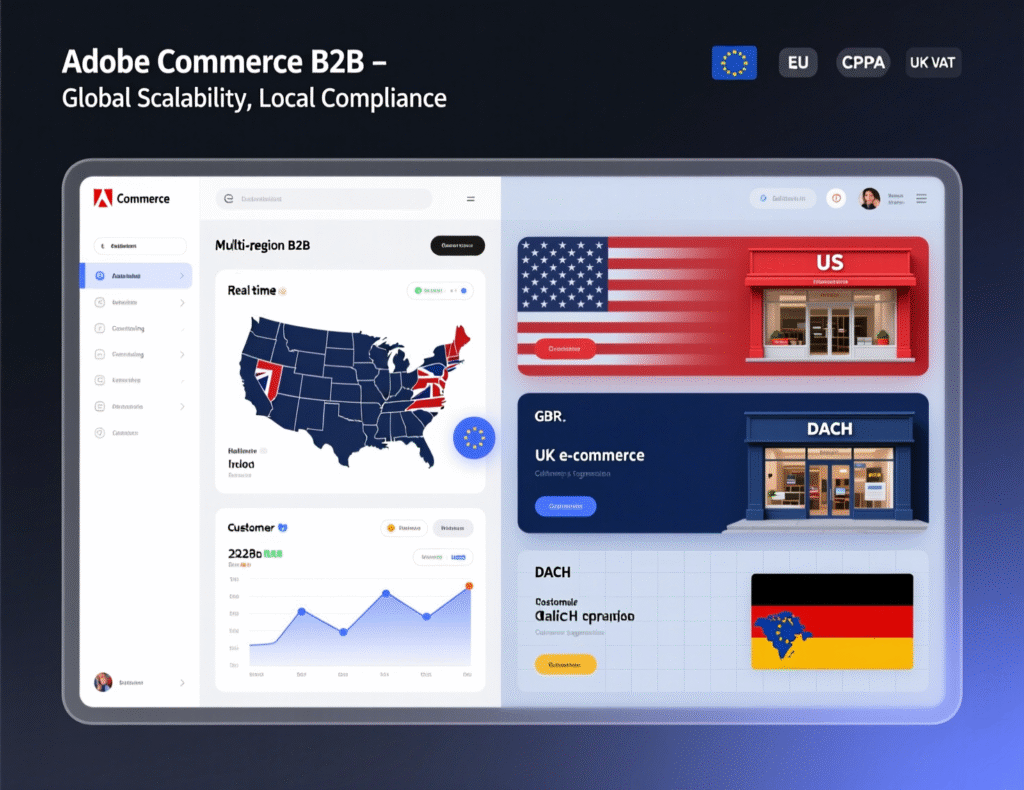
Non-negotiable signals: certifications, case studies, industries
Non-negotiables when evaluating potential partners
Adobe certifications and partner status check for Adobe Certified Expert/Professional credentials and official Adobe Commerce Partner listing.
Industry experience fashion, electronics, automotive, industrial B2B, healthcare, financial services, etc.
Case studies with numbers, such as.
Conversion rate increases.
evenue uplift after replatforming.
Load-time improvements after performance optimization.
Remember that global B2B ecommerce GMV is already in the tens of trillions of dollars and growing double-digit annually. You want a partner who can show they’ve actually moved the needle for brands in that environment.
GEO factors: Onshore, nearshore & hybrid teams across US, UK, EU
Each GEO model has trade-offs.
US-based teams (New York, Austin, San Francisco, Chicago)
Best for US enterprises needing tight time-zone collaboration and deep local market knowledge.
Higher day rates, especially in major metros.
UK teams (London, Manchester, Birmingham)
Strong for UK retail/wholesale, public sector-related sites and financial services.
Great for brands working with FCA/NHS-adjacent contexts and UK-GDPR.
German teams (Berlin, Cologne, Hamburg, Munich)
Excellent for Mittelstand and BaFin-adjacent use cases, with strong DSGVO awareness.
Nearshore Central/Eastern Europe (e.g., Poland, Romania, Baltic states)
Highly competitive rates with strong engineering depth.
Usually combined with local client leads in London, Berlin or Amsterdam (e.g., multi-location agencies like Atwix, Codilar, Iflexion).
A hybrid team (local solution architect + nearshore delivery pod) is often ideal for US, UK, Germany and wider EU brands looking to balance cost and collaboration.
Questions to ask in RFPs and discovery calls
In RFPs and discovery calls, your goal is to understand both capability and ways of working.
Ask questions like:
What does your Adobe Commerce roadmap look like for the next 12–24 months?
How do you handle security and patching, including zero-day vulnerabilities?
What SLAs do you offer for uptime, response and resolution?
How large is the core team that would work on our account, and what are their certifications?
Who owns the code and infrastructure (repos, cloud accounts, licenses)?
How do you communicate: Slack/Teams, weekly stand-ups, demo cadence?
How do you approach performance tuning and Core Web Vitals?
Can you share 2–3 recent case studies with metrics and client references?
You can score each vendor 1–5 across categories (expertise, fit, communication, cost, risk) to compare them side by side.
AEO micro-answer What should a retailer look for when choosing an Adobe Commerce development company in the US or Europe?
Adobe Commerce/Magento 2 certifications and official partner status.
Relevant case studies in your industry and region.
Clear SLAs, security processes and ownership of code/infrastructure.
A delivery model (onshore/nearshore) that fits your budget and collaboration style.
Compliance, Security & Hosting for Enterprise Adobe Commerce Stores
A good Adobe Commerce development company helps you stay compliant with GDPR/DSGVO, UK-GDPR, PCI DSS, HIPAA-related requirements and PSD2/SCA, while also designing a secure, scalable infrastructure on AWS, Azure or GCP with modern CDNs and WAFs.
GDPR/DSGVO, UK-GDPR, PCI DSS, SOC 2, HIPAA & PSD2 basics
For EU and UK
GDPR / DSGVO & UK-GDPR strict rules around data processing, consent, user rights and security measures like encryption and data minimization.
PSD2 & Strong Customer Authentication (SCA) multi-factor authentication for most online payments in the EEA, impacting checkout UX and PSP choices.
For payments and hosting
PCI DSS global standard for entities processing cardholder data; your platform, PSP and hosting stack must adhere to it.
SOC 2 framework many enterprise hosts and SaaS vendors follow for security and availability controls.
For US healthcare and sensitive industries:
HIPAA Security Rule requires administrative, physical and technical safeguards for protected health information, including risk assessments and appropriate encryption.
AEO micro-answer How does a good Adobe Commerce development company help maintain compliance?
They design data flows, hosting and integrations to align with GDPR/DSGVO, UK-GDPR, PCI DSS and HIPAA requirements, configure payment and identity flows to meet PSD2/SCA, and keep your platform patched and monitored according to agreed SLAs.
Working with BaFin-regulated, NHS and other sensitive industries
If you’re in or adjacent to regulated sectors
BaFin-regulated financial services (Germany) expect stricter log retention, audit trails, data residency in specific EU regions and tighter change control.
NHS-adjacent suppliers (UK) attention to PHI-adjacent data, lawful bases for processing and clear incident response procedures.
US medical or financial brands alignment with HIPAA and sector-specific security frameworks.
Your Adobe Commerce partner should propose:
Hosting in compliant regions with SOC 2 and strong data protection controls.
Structured logs and audit trails for key actions (logins, checkout, admin activity).
Documented incident response processes and penetration testing.
Infrastructure stack: Adobe Commerce on AWS, Azure, GCP & edge CDNs
On the infrastructure side, common options include:
Adobe Commerce Cloud managed PaaS on AWS/Azure with multi-environment architecture, CI/CD and high availability.
ustom self-managed hosting Adobe Commerce or Magento Open Source on AWS, Azure or GCP using reference architectures for scalability, WAFs and CDNs.
Typically combined with:
CDNs (CloudFront, Fastly, Akamai) to serve static assets globally and improve Core Web Vitals.
WAF & DDoS protection to block common web exploits.
APM and logging for proactive monitoring.
Your Adobe Commerce development company should be able to speak fluently with your internal IT and security teams so everyone is comfortable with the architecture.
Budget, Timelines & Next Steps With an Adobe Commerce Development Company
For enterprise Adobe Commerce projects, budget depends on scope, GEO, integration depth and internal readiness. The cost of inaction is also growing as ecommerce competition and security risks accelerate: global B2C ecommerce alone is forecast to reach around $5.5 trillion by 2027, and B2B digital sales are already in the tens of trillions. [VERIFY LIVE]
Cost drivers: scope, integrations, GEO, team seniority
Key cost drivers include
Number of storefronts and regions – single US site vs US + UK + DACH multi-store.
Catalog size and complexity – SKUs, configurable products, custom attributes.
B2B feature depth – corporate accounts, custom catalogs, quoting, approvals.
Integrations – ERPs, PIMs, CRMs, PSPs, marketplaces, data lakes.
UX and customization – bespoke design vs a component library approach.
Compliance & security requirements – regulated sectors tend to cost more.
GEO & seniority – day rates are higher in New York/London than Berlin or Warsaw, and senior architects cost more than junior devs.
Typical price ranges & delivery timelines
Exact numbers vary by partner, but very roughly:
Smaller projects / MVPs (e.g., focused migration, single-region store)
Roughly low-to-mid six-figure USD/GBP/EUR range.
Timelines around 8–12 weeks for a tightly scoped MVP.
Mid-market multi-region builds
Typically mid-to-high six figures.
Timelines around 3–6 months.
Large enterprise B2B programs (multi-region, deep integrations, headless, Experience Cloud)
Often from high six figures into seven figures, especially with ongoing retainers.
Timelines from 6+ months, with phased releases.
AEO micro-answer How much does it cost to build or replatform an enterprise store to Adobe Commerce in the USA, UK or Germany?
Most enterprise Adobe Commerce builds or replatforming projects in the US, UK and Germany fall somewhere between low six figures for focused MVPs and high six to seven figures for complex multi-region, B2B and headless implementations, typically delivered over 3–6+ months depending on scope and integrations.
Pilots, MVPs and how to start the relationship
The safest way to start with an Adobe Commerce development company is usually:
Paid discovery / solution design sprint – clarify requirements, integrations, risks and a realistic roadmap.
Pilot or MVP deliver a scoped launch (e.g., a single region or product line) to validate assumptions and the working relationship.
First 90 days plan shared backlog, sprint cadence, governance, SLAs and reporting.
FAQs
Q : Is Adobe Commerce better suited for B2B or B2C ecommerce projects?
A : Adobe Commerce works well for both B2B and B2C, but its native B2B features make it especially attractive for manufacturers, wholesalers and distributors. Corporate accounts, shared catalogs, negotiated pricing and quick ordering are built in rather than bolted on through third-party extensions. At the same time, powerful promotions, personalization and content tools make it a strong B2C platform too. The right Adobe Commerce development company will help you choose the right mix of features and integrations for your business model, whether you’re selling to consumers, businesses or a mix of both.
Q : How long does a typical Magento to Adobe Commerce migration take for a mid-size retailer?
A : For a mid-size retailer with a moderate catalog and a few key integrations, a well-planned Magento 1 or Magento 2 to Adobe Commerce migration usually takes 8–16 weeks, depending on complexity and team size. The timeline includes discovery, data and extension audit, development, test migrations, SEO-safe URL mapping and launch. If you add major UX redesigns, new integrations or headless architecture, expect the project to extend into the 3–6 month range. A good Adobe Commerce agency will create a phased plan so you can reduce risk and avoid long periods of “big bang” uncertainty.
Q : Can a remote Adobe Commerce agency effectively support a UK or German brand from another country?
A : Yes, a remote Adobe Commerce agency can effectively support UK and German brands, provided they have the right time-zone coverage, communication practices and SLAs. Many agencies use a hybrid model: local solution architects in London or Berlin, backed by nearshore delivery teams in Central/Eastern Europe. The critical elements are clear lines of accountability, regular status updates, shared tools (Jira, Slack/Teams) and 24/7 incident processes where required. For regulated or highly localized projects, you might still prefer some on-site workshops and contract entities in the UK or Germany.
Q : What internal team do we need to successfully run an Adobe Commerce project?
A : Even with a strong agency, you’ll need an internal product owner or ecommerce manager who can make decisions and prioritize work. Ideally, this person is supported by marketing/content specialists, a technical contact from IT, and finance/operations stakeholders to align pricing, fulfillment and reporting. As your platform grows, you may add in-house analysts, CRO specialists and marketing ops. The more clearly your internal team can articulate goals, constraints and timelines, the more effectively your Adobe Commerce development company can deliver outcomes rather than just code.
Q : Which payment methods and PSPs work best with Adobe Commerce for European markets?
A : For European Adobe Commerce stores, you’ll usually combine a major PSP (like Adyen, Stripe, Mollie or PayPal) with local payment methods by country. That often includes Klarna and Sofort in DACH, iDEAL in the Netherlands, Bancontact in Belgium, and various wallet and BNPL options across the EU. Your Adobe Commerce development company should help you balance conversion and compliance, especially around PSD2 and Strong Customer Authentication, by choosing a PSP with robust SCA support and optimizing your checkout flows to reduce friction while still meeting regulatory requirements.
Key Takeaways
Adobe Commerce ≠ Magento Open Source it’s the licensed, feature-rich, often cloud-hosted evolution of Magento, especially suited to mid-market and enterprise brands.
An Adobe Commerce development company handles strategy, UX, architecture, integrations, DevOps and long-term optimization – not just coding.
B2B brands in the US, UK and DACH benefit from native corporate accounts, complex pricing and deep ERP/PIM/CRM integrations.
Compliance with GDPR/DSGVO, UK-GDPR, PCI DSS, HIPAA and PSD2/SCA should be baked into your architecture and processes, not treated as an afterthought.
Budgets range from low six figures for focused MVPs to high six/seven figures for complex, multi-region builds, usually delivered over 3–6+ months.
The right partner will combine certifications, relevant case studies and a GEO-appropriate delivery model with clear SLAs and strong communication.
If you’re already on Magento or Adobe Commerce and want a second opinion, you can start with a store audit covering performance, security, code quality and UX.
Mak It Solutions’ own Adobe Commerce development services can be engaged exactly this way, starting with a focused assessment and then scaling into delivery. You can also combine this with their cloud cost optimization and business intelligence services as your platform matures. (Click Here’s )