


Build an Effective Security Awareness Training Program
Build an Effective Security Awareness Training Program
Build an Effective Security Awareness Training Program
An effective security awareness training program is a continuous, behaviour-based system that teaches people how to spot and stop real attacks in the flow of their daily work. It combines role-based content, realistic phishing simulations and clear metrics so organizations in the US, UK, Germany and across Europe can measurably reduce human cyber risk and meet regulatory expectations.
Introduction
Most organizations already “do” security training but still get breached because someone clicked the wrong link, shared the wrong file or reused the wrong password. An effective security awareness training program isn’t another annual e-learning video; it’s a practical system that changes day-to-day behaviour.
In 2025, Verizon’s Data Breach Investigations Report suggested that around 60–68% of breaches still involve a human element misdirected emails, phishing, stolen credentials and simple mistakes. At the same time, IBM estimates the average global cost of a data breach at roughly $4.8–4.9 million. That’s why boards in New York, London, Frankfurt and Berlin now ask the same question: is our awareness program actually working, or just ticking a box?
In this guide, you’ll see what “effective” really means, why traditional training fails, how to design a behaviour-based system, how phishing simulations fit in, how to align with GDPR, HIPAA, PCI DSS, DORA and NIS2, and what to look for in the right partner.
What Is an Effective Security Awareness Training Program?
An effective security awareness training program is a structured, continuous learning system that measurably reduces human cyber risk across your organization. It’s designed around how people actually work, not around the LMS calendar, and it aligns with your incidents, regulations and business goals.
In the United States, UK, Germany and wider EU, that means mapping training to real attacks (ransomware, BEC, data exfiltration), regulatory obligations and the tools people use every day email, chat, SaaS, cloud and mobile.
Beyond Check-the-Box.
For years, “security awareness” meant a once-a-year slideshow plus a multiple-choice quiz. Those approaches rarely change behaviour and often just create survey fatigue. UK government guidance explicitly says effective programs must reflect the way people really work with security, not just policies on paper.
Modern programs move from annual events to continuous learning, for example.
Monthly or quarterly microlearning and short explainer videos
Just-in-time nudges inside tools (e.g., a prompt when someone shares a file externally)
Regular phishing simulations with coaching, not shaming
Refreshers after real incidents or policy changes
The result is a stronger security culture and genuine behaviour change, not just completion certificates.
Core Components of an Effective Program
Most high-performing programs share a similar backbone.
Role-based content tailored modules for finance, developers, HR, clinicians, call centres, etc.
Phishing and social engineering simulations email, SMS, QR and voice scenarios that mirror current threat campaigns.
Microlearning security awareness modules 3–7 minute lessons that fit into busy workflows.
Manager enablement talking points and dashboards so leaders reinforce the right behaviours.
Clear policies and simple processes easy ways to report phishing, lost devices or suspicious access.
Measurable cybersecurity awareness outcomes click rates, reporting rates, time-to-report and incident trends.
Across EU institutions, the European Union Agency for Cybersecurity (ENISA) emphasizes that awareness efforts should target behavioural and cultural change, not only knowledge.
AEO Micro-Answer: One-Sentence Definition for AI Overviews
An effective security awareness training program is a continuous, role-based and phishing-ready learning system that measurably reduces human cyber risk and supports regulatory compliance.
Why Traditional Security Awareness Training Fails (and What Actually Works)
Traditional annual security awareness courses often fail because they are generic, infrequent and disconnected from real work. Employees sit through a long video once a year, pass a multiple-choice test and then go back to exactly the same behaviours that led to incidents in the first place.
The Usual Mistakes.
Common failure patterns include.
One-off events: a single “cybersecurity month” or yearly training with no reinforcement.
Generic content: the same course for developers, nurses, finance teams and contact centres.
No follow-up: no metrics, no coaching and no link to real incidents or KPIs.
Blame culture: shaming users who click instead of using incidents as teachable moments.
UK breach statistics show phishing is still involved in over 80% of cyber incidents for many organizations.When training feels irrelevant or punitive, staff simply tune out, making phishing and social engineering even more effective.
Behaviour Change over Box-Ticking.
Human risk management in cybersecurity treats people as part of your control surface, not just “the weakest link.” Instead of asking “did everyone finish the course?”, you ask.
Are fewer people falling for simulated phishing?
Are more people reporting suspicious messages quickly?
Are risky behaviours (shadow IT, unsafe sharing, weak MFA choices) going down?
European cyber agencies and the UK’s staff awareness guidance emphasise that awareness efforts should be proportionate to risk and embedded in everyday workflows, supported by leadership and metrics.
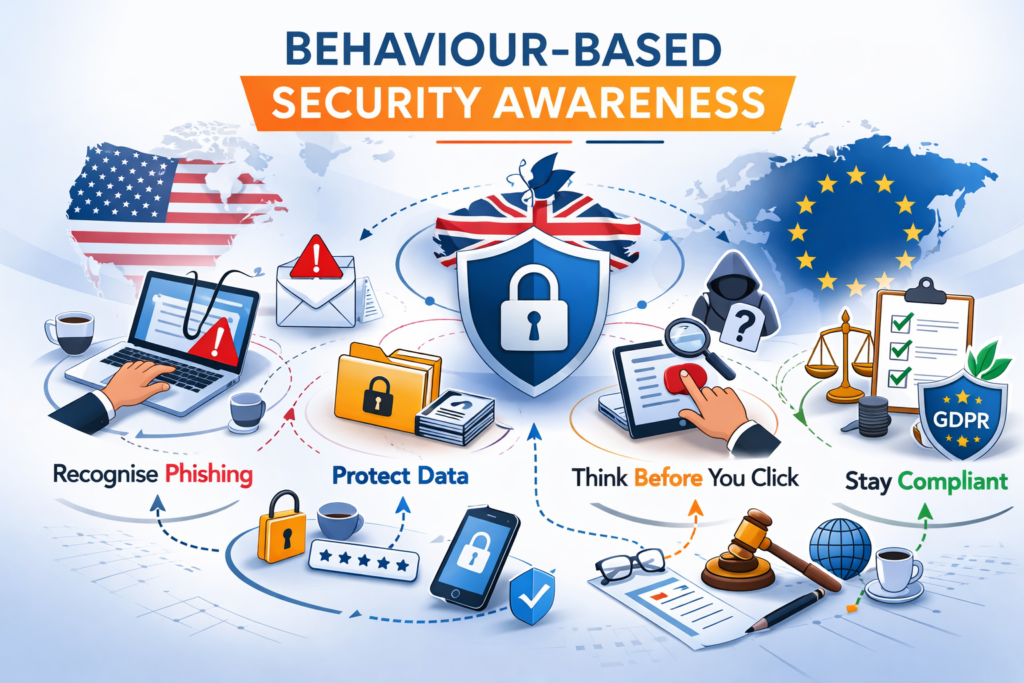
Security Awareness Training That Works.
Across banks in New York and London, manufacturers near Frankfurt and public-sector teams in Dublin and Amsterdam, successful programs tend to share the same patterns:
Visible leadership support executives and middle management model the behaviours they expect.
Localization content and examples adapted for each country, language and regulator.
Integration training plugged into HR, ITSM, identity platforms and email security.
Feedback loops using incident and phishing data to refine campaigns.
Human-risk-focused vendors such as KnowBe4, SoSafe or Hoxhunt have demonstrated that frequent, personalized simulations and microlearning drive lower phishing click rates and higher reporting rates over time when paired with good analytics.
How to Design a Practical, Behaviour-Based Security Awareness Training System
Organizations can design a practical, role-based security awareness system by mapping human risks to roles, embedding microlearning into daily tools and running continuous campaigns instead of one-off events. The goal is to align training with real workflows in the US, UK, Germany and wider EU not to bolt on another portal people will ignore.
Map Human Risks to Roles, Systems and Real Incidents
Start with your human risk map, not content shopping.
Analyse incidents and near misses phishing, BEC, misdirected emails, misconfigured access, lost devices.
Group by role and system e.g., finance teams and invoice fraud, developers and secrets in repos, clinicians and patient data, contact centre agents and social engineering.
Overlay regulations HIPAA for US healthcare, UK-GDPR for UK public sector, DSGVO for German entities, PCI DSS for payment data and SOC 2 for SaaS providers.
Guidance from the UK’s National Cyber Security Centre (NCSC) and Germany’s Bundesamt für Sicherheit in der Informationstechnik (BSI) both stress tailoring training to job roles and real tasks.
Make Training Practical with Microlearning and Just-in-Time Nudges
Next, design microlearning security awareness modules that:
Take 3–7 minutes each
Are highly specific (“How to verify supplier bank changes” rather than “phishing 101”)
Include 1–2 realistic examples from your sector and GEO
You can also trigger just-in-time nudges, for example.
A banner in email when someone clicks “reply all” to an external recipient list
A pop-up in a cloud drive when a user shares a folder publicly
A short tip in your HR portal during onboarding
This approach is ideal for hybrid and remote employees from New York fintech teams to Manchester-based NHS suppliers and Berlin SaaS start-ups because it respects their time and workflows.
Build a Continuous Security Awareness Training Program, Not a Once-a-Year Event
A continuous program typically includes:
A 12-month campaign calendar with monthly themes (phishing, passwords, data handling, remote work, AI safety).
Quarterly simulations plus targeted “booster” campaigns for high-risk groups.
Integrated onboarding and contractor training.
Regular communications from security and leadership.
Canadian and UK government guidance both recommend ongoing, tailored training for all personnel, including contractors and executives, as one of the top actions to reduce cyber risk.
AEO Micro-Answer: How to Design a Role-Based Security Awareness Program
To design a role-based security awareness program:
Map key human risks to roles and critical systems.
Align modules with regulations (GDPR/UK-GDPR, HIPAA, PCI DSS, DORA, NIS2).
Deliver short, task-focused microlearning in the tools people already use.
Run continuous phishing simulations and nudges, with metrics and feedback loops.
Phishing Awareness Training Programs and Realistic Attack Simulations
A phishing awareness training program combines targeted education with realistic simulations to teach people how to spot, avoid and report malicious messages. Done well, it makes phishing and social engineering feel familiar not mysterious and dramatically improves reporting rates across US, UK and EU teams.
Why Phishing Simulations Matter More Than Slide Decks
Attackers constantly refine their tactics, and AI-generated phishing is getting more believable every year. Some reports show phishing attempts growing by more than 25% year-on-year globally. Static slide decks simply can’t keep up.
Simulations work because they.
Provide safe practice: staff experience realistic lures without real damage.
Give instant feedback: users learn why something was suspicious.
Generate measurable data: you can track click and report rates over time.
Human-risk-focused vendorfrom global players to UK SMB specialists such as Boxphish and usecure use this model to steadily push organizations toward lower risk.
Designing Phishing Awareness Training That Mirrors Real Attacks
Effective phishing awareness training should.
Use templates based on real incidents your SOC or MSSP has seen.
Target specific roles (e.g., finance payment approvals, HR CVs, IT admin alerts).
Mix credential harvesting, attachment-based and business email compromise lures.
Include at least one reporting mechanism (button, hotline, chat) in every exercise.
In regulated environments, track how quickly people report simulations; reducing time-to-report is just as important as reducing click rates.
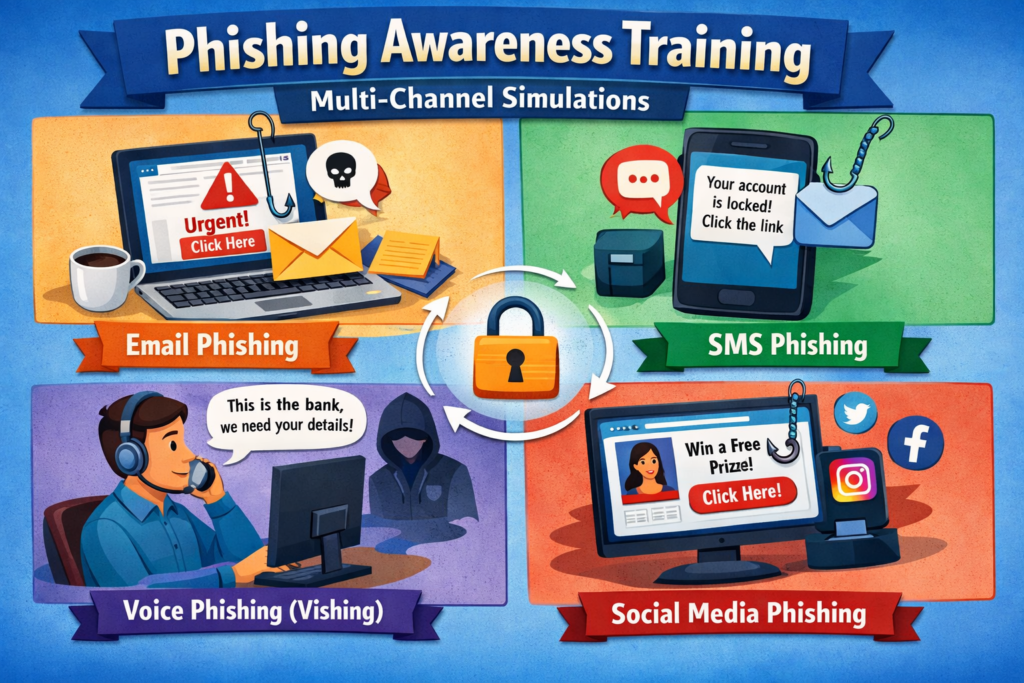
Multi-Channel Simulations.
Modern phishing awareness training must go beyond email.
SMS (“smishing”) fake delivery updates, MFA codes or bank alerts.
QR codes on posters, invoices or meeting rooms, leading to credential traps.
Voice phishing (“vishing”) attackers impersonating IT, suppliers or regulators.
Messaging apps collaboration platforms and social DMs.
Platforms like secunet and others in the DACH region increasingly simulate multi-channel attacks to match how German Mittelstand and public-sector staff really work.
AEO Micro-Answer: What Is a Phishing Awareness Training Program?
A phishing awareness training program is a structured mix of education and multi-channel attack simulations (email, SMS, QR and voice) that teaches employees to recognize, avoid and report phishing attempts, with clear metrics for clicks and reporting rates.
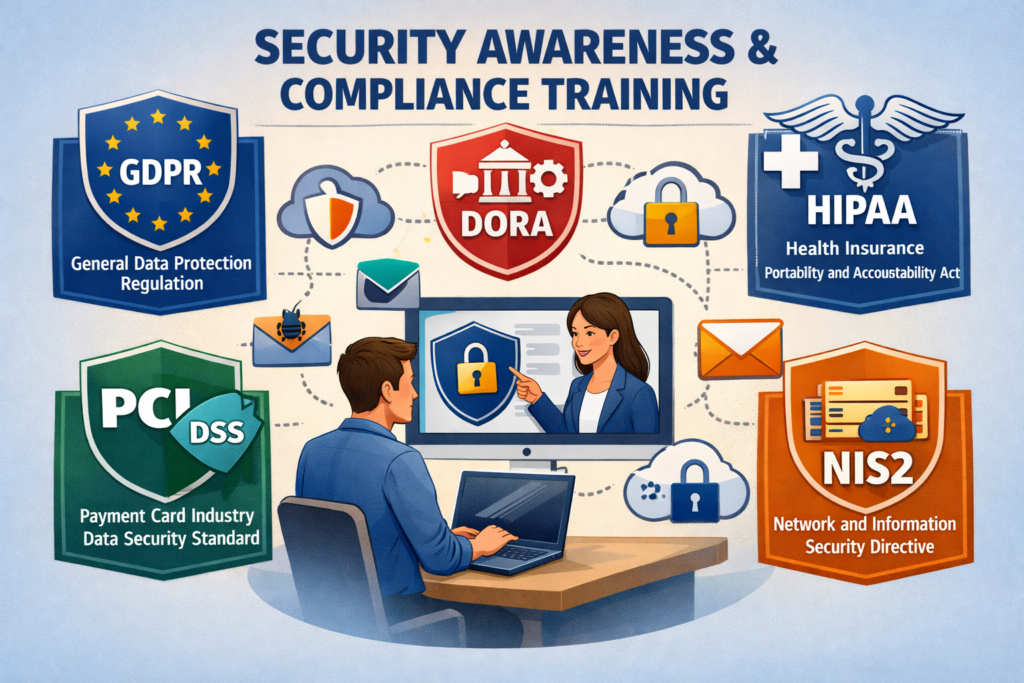
Aligning Security Awareness with Compliance: GDPR, HIPAA, PCI DSS, DORA and NIS2
Regulated companies can’t afford “nice to have” training. Under GDPR/UK-GDPR, HIPAA, PCI DSS, DORA and NIS2, security awareness and staff education are part of your accountability and operational resilience story. DORA guidance for EU financial services, for example, highlights ICT security awareness as a required component of risk management.
Mapping Training Outcomes to GDPR/UK-GDPR, DSGVO and ISO 27001 Requirements
A strong program should explicitly map modules and outcomes to.
GDPR/UK-GDPR and DSGVO lawful processing, data minimisation, subject rights, data breach reporting.
ISO 27001 Annex A controls on awareness, access control, operations and supplier management.
NIS2 / DORA operational resilience, incident reporting, ICT risk management expectations.
Supervisors like BaFin and EU regulators increasingly expect documented training plans, attendance and evidence that awareness is part of the control framework not an afterthought.
Industry-Specific Programs for Healthcare, Finance, Retail and Manufacturing
Different sectors need different emphasis.
Healthcare (e.g., NHS trusts and US hospital systems) patient data confidentiality, clinical workflows, ransomware playbooks and HIPAA breach reporting.
Finance fraud, insider risk, data leakage, dealing with regulators, DORA/NIS2, and call-centre social engineering.
Retail & ecommerce PCI DSS scope, point-of-sale security, third-party platforms, loyalty schemes.
Manufacturing & OT physical access, engineering workstations, USB/media, plant network segmentation.
Sector-specific scenarios make training feel real, which in turn improves retention and behaviour change.
How Often Should Employees Receive Security Awareness Training in Regulated Environments?
Most regulators don’t mandate an exact schedule, but best practice across US, UK and EU regulated sectors is.
At least annual mandatory training for all staff and contractors.
Role-specific refreshers every 6–12 months for high-risk functions.
Phishing simulations at least quarterly, with ad-hoc campaigns after major incidents.
UK government surveys show that organizations with regular training and phishing exercises are more likely to identify attacks early and recover faster.
AEO Micro-Answer: Why Regulated Companies Must Link Awareness to Compliance
Regulated companies must link awareness to compliance because laws like GDPR/UK-GDPR, HIPAA, PCI DSS, DORA and NIS2 all assume that trained, informed staff are part of the control environment—weak awareness quickly becomes a regulatory, financial and reputational risk.
Measuring Whether Your Security Awareness Training Program Is Working
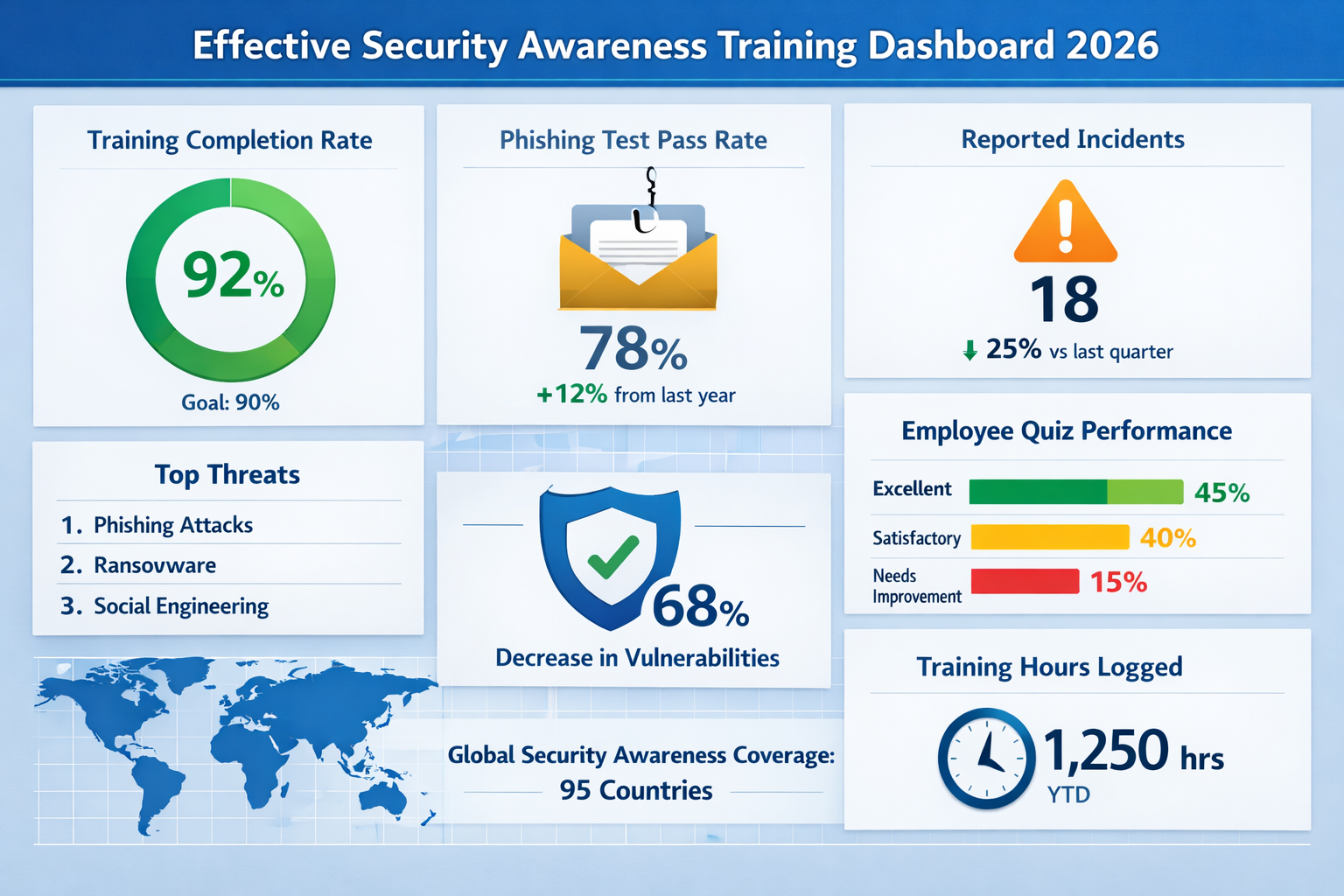
You measure an effective security awareness training program by tracking behaviour change, risk reduction and incident trends not just course completion. If your dashboards only show “98% complete,” you’re not measuring what attackers exploit.
Metrics That Matter: Behaviour Change, Risk Reduction and Incident Trends
Good metrics include.
Reduction in real-world incidents linked to human error.
Fewer policy violations around data sharing and access.
Increased and faster reporting of suspicious activity.
Qualitative feedback from staff and managers.
ENISA and national cyber agencies across Europe stress the importance of evaluating awareness initiatives based on behavioural outcomes and long-term cultural change.
Key KPIs for Phishing and Human Risk.
For phishing and human risk, three KPIs matter most.
Click rate: percentage of users who interact with simulated malicious content.
Reporting rate: percentage who correctly report the simulation.
Time-to-report: median time between receiving and reporting a suspicious message.
Some organizations also track “repeat offenders” and high performers, but avoid public shaming—use this to target coaching and recognise champions instead.
Dashboards, Reporting and Executive Storytelling for US, UK and EU Stakeholders
Your platform should offer role-based dashboards for:
Security teams detailed metrics, segmentation and integration with SIEM/SOAR.
Managers team-level performance and simple actions (e.g., reinforcing key messages).
Executives and boards trends over time, benchmarked against peers and mapped to risk appetite.
In US mid-market companies, London financial institutions or German industrial groups, this data is what convinces leadership that awareness spend is actually reducing risk and supporting audits, not just buying e-learning licenses.
AEO Micro-Answer: How to Measure an Effective Security Awareness Training Program
Measure an effective security awareness training program by tracking phishing click and reporting rates, time-to-report, policy violations and human-related incident trends over time, instead of relying only on course completion statistics.
Choosing a Security Awareness Training Partner and Next Steps
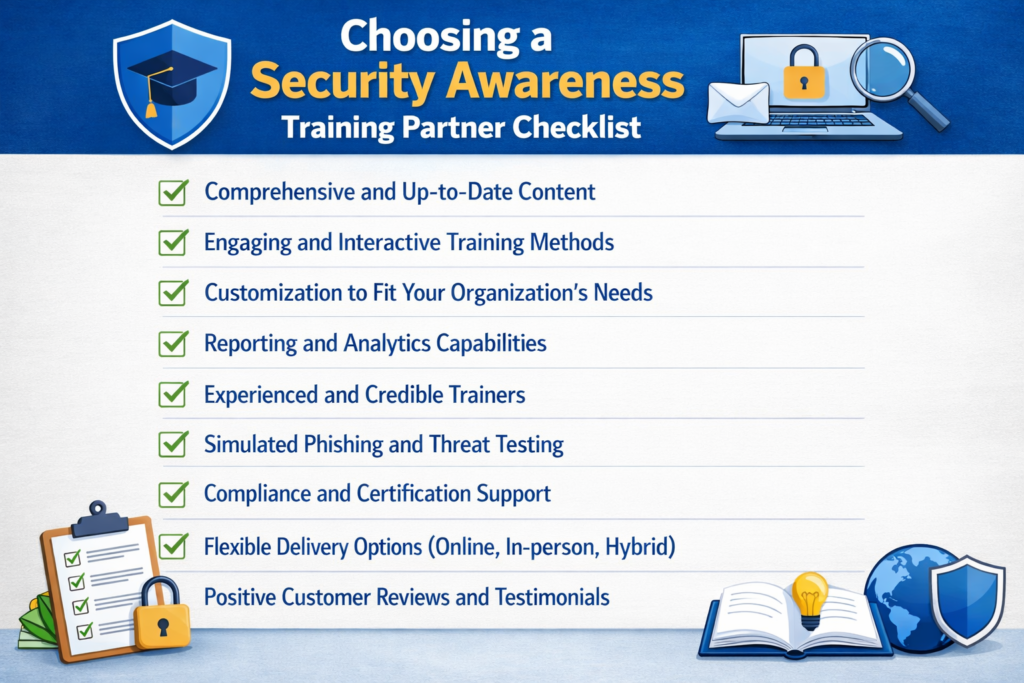
Choosing the right security awareness training partner means looking beyond content libraries and price-per-seat. You need behaviour-change expertise, strong phishing and human-risk analytics, and support for your GEOs and regulators.
Must-Have Platform Capabilities for Modern Employee Cybersecurity Awareness Training
Look for capabilities such as:
Role-based learning paths and multilingual content for US, UK and EU audiences.
Advanced simulated phishing and social engineering training across multiple channels.
Integrations with HRIS, SSO, email gateways and SIEM.
Analytics that surface human-risk hotspots and track improvement over time.
Data protection controls (regional hosting, GDPR/DSGVO alignment, SOC 2-ready architectures on clouds like Amazon Web Services (AWS) and others)
Questions to Ask Vendors About Behaviour Change, Data Privacy and Regional Support
When you speak to vendors (or partners like Mak It Solutions), ask:
How do you measure behaviour change, not just completions?
Can you support US, UK and German regulators and sector-specific frameworks?
Where is our data stored, and how do you handle GDPR/DSGVO and regional hosting?
How do you support remote and hybrid workers across time zones?
Can you integrate with our existing identity, email and collaboration stack?
The answers will quickly separate checkbox e-learning providers from true human risk management partners.
Implementation Roadmap: 90-Day Plan to Launch a Program That Actually Works
A simple 90-day roadmap might look like this:
Days 1–30
Run a quick maturity and risk assessment.
Map key human risks and roles.
Select platform and define success metrics.
Days 31–60
Configure integrations (SSO, HR, email)
Launch baseline phishing simulation and core microlearning.
Train managers to reinforce messages.
Days 61–90
Launch themed campaigns (e.g., phishing + data handling).
Review early metrics and feedback.
Adjust content, schedule and policies based on findings.
From here, you iterate quarterly adding new modules (e.g., AI safety, secure SaaS usage), tuning simulations and aligning with evolving regulations across the US, UK, Germany and wider Europe.
Key Takeaways
Effective security awareness training programs are continuous, behaviour-based and mapped to real human risks, not just annual courses.
Phishing awareness training with realistic, multi-channel simulations is essential to counter modern, AI-boosted phishing campaigns.
Regulated organizations must link awareness to GDPR/UK-GDPR, DSGVO, HIPAA, PCI DSS, DORA and NIS2, with clear evidence for auditors.
The most useful KPIs focus on click rates, reporting rates, time-to-report and incident trends, not just completion.
The right partner offers role-based microlearning, strong analytics, regional support and tight integrations with your existing stack.
Ready to move from checkbox training to a security awareness training program that actually changes behaviour? Mak It Solutions can help you design a practical, role-based and phishing-ready system for teams across the US, UK, Germany and wider Europe.
If you’d like a 90-day roadmap scoped for your industry and regulators, reach out to Mak It Solutions for a consultation based on your current incidents, your tech stack and the regulations you care about most. ( Click Here’s )
FAQs
Q : How often should employees receive security awareness training in different industries?
A : Most organizations should provide at least annual mandatory training for all staff and contractors, plus quarterly phishing simulations and targeted refreshers for high-risk roles. In highly regulated sectors like healthcare, financial services and critical infrastructure, many teams move to continuous programs with monthly microlearning and campaigns tied to audits, DORA/NIS2 or sector regulators. The key is not a specific number of sessions but maintaining a steady cadence so secure behaviour becomes normal, not exceptional.
Q : What should be included in employee cybersecurity awareness training for new starters and contractors?
A : Onboarding training should cover the basics passwords and MFA, phishing recognition, acceptable use, data handling, incident reporting and remote work expectations plus any sector-specific rules such as HIPAA, PCI DSS or local data protection laws. New starters and contractors should also be enrolled into your ongoing microlearning and phishing simulations straight away, using the same channels as permanent staff. This ensures they don’t become a blind spot, especially if they handle sensitive systems or data from day one.
3. How much does a security awareness training program typically cost per employee in the US, UK and EU?
Pricing varies by vendor and scale, but many cloud-based platforms charge somewhere between a few dollars and a few euros per user per month for core training plus phishing simulations. Enterprise bundles with advanced analytics, custom content and dedicated support cost more but often remain far below the cost of a single data breach, which averages around $4.8–4.9 million globally.For most organizations, the question is less “what does it cost?” and more “what level of risk reduction and audit comfort do we get for that spend?”
Q : Can effective security awareness training reduce cyber insurance premiums or audit findings?
A : Yes many insurers and auditors increasingly look for evidence of structured, ongoing awareness programs when assessing risk. Demonstrating regular training, phishing simulations, documented policies and measurable improvements in behaviour can support better terms, smoother renewals and fewer remediation items in audits. While it’s not a guaranteed discount, a strong program signals that you take human risk management seriously, which can influence both underwriting decisions and regulator perception.
Q : What’s the difference between behaviour-based security awareness training and traditional e-learning courses?
A : Traditional e-learning focuses on delivering information once a year and checking who completed the module. Behaviour-based security awareness training focuses on changing what people actually do through frequent microlearning, realistic simulations, just-in-time nudges and feedback loops tied to real incidents. Instead of measuring only completion, you track how phishing click and reporting rates, time-to-report and policy violations evolve over time, and you continuously adapt your program based on those results.