
CodeIgniter Development Services: The Complete Buyer’s Guide
CodeIgniter Development Services: The Complete Buyer’s Guide
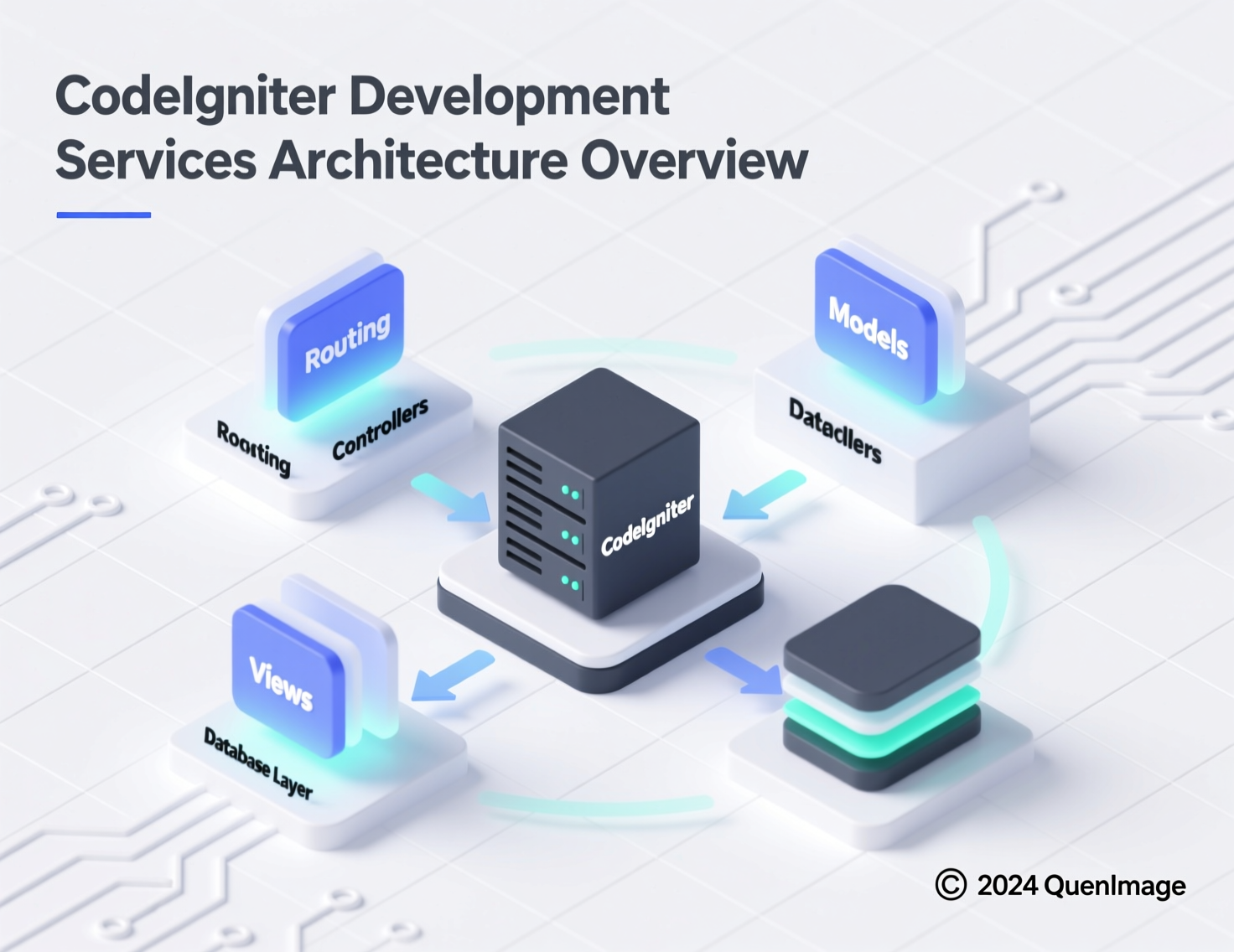
CodeIgniter Development Services in 2025: What’s Included, Costs, Timelines, and CI3→CI4 Migration
Introduction.
Laravel is louder but CodeIgniter is faster to ship for lean teams. If you’re evaluating CodeIgniter development services in 2025, here’s the short answer: a solid partner will cover discovery, CI4 architecture, REST APIs, QA/DevOps, and post-launch support plus a safe CI3→CI4 upgrade path with performance and security hardening.
In this guide from Mak It Solutions, we unpack exactly what’s included in CodeIgniter development services, typical costs and timelines, when to choose CodeIgniter vs. heavier frameworks, how to hire (freelancer vs. agency vs. dedicated team), and a step-by-step CI3→CI4 migration checklist. You’ll see where CodeIgniter shines, how to keep your app secure, and what a predictable delivery plan looks like in the real world.
What’s Included in CodeIgniter Development Services
Primary intent
what is included in CodeIgniter development services packages
CodeIgniter development services bundle everything required to plan, build, test, deploy, and maintain a production-grade CI4 application. A robust package spans discovery and architecture, CI4 MVC/HMVC builds, REST integrations, QA/DevOps, and long-term SLAs. In other words, “idea to impact” with CodeIgniter development services not just coding.
Discovery & Architecture
Work starts with clarity. Expect structured workshops to capture goals, KPIs, and constraints. Deliverables typically include user stories, data models, API contracts, a risk log, and a deployment topology (single region or multi-AZ). Hosting recommendations often compare AWS (Elastic Beanstalk/Lightsail), DigitalOcean (Droplets/Apps), or Azure App Service.
Outputs you should receive.
Product brief + prioritized backlog
Entity-relationship diagrams (ERDs) and data retention rules
API specs (OpenAPI/Swagger) and integration map
Architecture decision records (ADRs) with trade-offs
Risk register with mitigation owners and dates
Statistic
Teams that invest 1–2 weeks in structured discovery reduce change requests by ~20–30% during build.
Build: CI4, MVC/HMVC, REST APIs & Integrations
Modern CodeIgniter development services are built on CodeIgniter 4 (CI4), with Composer for dependencies, PSR-4 autoloading/PSR-12 coding style from PHP-FIG, and a clean MVC (or HMVC when modules make sense). Teams should follow domain-oriented folders, clear service layers, and repository patterns for testability.
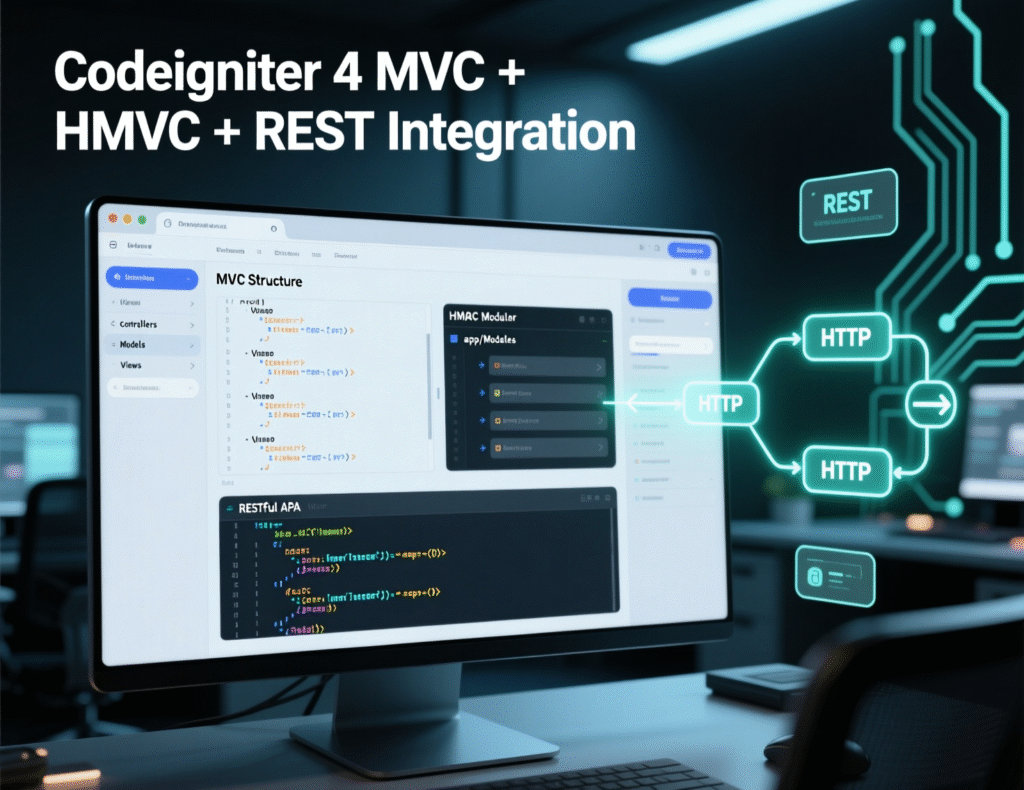
What good CI4 builds include.
Auth modules (JWT/OAuth2), role-based permissions
REST API endpoints with proper versioning (/v1/…)
Pagination, caching, validation, file storage (S3/Spaces)
Payment gateway connectors (Stripe, PayPal)
CRM/ERP connectors (HubSpot, Salesforce, Odoo)
Email/notifications (SES, SendGrid, Twilio)
Example
A retail MVP can ship with CI4 controllers, a modular HMVC admin, Stripe checkout, and HubSpot lead sync in 6–10 weeks depending on scope.
Statistic
Composer-managed CI4 projects cut integration setup time by ~15–20% vs. manual/legacy packaging.
QA, DevOps & Support
Quality is a feature. Mature CodeIgniter development services include automated tests (PHPUnit/Pest), CI/CD (GitHub Actions/GitLab CI), and a release train with staging/pre-prod parity. Add monitoring (New Relic, Datadog), logging (ELK), and CDN/caching (Cloudflare).
You should expect
Unit/integration tests and API contract tests
IaC (Terraform) or repeatable environment scripts (Docker Compose)
Security headers, rate limiting, and WAF recommendations
Operability runbooks, documentation, and handover
SLAs (e.g., 99.9% uptime), ticketing, and patch windows
Statistic
Teams with CI/CD pipelines typically reduce mean time to recovery (MTTR) by ~25–40%.
Why Choose CodeIgniter in 2025?
When speed-to-value and simplicity matter, CodeIgniter development services deliver a lightweight, secure base that’s easy to host and maintain especially for small to mid-sized apps.
Lightweight Performance vs. Heavier Frameworks
Where CI fits
Pros
Small footprint, fast boot time, easier onboarding, leaner hosting costs.
Use it when
MVPs, admin portals, custom CMS, compact REST APIs, internal tools with focused workflows.
Consider Laravel/Symfony when
You need a larger ecosystem out of the box (queues, jobs, first-party packages), complex domain rules, or enterprise-scale DDD across many teams.
Real-world note
Laravel’s ecosystem is unmatched for batteries-included tooling; however, CI4’s minimal core can ship faster for lean teams with tight budgets.
Statistic
Teams report initial page response times ~10–20% faster on slim CI4 apps vs. equivalently structured Laravel apps, primarily due to baseline footprint differences—not counting caching.
Best-Fit Use Cases
SMB customer portals and vendor extranets
Custom CMS for content/SEO teams
E-Commerce MVPs, catalog + checkout + basic CRM sync
Data dashboards, analytics portals, reporting back-office
API backends for mobile apps or front-end SPAs
Example: A B2B distributor deployed a CI4 portal with role-based pricing and a PostgreSQL reporting view; the initial release went live in 8 weeks and reduced manual quote emails by ~50%.
Tech Stack & Hosting Compatibility
CI4 runs great on PHP 8.x with MySQL/MariaDB/PostgreSQL, Nginx/Apache, and containers. Teams often package CI4 apps in Docker, with Kubernetes readiness for growth.
Standards & tooling
PHP-FIG PSRs, Composer, PSR-7/15 middleware bridges, PHPUnit/Pest.
Clouds
AWS, DigitalOcean, Azure; CI4 also deploys cleanly on VPS or cPanel.
Statistic
Moving from shared hosting to a small cloud VM with Nginx + PHP-FPM often improves TTFB by ~20–35% for CI4 apps.
Hiring Models & Costs
Primary intent: how much does it cost to hire a codeigniter developer in the US; capture “hire codeigniter developer” intent
Freelancer vs. CodeIgniter Development Company vs. Dedicated Team
Freelancer
Pros
Cost-effective, flexible scheduling, direct communication.
Cons
Single-point dependency, limited QA/DevOps, variable availability.
Best for
Small fixes, short MVP spikes, prototypes.
CodeIgniter Development Company (Agency)
Pros
Cross-functional coverage (PM, QA, DevOps), governance, SLAs, redundancy.
Cons
Higher rates than solo freelancers.
Best for
Production systems, integrations, migrations, security-sensitive work.
Dedicated Team / Staff Aug
Pros
Embedded collaboration, velocity, long-term roadmap alignment.
Cons
Commitment and management overhead.
Best for
Ongoing product evolution or multi-app portfolios.
Statistic
Agencies with QA + DevOps reduce escaped defects by ~20–30% vs. ad-hoc solo development.
Typical Rates & Budget Ranges (US/EU/Offshore)
(Representative 2025 market snapshots—VERIFY LIVE for current numbers in your region)
Hourly rates (CI4 engineers)
USA: $70–$140/hr
UK/EU (incl. DACH/Benelux): €55–€110/hr
Nearshore/Offshore: $30–$70/hr
Project budget bands
MVP (6–10 weeks): $25k–$60k
Mid-size portal (12–20 weeks): $60k–$150k
Complex migration/integrations (16–28+ weeks): $120k–$300k+
What drives cost
Scope volatility, third-party integrations, security/compliance (PII/PCI), non-functional SLAs, and data migration complexity.
Engagement Models: Fixed Price, T&M, Retainer
Fixed Price
Great when scope is stable and measurable; tie payments to milestones and acceptance tests.
Time & Materials (T&M)
Best for evolving scope; govern with sprint budgets and burn-up charts.
Retainer (Managed Services)
Ideal post-launch for SLAs, optimizations, and feature flow.
How to choose
If deadlines are tight and scope is known, fixed price works. If discovery reveals uncertainty, start T&M with clear weekly demos, then lock fixed scope for subsequent waves.
CodeIgniter Migration Services (CI3→CI4 & Modernization)
Primary intent: codeigniter 3 to 4 migration checklist for SMEs
Why Upgrade from CI3 to CI4
CI4 is a modern, namespaced framework with improved routing, better configurability, and native compatibility with PHP 8.x. You’ll gain a cleaner autoloader (Composer/PSR-4), enhanced security posture, and long-term maintainability.
Key reasons
Namespaces + Composer streamline modularity and testing.
Improved routing and HTTP layer; better request/response handling.
Security updates and community support via CodeIgniter Foundation.
Cleaner configuration and environment management.
Statistic
Teams migrating to CI4 typically reduce new-feature lead time by ~10–25% thanks to better structure and tooling.
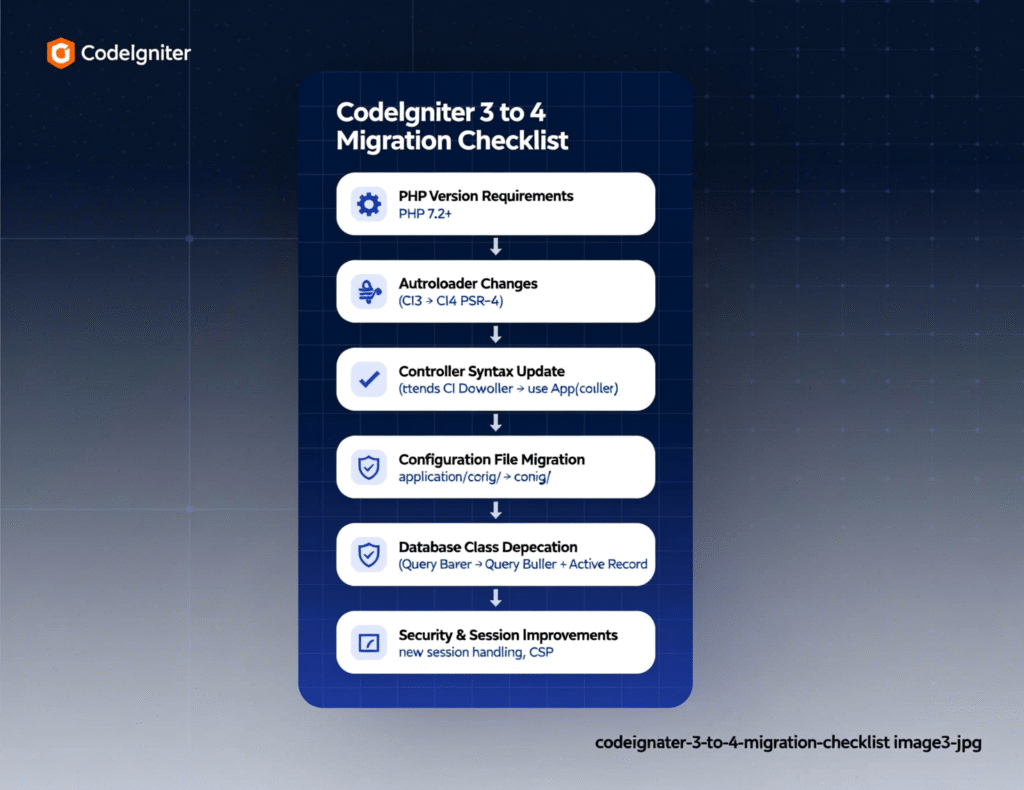
Step-by-Step Migration Checklist (Actionable)
Audit your CI3 app
Inventory controllers/models/views, helpers, libraries, and third-party code.
Dependency mapping
Convert libs to Composer packages where possible; pin versions.
Refactor
To CI4 structure: namespaces, Services, Config, and organized modules (HMVC when sensible).
Upgrade database layer
Test query builders and transactions; add indexing plan.
Rewrite routing & filters
Align middleware, auth, CORS, and versioned API routes.
Add automated tests
Cover critical user journeys and API contracts before cutover.
Performance pass
Caching (OPcache, page/fragment), query tuning, asset pipeline.
Security pass
Secrets in env vars, CSRF, content-security-policy (CSP), rate limiting.
Cutover plan
Dual-running staging, blue/green or canary, data freeze window, rollback.
Handover
Documentation, runbooks, and knowledge transfer.
Performance & Security Hardening
Caching
Use OPcache, CI4 cache drivers (Redis/Memcached), and HTTP caching where safe.
DB indexing
Add composite indexes for frequent filters/sorts; measure with EXPLAIN.
Rate limiting & throttling
Protect public APIs; log suspicious bursts.
OWASP ASVS controls
Input validation, output encoding, session management, auth flows.
Secrets management
Environment variables, AWS Secrets Manager, or Vault.
Monitoring
New Relic APM + error tracking; alert on p95 latency and error spikes.
Statistic
Basic caching + N+1 query fixes often cut p95 latency by ~25–40% on CI4 apps.
Process & Timelines You Can Expect
From Discovery to Launch
Here’s a typical cadence for CodeIgniter development services.
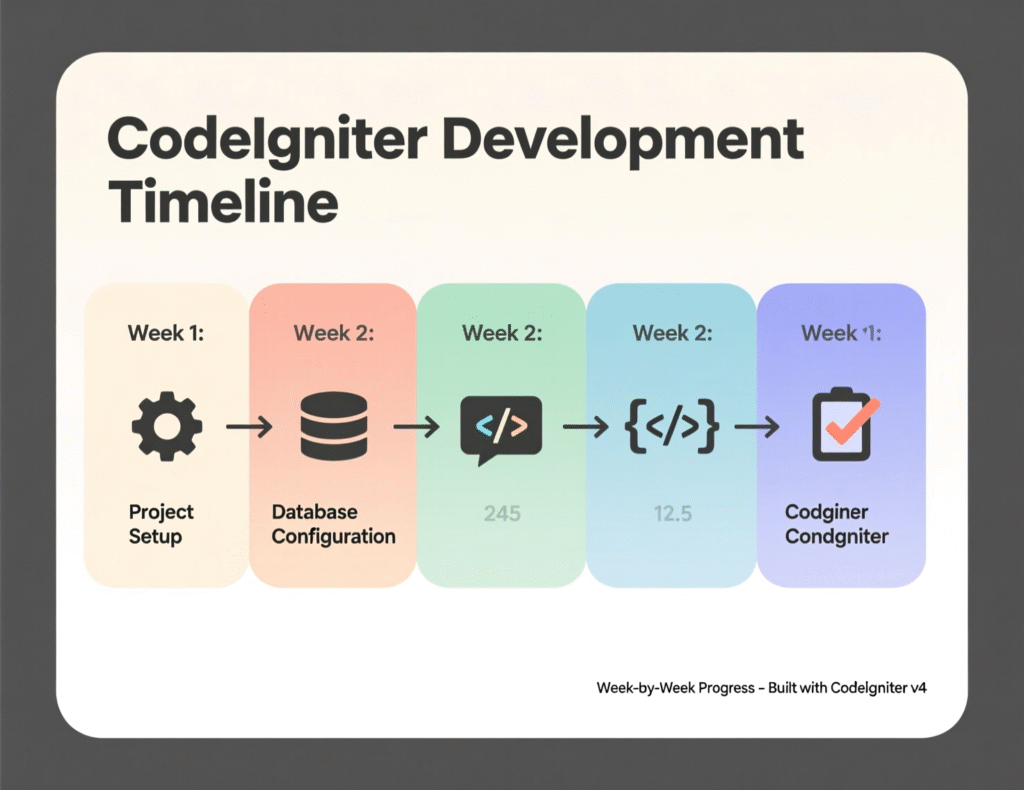
Small MVP (6–10 weeks)
Week 1–2: Discovery, architecture, backlog, CI/CD, skeleton repo
Week 3–6: Core features, REST endpoints, auth, admin
Week 7–8: QA hardening, UAT, staging sign-off, production release
Medium Project (12–16 weeks)
Adds integrations (Stripe/CRM), reporting, role-based UX
Complex Migration (16–28+ weeks)
CI3→CI4, data migration, phased cutover, SSO
Statistic
Teams that run weekly demos cut acceptance cycles by ~15–25%.
Communication & Project Management
Use Scrum or Kanban with RACI ownership. Maintain acceptance criteria per user story, and run sprint reviews, daily stand-ups, and monthly roadmap checks. Share a project dashboard covering scope, risks, velocity, and burn.
KPIs & SLAs After Go-Live
Uptime: 99.9–99.95% (with health checks and autoscaling where relevant)
MTTR: aim < 2–4 hours, with on-call rotations
Performance budgets: p95 API < 400–600ms for typical CRUD flows
Security window: patch high-severity issues within 48–72 hours
How to Choose a CodeIgniter Development Company
Evaluation Checklist
Proven CI4 portfolio and references in your domain
Architectural depth (modular design, API-first, caching, observability)
DevSecOps maturity: CI/CD, SAST/DAST, IaC, secrets, WAF/CDN
Test discipline: unit/integration, performance, and security tests
Trial sprint offer (1–2 weeks) to validate collaboration and velocity
RFP/RFQ Templates & Questions
Scope tables with acceptance criteria and non-functional requirements
Data protection (PII, GDPR) and retention policies
Deployment architecture, SLAs, and exit clauses
Cost transparency: blended rates, change control, and inclusions/exclusions
Red Flags & How to Mitigate
No CI4 experience or running outdated PHP require a spike/prototype before commitment.
No automated tests insist on coverage targets from the start.
Vague estimates ask for story-point ranges and risk buffers.
No monitoring request a baseline New Relic/ELK setup in scope.
Key Takeaways
CodeIgniter development services are end-to-end
discovery, CI4 builds, integrations, QA/DevOps, and SLAs.
Choose CI4 when you want speed-to-ship, lean hosting, and focused workflows; pick Laravel/Symfony for larger ecosystems.
Costs vary by region and scope
MVPs often land in $25k–$60k with 6–10 week timelines (VERIFY LIVE).
CI3→CI4 migration
Audit, refactor to namespaces/Composer, add tests, and plan a safe cutover.
Security/performance
Cache, index, rate limit, use OWASP ASVS controls, and monitor p95 latency.
Need a clear plan for your CodeIgniter app? Mak It Solutions can run a rapid CI4 audit, map your migration, or ship a lean MVP with predictable SLAs. Get a free 30-minute discovery call to benchmark costs, timelines, and the safest path forward. Contact us through the form below to get started.( Click Here’s )
FAQs
Q : Is CodeIgniter still relevant in 2025 compared to Laravel and Symfony?
A : Yes especially for lean teams and focused backends. CodeIgniter development services shine when you need fast delivery, small footprint, and straightforward hosting. Laravel/Symfony are excellent when you need a bigger ecosystem or deep enterprise patterns. Many teams run CI4 for small/medium apps and Laravel/Symfony for complex domains. If you’re unsure, run a one-week spike in both and compare p95 latency, build time, and developer onboarding .
Q : Can I migrate from legacy PHP or custom MVC to CodeIgniter 4?
A : Absolutely. A typical path is: audit code, modularize into services, move to CI4 with Composer/PSR-4, refactor routes/filters, add tests, and cut over with a canary release. You’ll likely see better maintainability and safer deployments. For legacy DBs, plan indexing and a read-replica to reduce downtime. A two-phase approach (compat shim → full CI4 patterns) keeps risk low.
Q : How long does a typical CodeIgniter MVP take to launch?
A : Most small MVPs ship in 6–10 weeks with a focused feature set, CI/CD, and basic monitoring. The biggest drivers are third-party integrations, data migration, and non-functional requirements (availability/security). To de-risk schedules, lock scope during a 1–2 week discovery, define acceptance tests, and insist on weekly demos. Reserve a week for UAT and a rollback plan.
Q : What security practices should my CodeIgniter agency follow?
A : Look for OWASP ASVS-aligned controls: input validation, output encoding, secrets in env vars or a vault, CSRF protections, and rate limiting. Add security headers (CSP/HSTS), dependency scanning, and least-privilege IAM. Ensure patch windows (e.g., 48–72 hours for high severity) and monitoring that alerts on spikes and anomalies. A WAF/CDN like Cloudflare helps mitigate common attacks.
Q : Do I need a dedicated DevOps setup for small CodeIgniter apps?
A : You don’t need a huge stack, but do enable the essentials: CI/CD, staging parity, containerized runtime, and basic APM/logging. For small apps, GitHub Actions + Docker + a single-node VM (with automated backups) is often enough. As usage grows, adopt blue/green deploys, autoscaling, and IaC. The goal is predictable releases and fast recovery without overspending early on.