


Coding Bootcamps in Saudi Arabia for Arab Youth
Coding Bootcamps in Saudi Arabia for Arab Youth
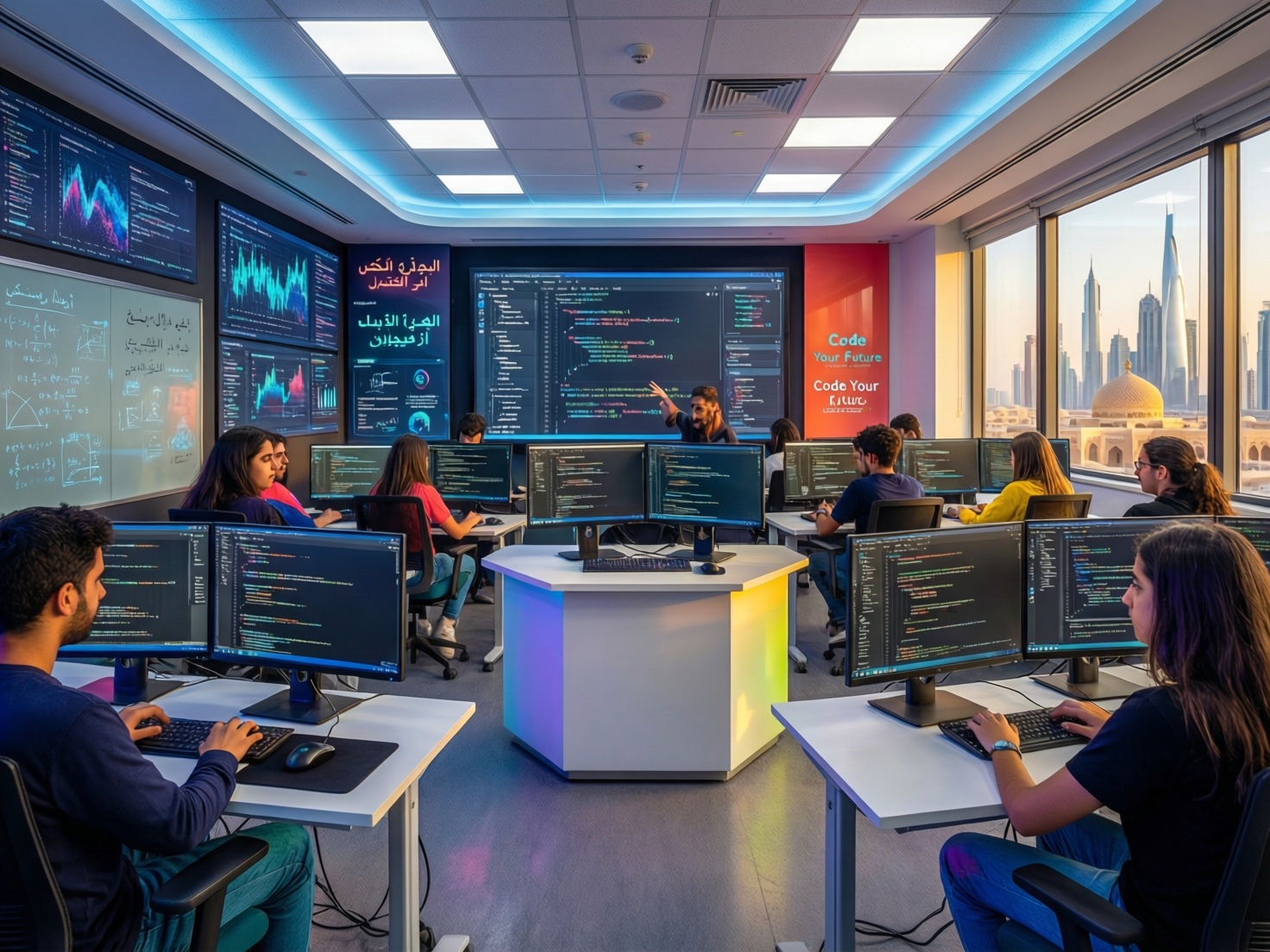
Coding Bootcamps in Saudi Arabia for Arab Youth
Coding bootcamps in Saudi Arabia are short, intensive programs that teach practical programming, web, data, and AI skills so Arab youth can move from beginner to job-ready in just a few months. Across KSA, UAE, and Qatar, these bootcamps support Vision 2030 and other national strategies by building a local tech talent pipeline for high-demand digital roles.
Introduction
Picture this: a 22-year-old in Riyadh scrolling TikTok, hearing words like “Flutter dev”, “AI engineer”, “cloud jobs” but not really knowing where to start. At the same time, companies in Riyadh, Dubai, Doha, and Dammam complain they “can’t find enough developers” with real project experience. This is the IT skills gap in the Middle East: talent and ambition are there, but the right skills and portfolios are missing.
That’s where coding bootcamps in Saudi Arabia and similar programs across the GCC come in. They give Arab youth a fast, focused path from zero to junior developer. Below, you’ll see how they work, how they compare across Saudi, UAE, and Qatar, and what to look at when choosing the right bootcamp for your goals.
What Are Coding Bootcamps in Saudi Arabia?
A coding bootcamp in Saudi Arabia is a short, intensive training program that focuses on practical coding skills and real projects, not long theory. Unlike a traditional 4-year CS degree in the Arab world, bootcamps compress learning into months, with hands-on mentorship and direct links to employers instead of academic research.
Bootcamp vs university degree in the Arab world
In KSA, UAE, and Qatar, a university degree is still respected – especially for roles in government and large enterprises. But it is slow and theory-heavy. Bootcamps are different:
Duration: weeks or months instead of 4 years.
Focus: build real apps, dashboards, and APIs that you can show in a portfolio.
Cost: often cheaper than a full degree, with scholarships or free options for citizens.
Outcome: very clear “get you into a junior developer or data role” rather than general academic knowledge.
For many young Saudis and GCC residents, a smart combo is: a bootcamp now to get into the market quickly, and possibly a degree later for career depth or promotions.

How coding bootcamps in Saudi Arabia actually work day to day
In Riyadh and Jeddah, you’ll find both in-person and online formats. Some are full-time “all in” programs, others part-time for people who work during the day. A typical day might include:
Short lecture or demo (in Arabic, English, or a mix).
Pair programming with classmates.
Working on a project for example a React frontend or a Python data pipeline.
One-on-one mentor sessions and code reviews.
Many Saudi bootcamps, including national initiatives like Tuwaiq Academy, combine Arabic-friendly content with international tools and cloud platforms, so graduates can work on AWS Bahrain, Azure UAE Central, or GCP Doha environments from day one.
Who coding bootcamps are for in KSA
Coding bootcamps in Saudi Arabia are intentionally built for:
Fresh graduates who studied something else (business, engineering, even humanities) but want tech careers.
Career switchers from retail, customer service, or operations into software, data, or product.
Unemployed youth who want digital skills training in GCC markets aligned to Vision 2030 hiring.
Employees who need workforce reskilling and upskilling in the Arab world to stay relevant in AI, data, and cloud roles.
If you fit any of these, a Saudi coding bootcamp for fresh graduates or career switchers can be a realistic, structured way into tech.
The IT Skills Gap in the Arab World and Why It Matters
Vision 2030, UAE Centennial 2071, and Qatar National Vision 2030 goals
Saudi Vision 2030, UAE Centennial 2071, and Qatar National Vision 2030 all depend on strong tech talent pipelines in software, data, AI, and cybersecurity. These visions talk about smart cities, e-government platforms, open banking, and digital IDs like UAE Pass and Qatar’s Digital ID none of this works without thousands of skilled developers and engineers.
So when you hear about coding bootcamps in Saudi Arabia, think of them as one piece of the larger tech talent pipeline for Vision 2030 and other GCC strategies.
What employers in Riyadh, Dubai, and Doha say they can’t find
Ask hiring managers in Riyadh, Dubai, or Doha and you’ll hear similar complaints:
Graduates know theory, but lack practical programming skills.
Weak exposure to cloud platforms and DevOps tools.
Limited data skills for dashboards, analytics, and AI.
Few strong GitHub portfolios.
English is “OK in class” but not comfortable for real projects or documentation.
Good bootcamps design intensive software development courses in MENA around these gaps: more projects, more teamwork, and constant feedback.
Youth unemployment vs unfilled tech roles in MENA
At a regional level, the paradox is painful: millions of young Arabs are unemployed, yet fintechs, logistics platforms, hospitals, and government agencies cannot fill their tech vacancies. The problem is not a talent gap, it is a skills gap.
Bootcamps sit exactly in that tension they turn raw talent and motivation into youth empowerment through coding and AI skills, matched to real jobs.
How Coding Bootcamps Help Close the GCC IT Skills Gap
Saudi coding bootcamps help close the IT skills gap for Vision 2030 jobs by quickly producing junior developers, data specialists, and cloud technicians who are ready to work on real projects. They align their curriculum with national initiatives and regulated sectors, so graduates can support fintech, government, and AI programs from day one.
From zero to junior developer in months realistically
A realistic promise from a good bootcamp in KSA, UAE, or Qatar is.
“If you show up, do the work, and complete the projects, you can reach junior-level in 3–9 months.”
From there, you can land roles like:
Junior or frontend developer
QA or test engineer
CRM or low-code specialist
Data associate or junior data analyst
Technical support engineer for SaaS products
You won’t become a “senior AI architect” in six months, but you can get your foot into the tech industry and keep growing.

Government-sponsored academies and national programs
Governments across the GCC have sent a strong signal: bootcamp-style learning is legitimate. For example:
Tuwaiq Academy in Saudi Arabia runs programming bootcamps aiming to qualify 100,000 programmers by 2030, directly linked to Vision 2030.
SDAIA Academy offers data and AI bootcamps such as the T5 programs, training national cadres in AI, data science, and data governance. (SDAIA)
In the UAE, initiatives like 42 Abu Dhabi provide a tuition-free, peer-to-peer coding school model supported by Abu Dhabi’s government and economic programs.
In Qatar, Qatar Digital Academy under MCIT delivers advanced digital training aligned with the country’s Digital Agenda 2030.
These public programs often partner with private bootcamps and platforms, creating a blended ecosystem of digital skills training in GCC markets.
Building fintech, AI, and data talent pipelines
Bootcamps also serve heavily regulated sectors:
For fintech, they align with requirements from SAMA in Saudi Arabia and QCB in Qatar, where open banking and digital payments require secure, compliant systems.
For AI and data, they consider standards from NDMO and SDAIA in KSA.
For UAE fintech and gov-tech, they keep an eye on frameworks in ADGM, DIFC, and TDRA.
Graduates may end up building dashboards for regulators, digital wallets that comply with SAMA rules, or integrations with UAE Pass and future Qatar Digital ID platforms.
Saudi vs UAE vs Qatar.
Coding bootcamps in Saudi Arabia.
When people search for coding bootcamps in Saudi Arabia, they usually care about two things: “Is it serious?” and “Will I get hired in Riyadh or Jeddah?”
Saudi has a strong advantage: Vision 2030 funding, Arabic-friendly UX, and a huge domestic market. Many programs are subsidised for citizens, and hiring demand is rising in fintech, e-government, logistics, and healthtech. For a Saudi or long-term resident planning to stay in KSA, starting with a local bootcamp in Riyadh, Jeddah, or Dammam is often the most direct path to work.
Coding bootcamp in Dubai and Abu Dhabi.
The UAE offers a different flavour. In Dubai and Abu Dhabi, you’ll find global brands and regional players – from small private academies to international schools like 42 Abu Dhabi, plus coding and data programs run from co-working hubs like Dubai Internet City.
A UAE coding bootcamp with Arabic support can be helpful, but many classrooms are English-first, with a mix of Emirati, GCC, and international students. This environment is great if you want regional or remote roles and are comfortable learning in English.
Learning to code in Doha and the wider Qatar market
Doha’s ecosystem is smaller but growing. Classic “Silicon Valley-style” bootcamps are fewer, but you have strong national initiatives like Qatar Digital Academy, Digital Station and other MCIT-backed programs focused on upskilling the local workforce.
Many Qataris and residents mix local training with a full stack web development bootcamp GCC online, joining remote cohorts based in Saudi or UAE while staying in Doha and respecting data residency needs via GCP Doha or other local cloud regions.
How Arab Beginners Can Choose the Right Bootcamp
Choosing a coding bootcamp in Saudi, UAE, or Qatar
Here’s a simple process you can follow:
Define your goal: junior web dev, data analyst, or cloud/AI path.
Check the curriculum: modern stacks (React / Node / Python / cloud) and enough project hours.
Language & schedule: do you need Arabic content? Weekend-only? Evenings?
Support level: mentors, career coaching, CV/LinkedIn help, mock interviews.
Alumni outcomes: real stories from Riyadh, Dubai, or Doha not just marketing.
If you need help mapping your goal to a learning path, you can always speak to a digital partner like Mak It Solutions or explore their IT and training-focused services to design a custom learning journey around your career.

What “job guarantee” and hiring partners really mean in GCC
Some providers especially international ones advertise “job guarantees” or “we place you in 90 days.” In the GCC, this usually means one of three things:
Extended career coaching until you land a job.
A partial refund if you meet all conditions but don’t get an offer.
Priority access to a network of hiring partners in Riyadh, Dubai, or Doha.
Always read the fine print and ask: “How many graduates in Saudi/UAE/Qatar actually got offers through this guarantee?”
Budget, scholarships, and government-sponsored options
If money is tight, look beyond just “cheap coding bootcamp in GCC”:
Government-sponsored academies sometimes offer fully free programs with stipends.
Women-in-tech and youth programs under Vision 2030 or national digital strategies often have scholarships.
Some employers sponsor staff to attend bootcamps as part of their workforce reskilling and upskilling in the Arab world.
Compare these options alongside private bootcamps, and remember that even a paid program is an investment if it leads to a stable tech role.
Switching to a Tech Career After Bootcamp
First tech jobs for bootcamp graduates in Riyadh, Dubai, and Doha
After graduation, typical first roles include:
Junior frontend or backend developer
CRM or marketing automation specialist
E-commerce implementation engineer
Data associate in a bank, retailer, or ministry
Support engineer for SaaS or logistics platforms
Salaries vary widely by city and company, but in Riyadh, Dubai, and Doha these roles can be a solid first step, especially when combined with rapid promotions as you prove yourself.
Bootcamps and opportunities for Arab women and under-represented groups
One of the most powerful shifts in KSA, UAE, and Qatar is the number of Arab women joining tech via bootcamps. You’ll find:
Women-only or women-priority cohorts in Saudi.
Remote online coding bootcamp for Arab women balancing family commitments.
Community support groups and networks that continue after graduation.
This is not just about jobs; it’s about long-term economic participation and flexibility for women across the region.
Continuous reskilling.
A bootcamp is not the final destination. Many graduates later specialise:
From frontend developer to cloud engineer via AWS Bahrain or Azure UAE Central courses.
From data associate to AI specialist, through programs by SDAIA, TDRA, MCIT, or partnerships like Google–Tuwaiq or IBM–MCIT.
From fintech developer to regtech or cybersecurity specialist aligned with SAMA, QCB, or ADGM/DIFC rules.
This continuous learning mindset is what keeps your career future-proof in a world of AI and automation.

Final Thoughts
You don’t need a computer science degree from day one to enter tech. For many Arab youth, coding bootcamps in Saudi Arabia and across the GCC are a practical, focused, and supported path into software, data, and AI roles.
By choosing the right bootcamp in Saudi, UAE, or Qatar, you’re not only upgrading your own career—you’re contributing to Vision 2030, UAE Centennial 2071, and Qatar’s Digital Agenda by helping build the region’s digital future. The next step is simple: clarify your goal, pick your path, and commit fully to the journey.
If you’re serious about joining the next wave of GCC tech talent, you don’t have to navigate it alone. The team at Mak It Solutions can help you align your career goals with the right learning path, tools, and platforms.
Explore our digital and IT services, book a consultation, and let’s design a custom GCC-focused strategy that connects your bootcamp journey to real opportunities in Riyadh, Dubai, Doha, and beyond. ( Click Here’s )
FAQs
Q: Are coding bootcamps in Saudi Arabia recognised by employers and Vision 2030 projects?
A : Yes, many coding bootcamps in Saudi Arabia are recognised and actively supported by employers, especially when they are aligned with national initiatives like Tuwaiq Academy, SDAIA Academy, and other Vision 2030 programs. Employers in fintech, logistics, and e-government increasingly see project-based bootcamp portfolios as proof of skills, particularly when graduates can work with cloud, data, and AI tools. As Vision 2030 pushes digital transformation across ministries and major companies, demand for bootcamp-trained developers and data specialists continues to rise in cities like Riyadh, Jeddah, and Dammam.
Q : Can I join a coding bootcamp in Dubai if I only speak basic English and fluent Arabic?
A : Yes, you can, but you should choose carefully. Some Dubai bootcamps are fully English-based, while others offer more Arabic support, preparatory content, or bilingual mentors, which can be helpful for GCC nationals who are still building confidence in English. Because most documentation and tools in tech are English-first, it’s smart to treat the bootcamp as both a coding and language upgrade. Programmes influenced by UAE initiatives such as TDRA and smart government projects often encourage strong English skills since regional roles can involve working with international teams and vendors.
Q : Is there a government-sponsored coding bootcamp in Saudi Arabia or Qatar that is free or low cost?
A : Yes. In Saudi Arabia, national programs like Tuwaiq Academy and SDAIA Academy regularly run bootcamps that are free or highly subsidised for citizens, often with stipends or strong career support. In Qatar, Qatar Digital Academy under the Ministry of Communications and Information Technology offers specialised digital skills tracks that support Qatar’s Digital Agenda 2030 and may be free or low cost for locals. Availability changes throughout the year, so it’s worth checking official websites and announcements linked to Vision 2030 and Qatar’s national digital strategies for current cohorts and eligibility rules.
Q : How long does it usually take for a bootcamp graduate in Riyadh or Dubai to land their first tech job?
A : Most motivated graduates in Riyadh or Dubai take somewhere between three and nine months after finishing a bootcamp to secure their first tech role, depending on their English level, networking effort, and willingness to start in junior or hybrid positions. Those who actively build portfolios, attend meetups, and apply widely across fintech, retail, logistics, and government projects tend to see faster results. National initiatives under Saudi Vision 2030 and UAE digital strategies often create internship and apprenticeship pipelines, helping shorten the time from graduation to first offer, especially for citizens and high-performing residents.
Q : Are there women-only or family-friendly coding bootcamps for Arab women in KSA, UAE, or Qatar?
A : Yes, and they are growing fast. In Saudi Arabia, several initiatives aligned with Vision 2030 and women’s economic participation offer women-only or women-priority cohorts with flexible timings that fit family responsibilities. In the UAE and Qatar, you’ll find a mix of co-ed bootcamps, online cohorts, and specialised women-in-tech programs supported by government and private-sector partnerships. Many provide remote learning, childcare-friendly schedules, and strong community networks, making tech careers more accessible for Arab women across the GCC.