


Digital Transformation Failures: 10 Pitfalls to Avoid
Digital Transformation Failures: 10 Pitfalls to Avoid

Digital Transformation Failures: 10 Pitfalls to Avoid
Digital transformation failures aren’t “bad tech stories.” They’re usually governance and adoption stories where new systems go live, but the business doesn’t truly change. If you want to avoid digital transformation failures in 2025, treat transformation as an operating-model shift: align outcomes, tighten decision-making, fix data early, and fund change management like it’s part of delivery (because it is).
Digital transformation failures rarely happen because of technology alone. They happen when outcomes are unclear, governance is weak, change management is underfunded, and incentives don’t match the new way of working. Teams that balance strategy, execution, and adoption and measure all three dramatically reduce risk and deliver measurable value.
The pattern behind digital transformation failures
Here’s the familiar sequence: a shiny platform launches, budgets expand, timelines stretch, and people quietly keep working the old way. On paper, “delivery” happens. In reality, value doesn’t.
Across the US, UK, Germany, and the EU, the root causes repeat: unclear value, fragile governance, underpowered data work, and change fatigue. This guide breaks down what failure looks like in 2025, the 10 biggest pitfalls, what regulated teams must do differently, and a rescue playbook that can stabilize a program without burning it down.
What “digital transformation failures” really mean in 2025
Failure vs. delay vs. under-delivery
In 2025, many “failures” aren’t cancellations. They’re delivery without impact: systems go live, but adoption stalls, workarounds grow, and benefits never show up in the numbers.
The 3 buckets.
Most digital transformation failures fall into three buckets:
Strategy failures: unclear outcomes, tech-first thinking, and no operating-model redesign
Execution failures: scope creep, integration fragility, data migration problems
Adoption failures: weak training, misaligned incentives, teams reverting to old processes
Why success metrics break across US vs UK/EU public sector
US programs often emphasize speed and ROI. UK and EU initiatives are more likely to prioritize assurance, accessibility, and compliance. If the metrics don’t match the context especially in regulated environments programs can “pass” governance gates yet still fail operationally.
The 10 most common digital transformation pitfalls
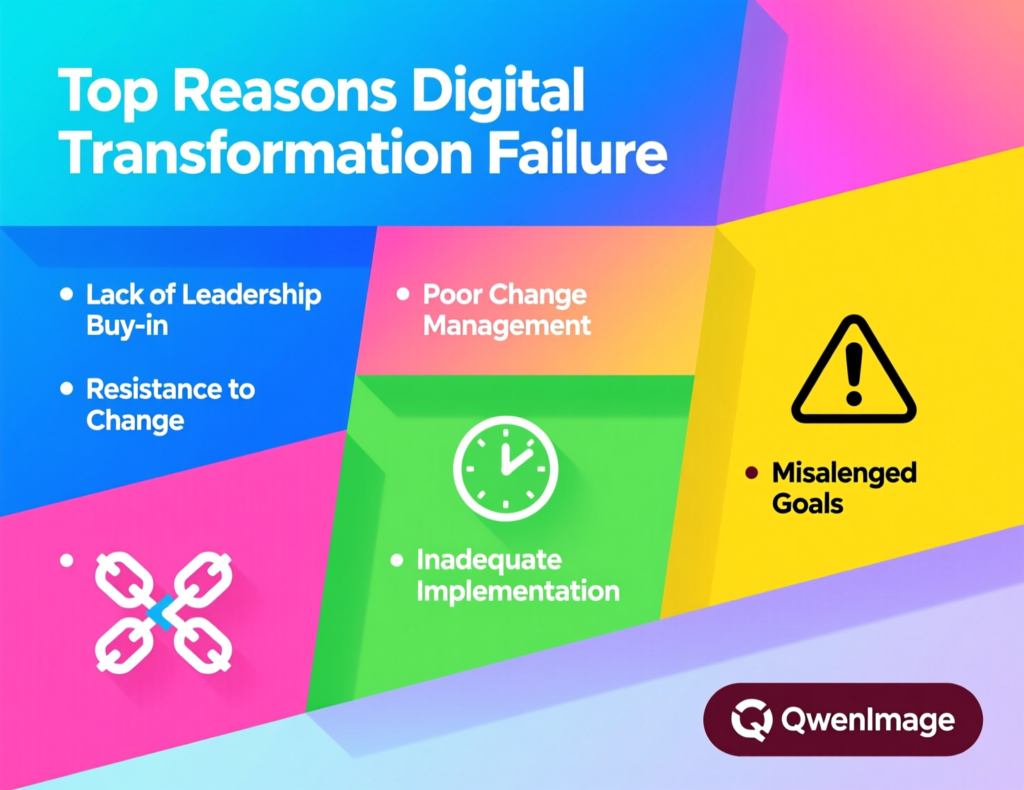
Below are the pitfalls that show up again and again in audits and postmortems—especially in multi-year ERP, CRM, and cloud modernization programs.
Starting with tech instead of value
If leadership can’t clearly answer who benefits and how, you’ll end up chasing outputs (features, migrations, licenses) instead of outcomes (faster cycle times, fewer errors, better customer experience).
Fix
Define 3–5 measurable outcomes and tie them to owners who can make decisions.
No product operating model (project mindset stays)
Programs run like “deliver and hand over” projects, while the business needs a product model continuous improvement, feedback loops, and accountable teams that own outcomes post-launch.
Fix
Shift from one-time releases to product teams with roadmaps, KPIs, and ongoing funding.
Governance that is either too weak or too slow
Weak governance creates scope creep and late surprises. Overbearing governance slows decisions until delivery teams improvise. Both lead to digital transformation failures.
Fix
Clarify decision rights, create fast risk gates, and make governance a decision accelerator.
Misaligned incentives (people are rewarded for the old world)
If managers and frontline teams are still rewarded for legacy KPIs, they’ll preserve legacy behaviors—even with a brand-new system.
Fix
Align incentives to the new process (adoption, data quality, process compliance, customer outcomes).
Underfunding change management
Training “at the end” is a classic mistake. Real change includes role design, communications, supervisor enablement, process coaching, and reinforcement over time.
Fix
Budget change as a core workstream—then measure adoption like you measure delivery.
Treating data migration as a technical task
ERP and CRM programs often derail because legacy data is inconsistent, undocumented, or owned by nobody. Migrating poor data simply moves chaos faster.
Fix
Treat data migration as a product: ownership, quality metrics, cutover rehearsals, and clear acceptance criteria.
Brittle integrations and hidden dependencies
Transformations fail when “edge systems” and manual steps aren’t mapped. You go live, then discover the business can’t close the month, reconcile revenue, or complete onboarding without spreadsheets.
Fix
Run dependency mapping early, and test end-to-end business journeys not just system functions.
Scope creep disguised as “small requests”
A hundred “small” additions become a second program. Delivery slows, testing balloons, and leadership loses confidence.
Fix
Freeze scope for release trains; triage new requests into a disciplined backlog with value-based prioritization.
Leadership churn and unclear sponsorship
Multi-year programs are vulnerable when sponsors change and priorities reset. Teams lose direction, and decisions get deferred until it’s too late.
Fix
Document decision history, lock outcome KPIs, and create a cross-functional steering group that survives org changes.
Measuring go-live instead of business impact
If success is “system launched,” you’ll get a launch. If success is “cycle time reduced by X,” you’ll build what’s needed to change work.
Fix
Track three layers of metrics
Value metrics: cost, revenue, cycle time, error rates
Adoption metrics: usage, process compliance, training completion quality
Resilience metrics: uptime, recovery time, incident volume
Micro-answers (AEO-friendly)
Most common pitfalls?
Misaligned incentives, weak governance, underfunded change management, and data migration risk.
Earliest warning signs?
Rising workarounds, missed milestones, inconsistent reporting, and growing shadow IT.
Why digital transformations fail more often in regulated industries (US/UK/DE/EU)
Regulated organizations don’t get the luxury of “move fast and fix later.” If compliance, resilience, and auditability aren’t built in from day one, the program can stall late—when changes are expensive.
Financial services.
In Germany and across the EU, regulators emphasize operational resilience not just innovation. Cloud programs often stumble when they ignore exit planning, vendor concentration, and third-party risk controls (especially in tightly regulated banking environments).
Healthcare.
US healthcare teams balance delivery speed with HIPAA constraints. UK providers also contend with UK-GDPR and NHS interoperability expectations. A common failure mode is post-go-live adoption friction clinicians and operations teams revert to workarounds when workflows don’t fit reality.

Assurance & security.
PCI DSS and SOC 2 introduce governance layers that many programs underestimate. For cross-border US–EU teams, GDPR-related data residency and processing constraints add another level of complexity especially when vendors and hosting span jurisdictions.
Practical takeaway: In regulated environments, compliance isn’t a “review step.” It’s a design requirement that shapes architecture, delivery sequencing, and operational ownership.
Failed digital transformation examples and what they teach
Public sector.
The UK’s NHS National Programme for IT is widely cited as a major failure. The deeper lesson isn’t “technology was hard.” It’s that centralized procurement and unrealistic scope struggled to serve diverse local clinical settings without enough local ownership and fit-for-purpose rollout design.
Enterprise platforms.
Large enterprises in cities like New York and London commonly run into the same wall: standardized ERP processes collide with local operations. Finance-centric data models rarely match real operational workflows without redesign.
Legacy modernization.
Cloud migrations often fail when teams lift-and-shift monoliths without changing the funding model, team structure, or deployment practices. You can end up with a more expensive, equally slow version of the old system plus new operational risk.
These patterns reflect recurring themes from audits, public postmortems, and academic/industry research not “vendor success stories.”
Governance + change management that prevents failure
The governance model that actually works
Strong governance isn’t about more meetings. It’s about fast, clear decisions:
decision rights (who can approve what)
architecture standards (what must be true before build)
risk gates (security, privacy, resilience, regulatory)
escalation paths (so blockers don’t rot)
Done right, governance speeds delivery by preventing late-stage surprises.
Change management that drives adoption (not box-ticking)
Adoption happens when.
training matches real roles and workflows
leaders reinforce the new behaviors consistently
incentives and metrics reflect the new process
teams get hands-on support during the “messy middle” after go-live
Change management matters more than tech because technology creates value only when people adopt new ways of working at scale.
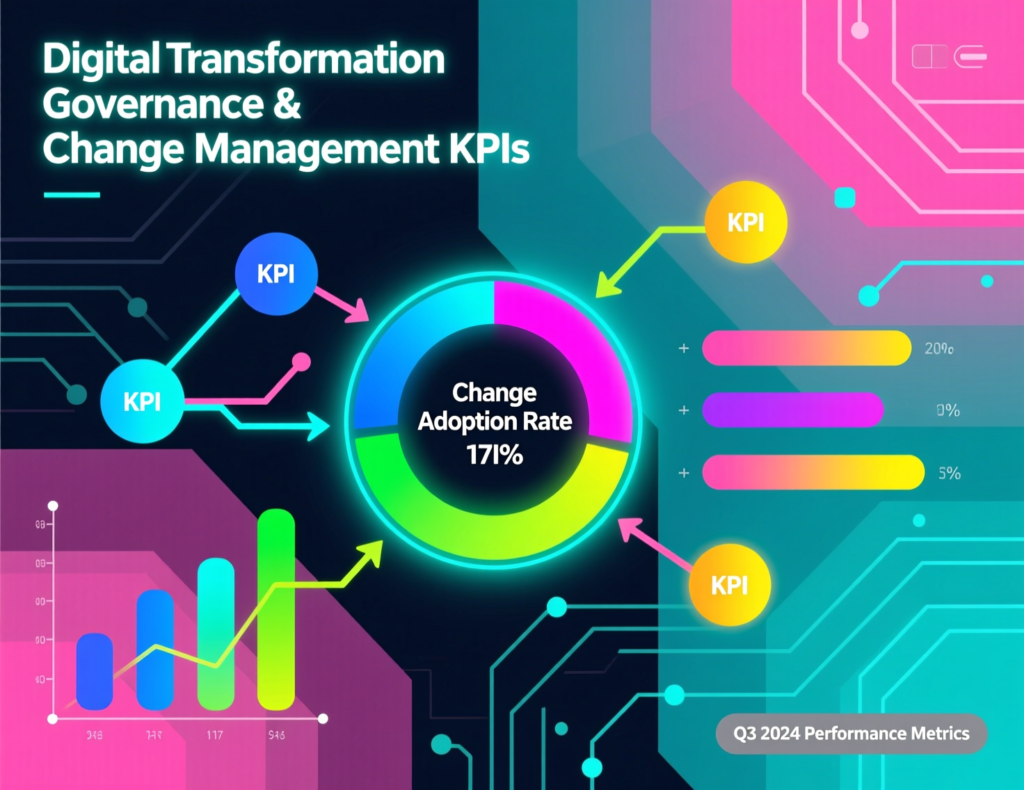
KPI framework that reflects reality
Use a balanced set of KPIs so you don’t “win delivery” and lose operations:
Value: unit cost, throughput, customer outcomes
Adoption: usage depth, process compliance, workarounds trend
Resilience: incident rate, recovery time, control effectiveness
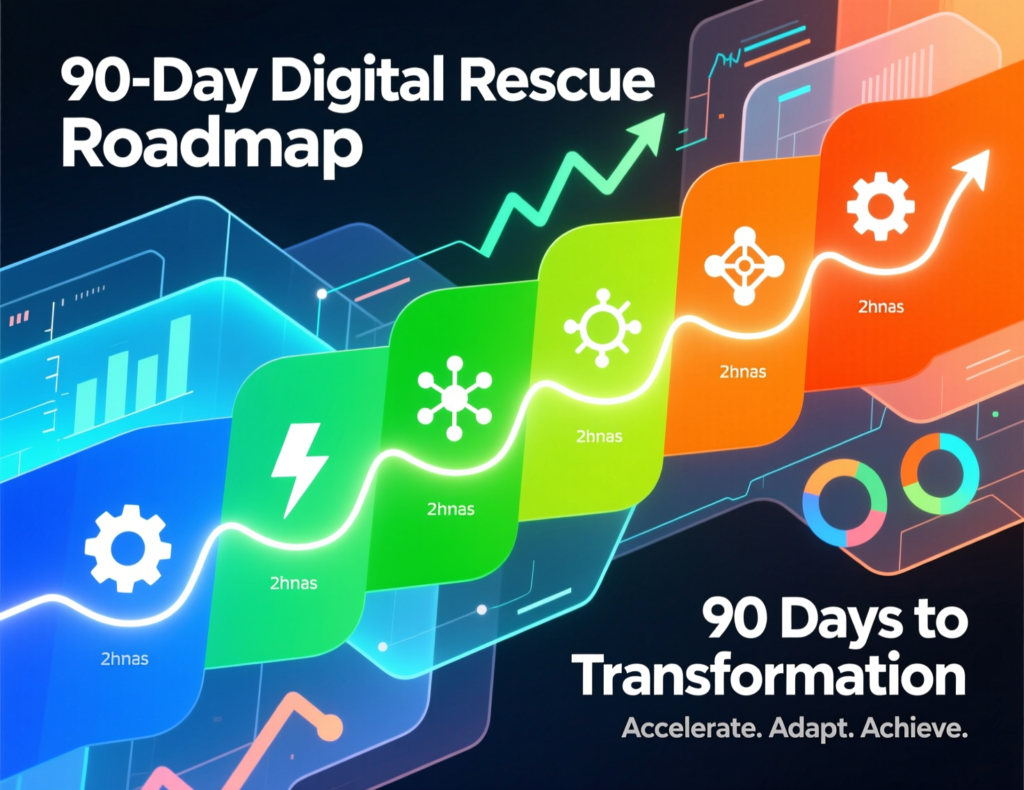
Rescue plan: how to recover without restarting from scratch
If your program is slipping, you don’t always need a restart. You need a reset that restores clarity and momentum.
Diagnose in 10 days: stoplight assessment
Run a fast assessment across:
scope clarity
data quality
integration risk
adoption readiness
regulatory/compliance gaps
Score each area red/yellow/green to identify where intervention will actually move the needle.
Stabilize in 30 days: execution reset
Focus on control and predictability:
freeze scope for the next release train
fix data pipelines and ownership
re-baseline milestones and testing
tighten vendor accountability (deliverables, acceptance criteria, escalation)
Relaunch in 90 days: phased delivery + adoption sprints
Relaunch with smaller, safer increments:
phased rollouts (business-unit or capability-based)
adoption sprints (training + reinforcement + workflow fixes)
if needed, a targeted vendor reset (only after governance is fixed)
Many teams use a structured Transformation Failure Risk Checklist to guide this reset especially when auditability and resilience are non-negotiable.
Concluding Remarks
Digital transformation failures are predictable and preventable when leaders treat transformation as an operating-model shift, not a software project.
Start with value, not technology
Design governance before delivery
Treat data migration as a product
Fund change management realistically
Deliver in phases with clear, balanced metrics
If you do those five things well, most “digital transformation failures” never get the chance to form.
Key takeaways
Most failures stem from governance and adoption gaps, not tools
Regulated industries carry higher late-stage risk without early compliance alignment
Data migration is often the #1 technical failure point in ERP programs
Phased delivery with clear KPIs lowers risk and improves learning cycles
Rescue is possible without restarting if you intervene early and focus on decision clarity
If your transformation program is slipping or you want to reduce risk before scaling Mak It Solutions can help. Book a free consultation to assess governance, data readiness, and adoption risk, or request a scoped transformation health check tailored to US, UK, and EU regulatory environments.( Click Here’s )
FAQs
Q : What are the earliest warning signs of a failing transformation program?
A : Rising manual workarounds, inconsistent reporting, missed milestones, and growing shadow IT are early indicators. These usually point to adoption and governance gaps not purely technical defects.
Q : How long should a phased rollout take for a regulated organization?
A : Many regulated teams succeed with 3–6 month phases, depending on control requirements and the operational impact of each release. Shorter cycles improve feedback while maintaining compliance oversight.
Q : What’s the #1 data migration mistake that causes ERP failures?
A : Underestimating data quality and ownership. Migration should be treated as a standalone product with clear accountability, quality thresholds, and cutover rehearsals.
Q : How do works councils (Betriebsrat) affect German transformations?
A : In Germany, Betriebsrat involvement can extend timelines, but it often improves adoption and legal stability when engaged early especially when roles, monitoring, or workplace processes change.
Q : Should you replace a vendor or fix governance first?
A : Fix governance first. Vendor changes without clear decision rights and outcome ownership usually repeat the same failure patterns just with a new logo on the slide deck.