


Do You Need Kubernetes? When It’s Worth the Complexity
Do You Need Kubernetes? When It’s Worth the Complexity
Do You Need Kubernetes? When It’s Worth the Complexity
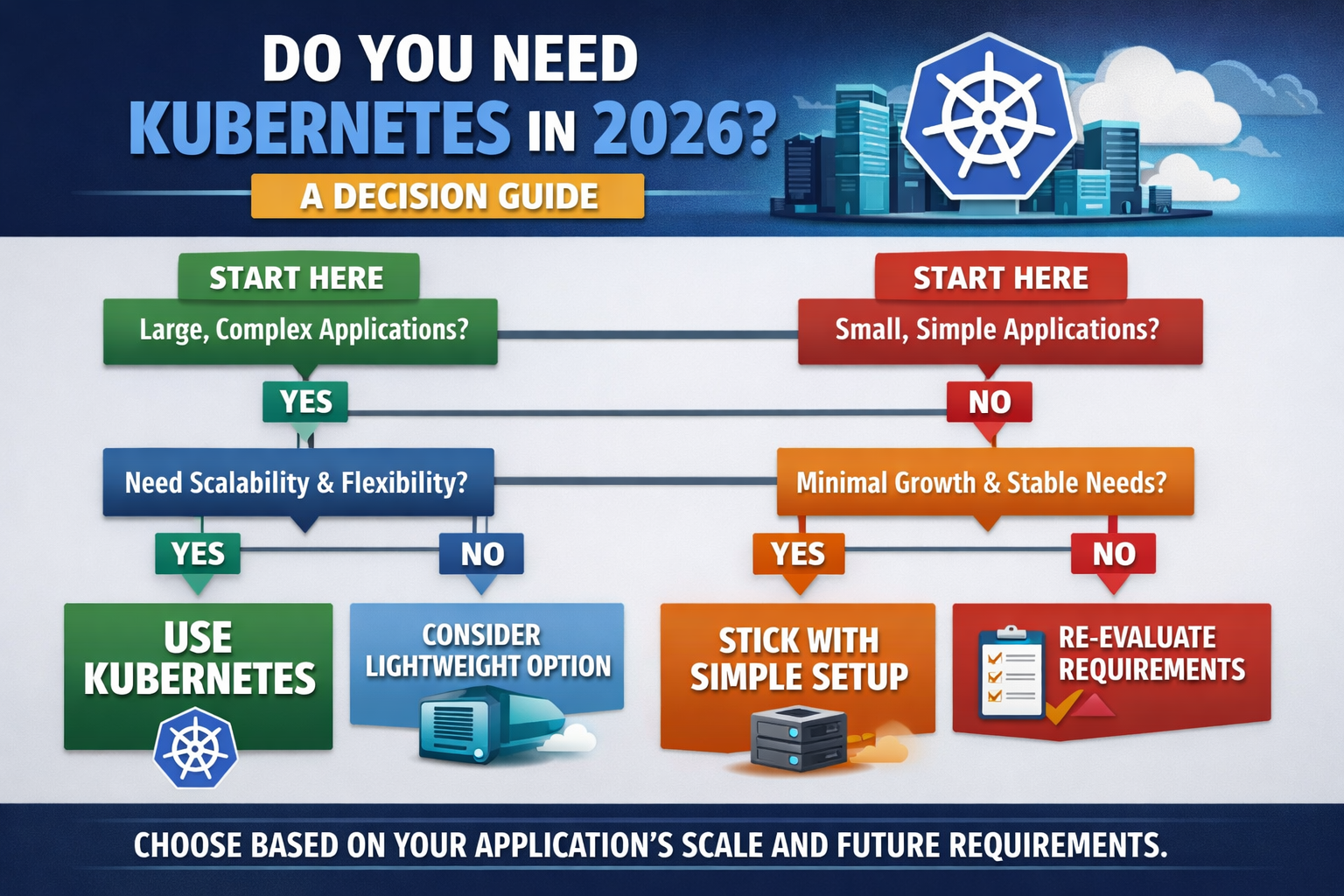
Do you need Kubernetes in 2026? For most small teams, no. For organizations juggling many services, stricter compliance, hybrid infrastructure, or internal platform needs, often yes.
That is the practical answer. Kubernetes is still the strongest option when scale, governance, portability, and operational consistency matter together. But if your team is small, your product is straightforward, and speed matters more than flexibility, lighter options like ECS, Cloud Run, serverless, or PaaS will usually get you to production faster with less overhead. Recent CNCF research shows Kubernetes is firmly mainstream, with 82% of container users running it in production, while broad cloud-native adoption also remains high.
Do You Need Kubernetes in 2026? Start With the Real Decision
The biggest mistake teams make is treating Kubernetes like a default. It is not.
In 2026, Kubernetes is a strong fit when your infrastructure complexity is already real or clearly approaching. If you are managing dozens of services, multiple environments, stricter security controls, or a platform used by many teams, Kubernetes can bring order, consistency, and better long-term leverage.
If that is not your reality yet, the platform can become a distraction.
For many startups and lean SaaS teams, the smarter move is still a simpler managed option that reduces infrastructure work and keeps engineers focused on shipping product.
The 3 Things That Actually Decide It
Scale
If you run a handful of services, Kubernetes is usually more platform than you need.
If you run many microservices, separate environments, scheduled jobs, background workers, internal APIs, and shared infrastructure patterns, the value starts to rise quickly. At that point, orchestration is not just about deployment. It becomes about consistency, rollback safety, workload scheduling, access control, and repeatable operations.
Complexity
Complexity matters more than company size.
A 20-person company with hybrid cloud, enterprise customers, and security-heavy deployments may need Kubernetes sooner than a 200-person company running one core application on a single cloud. The real question is whether your environments, release process, and compliance requirements are becoming harder to manage with simpler tools.
Team maturity
Kubernetes works best when someone owns the platform properly.
That does not always mean a large SRE department. It does mean clear ownership for networking, observability, security, release processes, upgrades, and cost control. If one overstretched engineer is expected to “just handle Kubernetes too,” the platform usually becomes a drag instead of an advantage.
When Kubernetes Makes Sense
You run many services across environments
Kubernetes makes sense when you need one operational model across dev, staging, production, and possibly more than one cloud or on-prem environment.
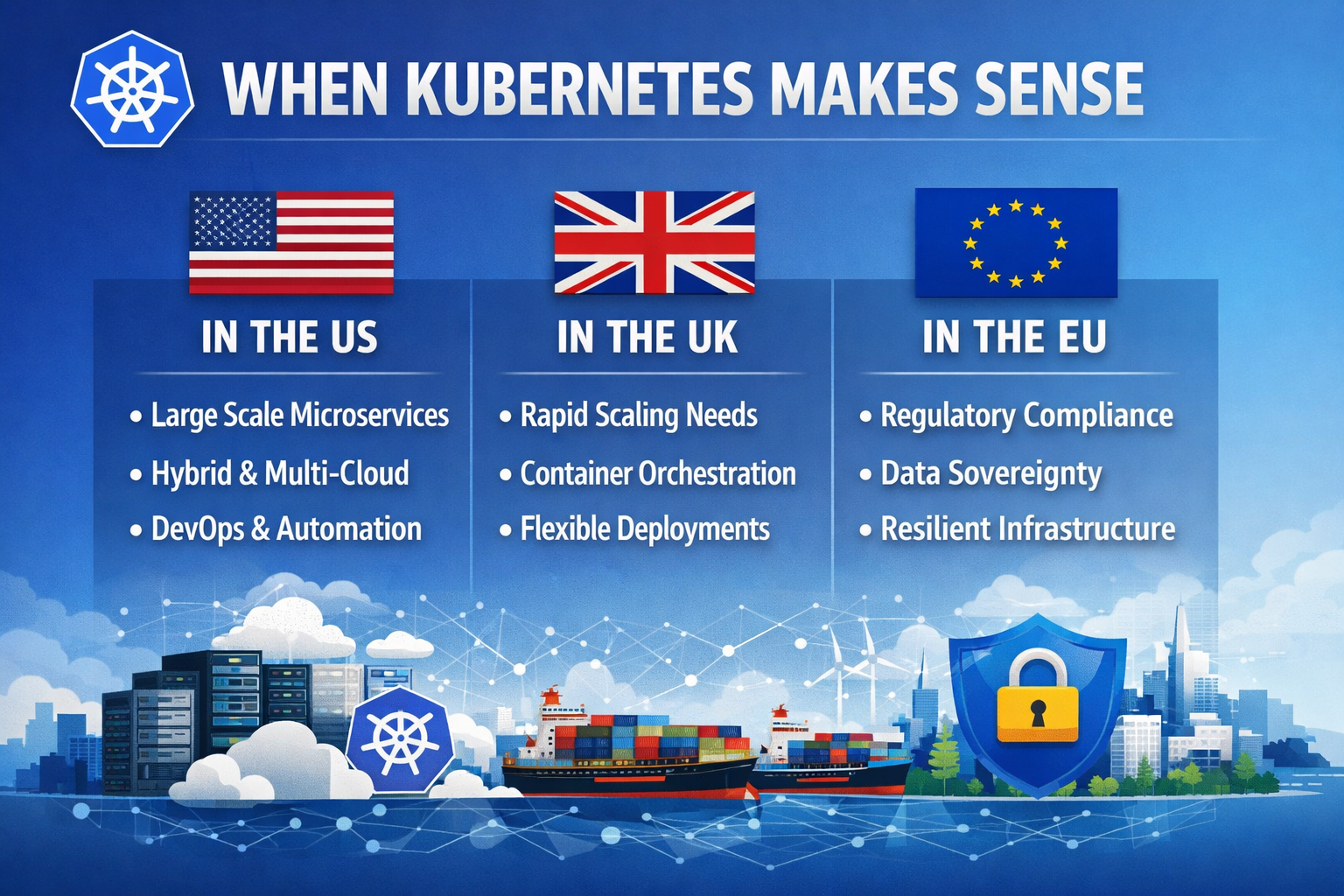
This is where the platform earns its keep: standardized deployments, service discovery, autoscaling, policy enforcement, and better workload consistency. For a B2B SaaS platform in New York serving enterprise customers, or a regulated product team in London or Frankfurt, that consistency can matter more than raw convenience.
You are building an internal platform
Kubernetes becomes much more compelling when the goal is not just “run containers” but “create a better developer platform.”
If your engineering organization wants self-service environments, reusable templates, golden paths, guardrails, and developer workflows that scale across teams, Kubernetes can serve as the foundation for that model. Red Hat’s platform engineering guidance leans heavily into this self-service and golden-path idea, which mirrors how many larger teams use EKS, GKE, AKS, or OpenShift in practice.
You have portability, governance, or hybrid-cloud requirements
This is where Kubernetes often stops being optional.
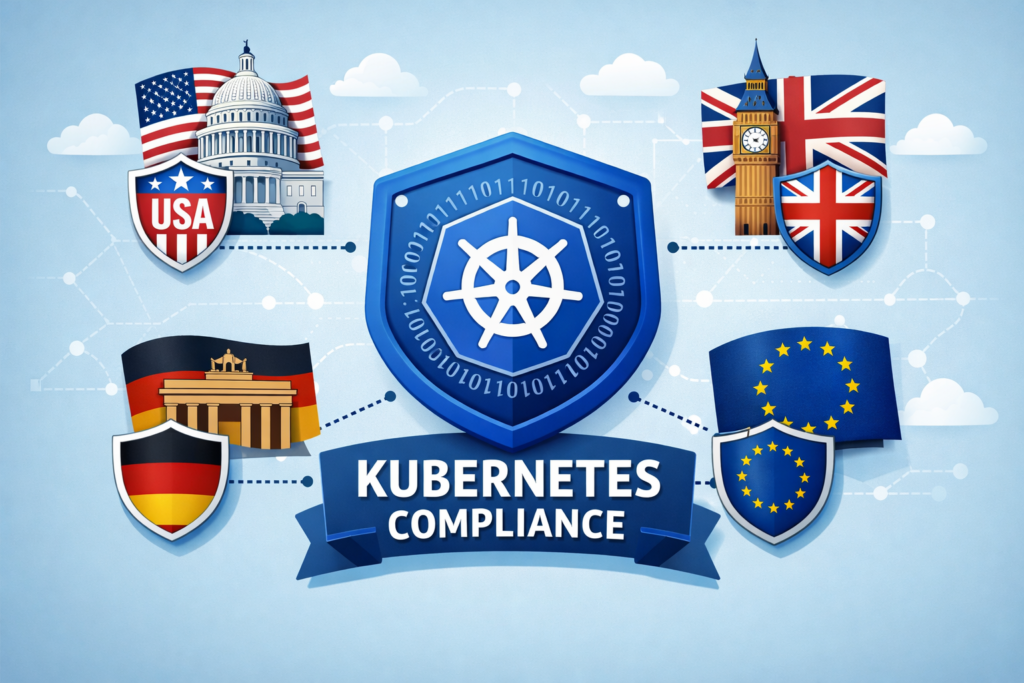
In regulated sectors, teams may need stronger policy control, clearer audit trails, data-handling discipline, or infrastructure portability. In the US, that often shows up around HIPAA, PCI DSS, and enterprise security expectations. In the UK, governance and accountability requirements under UK GDPR can push teams toward more formal operating models. In Germany and the wider EU, sovereignty, outsourcing oversight, DORA, and NIS2 can make portability and tighter control more attractive than narrower managed platforms.
When Kubernetes Is Overkill
Your team is small and your product is still simple
If you have a small engineering team, a modest traffic profile, and a limited number of services, Kubernetes often solves tomorrow’s problem by creating today’s complexity.
You do not just adopt Kubernetes. You adopt ingress decisions, networking concerns, policy models, cluster upgrades, observability tooling, security controls, and more operational surface area than many early-stage teams actually need.
You need speed more than flexibility
Early-stage startups rarely lose because they did not have Kubernetes.
They lose because shipping slowed down, the team became distracted, and infrastructure choices got ahead of customer demand. If your product is still searching for product-market fit, a simpler path usually wins.
Your current platform already covers 80% of your needs
That missing 20% matters only if it is truly blocking the business.
If ECS, Cloud Run, or a serverless setup already gives you deployment speed, autoscaling, and enough resilience, then forcing Kubernetes into the stack may lower efficiency instead of improving it.
Kubernetes vs Alternatives in 2026
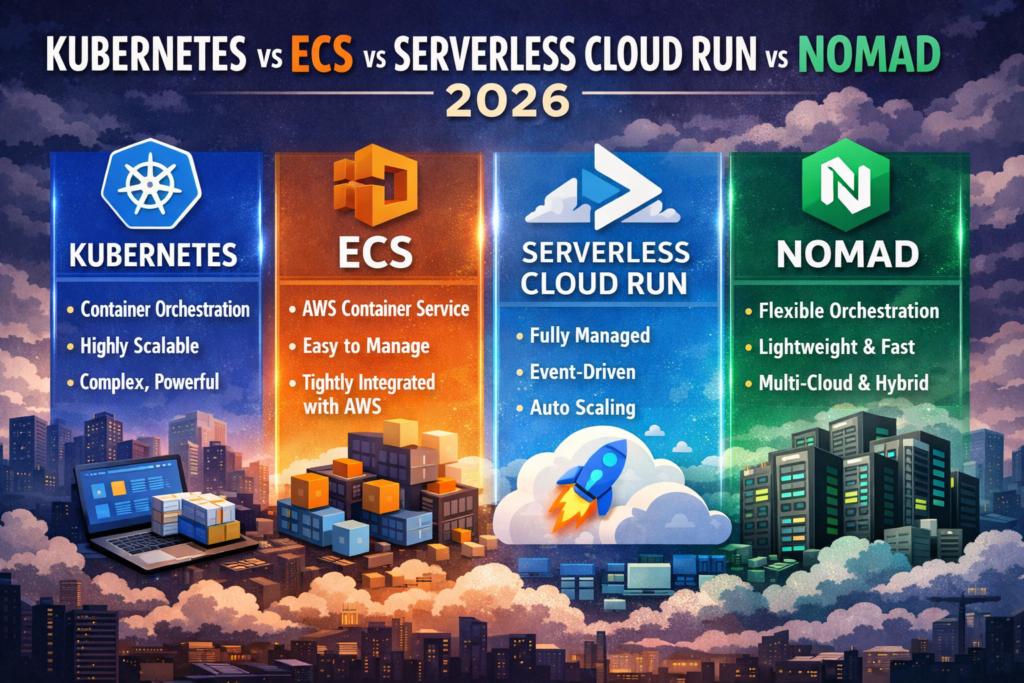
Kubernetes vs ECS and Fargate
For AWS-heavy teams, ECS or Fargate is often the cleaner answer.
AWS explicitly positions Fargate as a way to run containers without provisioning, configuring, or scaling groups of virtual machines yourself. That is a strong fit for teams that want managed containers without taking on the broader operational model of Kubernetes.
Choose Kubernetes over ECS mainly when you need deeper ecosystem tooling, stronger multi-cloud alignment, or an internal platform that is expected to grow beyond AWS-specific patterns.
Kubernetes vs Cloud Run and serverless
Cloud Run remains appealing because it is fully managed and serverless for containerized applications. That makes it a strong option for APIs, internal tools, event-driven services, and many moderate-scale products that do not need Kubernetes-level control.
For many teams in the US, UK, Germany, and the wider EU, this trade-off is practical: less control, but much less platform work.
That is often a good deal.
Kubernetes vs Nomad
Nomad is still worth considering when you want orchestration without the full Kubernetes operating model.
HashiCorp describes Nomad as architecturally simpler, with a single binary and no need for external services for coordination or storage. For teams that want a lighter orchestrator for containers and non-containerized workloads, that simplicity can be attractive.
Kubernetes still wins on ecosystem depth, standardization, policy maturity, and enterprise mindshare. But simpler tools can be the better engineering choice when the platform burden matters more than the broader ecosystem.
The Real Cost of Kubernetes
The cost of Kubernetes is rarely just the cluster bill.
The real spend shows up in:
Observability and alerting
Security tooling and policy enforcement
CI/CD design
Secrets management
Upgrade planning
Platform ownership
Incident response
Senior engineering time
That is why managed Kubernetes is usually the default if you truly need Kubernetes at all. Managed services reduce part of the operational burden, but they do not remove the need for platform discipline. You still own version lifecycle, governance, workload design, access control, and day-to-day operational quality.
How Geography and Compliance Change the Answer
US
US teams often reach Kubernetes because of operational control and enterprise buyer pressure.
Healthcare, fintech, and B2B platforms may need stronger auditability, cleaner segmentation, or more formal infrastructure controls. HIPAA’s Security Rule requires administrative, physical, and technical safeguards for protected health information, which can push infrastructure choices toward more structured platform models.
UK
In the UK, the argument is often about governance as much as scale.
Teams working with sensitive data or regulated buyers may care about accountability, audit readiness, and data protection by design. The ICO’s guidance emphasizes demonstrable accountability and embedding data protection practices into systems and services, which supports a more disciplined operating model when complexity rises.
Germany and the EU
Germany and the wider EU often present the strongest case for Kubernetes where sovereignty, outsourcing oversight, and hybrid control matter.
BaFin treats cloud services as significant from a supervisory perspective. DORA has applied since January 17, 2025, and NIS2 establishes a common cybersecurity framework across 18 critical sectors in the EU. For firms in Berlin, Munich, Frankfurt, Amsterdam, or Dublin, those pressures can make portable, controllable infrastructure more attractive than narrower managed platforms.
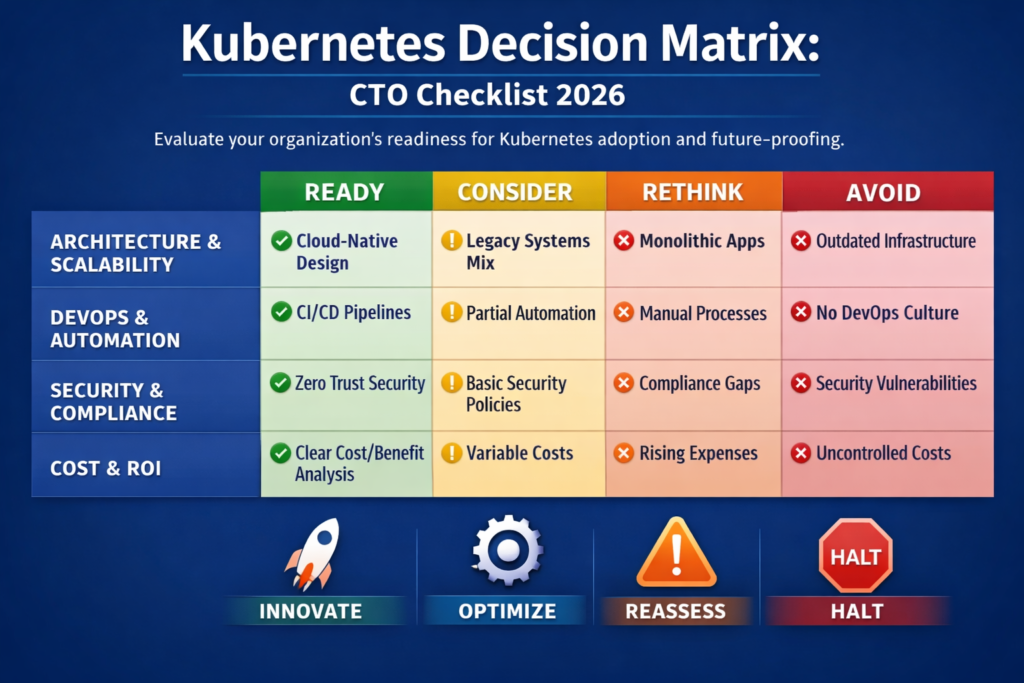
A Practical Kubernetes Decision Matrix
Choose Kubernetes when most of these are true:
You are running enough services that orchestration is now a real operational problem.
You need stronger portability across cloud, hybrid, or regulated environments.
You are building a platform for multiple teams, not just deploying one application.
Compliance, governance, and auditability are getting harder every quarter.
You have team capacity to own the platform properly.
Choose alternatives when most of these are true.
You have a small service count.
You are operating in one cloud with limited infrastructure variation.
Speed and simplicity matter more than platform flexibility.
You do not yet have clear platform ownership.
Simpler managed services already solve most of your real needs.
Key Takeaways
Kubernetes in 2026 is not the default choice. It is the right choice when complexity is already expensive.
If your workloads, compliance requirements, and platform needs are compounding together, Kubernetes can be a smart long-term investment. If your team is lean and your product is still relatively simple, it is often overkill.
That is why the best question is not “Should we use Kubernetes?” It is “What problem are we solving that simpler platforms cannot solve well enough?”
Concluding Remarks
For many startups and smaller SaaS teams, no. For multi-service platforms, regulated environments, hybrid-cloud operations, and organizations investing in platform engineering, yes, often enough that the decision becomes strategic rather than technical.
The best move is to match the platform to your real operating model, not to the market hype. If you are weighing Kubernetes against serverless, ECS, Cloud Run, or a leaner container strategy, start with workload shape, compliance pressure, and team readiness.
Explore our services, see our back-end development capabilities, or learn more through our About Us page.
FAQs
Q : Can a small SaaS team skip Kubernetes and still scale?
A : Yes. Many small SaaS teams scale well on ECS, Fargate, Cloud Run, or serverless platforms. If service count is low and the team is small, that route is often faster and more cost-effective than running Kubernetes.
Q : Is managed Kubernetes worth it?
A : Sometimes. Managed Kubernetes is worth it when you genuinely need Kubernetes features but want to reduce part of the infrastructure burden. It is still operationally serious, so it only pays off when the platform need is already real.
Q : Does Kubernetes reduce vendor lock-in?
A : Often, yes, but not by itself. Kubernetes improves portability at the orchestration layer, but storage, networking, IAM, and cloud-native dependencies can still create lock-in.
Q : What team size makes Kubernetes practical?
A : There is no fixed number. What matters is whether you have real platform ownership for security, observability, upgrades, and release operations. A mature smaller team can succeed; a larger but unclear team can still struggle.
Q : Is Kubernetes better for AI workloads in 2026?
A : For larger inference platforms and shared ML infrastructure, it is increasingly attractive. CNCF reported in early 2026 that 66% of organizations hosting generative AI models use Kubernetes for some or all inference workloads, but that does not mean every AI product needs it.