
Dubai Paperless Strategy: A GCC Digital Gov Blueprint
Dubai Paperless Strategy: A GCC Digital Gov Blueprint
Dubai Paperless Strategy: A GCC Digital Gov Blueprint
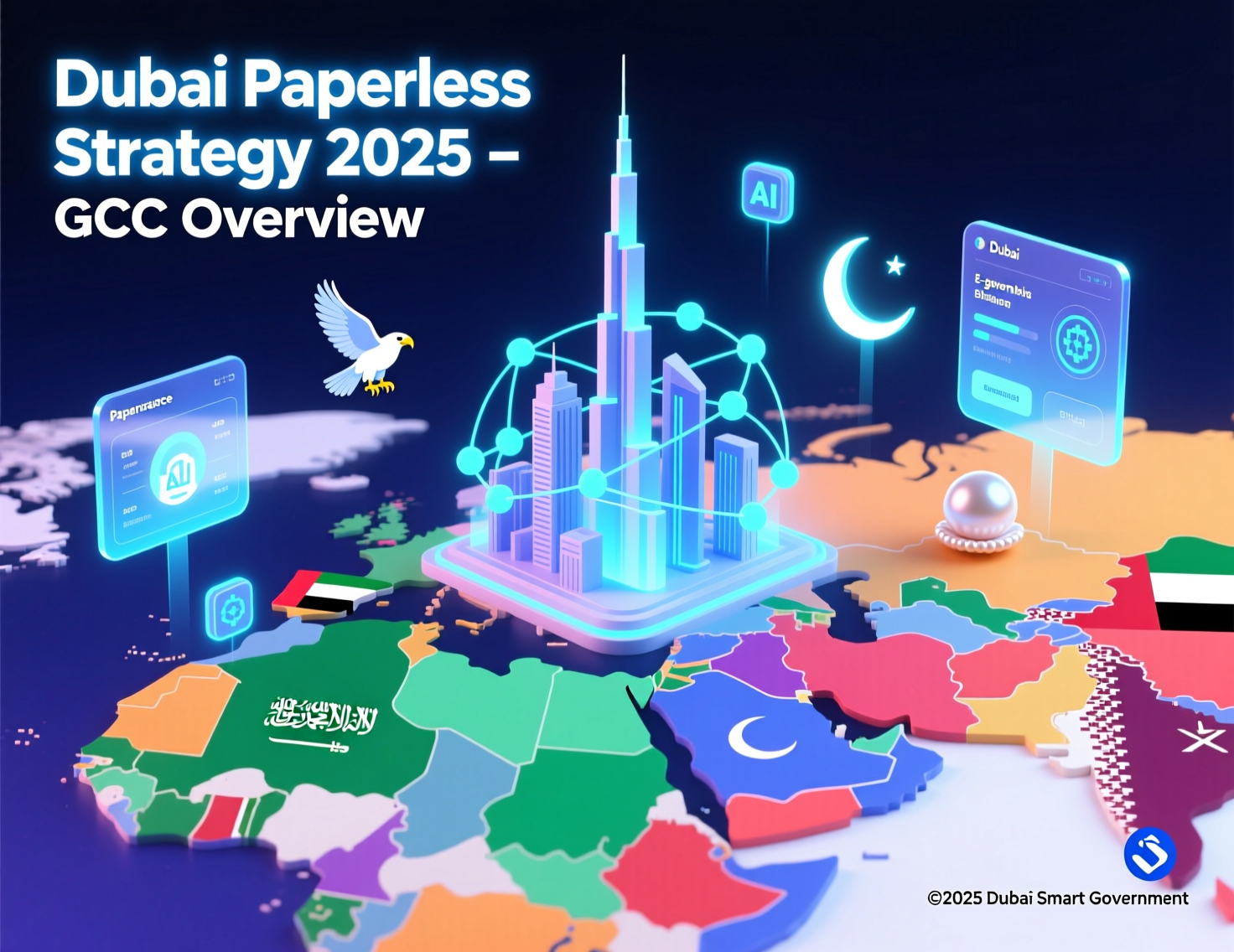
Dubai’s paperless strategy is a government-wide program led by Digital Dubai that made all Dubai Government services 100% digital, cutting more than a billion paper documents per year and moving over 1,800 services onto integrated smart city platforms. (Digital Dubai) For Saudi Arabia, the UAE and Qatar, this Dubai paperless strategy acts as a practical playbook: align national visions, build secure digital identity and cloud platforms, and redesign end-to-end digital citizen journeys instead of simply scanning existing paper processes. (Saudi Vision 2030)
Introduction
In December 2021, Dubai announced that it had become the world’s first 100% paperless government, after a five-phase rollout covering 45 entities and more than 1,800 services. The Dubai paperless strategy is not a concept note or pilot—it is a live production environment. For GCC leaders from Riyadh to Doha, it shows what a fully digital administration can look like in practice, across ministries, authorities and city services.
The GCC Pain Point.
Across the GCC, citizens still queue for permits, stamps and signatures even while national visions promise seamless, smart city government platforms. Many ministries run parallel systems—one digital, one paper creating duplication, compliance risk and frustration for citizens, residents and businesses. The result is slow government digital services optimization, uneven adoption of “digital-only” journeys and limited trust in online channels when something important is at stake.
What This Article Delivers.
This article uses Dubai’s paperless government as a practical playbook for GCC ministries, not just a success story. You’ll see how the strategy is structured, how it lines up with Vision 2030 and Qatar’s Digital Agenda 2030, which technologies actually matter, and how a ministry in Riyadh, Abu Dhabi or Doha can design end-to-end digital citizen journeys that stay compliant with local regulators.
Inside the Dubai Paperless Strategy.
What Is the Dubai Paperless Strategy and Who Owns It? (Dubai Government & Digital Dubai)
The Dubai paperless strategy is an emirate-wide program led by Digital Dubai to eliminate government paper by digitising every internal and external transaction. It sits under the broader UAE vision for smart government, but its governance is deliberately local: Dubai’s Executive Council provided the mandate, while Digital Dubai coordinated entities, platforms and common standards, turning policy into operational reality.
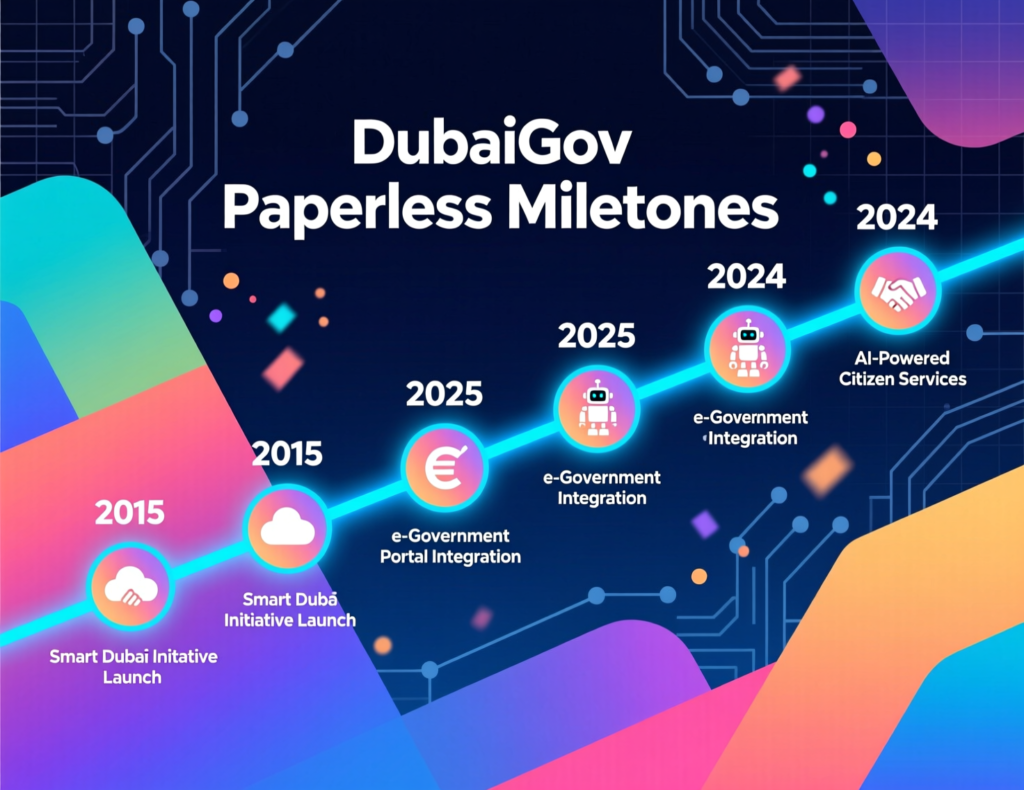
Key Milestones on the Road to 100% Paperless Government
The strategy rolled out in five phases, each onboarding a group of government entities until all 45 were fully digital.Key milestones included:
Launch of shared platforms like DubaiNow for citizen services
Issuing a 100% paperless “stamp” to compliant entities such as Dubai Customs
A final declaration in 2021 that no internal or external government transaction required paper
How did Dubai achieve 100% paperless government services and what were the key milestones?
Dubai achieved 100% paperless services by combining a strong political mandate with central governance through Digital Dubai and phased onboarding of entities to shared digital platforms. Key milestones were the launch of common service channels, mandatory digital workflows, a phased roll-in of 45 entities, and certification of fully compliant departments with a paperless stamp.
KPIs That Matter: Transactions, Cost Savings, Time Saved, and “Trees Saved”
Dubai tracks success not only in “no paper used” but also in:
Number and share of fully digital transactions
Government cost savings and reduced processing times
Citizen satisfaction scores and environmental impact (“trees saved” and CO₂ avoided)
For GCC leaders, these KPIs translate easily into dashboards, budget reviews and ESG reports that boards and ministers understand.
Comparing Dubai with Saudi Arabia and Qatar: Shared Goals, Different Paths
Dubai vs Saudi Arabia: Linking Paperless Strategy to Vision 2030 and DGA Initiatives
Saudi Arabia’s Digital Government Authority (DGA) strategy 2023–2030 turns Vision 2030 goals into measurable digital programs, including seamless, paperless public services. (DGA) Riyadh and Jeddah can use Dubai’s model to accelerate by:
Mandating digital-by-default channels via platforms like Absher and Nafath
Retiring redundant paper workflows and “shadow” processes
Aligning metrics with Vision 2030’s emphasis on transparency, efficiency and user satisfaction
Dubai’s experience can become a benchmark for Saudi program reviews and RFPs, without copying the exact same platforms.
Dubai vs Qatar: How Hukoomi and QDG NextGen Mirror Dubai’s Digital Ambitions
Qatar’s Hukoomi portal and the QDG NextGen Strategy aim for integrated e-government in GCC style: one front door, shared data platforms and AI-enabled services.Doha ministries can reuse Dubai’s playbook by treating Hukoomi as the primary citizen interface, while using the Digital Agenda 2030 to enforce common data and cloud standards across agencies.For citizens in Doha, the experience should feel similar to Dubai: one trusted login, one main portal, and consistent journeys across ministries.
Beyond the Big Three.
For Kuwait, Bahrain and Oman, Dubai’s value is less about copying names like DubaiNow and more about copying principles:
One digital identity as the front door
One main portal or app per government level
Strict rules against “shadow paper” and unapproved side processes
Smaller administrations can often move faster by designing paperless processes city by city, then scaling nationally once the model works.
What lessons can GCC governments learn from Dubai’s paperless strategy for their own digital transformation?
Key lessons include: secure top-level political sponsorship, appoint a central digital authority, define a single citizen front door, and enforce “no paper” policies across all entities. GCC governments should also use phase-based rollouts, shared cloud platforms and clear KPIs so that ministries in Riyadh, Dubai, Doha or Manama move in sync and avoid fragmented pilots.
Technology Enablers.
Digital Identity as the Front Door.
UAE Pass is the national digital identity that unlocks thousands of services across UAE federal and local entities, including DubaiNow. In Saudi Arabia, Absher and Nafath play a similar role, while Qatar is advancing its own Digital ID for access to Hukoomi and ministry platforms. These IDs are the front door to end-to-end digital citizen journeys, enabling secure login, e-signatures and consent flows across government.
To make a Dubai paperless strategy–style model work in any GCC country, digital identity must be treated as shared infrastructure, not just another standalone app.
Cloud, Data Platforms and Integration
Dubai’s paperless strategy relies on national infrastructure such as FEDnet, while the UAE, Saudi Arabia and Qatar are all investing in national clouds and sovereign data platforms. (U.AE) By using cloud regions such as AWS Bahrain, Azure UAE Central and GCP Doha, GCC governments can keep data in-region while connecting legacy systems through APIs, ESBs and integration hubs.
In practice, this means:
A secure national or GCC cloud baseline
Shared data platforms and integration layers
Standardised approaches for logging, monitoring and backup
Partners like Mak It Solutions, with experience in custom platforms and integration, can help ministries design these layers as part of a coherent smart city government architecture (https://makitsol.com/web-development-services/).
Automation, AI and Workflow Orchestration for End-to-End Digital Journeys
Paperless does not mean “PDF upload.” It means fully orchestrated workflows where business rules, approvals and notifications are automated. AI can pre-validate documents, route cases and flag risk, while low-code tools orchestrate processes from mobile app to back-office archive.
This is where partners such as Mak It Solutions can add value: designing and building modern web and workflow platforms that turn policy into reliable, scalable services rather than scattered portals (https://makitsol.com/services/).
Governance, Compliance, and Data Residency: Building Trust in a Paperless State
Regulatory Anchors
In KSA, SAMA, DGA, SDAIA and sector regulators set the rules for security, data protection and financial compliance. In the UAE, TDRA and Digital Dubai play similar roles; in Qatar, MCIT and QCB shape digital and financial governance. (Digital Government Authority) A sustainable Dubai paperless strategy–style program in GCC must be built hand-in-hand with these authorities, not around them.
For example, any move to host data in GCC cloud regions should be reviewed with bodies such as SAMA or TDRA early, not at the final approval stage.
Data Residency, PDPL, NDMO Standards and Government Cloud Requirements in GCC
Saudi’s PDPL and NDMO frameworks, UAE cloud requirements, and Qatar’s Digital Agenda 2030 all stress data residency, classification and controlled cross-border transfers. Practically, this means:
Choosing cloud regions that sit inside the GCC or national boundaries
Enforcing encryption, key management and access control policies
Ensuring vendor contracts reflect local data retention, processing and access rules
How can Saudi, UAE and Qatar balance paperless government with data residency and privacy regulations?
They can balance both by hosting sensitive workloads in national or GCC cloud regions, classifying data under PDPL/NDMO-style frameworks, and requiring vendors to certify where data is stored and processed. Joint governance boards with SAMA, TDRA, QCB and MCIT should review major digital government projects, ensuring paperless workflows never bypass privacy or cyber standards.
Auditability and Digital Records: E-signatures, Logs, and Long-term Archiving
A paperless state must still show its work. Ministries need compliant e-signature frameworks, tamper-evident logs, retention rules and integration with national archives so that digital records hold up in court and audits. This is where careful platform selection and architecture—with clear audit trails, export options and evidence policies matters more than front-end design.
For GCC teams, it is often worth treating digital records and archiving as a separate workstream, with legal, audit and regulator input from day one.
Note
This article is for general information and planning support. It does not replace legal, regulatory or compliance advice; always consult your local regulators and legal teams.
A Repeatable Blueprint
Align with National Visions
Step 1
Secure a clear mandate mapped directly to Vision 2030, the UAE’s Digital Government Strategy 2025 or Qatar’s Digital Agenda 2030.Link paperless targets to existing flagship programs rather than launching yet another side initiative.
Step 2
Establish a central program office under Digital Dubai–style leadership within DGA, TDRA or MCIT. Give it authority over standards, platforms and shared budgets.
Step 3
Define shared KPIs across ministries: digital adoption, share of digital-only journeys, cost savings and satisfaction, with a single dashboard visible to senior leadership.
Design Citizen-Centric Journeys and Rationalize Legacy Paper Processes
Step 4
Map priority life events start a business in Riyadh, renew residency in Dubai, register property in Doha and redesign them as digital-first, Arabic-first experiences that still work well in English.
Step 5
Decommission redundant paper forms, stamps and in-person approvals. Digitising everything is not enough if paper still “wins” when something goes wrong; policies and escalation paths must back digital as the default.
Step 6
Co-create with citizens and businesses using UX research, service blueprints and prototypes. Partners like Mak It Solutions can support rapid product discovery and MVP builds so ministries test real journeys before scaling (https://makitsol.com/services/).
Build the Tech Stack, Pilot in One City (Riyadh, Abu Dhabi, Doha) and Scale Across Government
Step 7
Implement secure identity, integration and workflow layers, often via bespoke platforms or modern web development services. (https://makitsol.com/web-development-services/)
Step 8
Pilot in a single city Riyadh, Abu Dhabi or Doha—covering a tightly scoped set of high-volume services to prove ROI, clarify compliance questions and refine UX.
Step 9
Scale horizontally across entities, supported by shared design systems, reusable APIs and a long-term managed services model. (https://makitsol.com/) Use Dubai’s paperless strategy as a reference architecture but tailor it to local laws and culture.
Measuring ROI, Citizen Impact, and Sustainability Across GCC
Core KPIs: Adoption, Digital-Only Journeys, Processing Time, Error Rates and Service Quality
GCC ministries should track:
Percentage of services completed fully online
Mobile vs desktop usage
Average processing time for key journeys
Error/return rates and contact-centre load
Combined with periodic perception surveys, these metrics show whether a paperless strategy is actually delivering better service quality, not just lower printing bills.
Citizen and Resident Experience.
For citizens in Riyadh, Dubai, Jeddah, Abu Dhabi and Doha, success feels like this: no surprise visits to government offices, Arabic-first UX that also works in English, and consistent journeys across portals and apps. Mobile-first design, inclusive content and proactive notifications are as important as the backend when measuring government digital services optimization.
Sustainability and Green Government.
Dubai’s focus on “trees saved” can be replicated by GCC ministries linking paperless programs to national sustainability and net-zero targets. Governments can:
Report CO₂ reductions from less printing and travel
Include these in ESG dashboards and sustainability reports
Align paperless initiatives with regional green finance and smart infrastructure programs
This turns the Dubai paperless strategy into part of a broader “green government” story.

To Sum Up
The Non-Negotiables: What Every GCC Paperless Strategy Must Include
Every GCC paperless strategy must include: a national digital identity, a single gateway portal, secure national or GCC clouds, strict data governance and strong regulator alignment. Without these, projects risk becoming cosmetic e-government websites rather than true smart city government platforms.
Where to Start in Saudi, UAE and Qatar in the Next 12 Months
In Saudi Arabia, start by hard-wiring paperless goals into DGA programs and top Vision 2030 initiatives. In the UAE, expand UAE Pass driven journeys across Dubai and Abu Dhabi. In Qatar, focus on Hukoomi and QDG NextGen pilots tied to Digital Agenda 2030. One or two visible “flagship journeys” per country can unlock political support and budget for broader reform.
Using Dubai’s Story in Boardrooms, RFPs and National Strategy Workshops
For ministers, CIOs and consultants, the Dubai paperless strategy is now a reference architecture: something to cite in board decks, RFP evaluation criteria and national workshops. Teams like Mak It Solutions can help translate that model into concrete roadmaps, architectures and delivery squads for GCC governments ready to move from concept notes to live, paperless services. ( Click Here’s )
If you’re working on digital government in Riyadh, Dubai, Abu Dhabi, Doha or any GCC capital and want to move from scattered portals to a true paperless strategy, you don’t have to start from a blank page. Mak It Solutions can help you shape the blueprint, design citizen journeys and build secure cloud-native platforms tailored to your regulators and residents. Visit https://makitsol.com/services/ to explore how we support public-sector digital transformation, or reach out via for a tailored consultation.
FAQs
Q : Is Dubai’s paperless strategy a model that fits Saudi Vision 2030 priorities?
A : Yes, Dubai’s paperless strategy fits very well with Saudi Vision 2030, which explicitly calls for expanding digital services and cutting bureaucracy.For Saudi ministries, the model works if it is localised to DGA’s Digital Government Strategy 2023–2030 and aligned with PDPL and NDMO standards. Start by using Dubai as a benchmark, then map each element identity, cloud, workflows and KPIs—to Vision 2030 programs and Saudi-specific regulations.
Q : What role do UAE Pass and DubaiNow play in enabling paperless government services?
A : UAE Pass is the national digital identity that lets citizens, residents and even visitors log in once and access thousands of services securely, while DubaiNow aggregates many of those services into a single city-focused app.Together they are the “front door” of the Dubai paperless strategy, making it easy to transact without paper. For UAE federal entities and Abu Dhabi government bodies, adopting UAE Pass as the default login and signature tool is one of the fastest ways to reduce fragmentation and move more services into fully digital journeys.
Q : How can Qatar’s Hukoomi portal adopt lessons from Dubai’s paperless government journey?
A : Qatar’s Hukoomi already serves as a unified entry point for many services, similar to DubaiNow. (Hukoomi) To mirror Dubai’s success, MCIT and other Qatari entities should prioritise expanding the number of “digital-only” services on Hukoomi, integrating Qatar Digital ID for secure login and signatures, and enforcing policies that retire parallel paper workflows. Aligning these steps with the QDG NextGen Strategy and Digital Agenda 2030 ensures that each new paperless service is also compliant with Qatar’s broader digital and data ambitions.
Q : What are the main compliance risks GCC ministries face when going fully paperless?
A : The biggest risks are around data protection, residency, cybersecurity and the evidential value of digital records. If ministries digitise without respecting frameworks like Saudi PDPL, NDMO controls, the UAE’s federal security policies or Qatar’s Digital Agenda 2030 standards, they can expose citizens to breaches or invalid records. GCC governments must work closely with regulators such as SAMA, TDRA, QCB and SDAIA to approve architectures, ensure sovereign hosting and set retention, logging and archiving rules before scaling paperless programs.
Q : Can GCC governments work with private SaaS vendors while meeting SAMA, TDRA and QCB regulations?
A : Yes, GCC governments can use private SaaS vendors as long as contracts and architectures respect local regulatory requirements. SAMA, TDRA and QCB typically expect clarity on data location, encryption, access controls, audit trails and incident response, especially for financial and identity-related systems. Hosting in GCC or country-level cloud regions, using strong identity integration and aligning with national digital government strategies helps satisfy these expectations. Working with experienced implementation partners such as Mak It Solutions to design compliant architectures can make regulator approvals smoother and faster.