
E-Government in the Arab World: From Portals to Platforms
E-Government in the Arab World: From Portals to Platforms

E-Government in the Arab World: From Portals to Platforms
In 2025, e-government in the Arab world means fully digital, mobile-first government platforms built on national digital identity, not just static portals and PDF forms. Saudi Arabia, the UAE and Qatar are in the lead with Absher, UAE Pass and Hukoomi, setting GCC-wide standards in secure digital ID, data residency, AI-enabled services and citizen experience that other Arab governments and technology vendors can learn from.
Introduction
Across the Arab world in 2025, e-government in the Arab world has shifted from a side project to a core pillar of economic strategy. Saudi Vision 2030, the UAE’s digital government agenda and Qatar National Vision 2030 all put digital public services at the centre of diversification, fintech growth and smart-city ambitions.
For many citizens and expats in Riyadh, Dubai, Abu Dhabi, Jeddah, Sharjah and Doha, daily life now runs through government apps: renewing residency permits, paying traffic fines, accessing health cards or signing documents from a phone instead of queuing at a counter. At the same time, people still complain about fragmented logins, confusing portals and uncertainty around where their data lives and how secure it really is.
On global benchmarks such as the UN E-Government Development Index (EGDI), GCC countries are now regulars in the “high” and “very high” categories, with the UAE ranked first in the Arab region and 13th globally in 2022. Their progress offers a practical playbook for Arab policymakers, CIOs and vendors who want to move from individual portals to real platforms between now and 2030.
What does e-government in the Arab world mean in 2025?
In 2025, digital government in the Arab world means integrated, mobile-first platforms built around national digital identity and proactive services, not just traditional e-government sites with static pages and PDF forms. It combines secure eID, cloud infrastructure, open data and AI to deliver smart, paperless services at national scale.
From ‘online forms’ to platform government in the GCC
GCC governments have steadily moved from simple “online forms” to platform government:
Saudi Arabia connects hundreds of services through my.gov.sa and Absher, with digital Resident ID, traffic, justice and municipal services all accessible through shared identity and data rails.
The UAE uses UAE Pass as a single sign-on across thousands of federal and emirate-level services, from Digital Dubai to Abu Dhabi’s TAMM.
Qatar positions Hukoomi as the main front door to services, increasingly linked with open data via data.gov.qa.
National digital identity – Absher ID, UAE Pass and Qatar ID accessed through Hukoomi – is the glue that lets government entities share data securely, reduce paperwork and move towards proactive, event-based services triggered by life events rather than manual applications.
How UN and global indices measure Arab digital government
The UN E-Government Development Index (EGDI) and its Online Service Index assess countries on online services, telecom infrastructure and human capital. In recent editions, GCC states sit in the “high” or “very high” tiers, with the UAE leading the Arab region and Saudi Arabia and Qatar close behind.
These rankings now matter far beyond prestige. Investors, tourists and multinational partners look at them as shorthand for ease of doing business, digital readiness and institutional capacity. For Arab governments, improving EGDI scores usually goes hand-in-hand with stronger cloud architectures, better cybersecurity frameworks and higher citizen trust.
Why 2025 is a turning point for GCC digital government
By 2025, several milestones have landed at once.
Saudi Vision 2030 has made digital government a measurable pillar. The Digital Government Authority (DGA) publishes strategies and indices like the Digital Experience Maturity Index, which has reached an “Advanced” rating above 86%.
The UAE Digital Government Strategy 2025 sets clear pillars for user-centric, data-driven and proactive services across all emirates.
Qatar’s MCIT and Hukoomi rely on open data portals and transaction statistics to track adoption and performance of digital government services year by year.
For vendors and systems integrators including teams like Mak It Solutions’ web development services working with government and regulated sectors architecture, UX and compliance decisions taken now will shape the next decade of public-sector digital transformation.
How far ahead are Saudi Arabia, the UAE and Qatar?
Saudi Arabia’s digital government under Vision 2030
Saudi Arabia’s Digital Government Authority (DGA) coordinates a fast-moving ecosystem centered on my.gov.sa, Absher and sector regulators such as SAMA, the National Cybersecurity Authority and NDMO.
Citizens and residents in Riyadh, Jeddah, Makkah and Madinah increasingly renew iqama, update Resident ID, pay traffic fines, track court cases and manage municipal services fully online. A new five-year Resident ID system is expected to cut around 65 million office visits by moving processes entirely into Absher and related e-services.
UAE’s ‘Digital UAE’ and city-level smart government
In the UAE, the Telecommunications and Digital Government Regulatory Authority (TDRA) oversees national digital policy, with UAE Pass as the secure digital ID foundation.
On top of this layer, Digital Dubai and Abu Dhabi Digital Authority run emirate-level smart government platforms, including apps like DubaiNow and TAMM. These integrate everything from visa services to utility payments and even virtual wedding services in Abu Dhabi, conducted legally over video through TAMM. Abu Dhabi’s ranking as the 5th smartest city globally reflects years of investment in digital public services and AI-ready infrastructure.
Qatar’s Hukoomi as a focused gateway
Qatar’s Hukoomi portal and app act as the main gateway to government information and online services, with Arabic and English interfaces for citizens, residents and businesses.
The Ministry of Communications and Information Technology (MCIT) backs Hukoomi with detailed datasets on e-government transaction volumes and service usage via data.gov.qa. This allows Doha-based ministries and agencies to track how quickly residents adopt digital channels and which services need UX or process fixes.
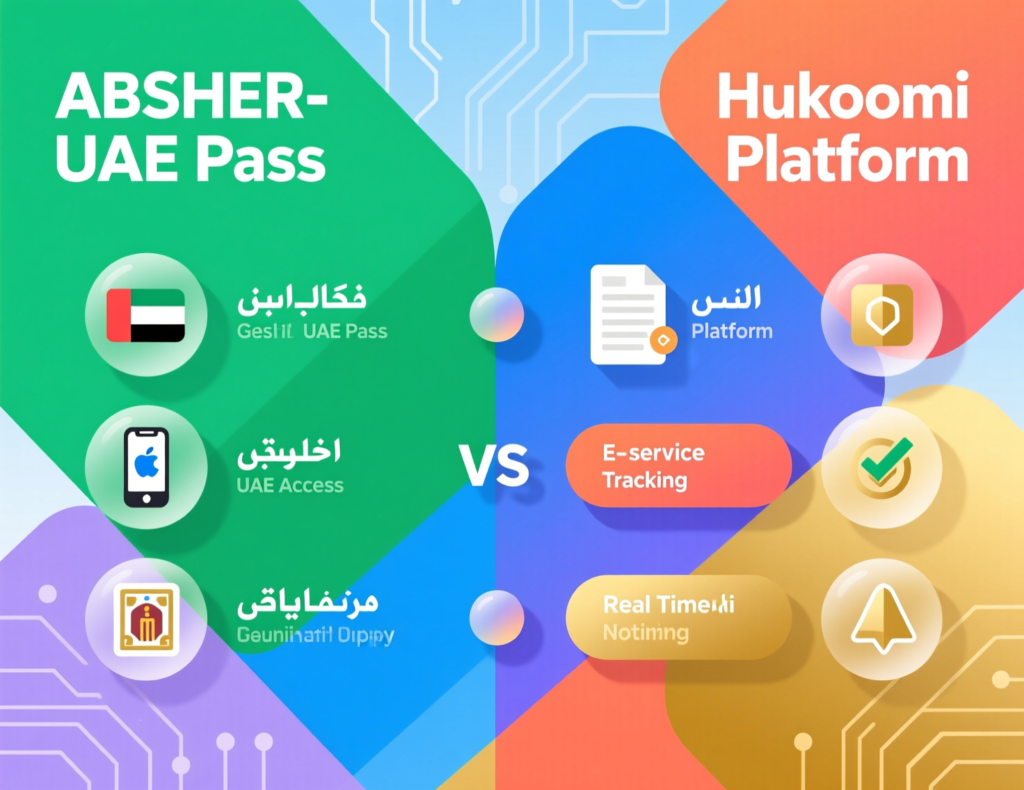
Absher vs UAE Pass vs Hukoomi: what’s the real difference?
The main differences between Absher, UAE Pass and Hukoomi are their core roles – ID system, service directory or “super app” – and how tightly they are woven into everyday life for citizens and expats.
Core roles: ID layer, service catalog or ‘super app’?
Absher (Saudi Arabia) is both a national digital identity layer and a deep services backbone, tied closely to interior, residency, traffic and justice systems.
UAE Pass is the UAE’s national eID and single sign-on a secure login, digital signature and identity wallet used across thousands of federal and local government services and a growing number of private-sector platforms.
Hukoomi (Qatar) works primarily as a curated, multilingual directory and transaction portal, routing users into specialised systems for visas, health, business and payments.
How people actually use these platforms day to day
A typical Saudi resident in Riyadh might log into Absher, renew their iqama, download a digital Resident ID to Apple or Google Wallet, pay traffic fines and book a vehicle inspection all without visiting a branch. In Jeddah, a business owner uses my.gov.sa to manage municipal licences and interact with customs and logistics services.
In Dubai or Sharjah, a UAE resident uses UAE Pass to sign into DubaiNow or TAMM, view Emirates ID details, pay Salik and utility bills, sign tenancy contracts and even complete civil services such as virtual marriage in Abu Dhabi.
In Doha, a new expat often starts on Hukoomi in English, using guides and online forms to apply for entry visas, QID, health cards and basic e-payments frequently before their first physical office visit.
Arabic English UX, mobile apps and accessibility
GCC digital government is inherently bilingual, balancing high-quality Arabic with clear English to serve diverse expatriate communities. Mobile apps are now the primary touchpoint, with biometric login (face or fingerprint) and, increasingly, passkeys replacing vulnerable SMS OTPs.
Designing accessible UX for older users, people with disabilities and those with lower digital skills is now just as important as launching new services. Vendors who already build inclusive mobile experiences – like those behind mobile app development services and digital marketing campaigns can transfer many of the same design patterns into government projects.
Why have Saudi Arabia and the UAE moved so fast on digital identity?
Saudi Arabia and the UAE have pushed hard on national digital identity because it directly supports Vision 2030 diversification, financial innovation and regional competition to attract investment, talent and tourists.
Strategic drivers.
Digital ID cuts friction for fintech, banking, logistics and e-commerce players who need strong KYC, e-signatures and cross-border verification. Financial regulators such as SAMA, the Central Bank of the UAE and free zones like ADGM and DIFC actively encourage secure eID and remote onboarding in their licensing frameworks.
For a fintech in Riyadh or Dubai, this means faster onboarding with verified government-backed identity instead of slow, manual paperwork a real advantage in crowded markets.
Governance model: regulators, standards and PPPs
Saudi Arabia’s governance stack now includes the DGA, SAMA, the National Cybersecurity Authority and NDMO, each setting standards for digital government, cybersecurity and data management.
In the UAE, TDRA works with Digital Dubai, Abu Dhabi Digital Authority and emirate-level entities to align standards around APIs, security and UX. Public-private partnerships with banks, telcos and hyperscalers (AWS, Microsoft Azure, Google Cloud) have been central to scaling digital ID across public and private services.
Impact on finance, retail, logistics and government services
For fintech and banking, national eID plus sector-specific KYC rules enable remote onboarding, digital signatures and instant approvals dramatically reducing branch visits in Riyadh, Dubai, Abu Dhabi and Doha.
For retail and e-commerce, strong digital ID helps reduce fraud in payments and BNPL flows.
For logistics and trade, integrated identity and customs systems accelerate clearance across ports, airports and land corridors.
Teams like Mak It Solutions, who already deliver search engine optimization and back-end development services for complex transactional platforms, can help stitch together these identity, payment and logistics building blocks for GCC public-sector projects.
Why are data residency and cybersecurity so critical in 2025?
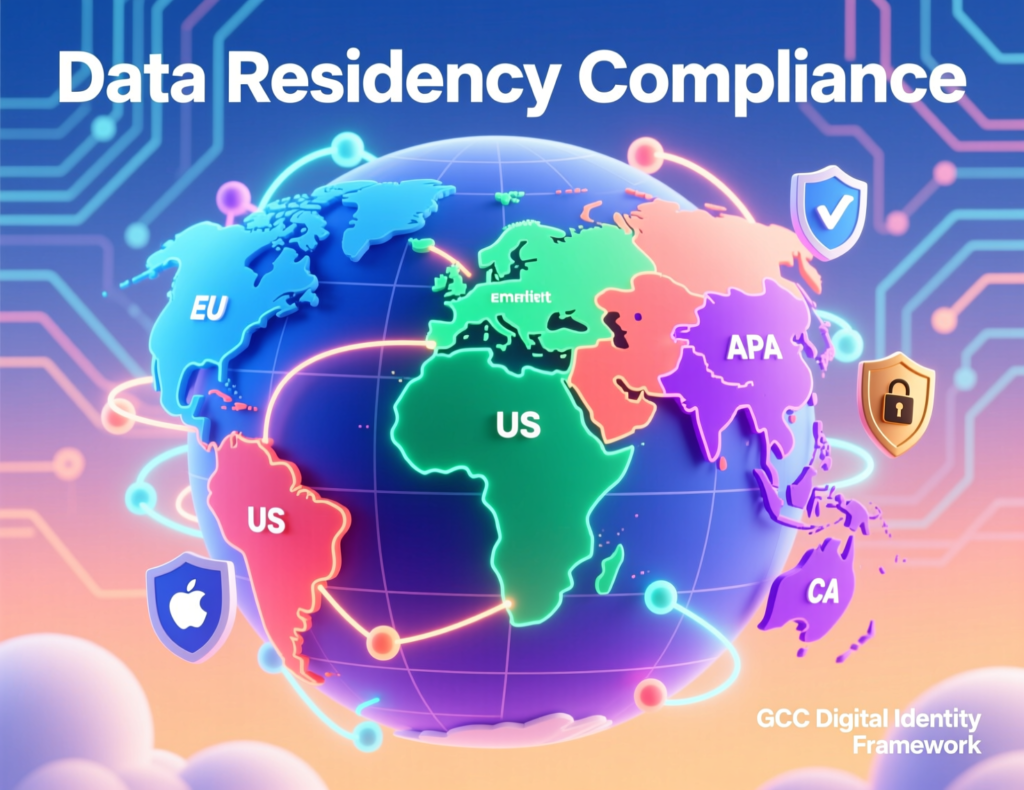
Data residency rules for government and financial workloads
Across the GCC, policies for sensitive government and financial workloads increasingly favour local cloud regions, in-country data centres and sovereign cloud setups:
Saudi Arabia is expanding local hosting and cloud options, with an AWS Saudi Arabia Region planned for 2026 to complement existing Bahrain and UAE regions.
The UAE relies on Azure UAE North / UAE Central and local data centre partners, alongside growing investments in AI-ready infrastructure.
Qatar leverages the Google Cloud Doha region and local hosting for Hukoomi and open data portals, aligning infrastructure with data governance policies.
Cybersecurity, identity fraud and trust in digital ID
Saudi Arabia’s National Cybersecurity Authority regularly updates Cloud Cybersecurity Controls (CCC) to harden national infrastructure and refine data localisation requirements. Similar authorities in the UAE and Qatar drive standards for encryption, incident response and identity assurance.
Common threats phishing, SIM-swap attacks, password reuse are pushing platforms like Absher, UAE Pass and Hukoomi away from SMS OTPs and towards FIDO-style passkeys and device-bound biometrics.
Cross-border data flows and GCC cooperation
For millions of expats, remittances and cross-border services depend on data flowing safely between banks, telcos and government platforms. The GCC Secretariat-General and bodies like the Digital Cooperation Organization (DCO) promote shared standards on data, AI and cybersecurity so that services can interoperate across borders without undermining national sovereignty.
This is where strong architecture and governance consulting often supported by partners delivering business intelligence services and complex integrations becomes as important as the underlying code.
How is AI changing digital government in the Gulf?
AI chatbots, virtual assistants and proactive services
AI chatbots and multilingual virtual assistants are now embedded into Saudi, UAE and Qatar portals to answer FAQs, recommend services and push real-time status updates in Arabic and English. In Dubai and Abu Dhabi, AI also sits inside immigration and residency workflows to triage applications and route complex cases, contributing to the cities’ reputation for world-class AI governance in public services.
AI in policy, regulation and back-office automation
The UAE is experimenting with AI-assisted drafting and analysis of laws, regulations and consultation feedback, while Gulf ministries use AI for fraud detection, risk scoring and eligibility checks in social programmes. For back-office teams, AI helps classify documents, validate identity documents submitted via Absher, UAE Pass or Hukoomi, and spot anomalies earlier.
Measuring impact
Saudi Arabia estimates that about 65 million in-person visits will be saved by the new five-year Resident ID and fully digital workflows through Absher and related services. In Qatar, datasets on Hukoomi transactions by year show steady growth in digital service usage as more services go online.
App store ratings, citizen satisfaction surveys and smart city indices such as Abu Dhabi’s position as a top-five smart city globally give policymakers a tangible way to see whether AI and digitalisation are really improving daily life rather than just adding more apps.
What should Arab governments and vendors prioritise for 2030?
Note
This article is for general information only and does not constitute legal, regulatory or financial advice. Always consult relevant authorities and professional advisers for project-specific decisions.
Design principles for next-generation e-government in the Arab world
Looking ahead to 2030, Arab governments should anchor digital government around:
Platform thinking: shared identity, payments, notifications and data exchange, reused across agencies.
Open APIs and modular services: enabling fintechs, logistics players and startups to plug into government rails instead of rebuilding them.
Inclusive design: first-class Arabic, clear English and strong accessibility for people with disabilities and older users.
This is exactly the kind of cross-cutting platform work where partners like Mak It Solutions – already handling complex web development, WordPress web development and React Native development can help governments move from siloed portals to integrated ecosystems.
Practical roadmap: from legacy portals to integrated platforms
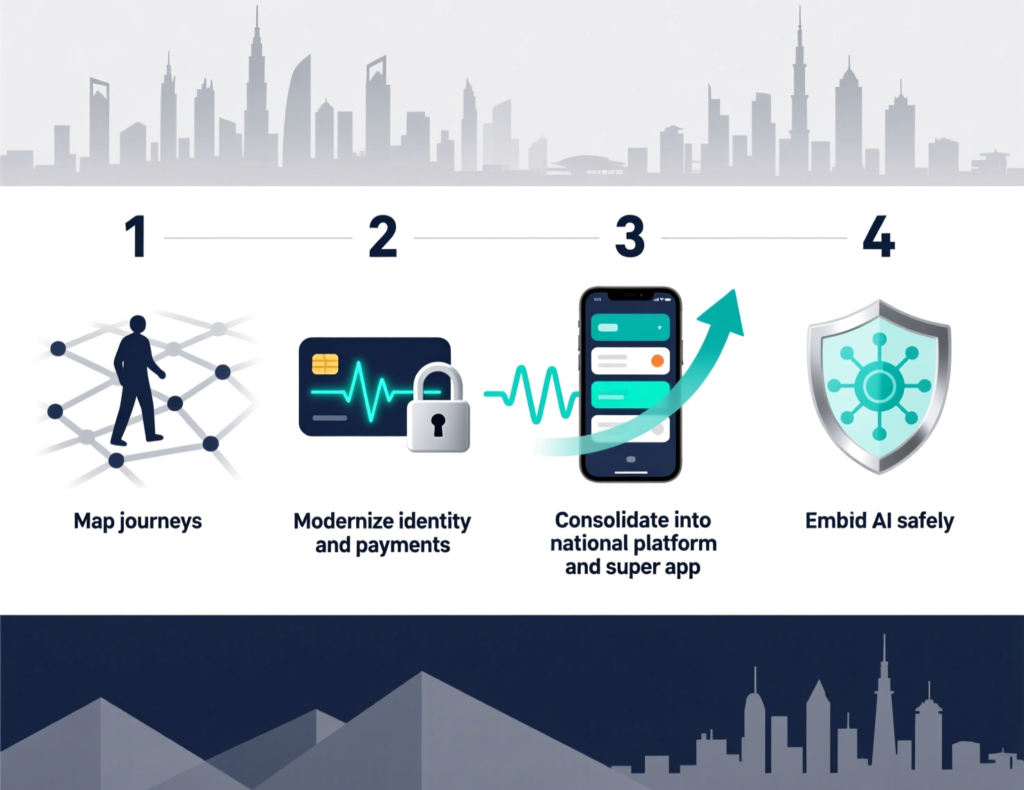
Map services and user journeys
Start with real journeys in Riyadh, Dubai, Abu Dhabi, Sharjah, Jeddah and Doha citizens, residents, businesses and document every pain point, duplicate login and paper step.
Modernise identity, payments and consent
Adopt strong national eID, unified payment gateways and clear consent management that private-sector partners can reuse across sectors.
Rationalise portals into a national platform and mobile super-app
Consolidate overlapping sites into a single national platform with one flagship app (plus specialised sector apps where truly necessary).
Embed AI safely
Use AI for support, analytics and personalisation, backed by clear ethics rules and cybersecurity frameworks so algorithms remain transparent, secure and accountable.
Governments can work with digital partners who understand both UX and infrastructure from web design to microservices architectures to deliver this roadmap incrementally instead of through a single risky “big bang” project.
Lessons from Saudi Arabia, the UAE and Qatar for the wider Arab world
For smaller Arab countries, the main lessons from e-government in the Arab world 2025 are pragmatic:
Quick wins: unify login across existing portals, publish open data, and prioritise high-volume services such as residency, traffic and licensing.
Long-term investments: national ID infrastructure, cloud regions or strong local hosting, robust cybersecurity frameworks and digital skills.
Opportunities for regional vendors and startups: build vertical solutions for health, education, logistics and smart homes that plug into government platforms similar to how GCC firms already build smart home and industrial IoT solutions and oil & gas digital platforms.
Concluding Remarks
E-government in the Arab world in 2025 is no longer about “putting forms online”; it is about platform government built on secure digital identity, sovereign cloud and AI with Saudi Arabia, the UAE and Qatar clearly in front. Understanding the differences between Absher, UAE Pass and Hukoomi is essential for anyone designing new services, because these platforms define how people in Riyadh, Dubai, Abu Dhabi, Jeddah, Sharjah and Doha experience the state every day.
For policymakers, CIOs and vendors, the next five years are about consolidating portals, hardening security and using AI responsibly not just launching more apps. Use this article as a checklist when planning your 2026–2030 digital government roadmap, and be clear about where you need expert partners to help architect, design and build citizen-grade platforms from day one.
If you’re planning or upgrading digital government, smart-city or regulated-industry platforms in Saudi Arabia, the UAE or Qatar, you don’t need to figure everything out alone. The team at Mak It Solutions combines GCC-focused strategy with hands-on delivery across web, mobile and cloud[24])
Whether you’re a ministry in Riyadh, an authority in Dubai or a regulator-linked project in Doha, Mak It Solutions can help you map user journeys, design compliant architectures and ship production-ready portals and apps. Reach out via the Services hub or contact page to explore a tailored GCC digital government strategy.
FAQs
Q : Is access to e-government services in Saudi Arabia available in English through Absher and my.gov.sa?
A : Yes. Most core e-government services in Saudi Arabia – including Absher and the National Platform my.gov.sa offer full interfaces in both Arabic and English. This helps expats in cities like Riyadh, Jeddah, Makkah and Madinah complete residency, traffic and government transactions without relying on translators. The Digital Government Authority and Vision 2030 programmes explicitly emphasise inclusivity and foreign investment, so English-language UX is treated as a strategic requirement, not a nice-to-have.
Q : Can UAE residents use UAE Pass to sign private-sector contracts and bank documents, or only government forms?
A : UAE Pass started as a government-focused login, but it is increasingly used by banks, telecom operators, business set-up providers and other private-sector players. Residents in Dubai, Abu Dhabi and Sharjah can often log in with UAE Pass, pre-fill verified data (such as Emirates ID information) and digitally sign documents with legal validity. For high-risk or complex agreements, banks and regulators in free zones like ADGM and DIFC still apply their own controls, but the trend is clear: UAE Pass is becoming a universal digital identity for both government and regulated private services under TDRA’s broader digital government strategy.
Q : How can new expats in Qatar use the Hukoomi portal and app to complete their first residency procedures online?
A : New expats heading to Doha can start by creating an account on the Hukoomi portal, choosing English or Arabic. From there, they can follow guided steps to apply for entry visas, track QID issuance, request health cards and pay relevant fees online, often before their first physical visit to a government office. Many of these services are backed by open datasets on data.gov.qa, which allow MCIT to monitor adoption and performance. The experience is not yet as fully app-centric as Absher or UAE Pass, but it significantly reduces paperwork and uncertainty during the first months in Qatar.
Q : Do GCC data residency rules require Saudi, UAE and Qatar government data to stay inside local cloud regions?
A : In practice, yes especially for government and financial data. Saudi Arabia’s National Cybersecurity Authority Cloud Cybersecurity Controls and related regulations push sensitive workloads into Saudi-based data centres or sovereign cloud arrangements, with an AWS Saudi Arabia Region due by 2026. The UAE relies on restricted-access regions like Azure UAE North / UAE Central and local providers, while Qatar leverages the Google Cloud Doha region plus local hosting for portals like Hukoomi. Exact rules differ by sector, but any digital government project should assume strong in-country data residency constraints.
Q : What are the main challenges Arab governments face when trying to copy the Saudi and UAE digital government models?
A : The biggest challenges are institutional, not technical. Building a national digital identity and platform like Absher or UAE Pass requires legal reforms, strong regulators (similar to DGA, SAMA, TDRA and the National Cybersecurity Authority) and long-term investment in cloud, cybersecurity and skills. Smaller Arab states may lack scale, local cloud regions or investment capacity, so they need to prioritise quick wins (unified login, top 20 services, basic open data) while planning multi-year programmes for full platform government. Regional collaboration through the GCC Secretariat-General, the DCO and knowledge-sharing with Qatar, Saudi Arabia and the UAE can help reduce risk and avoid reinventing the wheel.