


FinOps Cloud Cost Optimization for Saudi & UAE Teams
FinOps Cloud Cost Optimization for Saudi & UAE Teams
FinOps Cloud Cost Optimization for Saudi & UAE Teams
FinOps cloud cost optimization helps GCC organisations turn chaotic cloud bills into predictable, business-aligned spending by bringing engineering, finance and leadership around shared metrics and governance. For Saudi, UAE and Qatar teams, it can typically unlock 20–40% savings over 2–3 years while staying aligned with regulators like SAMA, TDRA and QCB through better data residency, tagging and accountability.
Introduction
Across MENA, cloud adoption is booming far faster than cloud value realization. McKinsey estimates that public cloud could unlock around $183 billion of value in the Middle East by 2030, yet many CIOs in Riyadh, Dubai and Doha still see rising invoices without matching business impact.
Quick answer (in plain language): FinOps cloud cost optimization is the discipline that connects cloud engineering, finance and business owners so they can see where every riyal or dirham goes, benchmark unit costs and continually remove waste. Done properly, it’s less about “cutting cloud” and more about funding growth, AI and digital programmes under Saudi Vision 2030, UAE’s Digital Government agenda and Qatar’s Digital Government Strategy.
The MENA cloud boom vs. value realization gap
AWS regions in Bahrain and the UAE, Azure UAE Central and the Google Cloud region in Doha mean GCC organisations can now host critical workloads inside or near their home markets with low latency and strong sovereignty options.
But in practice
Many Saudi enterprises migrated “lift and shift” without redesigning architectures.
UAE startups scaled quickly on flexible cloud credit programmes, but never revisited instance sizes or storage tiers.
Qatar public-sector projects leaned on managed services without robust cost allocation.
The result is a widening value gap: cloud spend grows in double digits, while finance teams struggle to tie it to revenue, citizen adoption or national KPIs.
The real problem: unmanaged cloud cost leakages, not just “expensive cloud”
Most GCC leaders don’t actually have a “too expensive cloud provider” problem they have unmanaged leakages.
Idle or underused VMs
Oversized instances “just in case”
Unattached storage volumes and snapshots
“Zombie” Kubernetes clusters and sandboxes
Test/QA environments left running 24/7
No tagging, so no clear showback/chargeback
Global studies from FinOps Foundation and firms like PwC show that structured FinOps practices consistently surface 20–40% optimisable spend over 2–3 years not only by cutting, but by right-sizing, scheduling and aligning usage with business value.
How FinOps cloud cost optimization helps GCC companies regain control
FinOps is a cloud financial management discipline that combines culture, data and tooling. For MENA organisations, it means:
Near real-time cloud cost visibility and accountability
Shared KPIs between CIO, CFO and product owners
Guardrails that reflect NDMO, SAMA, TDRA and QCB rules, not just “cheapest region” choices
This guide walks through leakages, quick wins, KPIs and a 90-day playbook tailored to Saudi, UAE and Qatar teams.
Cloud Cost Leakages & Quick Wins for GCC Teams
Why are Saudi and UAE enterprises losing money on unmanaged cloud resources?
Saudi and UAE enterprises often lose money not because their AWS, Azure or GCP prices are unfair, but because nobody “owns” optimisation day to day. Typical issues include.
Idle VMs and containers left on after projects finish
Oversized instances chosen during migration and never revisited
Unattached EBS disks, snapshots and log buckets quietly growing
Kubernetes clusters for hackathons and POCs still burning cash months later
24/7 non-production environments instead of business-hours scheduling
No showback/chargeback, so product teams don’t see their true unit costs
For FinOps cloud cost optimization in Saudi Arabia or the UAE to work, engineering and finance must jointly review these patterns, set budgets and adopt simple automation like schedules and rightsizing recommendations across regions such as AWS me-south-1 (Bahrain) and me-central-1 (UAE)
Common cloud cost leakages in MENA.
Across AWS, Azure and GCP in GCC, the same 6–8 leakages appear again and again.
Idle instances
Turn on utilisation alerts and shut down or hibernate below-threshold workloads.
Oversized VMs/DBs
Use rightsizing tools to move to smaller instance families.
Unattached storage & snapshots
Monthly hygiene: delete orphaned volumes and old snapshots outside retention policy.
Unoptimised storage classes
Shift infrequently used objects to colder tiers.
Underused managed databases & queues
Consolidate or downsize where QPS is low.
Missing or inconsistent tags
Enforce tags for cost centre, product, environment, regulator and data classification.
Over-provisioned Kubernetes clusters
Right-size node groups and autoscaling.
No anomaly detection
Enable anomaly alerts for sudden spend spikes.
Each fix is small, but combined they unlock fast savings and, more importantly, create the discipline needed for long-term optimisation.
Quick wins in 30 days.
A realistic 30-day FinOps quick-win sprint for a GCC team could look like this:
Week 1 Discovery scan
Export 12 months of billing data.
Identify the top 20 accounts/projects by spend and top 10 services.
Week 2 Tagging baseline
Define a minimum tag set (owner, cost centre, environment, regulator, data class).
Apply to all new resources; start a remediation backlog for untagged ones.
Week 3 Idle & underused clean-up
Shut down non-production after hours.
Remove unattached disks, old snapshots, unused load balancers and test clusters.
Week 4 Anomaly alerts & basic dashboards
Enable native anomaly detection and budgets.
Build a first FinOps dashboard (even in Power BI) grouping costs by product, country and environment.
Partners like Mak It Solutions can help by building GCC-ready dashboards and analytics models through their business intelligence services and web development services, so CIOs and CFOs see the impact quickly. (Mak it Solutions)
FinOps Fundamentals for MENA Cloud & Finance Teams
What is FinOps and how can it stop hidden cloud cost leakages in GCC companies?
FinOps, as defined by the FinOps Foundation, is an operational framework and cultural practice that maximises the business value of cloud by enabling data-driven decisions and financial accountability across engineering, finance and business. It is essentially a cloud financial management discipline that gives MENA organisations clear cloud cost visibility and accountability, so teams can continuously remove waste and invest savings into innovation.
In GCC markets, FinOps ensures that every workload from a Riyadh fintech app to an Abu Dhabi smart-city platform has a clear owner, budget, set of KPIs and alignment with local regulators and data residency rules.
FinOps vs traditional IT cost control in GCC organisations
Traditional IT cost control in the region has been CAPEX-driven: annual budgets, long hardware cycles and negotiation-heavy vendor management. That model doesn’t work for elastic, usage-based cloud where spend can change weekly.
FinOps instead focuses on.
Real-time data vs annual budget reviews
Unit costs (per transaction, user, API call) vs total invoice only
Shared responsibility between tech, product and finance vs siloed decisions
Cloud governance and budgeting that adjust dynamically as teams launch new microservices, AI features or citizen services.
For GCC leaders, this means treating cloud like any other strategic investment: money flows to workloads that deliver measurable outcomes.
FinOps maturity model for Saudi/UAE organisations.
A simple FinOps maturity model for Saudi, UAE, Qatar, Kuwait, Bahrain and Oman enterprises:
Crawl Ad-hoc
Single cloud, limited tagging, manual Excel reports.
Typical use case: first migrations for ERP or basic web apps.
Walk Structured
Standard tags, monthly reviews, initial budgets and showback.
Use case: multi-cloud environments, early AI workloads in Riyadh or Dubai.
Run Optimised
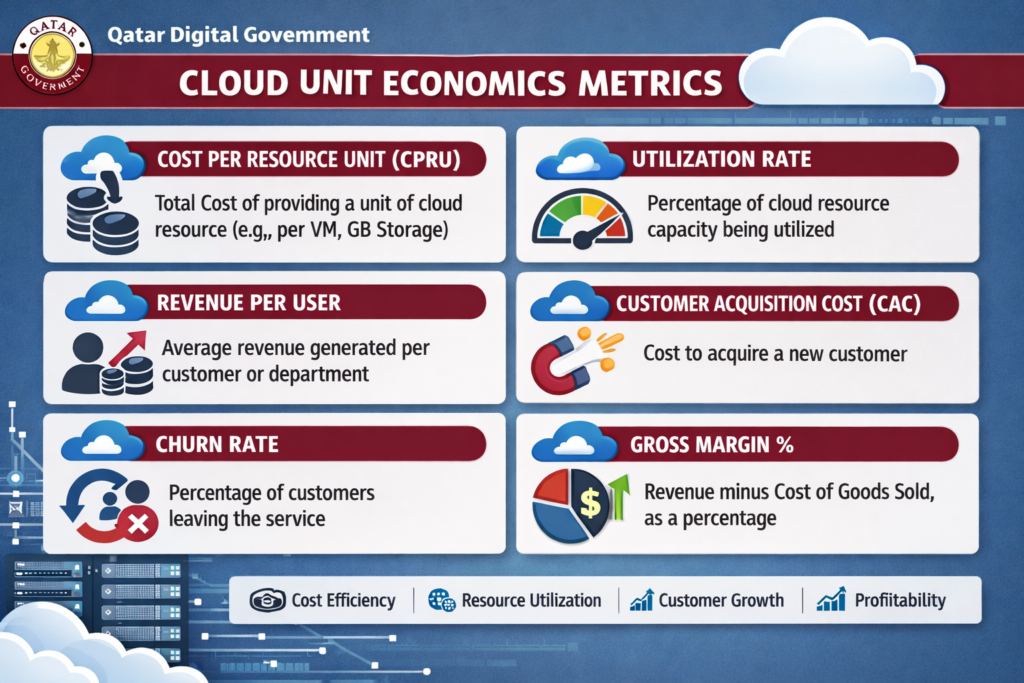
Automated policies, anomaly detection, formal cloud unit economics metrics and scenario planning.
Use case: regional groups with subsidiaries in Jeddah, Abu Dhabi, Doha and beyond.
Most GCC organisations today sit between crawl and walk. A 6–12 month FinOps programme can realistically push a Saudi or UAE enterprise to the run stage for key workloads.
Compliance-Driven FinOps for Regulated Sectors
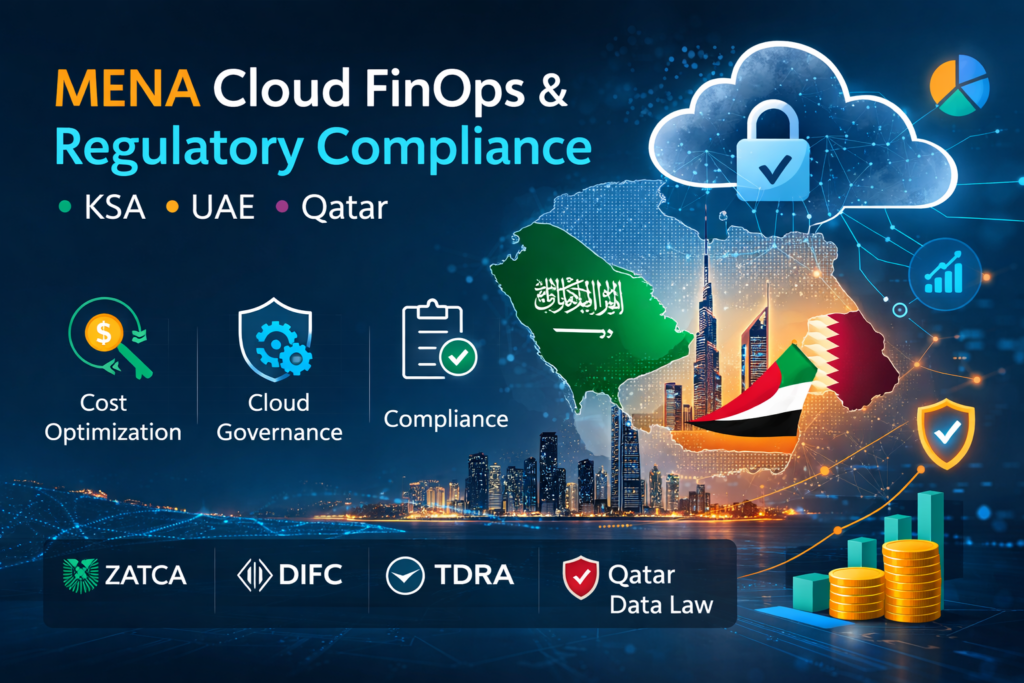
Data residency and cloud cost governance for regulators and national visions
For regulated sectors, “cheapest region” is rarely allowed.
SAMA requires banks and payment companies to follow outsourcing rules and ensure regulators have access to outsourced activities, including cloud.
NDMO/SDAIA sets data classification and residency policies that dictate where different data levels may be hosted.
QCB regulations require PSPs using cloud to host data in-country, with strong security and risk assessments.
TDRA tracks cloud service providers in the UAE through initiatives like the CLSP programme.
FinOps embeds these rules into region and service selection, balancing in-region options such as AWS Bahrain & UAE, Azure UAE Central and Qatar Cloud (Azure Qatar + Google Cloud) with cost and performance.
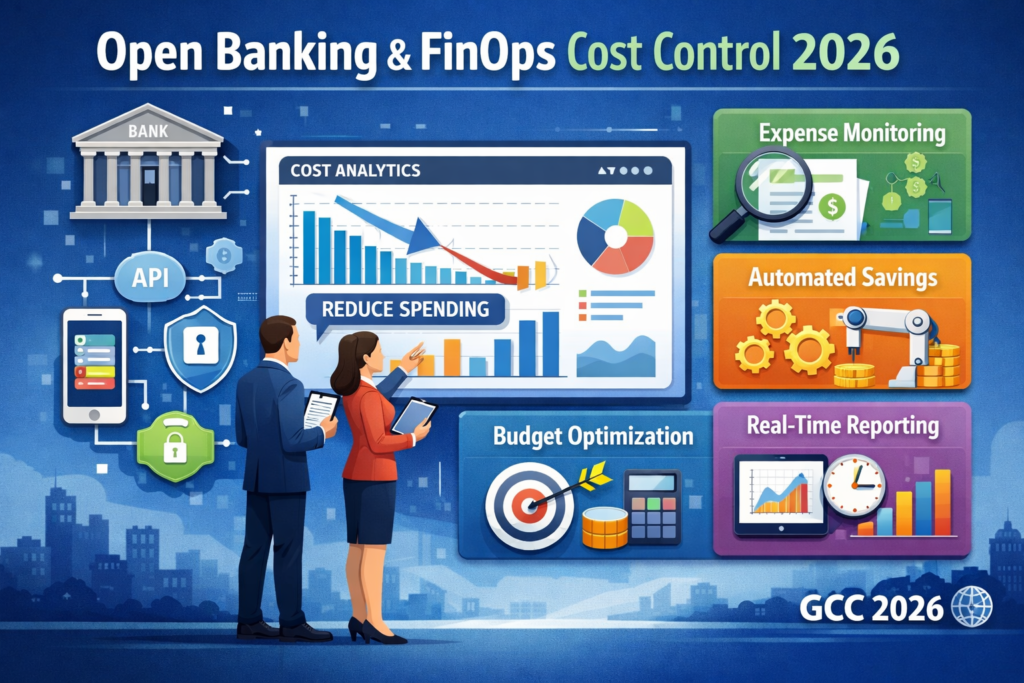
How can FinOps help Saudi banks and fintechs control open banking cloud costs?
Saudi open banking and digital payment ecosystems rely on scalable APIs, sandboxes and analytics — all running on elastic cloud. Without FinOps, banks and fintechs risk runaway costs from:
Always-on test environments
Duplicated data lakes for compliance reporting
Over-provisioned API gateways around peak events
FinOps for BFSI in KSA and ADGM/DIFC environments means:
Aligning API traffic forecasts with capacity plans
Using showback to allocate costs per partner or product
Proving to SAMA, ADGM, DIFC and QCB that cloud use is controlled, auditable and resilient
This is where FinOps cloud cost optimization in Saudi Arabia directly supports both innovation and strict regulatory expectations.
Applying FinOps to government and digital ID workloads in GCC
Government workloads from UAE Pass and national ID systems to Qatar Digital Government portals are highly sensitive and politically visible.
FinOps gives CIOs in Riyadh, Abu Dhabi and Doha:
Predictable spend per citizen or transaction
Cross-agency transparency when multiple ministries use shared platforms
Evidence that chosen cloud regions meet sovereignty requirements
For example, a smart-city platform using AI video analytics can be governed by KPIs such as cost per processed video hour and per active sensor, with clear dashboards shared between the digital authority, finance and operators.
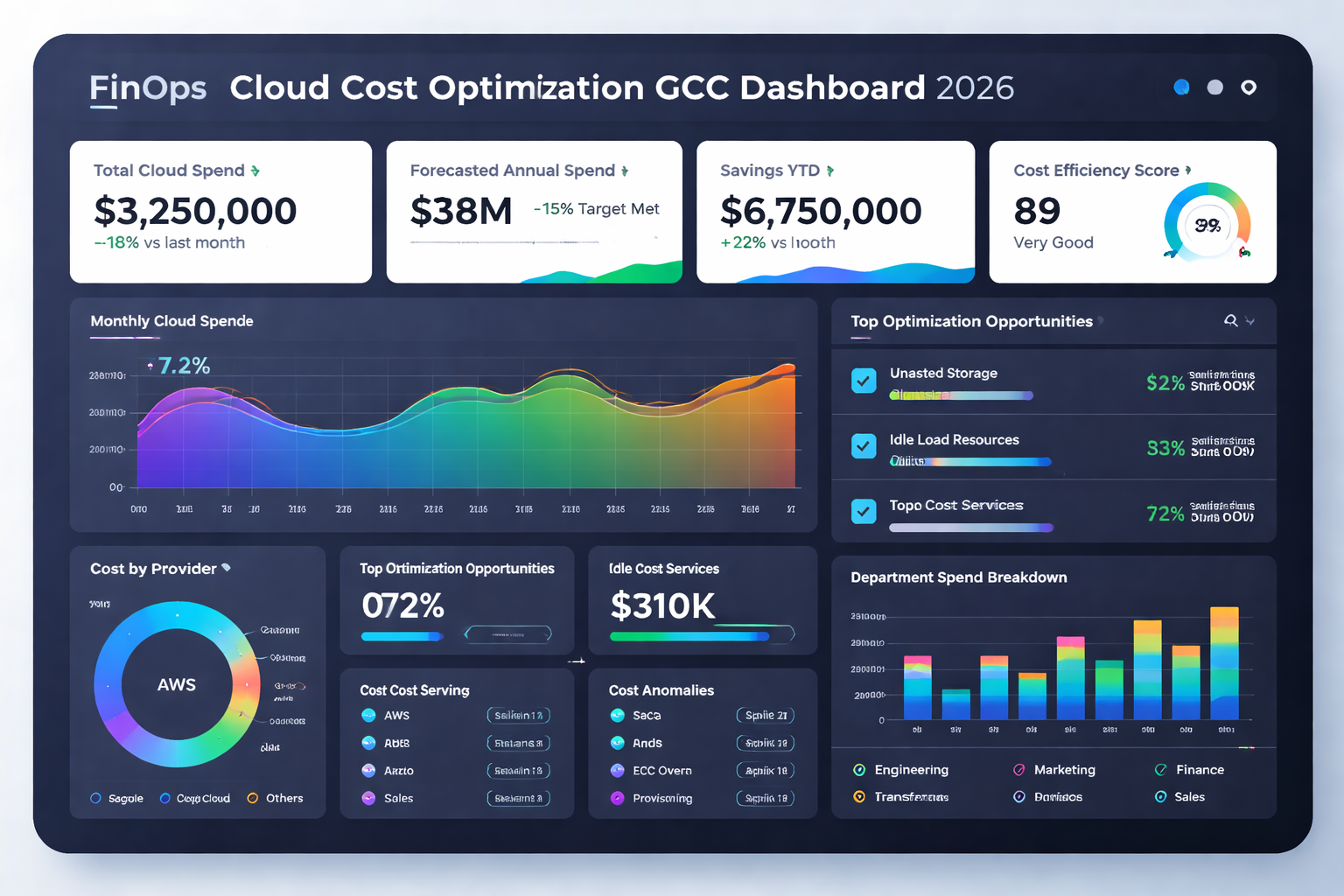
FinOps KPIs, Dashboards & Board-Level Reporting
What FinOps KPIs should MENA CIOs track to prove cloud cost savings to the board?
MENA CIOs don’t convince boards with “we saved 15%” alone; they need FinOps KPIs that tie cloud to business value. Common metrics include:
Unit costs per customer, citizen, order or transaction
Cost per product or digital service line
% idle/underutilised spend vs total
Savings realised vs agreed baseline
Forecast accuracy vs actuals (monthly/quarterly)
Number and value of anomaly alerts caught before billing
FinOps Foundation frames this as using cloud unit economics to optimise both marginal cost and marginal revenue over time.
Cloud unit economics metrics for AI, SaaS and core workloads in GCC
By workload type.
AI & analytics
Cost per 1,000 inferences, training job or dashboard refresh.
SaaS products
Cost per active user, per workspace, per seat.
Banking & fintech
– Cost per transaction, card, wallet or API call.
Citizen services
Cost per digital application, case or licence.
Logistics & e-commerce
Cost per order, shipment or delivery attempt. (finops.org)
These cloud unit economics metrics give boards in Riyadh, Dubai and Doha a simple language: What does it cost us, in cloud, to serve one more customer or citizen and is that trending in the right direction?
Building bilingual (Arabic/English) FinOps dashboards for C-suite in Riyadh & Dubai
Most GCC boards are mixed Arabic/English, and many prefer concise visuals over technical drill-downs. Practical tips.
Show both Arabic and English labels for KPIs and filters.
Group views by country (Saudi, UAE, Qatar), business line and regulator.
Highlight red-amber-green status per initiative (e.g., Vision 2030 programme, Abu Dhabi digital project)
Provide different slices for CIO, CFO and CEO needs.
If your internal team is stretched, it’s worth partnering with a GCC-savvy analytics and web team for example, using Mak It Solutions’ web development trends in the Middle East insights and digital marketing expertise to design dashboards that are not only accurate but also storytelling-ready for town halls and board packs. (Mak it Solutions)
Implementation Playbook & Tooling for GCC FinOps
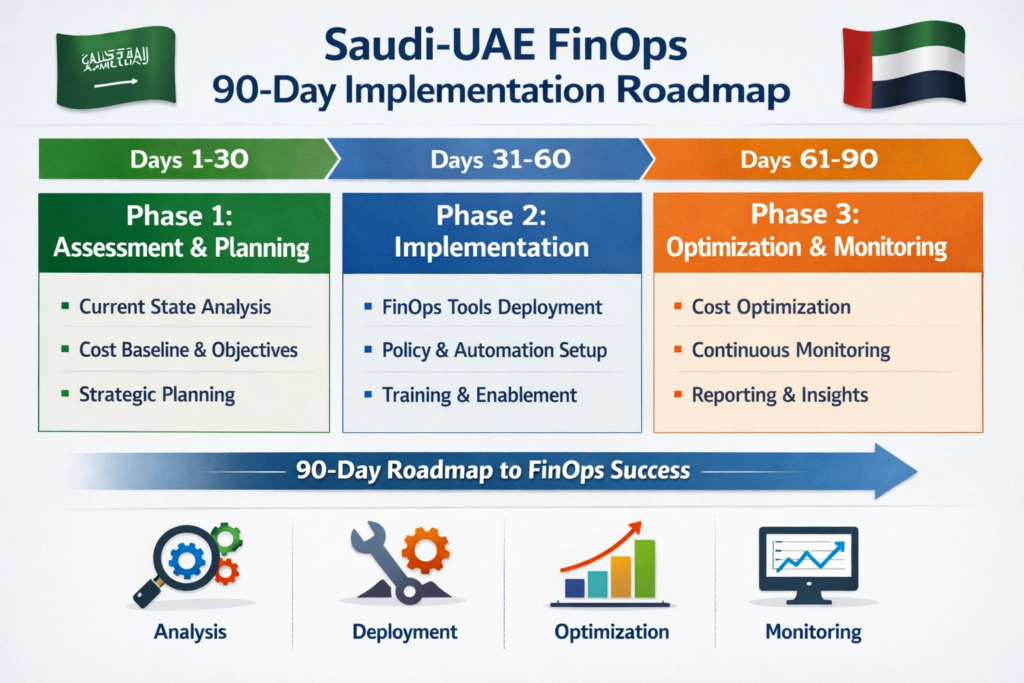
How to implement FinOps in a Saudi or UAE company in 90 days
A pragmatic 90-day FinOps implementation for a Saudi or UAE enterprise could look like this: (Alnafitha IT)
Discover & align (Days 1–15)
Map key cloud accounts, providers and regions.
Identify executive sponsors (CIO, CFO, Head of Digital)
Baseline & classify (Days 16–30)
Establish a spend baseline by workload, country and regulator.
Classify data per NDMO/TDRA/QCB rules to constrain region choices.
Policies, tagging & governance (Days 31–45)
Define mandatory tags and budget guardrails.
Approve simple policies: region allow-list, instance family guidelines, non-prod schedules.
Dashboards & KPIs (Days 46–60)
Implement the first FinOps dashboard with agreed KPIs and unit metrics.
Pilot showback for 1–2 products or departments.
Optimisation sprint (Days 61–75)
Run focused rightsizing and clean-up across top spenders.
Track realised savings and reallocate to priority projects.
Scale & embed (Days 76–90)
Extend policies to more teams, refine KPIs and schedule monthly FinOps reviews.
Train squads in FinOps basics and run an internal “FinOps champions” programme.
(As always, this is general guidance, not financial or legal advice. Regulated entities should align plans with their own advisors and regulators.)
FinOps tools comparison for GCC: native vs multi-cloud optimisation platforms
Most GCC teams start with native tools.
AWS Cost Explorer / Budgets
Azure Cost Management + Billing
GCP Billing export & dashboards
These are good for early FinOps cloud cost optimization in UAE or Saudi Arabia, especially when combined with BI tools built by partners like Mak It Solutions’ web design and mobile app development teams. (Mak it Solutions)
As complexity grows multi-cloud, multiple subsidiaries across Riyadh, Dubai and Doha multi-cloud optimisation platforms add value through.
Normalised views across AWS, Azure, GCP
Advanced rightsizing and commitment management
Policy-as-code with data residency and sovereignty constraints
When evaluating tools, always check: data residency (logs/metrics), Arabic UI support, GCC invoicing nuances and integration with your existing analytics stack.
Working with cloud cost optimization and FinOps partners in GCC
At some point, it’s cheaper to bring in specialists than to reinvent the wheel. GCC organisations often engage partners when:
Cloud spend crosses a defined threshold (e.g., $100k/month)
Multiple regulators (SAMA, ADGM, DIFC, QCB) are involved
New AI or open banking products require robust unit economics
Local and regional players such as SkyTech Digital GCC, Cloudativ, Bilytica, SquareOps, Goognu, NavLink, Hinology and Q Cloud-IT operate alongside consulting and engineering teams like Mak It Solutions’ services portfolio.
Example GCC scenarios
A Riyadh fintech startup under SAMA rules using AWS Bahrain and UAE regions aligns its API, data-lake and KYC workloads with FinOps KPIs before scaling.
A Dubai e-commerce brand running Shopify and custom apps uses FinOps dashboards and Shopify development services to understand cost per order and fund new mobile features. (Mak it Solutions)
A Doha SME hosting on Qatar Cloud and GCP Doha uses FinOps to balance in-country requirements with performance and spend across AI and analytics workloads.
Key takeaways for GCC leaders
FinOps is not a one-off cost-cutting project; it’s a continuous discipline that embeds accountability, culture and data into how your teams use cloud. For Middle East leaders, that means converting every riyal, dirham and Qatari riyal spent on cloud into measurable outcomes: transactions processed, citizens served, orders delivered, AI models deployed all under the umbrella of national visions and regulator expectations.
If your Saudi, UAE or Qatar teams suspect there are cloud cost leakages hiding in idle resources and untagged workloads, now is the time to act. Start with a 30-day FinOps quick-win sprint, then build a 90-day roadmap that fits your regulatory environment and growth plans.
Mak It Solutions can help you design GCC-ready dashboards, analytics and portals that make FinOps tangible for your C-suite from web development to business intelligence and digital services. If you’re ready to benchmark your FinOps maturity or run a cloud leakage audit, contact us to plan a tailored workshop for your Riyadh, Dubai or Doha teams.
FAQs
Q : Is FinOps cloud cost optimization allowed under SAMA and other GCC banking regulations?
A : Yes. FinOps cloud cost optimization is compatible with SAMA, QCB and other GCC banking regulators because it strengthens, rather than weakens, governance and control. SAMA’s outsourcing rules and open banking policies require clear oversight of cloud providers, data locations and risk — all core FinOps concerns. By documenting workloads, tagging data per NDMO standards and aligning budgets with risk assessments, banks can show regulators that cloud is used in a controlled, auditable way. In fact, many Vision 2030 and fintech initiatives assume disciplined cloud financial management as a prerequisite, not an optional extra.
Q : How does data residency in Saudi, UAE and Qatar affect which cloud regions I can use for cost optimisation?
A : Data residency requirements in Saudi, UAE and Qatar often restrict where sensitive workloads can run, especially in banking, payments and government services. NDMO, TDRA and QCB guidance typically expects regulated data to stay in-country or in approved regions, such as AWS Bahrain, AWS UAE, Azure UAE Central or Qatar Cloud and GCP Doha. FinOps doesn’t change these rules; it works within them by modelling scenarios (“all in-country”, “regional mix”), comparing unit costs and then helping leadership choose the best compliant pattern. That way, you avoid false savings from cheaper but non-compliant regions that could create regulatory risk later.
Q : Can GCC government entities apply FinOps even when using sovereign or private clouds?
A : Absolutely. FinOps is about governance, accountability and measurement not tied to any specific provider. Many GCC governments now run sovereign clouds or private stacks for digital ID, smart-city and internal platforms, alongside public cloud. FinOps practices such as tagging, showback, unit economics and anomaly detection can be applied inside these environments just as on AWS or Azure. For programmes like UAE Pass or Qatar Digital Government, FinOps helps ministries and authorities see the cost per citizen transaction and per service, supporting sustainable budgets and better alignment with national digital strategies.
Q : What’s a realistic cloud cost savings percentage for large GCC enterprises after 6–12 months of FinOps?
A : Most large enterprises in the region can realistically target 10–25% savings in the first 6–12 months of FinOps, assuming they already have material cloud spend. Global experience from FinOps Foundation, PwC and others suggests that 20–40% of spend is often optimisable over a multi-year journey, especially when rightsizing, scheduling and commitment management are introduced. In GCC contexts, this depends on sector, regulatory constraints and current maturity: a Riyadh bank running single-AZ workloads may unlock savings by adopting multi-AZ but right-sized patterns, while a Dubai e-commerce group might gain more from cleaning up idle non-production and consolidating AI sandboxes. The key is to reinvest savings into innovation aligned with Saudi Vision 2030 and similar programmes.
Q : How should multi-country GCC groups coordinate FinOps across subsidiaries in Riyadh, Dubai and Doha?
A : Multi-country GCC groups should treat FinOps as a shared, regional discipline with local adaptations. Practically, that means a central FinOps team sets common KPIs, tagging standards and reporting templates, while local teams in Riyadh, Dubai, Jeddah, Abu Dhabi and Doha own optimisation actions within their regulatory context. Using a common dashboard across AWS, Azure and GCP, groups can benchmark unit costs between subsidiaries and surface best practices quickly. Regional councils or steering committees aligned to Saudi Vision 2030, UAE’s digital strategy and Qatar Digital Government provide the governance layer, ensuring cloud cost decisions support long-term growth across all markets rather than creating fragmented, country-by-country approaches.