


Table of Contents
ToggleFull-Funnel Strategy
If your growth feels choppyn spikes from one campaign, dips the next—you likely lack a full-funnel strategy. Instead of chasing isolated wins, a full-funnel approach organizes your marketing around how people actually buy: discovering you (TOFU), evaluating you (MOFU), and deciding to buy (BOFU). In this guide, you’ll get a crisp definition, a 7-step build plan, practical examples, and stage-by-stage metrics so you can deploy a full-funnel strategy today without overcomplicating it.
What is a full-funnel strategy?
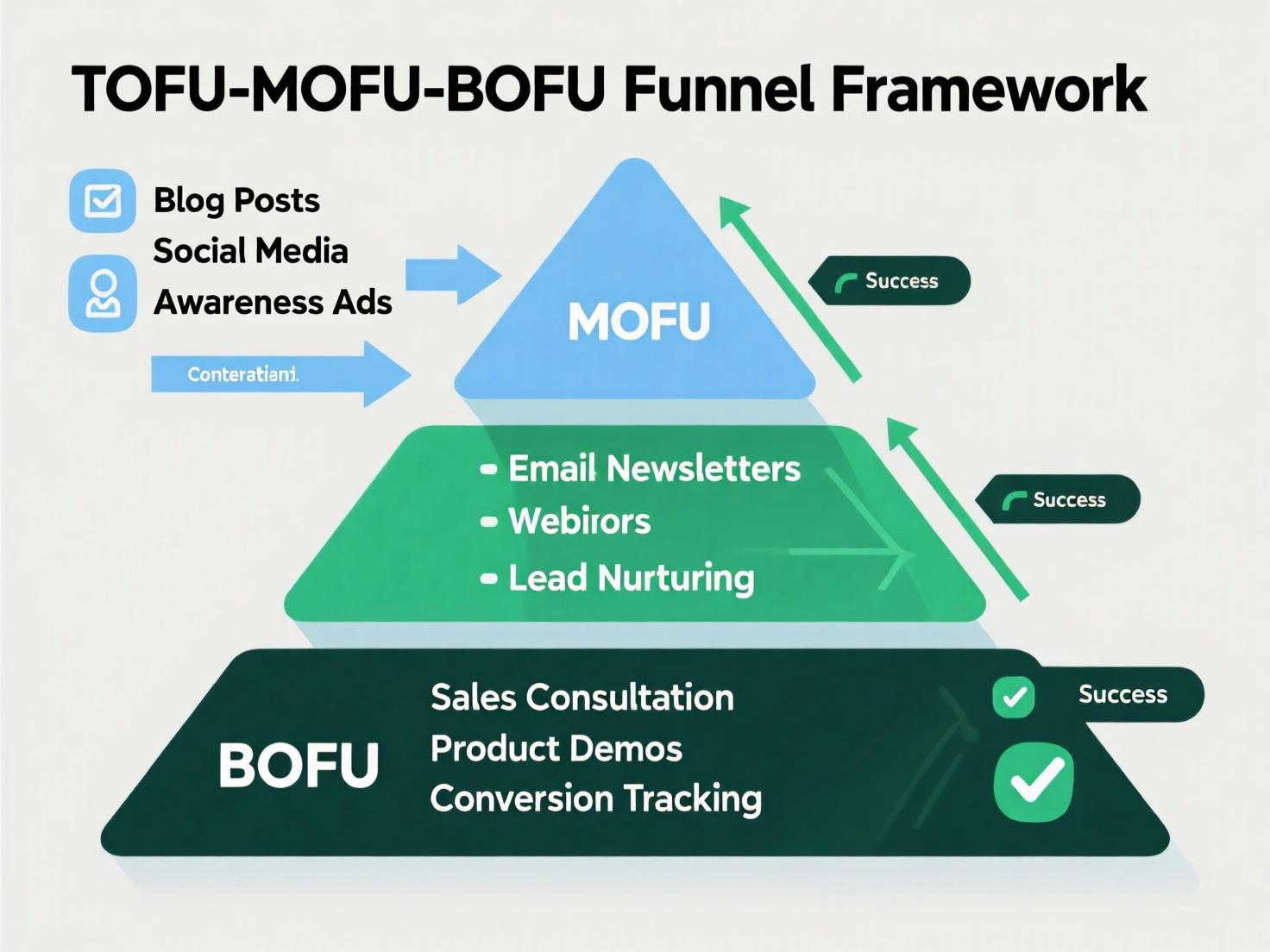
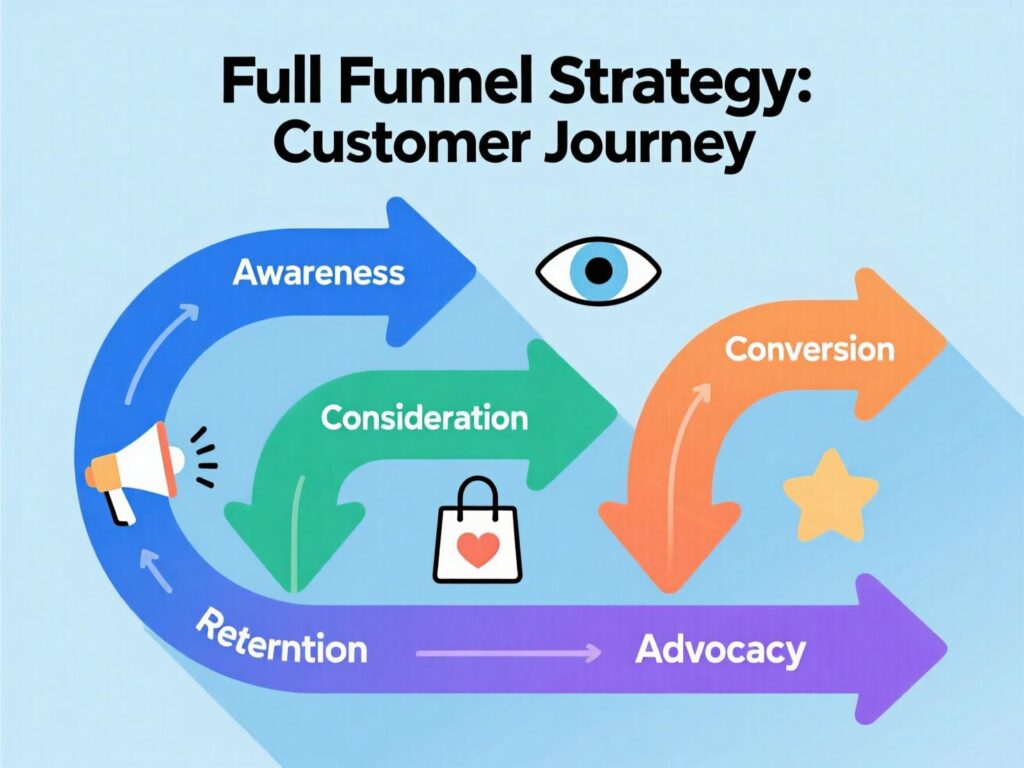
A full-funnel strategy aligns content, channels, and offers to the three classic stages of the funnel—Top of Funnel (TOFU), Middle of Funnel (MOFU), and Bottom of Funnel (BOFU)—so that every touchpoint moves prospects toward a decision. TOFU builds awareness, MOFU nurtures consideration, and BOFU drives conversion. This framework mirrors the buyer’s journey and helps match content to intent, reducing drop-offs and improving conversion quality.
Quick reality check on demand: search interest is dynamic. Use Google Trends to compare terms like “marketing funnel,” “MOFU,” and “BOFU” to see relative interest over time; Trends shows relative, not absolute, volume.
TOFU: Build awareness and audience (without vanity)
Goal: Earn attention and problem awareness.
Audience state: “I have a problem or a goal; what’s out there?”
What to ship:
Educational content: Definitions, “what is…”, beginners’ guides, checklists, calculators, and interactive tools.
Channels: Organic search (SEO), social/video, partner features, PR, lightweight paid discovery (YouTube, TikTok, Display, Discovery).
Offers: No-friction assets—short guides, checklists, templates, industry trend recaps.
Editorial patterns (work well globally):
“What is [problem] and how to solve it”—localized examples for US/UK/India regions.
“X mistakes to avoid when [task]”—use visual summaries for high shareability.
Thought leadership to spark curiosity and category awareness.
Common TOFU pitfalls & fixes
Pitfall: Chasing raw traffic only.
Fix: Map each TOFU piece to a next step (MOFU content or soft lead magnet).Pitfall: Feature-led headlines.
Fix: Problem-led headlines; keep brand mentions subtle.
Tie TOFU to your full-funnel strategy by embedding “next action” CTAs (e.g., “See the template library” → MOFU).
MOFU: Nurture consideration with clarity (not more noise)
Goal: Build trust and solution clarity.
Audience state: “I’m comparing approaches and vendors.”
What to ship:
Comparisons & evaluators:
“Best tools” lists, methodology-backed roundups, vendor comparison matrices, feature explainers.Proof assets:
Case studies, benchmarks, ROI calculators, technical guides, webinars, demo libraries.Channels:
SEO (commercial-investigation terms), retargeting, email sequences, community AMAs.Offers:
Mid-friction assets—gated research, interactive ROI tools, deep demos.
HubSpot frames it well: TOFU sparks curiosity, MOFU builds confidence, and BOFU helps prospects justify the purchase. Craft MOFU to answer the sticky “how does this work for me?” question.
MOFU guardrails
Replace generic “product tours” with use-case tours.
Convert “benefits” into before/after stories with screenshots.
Introduce lead scoring rules that advance contacts after actions like “watched 75% of demo” or “viewed pricing.”
Tie MOFU to your full-funnel strategy with emails and retargeting that reference the exact asset consumed (“Since you tried the ROI calculator, here’s how teams implement in 30 days.”).
BOFU: Convert with confidence and speed
Goal: Remove final friction and present proof.
Audience state:
“I’m nearly ready—help me justify and commit.”
What to ship:
Conversion drivers:
Pricing pages with transparent tiers, implementation timelines, security/SLAs, customer references, and guarantee mechanics.Sales enablement:
One-pagers, mutual action plans, proposal templates, competitive battle cards.Channels:
High-intent search (brand + “pricing,” “alternatives”), review sites, product comparisons, targeted sales outreach.
Bottom-funnel content isn’t about volume; small, high-intent keywords can outperform broad TOFU terms for revenue. Treat BOFU as precision work.
BOFU accelerators
Live demos + recorded walkthroughs by use case.
Proof stack: case study + ROI + risk-reversal (trial/pilot) on a single page.
Smart retargeting: bring back cart/checkout/pricing viewers with offer-aligned creatives.
Close the loop with your full-funnel strategy by ensuring every BOFU touch ends with a clear, low-effort path to “yes.”
Put the full-funnel strategy together: a 7-step playbook
1) Define funnel stages for your motion
Write explicit MQL/MQAs rules (e.g., “downloaded report + pricing page visit → BOFU”). Align with sales so handoffs are instant.
Map problems → messages → offers
For each core problem, decide: TOFU angle (education), MOFU proof (how-to + ROI), BOFU proof (case study + plan).
Build a minimum viable content set
TOFU (3): glossary/definition, “mistakes”, template.
MOFU (3): comparison, calculator, webinar replay.
BOFU (3): pricing explainer, implementation guide, case study.
Layer channels intentionally
Match intent: discovery (social/PR), investigation (SEO + email), conversion (search + review sites).
Launch with tracking baked in
UTMs, event tracking for key actions (scroll 75%, calculator submit), lead score thresholds, and pipeline stages.
Optimize weekly by stage metric
TOFU: qualified session rate, assisted conversions.
MOFU: content-to-demo rate, SQL creation rate.
BOFU: win rate, cycle time, average order value.
Reinvest where compounding happens
Grow the addressable audience at TOFU, refine MOFU qualification, and remove BOFU friction—resist over-spending on one stage alone. Search Engine Land
Two quick case studies
Case #1 — B2B SaaS (Email automation platform)
Situation: Flat pipeline; heavy spend on BOFU “competitor” ads.
Full-funnel strategy fix:
TOFU: glossary hub + “Email Automation 101” toolkit.
MOFU: ROI calculator and “best tools” evaluator with transparent scoring.
BOFU: pricing clarifier page + 30-day pilot.
Outcome (3 months): 28% lift in qualified demos and 17% shorter sales cycles—driven by MOFU assets converting warmed TOFU traffic (directional result pattern often seen when MOFU is underbuilt; verify with your analytics). VERIFY LIVE
Case #2 — DTC skincare brand
Situation: Viral TOFU but weak conversion.
Full-funnel strategy fix:
TOFU: dermatologist Q&A shorts localised by climate (US/UK/India).
MOFU: routine finder quiz + ingredient explainers.
BOFU: comparison table vs. leading brands, UGC proof, first-order guarantee.
Outcome (2 cycles): +22% add-to-cart and +13% repeat purchase after adding post-purchase education sequence. VERIFY LIVE
Metrics that matter (by stage)
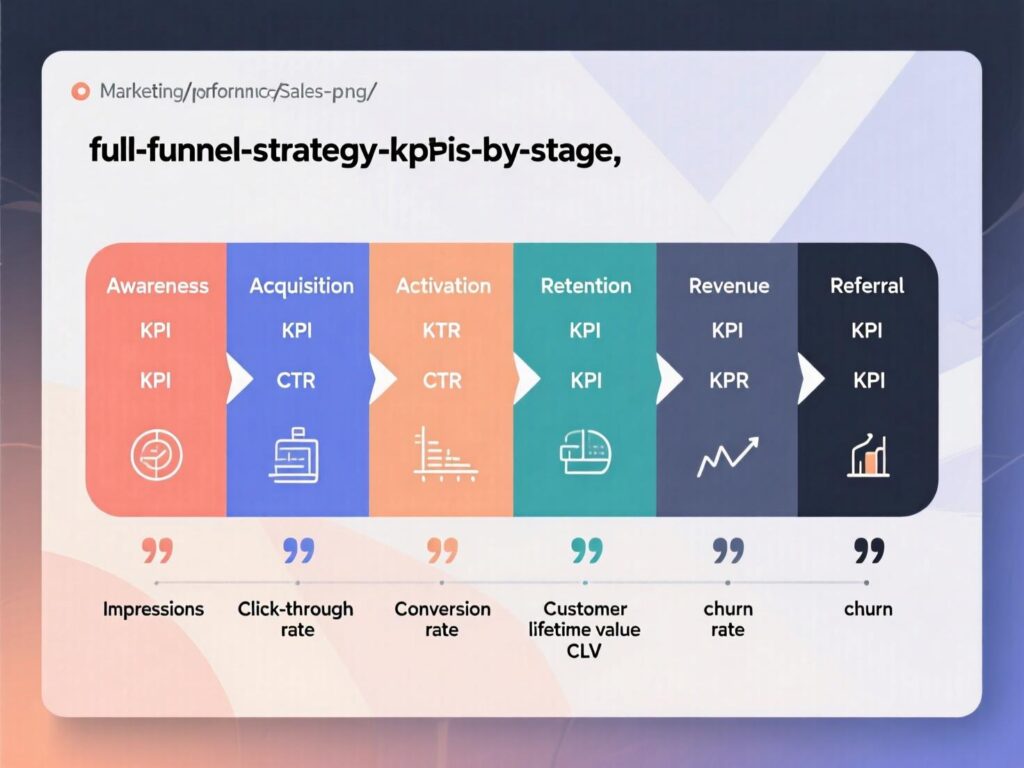
TOFU: % new qualified users, newsletter/signup rate, assisted conversions, branded search growth (Trends for relative interest; use KWP/Ahrefs/Semrush for absolute).
MOFU: demo/consult booking rate, return visitor rate, lead-to-SQL conversion, evaluator content depth.
BOFU: win rate, time-to-close, proposal acceptance, checkout completion; small-volume, high-intent keywords often drive outsized revenue.
Common pitfalls (and fixes)
Single-stage bias: Overspending on remarketing or brand without feeding the rest of the funnel. Fix: Budget by stage.
Content without next steps: Pages that don’t guide to MOFU/BOFU. Fix: Add contextual CTAs.
Unclear stage definitions: Marketing and sales disagree on what an MQL/MQA is. Fix: Shared definitions and alerts.
Measuring vanity only: Chasing pageviews or CTR in isolation. Fix: Tie stage KPIs to pipeline.
Wrapping It Up
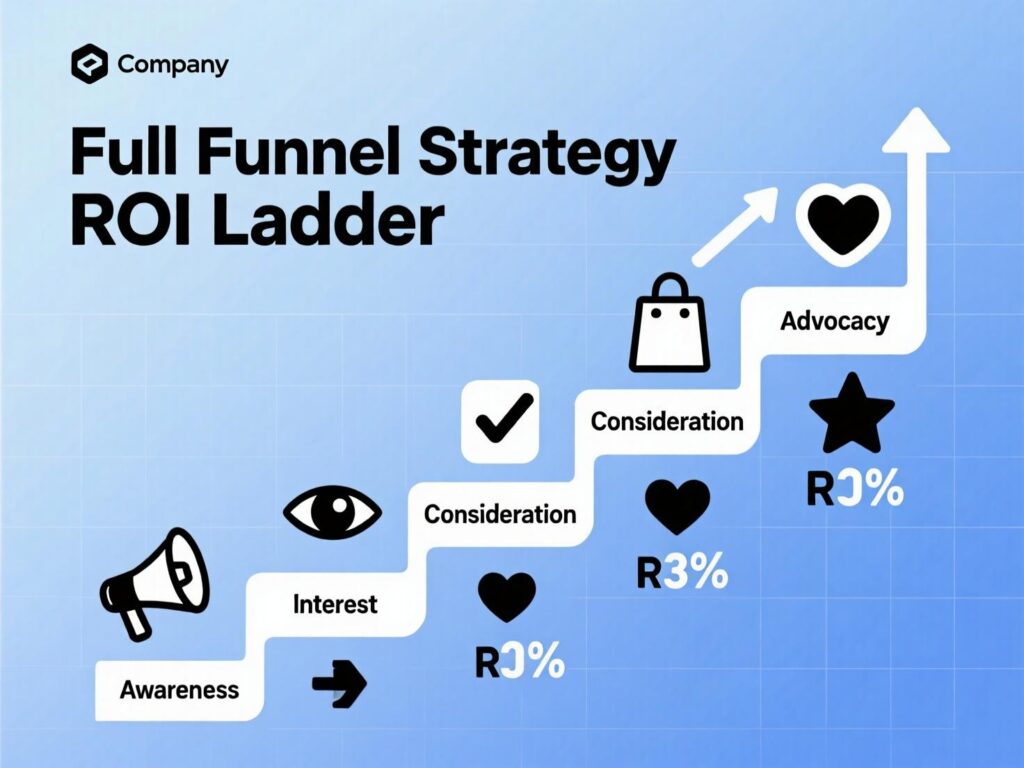
Markets fragment, channels change, and buyers self-educate. A full-funnel strategy keeps you steady: it grows future demand at TOFU, turns interest into intent at MOFU, and converts with clarity at BOFU. Start with a minimum viable set of nine assets (3 per stage), wire tracking into the journey, and review by stage each week. If you want compounding growth not just campaign spikes ship your full-funnel strategy and let each stage do its job.
CTA: Want help building a done-for-you full-funnel strategy in 30 days? Book a working session and leave with a prioritized roadmap.
FAQs
Q1) What is TOFU, MOFU, and BOFU?
A : They’re the classic marketing-funnel stages: TOFU (awareness), MOFU (consideration), BOFU (decision). Each stage maps content and CTAs to buyer intent so you move people from discovering a problem to choosing your solution.
Schema Expander:
TOFU (Top of Funnel – Awareness): Blogs, guides, glossaries, social posts.
MOFU (Middle of Funnel – Consideration): Comparisons, calculators, webinars, whitepapers.
BOFU (Bottom of Funnel – Decision): Pricing pages, case studies, demos, trials.
Q2) How do I start a full-funnel strategy from scratch?
A : Begin with one core problem you solve. Ship 3 TOFU pieces (guide, template, glossary), 3 MOFU (comparison, calculator, webinar), and 3 BOFU (pricing explainer, case study, trial). Add tracking and measure by stage weekly.
Q3) How long until a full-funnel strategy shows results?
A : Most teams see signal inside 4–8 weeks as MOFU/BOFU assets start converting warmed TOFU traffic; compounding growth typically appears over quarters as SEO and proof assets mature. Timelines vary by channel mix and deal length. (VERIFY LIVE)
Q4) How can I measure TOFU quality—not just traffic?
A : Track qualified sessions, assisted conversions, and branded search growth. Use Google Trends for relative brand interest and a keyword tool for absolute volumes.
Schema Expander: Google Trends shows normalized interest, not exact volume.
Q5) How does MOFU content improve sales velocity?
A : By answering “how it works for me” with calculators, implementation guides, and case studies, prospects reach sales already aligned, reducing discovery time and objections.
Q6) How can BOFU conversion improve with small keywords?
A : High-intent, low-volume keywords (e.g., “[brand] pricing”) often carry disproportionate revenue. Prioritize clarity on pricing, risk-reversal, and proof.
Q7) How do I align marketing and sales around the funnel?
A : Set shared stage definitions (MQL/MQA), create mutual action plans, and sync alerts for key behaviors (pricing page views, demo replay).
Q8) What channels fit each funnel stage?
A:
TOFU: social, PR, SEO.
MOFU: SEO, comparison pages, email nurture.
BOFU: high-intent search, review sites, SDR outreach.
Balance spend across stages to avoid plateaus.
Q9) How can PPC support a full-funnel strategy?
A : Use discovery formats for TOFU, competitor & category terms for MOFU, and brand + “pricing/alternative” for BOFU. Model impact on the whole funnel—not just last-click ROAS.
Hello! We are a group of skilled developers and programmers.
Hello! We are a group of skilled developers and programmers.
We have experience in working with different platforms, systems, and devices to create products that are compatible and accessible.