

GCC Data Protection Laws: A Riyadh & Dubai Guide
GCC Data Protection Laws: A Riyadh & Dubai Guide

GCC Data Protection Laws for Business in Saudi & UAE
GCC data protection laws in Saudi Arabia, the UAE and Qatar require businesses to protect personal data, implement strong cybersecurity controls, and respect data subject rights in a way that is broadly similar to GDPR. For companies in Riyadh, Dubai or Doha, compliance means knowing where personal data lives, choosing compliant cloud hosting, and aligning policies, processes and security tools with regulators like SDAIA, TDRA and QCB.
Introduction
GCC data protection laws have moved from “legal fine print” to board-level priorities, especially in Saudi Arabia, the UAE and Qatar. Saudi Arabia’s Personal Data Protection Law (PDPL) is now fully enforceable, while the UAE PDPL and Qatar’s Personal Data Privacy Protection Law are reshaping how organisations collect, store and transfer data across the region.
In simple terms, GCC data protection laws now expect every business to know what personal data it holds, protect it with strong cybersecurity, and be ready to respond quickly if something goes wrong. For owners, CISOs and compliance teams in Riyadh, Dubai, Abu Dhabi or Doha, the question is no longer if these rules apply, but how fast you can build a practical roadmap.
For many organisations, that roadmap touches everything from secure web platforms and APIs built with partners like Mak It Solutions to cloud hosting, vendor selection and bilingual (Arabic/English) consent journeys.
What Are the Main GCC Data Protection Laws?
Core GCC data protection laws at a glance
Across the GCC, the main pillars are.
Saudi Arabia
PDPL supervised by SDAIA/NDMO, now fully enforceable since 14 September 2024.
UAE
Federal Decree-Law No. 45 of 2021 (UAE PDPL), complemented by sector and free-zone regimes.
Qatar
Law No. 13 of 2016 on Personal Data Privacy Protection, with breach and consent guidelines issued by the competent ministry. ([DLA Piper Data Protection][3])
Bahrain has its own Personal Data Protection Law (Law No. 30 of 2018), while Kuwait and Oman use sectoral and e-transaction frameworks that increasingly mirror international standards.
If your business is selling to customers in Riyadh, Jeddah, Dubai, Sharjah or Doha, it is increasingly difficult to say “these laws don’t apply to us”. Even SMEs handling basic customer registration data are in scope.
How GCC cybersecurity regulations link to data privacy
These privacy laws sit on top of cybersecurity standards. In Saudi Arabia, the National Cybersecurity Authority’s Essential Cybersecurity Controls (ECC) and SAMA’s Cybersecurity Framework set minimum cybersecurity requirements for financial and other regulated entities.TDRA’s Information Assurance Regulation plays a similar role for critical UAE entities, especially telecom and digital government platforms.
In practice, if controls like access management, logging, encryption and vendor risk management are weak, you will struggle to meet your PDPL-style obligations. That is why cybersecurity standards for GCC organisations are now discussed together with privacy, not separately.
Key terms GCC businesses must understand
For leadership teams in Riyadh, Dubai or Doha, a few concepts are non-negotiable:
Personal data / sensitive data: any data that can directly or indirectly identify a person (customer ID, IBAN, mobile number, health data, geolocation).
Controller / processor: the business deciding “why and how” data is processed vs. vendors processing it on its behalf.
Data localisation & cross-border transfer: when data must stay in KSA/UAE/Qatar, and when it can move to EU or US clouds with appropriate safeguards.
DPO / Privacy Lead & DPIA: human oversight and risk assessments for high-risk processing (open banking APIs, health platforms, government portals).
How Saudi, UAE and Qatar Data Protection Laws Compare
Saudi Arabia PDPL and NCA cybersecurity controls
In Saudi Arabia, PDPL sits alongside the NCA’s ECC and NDMO/SDAIA policies, while SAMA adds extra expectations for banks, fintechs and payments institutions.
A Riyadh or Jeddah fintech is typically expected to:
Host critical workloads in KSA (often AWS me-south-1 or local providers).
Encrypt data at rest and in transit.
Maintain strong IAM, logging and monitoring.
Tightly govern third-party processors through contracts and due diligence.
For many Saudi organisations, the practical rule is: if customer data is core to your service, assume regulators will care how and where it is hosted.
UAE PDPL, ADGM and DIFC regimes
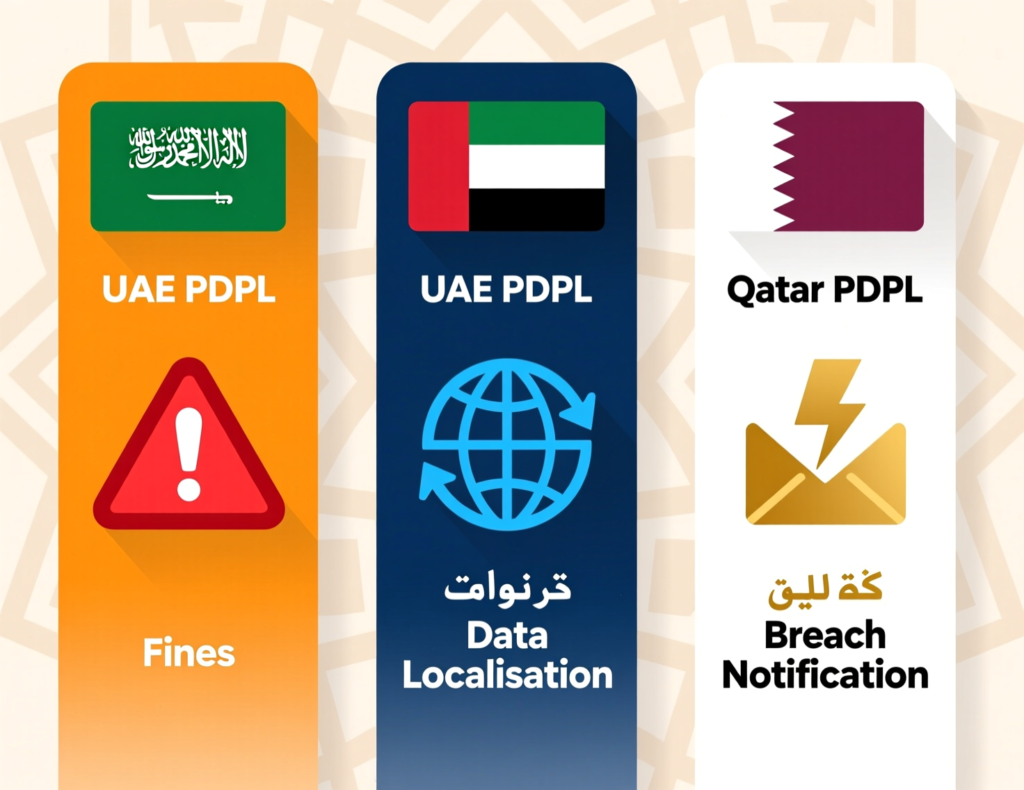
In the UAE, you have three layers:
The federal UAE PDPL.
ADGM’s Data Protection Regulations 2021.
DIFC’s own GDPR-style framework. ([U.AE][2])
TDRA sets security expectations for telecom, digital government and many cloud-backed services, while the Central Bank of the UAE drives cybersecurity maturity in financial services. ([tdra.gov.ae][6])
Dubai and Abu Dhabi businesses often balance these rules with practical choices like using Azure UAE Central or local data centres to keep sensitive data within the country.
Qatar PDPL and sector rules
Qatar’s Law No. 13 of 2016 introduced EU-style data subject rights and consent requirements, with guidance suggesting breach notifications within 72 hours in some cases.
For Doha-based banks and fintechs, the Qatar Central Bank layers cyber and outsourcing expectations on top of PDPL duties, while critical infrastructure suppliers to government must align hosting and security choices with national requirements.
GDPR vs GCC Data Protection Laws
Similarities GCC companies recognise
Most GCC PDPL-style laws borrow familiar GDPR concepts: lawful bases for processing, transparency, purpose limitation, security, data subject rights (access, correction, deletion) and breach notifications.
Like GDPR, violations can lead to significant fines and reputational damage, especially if rights are ignored or breaches are hidden.
For GCC companies already serving EU or UK customers, this creates useful overlap: the same mindset of accountability, documentation and “privacy by design” is expected.
Key differences GCC businesses must plan for
However, GCC data protection laws place more emphasis on data localisation, state and security interests, and bilingual (Arabic/English) consent flows.
For example:
Saudi PDPL narrowly restricts some cross-border transfers unless adequacy or specific safeguards exist.
ADGM and DIFC are closer to GDPR in their transfer tools and international outlook. ([PwC][12])
Regulators like SAMA, TDRA and QCB often combine privacy and cybersecurity supervision in a more centralised way than many EU regulators. ([sama.gov.sa][13])
If you apply a “copy-paste GDPR” approach without checking localisation rules in KSA, UAE and Qatar, you risk non-compliance.
What multinationals with EU–GCC data flows should do
For EU-headquartered groups with teams in Riyadh, Dubai, Sharjah or Doha, the safest approach is to:
Treat GCC laws as additional to GDPR, not simply “copies”.
Map EU–GCC data flows, especially cloud hosting, support tickets and shared analytics platforms.
Use SCC-style or contractual protections plus data localisation requirements in GCC where mandated.
Align vendor reviews, DPIAs and SOC controls across both regimes so audits and board reporting stay consistent.
Why Cybersecurity Controls Are Now Mandatory for GCC Compliance
Why Saudi and UAE regulators push data localisation
Saudi Arabia and the UAE see data as a sovereignty and resilience issue. That is why you increasingly hear about “Saudi-hosted” or “UAE-hosted” SaaS, often in AWS Bahrain, AWS UAE, Azure UAE Central or Google Cloud Doha.
Data residency reassures regulators that financial, health and government data from Riyadh, Dammam, Dubai or Abu Dhabi is protected under local law and subject to local oversight.

How weak cybersecurity leads directly to non-compliance
Ransomware, misconfigured cloud buckets or unpatched web apps do not just create IT incidents they often mean unlawful processing, unauthorised disclosure or failure to implement “appropriate security measures” under PDPL-style rules.
For GCC businesses, personal data breach reporting in Saudi and UAE is only credible if logs, alerts and incident response run 24/7, with clear playbooks and named owners.
Business case for SMEs
For SMEs in Jeddah, Sharjah or Doha, this can feel like heavy compliance. But robust security and privacy programmes are now prerequisites to win contracts with banks, telcos and government entities aligned with Saudi Vision 2030 and UAE digital government strategies.
By investing early – sometimes together with a partner that can harden your web stack or APIs through web development services or front-end engineering you turn “checkbox” compliance into a sales advantage.
Building a GCC Compliance Roadmap: From Policy to Technology
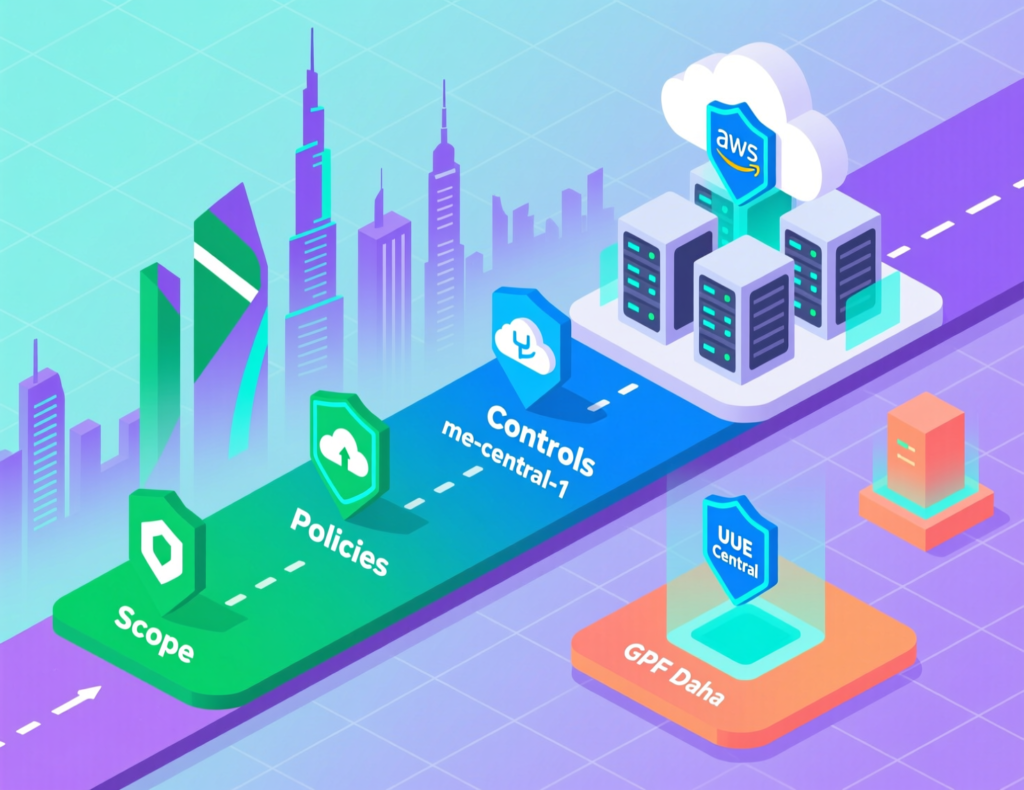
Understand scope, map data, classify systems
Start by defining which entities, apps and countries fall under each law (Saudi, UAE, Qatar, Bahrain, Kuwait, Oman).
Then.
Map personal and sensitive data across CRMs, mobile apps, payment gateways and analytics.
Include cloud hosting and data residency in Middle East regions like AWS me-south-1, me-central-1, Azure UAE Central and GCP Doha.
Classify systems by criticality so that fintech or health workloads receive stricter controls than marketing sites.
Design policies, processes and governance
Next, create or refresh privacy and cybersecurity policies, appoint a DPO or Privacy Lead, and define a clear RACI between IT, security, legal and business units in Riyadh, Dubai and Doha.
Build incident and breach playbooks aligned with PDPL, UAE PDPL and Qatar PDPL timelines, then embed them into realistic runbooks, not just PDF manuals.
Implement cybersecurity controls and ongoing monitoring
Finally, implement controls that regulators actually look for: NCA ECC, SAMA and UAE IA expectations for governance, identity, encryption, monitoring and vendor risk.
That may include
A SOC and meaningful log retention.
Vulnerability and patch management.
Regular reviews of SaaS and development partners.
For many GCC companies, combining internal teams with a specialised external partner – for example, to build compliant APIs with Flask development services or to refactor legacy web platforms – is the most realistic way to keep up.
Country-Specific Practical Examples: Saudi, UAE, Qatar
Saudi fintech preparing for PDPL and SAMA guidelines
A Riyadh-based open-banking fintech serving customers in Dammam starts by hosting core banking APIs and analytics in Saudi or nearby GCC regions, tightening IAM and encryption to meet NCA ECC and SAMA CSF.
It then updates consents, privacy notices and vendor contracts to reflect Saudi PDPL, including cross-border safeguards when using EU-based analytics vendors.
Dubai e-commerce startup handling GCC customer data
A Dubai e-commerce brand selling to Riyadh, Jeddah and Doha customers hosts its storefront on a secure stack (for example, modern front-end and web development), ensures card data is processed by compliant payment gateways, and uses bilingual consent banners that distinguish UAE PDPL requirements from those in Saudi and Qatar.
Qatar government supplier aligning with QCB and PDPL
A Doha-based systems integrator supporting a government or QCB-regulated client chooses Google Cloud Doha and/or Azure Qatar Central where available, keeps production data in-country, and restricts offshore access to anonymised logs.
It implements breach notification and data subject response processes consistent with Qatar PDPL guidelines and government security baselines.
When to Bring in External Help (and What to Look For)
Signs your business needs a GCC compliance assessment
Typical triggers include.
New RFPs from Saudi or UAE banks.
Onboarding as a supplier to a Dubai or Doha government entity.
Moving workloads to AWS Bahrain or Azure UAE.
Experiencing a recent security or privacy incident.
If you cannot easily answer basic questions like “Where is our customer data from Riyadh and Sharjah physically stored?” it is time to ask for help.
Choosing the right GCC cyber and privacy partner
Look for partners who.
Understand SAMA, NCA, TDRA, QCB and sector guidance.
Can work comfortably in Arabic and English with teams spread across Riyadh, Jeddah, Dubai, Abu Dhabi and Doha.
Combine consulting with build-and-run capabilities such as secure web development, business intelligence services and digital marketing analytics.
That way, your roadmap turns into working technology, not just a slide deck. ([makitsol.com][15])
Typical timelines, costs and engagement models
Most GCC programmes run in phases:
A 4–8 week gap assessment and data-mapping exercise.
A remediation phase where policies, controls and platforms are upgraded.
Ongoing managed services or periodic audits.
Rather than chasing the cheapest quote, focus on partners who can stay with you through cloud migrations, app rebuilds and future regulator reviews not just deliver a one-off report.

Last Words
GCC data protection laws are turning privacy and cybersecurity into a single, regulator-driven change programme for organisations across Saudi Arabia, the UAE, Qatar and the wider region. Instead of treating PDPL, UAE PDPL and Qatar PDPL as abstract legal texts, high-performing teams are using them as blueprints to modernise cloud hosting, data architecture and app security.
If you are unsure where to start, begin with a realistic inventory and a short, focused roadmap then bring in specialist support where your internal capabilities stop. That combination is what turns GCC data protection laws from a source of risk into a long-term competitive advantage.
This article provides general information only and does not constitute legal or regulatory advice. Always consult qualified counsel or advisers for your specific situation.
If you want to align your apps, data and cloud strategy with GCC data protection laws, you do not have to figure it out alone. Reach out to Mak It Solutions to review your current platforms, map your data and design a practical roadmap across Saudi, UAE and Qatar.
Whether you need secure web development, BI dashboards or API-driven platforms, our team can help you build compliance into the technology stack from day one. ( Click Here’s )
FAQs
Q : Is Saudi PDPL already fully enforced, and what does that mean for existing customer data in Riyadh or Jeddah?
A : Yes. Saudi Arabia’s PDPL is now fully enforceable, which means organisations processing personal data about individuals in the Kingdom must treat privacy and security as ongoing obligations, not future plans. Existing customer records in Riyadh, Jeddah or Dammam should be reviewed for lawful basis, retention, consents and data minimisation, and any unnecessary or unlawful data should be archived or deleted. You should also implement NCA ECC-aligned controls and be ready to demonstrate compliance if SDAIA, NDMO or sector regulators such as SAMA request evidence.
Q : Do UAE free zone companies in ADGM or DIFC follow the same data protection rules as mainland UAE businesses?
A : No. Mainland UAE entities primarily follow the federal UAE PDPL, while ADGM and DIFC have their own GDPR-style data protection regulations with separate regulators and guidance. A Dubai business operating in both zones may therefore need to comply with multiple frameworks at once, mapping which processing activities sit under UAE PDPL vs. ADGM or DIFC rules. Practically, that often means standardising to the strictest common denominator and then checking local nuances such as breach notification channels and cross-border transfer tools recommended by TDRA and each free-zone authority.
Q : What are the typical penalties for breaching Qatar’s Personal Data Privacy Protection Law for SMEs in Doha?
A : Under Qatar’s PDPL, regulators can impose administrative sanctions and, in serious cases, criminal penalties, including fines that can reach into the hundreds of thousands of Qatari riyals. For SMEs in Doha, the bigger risk is often investigation, reputational damage and contract loss with QCB-regulated or government clients rather than the headline fine alone. Non-compliance with consent, security or breach notification expectations can trigger scrutiny, especially where sensitive or children’s data is involved. Building PDPL-aligned policies, technical controls and training helps reduce these risks while supporting Qatar’s broader digital-government agenda.
Q : Can GCC companies store customer data in European or US clouds if they follow strong cybersecurity controls?
A : In many cases, yes but only if cross-border transfer conditions are met. Saudi PDPL, UAE PDPL and Qatar PDPL all restrict transfers outside their jurisdictions unless adequate protection, contractual safeguards or specific exemptions apply, and some sectors (like banking or government) impose extra localisation rules. Strong encryption, SOC monitoring and vendor due diligence are necessary but not sufficient on their own; you also need appropriate legal mechanisms and, in some cases, regulator approvals. When in doubt, GCC companies should prioritise local cloud regions such as AWS Bahrain, AWS UAE, Azure UAE Central and GCP Doha, then add carefully-governed external processing where needed.
Q : Do Bahrain, Kuwait and Oman have data protection laws similar to Saudi and UAE, and should regional HQs treat them differently?
A : Bahrain already has a comprehensive PDPL (Law No. 30 of 2018) with its own authority and guidance, while Kuwait and Oman rely on a growing mix of e-transaction, cybercrime, telecoms and sectoral rules that increasingly resemble PDPL-style frameworks. For regional HQs in Dubai or Riyadh, the safest approach is to maintain a single high baseline (inspired by GDPR, Saudi PDPL and UAE PDPL) and then layer country-specific rules on top. That means monitoring updates from Bahraini, Kuwaiti and Omani regulators and aligning with cross-GCC initiatives, Vision 2030 projects and national CERT guidance, especially when handling financial, health or government data.