

GraphQL vs REST for Startups in the US & EU
GraphQL vs REST for Startups in the US & EU
GraphQL vs REST for Startups in the US & EU
In 2025, the real difference between GraphQL and REST is that GraphQL exposes a single strongly typed schema where clients ask for exactly the fields they need, while REST exposes multiple fixed endpoints that return predefined resource shapes. For teams in the US, UK and EU, the better choice depends on UI complexity, client types, performance and caching patterns, and compliance needs — not on the assumption that one style is always faster or more secure.
Introduction
The GraphQL vs REST decision in 2025 is no longer just a “developer preference” debate. It shapes product velocity, mobile performance, observability, and even regulatory compliance across the US, UK and EU. With AI-heavy features, multi-tenant SaaS dashboards and global mobile apps becoming the norm, your API style can quietly accelerate teams or slow them down.
REST is an architectural style where you expose resources via multiple HTTP endpoints, typically returning JSON over HTTP.GraphQL is a query language and runtime where a single strongly typed schema lets clients specify exactly which data they need in one request.
Practically, the GraphQL vs REST choice affects how your teams design frontends, handle mobile constraints, manage performance and caching, and prove compliance with GDPR/UK-GDPR, HIPAA and PCI DSS. It also influences how easily you can evolve your platform from San Francisco and Austin to London, Berlin and Munich.
What is the real difference between GraphQL and REST in 2025?
In 2025, the core difference between GraphQL and REST is simple:
GraphQL exposes a single, strongly typed schema that clients query flexibly.
REST exposes multiple fixed resource endpoints with predefined response shapes.
GraphQL is inherently client-driven (the client asks for specific fields), while REST is more server-driven (the server decides what each endpoint returns).
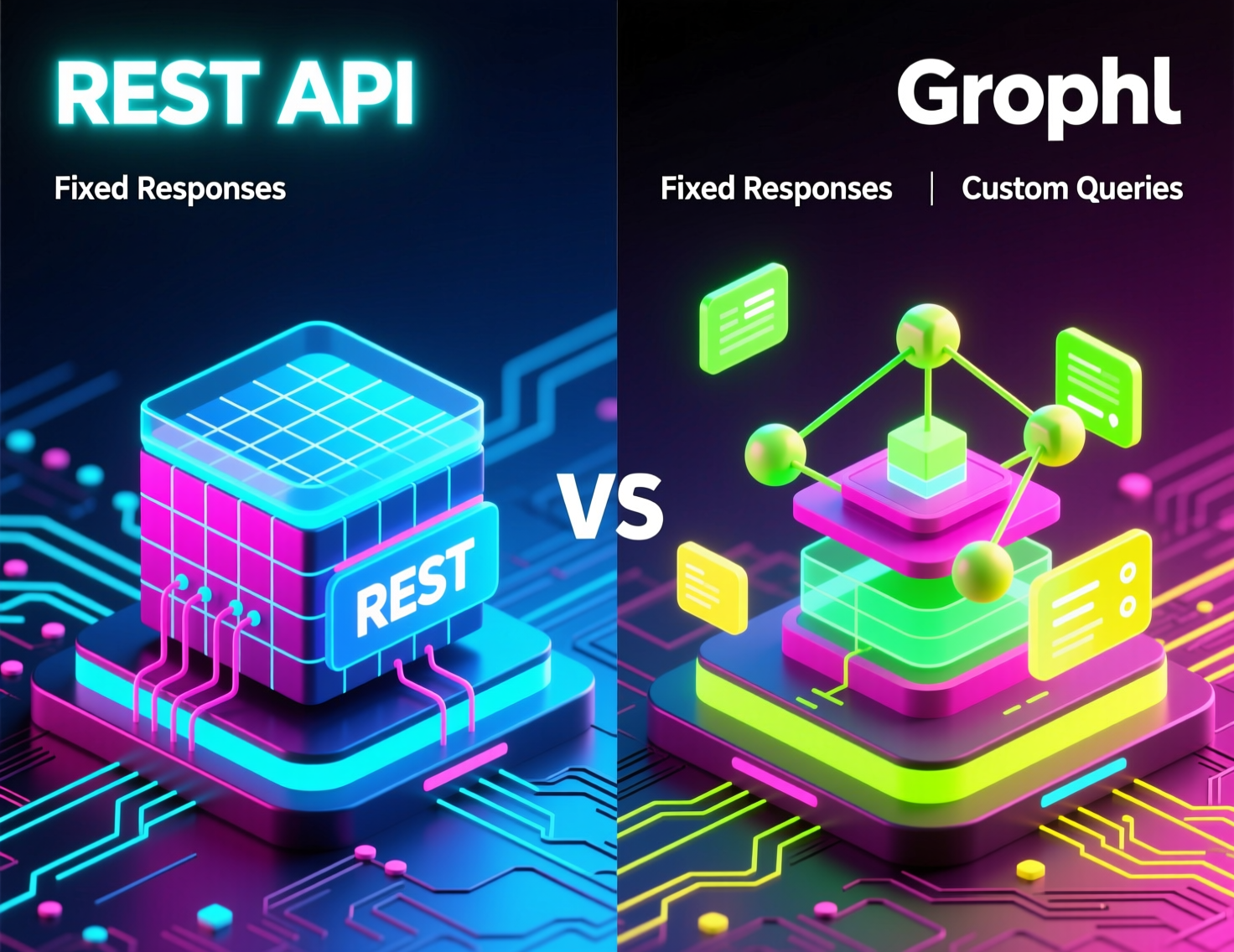
GraphQL vs REST API at a glance (single endpoint vs multiple endpoints)
In a typical REST API, you model your domain as resources.
Each resource supports standard HTTP verbs (GET, POST, PUT, DELETE). REST works well when resources and their representations change slowly and when it’s acceptable to return a few extra fields in each response.
GraphQL flips that model. You define a strongly typed API schema (types, fields, relationships) and expose a single endpoint such as. Clients send queries describing exactly which fields they want; the server resolves them and returns a JSON response that mirrors the query shape.([GraphQL][2])
That design directly tackles:
Overfetching getting more data than a screen needs (very common with REST).
Underfetching getting too little and needing multiple round-trips.
Client-driven data fetching GraphQL lets a React, iOS or Android client pull just the fields needed for each view, which matters a lot on slower mobile networks.
For teams already managing complex backends (for example via Back End Development Services or broader SaaS platform development), this choice shapes how easily they can evolve their API surface over time.
GraphQL vs REST pros and cons for modern teams
GraphQL – Pros
One strongly typed schema powers documentation, IDE autocomplete and schema-driven tools.
Excellent DX with tools like GraphiQL, Apollo, Relay and schema registries.
Great for client-driven data fetching in React/Next.js, iOS and Android apps.
Ideal for aggregation and federation across many microservices (for example, via platforms like or other modern headless CMS stacks)
Strong fit for headless architectures like those covered in Mak It Solutions’ Headless CMS content.
GraphQL – Cons
The gateway layer adds complexity (N+1 queries, query cost analysis, schema governance).
HTTP caching is not automatic; you typically rely on client caching (Apollo, Relay) or edge gateways.
Steeper learning curve for teams who only know REST.
REST – Pros
Simple mental model; widely understood by vendors and partners.
Mature HTTP caching and CDN behaviour.
Excellent observability: per-endpoint metrics are easy to reason about.
Default choice for many standards (Open Banking, government APIs, legacy enterprise stacks)
REST – Cons
Overfetching/underfetching pain in complex UIs.
Versioning and endpoint sprawl over time.
Multiple round-trips from mobile clients and SPAs.
Cloud vendors and platforms like Strapi, Hygraph and Memgraph generally share the same pattern. GraphQL can unlock powerful experiences, but needs careful schema, caching and security design; REST remains the baseline for simpler or highly interoperable integrations.
GraphQL vs REST example for beginners (simple feature walk-through)
Imagine a product team in San Francisco, London or Berlin building a dashboard that shows a user profile plus their latest orders.
REST-style.
Mobile clients may call both endpoints on every screen load, possibly getting fields they never show.
GraphQL-style.
Here, the frontend declares its exact data needs in a single request. On a congested 4G network in New York or Manchester, trimming payload size and round-trips can noticeably improve perceived performance.
The same pattern underpins many headless commerce and CMS builds (for example, Shopify/WooCommerce frontends or headless CMS integrations) that agencies like Mak It Solutions deliver for US and EU brands, often using architectures described in Headless CMS and Shopify vs WooCommerce content.
Why is GraphQL often a better fit for complex frontends and mobile apps than REST?
GraphQL is often a better fit for complex frontends and mobile apps because it lets each client request exactly the data its screens need in a single round-trip, avoiding the overfetching and underfetching common with REST. This is attractive for multi-device SaaS platforms and consumer apps in the US, UK and EU that must perform well on variable mobile networks.
Overfetching vs underfetching.
Overfetching happens when a REST endpoint returns far more data than a view needs.
Underfetching happens when it returns too little and the client must call additional endpoints.
Both scenarios increase latency and bandwidth usage particularly painful for mobile apps and single-page applications.
GraphQL’s selection sets let clients describe exactly what they need, and nothing more. In a global app serving users across the US, UK, Germany, France and the Nordics, this means:
Smaller payloads for low-bandwidth users (for example, commuters in London or Berlin on 3G/4G).
Fewer round-trips for chatty dashboards or AI-powered views.
Easier evolution of UI requirements without constantly adding REST endpoints.
For teams already thinking in terms of component-level data (React, Next.js, Vue), GraphQL fits naturally with patterns Mak It Solutions uses in modern web development services and backend API design.

GraphQL vs REST for mobile apps and complex frontends
Real-world scenarios where GraphQL shines.
React/Next.js frontends consuming a single GraphQL endpoint for complex dashboards, similar to those fronting a headless CMS.
iOS/Android apps that need stitched data (user + permissions + latest notifications) with minimal battery and bandwidth impact.
Multi-tenant SaaS dashboards serving different roles (admin, finance, operations) with highly customised views.
Headless CMS & e-commerce (Strapi, Hygraph, Shopify storefront APIs) where frontends can compose content and catalog data flexibly.
One study cited in a 2025 review found that apps switching from REST to GraphQL saw around 60–70% better response times, mainly by eliminating redundant network calls and payload bloat.
GraphQL vs REST for microservices and API gateways on AWS/GCP
For microservices, the most common pattern in 2025 is.
REST inside, GraphQL at the edge.
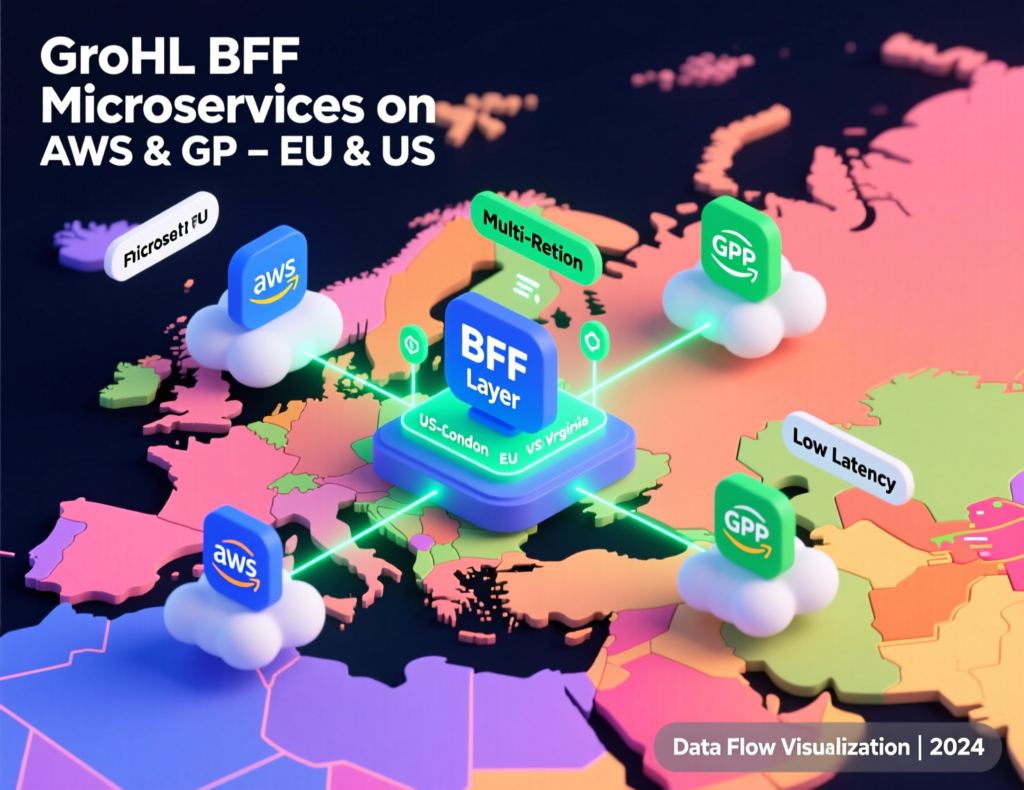
Internal services expose narrowly scoped REST or gRPC APIs, while a GraphQL BFF (backend-for-frontend) or aggregation layer sits on top and orchestrates calls.
Managed services like and modern API gateways on AWS, GCP and Azure make it easier to implement this pattern combining GraphQL at the edge with REST/gRPC behind the scenes.
This pattern suits distributed SaaS platforms in New York, Amsterdam or Stockholm that need to serve multiple surfaces (web app, admin console, partner portal, public API) from the same underlying microservice mesh.
Mak It Solutions often couples this with hosting choices across US and EU regions and rendering strategies explained in server-side rendering vs static generation to balance performance, SEO and compliance.
What types of projects still make more sense with REST than GraphQL?
REST is still a better fit when your project is simple, highly stable or heavily constrained by partner standards – for example, basic CRUD APIs, line-of-business applications, or regulated ecosystems where REST/JSON is the expected interface. In these cases, GraphQL’s additional gateway logic can be overkill.
When to use REST instead of GraphQL.
Use this quick checklist when weighing when to use GraphQL vs REST.
Simple CRUD API
A back-office tool or internal line-of-business app where every screen maps cleanly to one or two resources.
Low-change, long-lived integrations
Partner APIs where breaking changes are rare and contracts are stable for years.
Strict HTTP caching needs
Content-heavy sites where you rely on CDNs caching full page or resource responses.
Smaller teams
If your team in Austin or Manchester doesn’t have the bandwidth to operate a GraphQL gateway, mature REST with OpenAPI can be the safest call.
Conservative ecosystems
When you’re integrating with older systems that only “speak REST”.
This is exactly the kind of pragmatic trade-off Mak It Solutions helps teams navigate in backend development projects, especially where budgets and timelines are tight.
REST vs GraphQL in regulated integrations and legacy ecosystems
Many ecosystems remain REST-first.
Banking and Open Banking (PSD2) in the UK, Germany and wider EU mostly standardise on RESTful JSON APIs to guarantee interoperability between banks and fintechs.([Open Banking
Legacy ERP, SOAP and XML stacks still dominate in some manufacturing and public sector environments.
Government APIs often default to REST, as reflected in.
In these contexts, introducing GraphQL at the edge may still be useful for your own apps, but the “northbound” contract to partners will remain REST or even SOAP/gRPC for years.
Why some teams regret migrating from REST to GraphQL
Common complaints you’ll see on engineering blogs and Reddit when teams rush into GraphQL include.
Operational complexity: Schema registry, breaking change management, query whitelisting.
Caching surprises: No out-of-the-box HTTP caching, leading to higher cloud bills.
Underestimated N+1 problems: Poor resolver design hammering databases.
Lack of governance: Fields proliferate quickly without clear ownership.
These stories are a useful warning: if you go GraphQL, treat the gateway as a product with clear ownership, SLAs and tooling the same way Mak It Solutions structures complex backend and API programmes for clients in the US and EU.
How do GraphQL and REST compare for performance, caching and scalability?
GraphQL is not automatically faster than REST. Performance depends on query patterns, schema design, caching and infrastructure. In some high-traffic SaaS benchmarks, well-designed GraphQL APIs outperform equivalent REST endpoints, while naïve GraphQL gateways can actually be slower and more expensive.
GraphQL vs REST performance benchmarks for high-traffic SaaS
Studies and case studies from 2023–2025 broadly show.
Moving from very chatty REST endpoints to consolidated GraphQL queries can cut network calls and payload sizes significantly, improving end-user latency by roughly 40–60% for some mobile flows.
Poorly constrained GraphQL queries (deep nesting, no limits) can spike CPU, memory and database load under tens of thousands of requests per second common in high-traffic SaaS platforms in New York, London or Berlin.
GraphQL federation is maturing quickly, with surveys in 2024 reporting that over 70% of respondents had more than a year of federation experience – a sign that large organisations are now running GraphQL at serious scale.
For many Mak It Solutions clients, the biggest performance win comes from eliminating unnecessary round-trips and designing clear query complexity limits, rather than the protocol choice alone.
Caching in GraphQL vs REST: what actually changes?
With REST.
CDNs like CloudFront or Cloud CDN cache by URL and headers an easy win for static or semi-static content.
With GraphQL.
Everything goes through one endpoint so CDNs can’t cache easily by URL alone.
Caching often moves to:
The client cache (Apollo/Relay normalised cache).
A GraphQL gateway cache that understands query signatures and variables.
Pattern-based edge caching at API gateways (for example, pinning certain “public query” signatures).
This is why many teams mix approaches REST for highly cacheable public content (for example, catalogs or CMS lists) and GraphQL for tailored, user-specific experiences. That hybrid is also easy to combine with rendering strategies discussed in Mak It Solutions’ server-side rendering vs static generation article.
Observability, monitoring and cost control
REST
Metrics naturally align to endpoints, which is great for SLOs and cost attribution.
GraphQL
You get per-query or even per-field metrics, which can be extremely powerful but require better tooling and schema discipline.
For teams running at scale on AWS, Azure or Google Cloud across US and EU regions, the key is to:
Track query cost per tenant and per feature.
Set clear limits on depth, complexity and timeouts.
Integrate GraphQL gateway metrics into central observability stacks (Prometheus, Datadog, OpenTelemetry).
These practices increasingly form part of structured backend development services Mak It Solutions provides for SaaS platforms that want to control cloud spend while scaling.

Security, compliance and GEO realities.
Security and compliance are driven far more by architecture, controls and processes than by choosing GraphQL vs REST. Both styles can be made compliant with GDPR/UK-GDPR, HIPAA, PCI DSS and PSD2/Open Banking or misconfigured badly.
Nothing in this article is legal or financial advice. For regulatory questions, always consult qualified counsel or your internal compliance team.
GraphQL vs REST security basics (auth, authZ, rate limits)
Key points that apply to both styles.
Use OAuth 2.0 / OIDC for authentication and token-based session management.
Apply fine-grained authorization at field or resource level.
Rate limit and throttle abusive clients.
GraphQL adds some specific concerns.
Introspection: great in development, but often restricted in production to reduce schema reconnaissance.
Deep query nesting & recursion: can be abused to exhaust resources if not constrained.
N+1 queries: if not optimised, they can leak timing patterns or amplify DoS impact.
REST brings its own issues (ID enumeration, insecure query parameters, inconsistent auth), but the standardisation of REST security patterns remains an advantage, especially in regulated sectors.
GDPR / DSGVO, UK-GDPR and EU data protection for APIs
Under GDPR/DSGVO and UK-GDPR, principles like data minimisation, purpose limitation and privacy by design apply regardless of API style.
With GraphQL, it’s easy to expose too many fields in a single type. You must:
Limit which fields are accessible to which roles.
Avoid exposing “internal only” relationships by default.
Design selection sets consciously for data minimisation.
With REST, the risk is endpoint sprawl dozens of endpoints that each leak small pieces of personal data.
Regulators like BaFin and the European Banking Authority expect evidence of technical and organisational measures access control, logging, DPIAs rather than a specific API style. For cross-border SaaS in Germany, the Netherlands or Nordics, you’ll also need to map how your APIs interact with EU regional hosting (for example, AWS eu-central-1, Azure West Europe).
HIPAA, PCI DSS, PSD2, NHS and Open Banking
US healthcare & HIPAA
APIs that process PHI must comply with the HIPAA Security Rule’s requirements for confidentiality, integrity and availability, including technical safeguards like encryption and audit logging.GraphQL can work here, but you must tightly scope fields that expose PHI and log all access particularly as HHS enforcement expectations rise in 2025.
Fintech & PCI DSS / PSD2
Payment APIs in the US, UK, Germany and wider EU must align with PCI DSS 4.0 and, for EU/UK banks, PSD2/Open Banking standards, most of which are REST/JSON-centric. A GraphQL layer may still drive your apps, but card and payment rails will usually expose REST.
UK public sector & NHS
GOV.UK and NHS-related integration guides still lean heavily on RESTful patterns, promoting clear endpoint-level contracts and documentation.
In all these sectors, Mak It Solutions typically advocates a compliance-first architecture (threat modelling, DPIAs, audit logs, data mapping) and only then decides whether GraphQL, REST or a mix best serves the use case, including in regions like Saudi Arabia and the UAE where backend development services for growth are increasingly API-led.
How should engineering teams decide between GraphQL and REST for new APIs in 2025?
Teams in the US, UK and EU should decide between GraphQL vs REST by starting from their use case, client diversity, performance and compliance needs then choosing a pure or hybrid model. In many cases, the winning pattern is REST for public and partner integrations plus GraphQL as an aggregation layer for internal and product-facing clients.
Step-by-step decision framework (with US/UK/EU examples)
Use this 7-step checklist.
Domain complexity
Many interconnected entities and screens? GraphQL is attractive.
Simple CRUD with stable schemas? REST probably wins.
Client diversity
Only one internal web client? REST is fine.
Web + mobile + partners + maybe public APIs? Consider GraphQL or a hybrid.
Performance & UX targets
Mobile-first app for commuters in New York or London? Prioritise bandwidth and round-trips → GraphQL or highly optimised REST.
Team skills & tooling
Strong TypeScript, schema-driven culture, appetite for tools like Apollo, federation, schema registries? GraphQL is a good fit.
Mostly backend generalists with existing REST best practices? Lean into REST.
Compliance regime
HIPAA, PCI DSS, PSD2/Open Banking, BaFin/NHS constraints? Map which layers must use standard REST and where a GraphQL BFF is acceptable.
Ecosystem expectations
Partners expect REST/OpenAPI contracts? Keep those RESTful.
Internal product teams craving flexibility? Offer them GraphQL.
Budget & runway
Early-stage Austin SaaS startup: maybe start with REST, add GraphQL later for the main dashboard.
London fintech or Munich Industry 4.0 platform with bigger budgets: go hybrid from day one.
Mak It Solutions often uses a similar framework when scoping backend and web development services for US, UK and German clients who want a defensible architecture rather than chasing hype.
When a hybrid GraphQL + REST strategy makes sense
A hybrid GraphQL + REST strategy is often the sweet spot:
Core integrations, partner APIs and webhooks: REST/OpenAPI.
Internal product teams and dashboards: GraphQL as BFF or federation layer.
Public content & SEO: REST + SSR/SSG frontends, as discussed in Mak It Solutions’ SSR vs Static Generation guidance.
To avoid double maintenance.
Auto-generate GraphQL schemas from existing REST/OpenAPI specs where possible.
Use API gateways that support both REST and GraphQL routing.
Introduce federation gradually for larger organisations, building on patterns highlighted in 2024 GraphQL federation surveys.([WunderGraph][13])
Implementation roadmap and when to bring in a partner
A pragmatic 30/60/90-day outline.
Days 0–30 – Discovery & pilot
Pick one product area (for example, analytics dashboard).
Map existing REST endpoints and data sources.
Build a small GraphQL or improved REST pilot with clear KPIs (latency, error rate, developer velocity).
Days 31–60 – Patterns & platform
Standardise patterns: auth, logging, error shapes, versioning.
Decide on federation, schema registry and API gateway strategy on AWS/Azure/GCP.
Document everything in living API standards (similar to for your own organisation.
Days 61–90 – Scale & harden
Extend to more domains; integrate with CI/CD and governance.
Implement rate limits, query complexity limits and central observability.
Run security reviews and compliance checks for GDPR/HIPAA/PCI/PSD2 where relevant.
This is often the stage where bringing in a specialist partner like Mak It Solutions adds value – to architect the platform, avoid known GraphQL vs REST pitfalls, and align everything with US, UK and EU regulatory realities.

Key Takeaways
GraphQL vs REST in 2025 is about schema and client flexibility vs simplicity and interoperability, not “modern vs legacy”.
GraphQL is usually better for complex frontends, mobile apps and multi-tenant SaaS dashboards, especially when overfetching and underfetching hurt UX.
REST remains the safer choice for simple CRUD, long-lived integrations and regulated ecosystems like Open Banking, NHS and many government APIs.
Performance differences depend heavily on query patterns, caching strategy and gateway design, not just protocol choice.
Both GraphQL and REST can meet GDPR/UK-GDPR, HIPAA, PCI DSS and PSD2 requirements when designed with privacy and security in mind.
For many US/UK/EU teams, a hybrid GraphQL + REST architecture offers the best blend of flexibility, compliance and long-term maintainability.
If you’re wrestling with the GraphQL vs REST decision for a new product or migration, you don’t have to guess. Mak It Solutions can help you map your domain, performance targets and compliance obligations, then design a practical API architecture REST, GraphQL or hybrid that your team can actually operate.
Reach out to our Editorial Analytics Team and request a scoped architecture review or API modernisation workshop tailored to your US, UK or EU organisation. ( Click Here’s )
FAQs
Q : Is GraphQL faster than REST for every type of request?
A : No. GraphQL is often faster when it replaces multiple REST calls with a single well-designed query, especially for mobile apps and complex dashboards. But naïve GraphQL schemas with deep nesting and no limits can be slower than REST because they trigger more resolver work and expensive joins on the backend. In many 2023–2025 benchmarks, performance comes down more to query design, database indexing and caching than to the GraphQL vs REST label.
Q : Can you use GraphQL and REST together in the same API architecture?
A : Yes, and in 2025 that’s very common. Many organisations keep external and partner-facing APIs in REST/OpenAPI form, while exposing a GraphQL BFF or gateway for internal frontends and mobile clients. Microservices often remain REST or gRPC internally, with a GraphQL layer aggregating data for React, iOS and Android apps. This hybrid model lets you benefit from GraphQL’s flexibility without breaking compatibility with existing REST ecosystems, especially in fintech and public-sector contexts.
Q : How hard is it to migrate an existing REST API to GraphQL in a large enterprise?
A : Migration effort depends on the size and quality of your existing REST layer. A common approach is to wrap, not rewrite: you build a GraphQL gateway that calls your existing REST endpoints, then gradually refactor services behind the scenes. The main challenges are schema design, resolver performance (avoiding N+1 queries), governance and training developers. In large US/UK/EU enterprises, successful migrations usually start with one or two domains, prove value, then expand with strong platform and security patterns.
Q : What skills and tooling do developers need to work effectively with GraphQL vs REST?
A : REST requires solid HTTP fundamentals, JSON modelling, OpenAPI/Swagger, and knowledge of caching and versioning best practices. GraphQL adds needs around schema design, type systems, query languages, resolvers, tools like Apollo or Relay, and sometimes federation or schema registries. Both benefit from strong monitoring, security and CI/CD practices. Teams that already embrace TypeScript, schema-first design and automated testing usually adapt to GraphQL faster.
Q : How does GraphQL compare to REST and SOAP/gRPC for long-lived enterprise integrations in the EU?
A : For long-lived, heavily regulated integrations in the EU such as PSD2/Open Banking or public-sector B2B services REST and SOAP/gRPC remain the dominant choices because they’re explicitly referenced in many standards and vendor contracts.GraphQL is increasingly used internally in these organisations to power frontends and mobile apps, but the external, contract-bound interface often stays REST or SOAP for interoperability and certification reasons.