


Industrial IoT in Oil & Gas for Saudi & UAE Leaders
Industrial IoT in Oil & Gas for Saudi & UAE Leaders

Industrial IoT in Oil & Gas for Saudi & UAE Leaders
Industrial IoT in oil and gas means connecting wells, pipelines and refineries with smart sensors, secure networks and analytics so operators can spot issues early, predict failures and optimise production. In the Gulf, national oil companies in Saudi Arabia, the UAE and Qatar use industrial IoT in oil and gas to cut unplanned downtime, improve HSE performance and meet local data residency and cybersecurity requirements while staying globally competitive.
Introduction
Picture a control room in Dhahran or Abu Dhabi: a vibration anomaly pops up on a compressor, an IIoT platform flags it within seconds, and a maintenance crew is dispatched before the fault turns into a shutdown. That is industrial IoT in oil and gas in action across the Gulf.
For Saudi, UAE and Qatar operators, IIoT is becoming the practical engine of Oil & Gas 4.0 helping aging assets survive harsh desert heat, offshore humidity and relentless production targets. When it’s done well, IIoT means fewer leaks and flares, safer people, and higher utilisation from fields to refineries.
In simple terms, Gulf energy companies are using industrial IoT in oil and gas to:
Monitor critical assets in real time across remote fields, pipelines and plants
Predict failures and schedule maintenance instead of reacting to breakdowns
Run compliant, in-country data platforms that satisfy regulators and cybersecurity teams
This guide is for digital leaders, OT/IT teams and operations managers inside Aramco, ADNOC, QatarEnergy and their ecosystem of service companies who want a realistic, GCC-grounded playbook not generic Industry 4.0 slides.
What Is Industrial IoT in Oil & Gas for Gulf Operators?
From IoT to Industrial IoT in Oil & Gas
At its core, industrial IoT in oil and gas is the network of sensors, edge devices and platforms that collect data from wells, pipelines, rotating equipment and process units then turn that data into decisions. Unlike consumer IoT, IIoT devices are built for explosive atmospheres, extreme temperatures and high reliability, and must integrate tightly with SCADA, DCS and safety systems rather than just a mobile app.
Oil & Gas 4.0 and Industry 4.0 Narratives in the GCC
Saudi Aramco, through Aramco Digital and initiatives like SAIL, positions digitalisation as central to its production and safety strategy. ADNOC’s Oil & Gas 4.0 narrative links advanced analytics and automation to better recovery factors and lower emissions. QatarEnergy is pursuing a similar digital transformation around Ras Laffan and North Field expansion, aligned with Saudi Vision 2030, UAE Centennial 2071 and Qatar National Vision 2030.
Why Gulf National Oil Companies Are Doubling Down on IIoT
Regional drivers are clear: maximise barrels with minimal downtime, keep people out of hazardous zones, prove ESG progress to investors, and cope with talent shortages in remote sites. For KSA, UAE and Qatar, IIoT delivers higher asset utilisation, fewer surprise shutdowns and safer remote surveillance from unmanned well pads outside Riyadh to offshore platforms off Abu Dhabi and complex LNG trains near Doha.
Key Industrial IoT Use Cases for Fields, Pipelines & Refineries in the GCC
Smart Oilfields in Saudi Arabia, UAE and Qatar
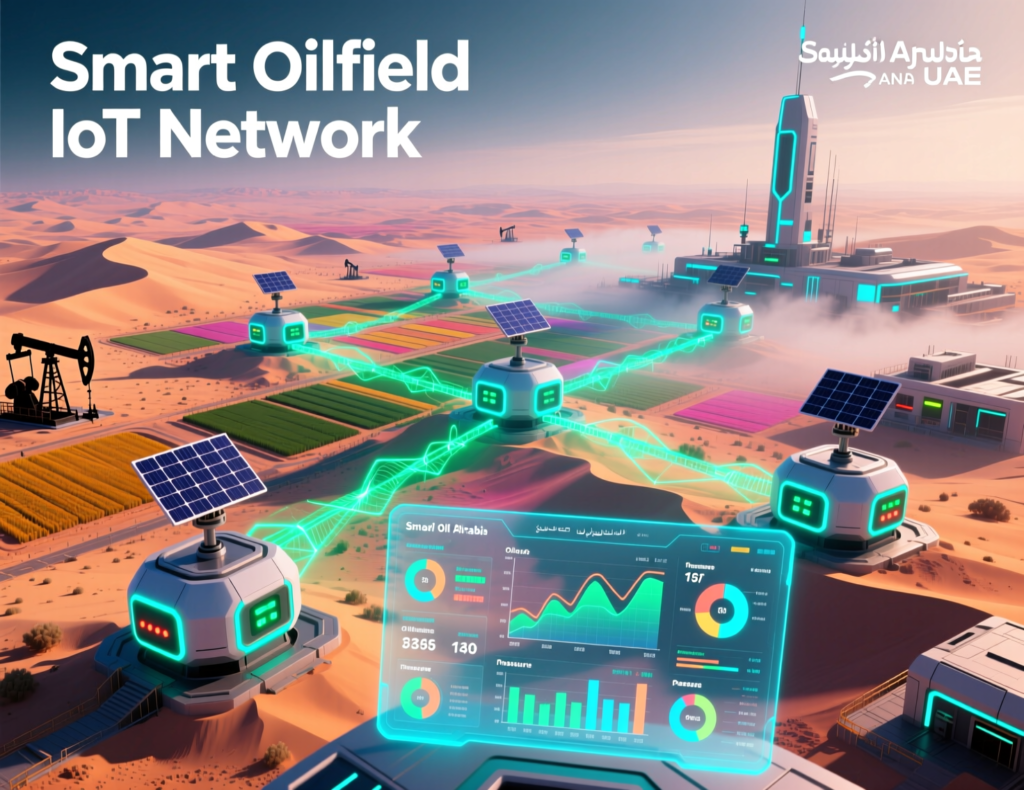
Digital oilfield solutions connect wells, ESPs, pumps and compressors so engineers in Dhahran, Abu Dhabi or Doha see real-time pressure, flow and vibration data. For Aramco upstream or ADNOC Onshore, that means fewer truck rolls to remote sites, faster fault detection and production optimisation based on live reservoir behaviour instead of yesterday’s reports.
Pipeline & Midstream Monitoring Across Desert and Offshore Routes
Cross-country pipelines in Saudi Arabia or crude and gas lines feeding UAE terminals face theft, corrosion and third-party interference. IIoT leak-detection sensors, pressure/temperature monitoring and right-of-way cameras can stream into edge gateways that raise alerts even when satellite or LTE links are weak. This cuts detection time from hours to minutes crucial in remote desert or offshore segments.
Smart Refineries, Gas Plants and LNG Facilities
In refineries like Ruwais, gas plants in Jubail or LNG trains at Ras Laffan, IIoT supports energy optimisation, flare monitoring, emissions tracking and predictive maintenance on turbines and compressors. Smart refinery and petrochemical plant solutions use digital twins and condition monitoring to identify efficiency losses, reduce flaring events and support compliance with tightening environmental rules in all three countries.
The Technology Stack Behind Oil & Gas 4.0 in the GCC
Connectivity: Private 5G, LTE and Industrial Wi-Fi in Remote Sites
Connecting remote wells and pipelines depends on a mix of industrial Wi-Fi, LTE, satellite and increasingly private 5G with operators like e& / Etisalat, du, STC, Ooredoo and others. Many Gulf teams are already exploring 5G-enabled Industry 4.0, a theme covered in more depth in our guide to 5G business opportunities in the Middle East for GCC companies.
(See: https://makitsol.com/5g-business-opportunities-in-the-middle-east-for-gcc/)
Edge Computing, AI and Digital Twins for Critical Assets
Edge computing nodes at well pads, compressor stations and plants run AI models for anomaly detection, vibration analysis and local control even when the cloud link drops. Digital twins of pipelines, rotating equipment and process units help teams in Riyadh, Dubai and Doha simulate what-if scenarios and optimise setpoints before touching live operations.
Integrating Legacy SCADA/DCS with Modern IIoT Platforms
Every Gulf operator has decades of PLCs, SCADA and DCS in place. Successful IIoT projects rely on OPC UA gateways, historians and secure DMZs to expose selected data into modern platforms without compromising safety systems. This is where partners like Mak It Solutions can help design robust web development services and integration patterns for dashboards, custom portals and OT/IT convergence.
(See: https://makitsol.com/service/web-development-services/)
GCC Compliance, Data Residency & OT Cybersecurity for Industrial IoT
Data Residency Rules in Saudi, UAE and Qatar
Saudi’s NDMO data management standards expect critical and sensitive data including operational data in many cases to stay within the Kingdom or move only through tightly controlled transfers. In the UAE, TDRA and sector regulators encourage using in-country cloud regions and licensed providers. Qatar’s data and cybersecurity policies similarly push oil & gas operators towards national infrastructure, especially for strategic facilities like Ras Laffan.
OT Cybersecurity Expectations for Critical Energy Infrastructure
While SAMA and QCB regulate finance, their cybersecurity frameworks set a bar that energy companies cannot ignore. Across the GCC, authorities expect clear separation between OT and IT zones, strong identity and access management, network segmentation and incident response plans for critical infrastructure. Many of the same controls used in fintech, government and logistics are now being applied to IIoT platforms in fields and refineries.

Designing a GCC-Compliant IIoT Architecture
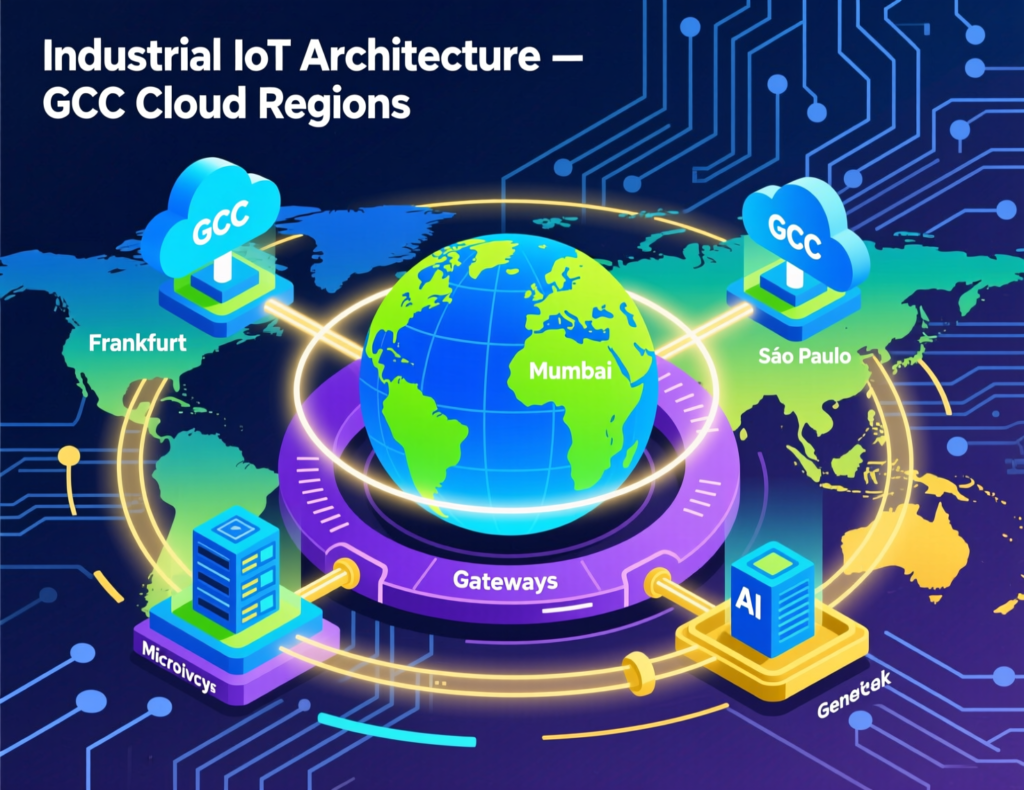
Practically, this means hosting IIoT platforms and data lakes on regional cloud regions such as AWS Middle East (Bahrain) me-south-1, Azure UAE Central/UAE North and Google Cloud’s Doha region, all of which provide low-latency, in-region compute and storage options.
A Doha SME supporting QatarEnergy, for example, might choose a Qatar Central or Doha region to keep telemetry inside the country while serving analytics dashboards to Ras Laffan and Doha offices.
How Gulf Energy Companies Roll Out IIoT
Assess, Prioritise and Pilot in One Field or Plant.
Start with a maturity assessment across OT, IT and cybersecurity in sites like Riyadh, Dhahran, Abu Dhabi or Doha. Pick a lighthouse asset one gas plant, one pipeline segment or one offshore platform and focus on a small number of high-ROI use cases such as pump condition monitoring or leak detection. Keep KPIs simple: fewer trips, fewer alarms, less downtime.
Scale Across Assets with Local Integrators.
Once the pilot proves value, standardise device types, protocols and data models, then scale with local integrators in Saudi Arabia, the UAE and Qatar. Firms like Mak It Solutions can complement OT specialists by building secure APIs, mobile app development for field crews and unified analytics dashboards on top of your chosen platform.
(See: https://makitsol.com/service/mobile-app-development/)
Embed Change Management, Training and Arabic UX.
IIoT only sticks when people use it. Build training programmes for field technicians and control room staff, prioritising bilingual Arabic + English dashboards and workflows. A Riyadh fintech startup or Dubai e-commerce brand wouldn’t launch a product without great UX the same thinking now applies to internal oil & gas tools, backed by ongoing governance and a small Center of Excellence.
Selecting an Industrial IoT Partner in Saudi, UAE & Qatar
Evaluation Criteria for IIoT Vendors and Integrators
When you shortlist IIoT partners, look for real GCC oil & gas references, ATEX/IECEx-certified hardware skills, proven OT cybersecurity, and the ability to design Arabic-friendly dashboards. They should understand data residency rules, cloud regions and on-prem options as well as classic OT protocols.

Local vs Global.
Global IIoT platforms bring scale and advanced features; local system integrators bring on-site support, Arabic UX and practical knowledge of SAMA, TDRA, QCB and free-zone regimes like ADGM or DIFC. Most successful projects combine both – a global platform stack, plus regional experts who can tailor business intelligence services, reporting and mobile experiences for Gulf users.
(See: https://makitsol.com/service/business-intelligence-services/)
Example RFP Questions for Gulf Energy IIoT Projects
Your RFP might include questions such as.
How do you support deployment in AWS Bahrain, Azure UAE and Doha cloud regions with full data residency control?
How will you integrate with our existing SCADA/DCS and historians without impacting safety systems?
What OT cybersecurity framework do you follow, and how do you meet local audits?
Can you deliver Arabic + English UX and local 24/7 support in Riyadh, Dubai and Doha?
How do you support predictive maintenance and condition monitoring for oilfield assets?
Concluding Remarks
Summary of Benefits Across Saudi, UAE and Qatar
Industrial IoT in oil and gas is already reducing downtime, improving HSE metrics, boosting recovery factors and helping operators hit emissions targets in Saudi, UAE and Qatar. Combined with Oil & Gas 4.0 strategies, it turns data from wells, pipelines and refineries into a competitive advantage.
Where to Start in the Next 90 Days
Over the next 90 days, you can run an internal workshop, map priority assets, shortlist 3–5 use cases, and engage 1–2 integrators and digital partners to define a pilot. Use this period to align OT, IT, cybersecurity and compliance teams around a single roadmap that works for your specific Saudi, UAE or Qatar asset base.
How to Future-Proof Your Industrial IoT Strategy
To future-proof, favour open standards, modular architectures and cloud regions that keep options open across KSA, UAE and Qatar. Invest in skills for GCC nationals in data, analytics and cybersecurity, and treat industrial IoT in oil and gas as a continuous improvement journey — not a one-off project.
If you’re planning an industrial IoT initiative in Saudi, the UAE or Qatar and need a partner who understands both the technology stack and GCC compliance realities, Mak It Solutions can help. Our team builds secure dashboards, custom web platforms, mobile apps and analytics layers that sit on top of your chosen IIoT and cloud infrastructure.
Reach out to Mak It Solutions to book a consultation, review your current OT/IT landscape and design a practical industrial IoT roadmap tailored to your fields, pipelines and plants. Together, we can turn Oil & Gas 4.0 from a buzzword into measurable value on your control room screens. ( Click Here’s )
FAQs
Q : Is industrial IoT allowed for critical oil and gas operations under Saudi NDMO and national cybersecurity rules?
A : Yes, industrial IoT is allowed in Saudi Arabia, but it must respect NDMO data management standards and national cybersecurity controls. For critical oil and gas assets, that usually means hosting IIoT platforms and data in approved Saudi or regional cloud/data centres, enforcing strong access control, and segregating OT from IT networks. Many operators map their IIoT governance to Saudi Vision 2030 digital objectives while borrowing good practices from SAMA’s cybersecurity framework, even though it targets financial institutions.
Q : What is the difference between deploying an IIoT platform on Saudi or UAE cloud regions versus global data centers?
A : Using Saudi or UAE cloud regions like AWS Bahrain, Azure UAE or local sovereign clouds keeps telemetry and logs closer to the physical assets and helps satisfy data residency and audit expectations. Global regions may offer more services, but they can trigger cross-border data transfer reviews and longer latencies for real-time use cases. In practice, many GCC energy companies run production IIoT workloads in local regions, while using selected global regions for non-sensitive R&D or anonymised analytics, guided by NDMO, TDRA and sector regulators.
Q : How can ADNOC and other UAE operators use private 5G to improve offshore safety and productivity?
A : Private 5G lets ADNOC and other UAE operators connect cameras, sensors, drones and worker wearables across offshore platforms with low latency and high reliability. That enables real-time video inspections, better location tracking, digital permits-to-work and faster response to gas or fire alarms. Combined with edge analytics and integration into existing safety and maintenance systems, private 5G reduces the need for risky manual inspections. TDRA’s spectrum and 5G guidelines, together with ADNOC’s Oil & Gas 4.0 programme, provide the regulatory and strategic context for such deployments.
Q : Are there local industrial IoT integrators in Qatar that can support QatarEnergy and Ras Laffan facilities?
A : Yes, Qatar has a growing ecosystem of local and regional integrators who understand LNG, pipelines and industrial facilities around Ras Laffan. Many work closely with global vendors and hyperscalers, taking advantage of the new Doha and Qatar Central cloud regions to keep data inside Qatar. For QatarEnergy and its contractors, the key is to pick partners that can meet national cybersecurity requirements, collaborate with Qatar Digital Government initiatives and support bilingual dashboards for operations teams in Doha and at site.
Q : What are the typical ROI and payback periods for industrial IoT in Gulf refineries and petrochemical plants?
A : While numbers vary, many Gulf refineries and petrochemical plants see IIoT payback periods between 12 and 36 months. Savings come from fewer unplanned shutdowns, lower maintenance costs, reduced flaring and more efficient energy use. In some cases, a single avoided compressor failure or major leak can fund an entire pilot. When you build a solid business case aligned with Saudi Vision 2030, UAE industrial strategies or Qatar National Vision 2030, finance and leadership teams usually see IIoT as an enabler of broader digital transformation, not just another IT cost.