


Internal Developer Platform Guide for Platform Leaders
Internal Developer Platform Guide for Platform Leaders
Internal Developer Platform Guide for Platform Leaders
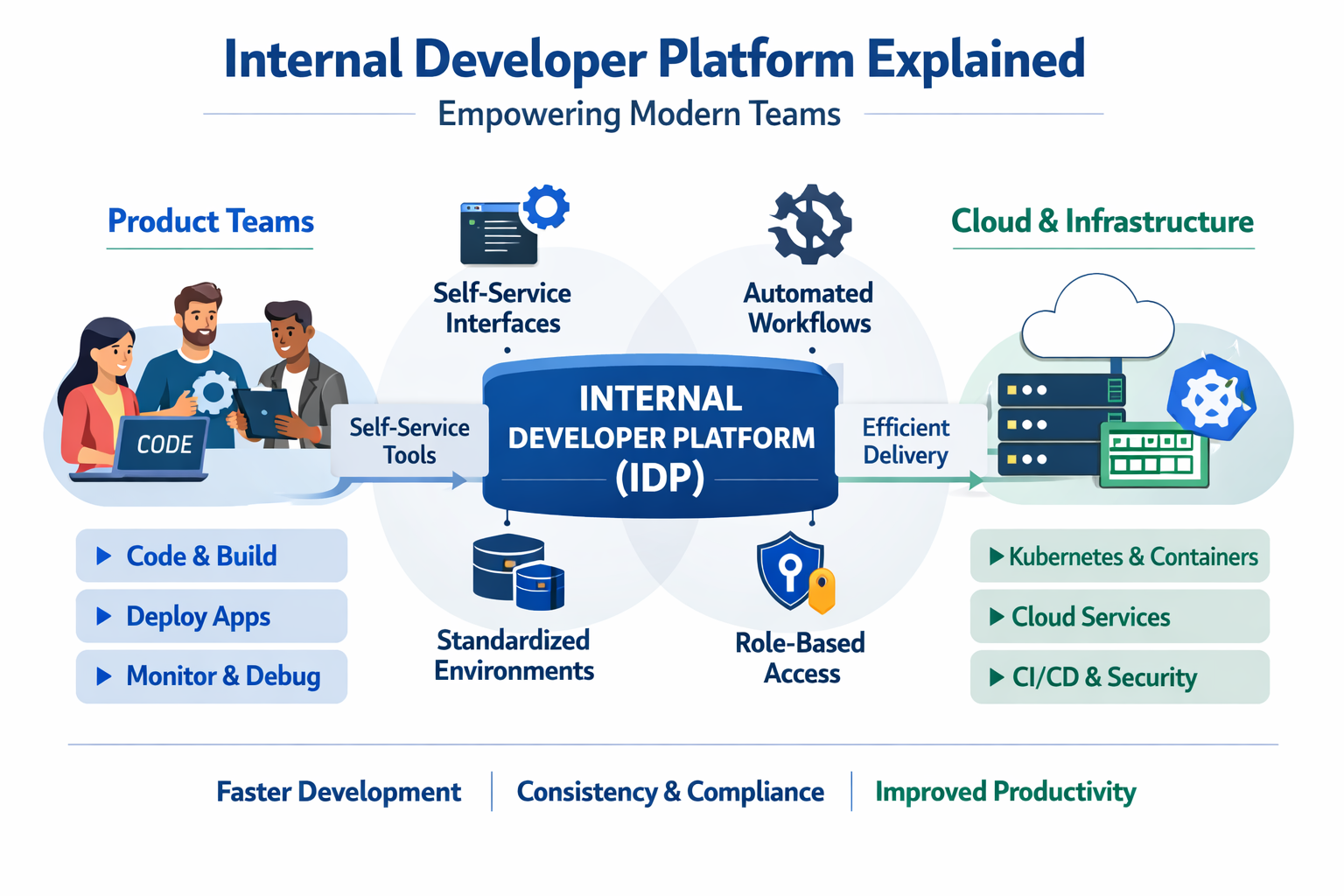
An internal developer platform gives engineering teams a safer, faster way to build and ship software without forcing every squad to master infrastructure, security, CI/CD, observability, and compliance from scratch. In practice, it is a self-service layer created by a platform engineering team so developers can use approved templates, workflows, and guardrails instead of relying on tickets, scattered docs, and tribal knowledge.
For modern teams, that matters because software delivery has become harder to standardize at scale. Gartner says that by 2026, 80% of large software engineering organizations will establish platform engineering teams, up from 45% in 2022.
What Is an Internal Developer Platform?
An internal developer platform, often shortened to IDP, is a self-service platform built by a platform engineering team to reduce developer friction. It typically combines curated golden paths, reusable templates, automation, a service catalog, and policy controls so teams can ship with less cognitive load and more consistency. CNCF and Backstage-aligned guidance both reinforce this model of self-service, standardization, and abstraction for developers.
Put simply, an IDP is the product your internal engineering organization builds for developers.
Instead of every team reinventing how to provision environments, wire pipelines, request access, document ownership, or apply secure defaults, the platform gives them a paved road. That does not remove engineering ownership. It removes avoidable friction.
Internal developer platform explained in simple terms
A good IDP is not just another DevOps toolchain with a nicer UI. It is a managed developer experience.
A developer can start with a standard service template, generate a repository, apply infrastructure modules, connect CI/CD, register ownership in the catalog, and deploy through approved workflows. The point is not to hide everything. The point is to hide the unnecessary complexity while keeping the important controls visible.
How an IDP works
Most internal developer platforms revolve around a few core ideas.
Self-service so developers can complete routine tasks without waiting on another team
Golden paths that standardize common workflows with proven defaults
Guardrails that enforce policy, security, and operational standards
Catalogs and metadata that make ownership, dependencies, and service health easier to understand
That combination is what makes an IDP more useful than a pile of scripts, docs, and internal tickets.
Internal developer platform examples
A fintech team in the US may use an IDP to launch payment-related services with logging, secrets handling, and PCI-aware controls already built in. A UK team dealing with health or public-sector workflows may focus more on auditability and access controls. A Germany- or EU-based SaaS company may put extra emphasis on data residency, vendor transparency, and governance.
The use cases change. The operating model stays the same.
Why Platform Engineering Teams Are Investing Now
Platform engineering has become more important because delivery complexity has outgrown informal DevOps support in many organizations. DORA’s 2024 report highlights platform engineering as a major topic and explores both its promise and its tradeoffs, while Gartner continues to frame platform teams as a mainstream response to engineering scale.
For leaders, this is not really about buying a single product.
It is about creating a repeatable way for many teams to move faster without lowering standards.
Platform engineering vs traditional DevOps
DevOps is still the foundation. It emphasizes collaboration, automation, and shared responsibility across development and operations.
Platform engineering builds on that foundation, but it adds something more explicit: product thinking for internal engineering users. The platform team treats developers as customers and creates reusable services, interfaces, and workflows that reduce reinvention across the organization. DORA describes platform engineering as a meaningful area of research and practice, while CNCF defines it around building and maintaining self-service software development platforms for developer teams.
That difference matters at enterprise scale.
When dozens of teams all “own their own pipeline,” the result is often fragmentation, inconsistent controls, and a poor developer experience. A dedicated platform function helps close that gap.
Why now?
A few forces are pushing this shift.
More microservices and distributed architectures
Ongoing Kubernetes and cloud complexity
Higher expectations around compliance and auditability
Pressure to improve onboarding and delivery speed
Growing demand for better developer experience
Backstage has become a visible part of this trend because it gives organizations a framework for building developer portals backed by a centralized software catalog and shared tooling.
Internal Developer Platform Architecture and Core Components
A practical internal developer platform usually includes a developer interface, service catalog, software templates, workflow automation, infrastructure provisioning, observability hooks, and policy controls. Backstage’s official documentation reflects this catalog-and-portal model, while platform engineering guidance from CNCF reinforces self-service and abstraction as core design principles.
Core building blocks
Here are the components most teams start with.
Service catalog: tracks service ownership, metadata, lifecycle, and dependencies
Software templates: standardize how new services or apps are created
Automation workflows: handle provisioning, deployment, access requests, and routine ops tasks
Policy controls: enforce what must happen for security, compliance, and reliability
Docs and ownership signals: help teams discover the right service, team, or standard quickly
A service catalog alone is useful, but it is not a full platform. The real value appears when catalog data connects to automation and policy-backed workflows.
Common tooling patterns
A common enterprise pattern looks something like this:
| Layer | Common Options |
|---|---|
| Developer interface | Backstage, Port, custom internal portal |
| CI/CD | GitHub Actions, GitLab CI, Azure DevOps |
| Infrastructure as code | Terraform, OpenTofu |
| Runtime | Kubernetes, serverless platforms |
| Cloud | AWS, Azure, Google Cloud |
| Governance | Policy engines, IAM controls, approval workflows |
| Visibility | Observability tooling, service metadata, docs |
The exact stack is less important than the experience it creates. Developers should be able to discover what exists, start from a trusted template, and complete common delivery tasks through one coherent path.
For broader engineering organizations, that often connects naturally with related internal capabilities such as Kubernetes planning, serverless strategy, and disaster recovery architecture.
Governance for US, UK, and EU teams
Governance is where many IDP programs prove their value.
The EU GDPR governs how personal data of individuals in the EU may be processed and transferred. The UK operates its own UK GDPR framework alongside the Data Protection Act 2018. In healthcare settings, the HIPAA Security Rule establishes national standards to protect electronic protected health information. For payment environments, PCI DSS provides a baseline of technical and operational requirements to protect payment account data.
That means a strong internal developer platform may need to apply controls for.
Region-aware deployment choices
Encryption defaults
Access management
Audit logs
Approved vendors and services
Policy checks before deployment
For Germany and broader EU teams, data residency and vendor scrutiny often carry more weight. In the UK, governance clarity and public-sector sensitivity can shape platform decisions. In the US, the conversation often centers on security, speed, and lower operational overhead.
Internal Developer Platform vs Internal Developer Portal
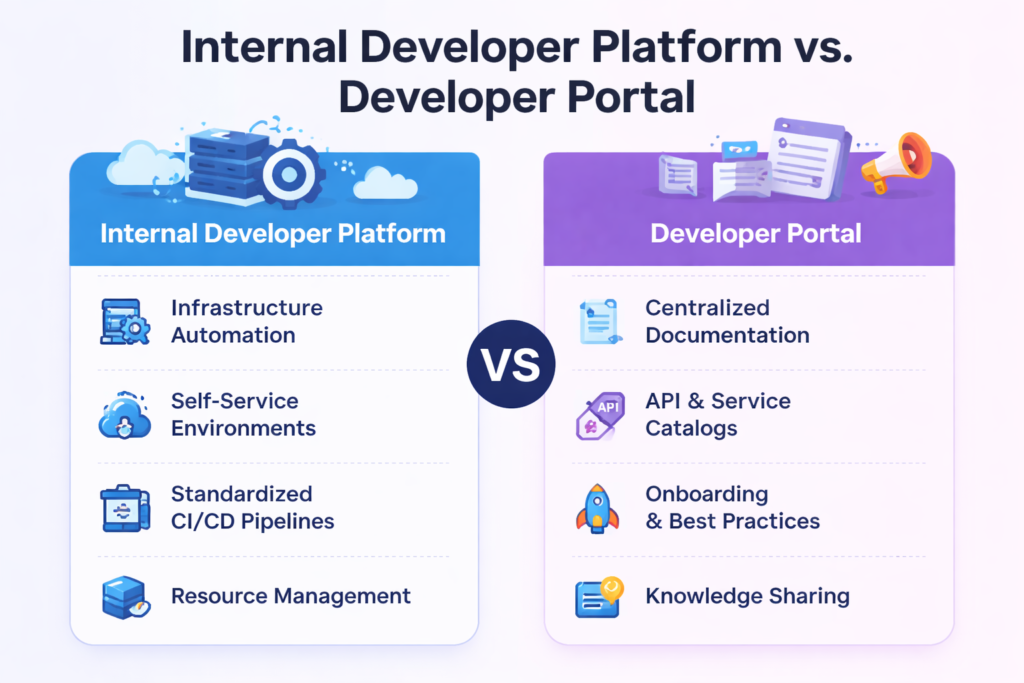
An internal developer portal is usually the front door. An internal developer platform is the larger system behind it.
Backstage’s own documentation describes it as an open framework for building developer portals powered by a centralized software catalog. That makes it a strong fit for the portal layer, but not the entire platform on its own.
What a portal does
A portal helps developers.
Find documentation
Discover services
Understand ownership
Browse templates
Access internal workflows
It improves discoverability and user experience.
What the platform adds
The platform includes the execution layer behind that experience.
Provisioning
Deployment automation
Policy enforcement
Runtime controls
Observability integrations
Lifecycle workflows
That is why a portal is best understood as one important piece of a wider IDP strategy.
How to Build an Internal Developer Platform Without Overengineering It
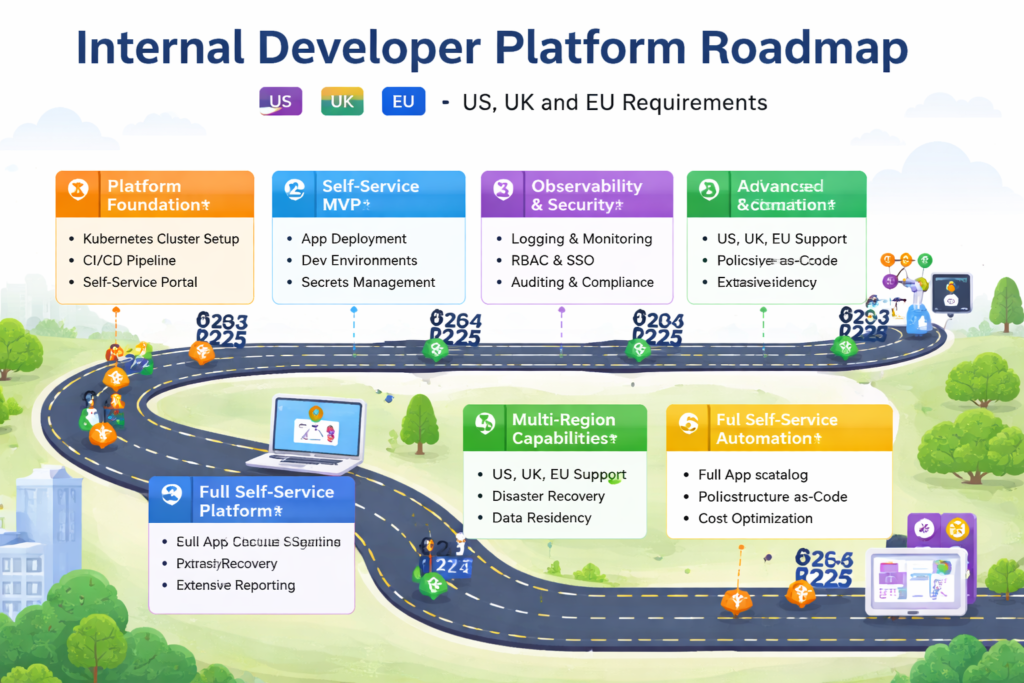
The smartest way to build an internal developer platform is to start with repeated pain points, not with a giant architecture diagram. DORA’s platform engineering research and CNCF maturity guidance both support a practical, iterative approach instead of building for every hypothetical future use case at once.
Identify real developer friction
Start by mapping where teams lose time.
Common examples include.
Slow onboarding
Inconsistent CI/CD setup
Access request bottlenecks
Unclear ownership
Environment creation delays
Scattered operational knowledge
That is the raw material for your first platform roadmap.
Choose one or two golden paths
Do not try to solve everything at once.
Pick a small number of high-frequency workflows, such as:
Create a new backend service
Deploy an internal application
Request a standard development environment
Then wrap those workflows in templates, secure defaults, ownership metadata, and automation.
That is usually enough to prove value early.
Standardize secure defaults
The best paved roads are opinionated. They save time because teams do not need to re-decide the basics for every project.
Good defaults often include:
Repository structure
CI/CD baseline
Observability hooks
Access policies
Infrastructure modules
Documentation requirements
Roll out by team, region, and compliance need
A phased rollout works better than a one-shot transformation.
A US fintech team may care first about PCI-aware self-service and delivery speed. A UK enterprise may prioritize stronger governance and accountability. A Germany- or EU-based organization may need tighter control around data handling, transfer risk, procurement, and vendor visibility.
That is why regional context matters in platform design.
For teams shaping a broader delivery model, related service areas such as web development services, front-end development services, and business intelligence services often connect to the same platform roadmap.
Internal Developer Platform ROI for US, UK, Germany, and EU Teams
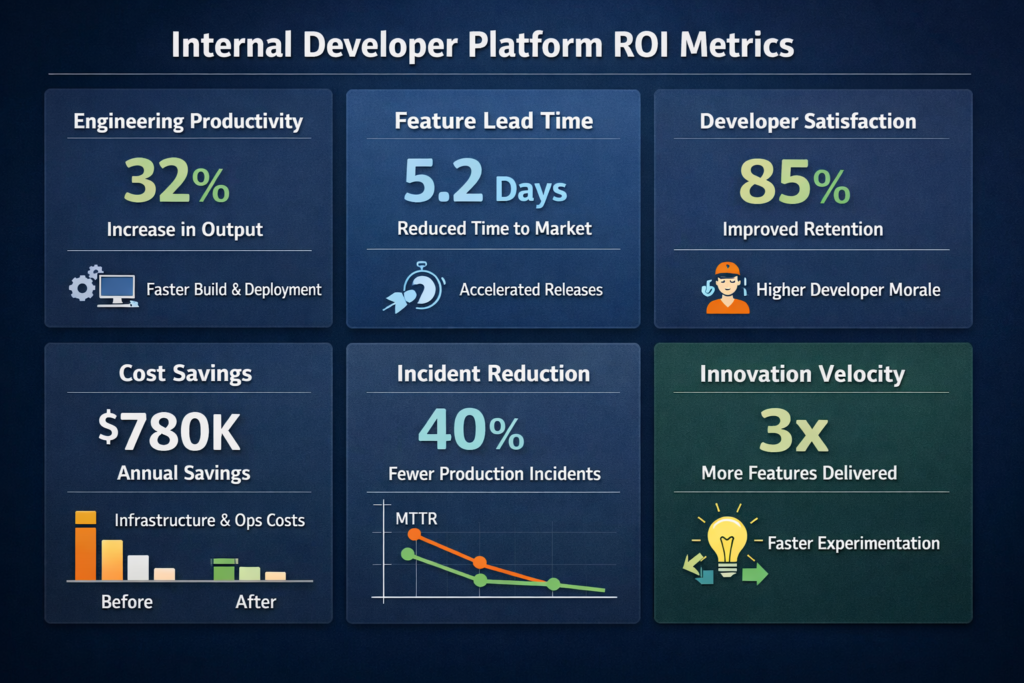
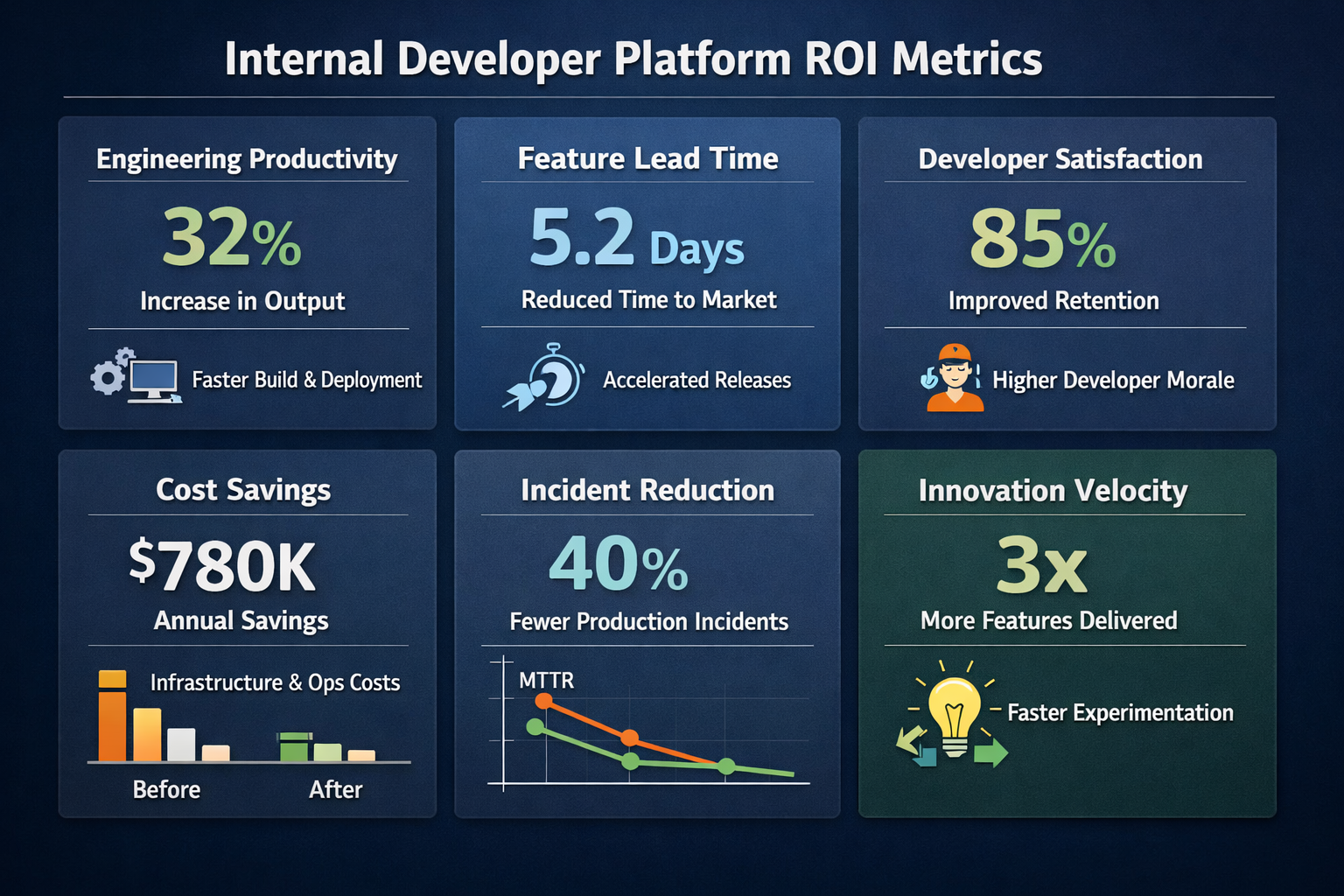
Internal developer platform ROI is usually strongest when it is tied to delivery outcomes, not just tooling consolidation. DORA remains one of the most widely used benchmarks for software delivery performance, with metrics such as lead time, deployment frequency, change failure rate, and reliability shaping how teams discuss impact.
The metrics that matter
Useful ROI signals include
Faster onboarding
Shorter lead time for changes
Higher deployment frequency
Lower change failure rates
Lower ticket volume for routine work
Stronger adoption of self-service workflows
Fewer policy exceptions
Better service ownership visibility
The business case gets clearer when the platform makes the right way the easy way.
Regional ROI priorities
Regional priorities are not identical.
In the US, leaders often want to see less ticket-driven ops, better security posture, and measurable productivity gains.
In the UK, governance quality, accountability, and regulated-service sensitivity can carry more weight.
In Germany and the broader EU, data residency, vendor trust, auditability, and compliance maturity often have a bigger influence on platform adoption.
How to justify the investment
The pitch to a CTO or VP of Engineering does not need to be complicated.
A well-designed internal developer platform reduces wasted effort, improves consistency, and gives product teams trusted self-service. That can improve developer experience without weakening governance. DORA’s 2024 report and Gartner’s 2026 platform engineering forecast both support the argument that platform engineering is now a serious operating model, not a niche experiment.
Best Practices for Internal Developer Platform Success
The teams that get the most value from an IDP usually treat it as an internal product, keep the scope tight at the start, and improve it continuously based on adoption and feedback. Backstage’s portal model and CNCF’s platform engineering guidance both align with this product mindset.
Treat the platform like a product
Internal users are still users.
That means the platform needs:
A roadmap
Documentation standards
Adoption metrics
Feedback loops
Clear ownership
Balance standardization with flexibility
Too much freedom creates chaos.
Too much control creates shadow tooling.
The healthiest platforms give teams a strong default path while leaving room for justified exceptions.
Make documentation and ownership part of the platform
Self-service breaks down when teams cannot find the right service, owner, or standard.
That is why catalogs, metadata, and searchable docs are not side features. They are part of the core platform experience.
Final Thoughts
For modern engineering teams, an internal developer platform is no longer just a nice-to-have. It is a practical way to reduce cognitive load, improve developer experience, and create safer delivery paths at scale.
If your organization is dealing with fragmented tooling, slow onboarding, or inconsistent engineering standards, this is a good time to assess platform maturity and define a realistic roadmap. Explore Mak It Solutions’ expertise in cloud and architecture planning, engineering delivery, and project consultation to shape an internal developer platform strategy that fits your teams, regions, and governance needs.( Click Here’s )
Key Takeaways
An internal developer platform is a self-service layer that reduces friction with golden paths, templates, automation, service catalogs, and guardrails.
Platform engineering extends DevOps by treating developer experience as an internal product.
An internal developer portal is usually the experience layer, while the platform includes the workflows, provisioning, governance, and automation behind it.
The best rollout starts small, solves repeated pain points, and expands based on real adoption.
ROI is clearest when measured through onboarding speed, lead time, delivery quality, and trusted self-service adoption.
US, UK, Germany, and broader EU teams often need different emphasis areas around PCI DSS, HIPAA, UK GDPR, GDPR, auditability, and data residency.
Frequently Asked Questions
Q : What teams should own an internal developer platform?
A : An internal developer platform is usually owned by a dedicated platform engineering team, with close input from security, infrastructure, developer experience, and product engineering leaders. In smaller organizations, ownership may start as a shared responsibility before becoming a formal platform function.
Q : How long does it take to launch an internal developer platform?
A : A focused first release can often go live within a few months when the team starts with one or two high-frequency workflows. A broader enterprise rollout takes longer because it also needs governance, catalog design, documentation, and change management.
Q : Do you need Backstage to build an internal developer platform?
A : No. Backstage is a credible and widely used option for building the portal and software catalog layer, but it is not required. The real goal is to create one coherent self-service experience, whether that is built with Backstage, Port, custom workflows, or another combination of tools.
Q : What are the most common mistakes in platform engineering adoption?
A : The biggest mistakes are overengineering, building for imagined future needs, weak documentation, and turning the platform into a central gate instead of a helpful product. Teams also struggle when they launch too many templates too early and fail to measure adoption.
Q : How do you measure developer self-service success in an IDP?
A : Measure both usage and outcomes. Usage metrics include template adoption, self-service completion rates, catalog coverage, and lower ticket volume. Outcome metrics include faster onboarding, shorter lead time for changes, fewer deployment errors, lower change failure rates, and better compliance consistency.