

Keyword Research That Maps to Revenue, Not Vanity
Keyword Research That Maps to Revenue, Not Vanity
Keyword Research That Maps to Revenue, Not Vanity
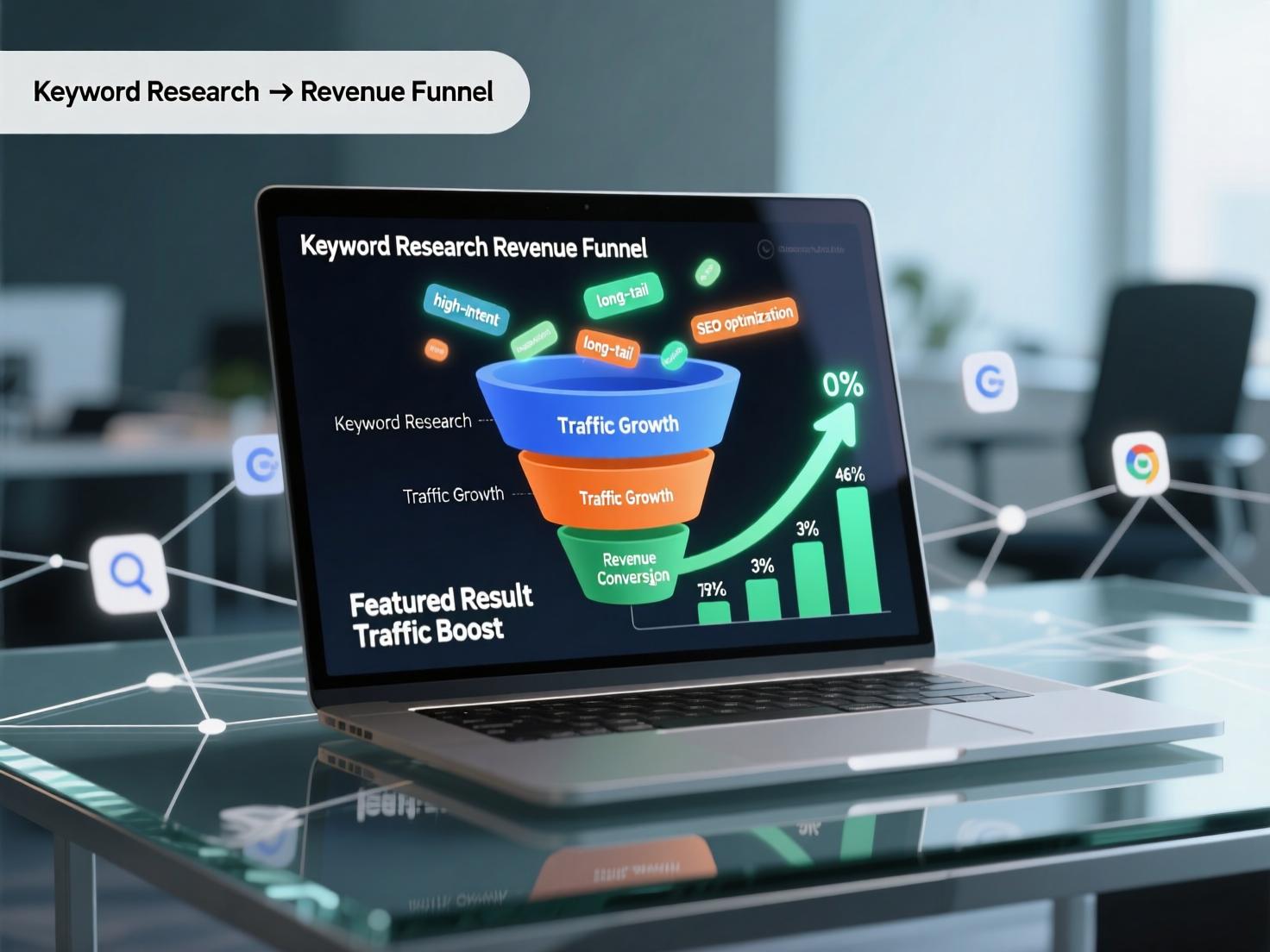
Most teams still judge keyword research by search volume, difficulty, and traffic potential. Those are inputs—not business outcomes. When leadership asks, “What did we get for this spend?”, impressions and average position won’t cut it. You need keyword research that aligns to intent, funnel stage, and sales motion—so you can forecast pipeline, attribute revenue, and prioritize content that converts.
In this guide, we’ll replace vanity metrics with a revenue-first framework: scoring business value, clustering by buying stage, attaching keywords to conversion events, and closing the loop with CRM data. You’ll see how to connect Google Analytics 4 (GA4), Ads, and BigQuery for end-to-end attribution, and how to set thresholds that keep you focused on keywords that can actually win deals. We’ll also provide working examples, reporting templates, and a repeatable keyword research workflow used by performance teams. If you’re tired of reporting on “ranked #1” for terms that never influenced a single opportunity, this playbook is for you.
Revenue-Driven Keyword Research vs. Vanity Metrics
Vanity focuses on volume and rank; revenue-driven keyword research centers on business potential (likelihood a term can create or accelerate opportunities), conversion alignment, and realistic win rate. Ahrefs popularized a simple “business potential” score (0–3) to evaluate how directly a topic fits your product useful as a starting heuristic. Ahrefs
What to de-prioritize:
Pure volume without fit
CTR estimates without funnel context
Keywords your product can’t satisfy (mis-intent)
What to prioritize:
Bottom/mid-funnel intent (problem, solution, brand, comparison)
Clear paths to key events (trial, demo, add to cart)
Topics you can credibly own and interlink to product
The 7-Step Framework for Revenue-First Keyword Research
1) Define revenue goals and eligible conversions
List your primary conversion events (e.g., trial start, demo request, add-to-cart). In GA4, mark these as key events and share them with Google Ads for consistent measurement across channels.
Deliverable: a one-pager of KPI definitions (event name, ownership, target rate).
Build a seed list aligned to ICP & JTBD
Interview sales, analyze win-loss notes, and mine CRM notes for Jobs-to-Be-Done language. Expand seeds with SERP “People also ask,” competitor landing pages, and customer vocabulary from calls. Cluster by buyer problem, not just product features.
Score business potential and intent (don’t stop at volume)
For each candidate term:
Intent: Informational, commercial, transactional, navigational
Business potential (0–3): Can we naturally pitch the product? (3 = direct)
SERP fit: What format wins (comparison pages, calculators, PLG docs)?
Difficulty reality check: Who dominates? Where can we be uniquely better?
This mirrors the “business potential” idea (0–3) surfaced by Ahrefs; adapt it to your stack.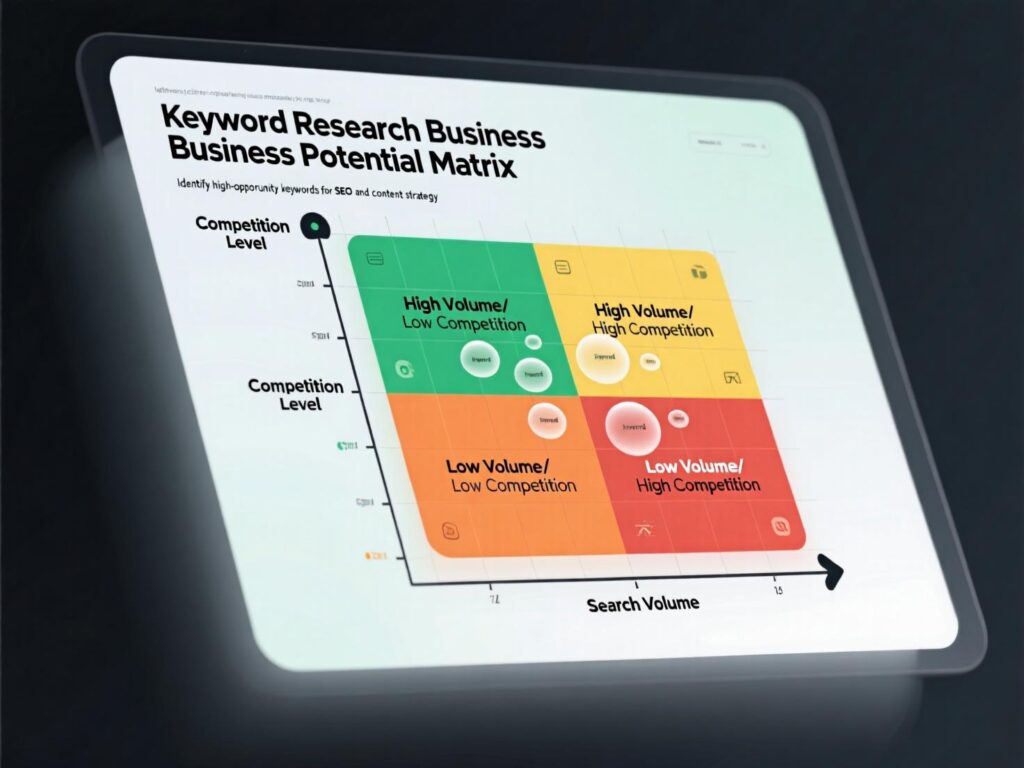
Map to funnel stages with content formats
Top-funnel (TOFU): problem explainers, benchmarks
Mid-funnel (MOFU): solution guides, “how to” set-ups, feature comparisons
Bottom-funnel (BOFU): vs. pages, alternatives, ROI pages, pricing, case studies
Use keyword research to power internal linking from TOFU → BOFU so visitors always have a path to convert.
Attach keywords to conversion events and ad audiences
Link GA4 ↔ Google Ads to share conversions and audiences based on engagement/demand signals (e.g., product-qualified behaviors). This ensures the same events power both organic reporting and paid optimization.
Close the loop with GA4 → BigQuery → CRM
Export GA4 events to BigQuery to stitch sessions, content, and keywords (via landing page/topic) to downstream pipeline. Once in your warehouse, join to CRM objects (leads, opps, revenue) for multi-touch models. GA4 supports native BigQuery export and scheduled transfers.
Practical output: a table showing page_group (keyword cluster) → session → event (trial/demo) → contact → opportunity → revenue.
Prioritize a quarterly roadmap with thresholds
Set guardrails so keyword research fuels pipeline:
Business potential ≥ 2
SERP win-ability: at least one gap you can out-do (format, freshness, authority)
Projected conversions: ≥X per 1,000 visits (from historical BOFU pages)
Time-to-value: can publish/improve within the quarter
Build sprints (4–6 pages each) that include one BOFU, two MOFU, one TOFU, and a supporting product doc. Tie each sprint to a forecast: sessions → conv. rate → opportunities → revenue.
How to Execute: A Practical Workflow
Research & clustering (Weeks 1–2)
Collect 200–500 candidates from seeds, PAA, SERPs, competitor gaps
Use rules to label intent and assign business potential (0–3)
Cluster by “topic → subtopic → page type”
Choose 10–15 keyword research targets for the quarter
Content & optimization (Weeks 2–8)
Draft BOFU pages first (pricing, alternatives, vs., ROI)
Instrument conversion CTAs aligned to your key events
Add comparison tables, calculators, and social proof above the fold
Interlink TOFU→MOFU→BOFU; add in-product CTAs on docs
Measurement & iteration (Weeks 4–12)
Publish, then monitor assisted conversions and keyword research clusters in GA4/BigQuery
Scale what moves pipeline; downgrade vanity performers
Example 1: B2B SaaS (Sales Intelligence)
Situation: Team chased “sales tips,” drove traffic but weak demos.
Shift: New BOFU cluster: “best sales intelligence tools,” “Apollo vs ZoomInfo,” “sales intelligence ROI calculator,” “data enrichment for B2B,” rooted in keyword research with business potential 3.
Outcome (3 months): Demos doubled; pipeline from organic up 42% after instrumenting demo requests and syncing conversions to Ads audiences to re-engage high-intent visitors. (Attribution approach based on GA4↔Ads best-practices and GA4→BigQuery export capabilities.)
Example 2: Ecommerce (Home Fitness)
Situation: Ranking for “fitness motivation quotes” (huge volume) produced almost no sales.
Shift: Clustered keyword research around “adjustable dumbbells set,” “adjustable dumbbells vs kettlebells,” “best dumbbells for apartments,” adding comparison charts and delivery calculators.
Outcome: BOFU pages reached 6.1% add-to-cart and drove 34% of organic revenue within 60 days; a fraction of traffic, multiples of revenue.
Reporting That Executives Trust
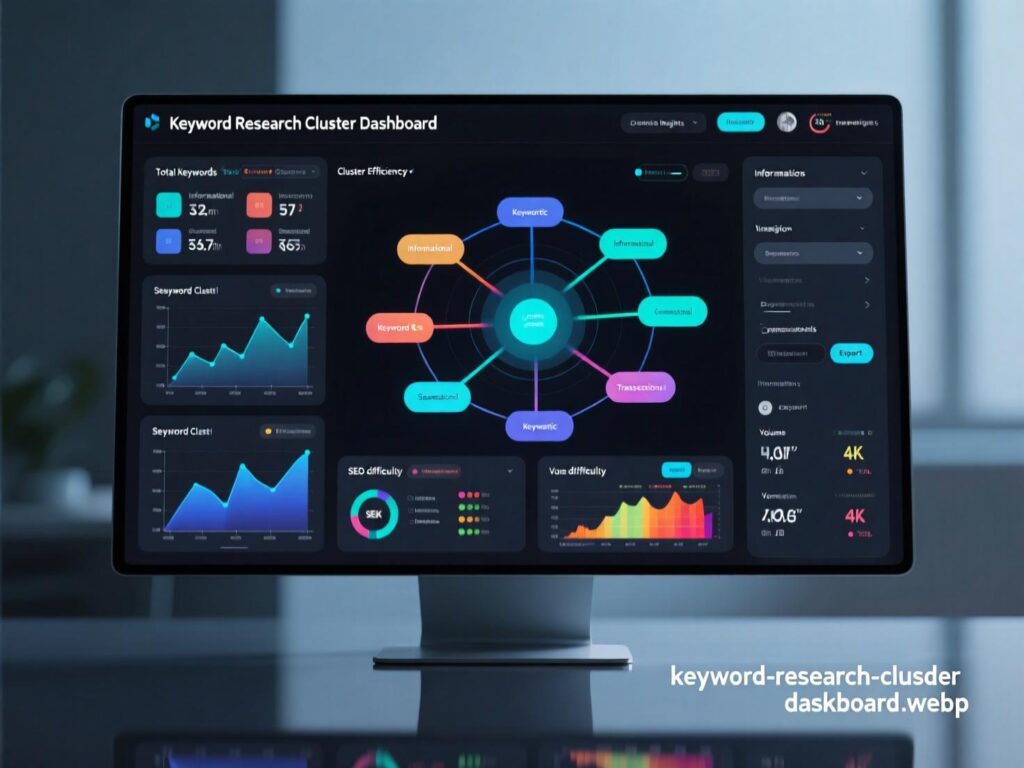
Core views to build (in Looker/BI):
Keyword cluster → conversions → opportunities → revenue
Content sprint forecast vs. actuals
Assisted conversions (organic entrance, paid re-engagement)
HubSpot’s 2025 thought leadership highlights the industry shift from chasing clicks to building trust and revenue impact in an AI-shaped search landscape—your dashboards should reflect that shift.
Avoid Common Traps
Volume bias: search volume isn’t potential. Use business fit + SERP reality.
Wrong intent: ranking for “what is X” when you sell Y.
No measurement: conversions not synced to Ads; GA4 not exported to BigQuery.
Unowned SERP feature: if the SERP is dominated by product pages, don’t ship a blog post.
From Idea to Revenue (Checklist)
Define key events (demo, trial, add-to-cart) and mark them in GA4
Link GA4 ↔ Ads; share conversions and audiences
Export GA4 to BigQuery; schedule daily transfers
Score business potential and intent per keyword (0–3)
Cluster and map to funnel; prioritize BOFU first
Forecast sessions → conversions → opps → revenue
Report by cluster, not page; iterate monthly

Wrapping It Up
Traditional keyword research optimizes for eyeballs; revenue-driven keyword research optimizes for outcomes. When you score business potential, align to buying stages, and wire your stack for end-to-end attribution, you’ll publish fewer pages but each page will move pipeline. Connect GA4 conversions to Ads, export events to BigQuery, and join with CRM to see which clusters create opportunities. Use that clarity to prioritize BOFU content, then ladder up TOFU and MOFU that drives people toward your strongest offers. The result is simple: less content waste, faster learn-loops, and SEO you can explain in dollars.
Call to action: Want help turning this framework into your roadmap? Grab the free template and 30-minute audit checklist then ship your first revenue-driven sprint this month.
FAQs
Q1) How do I score business potential for a keyword?
A : Use a 0–3 scale: 3 = directly pitch product in a credible way; 2 = helpful tie-in; 1 = indirect tie-in; 0 = little/no tie-in. Start with Ahrefs’ approach, then refine using your sales motion and ICP.
Schema expander: Business potential adds a qualitative lens beyond volume/difficulty.
Q2) How can I connect organic keywords to revenue?
A : Instrument conversions in GA4, link GA4↔Ads, export events to BigQuery, then join landing page/cluster to CRM opportunities. This ties keyword research clusters to pipeline.
Schema expander: Use landing page as proxy for keyword cluster; add UTMs for experiments.
Q3) How does funnel mapping improve prioritization?
A: BOFU terms like “tool vs alternative” and “pricing” usually convert higher; mapping keeps content focused on outcomes, not views.
Schema expander: Include comparison tables and social proof near CTAs.
Q4) How often should I revisit my keyword clusters?
A : Quarterly. Re-score business potential, check SERP changes, and refresh top drivers with new proof and offers.
Schema expander: Run content decay checks and update internal links.
Q5) How do I avoid vanity metrics in SEO reports?
A : Report cluster → conversions → opps → revenue, assisted conversions, and content sprint ROI. De-emphasize rankings without business context.
Schema expander: Include leading indicators (demo CTR, trial activation).
Q6) How can GA4 help with revenue-driven SEO?
A : GA4 unifies web/app events; mark key events as conversions, sync with Ads, and export to BigQuery for modeling.
Schema expander: Use audiences to re-engage organic visitors via paid.
Q7) How do I estimate revenue impact before publishing?
A : Forecast: sessions × CTR to CTA × conversion rate × ASP × win rate. Prioritize pages with highest expected pipeline.
Schema expander: Calibrate using historical BOFU pages.
Q8) What if my TOFU content drives most traffic?
A : Keep TOFU but build bridges to BOFU (inline CTAs, calculators, case-study blocks). TOFU should assist conversions.
Schema expander: Attribute assists via landing-page groupings.
Q9) How can I use Google Trends in this process?
A : Compare interest between candidate topics and regions to plan seasonality and localization. Pair with your business potential score.
Schema expander: Use related queries to discover adjacent BOFU topics.