


Modern Web Development for SEO, Speed & Growth
Modern Web Development for SEO, Speed & Growth

Modern Web Development for SEO, Speed & Growth
Modern web development is no longer just about putting a polished design online. In 2026, modern web development means building a site that is fast, crawlable, secure, privacy-aware, and ready to convert traffic into real business opportunities across US, UK, and EU markets.
At a practical level, that means performance, technical SEO, compliance, accessibility, and conversion paths need to be planned together from the start. When those pieces are treated as separate cleanup tasks, websites usually end up slower, harder to rank, and less effective at turning visitors into qualified leads.
For B2B companies in places like New York, London, Berlin, and wider EU markets, the bar is higher now. Buyers expect speed, trust, and clarity before they ever book a demo or fill out a form.
What modern web development means in 2026
Modern web development in 2026 means building for four things at once.
Performance
Search visibility
Security and compliance
Conversion readiness
That sounds obvious, but many websites still underperform because these priorities are handled in silos. A site might look sharp but carry heavy scripts, messy internal linking, weak canonical signals, or a form flow that creates friction at the exact moment a user is ready to act.
In practice, the strongest websites are not just attractive. They are technically clean, responsive under real user conditions, easy for search engines to understand, and built to support trust from the first visit.
Build performance-first or lose visibility
Core Web Vitals still matter because they measure real-world user experience around loading, responsiveness, and visual stability. Google defines them around LCP, INP, and CLS, and INP officially replaced FID in March 2024.
For teams working with React, Next.js, or similar stacks, performance-first development usually means.
Sending less JavaScript on first load
Using code splitting carefully
Optimizing images and media delivery
Choosing server rendering where it helps
Keeping third-party scripts under control
That matters even more for B2B sites that rely on analytics tools, chat widgets, CRM integrations, and personalization layers. One extra script rarely breaks a site. Ten of them often do.
The broader trend is improving, but not enough to be comfortable. The 2025 Web Almanac reported that 48% of mobile sites and 56% of desktop sites passed Core Web Vitals, while StatCounter showed mobile generated 55.99% of worldwide web traffic in March 2026. In other words, mobile performance is still where many business sites quietly lose attention, rankings, and leads.

SEO-ready architecture starts at build time
Technical SEO is not something you bolt on after launch with a plugin stack. It starts with the way the site is structured.
A strong build usually includes.
Clean internal linking
Clear crawl paths
Canonical consistency
Controlled indexation
Structured data where relevant
Logical URL architecture
Google’s documentation is clear that structured data helps search engines understand page content and can support richer search appearances. That also makes it more useful in a search environment shaped by AI-assisted discovery, where machine readability matters more than ever.
For international businesses, localization needs the same level of planning. Hreflang helps Google understand localized versions of content, which matters when a business serves different audiences in the US, UK, Germany, or the wider EU. A page tailored for London buyers should not feel like a lightly edited US version, and a German market page usually needs stronger privacy and legal clarity than a generic international template.
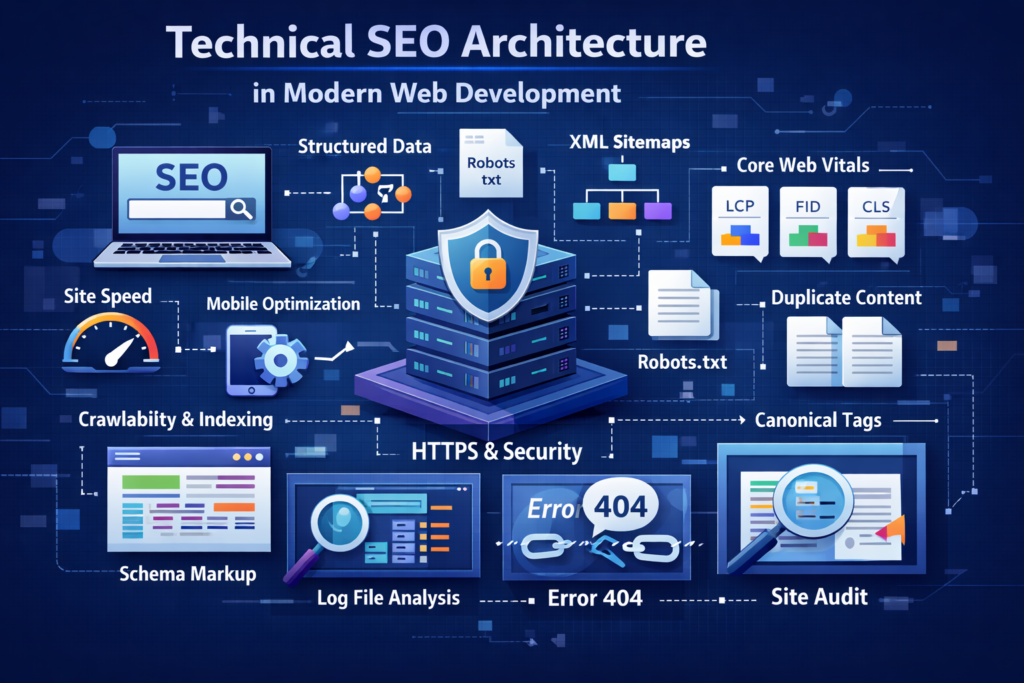
What good technical architecture usually looks like
| Area | What to get right |
|---|---|
| Crawlability | Search engines can reach key pages easily |
| Canonicals | Preferred URLs are clear and consistent |
| Internal links | Important pages receive strong contextual links |
| Structured data | Key entities and page types are machine-readable |
| Localization | Regional and language versions are properly signaled |
Secure and compliant development builds trust
Secure web development does more than reduce risk. It also affects whether users trust your site enough to submit a form, request a quote, or complete a transaction.
A secure-by-default setup usually includes.
HTTPS everywhere
Strong authentication patterns
Dependency and package hygiene
Content security controls
Least-privilege access
Careful third-party integration management
Compliance expectations also change by region. In the EU, GDPR remains the core legal framework for personal data protection. In the UK, UK GDPR and ICO guidance shape how organizations handle personal data. In US healthcare, HHS states that the HIPAA Security Rule requires administrative, physical, and technical safeguards for electronic protected health information.
That changes real build decisions. A London-based professional services site may need clearer consent and privacy messaging. A Berlin fintech company may need tighter data-handling language and vendor scrutiny. A US healthcare platform has to think much more carefully about how forms, hosting, access control, and data flows are designed from day one.

Conversion-focused web development turns traffic into pipeline
A fast site is helpful. A fast site that also removes friction is what drives growth.
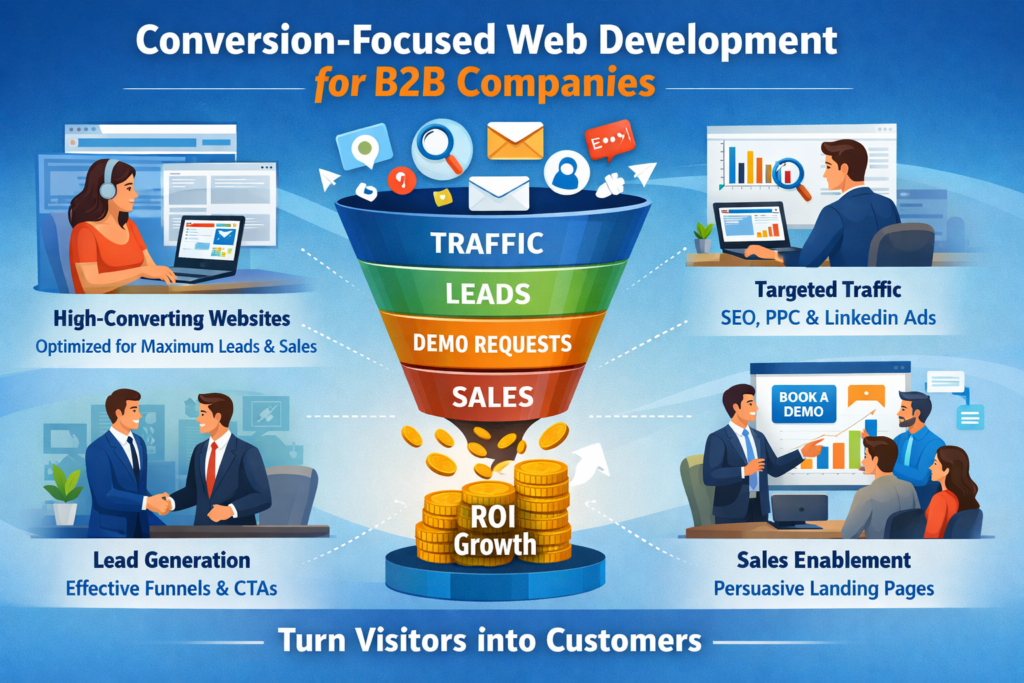
Conversion-focused web development is about aligning speed, UX clarity, proof, and buyer intent. That often includes.
Clear messaging above the fold
Proof close to decision points
Shorter, cleaner forms
Better mobile usability
Stronger CTA placement
Fewer distractions between click and action
From a small business point of view, this is where many websites underperform. They spend heavily on traffic, then send people to pages that are slow, vague, or overloaded with friction.
Accessibility belongs in this conversation too. The WebAIM Million 2025 found that 94.8% of the top one million home pages had detectable WCAG failures, with an average of 51 errors per page. Those are not just compliance issues. They are conversion issues, because poor contrast, unlabeled fields, and weak structure make it harder for real people to trust and use a site.
How regional priorities change web development choices
The core discipline stays the same, but the emphasis shifts by market.
United States
Growth teams in the US often prioritize.
Scalability
CRM integration
Landing page experimentation
Performance for SaaS, fintech, and healthcare journeys
United Kingdom
UK service businesses often benefit more from.
Trust-led service design
Accessibility-first thinking
Clear consultation and inquiry paths
Stronger policy and compliance clarity
Germany and wider EU
In Germany and broader EU markets, buyers often respond more strongly to.
Clear privacy language
Formal trust signals
Strong localization
Better data-handling transparency
Multilingual site structure where needed
Same discipline. Different emphasis.
A San Francisco SaaS company may win with speed, demos, and lifecycle automation. A London consultancy may need a more structured services architecture and better proof near inquiry forms. A Berlin fintech brand may need tighter privacy messaging and stronger reassurance around data governance.
A practical 2026 checklist for modern web development
If you are reviewing a business website this year, start here:
Performance
Check LCP, INP, and CLS
Review JavaScript weight
Audit image delivery
Reduce unnecessary third-party scripts
SEO
Review crawl depth and indexation
Clean up canonicals
Strengthen internal linking
Add structured data where it fits
Implement hreflang correctly for regional versions
Security and compliance
Confirm HTTPS and certificate hygiene
Review dependency risk
Check cookie and consent handling
Map data collection to market requirements
Conversion readiness
Simplify forms
Tighten CTA placement
Improve proof near key actions
Check mobile UX on high-intent pages
Fix accessibility friction
The big takeaway is simple: build the site like a business asset, not a digital brochure. Teams that treat performance, SEO, trust, and conversion as one system usually spend less time fixing technical debt later and more time compounding results.
Wrapping It Up
If your site is getting visits but not enough qualified leads, the problem is often deeper than copy alone. Modern web development gives you the technical foundation to improve discoverability, trust, and conversions at the same time.( Click Here’s )
Key takeaways
Modern web development works best when performance, SEO, security, and conversion are planned together.
Core Web Vitals still matter, especially on mobile.
Technical SEO starts with architecture, not plugins.
Compliance requirements vary across the US, UK, and EU.
Accessibility issues affect revenue, not just usability.
Localization changes how trust, privacy, and buyer journeys should be presented.
FAQs
Q : Is modern web development different from traditional website development?
A : Yes. Traditional website projects often treated design, SEO, speed, security, and conversion as separate workstreams. Modern web development treats them as one connected system, which usually leads to better rankings, stronger UX, and better business outcomes.
Q : Which matters more for rankings: Core Web Vitals or content quality?
A : Content quality still matters more in most competitive searches, but performance is not optional. The strongest approach is pairing useful content with a fast, stable, crawlable website.
Q : Do B2B websites need different development priorities than ecommerce sites?
A : Usually, yes. Ecommerce sites focus more on product architecture, checkout, and merchandising. B2B sites usually rely more on trust, service clarity, CRM integration, case studies, and lead-routing paths.
Q : How early should GDPR or UK GDPR requirements be considered?
A : At the start of the project. Privacy requirements affect forms, analytics, cookies, consent flows, data storage, and even infrastructure choices, so leaving them until launch usually creates rework.
Q : What should a business audit first when traffic is high but leads are low?
A : Start with page speed, message-to-intent match, and form friction. Then review mobile UX, proof placement, analytics accuracy, and accessibility barriers. In many cases, the traffic is not the problem. The experience is.
[…] vs WordPress SEO is not about picking the “new” platform over the “old” one. It is about choosing the setup […]