
No-Code + Low-Code
Choosing between no-code vs low-code isn’t just a tooling debate it’s a delivery strategy decision that affects speed, scalability, governance, and long-term cost. In many teams, the terms get blurred, which leads to mismatched expectations: business users expect “drag-and-drop magic,” while IT worries about security, maintainability, and vendor lock-in.
This guide cuts through the hype with crisp definitions, a practical decision framework, a side-by-side comparison, and field-tested examples so you can confidently pick the right approach project by project. We’ll also cover pitfalls to avoid, governance you actually need, and a short How-To to run a successful pilot. By the end, you’ll know exactly when no-code vs low-code makes sense—and when to combine them.
What Each Term Means (fast definitions)
No-code: Visual builders for non-developers to create workflows, forms, internal tools, simple apps, and integrations using drag-and-drop and prebuilt connectors. Minimal configuration; no hand-written code.
Low-code: Visual development plus optional code (scripts, components, APIs). Targets more complex, scalable, and integrated apps while accelerating pro-dev teams.
Google Trends shows sustained global interest in both “no-code” and “low-code” since 2020, reflecting mainstream adoption across business and IT audiences. Google Trends
When to Use No-Code vs Low-Code (the quick answer)
Use no-code vs low-code based on risk, complexity, and changeability:
Choose no-code when:
The problem is well-understood and process-driven (requests, approvals, data capture).
You need speed (hours or days) and the audience is business-owned.
Data lives in SaaS tools and you can rely on prebuilt integrations.
“Good enough” UX is fine; limited customization is acceptable.
Choose low-code when:
You need custom logic, scalable data models, or complex integrations (ERP, legacy, custom APIs).
You expect long-term evolution and engineering oversight.
You must meet stricter security/compliance and performance requirements.
You want to mix visual dev with pro-code (extensions, custom components).
Analyst roundups attribute to Gartner that a large share of new apps are now built with low-code or no-code—an adoption trend corroborated by multiple enterprise sources (EY, Ninox summaries of Gartner insights).
No-Code vs Low-Code: Side-by-Side Comparison
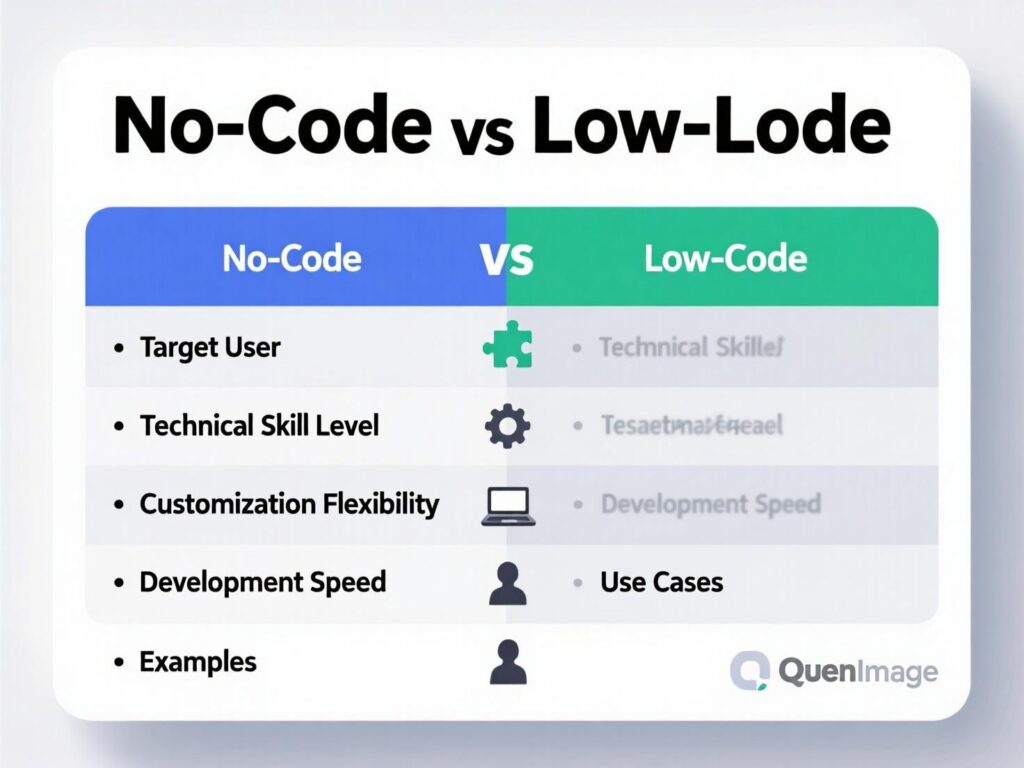
| Dimension | No-Code | Low-Code |
|---|---|---|
| Target users | Ops, PMs, analysts (“citizen developers”) | Pro devs + business builders |
| Speed | Hours–days | Days–weeks |
| Custom logic & UX | Limited; templates | Broad; extensible |
| Integrations | Prebuilt connectors | Connectors + APIs + custom code |
| Data & scale | Light–moderate | Moderate–enterprise |
| Security/compliance | Varies by vendor; often SOC 2/ISO available | Stronger enterprise controls & SSO/SCIM |
| Governance | Guardrails + template governance | Full lifecycle (dev/test/prod), policies |
| Long-term maintainability | Risk of vendor constraints | Designed for ongoing evolution |
| TCO over 2–3 years | Low entry cost; watch per-seat limits | Higher setup; better at complex scale |
Vendor resources broadly agree on these patterns (e.g., Oracle, OutSystems, Bizagi primers).
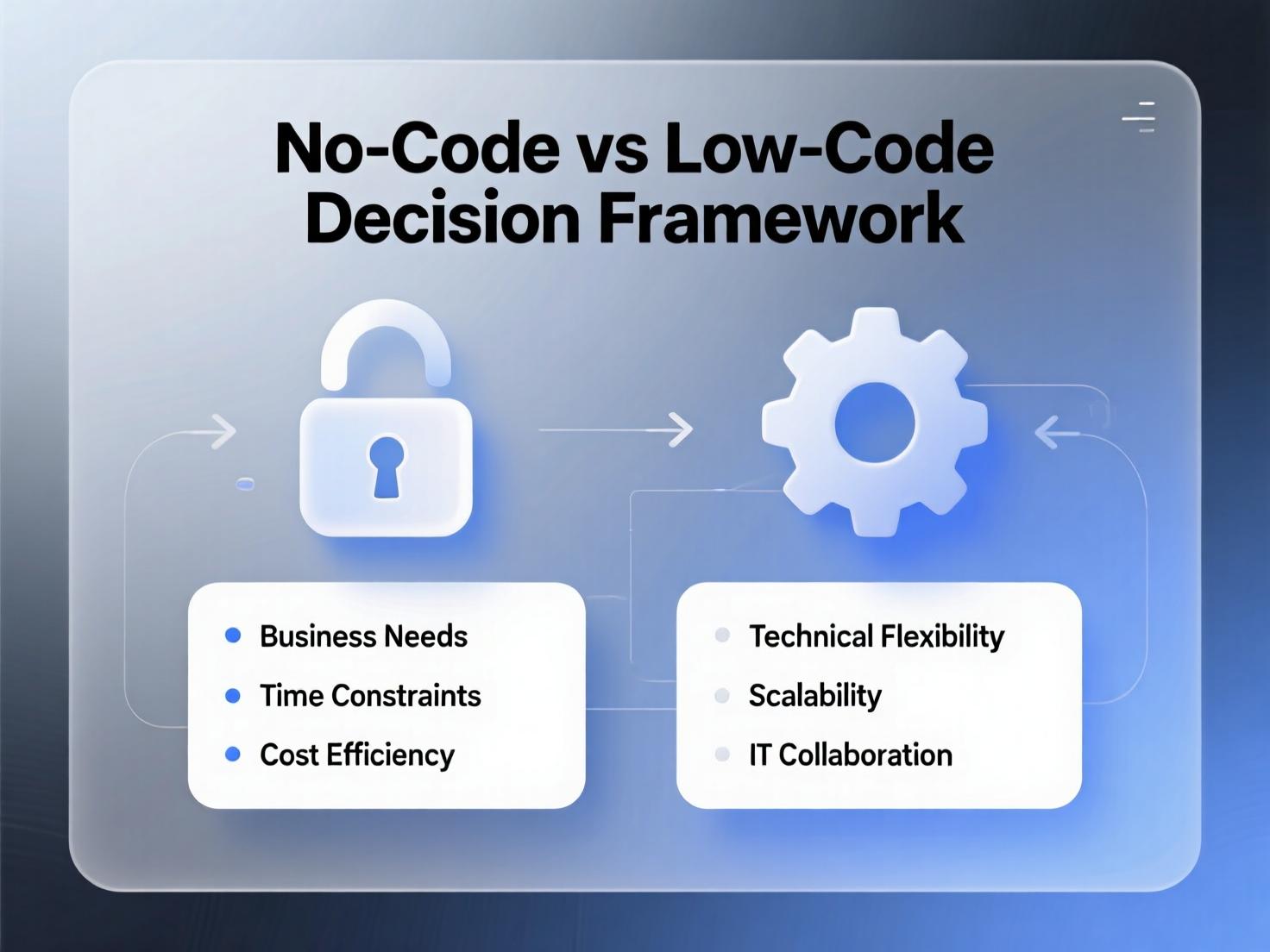
A Decision Framework You Can Reuse
Use this five-question litmus test across initiatives to decide no-code vs low-code:
Who owns it?
If the business runs it day-to-day and IT just provides guardrails, favor no-code. If engineering must extend or integrate deeply, favor low-code.
How complex is the logic?
Straight-through workflows and simple rules → no-code; multi-step, conditional, or event-driven logic → low-code.
What’s the integration surface?
SaaS-to-SaaS with popular apps → no-code; legacy/ERP/custom APIs → low-code.
Change horizon (12–24 months)?
If requirements are fluid with frequent tweaks, no-code can empower rapid iteration; if complexity will grow, start low-code to avoid re-platforming.
Risk & compliance posture?
Regulated data, strict SSO/least-privilege, audit trails → low-code enterprise platforms.
Real-World Examples (brief, concrete)
Unilever (Power Apps / no-code-leaning): Digitized factory quality checks and adjustments across plants, saving time and paper and enabling real-time process tweaks—illustrating speed and business ownership with governance.
Siemens (Mendix / low-code):
Built collaborative apps to streamline controlling and manufacturing processes, demonstrating enterprise-grade extensibility and integration under IT oversight.SMBs with Zapier (no-code automation):
Millions of teams orchestrate cross-SaaS workflows (lead routing, notifications, handoffs) without writing code—classic no-code value.
Architecture, Security & Governance (what actually matters)
Identity & access:
Enforce SSO (Okta/AAD), MFA, and least-privilege roles.Environments & promotion:
Separate dev/test/prod; require change reviews for critical apps.Data protection:
Prefer vendors with SOC 2/ISO 27001 and field-level encryption; document data flows.Auditability:
Enable audit logs, versioning, and artifact export.Exit strategy:
Confirm data/model export and how to unwind automations; avoid opaque lock-in.
OutSystems’ and Oracle’s guidance emphasizes enterprise-grade integrations and lifecycle controls on low-code platforms critical once apps become business-critical.
Cost, Time-to-Value & ROI
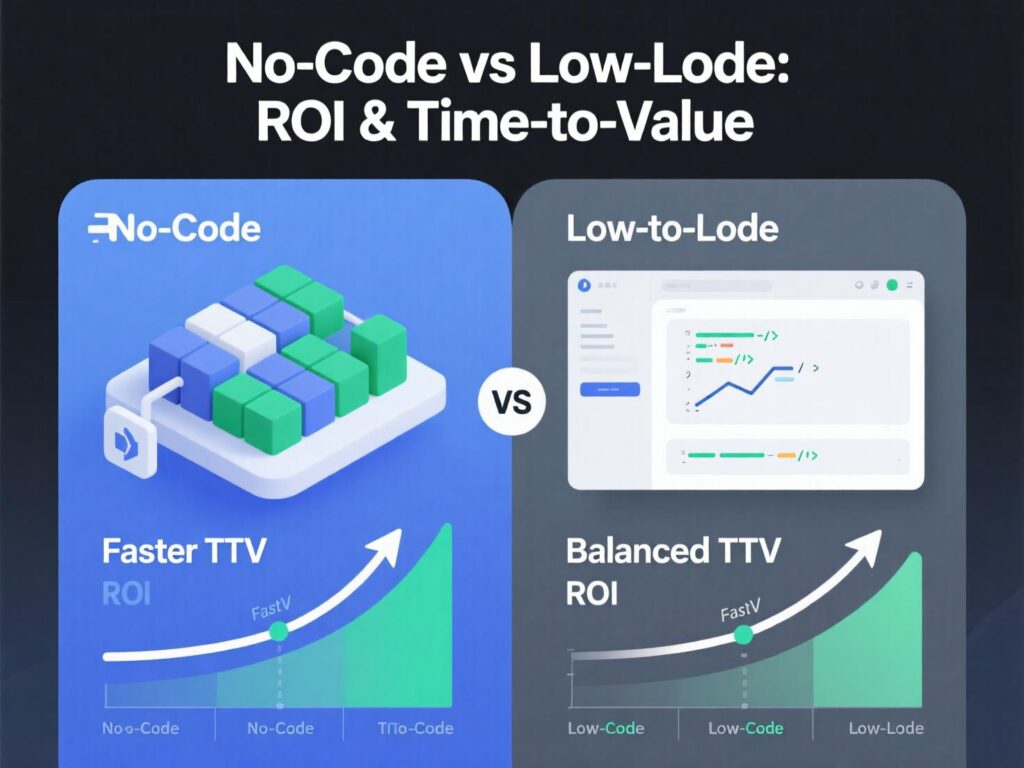
Third-party summaries of Gartner insights (EY; Ninox) report that a majority of new apps in the mid-2020s leverage no-code/low-code, reflecting enterprise demand for faster delivery amid talent constraints. The business case typically centers on time-to-value and capacity relief for dev teams.
Practical takeaway: Start with a small, high-visibility workflow (e.g., request → approval → handoff), measure lead-time reduction and error rate, then scale to adjacent processes.
Common Pitfalls & How to Avoid Them
Shadow IT:
Solve with governed sandboxes, approved vendor list, and federated app review.Single-maker risk:
Require shared ownership, documentation, and role backups.Connector sprawl:
Standardize on a core integration layer; document data lineage.Re-platform whiplash:
Use the framework above; if future complexity is likely, prefer low-code now.Hype-driven agents:
Many “agentic AI” claims are early; validate ROI before wiring agents into mission-critical flows.
Implementation Playbook (How-To)
Pick a pilot with a tight scope (1–2 workflows, 2–4 systems).
Decide approach using the five-question framework (no-code vs low-code).
Set guardrails:
identity, data policy, environments, and audit.
Build a thin slice end-to-end; ship in ≤2 weeks.
Measure outcomes:
cycle time, error rate, NPS, adoption.
Plan evolution:
backlog of v2 features; decide if/when to step from no-code to low-code.
Document & hand off with ownership, support model, and exit plan.
Bottom Lines
You don’t have to pick a side forever. Use no-code vs low-code as a portfolio: ship simple, well-bounded workflows fast with no-code, and build scalable, integrated apps with low-code under engineering governance. Many teams run both approaches in parallel—business users iterate on front-line workflows while pro-devs extend the platform and integrations. Start small, measure real outcomes, and scale what works.
CTA: Want a bespoke no-code vs low-code roadmap for your stack? Book a 45-minute discovery session, and we’ll map 3 quick-win candidates plus the guardrails you’ll need.
FAQs
Q1 : How do I decide between no-code vs low-code for a new project?
A : Use the five-question framework: ownership, logic complexity, integration surface, change horizon, and risk posture. If business owns it and complexity is low, start no-code. If you expect growth in logic/integrations, begin low-code to avoid re-platforming.
Q2 : How secure are no-code platforms?
A : Security varies. Look for SOC 2/ISO 27001, SSO/MFA, audit logs, and export options. For regulated data or strict compliance, prefer enterprise-grade low-code with stronger controls.
Q3 : How can we avoid vendor lock-in?
A : Check data export, open APIs, and portability. Keep “system of record” data outside the app builder where practical, and document workflows so you can rebuild if needed.
Q4 : How does governance differ for no-code vs low-code?
A : No-code governance focuses on templates, roles, and approvals; low-code adds environments, CI/CD, code review, and lifecycle management.
Q5 : How fast can we deliver value with no-code?
A : Simple workflows ship in hours or days. Prove value with a thin slice—request → approval → handoff then iterate.
Q6 : How do we scale from a no-code pilot to low-code?
A : Define a handoff: freeze no-code MVP, rebuild critical services in low-code with APIs, and keep front-line tweaks in no-code where safe.
Q7 : How do AI agents fit into this?
A : Treat agents as optional accelerators. Pilot narrowly, track ROI, and gate deployments with auditability many agent projects get shelved when value is unclear.
Q8 : How can business users contribute without creating shadow IT?
A : Provide an approved toolset, a request intake, environment guardrails, and a monthly review board. Pair a business “maker” with an IT steward.
Q9 : How do we estimate ROI?
A : Measure current lead time and error rates; estimate savings from hours reclaimed and defect reduction. Roll up a 6–12-month payback model and validate against pilot data.