


React vs Angular vs Vue 2025: The Real Winner
React vs Angular vs Vue 2025: The Real Winner
React vs Angular vs Vue 2025: The Real Winner
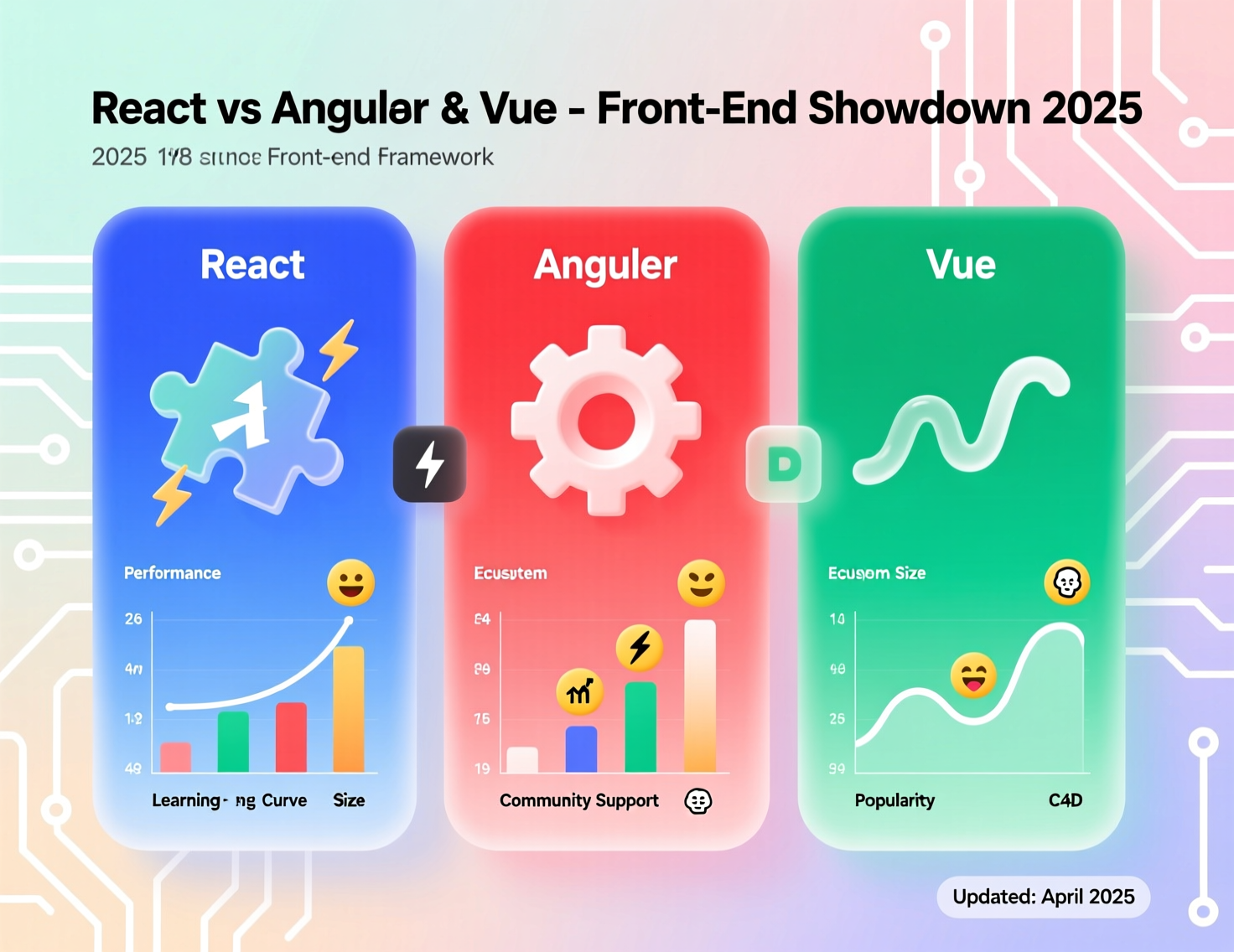
For most US, UK and EU teams in 2025, React is still the safest default thanks to its huge talent pool, ecosystem depth and flexibility. Angular shines in TypeScript-first, highly governed enterprise environments, while Vue fits lean teams that care about fast delivery and a gentle learning curve.
In other words: pick React when hiring and ecosystem are your top risks, Angular when governance and long-term consistency matter most, and Vue when you want simplicity, great DX and speed of execution.
The “framework wars” are still very real in 2025 but the smartest teams no longer ask “Which framework is objectively best?” and instead ask “Which one will reduce risk and speed us up?” Choosing between React, Angular and Vue now affects hiring in New York and London, your Core Web Vitals in Berlin, and even how cleanly you meet GDPR/DSGVO and HIPAA requirements.
This guide is written for developers, tech leads and CTOs in the US, UK, Germany and wider EU who need to pick a front-end stack for real projects: startup MVPs, high-traffic SaaS platforms, fintech and healthtech products, public-sector portals and legacy modernization programmes.
You’ll get a clear, opinionated verdict by use case plus a decision checklist, example stacks and practical next steps. If you just want the executive summary, jump straight to “How to Decide in 2025: Checklist, Stack Combos & FAQs.”
Core Differences: React vs Angular vs Vue at a Glance
What Each One Actually Is in 2025
React is a UI library from Meta focused on building component-based interfaces using a virtual DOM. Around it sits a huge ecosystem: Next.js, Remix, React Native, design systems, headless CMS integrations and more.
Angular (the modern, TypeScript-based version, not AngularJS) is a full, batteries-included framework from Google with strong TypeScript support, dependency injection, routing, forms and testing tools built in.
Vue is a progressive framework: you can sprinkle it into an existing page or use the Composition API plus tools like Nuxt and Vite to build full SPAs.
Put simply
React → flexible component-based UI library
Angular → all-in-one SPA framework
Vue → progressive framework sitting between the two
Ecosystem, Tooling & State Management
Typical stacks in 2025 look like this.
React
Often React + Next.js + Redux/Zustand/RTK Query, compiled with Webpack, Vite or Turbopack, tested with Jest and Cypress, and deployed to Vercel, Netlify or AWS/Azure/GCP.
Angular
Typically built with the Angular CLI, NgRx for state management, Jasmine/Karma or Jest for tests, integrated into monorepos via Nx, and deployed to Kubernetes or managed PaaS on AWS/Azure/Google Cloud.
Vue
Leans on Vite, Nuxt, Pinia for state, and an ecosystem that emphasizes DX and simplicity. For content-heavy and SEO-sensitive sites, Nuxt + server-side rendering gives you a strong single page application framework 2025 setup that still plays nicely with search engines.
Across all three, component-based UI and client-side routing are standard. Your real decision is how much of the stack you want the framework to decide for you.
Learning Curve, Team Fit & Developer Experience
React
Easy to start with if you know JavaScript, but you quickly need to choose routing, state, forms and data-fetching solutions. That flexibility is fantastic for experienced teams but can overwhelm juniors.
Angular
Steeper learning curve decorators, DI, RxJS but once the patterns click, large teams gain predictability. Many enterprise devs coming from .NET/Java appreciate Angular’s structure and TypeScript-first mindset.
Vue
Often seen as the smoothest on-ramp for full-stack Node.js developers, designers with some JavaScript, and agencies that onboard freelancers regularly. The Composition API feels conceptually close to React Hooks, without losing Vue’s overall approachability.
Popularity, Jobs & Community in US, UK, Germany & EU
US & Canada Silicon Valley to New York.
In North America, React dominates job postings.
One 2024 analysis of around 250k frontend job offers reported roughly 126k React roles, 87k Angular roles and 24k Vue roles worldwide.React clearly leads the “can we hire for this quickly?” conversation.
Surveys and 2025 comparison articles still place React at around 40% usage share, with Vue roughly 20–22% and Angular around 18% among respondents.
For US fintech and healthtech (think HIPAA-aware patient portals and PCI DSS-sensitive dashboards), React is usually first choice. Angular appears in larger enterprises and vendor products, while Vue is more common in internal tools and admin dashboards.
UK & Ireland London Agencies, Fintech & NHS Projects
In London, React is again the most common option for VC-backed startups and Open Banking providers integrating with the Open Banking Implementation Entity standards.
Angular is popular in banks and insurance where teams like the opinionated, TypeScript-heavy ecosystem, and in some NHS and Gov.UK-style projects that value standardization and strict accessibility baselines. Vue is widespread among digital agencies shipping polished marketing sites and portals with Nuxt.
Local communities in London, Manchester and Dublin host active meetups for all three frameworks, but React and TypeScript tend to dominate conference schedules and job boards.
Germany & Wider EU DACH, Paris, Amsterdam & Beyond
In Germany and the DACH region, many BaFin-regulated enterprises and public-sector bodies choose Angular for its stability, long-term support and prescriptive structure. Teams building for the German Mittelstand often expect applications to live 7–10 years, which makes Angular’s governance-friendly approach attractive.
React is strong in international product companies in Berlin, Munich, Hamburg, Paris, Amsterdam and Barcelona, especially where the product has a global audience and the hiring market is competitive.
Vue continues to grow with agencies and product teams for portals and content-driven sites, and has good traction in France, the Netherlands and the Nordics particularly when paired with a headless CMS and Nuxt.
Performance, DX & Architecture in 2025
Rendering Models, Signals & Reactivity
All three frameworks can deliver excellent performance in 2025. Your architecture, data fetching and caching strategy usually matter more than the logo on your repo.
React
Uses a virtual DOM and Hooks, with features like Suspense and Server Components to improve perceived performance in tools such as Next.js.
Angular
Uses change detection and now signals, along with RxJS, to model complex data streams with fine-grained control.
Vue
Uses a reactive system with the Composition API, giving granular reactivity with a straightforward mental model.
In practice, all three can hit “fast enough” Lighthouse scores. The bigger differentiators are how you handle network boundaries, caching, bundling, and assets.
Bundle Size, Lighthouse Scores & Core Web Vitals
Out of the box, Angular tends to ship a larger base bundle because it includes more features by default, while Vue and React can start leaner but grow just as heavy if you bolt on too many libraries.
Modern build tools — Vite, Webpack 5, Turbopack — plus tree-shaking, code-splitting and lazy loading keep all three competitive. For SEO and Core Web Vitals, server-side rendering via Next.js (React), Nuxt (Vue) or Angular Universal is often more important than which framework you pick.
If you’re planning nuanced SSR vs SSG strategies, pairing this guide with Mak It Solutions’ article on server-side rendering vs static generation can help shape your architecture decisions.3
Scalability for High-Traffic SaaS, Fintech & Health Apps
For high-traffic SaaS and regulated apps in the US, UK or EU, common patterns include:
React or Angular front-ends
Micro-frontends via Module Federation, Nx or single-spa
Centralized logging, metrics and audit trails for HIPAA, PCI DSS and SOC 2
AWS, Azure and Google Cloud support all three frameworks equally. What matters is your observability, error handling and least-privilege access, not whether you used React, Angular or Vue.
React and Angular both have mature patterns for micro-frontends; Vue often appears in the same organizations for dashboards and internal tools within a polyglot front-end landscape.
Startups, Enterprise & Legacy Modernization
Choosing for a Startup MVP in the US/UK/EU
For a 2–5 person startup team in San Francisco, London or Berlin, speed, hiring and onboarding matter more than theoretical benchmark charts.
If you want the largest hiring pool across US/UK/EU and a huge library of ready-made components, choose React (typically with Next.js).
If your founding team already has strong Angular/TypeScript experience from corporate roles, Angular can be a perfectly fine MVP choice.
If your team values simplicity and tight feedback loops, Vue + Vite/Nuxt offers delightful DX and fast iteration, especially for content-heavy products.
Mak It Solutions’ front-end development services can help validate these decisions with a short architecture spike or MVP blueprint.
React vs Angular vs Vue for Enterprise & Regulated Sectors
In US enterprises and health systems, React often wins when product teams own the UX and want to move quickly, integrating with Node.js backends and Next.js for SSR.
In UK public sector and Open Banking, Angular is common in portals where long-term maintainability and shared design systems matter especially in NHS-style environments.
In German and EU banks and insurers, Angular’s opinionated structure and strong CLI align well with governance requirements under BaFin and EBA guidance.
A simple rule of thumb.
Angular wins where strict governance, shared patterns and long-lived portals are critical.
React wins where product teams prioritize speed, ecosystem and cross-platform reach.
Vue wins when you’re building internal tools and portals that must be pleasant and quick to ship, without deep corporate constraints.

Modernizing Legacy Apps (jQuery, AngularJS, Older SPAs)
Common modernization paths look like this.
Strangler-fig pattern
Wrap the old app and gradually replace sections with micro-frontends in React, Angular or Vue.
Incremental rewrites
Start with new modules or routes in your new framework, maintaining interop via iframes, custom elements or shared routing shells.
Full rewrite
Reserved for smaller codebases or when regulatory or UX demands force a clean break.
Migrating AngularJS often points naturally to modern Angular, but many teams still choose React or Vue when they want a fresh start and broader hiring options.
Mak It Solutions has dedicated React, Vue.js and Angular services if you need help planning a phased migration strategy.
Geo & Compliance Lens: US, UK, Germany & EU Realities
Data Privacy & Consent
Your choice of front-end framework does not automatically make you GDPR/DSGVO or UK-GDPR compliant, but it does influence how cleanly you can implement:
Cookie banners and consent flows
Consent-based analytics
Error tracking and logging with EU data residency
Data minimization in local storage and browser APIs
For EU and especially German projects, you may be required to keep telemetry within EU data centers and follow Schrems II guidance. This affects your hosting and observability tools far more than it affects the React/Angular/Vue decision itself.
Framework-agnostic UI component libraries plus headless CMS setups like those described in Mak It Solutions’ headless CMS guide can help you keep data flows auditable and compliant.
Accessibility, Localization & Design Systems
In NHS, Gov.UK, EU Commission and large banks, WCAG 2.1+ accessibility and multi-language support are non-negotiable.
React has a huge ecosystem of accessible design systems, including many internal big-tech libraries and open-source kits.
Angular powers many internal enterprise design systems where consistency and long-term maintainability matter more than experimental UX.
Vue is favored in some EU agencies for its lightweight templates, straightforward localization and quick onboarding.
All three can meet accessibility and localization requirements. What matters most is discipline, component governance and automated testing, not the choice of framework alone.
Hosting, Data Residency & Cloud Providers
On AWS, Azure and Google Cloud, you can host React, Angular and Vue apps from regions in Frankfurt, Dublin, London, Paris, Amsterdam and beyond.
The framework rarely determines your compliance posture your logging, storage, encryption and vendor contracts do. That said, Angular + TypeScript sometimes fits more naturally into existing enterprise toolchains in German/EU contexts, while React is very common in cloud-native, microservice-first setups.
For SEO-critical projects, pairing your framework with SSR/SSG patterns and smart routing matters more than the specific framework logo. Mak It Solutions’ Next.js development services and broader web development services cover these choices end-to-end.

How to Decide in 2025
Use these questions in your next architecture workshop or roadmap meeting.
Where is your talent pool?
Mostly US/UK/EU, hiring generalist JS devs → React.
Enterprise-heavy TypeScript devs → Angular.
Small, design-led or full-stack Node teams → Vue.
What’s your time-to-market pressure?
Need an MVP in weeks → React or Vue.
Long roadmap with many teams → Angular or React.
How strict is your governance/compliance?
BaFin/EBA, public sector, NHS-style → Angular is often strongest.
Product-led SaaS under HIPAA/PCI DSS → React, with solid architecture and DevSecOps.
Do you already have a design system?
React-based → stay on React.
Angular-based → stay on Angular.
Starting from scratch → any of the three, with Vue often fastest for smaller teams.
What are your mobile and omnichannel plans?
iOS/Android with one skills pool → excellent ecosystem around React Native.
Web-first internal tools → any framework works.
How big will the front-end get?
Many modules, teams and micro-frontends → Angular or React with Nx/Module Federation.A few domains and small teams → React or Vue.
What future hiring expectations do you have?
Want maximum CV visibility in US/UK/EU → React remains the safest bet.4
Short version.
React for the largest hiring pool, Angular for strict governance and structure, Vue for small teams optimizing for simplicity and shipping speed.
Recommended Stack Combinations for 2025
React + Next.js + Node.js/Serverless (AWS Lambda, Azure Functions)
Ideal for SaaS, marketing sites and global apps that need SSR, edge caching and flexible APIs.
Angular + Nx + .NET/Java/Node backends
Great fit for large enterprises with monorepos, layered architecture and strong governance.
Vue + Nuxt + Headless CMS
Excellent for content-heavy, SEO-focused sites in the EU, especially when combined with SEO services and a headless CMS.
Mak It Solutions also offers Node.js development and business intelligence services that pair well with all three stacks.
Key Takeaways
React offers the largest global hiring pool and ecosystem, making it the safest default for cross-region product teams in the US, UK and EU.
Angular excels in TypeScript-first, highly governed environments such as banks, insurers and public-sector portals especially in Germany and the wider EU.
Vue gives small, design-focused teams a delightful DX and fast iteration, especially for content-heavy sites, portals and internal tools.
Performance differences are largely implementation-dependent SSR/SSG, caching and asset strategy matter more than framework choice alone.
Compliance (GDPR, DSGVO, UK-GDPR, HIPAA, PCI DSS) is driven by architecture, hosting and data flows, not by your choice of front-end framework.
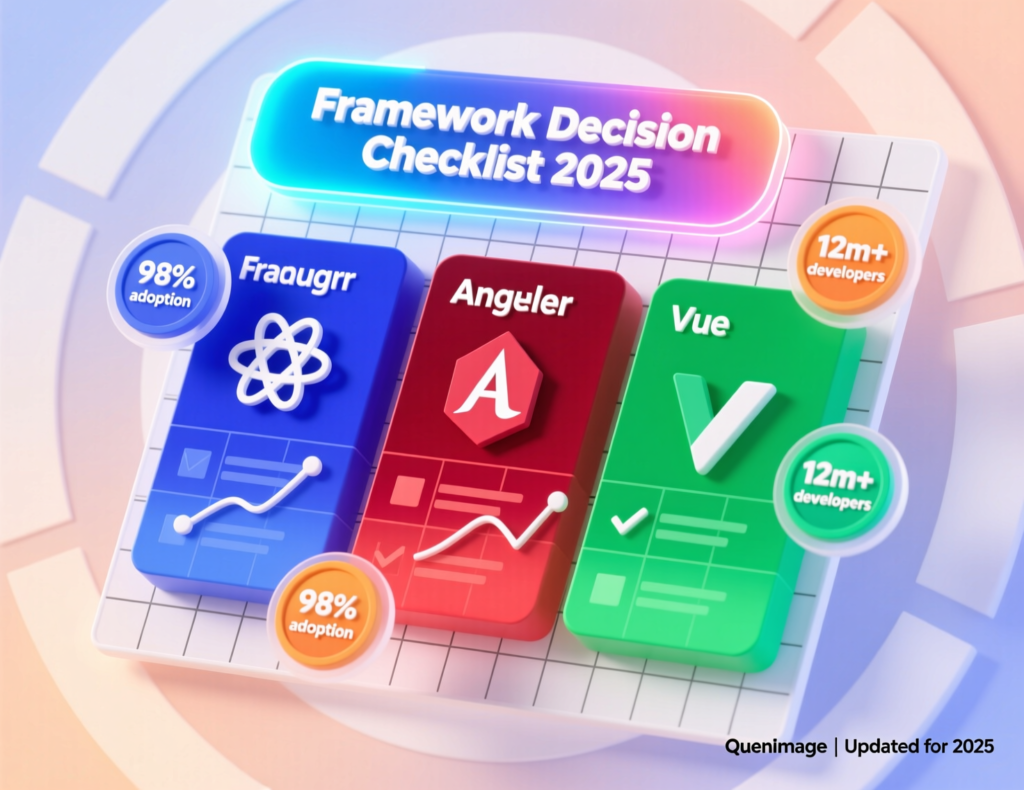
A structured checklist that considers skills, governance, UX, mobile plans and maintenance will give you a future-proof, low-regret choice.
Share your current stack, team profile and target markets (US/UK/EU) with Mak It Solutions, and we’ll help map out a pragmatic front-end strategy including framework choice, rendering model and hosting approach.
Whether you’re planning a new SaaS platform, rebuilding a monolith or modernizing legacy jQuery or AngularJS apps, our team can scope a low-risk pilot and give you a clear, actionable recommendation you can take straight into your next roadmap meeting.( Click Here’s )
FAQs
Q : Is it a bad idea to mix React, Angular and Vue in the same organization or micro-frontend architecture?
A : It’s not inherently bad, but you do pay an operational tax. Many large enterprises run multiple frameworks across different products or micro-frontends. The real risk is fragmentation: duplicated design systems, inconsistent UX and longer onboarding times. If you mix frameworks, invest in shared design tokens, APIs, CI/CD standards and monitoring so teams can collaborate without confusion. For smaller organizations, picking one primary framework and sticking with it is usually simpler.
Q : How long does it typically take to migrate a large legacy app (jQuery or AngularJS) to React, Angular or Vue in 2025?
A : Migration timelines depend on codebase size, test coverage and team capacity. A medium-sized jQuery app might be strangled and replaced in 6–12 months, while a very large AngularJS or custom SPA can take 18–36 months of phased work. The safest approach is usually the strangler-fig pattern: carve out new sections in the modern framework, run them alongside the legacy app, and gradually retire the old code instead of attempting a risky “big bang” rewrite.
Q : Which framework is easiest for full-stack developers who mostly work with Node.js and REST/GraphQL APIs?
A : Full-stack Node.js developers often gravitate towards React or Vue. React aligns well with the broader JavaScript ecosystem and has excellent tooling around GraphQL (Apollo, Relay) and REST clients. Vue offers an approachable syntax and pairs nicely with Vite and Nuxt, which full-stack devs usually find straightforward. Angular is still a strong choice if you appreciate strict TypeScript and structured architecture, but its learning curve can be steeper for pure Node.js developers.
Q : How do React, Angular and Vue compare for building design-system-driven UIs and reusable component libraries?
A : All three can power robust design systems, but the cultures differ. React has the largest ecosystem of design systems (from big-tech internal libraries to open-source kits) and strong Storybook support. Angular’s strong typing and structure make it natural to build enterprise-grade component libraries consumed by many teams. Vue’s simplicity makes it quick to build smaller, highly tailored design systems for agencies and product squads. Choose the framework where your designers and engineers collaborate most effectively.
Q : Are there performance or SEO disadvantages to choosing SPA frameworks like React, Angular or Vue for content-heavy sites in 2025?
A : If you ship a purely client-rendered SPA with large bundles, there can be SEO and performance downsides, especially for content-heavy sites. In 2025, the standard pattern is to use SSR, SSG or hybrid rendering via frameworks like Next.js (React), Nuxt (Vue) or Angular Universal, combined with code-splitting, image optimization and good caching. When you follow these practices, React, Angular and Vue can all power SEO-competitive content sites.