

Schema Markup for Arabic Websites: GCC SEO Guide
Schema Markup for Arabic Websites: GCC SEO Guide
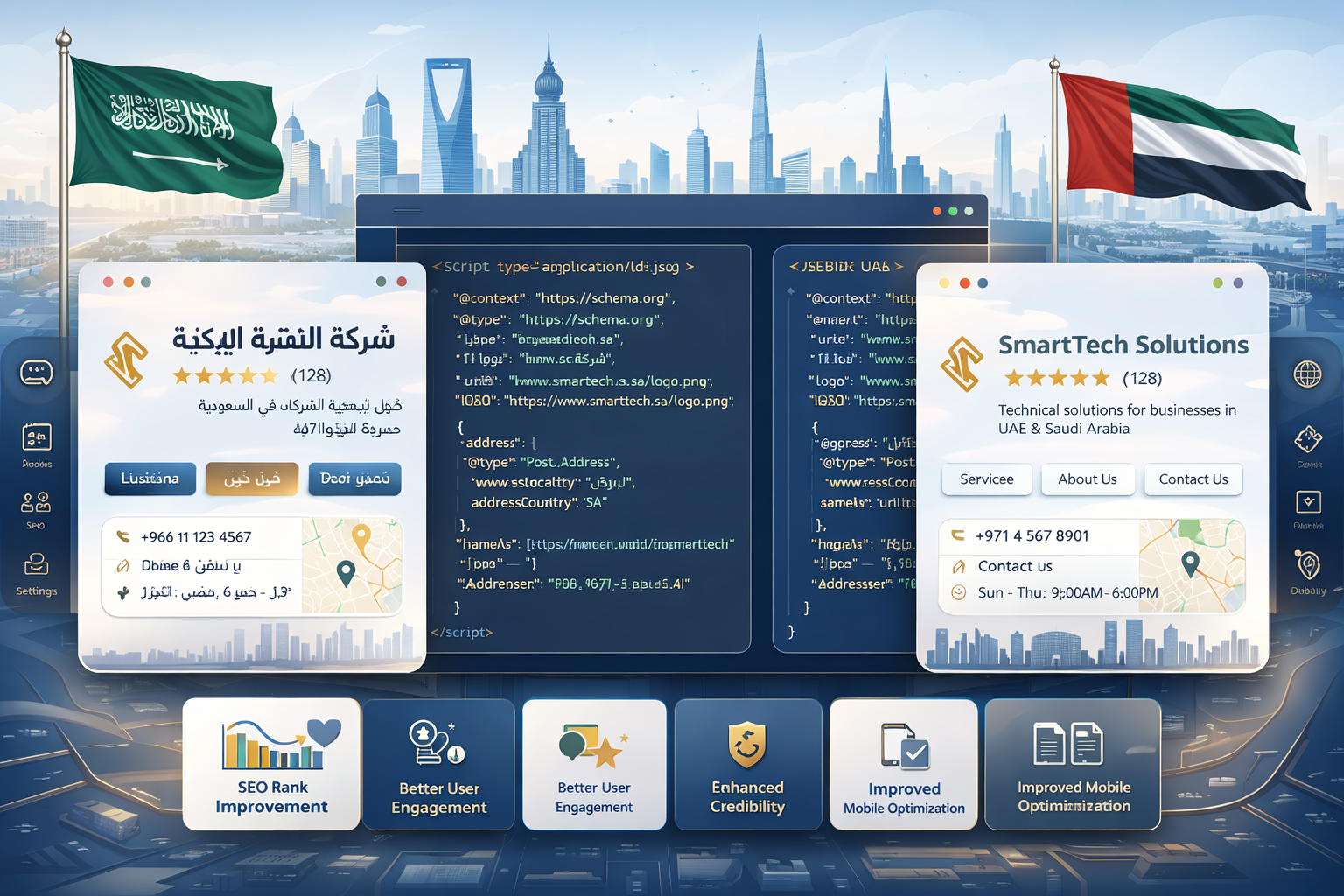
Schema Markup for Arabic Websites: GCC SEO Guide
Schema markup for Arabic websites helps search engines understand who you are, what you offer, and where you operate. For businesses in Saudi Arabia, the UAE, and Qatar, that matters even more because many sites are bilingual, brand names appear in both Arabic and English, and trust plays a major role in industries like fintech, healthcare, logistics, and e-commerce.
The most practical setup for GCC service websites is usually simple: use Organization schema for your business identity, Service schema for key landing pages, and FAQPage only where it genuinely improves the user experience. That approach supports stronger entity clarity, cleaner indexing, and better AEO readiness without relying on outdated rich-result expectations.
Why schema markup matters for Arabic websites in the GCC
Schema markup for Arabic websites is no longer just a technical extra. In competitive GCC markets, it helps search engines connect your business name, services, contact details, and location signals across Arabic and English versions of your brand.
That is especially useful when a company appears one way in Arabic, another way in English, and slightly differently again on LinkedIn, directories, or social profiles. Without structured data, those signals can feel fragmented.
In practice, businesses in Riyadh, Dubai, Abu Dhabi, and Doha often need schema for three reasons.
Better entity clarity across Arabic and English brand names
Stronger trust signals on service and conversion pages
Cleaner understanding of local service intent
For Arabic-first or bilingual websites, schema helps reduce ambiguity. It gives search engines a more reliable map of your business.
What schema markup for Arabic websites actually does
At its core, schema markup is structured data that explains your page in a machine-readable format. It tells search engines.
Who the business is
What the page is about
Which services are offered
How users can contact you
Which profiles and official pages belong to the same entity
For GCC businesses, this becomes more important when the same company serves multiple cities or markets. A single brand may target Saudi Arabia, the UAE, and Qatar while using localized pages for each audience.
That is where clean JSON-LD can make a real difference.
Why Saudi, UAE, and Qatar need a localized schema strategy
Saudi Arabia.
Saudi users often search in Arabic first, especially for services tied to finance, healthcare, government-adjacent work, and consumer offers. In markets like Riyadh and Jeddah, trust matters early in the buying journey.
For businesses in regulated or trust-heavy sectors, schema markup for Arabic websites helps reinforce identity, service clarity, and business legitimacy.
UAE.
The UAE is highly competitive and more visibly bilingual. A service page in Dubai may need to perform for both Arabic and English queries, sometimes on the same domain.
Structured data helps connect those versions of the same entity. That can improve consistency across branded search, service pages, and external business profiles.
Qatar.
Qatar often gives smaller and mid-sized businesses a cleaner long-tail opportunity than more saturated markets. A Doha company with strong Arabic service pages and accurate schema can stand out faster, particularly in B2B, fintech, logistics, and digital services.
From a small business point of view, that makes structured data a smart foundational move rather than an optional add-on.
The best schema setup for most Arabic service websites
For most GCC businesses, the strongest framework is not complicated. Start with these three layers.
Organization schema
Use Organization schema to define your core business identity, including:
Official business name
Arabic and English brand variations
Website URL
Logo
Contact details
Social profile links
Key business information
This creates the foundation for entity trust.
Service schema
Use Service schema on commercial landing pages that describe a real offer, such as.
Arabic SEO services
E-commerce development
Cloud migration
Fintech UX
App development
Logistics technology consulting
Each service page should reflect the visible page content. The schema should match what users actually see.
FAQ Page schema, used selectively
FAQ Page still has value, but it should be used carefully. It is helpful when it improves content clarity and answers real user questions. It should not be added only in the hope of getting rich results.
For commercial sites, FAQ markup works best as a support layer around stronger business and service schema.

How to combine Organization, Service, and FAQ schema on Arabic pages
A clean rollout usually looks like this.
| Page Type | Recommended Schema | Why It Matters |
|---|---|---|
| Homepage | Organization |
Defines the main entity |
| Service landing page | Organization + Service |
Connects the business to the offer |
| FAQ section on a service page | FAQ Page |
Improves clarity when questions are genuinely useful |
| Regional landing page | Organization + Service |
Supports local service intent in Riyadh, Dubai, Abu Dhabi, or Doha |
This structure is practical, scalable, and easier to maintain across bilingual websites.
GCC trust and compliance signals to reflect in schema planning
Schema itself does not prove compliance. Still, it supports a cleaner trust architecture when paired with accurate on-page content.
For GCC businesses, that means your structured data should align with visible trust signals such as:
Legal business naming
Accurate contact details
Consistent Arabic and English branding
Clear service ownership
Local office or service-area relevance
Regulated-sector context where appropriate
For example, fintech brands in Saudi Arabia, the UAE, or Qatar should make their business identity and service purpose unmistakably clear. That does not mean stuffing compliance claims into schema. It means keeping your entity signals clean, consistent, and easy to verify.

Best practices for schema markup on Arabic websites
Match the visible page content
Your structured data should never say more than the page itself says. If your Arabic landing page mentions a specific service, city, or contact method, the schema should match it exactly.
Keep Arabic and English brand names consistent
Many GCC websites weaken their entity trust because the Arabic name, English trading name, and social profile labels do not line up. Try to standardize.
Brand spelling
Logo usage
Contact details
Official URLs
Social profile naming
Use JSON-LD for cleaner implementation
JSON-LD is usually the easiest format to manage and maintain. It is cleaner to deploy, easier to validate, and less likely to break visible page formatting.
Localize by city and market where relevant
If a page targets Riyadh, Dubai, Abu Dhabi, or Doha, reflect that naturally in the content. Local contact details, service areas, and market-specific offers help make the schema more meaningful.
Prioritize your highest-value pages first
Do not try to mark up everything at once. Start with.
Homepage
Top service pages
High-converting Arabic landing pages
FAQ sections that answer real buyer questions
That usually gives the best return with the least complexity.
Common schema mistakes on Arabic GCC websites
Using FAQ schema as the whole strategy
This is still one of the most common mistakes. FAQ markup can help, but it should not be the entire plan.
Mismatched Arabic and English brand signals
If your brand name changes across the website, directory listings, and social media, your entity becomes harder to interpret.
Adding schema that does not match the page
If the page content does not support the structured data, the implementation becomes weak and potentially misleading.
Ignoring local trust signals
A GCC service page that feels generic tends to underperform. Local relevance matters. Users in Saudi Arabia, the UAE, and Qatar want to know who is behind the business, where it operates, and whether it feels credible in their market.

A practical rollout plan for Riyadh, Dubai, Abu Dhabi, and Doha pages
A simple rollout can look like this.
Audit your existing Arabic and bilingual pages
Standardize business naming in Arabic and English
Add Organization schema to the homepage
Add Service schema to core service pages
Use FAQ Page only where it improves clarity
Validate the implementation before publishing
Review brand consistency across your website and external profiles
Many businesses overcomplicate schema early on. A better approach is to fix the foundation first, then expand.

Final thoughts
Schema markup for Arabic websites works best when it supports real clarity, not shortcuts. In Saudi Arabia, the UAE, and Qatar, that means helping search engines understand your business identity, service pages, and local relevance across both Arabic and English signals.
If your current setup relies on generic markup or outdated FAQ tactics, it is worth revisiting the structure. A clean combination and selective can strengthen trust, support SEO and AEO, and make your most important Arabic pages easier to understand.( Click Here’s )
FAQs
Q : Is FAQ schema still useful for Saudi Arabic business websites?
A : Yes, but mainly as a content clarity tool. It can help structure answers and improve page usefulness, but it should not be your main visibility strategy.
Q : Should Dubai service pages use both Organization and Service schema?
A : In most cases, yes. Organization defines the company, while Service explains the specific commercial offer on the page.
Q : How should Qatar businesses start with schema markup on Arabic pages?
A : Start with the basics: mark up the business with Organization, apply Service to core landing pages, and add FAQs only where users genuinely need them.
Q : Does schema markup help bilingual UAE websites?
A : Yes, indirectly. It helps search engines connect Arabic and English versions of the same entity more clearly, which supports consistency and trust.
Q : What is the best schema type for Riyadh service companies?
A : Usually, it is not one schema type alone. The best setup is a combination of Organization and Service, with FAQ Page used selectively.