
Smart City Dashboard for GCC City Ops
City operations teams in Riyadh, Dubai, and Doha cannot afford to manage transport, utilities, incidents, and public services through disconnected systems. A smart city dashboard brings those moving parts into one operational view, but the real value comes from the architecture behind it: live integrations, clear governance, bilingual usability, and hosting decisions that fit GCC requirements.
In practical terms, the best smart city dashboard for GCC municipalities combines IoT feeds, GIS context, incident workflows, and compliance controls in one platform. It should help teams see what is happening now, understand where it is happening, and respond faster without creating governance problems later.
GCC cities are already operating in a high-pressure environment. Congestion, infrastructure demand, public expectations, and digital transformation goals are all rising at once. That is why dashboards only work when they are treated as operational platforms, not just executive reporting screens.
For teams already exploring smart city digital twin strategies, this is the layer where day-to-day city operations become visible, measurable, and scalable.
What Is a Smart City Dashboard in GCC City Operations?
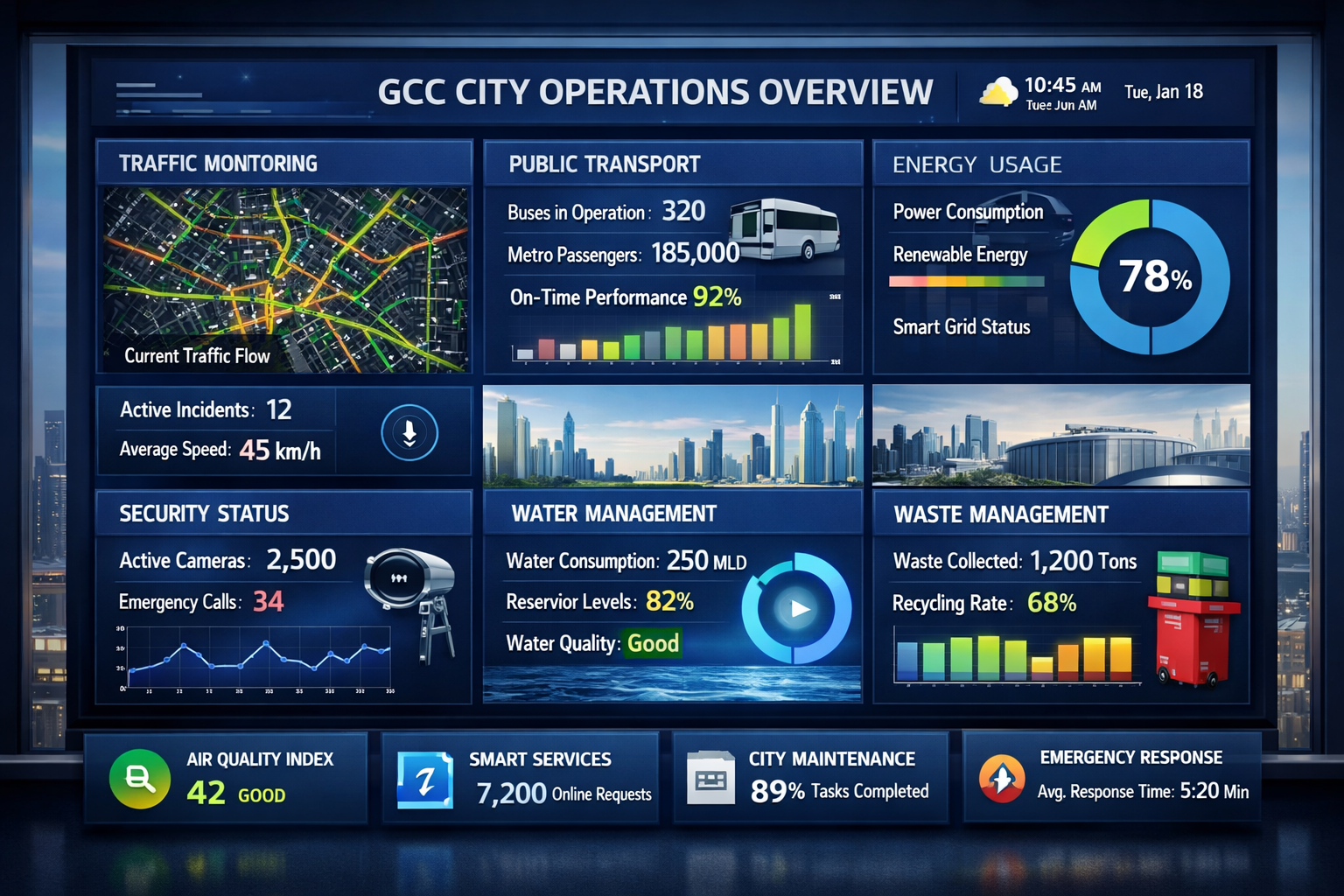
A smart city dashboard is a real-time operations interface for municipal leaders, command centers, and govtech teams. It combines live data, maps, alerts, and service KPIs so decision-makers can monitor conditions and act quickly.
Unlike traditional business intelligence tools, a city dashboard is built for active operations. It does not just explain what happened last week. It helps teams manage what is happening now.
Why it matters in Riyadh, Dubai, and Doha
Each GCC city has different operational pressures.
Riyadh often requires scale, centralized governance, and visibility across large urban zones. Dubai usually emphasizes service integration, speed, and high-availability digital experiences. Doha projects often place more weight on trusted infrastructure, controlled environments, and resilience.
Even with those differences, the underlying need is the same: one reliable operational layer that connects city systems without creating new silos.
Real-time visibility beats static reporting
Static BI has a role, especially for planning and historical analysis. But a smart city dashboard is more useful when teams need to manage traffic flow, dispatch field crews, monitor service disruptions, or coordinate incident response.
That is why strong business intelligence services still need event-driven architecture behind the scenes. Without live signals and integrated workflows, the dashboard becomes another passive reporting tool.
The Core Architecture Behind a Smart City Dashboard
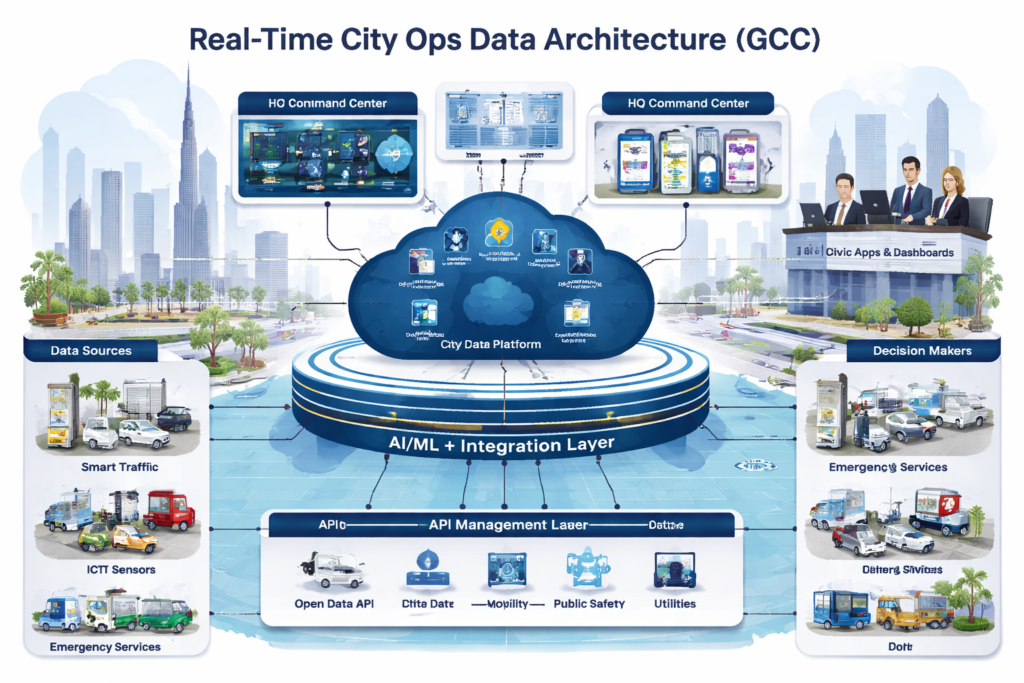
A dashboard is only as strong as its data pipeline. In practice, city operations platforms work best when they are built on a layered architecture that supports ingestion, processing, visualization, and governance from the start.
The source systems that matter most
Most GCC city dashboards pull data from multiple environments, including.
IoT and environmental sensors
GIS and location data layers
CCTV or video-event systems
Citizen service platforms
Work-order and field service tools
Mobility and transport platforms
Utilities and infrastructure monitoring systems
In a real municipal setup, these systems rarely arrive in a clean, unified format. That is why integration planning matters so much early in the project.
How the data flow should work
A practical architecture usually follows this sequence.
Data ingestion from sensors, enterprise systems, and external feeds
Integration through APIs, middleware, or event streams
Governed storage for structured and semi-structured data
Processing and rules for alerts, thresholds, and workflow triggers
Visualization through dashboards, maps, and operator screens
For GCC public-sector projects, this stack also needs to connect well with web development services, React development services, and mobile tools for on-ground teams.
Why APIs and event streaming are essential
APIs help systems talk to each other. Event streaming helps them stay timely.
That distinction matters. A city can have dozens of integrated systems and still fail operationally if data only syncs in batches or arrives too late for action. A real-time dashboard must support alerts, escalations, and workflow changes as events happen.
How GCC Cities Can Unify IoT, GIS, and Incident Data
This is where many projects either become powerful or stay fragmented.
Connect IoT with GIS for location-aware decisions
Sensor data becomes much more useful when it is tied to location. It is one thing to know that an issue exists. It is another to know exactly where it happened, which district it affects, and which nearby assets or teams are involved.
That matters in Riyadh mobility corridors, Dubai mixed-use districts, and Doha infrastructure zones, where response time depends heavily on location context.
Bring incidents, services, and asset alerts into one workflow
A strong smart city dashboard should not force operators to jump between tools for tickets, alarms, and field updates. It should combine service requests, incident notifications, and asset health signals in one operating view.
In practice, that means.
One alerting layer
Clear severity rules
Ownership by role or agency
Linked maps and asset records
Traceable actions and escalation history
From a delivery point of view, this is often where city teams see the biggest efficiency gain.
Design for bilingual operations from day one
Arabic and English support is not a nice extra in GCC city operations. It is a core requirement.
Labels, incident types, dashboards, mobile forms, and map annotations should be usable in both languages from the start. Retrofitting Arabic into a complex control-center interface later usually costs more and slows adoption.
This becomes even more important when mobile app development services are part of the operating model for field teams, contractors, and supervisors.
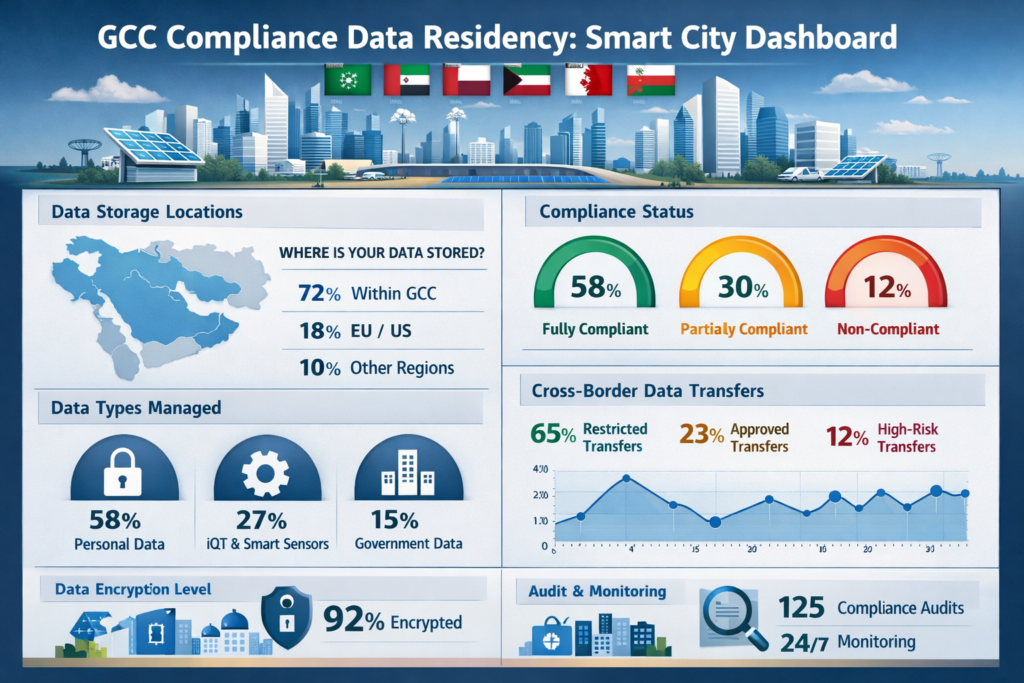
GCC Compliance, Data Residency, and Governance Requirements
Architecture decisions in the GCC are never just technical. They are also shaped by governance, procurement, and regulatory expectations.
Saudi Arabia.
For Saudi projects, governance should be built into the platform from day one. Where operational or personal data is involved, teams typically need to align with local privacy and data management expectations, including PDPL-related obligations and broader data governance frameworks.
That usually affects.
Role-based access control
Audit logging
Data classification
Sharing rules across agencies
Retention policies
Hosting and residency choices
For public-sector teams in Riyadh and other Saudi cities, this is often a project-defining requirement, not a final-stage checklist.
UAE and Qatar.
In the UAE, digital government and telecom-related governance expectations often influence implementation models, especially where service reliability and secure data handling matter. In Qatar, regulated sectors and semi-government ecosystems may require a more careful approach to risk, access, and hosting.
For that reason, a smart city dashboard should be designed with governance maturity in mind, even if the first rollout begins with only one operational use case.
Hosting and residency choices should be made early
For GCC cities, cloud decisions usually come down to three things.
Data sensitivity
Latency needs
Procurement or residency expectations
Saudi, UAE, and Qatar teams increasingly compare regional cloud options and local hosting models before building out the platform. That is especially relevant for urban operations data, camera-related events, and cross-agency workflows.
Teams working through these decisions may also want to review a multi-cloud strategy guide for GCC CIOs.
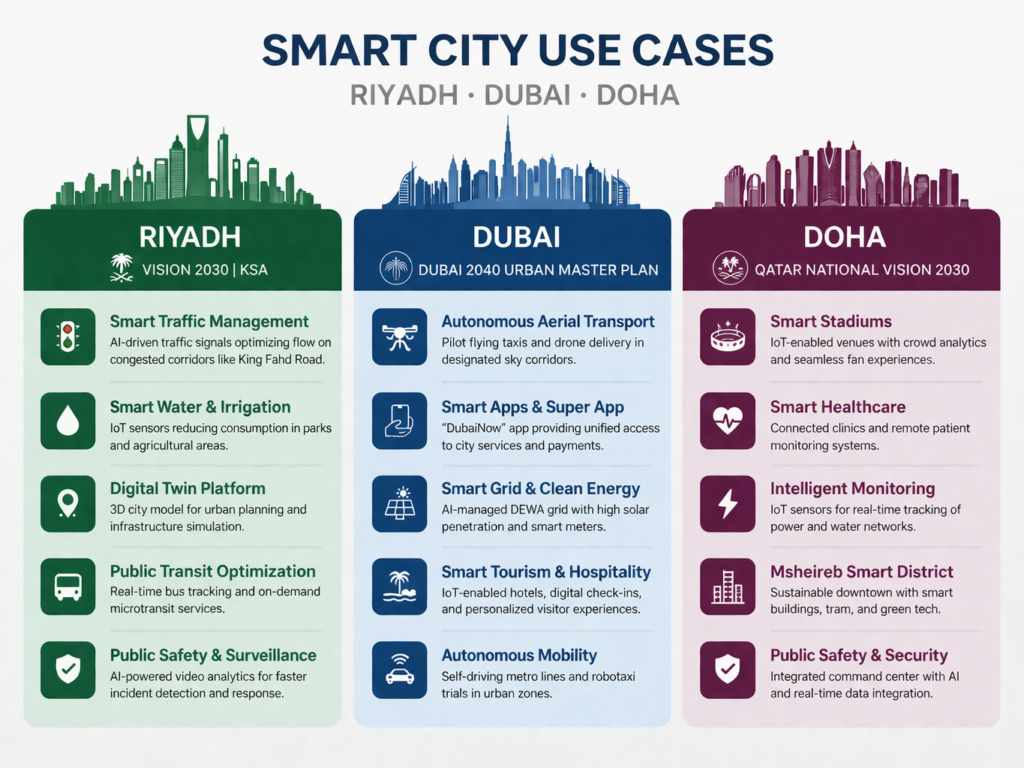
Common Smart City Dashboard Use Cases in Riyadh, Dubai, and Doha
A dashboard becomes easier to justify when it is tied to visible operational outcomes.
Traffic, mobility, and congestion monitoring
Operations teams use dashboards to monitor corridor pressure, route disruptions, traffic density, and public transport flow. In fast-growing cities, this helps reduce blind spots and improve coordination between transport and response teams.
Utilities, waste, and infrastructure monitoring
A proactive dashboard can flag outages, overflow events, service anomalies, and maintenance risks before they turn into public complaints. In hot Gulf climates, where service continuity matters year-round, that level of visibility becomes especially valuable.
Public safety and incident coordination
The highest-value dashboards are usually the ones that reduce coordination time between agencies, field teams, and decision-makers. When alerts, maps, asset context, and ownership rules are all visible in one place, response becomes faster and more consistent.
That is one reason many city teams move away from siloed tools and toward integrated services built around delivery and integration.
What Affects Budget, Team Roles, and Rollout Timelines?
There is no single price or timeline for a municipal platform, because complexity varies widely.
The biggest cost drivers
Budget is usually shaped by.
Number of integrations
Sensor density
GIS quality and map layers
Bilingual UX requirements
Workflow complexity
Compliance and audit needs
Hosting model
Resilience and availability expectations
In practice, integration and governance often affect cost more than the dashboard UI itself.
Who should own the project?
The strongest delivery model is usually shared.
Municipal IT should own governance and platform controls. The smart city office should define outcomes and priorities. An implementation partner or systems integrator should handle delivery, integration, and platform execution.
That balance helps prevent the project from becoming either too technical or too disconnected from operational reality.
Why phased rollout works better
Most GCC municipal projects are more successful when they start with one priority area, such as mobility, utilities, or incident management.
A phased model allows teams to.
Prove value early
Improve data quality
Test alert logic
Refine workflows
Reduce delivery risk
Expand by district or use case over time
That approach is usually more realistic for public-sector environments in Saudi Arabia, the UAE, and Qatar.
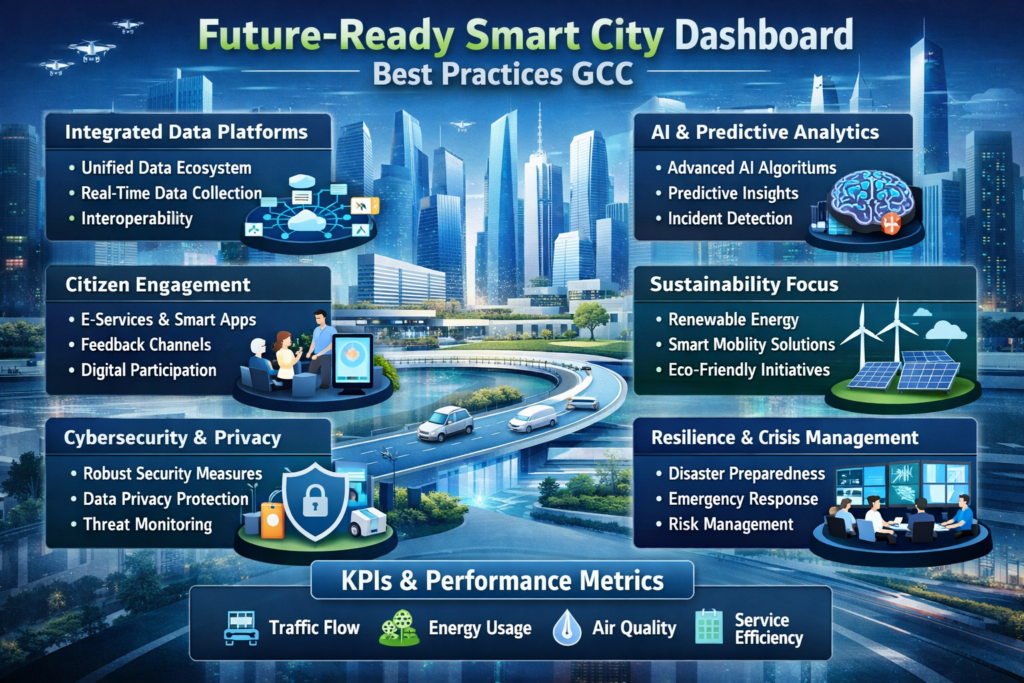
Best Practices for Building a Future-Ready Smart City Dashboard
The cities that get the most value from a dashboard usually keep the first version focused and operational.
Start with one operational priority
Do not try to connect every city system at once. Start with the use case that has the clearest operational pain and measurable outcomes.
Build for interoperability and auditability
Future-ready platforms should support APIs, event-driven workflows, structured access control, and strong logging. The goal is not just visibility. It is trusted visibility.
Measure success with operations KPIs
The best-looking dashboard is not always the most useful one. A good smart city dashboard should improve response time, service reliability, and coordination quality across teams.
For Riyadh, Dubai, and Doha, that is the benchmark that matters most.
Final Thoughts
A smart city dashboard only delivers real value when it is backed by the right architecture, governance model, and rollout strategy. For GCC cities, that means more than attractive charts. It means real-time integration, bilingual usability, compliance-aware design, and hosting choices that fit Saudi, UAE, and Qatar expectations.
If your city operations stack still sits across disconnected tools, this is the right time to map the integrations, residency model, and governance controls required for a practical GCC-ready platform. Explore more smart city content, or use the contact page to start a tailored discussion for your team.
FAQs
Q : Is a smart city dashboard suitable for Saudi municipal operations teams?
A : Yes. It is especially effective when the platform is designed around operational visibility and governance from the beginning. Saudi municipal teams usually need both real-time coordination and strong control over access, logging, and data-sharing.
Q : Can Dubai city dashboards combine GIS, IoT, and incident data in one platform?
A : Yes. That is often the most valuable setup. It allows operators to understand where an issue occurred, how severe it is, and which team should respond without switching across multiple systems.
Q : What hosting model is best for a Qatar smart city dashboard project?
A : The answer depends on data sensitivity, latency, procurement rules, and resilience requirements. Many Qatar projects compare regional cloud and local hosting options to balance performance with stronger confidence around data location.
Q : Do GCC city operations dashboards need Arabic and English interfaces?
A : In most cases, yes. Bilingual support improves usability across operators, contractors, executives, and field teams, and it is much easier to design properly from the start than add later.
Q : How should a city start building a smart city dashboard?
A : Start with one operational priority, connect the minimum required systems, and measure impact early. Once workflows, governance, and data quality are stable, the platform can expand with less risk.