
Smart City Platform Vendor Checklist for GCC Buyers
Smart City Platform Vendor Checklist for GCC Buyers
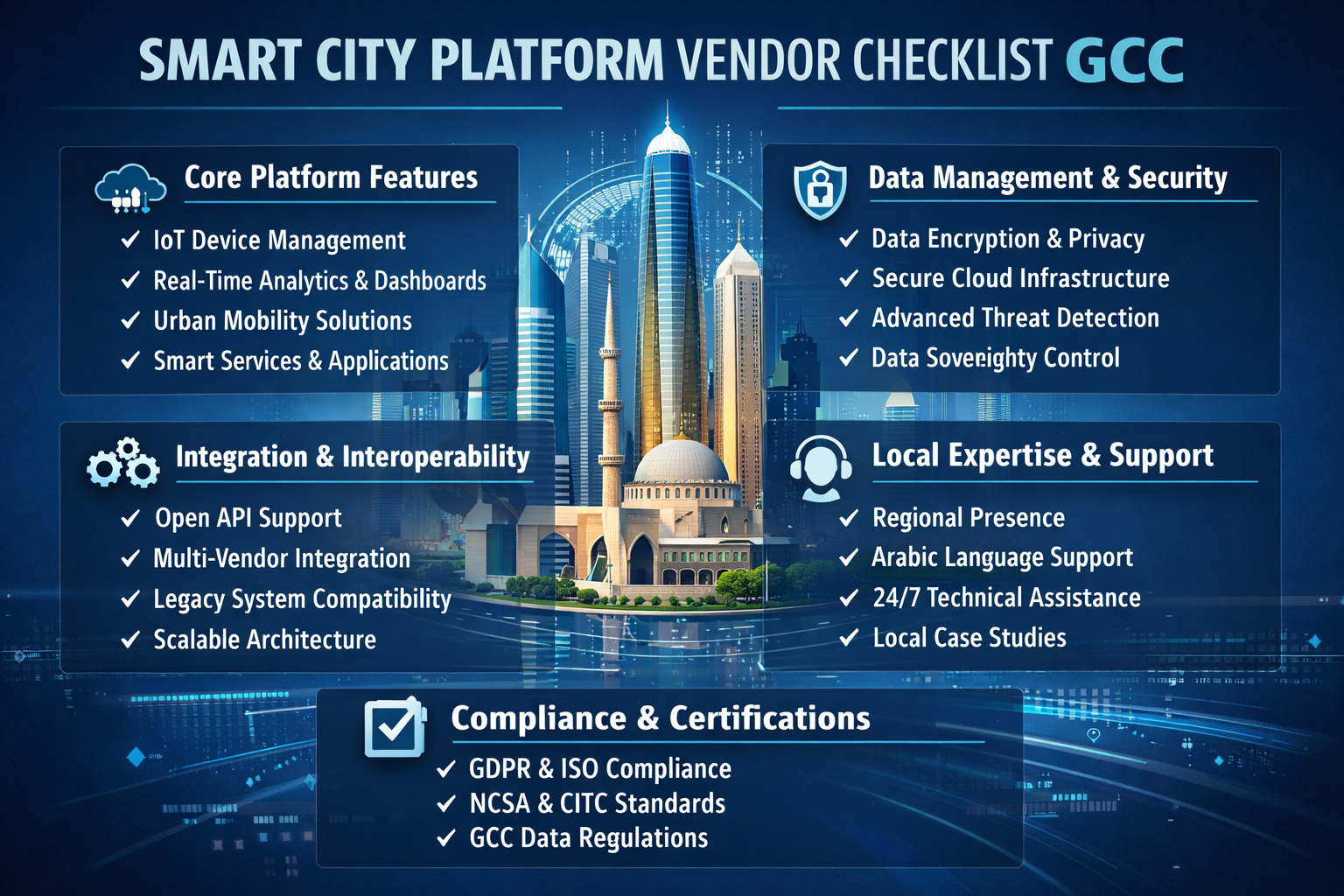
Smart City Platform Vendor Checklist for GCC Buyers
Choosing a smart city platform in the GCC is not just a software decision. It is a long-term procurement choice that affects compliance, integration, operations, and public trust across Saudi Arabia, the UAE, and Qatar.
A smart city platform vendor selection checklist helps GCC buyers compare vendors on what actually matters: compliance fit, interoperability, Arabic usability, data residency, support quality, and delivery strength. In practice, the best vendor is usually not the one with the flashiest dashboard. It is the one that can prove secure integration, regional readiness, and reliable execution in complex environments.
From Riyadh and Jeddah to Dubai, Abu Dhabi, and Doha, buyers often need to evaluate multiple agencies, legacy systems, cloud options, and governance expectations at the same time. That is why a structured checklist matters.
What a Smart City Platform Should Include
A real smart city platform is more than a dashboard layered over sensors. For GCC buyers, it should bring together the systems that make urban operations visible, connected, and manageable.
Core platform layers to assess first
A strong smart city platform vendor selection checklist should cover these four layers.
Device connectivity for sensors, cameras, meters, and field devices
Urban data platform to collect, normalize, and store data
Command-and-control visibility through dashboards, maps, and alerts
Workflow orchestration and APIs to connect departments and automate actions
If one of these layers is weak, the platform may look polished in a demo but struggle in a real deployment.
Why GCC buyers need more than a generic IoT stack
A generic IoT platform rarely meets GCC requirements on its own. Saudi buyers may need stronger data governance alignment. UAE projects often require service integration readiness and secure identity-linked workflows. Qatar programs increasingly value orchestration across sectors instead of isolated pilots.
For municipalities, utilities, district developers, and enterprise campuses, the goal is not just collecting data. The goal is turning it into coordinated decisions.
What makes a platform procurement-ready
Procurement-ready vendors can show evidence, not just claims. That usually includes.
Reference architectures
Security and compliance documentation
Proven integrations
Regional support model
SLA maturity
Delivery partner ecosystem
Clear roadmap for scale
That difference matters. A feature-rich platform may still be a weak procurement choice if it cannot support governance, localization, and long-term delivery.

The Vendor Selection Checklist for Saudi, UAE, and Qatar Projects
When comparing providers, buyers should score vendors across governance, technical fit, commercial terms, and delivery capability.
Governance and procurement criteria
Start with the questions that affect control over time.
Who owns the data model?
How portable is the deployment?
How hard is it to exit the contract?
Can the vendor support regulated sectors?
Is the architecture flexible enough for future agencies or business units?
In Riyadh, Abu Dhabi, or Doha, these questions are not theoretical. They influence procurement approval, legal review, and operational risk.
Technical evaluation criteria
A vendor should not be shortlisted without proving core technical strengths such as.
Open APIs
Interoperability with existing systems
Scalability across sites and departments
Edge and cloud deployment readiness
Multi-agency or multi-entity support
Role-based access and auditability
Arabic-friendly workflows and interfaces
The strongest platforms connect with GIS, ERP, transport systems, building systems, security tools, and service portals without forcing a full rip-and-replace strategy.
Commercial and delivery questions
Even good platforms fail when delivery is weak. Buyers should ask.
What is included in the implementation scope?
How are change requests priced?
Is local or regional support available?
Which delivery partners are involved?
What does escalation look like after go-live?
A vendor without Saudi, UAE, or Qatar delivery experience may still look strong on paper. In practice, multi-stakeholder projects expose execution gaps very quickly.
Compliance, Data Residency, and Trust Signals in the GCC
Compliance is one of the biggest reasons smart city procurement becomes slow. Buyers should map these requirements early, not after the shortlist is finalized.
Saudi Arabia.
Saudi buyers should review data governance, hosting sensitivity, and public-sector expectations at the start of evaluation. Projects tied to regulated services, sensitive infrastructure, or citizen-facing operations often need stronger control over classification, residency, and access.
For many teams in Riyadh and Jeddah, the real issue is not whether data must always remain in one place. It is whether the vendor can support the right governance model from day one.
UAE.
In the UAE, buyers should look closely at interoperability claims. A vendor may say it supports APIs, but that is not enough for public-sector or regulated environments.
In Dubai and Abu Dhabi, secure service exchange, identity-linked workflows, and government integration readiness can matter more than visual features. Regulated environments such as ADGM and DIFC may also raise the bar for privacy and governance expectations.
Qatar.
Qatar buyers should assess whether a platform can support connected services across sectors, not just one-off use cases. That includes controlled data sharing, governance visibility, and national-scale growth potential.
Where regulated digital finance or payment-linked environments are involved, additional controls may become important. For Doha-based projects, platform governance and interoperability should be tested as seriously as reporting and dashboards.

Integration and Interoperability Requirements
Integration is where many smart city projects become expensive. It is also where the best vendors separate themselves from the rest.
Systems the platform should connect with
Real GCC deployments often need to integrate with.
GIS platforms
ERP systems
Utilities and metering systems
Building management systems
Physical security systems
Transport platforms
Citizen or customer service portals
Maintenance and incident tools
A platform that cannot connect cleanly to these systems will create operational silos instead of solving them.
Why APIs, data models, and middleware matter
Many GCC organizations modernize in phases. A district in Riyadh may combine legacy municipal systems with newer operational platforms. A Dubai project may require structured service exchange across entities. A Doha rollout may begin with one domain and later expand into a broader orchestration model.
That is why buyers should pay attention to.
API maturity
Documentation quality
Data schema flexibility
Event-driven integration
Middleware compatibility
Identity and access integration
This is where long-term scalability is won or lost.
How to test interoperability before signing
Do not rely only on slide decks. Run a pilot or technical validation that includes.
Scripted integrations with real or sample systems
Arabic workflow testing
Live or staged data ingestion
Alerting and escalation scenarios
Access-control and audit-log checks
Performance testing across connected services
For example, a Riyadh-based regulated environment may focus more on governance controls. A Dubai mixed-use project may prioritize service flow integration. A Doha deployment may care more about controlled data-sharing and regional cloud options.

Buyer Priorities by Sector
Not every GCC buyer needs the same scoring model. The checklist can stay consistent, but the weight of each criterion should change by sector.
Public sector and municipalities
Municipality and government buyers usually prioritize.
Incident response
Infrastructure monitoring
Citizen service coordination
Command-and-control visibility
Cross-agency collaboration
Governance and auditability
Utilities and infrastructure operators
Utilities usually focus more on.
Asset monitoring
Predictive maintenance
Reliability and resilience
GIS and maintenance integration
Event-driven workflows
Operational visibility
Real-estate developers and smart districts
Developers in Dubai, Riyadh, Jeddah, or Lusail often care more about.
Tenant experience
Occupancy intelligence
Energy optimization
District operations
Centralized reporting
Expansion across mixed-use assets
Enterprise campuses and business zones
Enterprise environments often prioritize.
Multi-site visibility
Workplace automation
ESG reporting
Security and facilities integration
Centralized operations
Flexible scaling across business units
From a small business district to a large public program, the scoring logic should reflect the real operating model.
Cost, Timelines, and Delivery Model
Smart city platforms are often budgeted around licenses first, but the integration layer usually has a bigger impact on total cost.
What shapes total cost
Cost typically depends on.
Licensing model
Number of integrations
Hosting architecture
Cybersecurity controls
Dashboard customization
Analytics requirements
Support and managed services
Local implementation resources
That is why the cheapest proposal can become the most expensive one later.
Common deployment phases
A practical rollout usually follows this path.
Discovery and requirements mapping
Pilot or proof of value
Integration rollout
Controlled scale-up
Optimization and governance refinement
Phased delivery is often the safer choice for GCC buyers because it allows teams to validate trust, usability, and operational fit before a full expansion.
Questions to ask before budget approval
Before moving to final approval, ask.
What is included in implementation?
What increases cost later?
Which dependencies sit with third parties?
What happens if the vendor misses milestones?
What does the exit path look like?
How much internal effort is required from our team?
These questions often reveal more than the product demo itself.
Best Practices for Shortlisting the Right Vendor
A shortlist should be built around evidence, not marketing language.
Build a weighted GCC scorecard
Use a weighted scorecard that covers:
| Evaluation Area | What to Check |
|---|---|
| Compliance | Governance fit, certifications, residency options |
| Integration | APIs, middleware, legacy compatibility |
| Localization | Arabic UX, local workflows, regional deployment readiness |
| Support | GCC coverage, SLAs, escalation paths |
| Scalability | Multi-site, multi-entity, future expansion |
| Commercial Fit | Pricing clarity, contract flexibility, delivery model |
Ask for proof that matches regional reality
Request evidence such as.
Arabic interface samples
Local or regional hosting options
Public-sector or regulated references
Security certifications
Integration case examples
GCC delivery partner details
This helps buyers separate general enterprise software from genuine regional readiness.
Run a pilot before final award
A pilot is still one of the most reliable ways to test.
Interoperability
User adoption
Support quality
SLA responsiveness
Workflow fit
Reporting accuracy
It is far better to discover limits during a pilot than after procurement.

Final Take
Choosing the right smart city platform is about more than comparing features. GCC buyers need a vendor that can support compliance, integration, Arabic usability, data residency, and long-term operational growth. In Saudi Arabia, the UAE, and Qatar, success usually comes from selecting a platform built for real governance and multi-stakeholder delivery, not just impressive demos.
A strong smart city platform vendor selection checklist helps procurement teams reduce risk and make better decisions with confidence. By scoring vendors against regional realities, buyers can move from early evaluation to a practical, RFP-ready shortlist that supports scalable, future-ready smart city outcomes.( Click Here’s )
Final Takeaway
A smart city platform vendor selection checklist gives Saudi, UAE, and Qatar buyers a practical way to compare vendors on the issues that shape long-term success: governance, integration, localization, scalability, and delivery resilience.
Before issuing an RFP or finalizing a shortlist, confirm the non-negotiables.
Compliance fit
Data residency support
Integration maturity
Arabic usability
Scalability across entities or sites
Local or regional delivery support
In the GCC, the strongest smart city platform vendor is usually the provider that can prove interoperability, governance readiness, and execution strength across complex environments. That is what turns evaluation into a confident buying decision.
If you are assessing smart city platforms for a municipality, utility, district developer, or enterprise campus, now is the time to structure the evaluation properly. A clear shortlist built on evidence will save time, reduce risk, and make the RFP process far stronger.
FAQs
Q : Is a smart city platform required to host data inside Saudi Arabia?
A : Not always in every scenario, but Saudi buyers should assess data classification, governance, and sector expectations very early. Sensitive public-sector or regulated workloads often need stricter residency and auditability controls.
Q : How do UAE buyers assess interoperability in smart city software?
A : They should go beyond API claims and ask whether the vendor can support identity-linked workflows, service exchange, and secure multi-entity operations. In Dubai and Abu Dhabi, buyers should request demos, sandbox proofs, and evidence of real integration readiness.
Q : What makes a smart city platform suitable for Qatar projects?
A : A strong fit for Qatar usually means the platform can support orchestration, controlled data sharing, and expansion across connected services. Buyers should prioritize governance, interoperability, and long-term scalability over isolated pilot features.
Q : Can GCC real-estate developers use the same checklist as municipalities?
A : Yes, but the scoring weights should change. Municipalities usually emphasize governance and cross-agency coordination more, while developers often focus on tenant experience, occupancy analytics, and district operations.
Q : Which smart city platform features matter most for utilities in Riyadh, Dubai, and Doha?
A : Utilities usually need reliable connectivity, strong analytics, event-driven workflows, and integration with GIS, ERP, and maintenance systems. Security controls, reporting quality, and continuity planning also matter.