
Tech Startup Funding 2025: US vs Europe Power Shift
Tech Startup Funding 2025: US vs Europe Power Shift
Tech Startup Funding 2025: US vs Europe Power Shift
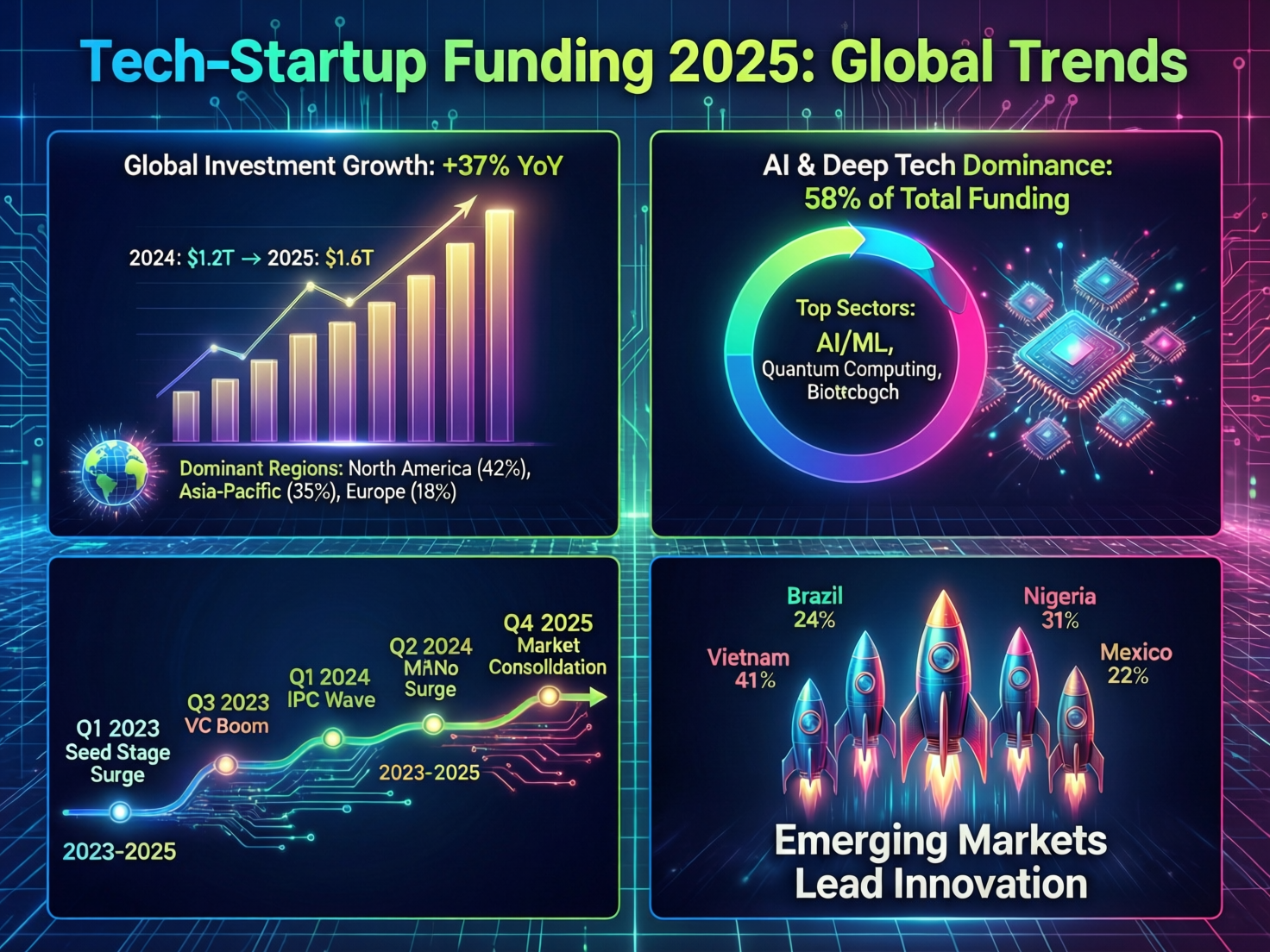
In 2025, tech startup funding is rebounding from the post-2021 downturn, with global venture capital stabilising and AI and deeptech taking close to half of all capital deployed. The US still leads on total dollars, late-stage mega-rounds and AI concentration, while Europe (including the UK and Germany) is recovering from a 2024 low with smaller, earlier-stage rounds, stronger public funding support and a slowly closing gap.
Introduction
After the 2021 peak and the painful reset of 2022–2023, tech startup funding in 2025 finally feels…normal-ish again. Global venture investment in 2024 came in at roughly $300–350 billion, slightly above 2023 and well below 2021, with data providers like Crunchbase and KPMG showing modest year-on-year growth.
At the same time, AI and deeptech investment exploded. In 2025, AI-related companies are estimated to have captured around half of all global venture funding, with AI funding alone crossing the $200 billion mark.
For founders in the US, UK, Germany and wider Europe, the real question isn’t just “Is the market back?” It’s:
Why does the US still lead on tech startup funding 2025?
How fast is Europe really catching up?
And what funding moves should you make in the next 90 days?
We’ll lean on data from KPMG Venture Pulse, Crunchbase, Atomico’s State of European Tech and Dealroom-style datasets to unpack those questions, then translate the numbers into a practical playbook you can act on this year.
Global tech startup funding trends 2025
From the 2021 peak to the 2024–2025 reset
Most datasets now agree on the same basic arc: a record 2021, a sharp drop in 2022–2023, then a cautious floor and rebound in 2024–2025.
Crunchbase estimates that global startup funding in 2024 was around $314 billion, up ~3% vs 2023, but still well below 2021 highs. KPMG’s 2024 venture report puts global VC investment closer to $368 billion, with the US at about $209 billion, underlining that methodology differs but direction is the same: stabilisation with AI as the growth engine.
By mid-2025, Crunchbase data shows around $205 billion deployed already, making it the strongest half-year since early 2022 and pointing to a much healthier deal environment across seed, Series A and growth rounds.
AI startup funding boom 2025 and deeptech’s rise
The venture capital ecosystem has gone all-in on AI and deeptech. Across 2024–2025.
AI-related companies consistently attracted ~50% of global funding, and AI funding in 2025 is estimated at $200–210 billion, up ~80–90% year-on-year.
The biggest rounds are heavily skewed to frontier and foundation model players, with deals like Databricks’ $10 billion round and multi-billion raises for OpenAI and Anthropic dominating Q4 2024 and 2025 headlines.
Under the surface, SaaS, fintech, healthtech and climate tech are still very much alive, but investors increasingly want an AI or data edge baked into the product and go-to-market story. That’s as true for a New York fintech as it is for a Berlin industrial deeptech startup.
Where the US, UK and Europe sit in global VC rankings
On raw dollars, the United States remains the clear leader. 2024 US VC investment of around $200+ billion represented well over half of global capital, depending on the dataset.
Europe (including the UK) sits in a solid but distant second tier:
Atomico’s State of European Tech projects European tech investment at about $44–45 billion in 2024, marking what looks like the bottom of the cycle for the region.
Within Europe, the UK and Germany lead: the UK saw roughly £16.5 billion of VC investment in 2024 despite a drop in deal count, while Germany’s tech startups are projected to raise around $7.4 billion in 2025, up ~10% vs 2024
France, the Netherlands, the Nordics and Spain round out a long tail of global innovation hubs like Paris, Amsterdam, Stockholm, Helsinki and Barcelona, often with strong specialisation in climate, industrial tech and deeptech.

Methodology.
A quick data health warning before we go further.
Crunchbase and Dealroom track individual startup and scaleup rounds, often under-counting stealth deals but giving good sector and stage granularity.
KPMG Venture Pulse focuses on larger venture rounds and sometimes includes growth equity and corporate deals
Atomico’s State of European Tech blends Dealroom, Crunchbase and other sources to focus specifically on European and UK ecosystems.
Numbers won’t match exactly, so throughout this article we use rounded ranges and focus on trends, not false precision in the decimals. For any fundraising or board discussion, always pull the latest live charts from your preferred dataset and annotate with your sector and geography.
What is tech startup funding in 2025 doing differently in the US compared to Europe?
In 2025, the US deploys more late-stage, larger AI and deeptech rounds, while Europe skews to earlier-stage, smaller ticket sizes but with rapidly growing local mega-funds and blended public–private capital. US startups raising Series B+ typically see bigger checks, faster timelines and more aggressive growth expectations; European founders see more discipline on path-to-profitability and governance, especially in Germany and the Nordics.
Funding volumes, stage mix and round sizes.
At seed and Series A funding rounds, the gap between the US and Europe is narrower on a per-round basis, but the US still wins on sheer volume. In hubs like San Francisco, New York, Austin, London and Berlin, healthy pre-seed/seed rounds in 2025 still land in the $1–4 million range in both ecosystems, with US rounds skewing to the upper end and a higher proportion of priced equity vs SAFEs.
At growth and mega-rounds, the divergence becomes stark:
The US hosts the majority of $100M+ mega-rounds, especially in AI and fintech.
Europe sees more €20–50 million Series B/C raises, with fewer nine-figure checks and more reliance on sovereign funds, development banks and corporate venture arms.
For founders, that means your stage mix and geo story matter as much as your sector. A Berlin startup with US revenue and a Delaware top-co will generally find it easier to tap US-style growth rounds.
US vs European startup funding trends across AI, deeptech and SaaS in 2025
In 2025, US funding is heavily concentrated in AI and frontier tech, while Europe is more balanced between SaaS, climate and industrial deeptech, with a smaller AI share but very rapid AI growth.
In the US, AI-related companies are drawing tens of billions per quarter, powered by hyperscalers like AWS, Google Cloud and Microsoft Azure, plus corporate and private-equity investors piling into infrastructure and model-layer bets
In Europe
AI and deeptech now account for roughly one-third of all venture funding, especially in Germany, France and Spain.
There is outsized strength in climate tech, industrial robotics, quantum and applied deeptech tied to the EU’s industrial base.
Classic B2B SaaS is still investable in both regions, but investors now ask hard questions about AI features, security, compliance and data moats.
Valuations and deal terms.
Broadly, startup valuations by region still sit higher in the US than in Europe for similar revenue and growth profiles often by 20–40% at Series A/B, especially for hot AI companies in Silicon Valley or New York.
The trade-offs founders report:
US higher valuations and bigger checks, but tighter milestones, aggressive liquidation preferences and board rights; growth-at-all-costs expectations are back at the frontier AI layer.
Europe/UK slightly lower valuations and smaller rounds, but often cleaner cap tables, more governance maturity and more patience on unit economics, particularly from funds in London, Berlin and Paris.
Time-to-close also differs: US founders routinely mention 4–8 week processes for competitive AI rounds, while European founders still see 3–4 month cycles as normal outside the very top tier.
Founders’ experience on the ground.
Talk to founders and you’ll hear a human version of the data:
Silicon Valley & New York dense investor networks, warm intros matter, partners are ex-operators or ex-FAANG, and you may get a term sheet after a week of partner meetings if you’re in the right AI or deeptech niche.
London arguably Europe’s closest analogue to the Bay Area, with a strong fintech and SaaS bias and a deep bench of global funds; process is still more structured and committee-driven than in the US.
Berlin & Paris slightly slower and more thesis-driven, but with growing appetite for indus
Across the board, founders in both ecosystems report that data-rich metrics, security and compliance readiness, and a clear AI story are table stakes by 2025. That’s exactly where teams like Mak It Solutions help startups build investor-ready product, data and analytics stacks from day one.

Why the US leads in tech startup funding in 2025
What data shows the US leading global tech startup funding in 2025?
Recent VC reports show the US capturing the largest share of global startup capital, with higher total dollars invested, more mega-funds and more late-stage deals than Europe. KPMG estimates around $209 billion of US VC investment in 2024 (third-highest in the last 20 years), while Crunchbase data shows US-based AI startups taking several of the world’s largest rounds.
By 2025, more than half of global AI funding is estimated to land in US-based companies, reflecting not just startup activity but deep corporate and infrastructure investment.
Deep capital markets, exits and the Silicon Valley venture capital ecosystem
The US advantage isn’t just about VC funds it’s the full capital markets stack:
Deep public markets via NASDAQ and NYSE for tech IPOs.
A large M&A universe from Big Tech (Apple, Google, Microsoft, Meta, Amazon) and strategic acquirers across sectors.
Decades-old VC institutions along Sand Hill Road, Boston and New York recycling capital into each new generation of funds.
This creates a flywheel: big exits feed LP returns, which feed bigger funds, which feed larger seed, Series A and growth rounds for founders in San Francisco, Austin or New York.
US AI and deeptech investment 2025: why investors pay a premium
US investors pay a premium for AI and deeptech investment because they’re underwriting not just software, but infrastructure and strategic control:
Hyperscalers like AWS, Google Cloud and Microsoft Azure pour capital into AI startups that drive cloud consumption.
Corporate and private-equity investors see AI as a defensive and offensive play in every sector from healthcare to defense.
As a result, AI startups in the US often command:
Higher valuations at lower revenue.
Larger seed and Series A rounds (e.g., $5–15 million) if they show credible teams from Stanford, MIT or FAANG research labs.
More tolerance for capital-intensive R&D before commercial traction.
US startup funding playbook.
The US funding playbook in 2025 still leans toward speed and risk appetite:
Term sheets can arrive quickly, and partner conviction can override formal processes.
Growth expectations are higher, especially for companies pitching US TAM stories (think “owning” a vertical across the US before expanding to London or Berlin).
There is more tolerance for short-term burn as long as founders show a credible route to category leadership.
Europe is more likely to insist on clearer paths to profitability, which can be a strength for founders building sustainable businesses but may cap valuations if you’re competing for global AI or SaaS leadership.
How Europe is closing the tech startup funding gap in 2025
Why did European tech startup funding bottom out around 2024 and start to recover?
European funding hit a low in 2024 as interest rates rose and late-stage capital retreated, but new EU-focused funds, stabilising macro conditions and AI enthusiasm set up a cautious rebound in 2025. Atomico’s 2024 report projects around $44–45 billion in European tech funding for 2024, widely seen as the trough; early 2025 data points to modest growth from that floor.
As the European Central Bank signals a more stable rate path and IPO windows slowly crack open, deal volume in hubs like London, Berlin, Paris and Stockholm is ticking up again, especially for AI, climate and industrial tech.
Why is Europe still behind the US in tech startup funding, even as the gap closes?
Europe lacks the same depth of late-stage capital, unified market and exit options as the US, so rounds are smaller and fewer, even though more funds and public initiatives are narrowing the gap. Fragmented regulations, language and tax rules mean founders often have to stitch together the UK, Germany, France, Netherlands and Nordics one by one, rather than selling into a single US-scale market.
IPO markets in London, Frankfurt and Euronext have also been slower than NASDAQ to reopen for high-growth tech companies, limiting late-stage recycling of capital back into the venture ecosystem.
European tech hubs.
Within Europe, sector strengths are diverging in useful ways:
London & Manchester intech, B2B SaaS and AI infrastructure, backed by FCA-savvy investors and proximity to global finance.
Berlin & Munich industrial deeptech, climate tech, AI for manufacturing, and increasingly defense-related deeptech; Germany alone is forecast to attract about $7.4 billion in tech investment in 2025
Paris & Amsterdam frontier AI (think Mistral-type stories), B2B SaaS and design-led consumer products.
Stockholm, Helsinki and the wider Nordics product-led SaaS, gaming and climate tech, often built with global markets in mind from day one
For founders, this means you can often raise solid seed and Series A rounds at home, then tap US or pan-European growth capital once you show traction across multiple EU markets.
European VC funds 2024–2025.
European VC isn’t standing still. Atomico and McKinsey highlight the rise of large European deeptech funds and national champions, along with more sector-specialist funds in AI, climate and industrial tech.
Key patterns.
Larger €500M+ funds headquartered in London, Berlin and Paris targeting late-stage B/C deals.
A thickening layer of seed funds and venture studios in hubs like Amsterdam, Copenhagen and Barcelona.
Stronger ties between European VCs and US funds co-leading rounds, especially for AI, fintech and infrastructure SaaS.
Public capital and development banks.
Europe also has a unique lever: development banks and EU programmes. The European Investment Bank (EIB), KfW (Germany), Bpifrance (France) and similar institutions co-invest with private VC funds and anchor new vehicles.
These programmes:
De-risk early-stage capital in sensitive areas like healthtech, fintech and deeptech.
Provide grants and quasi-equity, especially for climate and industrial innovation.
Help “crowd in” private capital to geographies and sectors that might otherwise be under-served.
For a Berlin deeptech or Paris climate tech startup, this blended stack (grants + EIB or KfW money + private VC) can be the difference between stalling at Series A and crossing the chasm to growth.
Policy, regulation and capital markets: US vs Europe
US vs EU capital markets for startups and IPO windows in 2025
In 2025, US capital markets are still more liquid and tech-friendly: NASDAQ and NYSE host most global tech IPOs, while London Stock Exchange, Frankfurt and Euronext are working hard to attract more listings with reforms but are reopening more slowly.
The EU’s long-running effort at a Capital Markets Union is aimed precisely at this gap: making it easier to raise growth equity and list in Frankfurt, Amsterdam or Paris, instead of defaulting to New York. Until that fully lands, founders eyeing a listing often still think “US listing, European operations.”
How GDPR/DSGVO, UK-GDPR and the EU AI Act affect startup funding
Regulation is a double-edged sword.
GDPR/DSGVO and UK-GDPR raise the bar on data privacy but also create clear playbooks for compliant SaaS, healthtech and fintech products
The EU AI Act (Regulation 2024/1689) introduces a risk-based framework for AI systems, adding compliance cost for high-risk use cases but giving sophisticated founders a regulatory moat.
US investors increasingly ask European teams to show explicit compliance by design: where data is stored, how consent is handled, what models are used, and whether high-risk AI use cases are properly documented.
BaFin, FCA, SEC and other regulators: what investors worry about
Regulators directly shape fintech and capital flows:
In Germany, BaFin supervision matters for anything touching banking, securities or insurance.
In the UK, the FCA oversees fintech and Open Banking / PSD2 rules that underpin many London fintech scale-ups.
In the US, the SEC remains central to public markets, tokenisation and broker-dealer models.
Investors in New York, London or Berlin increasingly expect regulatory strategy slides in your deck, not just a legal footnote.
Sector-specific compliance.
For healthtech, fintech and B2B SaaS, compliance is now squarely part of the investment case.
HIPAA and its evolving Security Rule define the bar for US health data protection.
PCI DSS and the PCI Security Standards Council govern payment card security, underpinning trust in fintech and payments SaaS.
SOC 2 and related frameworks are fast becoming baseline for B2B SaaS targeting enterprise buyers.
Open Banking and PSD2 create both opportunities and regulatory obligations for UK and EU fintech startups.
Founders who can show audit-ready controls, logs and dashboards in their data room (often built with help from analytics partners like Mak It Solutions) remove a major objection for both US and European investors.

Funding strategy playbook for founders in 2025
How can founders in Europe position themselves to access US-level startup funding in 2025 and beyond?
European founders can access US-style funding by incorporating or co-locating in key hubs, building US-ready governance and compliance (SOC 2, PCI DSS), and targeting US customers early to demonstrate a large addressable market. Practically, that means aligning your cap table, IP, data and go-to-market story with what a partner at a San Francisco or New York fund expects to see.
Concretely.
Structure consider a US or UK top-co above your German, French or Dutch operating entities if you’re aiming at US-led Series A/B rounds.
Compliance bake in security and compliance from day one, not as an afterthought before diligence.
Revenue mix show early traction in the US, UK or global enterprise accounts, not just local clients.
Teams often work with full-stack partners like Mak It Solutions to build investor-ready web platforms, mobile apps and BI dashboards that stand up under US diligence.
Choosing between US, UK and EU investors at seed and Series A
At seed, local investors who understand your market (e.g., London fintech funds, Berlin deeptech specialists, Nordic climate funds) are often the fastest and most helpful. At Series A, the trade-offs shift:
US investors larger checks, strong networks in New York/SF, but higher bar and more aggressive terms.
UK investors a bridge between US and EU; many London funds are comfortable leading rounds in Manchester, Edinburgh, Berlin or Paris and co-leading with US funds.
EU investors important for grants, local credibility and navigating programmes like EIB or national schemes.
Your board dynamics, control terms and future exit markets should all factor into which investor base you prioritise.
Building an “investable” data room for US and European VCs
An investable data room in 2025 includes.
Clean cap table, option pool and key legal docs.
Cohort and unit economics dashboards, ideally automated via tools and BI stacks (Mak It Solutions frequently helps teams build these).
Security and compliance evidence: SOC 2 reports, penetration test summaries, HIPAA/PCI mapping where relevant.
Product roadmap, AI and data strategy, plus architecture diagrams (e.g., SSR vs static generation plans for web platforms).
If it looks like something a partner at a top-tier US or European venture capital ecosystem would see weekly, you’re in a good place.
Tapping accelerators, venture studios and ecosystem programs
For many founders, accelerators and venture studios are still the most direct route into global capital:
Global accelerators like Y Combinator and Techstars give US investor access even if you’re based in London, Berlin or Stockholm.
Entrepreneur First and local European programmes backed by national funds or the EU build founder pipelines that VCs actively track.
Layer in national initiatives (e.g., British Business Bank programmes in the UK, KfW-backed schemes in Germany, Bpifrance initiatives in France) and you get a dense web of support that can compound with private capital.
Geo-expansion roadmap.
A simple but effective expansion sequence for many European startups in 2025 looks like:
Home hub dominance e.g., win Germany (Berlin/Munich) or the UK (London/Manchester) with a strong local narrative.
Pan-European footprint add France, Netherlands, Nordics and Spain for proof you can operate across the EU single market and under GDPR/DSGVO and EU AI Act constraints.
US entry targeted push into New York, Boston or SF Bay Area with local hiring, customer wins and, ideally, a US-based investor.
Your website, app experience and analytics stack need to scale with that journey something Mak It Solutions already optimises for clients across the USA, UK, Germany and broader Europe.
US vs European startups raising in 2025
A US AI SaaS startup raising Series A from coastal VCs
Imagine a San Francisco AI SaaS startup selling compliance automation to US hospitals and insurers:
Round $15 million Series A from New York and SF funds at a healthy multiple of ARR.
Metrics $1.5 million ARR, 3x year-on-year growth, strong net revenue retention and pilots with large healthcare systems subject to HIPAA.
Story proprietary models, robust HIPAA and SOC 2 roadmap, and a credible path to $20–30 million ARR in 3 years.
The funding case leans heavily on US TAM, AI differentiation and compliance readiness.
A Berlin deeptech startup combining EU grants and private VC
Now take a Berlin deeptech startup building AI-powered industrial robotics.
Capital stack €3 million EU and German innovation grants, plus a €10 million Series A from a Berlin deeptech fund, a pan-European VC and a corporate investor.
Metrics limited revenue but strong pilots with manufacturers in Germany and the Nordics.
Story deeptech IP, alignment with EU industrial policy, and a long-term path to automation and climate benefits.
Here, EIB, KfW and national schemes plus private VC enable a blended, capital-efficient path where US mega-rounds aren’t strictly necessary early on.
A London fintech scaling with UK, EU and US investors
Finally, a London-based fintech scaling across payments and Open Banking:
Round £25 million Series B
Led by a London growth fund, with participation from a US fintech specialist and a European bank-backed fund.
Regulatory stack
FCA-regulated in the UK, passporting rules for EU operations under PSD2, PCI DSS compliance for card data.
Expansion
live in London, Manchester and Berlin, with a New York office to support US enterprise deals.
The result is a truly transatlantic cap table, with the company able to pitch both NASDAQ and London Stock Exchange as potential exit venues down the line.

Key takeaways
The US still leads on total tech startup funding 2025, AI/deeptech concentration and late-stage mega-rounds.
Europe (including the UK and Germany) has likely bottomed out in 2024 and is now cautiously rebounding, with AI, climate and industrial deeptech as key growth engines.
Stage mix, sector and compliance posture are as important as geography in determining whether you can access US-style funding.
Regulatory frameworks GDPR, UK-GDPR, EU AI Act, HIPAA, PCI DSS, SOC 2 are turning from “annoying overhead” into core parts of investor diligence and moats.
90-day action checklist for founders and operators
Over the next 90 days, you can materially improve your funding odds by.
Tuning your narrative.
Update your deck to clearly answer: “What is our AI edge?” and “How big is our US/Europe TAM?”
Hardening compliance.
Map your product against GDPR/UK-GDPR, sector-specific rules (HIPAA, PCI DSS, SOC 2) and the emerging EU AI Act. Document this in your data room.
Leveling up your data room .
Build or refine dashboards for cohorts, churn, LTV/
Clarifying GEO strategy .
Decide where you’ll raise (US, UK, EU), where you’ll incorporate, and how you’ll tell a cross-border story.
Shortlisting investors and programmes.
Build a ranked list of US, UK and EU investors and accelerators that match your sector and stage, and start warm intro work now.
When to talk to advisors, lawyers and funding partners
You don’t need a full Series B data room on day one but the moment you’re serious about raising seed or Series A in the 2025 tech startup funding environment, it’s worth bringing in:
A legal team that understands US/UK/EU structures and cross-border funding.
A technical partner (like Mak It Solutions) who can ship investor-ready websites, apps and analytics views quickly.
Done right, you’ll show up to investor meetings not just as “another AI startup”, but as a globally structured, compliance-ready, data-driven company that can scale across the US, UK, Germany and the wider EU.
If you’re planning a seed, Series A or growth round in 2025 and your product, metrics or compliance story still feel “half-baked,” this is the moment to fix it. The team at Mak It Solutions works with founders across the USA, UK, Germany and Europe to build investor-ready web platforms, mobile apps and analytics stacks that hold up under US and European VC diligence. Share your funding timeline, GEO focus and current stack, and request a scoped engagement or book a short discovery call via the Mak It Solutions contact page. ( Click Here’s )
FAQs
Q : How much funding do tech startups typically raise at seed and Series A in 2025?
A : In 2025, pre-seed and seed rounds in major hubs like San Francisco, London, Berlin and Paris typically range from $0.8–4 million, with US rounds often landing at the higher end and including more SAFEs or convertible notes. Series A rounds are more spread out: $5–20 million is common in the US for strong AI or SaaS teams, while European Series A rounds cluster more around €5–12 million except for outlier AI or deeptech deals. Exact numbers depend heavily on sector, traction, founder profile and whether US investors are leading the round.
Q : Which tech sectors are attracting the most venture capital in Europe in 2025?
A : In Europe, AI, deeptech and climate tech are attracting a growing share of venture capital, with AI and deeptech together accounting for roughly one-third of all funding, especially in Germany, France and Spain. Classic B2B SaaS remains an important category, often combined with AI features and data-driven workflows. Fintech is still strong in London and Amsterdam, and industrial tech and robotics are key in Berlin and the Nordics. Founders in these sectors who can demonstrate strong compliance and data strategies tend to see the best term sheets.
Q : Is it better for a European founder to incorporate in the US to raise funding?
A : Not always. Incorporating in the US (for example via a Delaware C-corp) can make it easier to raise from US coastal VCs, especially at growth stages or for AI and deeptech startups aiming at US enterprise markets. However, many successful European founders raise large rounds through UK or EU holding companies, sometimes with dual structures or flip-ups later. The right answer depends on your primary customer base, exit ambitions (NASDAQ vs local exchanges), tax and legal implications, and where your leadership team will actually live. It’s wise to decide this early with experienced lawyers and funding advisors, rather than making a rushed change mid-round.
Q : How are valuations for AI startups changing in 2025 compared with 2021–2022?
A : Compared with the exuberant 2021–2022 period, valuations for most sectors have re-rated downward, but frontier AI and deeptech are notable exceptions. In 2025, large AI rounds in the US and Europe especially those tied to infrastructure, models or GPUs are again pricing at aggressive multiples, sometimes exceeding 2021 levels, driven by capital concentration and strategic corporate investment. For more typical AI-enabled SaaS products, valuations are more disciplined than 2021 but still a premium over non-AI peers, provided you can show real usage, retention and defensible IP.
Q : What metrics do US vs European VCs care about most at Series A in 2025?
A : US and European VCs increasingly look at similar core metrics at Series A: annual recurring revenue (ARR), growth rate, net revenue retention, gross margin, sales efficiency (like LTV/CAC) and product usage depth. US investors may emphasise growth and TAM more heavily, especially for AI and SaaS companies targeting large US markets, while European investors are somewhat more focused on capital efficiency, path-to-profitability and regulatory/compliance alignment (GDPR, EU AI Act, PSD2, etc.).Across both regions, having a clean data room with BI dashboards and evidence of solid security and compliance (SOC 2, PCI DSS, HIPAA where relevant) is now a baseline expectation, not a bonus.