


Will AI Take My Job? A Developer’s Survival Guide
Will AI Take My Job? A Developer’s Survival Guide

Will AI Take My Job as a Developer in 2025?
For most software engineers in the US, UK and Europe, AI is far more likely to change how you work than to completely take your job. The developers who stay safest are those who deepen core engineering skills, learn to work with AI tools, and build domain expertise in regulated, high-value sectors.
Introduction
If you’ve ever stared at GitHub Copilot or ChatGPT and thought, “Will AI take my job as a developer?” you’re not alone. Surveys of workers across the US and Europe show rising anxiety about artificial intelligence, automation and white-collar work, especially in software and IT.
Here’s the good news: research from governments, universities and industry bodies suggests that AI is much more likely to reshape software roles than wipe them out entirely, especially in high-skill, regulated domains like fintech, healthtech and B2B SaaS in the US, UK and Germany. Software development as an occupation is still projected to grow faster than average over the next decade, even as some sub-roles shrink.
In this guide, you’ll get.
A clear, evidence-based answer to whether AI will take your job as a developer
A risk map of tech roles (what’s vulnerable vs what’s safer) by region
AI-resilient skills to focus on
A 12–36 month roadmap plus a 3–5 year view
Region-specific perspectives for the US, UK and Germany/EU
Practical next steps, including reskilling paths and when to seek help
Let’s turn fear into a concrete, future-proof plan.
Will AI Take My Job as a Developer?
For most software engineers in the US, UK and Europe, AI will change your day-to-day tasks more than it will fully replace your role. Studies consistently find that AI automates tasks inside jobs long before it makes entire jobs disappear, especially in complex knowledge work like software engineering
What current research says about AI and software jobs
Recent simulations by MIT and others estimate that current AI could technically replace around 11–12% of the US workforce, but the biggest impact is on specific tasks in white-collar roles rather than outright job elimination.
In the UK, one major study estimated that up to 3 million low-skilled jobs could be automated by 2035, while demand for highly skilled professionals rises. Meanwhile, US Bureau of Labor Statistics projections still show software development roles growing roughly 17–18% from 2023–2033, which is much faster than the average for all occupations.
The key distinction most economists now make is:
Tasks automated: repetitive coding, boilerplate, documentation, simple testing
Jobs eliminated: typically where a role is almost entirely made of those repetitive tasks
That’s why you see pressure on narrow “computer programmer” roles in the US, where more than a quarter of such jobs disappeared in two years, while software developer roles stayed relatively stable.
How AI is changing tasks, not entire roles
In practice, human–AI collaboration in software development already looks like this:
GitHub Copilot and AWS CodeWhisperer scaffolding functions, tests and boilerplate
ChatGPT and Microsoft Copilot suggesting refactors, docs and unit test cases
LLMs generating first drafts of integration code for cloud APIs or low-risk scripts
In the 2024 Stack Overflow survey, about 62% of developers said they already use AI tools in their workflow, and over 75% either use them or plan to soon.
But those tools still need humans to:
Define the problem and architecture
Validate security, performance and compliance
Interpret vague stakeholder requirements
Own production incidents and trade-offs
So the future of coding in the age of AI isn’t “AI replaces all devs”, it’s “AI takes more of the low-level typing, while humans take more of the judgment, design, and communication.”
Which tech roles feel most exposed right now
The roles that currently feel most at risk of artificial intelligence job displacement share three traits: highly repetitive, easy to specify, and weakly connected to business context. Examples include:
Junior devs whose work is mostly CRUD forms, simple APIs or pixel-perfect landing pages
Manual QA testers who don’t yet use test automation frameworks
Basic web builders relying heavily on templates, WordPress themes or Webflow clones
Data-wrangling jobs focused on simple ETL scripts without analytics or ML depth
Regional nuance matters:
US: offshored routine work and contract roles in big hubs like San Francisco, New York and Austin are under more pressure
UK: contractor-heavy markets in London and Manchester, plus IR35 complexity, make “pure coding” gigs more fragile
Germany/continental Europe: outsourcing pressures exist, but works councils and stronger protections in cities like Berlin, Munich and Frankfurt slow down abrupt cuts
Early warning signs your own role is drifting into the danger zone:
Your tasks are highly repetitive week to week
You rarely speak to users, stakeholders or domain experts
Your outputs are easy to fully specify in a short ticket (“build this form exactly like X”)
If that sounds familiar, it’s a signal to move up the value chain, not a reason to panic.
What Tech Jobs Are Most at Risk and Which Are Safer?
Highly repetitive coding jobs are more at risk of AI automation, while roles that mix deep engineering, business context and compliance are significantly safer and often growing.
Higher-risk roles in the age of AI
When people ask “will AI replace software engineers, programmers or QA testers?”, the honest answer is “it depends on what you actually do all day.”
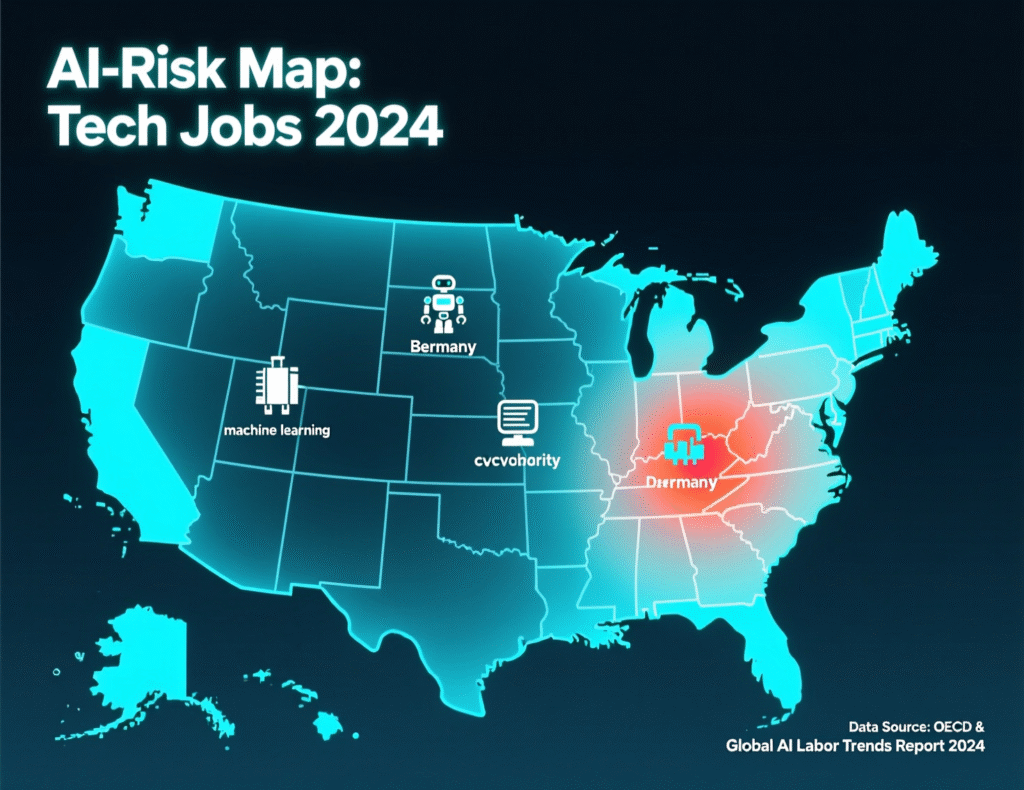
Higher-risk patterns include:
Manual QA without automation
Testers who only execute scripted tests by hand are vulnerable as organisations adopt Cypress, Playwright, Selenium, CI pipelines and AI-assisted testing.
Simple front-end and brochure sites
Page builders, low-code tools and AI website generators increasingly handle marketing sites, especially for SMEs across the US, UK and Germany.
Data-wrangling roles without analytics
Jobs focused on cleaning CSVs and writing basic SQL are at risk as data platforms add built-in AI cleaning and transformation features.
In the US and UK, job-posting data shows steep drops for generic frontend and mobile roles, while openings for AI and ML engineers have grown 70–80% year-on-year.
AI-resilient and growth roles for tech professionals
On the other side, some roles are more AI-resilient — not because AI can’t touch them, but because AI actually increases demand for them:
Platform and systems engineers
Building infrastructure, deployment pipelines, observability and security for fleets of AI-enabled apps.
Machine learning and AI engineers
Designing, evaluating and integrating models into real products a huge growth area in US hubs and European fintech/industry.
Security engineers
SOC 2, PCI DSS and HIPAA requirements create ongoing need for humans to design controls and review AI-driven systems.
Data and analytics engineers
Curating high-quality, compliant data pipelines that AI systems depend on.
These are the “AI-proof careers in tech”: they mix code, data, regulation and domain expertise in sectors like Open Banking fintech (BaFin-regulated in Germany, FCA/Prudential Regulation Authority overseen in the UK), NHS-linked healthtech, or EU AI Act-classified high-risk systems.
Risk profiles across the US, UK and Germany/EU
United States
Demand is shifting toward AI-literate engineers, cloud/platform specialists and security. Competition is fiercest in San Francisco, Seattle, New York and Austin, especially for pure software engineering roles without AI skills.
United Kingdom
London and Manchester remain major hubs. Contractor markets are sensitive to IR35 tax rules, and ACAS/ICO guidance encourages clear workplace AI policies good engineers who understand both AI tools and compliance are especially valuable.
Germany / wider EU
Berlin, Munich and Frankfurt are strong for fintech, automotive/IoT and industrial SaaS. Works councils and Bundesagentur für Arbeit programmes emphasise Weiterbildung (upskilling) and EU AI Act compliance, which favours roles with strong domain and regulatory expertise
In short
if your work sits close to regulated data, complex systems and real business decisions, you’re in a safer lane.
What Skills Make Your Tech Career “AI-Resilient”?
AI-resilient developers combine deep engineering fundamentals with fluency in AI tools and strong product/communication skills.
Deep technical skills that are hard to automate
Some skills are simply harder for AI to absorb end-to-end:
System design and architecture trade-offs, boundaries, failure modes
Scalability and performance tuning capacity planning, caching, profiling
Security and observability threat modelling, incident response, monitoring design
These skills underpin senior roles at FAANG-style companies in the US, high-stakes fintechs in London and Manchester, and German industry heavyweights in automotive and manufacturing where reliability and safety are non-negotiable.
Best skills to learn to work with AI, not against it
Rather than “compete” with AI, focus on orchestrating it:
Prompt engineering for developers
Writing precise prompts for specs, tests, refactors and code reviews.
Integrating AI APIs into products
Using platforms like OpenAI, Azure OpenAI, AWS Bedrock or Google Cloud Vertex AI to build features into web, SaaS and mobile apps.
Evaluating models and data privacy
Understanding training data, evaluation metrics, and privacy implications under GDPR/DSGVO, UK-GDPR and sector-specific rules
If you’re already building apps with modern stacks (React, Next.js, mobile or Webflow/Shopify front-ends), adding AI-powered features can be a natural extension — especially if you work with an experienced partner like Mak It Solutions on cloud architecture or mobile app integration.Mak it Solutions+2Mak it Solutions+2
Human skills that AI can’t easily replace
AI doesn’t negotiate conflicting priorities between a product manager, compliance officer and a demanding customer you do. Human, non-trivial skills include:
Product thinking and prioritisation
Stakeholder communication and expectation-setting
Mentoring juniors and leading teams
Domain expertise in healthcare (NHS, HIPAA), finance (PCI DSS, BaFin, Open Banking) and public sector projects
Remote collaboration across time zones (e.g., a Berlin team collaborating with New York and London) is also becoming a core competency, not a nice-to-have.
How Can You Future-Proof Your Tech Career from AI?
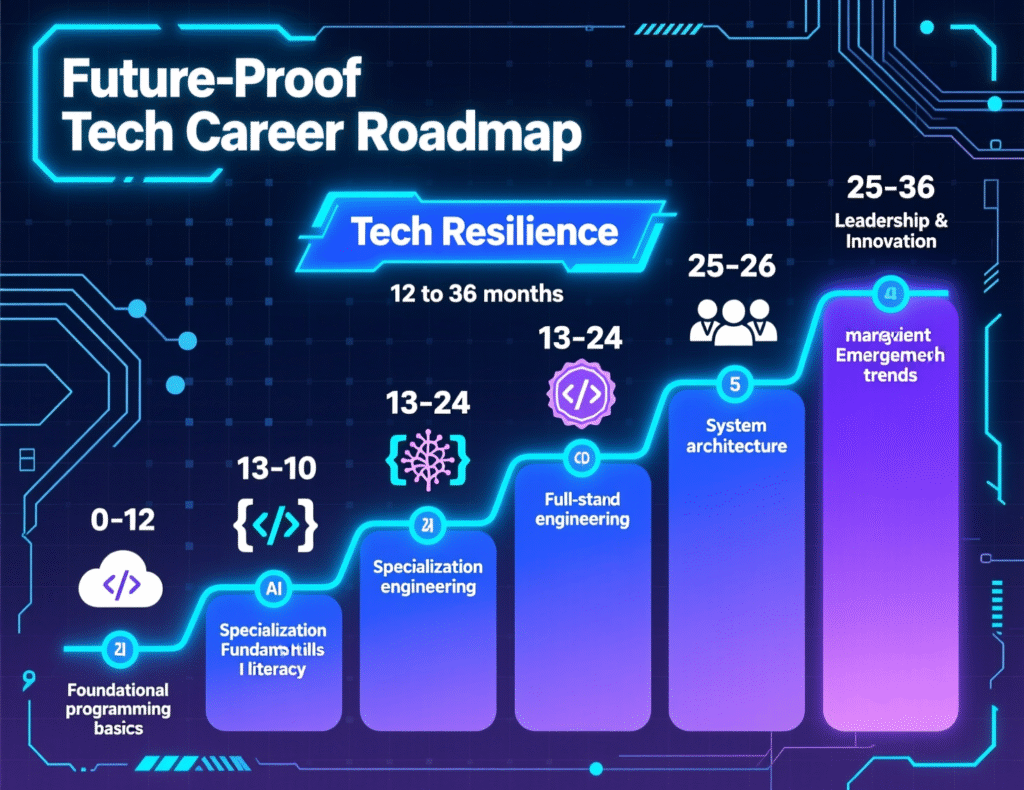
Future-proofing your tech career means designing a 12–36 month skill plan that deepens your engineering value while adding AI and domain specialisation on top.
A 12–24 month “future-proof” skill sprint
Here’s a practical, step-by-step sprint you can start this quarter:
Choose one deep area — backend, data, DevOps, security or mobile.
Choose one AI-adjacent skill — e.g., LLM integration, MLOps fundamentals or AI-assisted test automation.
Ship 2–3 portfolio projects — public GitHub repos, case studies or internal proofs-of-concept.
Examples by region
US
Build an internal AI coding assistant prototype for an Austin SaaS team.
UK
Automate parts of a London healthtech triage workflow while respecting NHS data guidance.
Germany
Run a small GenAI pilot in a Berlin fintech under BaFin and GDPR constraints.
Treat this as a deliberately designed reskilling and upskilling plan, not random tutorial-watching.
A 3–5 year tech career roadmap in the age of AI
Think in phases
Years 1–2
Solidify core engineering fundamentals.
Adopt AI tools for daily work: code generation, tests, documentation, analytics queries.
Years 3–5
Aim towards staff engineer, tech lead or AI specialist roles.
Own at least one cross-team initiative (e.g., AI coding standards, GenAI governance, data quality for AI).
GEO nuance
US
Role-hopping between startups and bigger firms, often with equity as part of comp, can accelerate exposure to AI products.
UK
Many engineers mix permanent roles with stints as contractors; IR35 rules and evolving AI workplace policies will shape how you structure that.
Germany/EU
Long-term employment plus employer-funded Weiterbildung and EU/Erasmus+ programs make structured, multi-year learning paths very realistic.
Building your personal “future-proof curriculum”
Your curriculum should blend:
Online courses (Coursera, edX, Open University, FutureLearn)
Local meetups and conferences in your city or region
Employer-sponsored training and certifications
For most devs, the most useful certifications over the next 3–5 years will be:
Cloud (AWS, Azure, GCP)
Security (Security+, CISSP later, or cloud security specialties)
Data (Snowflake, Databricks, Google Professional Data Engineer)
If you’re already working with a consultancy like Mak It Solutions on web, mobile or SaaS projects, you can often “sneak” this curriculum into real client work and internal initiatives.Mak it Solutions+2Mak it Solutions+2
How to Transition into AI-Focused Roles Without Starting Over
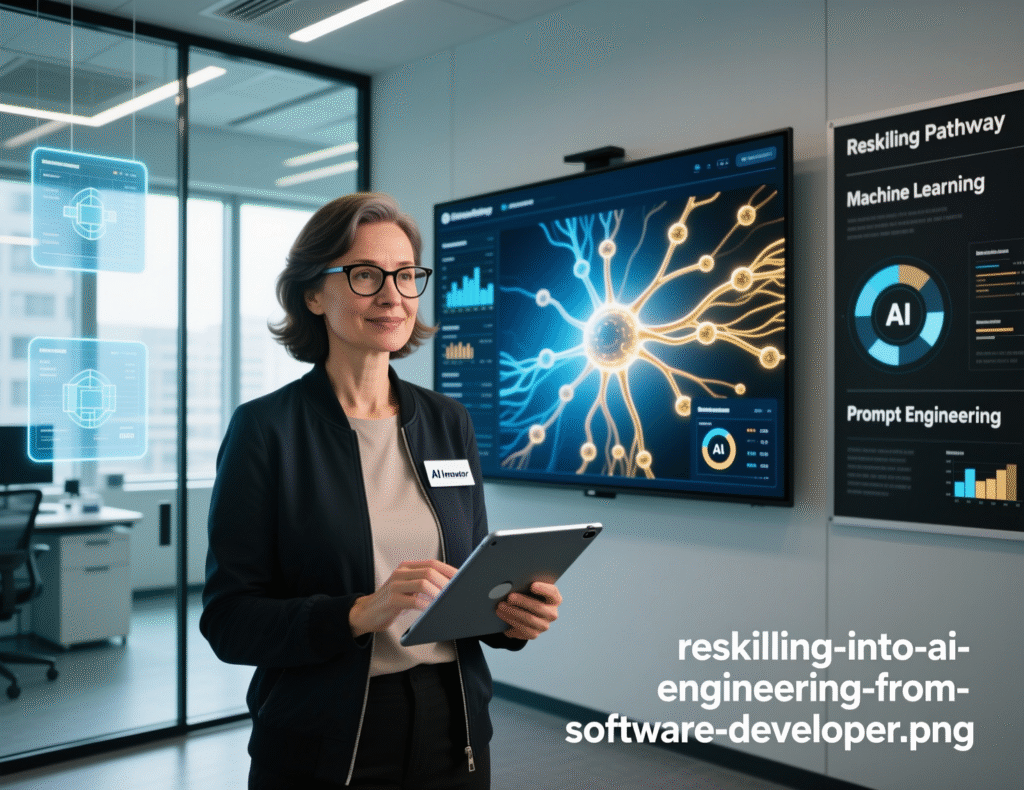
You don’t need to throw away your existing experience to move into AI. The best transitions reuse your current strengths and add targeted skills on top.
From software engineer to machine learning or AI engineer
You already have more than you think:
Programming, debugging and version control
System design and distributed systems experience
Working with APIs, databases and cloud platforms
New skills you’ll need
Statistics and probability basics
Machine learning fundamentals (supervised/unsupervised, evaluation metrics)
Data pipelines and MLOps (training, deployment, monitoring)
Practical entry points
US
Part-time ML/AI nanos or bootcamps plus internal rotations into data/AI teams in New York or Seattle.
UK
London fintechs and Open Banking providers often hire devs who upskilled into data/ML, especially if they understand regulatory context.
Germany
Berlin and Munich are rich in industrial AI and SaaS; many companies are open to “T-shaped” engineers who can bridge classic backend and ML.
Reskilling and Weiterbildung options by region
US
Accredited university certificates, online master’s programs, and employer learning budgets are common, especially in larger enterprises.
UK
Strong ecosystem of London bootcamps, apprenticeships, Open University and FutureLearn courses.
Germany/EU
Bundesagentur für Arbeit and “mein NOW” support funded Weiterbildung and reskilling in response to structural changes like AI.
Realistic case studies from San Francisco, London and Berlin
San Francisco — Senior full-stack → AI engineer
A senior engineer at a SaaS startup started by using LLMs for internal tools, then led an AI-powered feature for customers. Within ~2 years, their title and responsibilities shifted to “AI engineer” without a full restart.
London — Backend dev → Data/AI role in fintech
A mid-level backend dev in a London Open Banking startup took evening courses in data engineering, then owned a fraud-detection pipeline. Their new role sits at the intersection of payments, PCI DSS compliance and applied ML.
Berlin — DevOps → MLOps engineer in B2B SaaS
A DevOps engineer in a Berlin SaaS company gradually took ownership of ML model deployment and observability, working closely with legal on GDPR/DSGVO and EU AI Act compliance.
None of these people “started over”; they layered AI skills onto years of existing experience.
What Developers Need to Know
Key frameworks shaping AI work in the US, UK and EU
If you want a future-proof tech career, you can’t ignore regulation:
GDPR / DSGVO & UK-GDPR
strict rules on personal data processing and data subject rights in the EU and UK.
EU AI Act
categorises AI systems into unacceptable, high, limited and minimal risk, with the heaviest obligations on high-risk systems (e.g., certain healthcare, employment and financial AI).
HIPAA
US healthcare privacy and security rules, increasingly important as hospitals and healthtechs deploy AI.
PCI DSS & SOC 2
baseline security requirements for payments and B2B SaaS, both directly relevant when you add AI to existing systems.
These frameworks heavily influence which AI projects get funded and which skills employers prioritise.
Why compliance-heavy environments protect human roles
In regulated sectors, AI doesn’t get to “decide everything on its own.” You need humans to:
Approve model use cases and risk categories
Design data minimisation strategies and consent flows
Oversee audit trails, explainability and incident handling
Senior engineers, architects and technical leads play key roles in model governance councils, data protection impact assessments and regulator discussions whether that’s the NHS in the UK, BaFin in Germany, or European Commission-led initiatives around the EU AI Act.
Workplace policies, works councils and contractor rules
US
Many companies are drafting internal AI policies aligned with existing HR, security and legal frameworks.
UK
ACAS and the ICO have both published guidance around AI and data protection, recommending clear policies and consultation with staff.
Germany/EU
Works councils often need to be consulted before large-scale AI rollouts that affect employees, adding another layer of human oversight and negotiation.
For developers, this all means: the more you understand compliance and ethics, the more central you become to AI projects not replaceable by them.
Your Personal Future-Proof Plan
Quick self-audit: how exposed is your current role?
Use this mini-checklist to assess your risk
Repetition
Are most of your tasks similar week-to-week and easy to fully specify?
User/domain contact
Do you regularly talk to users, PMs, compliance or domain experts?
AI usage
Are you already using AI tools, or ignoring them?
Depth vs surface
Are you mainly wiring simple CRUD UIs, or designing systems and data flows?
Traffic-light your situation:
Red
Mostly repetitive, little domain contact, no AI usage
Amber
Some complex tasks, basic AI usage, limited domain visibility
Green
Mix of architecture, stakeholder work, AI fluency and domain responsibility
Wherever you land, you can move one colour safer over the next 6–12 months.
90-day action plan to stay relevant
For the next 90 days, commit to three concrete moves:
Pick one AI tool
E.g., GitHub Copilot, ChatGPT, CodeWhisperer or Microsoft Copilot. Use it daily for safe tasks (tests, boilerplate, docs).
Pick one deep skill
System design, observability, test automation, or cloud architecture. Apply it to a real project at work or a serious side project.
Pick one domain to learn
Fintech, healthcare, public sector, e-commerce, etc. Read the relevant regulations (GDPR, HIPAA, PCI DSS, local guidance).
Aim for a weekly rhythm
2–4 hours of focused learning
2–4 hours of experiments in real code
30 minutes of sharing learnings with your team (demo, doc or Slack summary)
When to seek coaching, mentors or structured programs
You may need outside support if.
Your role has been restructured or made redundant
You’ve been stuck at the same level for years despite good performance
You feel lost choosing between dozens of AI courses and career paths
In those cases, consider.
Career coaches specialising in AI and tech
Mentorship platforms or local meetups in cities like London, Berlin, New York or Dublin
Structured programmes, often in partnership with consultancies like Mak It Solutions, which can combine real client projects with guided upskilling in AI, cloud and analytics.Mak it Solutions+2Mak it Solutions+2
You don’t need to know the entire five-year plan today you just need to commit to the next concrete step.
If you’re worried “will AI take my job as a developer?”, the most dangerous move is doing nothing. The second most dangerous is trying to learn everything at once.
Mak It Solutions helps teams across the US, UK, Germany and wider Europe modernise their web, SaaS and mobile products including AI-powered features while keeping security and compliance front and centre. If you’d like a pragmatic view of your current stack and skills, and a realistic 12–36 month roadmap, reach out to the team and request a no-pressure consultation via the contact page at Mak It Solutions. ( Click Here’s )
Key Takeaways
AI is automating tasks inside software jobs, not wiping out most software engineering roles especially in complex, regulated domains.
The most at-risk roles are highly repetitive, low-context coding and manual QA; safer roles mix deep engineering, domain knowledge and compliance.
AI-resilient developers double down on fundamentals (architecture, security, data) while learning to orchestrate AI tools and APIs.
A realistic future-proof plan spans 12–36 months of focused learning and projects, plus a 3–5 year view towards staff, tech lead or AI-specialist roles.
Region-specific factors (IR35 in the UK, works councils and Weiterbildung in Germany, US startup dynamics) shape how AI impacts your local market.
You don’t need a new degree to stay relevant you need carefully chosen skills, real projects and, if helpful, the right partners and mentors.
FAQs
Q : Which developer skills should I learn first to stay ahead of AI tools?
A : Start with skills that make AI more useful instead of trying to “beat” it. In practice that means: strong fundamentals in algorithms and system design, solid Git and CI/CD, and at least one cloud platform. On top of that, learn how to use AI tools for tests, refactors and documentation, and how to integrate AI APIs into real applications. These skills make you the person who can direct AI effectively, not be replaced by it
Q : Are junior software engineers more likely to lose their jobs to AI than seniors?
A : In the short term, junior engineers in roles that are mostly repetitive (bug fixes, CRUD tickets, simple pages) are more exposed, because AI tools can already handle many of those tasks. However, companies still need juniors who can grow into mid and senior roles, so the key is how you spend your first 2–3 years. Juniors who quickly learn testing, automation, system design basics and AI-assisted workflows are far less likely to be sidelined than those who stay stuck on simple tickets.
Q : How is AI affecting remote developer jobs in the US, UK and Europe?
A : AI makes it easier to coordinate remote teams by helping with documentation, code reviews and translation, but it also increases global competition for routine coding work. In the US and UK, some low-complexity remote roles are being offshored or automated, while high-impact remote positions in platform engineering, security and AI integration remain strong. In Germany and the wider EU, stronger worker protections and works councils mean remote roles change more gradually, but expectations for AI fluency are still rising.
Q : Do I need a master’s degree in AI or data science to stay employable as a developer?
A : No most developers do not need a master’s degree to stay relevant. Employers in the US, UK and EU increasingly care more about demonstrable skills (projects, portfolios, contributions) than formal credentials, especially at the mid-level. A targeted mix of online courses, certifications (cloud, security, data) and real projects using AI tools is usually enough to remain competitive. A master’s can help if you want to specialise deeply in research or advanced ML, but it’s optional, not mandatory.
Q : What’s the best way to balance learning AI skills with a full-time coding job?
A : The key is to embed learning into your existing work instead of treating it as a separate hobby. Use AI tools on your real tickets, volunteer for small AI-related initiatives at your company, and set a realistic weekly cap (for example, 4–6 hours) for focused study. Break your goals into 30–90 day sprints: one AI tool to master, one deep technical topic to improve, and one domain to explore. This approach keeps you progressing without burning out alongside a full-time job.