


Human-Centred Change Management in Tech for 2025
Human-Centred Change Management in Tech for 2025
Human-Centred Change Management in Tech for 2025
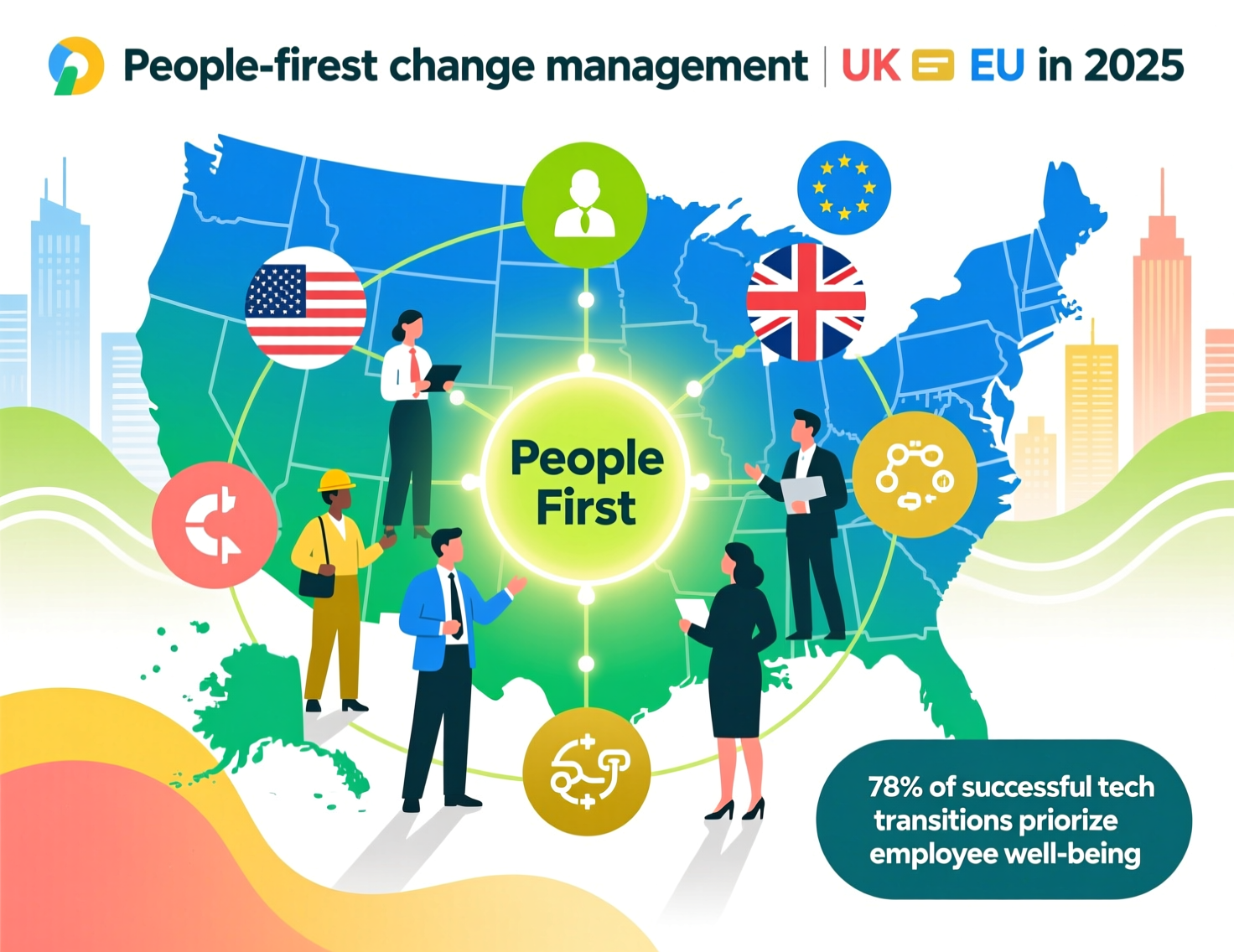
Change management in tech is the structured way organisations prepare people, teams and processes for new digital tools, cloud platforms and AI-enabled workflows. Done well, it blends frameworks like ADKAR with local compliance (GDPR, UK-GDPR, HIPAA, BaFin) so employees actually adopt the software instead of working around it.
Introduction
Getting new software live is easy; getting people to actually change how they work is where most organisations get stuck. In modern change management in tech, the bottleneck isn’t cloud capacity or AI models it’s adoption, trust and day-to-day behaviour across US, UK and European teams.
Digital transformation, AI pilots, ERP/CRM rollouts, security platforms and hybrid work tools mean most organisations are now “always changing”. Yet studies still suggest that 60–70% of change initiatives fail or under-deliver, even as companies run multiple transformations every few years.
What follows brings together organizational change management and technology change management into one people-first playbook rooted in frameworks like Prosci ADKAR, people process technology (PPT) and real-world ERP/AI/cloud programmes on SAP, Oracle, Microsoft 365 and major hyperscalers. The focus is on leaders in the US, UK, Germany and wider EU who want tech that actually gets adopted, not just purchased.
Along the way, we’ll point to practical patterns Mak It Solutions sees across cloud and AI-heavy programmes from San Francisco to London to Berlin, and how our consulting and engineering teams help make that change stick.
What is change management in tech, and how is it different from traditional change management?
Change management in tech is the structured way you prepare people, teams and processes for new digital tools, platforms and ways of working. Unlike traditional change management, it has to keep pace with rapid release cycles, cloud platforms and AI, and it tightly links user adoption to security, compliance and your product roadmap decisions.
Clear definition tailored to modern digital products and cloud
Classical organizational change management focuses on culture, leadership and structures—re-orgs, mergers, operating-model shifts. Technology change management zooms in on the specific journeys people take when you introduce or upgrade software: SaaS platforms, ERP, CRM, HRIS, developer tools, AI copilots and cloud migrations.
A modern technology change management framework connects.
Product and platform decisions (what you roll out, in which region)
Technology adoption strategy (who needs to change which behaviours)
Enablement (training, sandboxes, support, champions)
Continuous improvement (feedback, telemetry, backlog grooming)
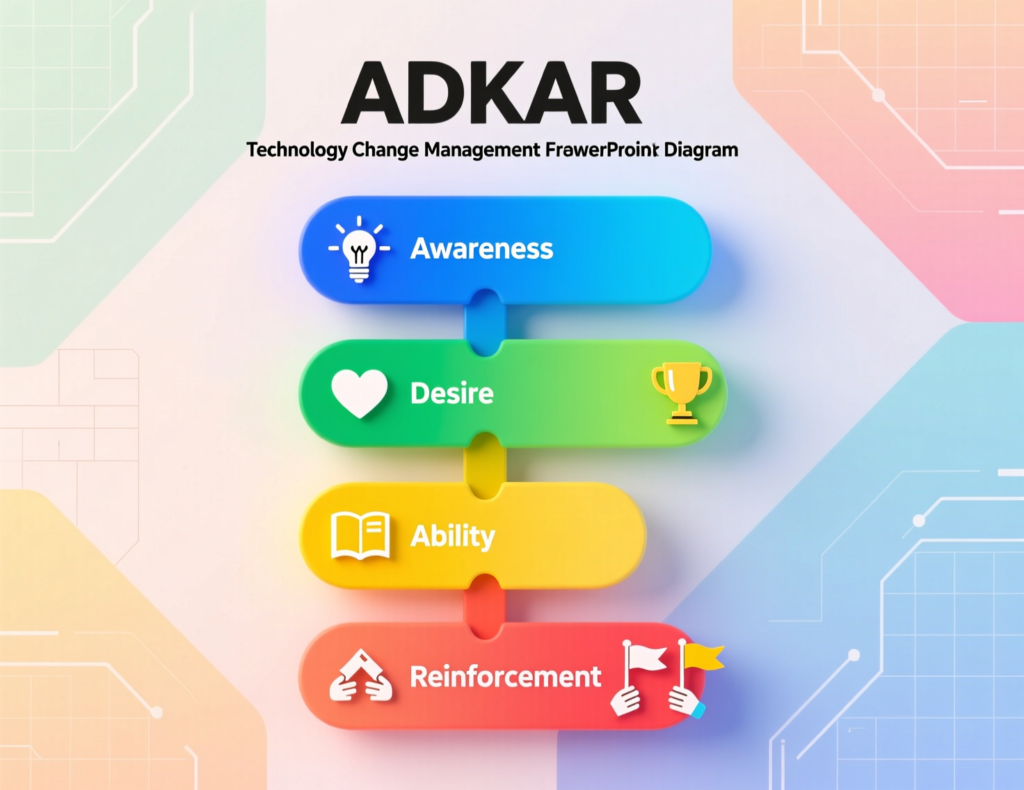
Frameworks like Prosci ADKAR Awareness, Desire, Knowledge, Ability, Reinforcement—are still valid, but you apply them to specific user journeys inside Salesforce, SAP S/4HANA, Workday, Microsoft 365, Atlassian or your in-house tools.
Key differences from traditional change management in US, UK and European tech firms
In tech-heavy organisations, the pace and context are different:
Faster cycles.
DevOps, CI/CD and feature flags mean tools change weekly, not once a year.
Cross-border teams.
A single product squad might cover New York, London and Berlin; governance and labour law differ by country.
Stack complexity.
Cloud, SaaS and data platforms create overlapping interfaces, permissions and workflows that must all be aligned.
Governance also diverges
US enterprises focus heavily on SOC 2, HIPAA and PCI DSS for cloud and SaaS, often with internal security councils.
UK public sector and NHS emphasise procurement rules, UK-GDPR and information governance boards.
German Mittelstand and DACH organisations must factor in DSGVO (EU GDPR in German law), works councils (Betriebsrat) and, for banks, BaFin supervision and Open Banking/PSD2 obligations.
Technology change management in this environment is as much about legal and culture orchestration as it is about UX.
When dedicated technology change management becomes critical
Dedicated technology change management becomes non-negotiable when:
You roll out ERP/CRM/HRIS platforms (SAP, Oracle, Dynamics, Workday) across multiple countries.
You migrate core systems to AWS, Azure or Google Cloud, or re-platform to microservices and data lakehouses. (Mak it Solutions)
You introduce AI/automation into decisions, workflows or customer interactions.
You deploy new security and developer tools (CI/CD pipelines, SAST/DAST, SIEM/SOC tools) that affect how engineers and operators work.
Regulated sectors feel the pain fastest: HIPAA-bound US hospitals, PCI DSS-heavy card processors, SOC-2-oriented SaaS vendors, NHS trusts in the UK, and BaFin-supervised banks or Industrie 4.0 manufacturers in Germany. When behaviour lags behind tools, audit findings and operational risk follow quickly.
Why the people side of technology change matters more than the software
The human side of technology change determines whether your expensive software becomes everyday workflow or shelfware. If employees don’t understand, trust or feel involved in the change, employee adoption of new software stalls, workarounds appear and ROI disappears no matter how good the tool is.
Analysts repeatedly find that around 70% of digital transformations fail to meet their goals, largely due to people and culture issues rather than technology itself.
Why employee adoption of new software lags behind the tech
Most teams aren’t “anti-tech” they’re exhausted and confused.
Common problems include:
Change fatigue.
Employees in San Francisco, London or Munich may have lived through multiple ERP upgrades, collaboration tools and “AI pilots” in just a few years.
Poor communication.
Vague slogans instead of concrete “here’s what changes for you next month”.
Lack of a clear “what’s in it for me?” for each role and persona.
Research shows that roughly 63% of employees drop a new tool if they can’t see its relevance to their daily work. That’s pure resistance to change in software rollouts not because the tech is bad, but because the story and support around it are weak.
Overcoming resistance to tech change in engineering and operations teams
In engineering and operations teams, resistance often shows up as:
Fear of loss of autonomy (“The new platform locks me in”)
Anxiety about AI or automation replacing core parts of their work
Concern about short-term productivity dips during rollout
Practical tactics:
Co-creation.
Involve senior engineers, nurses, branch staff or controllers in design decisions and pilots.
Champions networks.
Identify local champions in New York, Manchester, Berlin or Zurich who translate the change into local language and examples.
Safe sandboxes.
Allow people to experiment in non-production environments before anything is mandatory.
Feedback loops.
Use in-app surveys, office hours and backlog triage to turn complaints into product improvements.
Mak It Solutions often combines these tactics with data-driven adoption dashboards (usage, error rates, satisfaction) in cloud and SaaS programmes so leaders can see resistance early and adjust. (Mak it Solutions)
Employee experience and culture in US, UK and DACH tech organisations
Culture shapes how resistance shows up:
US tech firms (e.g., in Austin, Seattle or Boston) tend to emphasise speed, productivity and career growth. Employees may tolerate more experimentation if they see a path to new skills and promotions.
UK organisations, especially NHS trusts and public bodies, put more weight on fairness, inclusion and formal consultation. Governance boards, unions and regulators like the ICO play a visible role.
Germany/DACH brings strong co-determination traditions. You can’t implement monitoring tools, AI or process automation without engaging works councils (Betriebsräte) early, and ensuring the change is DSGVO-konform and psychologically safe.
Ignoring these nuances turns a neutral change into an avoidable crisis.
Why do technology projects fail when organisations ignore change management and user adoption?
Tech projects fail without change management because people never fully switch to the new way of working. The system goes live, but behaviour stays the same leading to low usage, bad data, compliance gaps and spiralling costs, especially in regulated US and European industries.
Bain & Company found that around 88% of business transformations fail to achieve their original ambitions, with talent overload and weak change leadership as key culprits.
Top reasons tech implementations fail (ERP, CRM, cloud, AI)
The patterns are depressingly consistent:
“Big bang” go-lives where everyone flips to the new system overnight with minimal soft launch.
Underfunded change—no dedicated change leads, trainers or communications support.
Misaligned incentives. Sales teams measured on revenue, not CRM usage; clinicians measured on throughput, not data quality.
**No structured change management for software implementation—no ADKAR journey, no clear ERP implementation change management plan.
For cloud and AI, failures often trace back to poorly handled people aspects: unclear roles, under-skilled teams and fear about automation. AI adoption research suggests that roughly three-quarters of companies struggle to scale value from AI initiatives, despite heavy investment.
Warning signs you’re underinvesting in technology change management
If you see these signals, your tech change is probably people-starved:
Shadow IT and “unofficial” tools popping up around your shiny new SaaS
A forest of duplicate spreadsheets recreating old workflows
Usage metrics plateauing far below licence counts
Helpdesk tickets spiking around “how do I…?” questions months after go-live
This is familiar territory for mid-size US SaaS companies, UK public sector bodies and SAP-heavy German enterprises. A Mak It Solutions review often reveals that more time was spent debating vendor selection than on technology adoption change management or internal capability building. (Mak it Solutions)
What failure looks like in regulated industries (HIPAA, PCI DSS, BaFin, Open Banking)
In regulated sectors, poor adoption isn’t just inefficient—it’s non-compliant:
US healthcare (HIPAA)
Clinicians document partly in the new system and partly in old notes, so audit trails are incomplete.
US payments (PCI DSS)
Staff still export card data to local files “for convenience”, undermining tokenisation and monitoring.
UK/EU Open Banking (PSD2) and UK-GDPR/GDPR.
Teams don’t actually follow the data-access and consent flows the solution was designed for, leaving gaps between policy and practice.
BaFin-supervised German banks
Branch staff keep “shadow lists” or Excel trackers that bypass controls the new platform was meant to enforce.
In all cases, the root issue is the same: you changed the tool, not the behaviour.
Technology change management frameworks & best practices for US and European teams
Effective change management in tech blends proven frameworks like Prosci ADKAR and people process technology with local governance, compliance and culture. The goal isn’t a one-off hero project, but repeatable playbooks you can reuse for every new tool.
Technology change management frameworks: ADKAR, people process technology and agile change
Three practical anchors:
ADKAR (Prosci)
Focused on individuals: Awareness → Desire → Knowledge → Ability → Reinforcement. For tech, this might map to “Why we’re moving to SAP S/4HANA”, “what changes for your team”, “training paths”, “go-live coaching” and “post-go-live reinforcement campaigns”.
People–Process–Technology (PPT)
Forces you to design beyond the tool: who does what, which process steps disappear or appear, and how the platform supports them.
Agile change
Adapted from product development shorter change cycles, frequent stakeholder demos, early pilots, and backlog-driven improvements.
A robust technology change management framework will combine these ideas with your existing organizational change management methods and governance forums.
Step-by-step technology change management process for SaaS and cloud rollouts
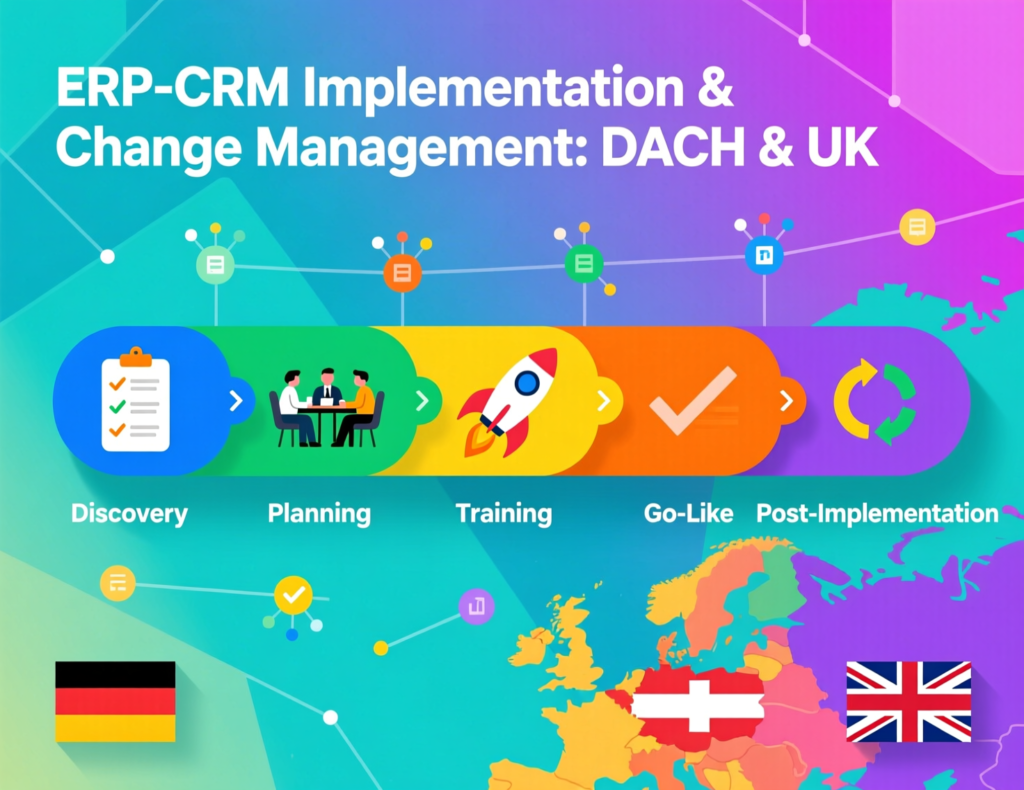
For SaaS, ERP or cloud platforms, a repeatable process usually includes:
Discovery & impact mapping
Inventory systems, processes and regulations (HIPAA, GDPR, UK-GDPR, BaFin, PCI DSS).
Identify impacted personas across New York, London, Berlin, Amsterdam and Dublin.
Stakeholder & works council mapping
Clarify who must be informed, consulted or give consent (e.g., NHS information governance, German works councils).
Vision & story
Translate architecture choices into a human narrative: “Here’s what this means for your daily work and career.”
Communications & enablement
Multi-channel comms (town halls, email, Teams/Slack, intranet).
Role-based training, sandboxes, office hours and “show me” videos.
Launch, reinforcement & optimisation
Phased go-lives, hypercare, targeted nudges and refresher training.
Instrumented metrics for feature usage, data quality, error rates and satisfaction.
Mak It Solutions often embeds these technology change management process steps into wider cloud and cost-optimisation programmes, so CIOs can track both financial and human ROI. (Mak it Solutions)
Governance, compliance and works councils: GDPR, UK-GDPR, DSGVO and sector rules
To build trust, governance must be part of the plan not an afterthought.
GDPR/DSGVO and UK-GDPR.
Design data flows, roles and training with regulators like the ICO, NHS bodies and EU data protection authorities in mind.
Sector rules.
Align healthcare changes with NHS guidance, banking changes with BaFin and PSD2/Open Banking, and payments changes with PCI DSS expectations.
Works councils & unions.
In DACH, build consultation into early design stages especially for monitoring, analytics or AI use cases.
A 2025 market analysis estimated the global change management software market at roughly USD 3.5B, projected to more than double by 2035 reflecting how seriously organisations are now taking structured, governed change.
Change management for software implementations and AI-enabled tools
Big-ticket projects like ERP, CRM and HRIS implementations or AI adoption benefit from reusable playbooks that account for GEO-specific realities in the US, UK, Germany and wider EU.
ERP and CRM implementation change management (SAP in DACH, Oracle/Microsoft in US/UK)
For ERP implementation change management, especially Change-Management bei SAP-Einführung in Deutschland (DSGVO-konform), three patterns recur:
Process first, then configuration.
Map future processes with business and works councils before locking SAP or Oracle configuration.
Localisation.
Consider DACH accounting rules, German language UX and data residency locations (e.g., Frankfurt or Berlin regions).
Hybrid training.
Mix classroom sessions, e-learning and floor-walking support for plants in Munich, Hamburg or Stuttgart.
For CRM and HRIS in US/UK contexts, it helps to offer a CRM/HRIS change management plan template covering:
Stakeholder matrix (sales, marketing, HR, finance, compliance)
Data migration and cut-over approach
Role-based enablement and change champions by region
Governance for ongoing enhancements
ERP and CRM are classic areas where Mak It Solutions’ engineering work intersects deeply with change management and training.
Cloud migration, dev tools and HR systems: practical adoption playbooks
For cloud migrations and new dev tools, adoption playbooks usually include:
Environment journey mapping.
What changes for developers in Seattle or Dublin when CI/CD pipelines move to a new platform?
Role-based access and training.
Security engineers, SREs, HR admins and finance teams all need different views and runbooks.
Sandboxing.
Let teams experiment with new cloud consoles, HR workflows or analytics dashboards before enforcing them.
A strong user adoption strategy for new software will also cover:
Change impact by region and function
Minimum viable documentation and “how-to” videos
KPI dashboards tied to latency, incident resolution, time-to-hire or employee experience
Internal Mak It Solutions guides on cloud comparison and cost optimisation often pair these adoption mechanics with architecture decisions across AWS, Azure and Google Cloud for US and EU workloads. (Mak it Solutions)
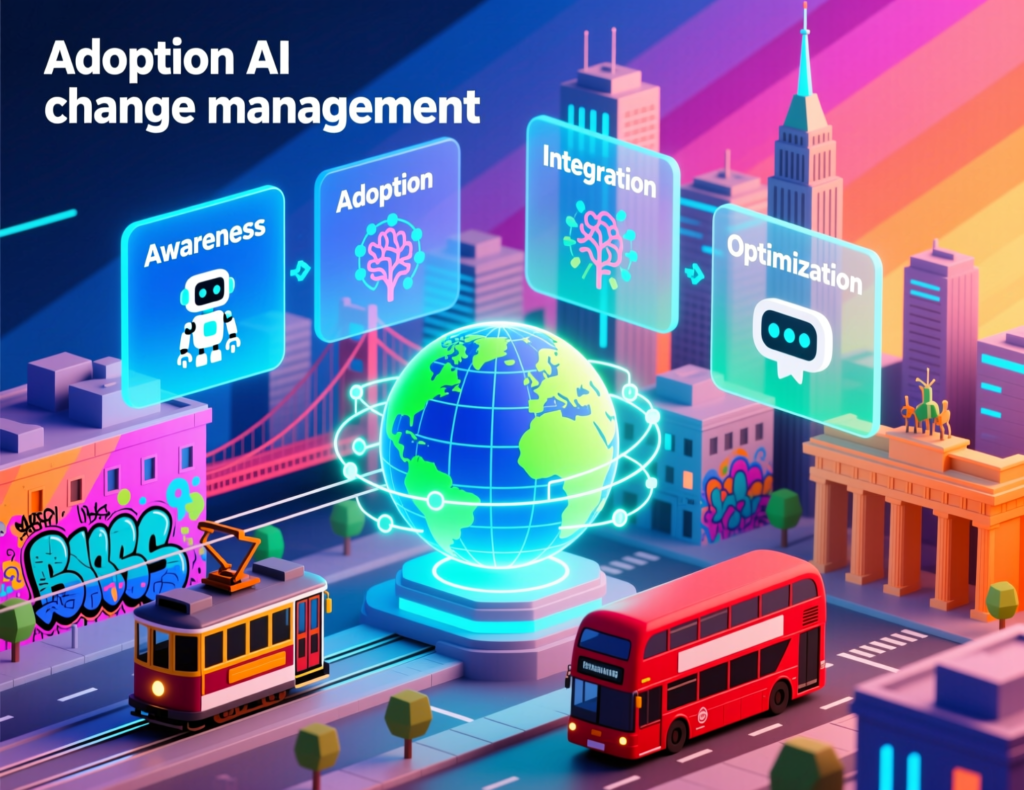
Change management for AI adoption in the workplace in US and European companies
How should change management approaches adapt for AI, automation and continuous software delivery?
Start by assuming AI is as much a people and governance change as it is a model-tuning exercise. Recent reports suggest that a large majority of enterprises still struggle to achieve or scale value from AI, and some analyses show failure rates above 70% for AI pilots and projects.l)
Across San Francisco, London, Berlin, Amsterdam and Dublin, effective AI change programmes:
Clarify where AI assists vs. decides, and what human oversight remains.
Provide transparent communication about monitoring, data use and bias safeguards crucial under GDPR, UK-GDPR and emerging EU AI rules.
Offer skills pathways so employees see AI as an upskilling opportunity, not just automation risk.
Mak It Solutions’ work on AI content guardrails and AI-enabled cybersecurity is an example of pairing responsible AI with practical training and “guardrails by design” workshops.
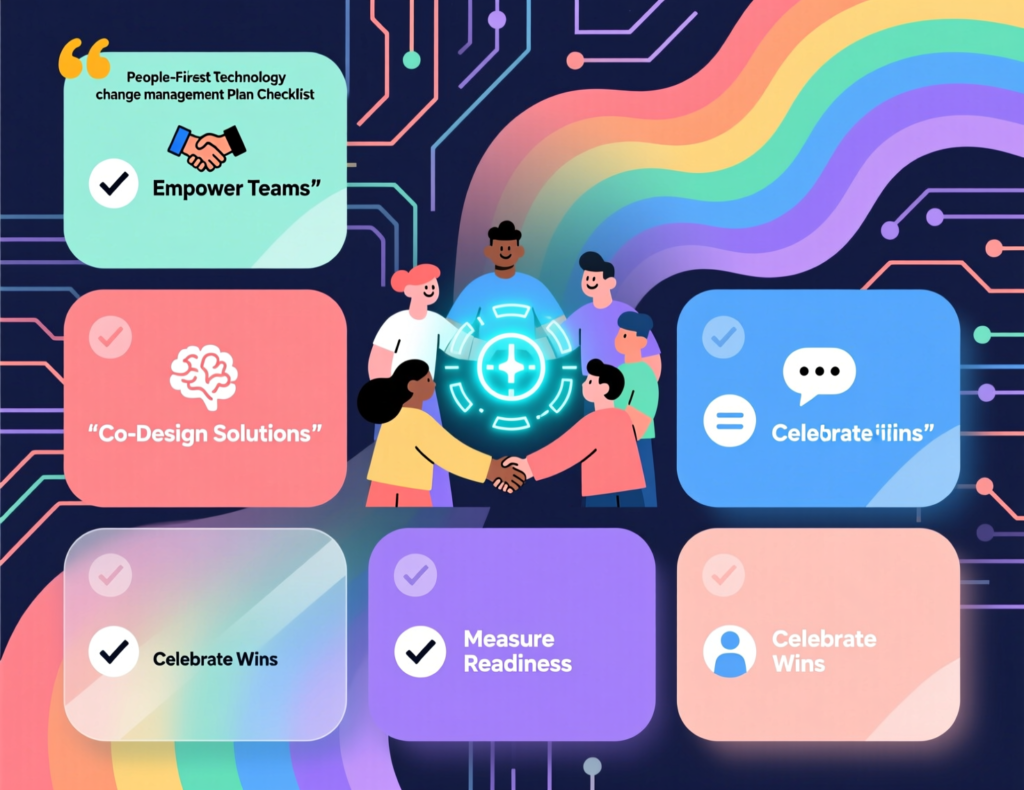
How can organisations design a technology change management plan that puts people first?
A people-first change management in tech plan starts with understanding who is impacted, what behaviours must change and how you’ll support them. From there, you design user journeys, communication, training and feedback loops tailored to US, UK and European contexts then measure adoption and adjust.
Assessing readiness.
Begin with a structured readiness assessment.
Map impacted roles across New York, London, Berlin, Zurich, Paris and Dublin—including remote and hybrid workers.
Identify formal stakeholders: CIO, CISO, HR, legal, compliance, works councils, unions, NHS boards or BaFin liaison teams where relevant.
Assess culture and change history: how many transformations have teams survived in the last 3–5 years?
This is also where you spot GEO-specific blockers—e.g., explicit works council consultation in Germany, or information governance boards in the NHS.
Designing a people-first user adoption strategy and communication plan
Turn your diagnosis into a technology adoption strategy:
Personas.
Create practical personas: call-centre agent in Manchester, nurse in an NHS trust, manufacturing engineer near Munich, data analyst in Paris.
Messages and channels.
Tailor the “why” to each persona and country; consider languages (English, German, French, Dutch) and local regulators.
Training formats.
Blend live sessions, short videos, guided tours and in-app help.
Champions and leaders.
Equip managers to reinforce the change in 1:1s and stand-ups.
Deliverables often include
An adoption roadmap by region and function
A change management checklist for new software implementation (cut-over, communications, training, hypercare)
FAQ packs for US, UK and German audiences that answer compliance and job-impact questions head-on
You can see similar structured playbooks in Mak It Solutions’ content on web, cloud and data modernisation for US and EU organisations those same patterns adapt well to change management in tech. (Mak it Solutions)
Measuring impact and when to bring in technology change management consulting
Finally, define what “good” looks like:
Usage KPIs.
Active users, time in app, feature usage, mobile vs. desktop, log-ins per week.
Experience and quality.
NPS or employee experience (EX) scores, error rates, rework, ticket volume.
Compliance metrics.
Completion of mandatory training, data-quality rules passed, policy exceptions, audit findings.
Change management studies suggest that organisations with strong change capabilities significantly outperform peers on project success rates often doubling their odds of meeting objectives.
You’ll typically benefit from technology change management consulting when:
You’re orchestrating multi-country rollouts (US + UK + DACH/EU) with heavy regulation.
Your internal teams are at capacity running BAU and can’t also run structured adoption.
You need reusable templates, training and coaching—fast.
Mak It Solutions can pair this people-first change expertise with hands-on delivery across SaaS, cloud, data and AI platforms, so you aren’t juggling multiple vendors for one transformation. (Mak it Solutions)
Concluding Remarks
Software is the trigger; people, culture and adoption are the moat. Take your current portfolio ERP, CRM, HRIS, AI pilots, security tools and pick one US, UK or German use case as a pilot for people-first change management in tech. Build a simple, ADKAR-aligned change plan, measure adoption honestly, and use the lessons to design a reusable playbook for everything that follows.
Key Takeaways
Change management in tech is different from traditional change it must keep up with rapid software releases, cloud platforms and AI while staying compliant with GDPR, UK-GDPR, HIPAA, PCI DSS and BaFin rules.
Ignoring the people side of technology change is the fastest way to turn big-ticket ERP, CRM, cloud or AI projects into shelfware, especially in regulated US and European industries.
Proven frameworks like ADKAR and people–process–technology still work, but only when combined with GEO-aware governance, works councils and sector-specific constraints.
The most effective programmes use repeatable process steps discovery, stakeholder mapping, vision, comms, training and reinforcement rather than treating each implementation as a one-off.
A people-first tech change management plan maps behaviours by persona and country, uses transparent communication, and tracks adoption, experience and compliance metrics over time.
Bringing in a partner like Mak It Solutions can accelerate both the hard (cloud, SaaS, AI engineering) and soft (change management, training, governance) sides of your transformation.
If you’re staring at a backlog of tools that never quite landed ERP, CRM, AI pilots, cloud platforms it’s time to fix the people side, not just the tech stack. Share your current roadmap, GEO footprint (US, UK, DACH/EU) and top three problem systems with the Mak It Solutions team, and we’ll help you design a people-first change blueprint and pilot. Whether you need a lightweight checklist, a workshop with your leadership team or a full change-and-build engagement, we’ll shape a plan that fits your pace and budget. ( Click Here’s )
FAQs
Q : What is the role of HR and people leaders in technology change management?
A : HR and people leaders are the bridge between your technology roadmap and day-to-day employee experience. They help define skills and role changes, design training and career paths, and ensure policies align with new tools especially in hybrid-work and AI contexts. In US, UK and DACH organisations, HR also partners with legal, compliance and works councils to make sure technology change respects labour law, data protection and well-being. When HR is at the table from day one, adoption and trust rise significantly.
Q : How much budget should we allocate to change management in a major software implementation?
A : A common rule of thumb is to allocate 10–15% of the overall project budget to change management for large ERP, CRM or HRIS implementations, with higher percentages for multi-country or highly regulated rollouts. That includes change leads, communications, training, travel, adoption tooling and post-go-live reinforcement. Under-investing here often leads to low adoption, rework and extra customisation later costs that can easily exceed the original change budget. Treat these figures as benchmarks and align final numbers with your internal finance and risk teams.
Q : What’s the difference between a global technology change strategy and local rollouts in the US, UK and Germany?
A : A global technology change strategy sets the shared story, principles, KPIs and core enablement assets for everyone. Local rollouts adapt that backbone to US, UK and German realities different regulators (HIPAA vs. NHS vs. BaFin), different labour rules (works councils in Germany) and different expectations about communication and training. The best programmes keep architecture, data standards and core UX global, but let each region shape examples, language, timelines and governance to its context.
Q : How can small and mid-size SaaS companies build a repeatable change management playbook without a big consulting budget?
A : Mid-size SaaS companies don’t need an army of consultants; they need a lightweight, repeatable playbook. Start by templating a simple ADKAR-based journey for any new tool: who needs awareness, desire, knowledge, ability and reinforcement, and through which channels? Capture lessons from each rollout into living documents, short Loom videos and internal guides. Over time, this becomes your internal “change library” that product, engineering and customer-facing teams can reuse much like Mak It Solutions reuses cloud and AI playbooks across multiple clients.
Q : Which metrics best show whether our technology change management efforts are working?
A : The most useful metrics combine usage, experience and compliance. On the usage side, track active users, feature adoption, log-ins and task completion in the new system. For experience, look at NPS/EX scores, qualitative feedback and reductions in helpdesk tickets over time. On the compliance and quality side, measure data-quality rules passed, training completion, audit findings and incident volumes. Together, these indicators tell you whether people have truly changed how they work, not just clicked through a new UI once.