


GCC AI Predictive Maintenance for Utilities, Fleet & Rail
GCC AI Predictive Maintenance for Utilities, Fleet & Rail
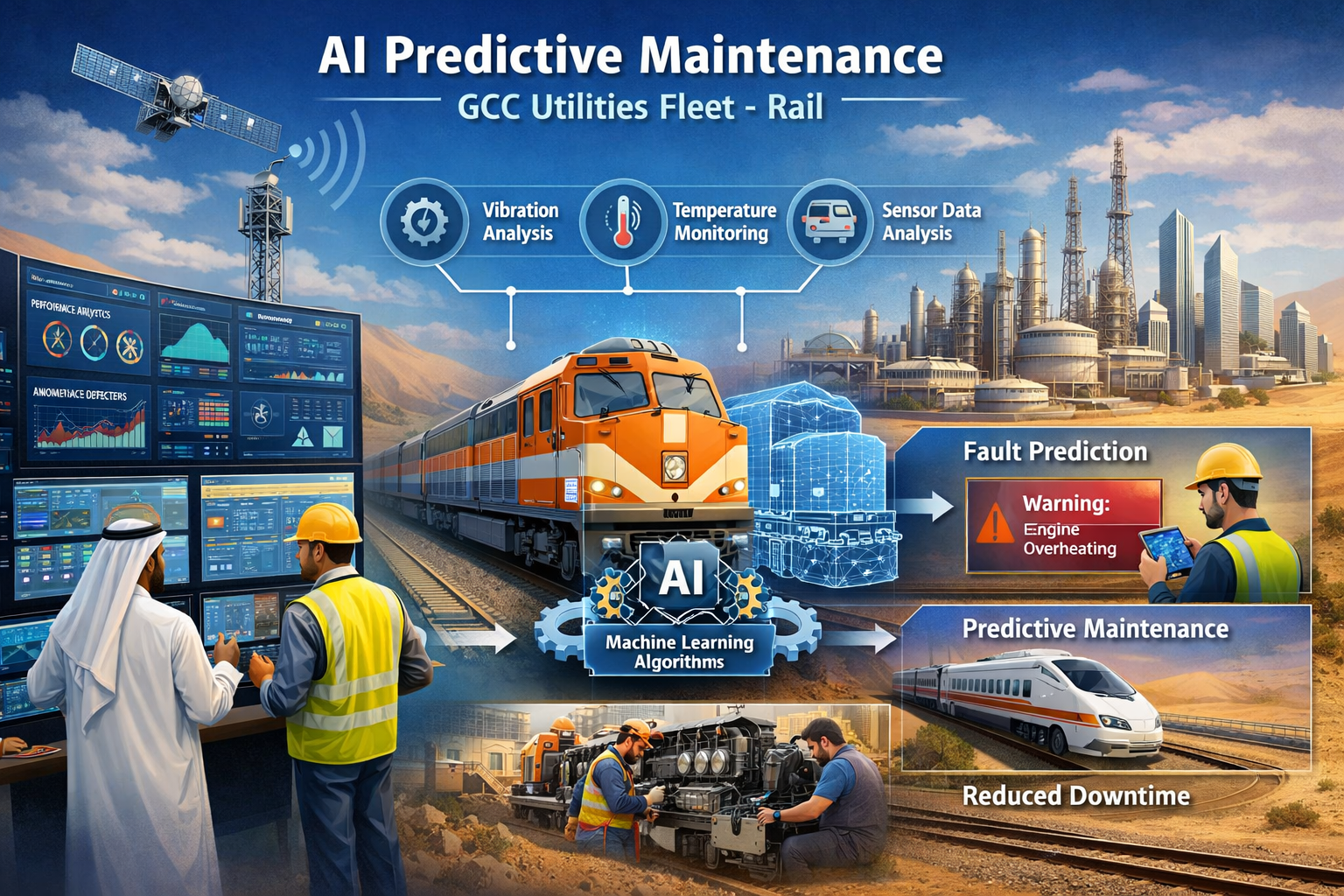
GCC AI Predictive Maintenance for Utilities, Fleet & Rail
AI predictive maintenance helps GCC utilities, fleet operators, and rail teams spot likely equipment failures before they turn into service disruptions. For Saudi Arabia, the UAE, and Qatar, the real value is not only better uptime. It is deploying a solution that also fits local hosting preferences, governance expectations, and day-to-day operational workflows.
That is why AI predictive maintenance is no longer just an engineering topic. In Riyadh, Dubai, Abu Dhabi, and Doha, it is becoming a boardroom priority for organizations that need stronger reliability without adding disconnected tools, weak controls, or unnecessary cross-border data exposure.
Introduction
AI predictive maintenance uses sensor readings, asset history, and operational data to estimate when equipment is likely to fail. That can include vibration, temperature, pressure, battery behavior, fuel use, runtime, and historical maintenance records.
Instead of waiting for a breakdown, teams get earlier warning signs. That gives planners time to schedule inspections, order parts, and reduce disruption before an asset fails in service.
For utilities, this may apply to pumps, transformers, substations, and meters. For fleet and rail teams, it often includes brakes, engines, cooling systems, batteries, and route-driven wear patterns.
Predictive vs preventive vs condition-based maintenance
These three approaches are related, but they are not the same.
Preventive maintenance follows a fixed schedule.
Condition-based maintenance reacts to measured equipment condition.
Predictive maintenance estimates failure risk before the issue becomes critical.
In practice, predictive maintenance gives operators a more precise way to plan work. It can reduce unnecessary servicing, cut spare-parts waste, and improve asset performance over time.
Why GCC buyers evaluate it differently
In the GCC, buyers rarely look at AI predictive maintenance as a standalone analytics tool. They usually assess it through a wider operational and governance lens.
In Saudi Arabia, discussions often connect to data governance, auditability, and regulatory alignment. In the UAE, the conversation usually includes resilience, digital-service continuity, and enterprise assurance. In Qatar, infrastructure sensitivity, controlled deployments, and data residency tend to shape the buying process.
Why Saudi, UAE, and Qatar Operators Are Prioritizing It
Saudi Arabia.
In Riyadh and Jeddah, utilities and industrial operators are under pressure to improve resilience while modernizing maintenance decisions. Outages are costly, visible, and difficult to justify when service expectations are high.
That is where AI predictive maintenance becomes practical. Transformer groups, pumping stations, and field assets generate the kind of operational signals that can support earlier intervention and better maintenance planning.
UAE.
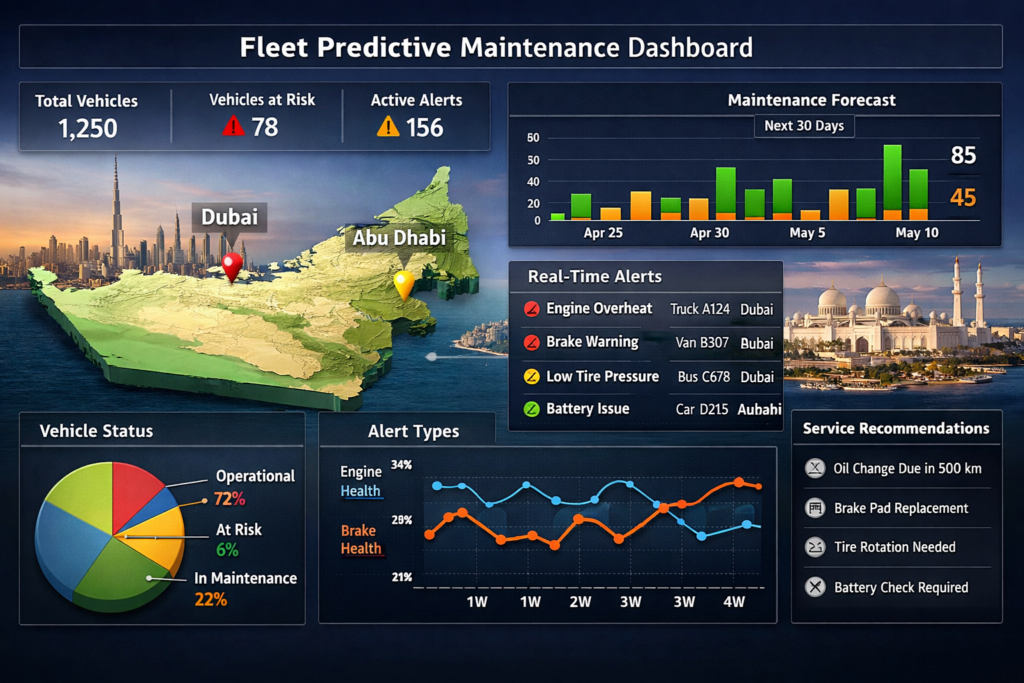
In Dubai and Abu Dhabi, fleet and transport teams are focused on uptime, route reliability, and faster fault detection. Public-facing operations cannot afford avoidable breakdowns, especially in high-volume city environments.
For buses, municipal vehicles, and logistics fleets, predictive maintenance can improve scheduling, reduce roadside failures, and support more consistent service delivery.
Qatar.
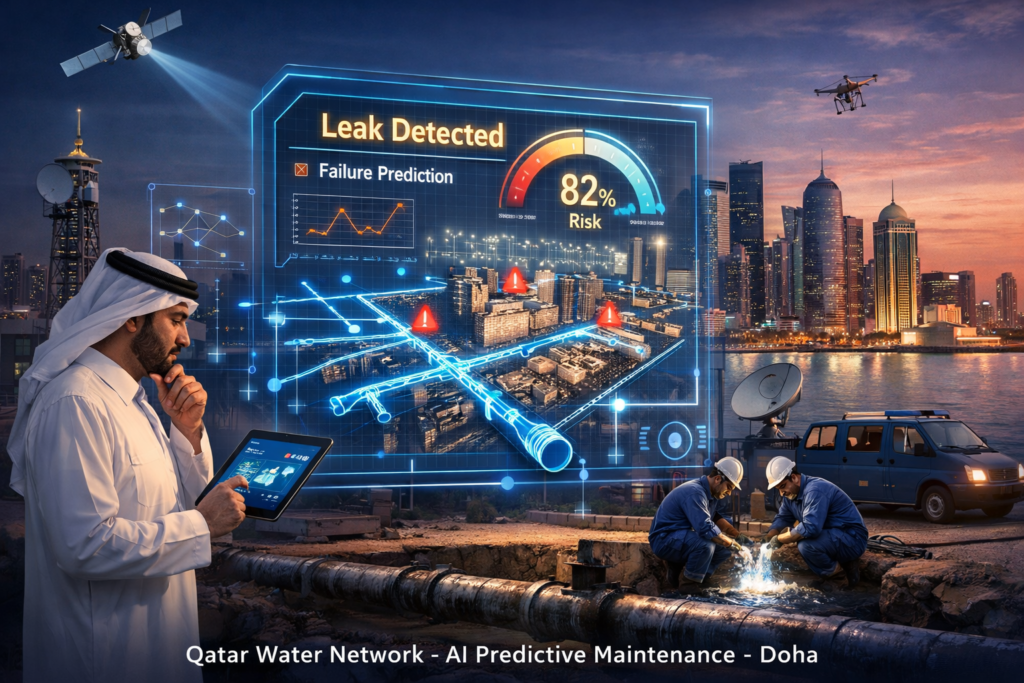
In Doha, reliability across water, power, and smart infrastructure remains a clear priority. Predictive models can help identify anomalies earlier in pumps, meters, valves, and networked field assets.
This is especially useful in environments where manual inspections are expensive, distributed assets are difficult to monitor continuously, and governance expectations are high.
Where AI Predictive Maintenance Delivers ROI First
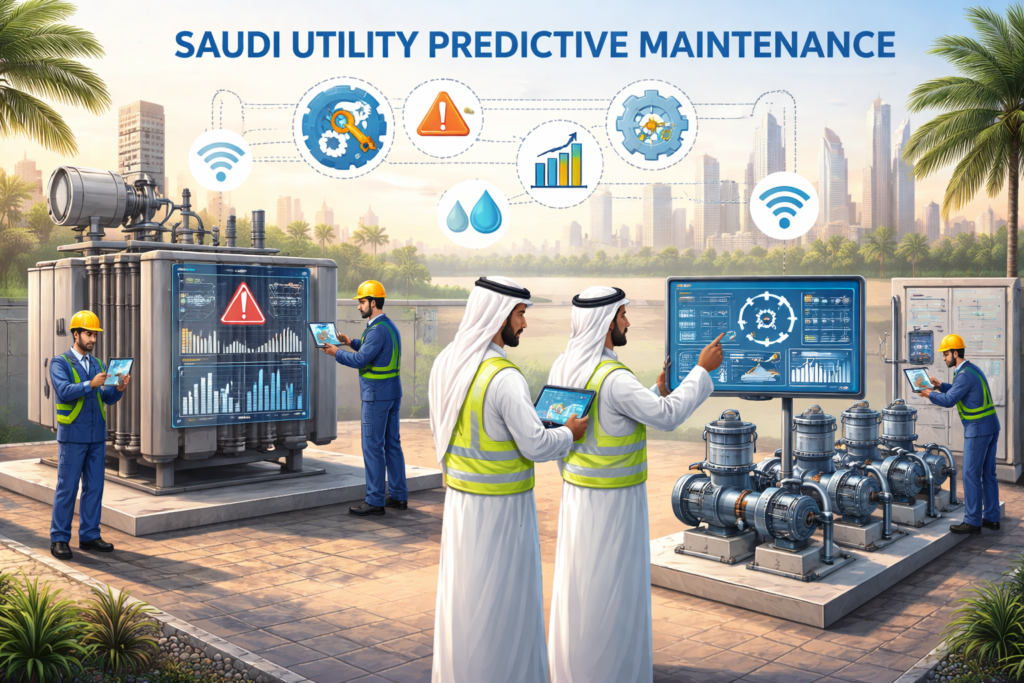
Utilities: transformers, pumps, substations, meters, and water networks
Utilities often see the fastest return where equipment is both costly to fail and difficult to inspect manually.
Common high-value use cases include
Transformer overheating detection
Pump cavitation and vibration anomalies
Substation behavior monitoring
Smart-meter anomaly detection
Pressure instability across water networks
These asset classes are strong starting points because even one avoided failure can justify a pilot.
Transport and fleet: buses, trucks, municipal fleets, and rail assets
For fleet and rail operators, the quickest wins often come from identifying wear patterns before they become roadside or in-service incidents.
Early indicators may include.
Brake wear signals
Battery-health drift
Cooling-system issues
Engine anomalies
Route-linked equipment stress
In practice, this improves maintenance planning and reduces disruption across daily operations.
Other strong-fit sectors across the GCC
The value is not limited to utilities and transport. Predictive maintenance also fits government infrastructure, retail logistics, regulated facilities, and public assets where uptime matters.
A Riyadh-based enterprise campus may focus on critical facility continuity. A Doha operator may care more about smart-meter monitoring and controlled cloud deployment. Different sectors have different priorities, but the same principle applies: the more expensive the failure, the stronger the business case.
What Data, Sensors, and Systems Are Required
Core sensor and telemetry inputs
Strong results depend on usable data, not just advanced models. Many operators can start with signals they already collect rather than launching a full sensor overhaul.
Useful inputs often include.
Vibration
Temperature
Pressure
Fuel consumption
Battery behavior
Runtime data
Fault codes
Maintenance history
The smartest approach is to begin with existing telemetry from SCADA, telematics, BMS, meters, or onboard systems, then fill critical gaps only where the asset case justifies it.
System stack: IoT, CMMS, EAM, telematics, and SCADA
A practical deployment usually connects several systems into one workflow.
| System | Role in predictive maintenance |
|---|---|
| IoT or telemetry platform | Collects and streams asset data |
| CMMS or EAM | Connects predictions to work orders and maintenance planning |
| SCADA or telematics | Supplies operational and field signals |
| Analytics layer | Detects patterns, anomalies, and failure risk |
Teams that also need executive visibility can connect predictive maintenance outputs with business intelligence services or extend workflows through web development services.
Why bilingual dashboards matter in GCC operations
In many GCC environments, adoption improves when the platform works comfortably in both Arabic and English. That matters on the ground.
Technicians, planners, supervisors, and executives may not all prefer the same working language. Bilingual dashboards reduce friction, speed up exception handling, and make model-driven alerts easier to trust during real incidents.
GCC Compliance, Governance, and Data Residency Considerations
Saudi Arabia.
Saudi deployments should be designed with clear rules around access, storage, and review. For many buyers, that means mapping data flows carefully and documenting how model outputs are monitored by humans.
The goal is not simply to tick a compliance box. It is to make sure the solution can stand up to enterprise scrutiny and support regulated or sensitive operating environments.
UAE.
In the UAE, buyers often look beyond model performance. They want to know how the platform supports continuity, secure access, and operational trust.
That is why hosting design, audit logs, identity controls, and incident visibility tend to become part of the buying decision early, not late.
Qatar.
In Qatar, infrastructure sensitivity often shapes architecture choices from the start. Operators may need clearer boundaries around cloud design, cybersecurity controls, and operating procedures.
From a practical point of view, the more sensitive the environment, the more important controlled deployment becomes.
How to Deploy AI Predictive Maintenance Across GCC Operations
Start with one asset class
Begin with a high-value asset group that has enough historical data and a clear cost of failure.
Good pilot candidates include
Utility pumps
Transformer groups
Fleet segments
Rail subsystems
Smart-meter clusters
Starting narrow gives teams a cleaner way to test value without creating an overly complex rollout.
Design the hosting and governance model early
Before deployment, define.
Where data will be stored
Who can access it
How alerts will be reviewed
How cross-border flows will be handled
What audit evidence needs to be retained
Many GCC teams prefer a regional cloud strategy when they need lower latency and stronger residency confidence. Depending on requirements, this can include options such as AWS Bahrain, Azure UAE Central, or Google Cloud Doha.
Build for human oversight, not just automation
Predictive maintenance works best when engineers and operations teams stay in the loop. Alerts should support better judgment, not replace it blindly.
This is especially important in utilities, transport, and public infrastructure where service decisions have operational and reputational consequences.
Scale from pilot to multi-site operations
Once the first pilot shows fewer failures, better planning, or lower maintenance waste, scale by asset class and location.
For organizations expanding across Riyadh, Dubai, Abu Dhabi, and Doha, rollout success usually depends on repeatable workflows, strong integration, and role-based visibility for both technical and management teams.
Field execution can also be supported through mobile app development services where technicians need faster access to alerts, inspections, and work-order actions.
How to Choose the Right GCC-Fit Vendor or Platform
A strong vendor should not only show model performance. They should also prove that the platform fits GCC operational reality.
Ask about model quality and workflow fit
Look for answers to questions such as.
How is prediction accuracy measured?
How are false positives handled?
Can alerts connect directly to CMMS or EAM workflows?
How quickly can teams act on the output?
A polished dashboard is not enough if the system does not fit how maintenance teams actually work.
Ask about hosting, residency, and auditability
Buyers should also ask.
Where are production data, logs, and backups stored?
How are cross-border transfers controlled?
What retention policies apply?
What evidence is available for internal or regulator-facing review?
These questions matter across Saudi Arabia, the UAE, and Qatar, especially in regulated or infrastructure-heavy sectors.
Ask about localization and regional support
Localization can shape adoption as much as technical capability. Ask whether the vendor offers.
Arabic-English dashboards
Regional implementation support
Experience with GCC enterprise environments
Integration maturity across existing systems
Organizations comparing enterprise software services, Laravel development services, or Next.js development services should prioritize workflow integration, governance readiness, and operational usability over surface-level design.
For larger rollouts spanning Saudi Arabia, the UAE, and Qatar, it also helps to start early with a regional implementation conversation through Mak It Solutions contact.

Final Thoughts
AI predictive maintenance creates the most value in the GCC when it does two things at once: improves uptime and fits local governance expectations.
For utilities, fleet operators, and rail teams in Saudi Arabia, the UAE, and Qatar, the winning approach is usually not the most complex model. It is the one that combines strong asset data, practical workflows, bilingual usability, and a deployment architecture that decision-makers can trust.
If you are evaluating AI predictive maintenance for utilities, transport, or smart infrastructure, the next step is to map the right pilot, hosting model, and integration path before scaling across operations.
FAQs
Q : Is AI predictive maintenance suitable for Saudi utility assets like transformers and water pumps?
A : Yes. It is especially useful for assets that are expensive to inspect, costly to fail, or critical to service continuity. In Saudi Arabia, transformers, pumps, and substation equipment are often strong pilot candidates because they produce usable operational data and have a clear maintenance impact.
Q : How do UAE fleet operators connect telematics with predictive maintenance software?
A : Most projects begin by linking telematics feeds, maintenance records, and fault-code history into one workflow. That allows operators to detect patterns in fuel use, temperature, battery behavior, and route-related stress before a major breakdown happens.
Q : Can Qatar infrastructure operators use predictive maintenance for water and smart-meter networks?
A : Yes. Predictive models can help Qatar operators monitor pumps, valves, pressure zones, and smart-meter behavior to catch anomalies earlier. This is especially helpful when assets are distributed and manual inspection cycles are time-consuming or expensive.
Q : Do GCC enterprises need Arabic dashboards for predictive maintenance adoption?
A : In many cases, yes. English-only platforms may work for technical leadership, but bilingual dashboards improve adoption across supervisors, planners, field teams, and operations stakeholders who need quick decisions during incidents.
Q : What should Riyadh, Dubai, and Doha buyers ask vendors about data residency and hosting?
A : They should ask where production data, backups, and logs are stored, whether regional hosting is available, how cross-border transfers are controlled, and how audit trails are preserved. Those answers are often just as important as the model itself.
[…] behind it: live integrations, clear governance, bilingual usability, and hosting decisions that fit GCC […]