


AI Agents for SMEs: GCC Cost-Saving Guide
AI Agents for SMEs: GCC Cost-Saving Guide
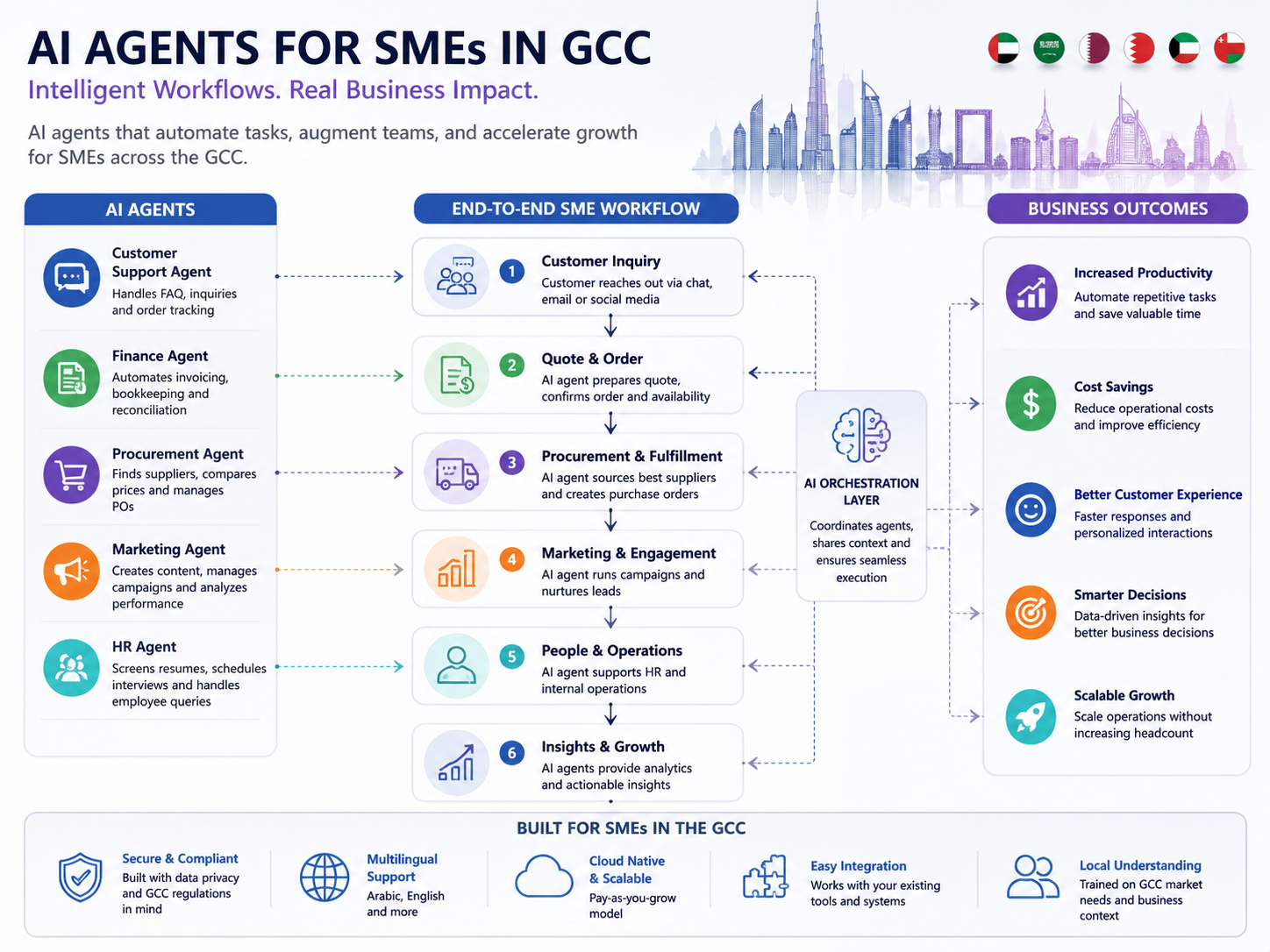
AI Agents for SMEs: GCC Cost-Saving Guide
GCC SMEs are under pressure to grow faster, serve customers in Arabic and English, and control costs without building large teams. AI agents for SMEs help by handling repetitive tasks, connecting business tools, and supporting staff with faster, more reliable workflows.
In simple terms, AI agents for SMEs are intelligent software assistants that can understand a task, check relevant systems, take approved actions, and escalate sensitive decisions to humans. For businesses in Saudi Arabia, the UAE, and Qatar, they can reduce manual work, improve bilingual service, and support safer digital growth when built with the right governance.
What Are AI Agents for SMEs?
AI agents for SMEs are software-based assistants that can plan, reason, use tools, and complete business workflows under human supervision. They can connect with CRM systems, email, WhatsApp, ERP tools, accounting platforms, and internal dashboards.
For GCC businesses, this matters because automation must fit local realities. A Saudi fintech, a Dubai e-commerce brand, and a Doha logistics company may all need AI, but their approval flows, Arabic UX, data expectations, and compliance needs will not be identical.
How AI Agents Differ From Basic Chatbots
A chatbot mainly answers questions. An AI agent can go further: it can understand a goal, check information, update a record, send a follow-up, summarize a document, or escalate a case.
For example, a chatbot can answer, “Where is my order?” An AI agent can check the order system, identify the delay, notify the logistics team, update the customer in Arabic or English, and create a support note.
Why GCC SMEs Are Moving Toward Agentic AI
Across the GCC, digital transformation is no longer limited to large enterprises. Saudi Vision 2030 continues to push private-sector growth and digital services, while the UAE’s TDRA has launched AI initiatives to support digital government enablement. Qatar Central Bank also lists Artificial Intelligence Guidelines under its fintech resources, which makes responsible AI adoption especially relevant for financial workflows.
For SMEs, the opportunity is practical: fewer manual handoffs, faster replies, cleaner reporting, and better use of small teams.
Where Multi-Agent Systems Fit
A multi-agent system works like a small digital team. One agent may qualify leads, another may prepare invoices, another may monitor support tickets, and another may create management reports.
This approach is especially useful for SMEs exploring Arabic GenAI multi-agent systems for GCC growth, where Arabic-first support, workflow automation, and human approval need to work together.
How AI Agents for SMEs Reduce Costs
AI agents reduce costs by cutting repetitive work, improving response speed, and helping lean teams handle more customers without immediately adding new roles.
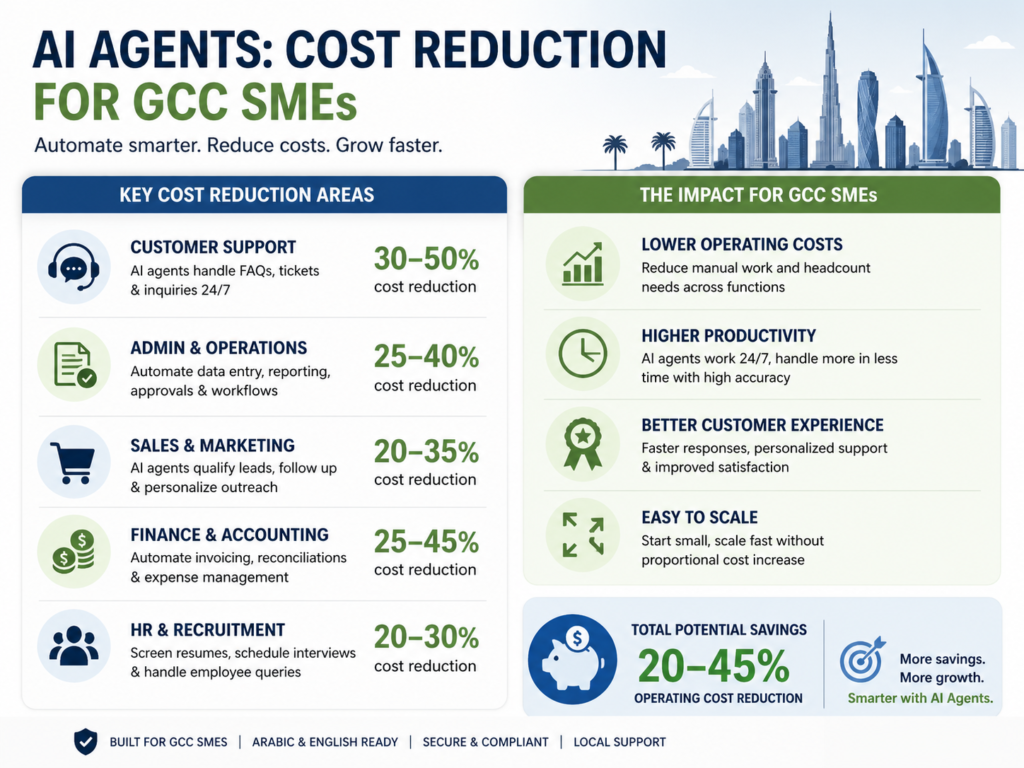
Automating Admin and Back-Office Work
AI agents can process documents, schedule appointments, update CRM records, send invoice reminders, prepare internal reports, and route approvals.
A Riyadh services firm, for example, can reduce manual follow-up by letting an AI agent remind clients, update payment status, and notify finance only when human action is needed.
Improving Response Speed in Arabic and English
Many GCC customers expect quick, polite, bilingual service. AI agents can answer common questions in Arabic and English, summarize past conversations, and escalate sensitive cases to staff.
This is useful for e-commerce, healthcare, logistics, hospitality, retail, and government-service suppliers across Saudi Arabia, the UAE, and Qatar.
Reducing Dependency on Extra Hires
AI does not replace business judgment. It helps teams scale routine work.
A Dubai e-commerce brand can use AI agents for order updates, returns triage, product questions, and abandoned-cart follow-ups while its team focuses on growth, partnerships, and customer experience.
Best AI Agent Workflows for Saudi, UAE, and Qatar SMEs
The best place to start is usually one workflow with high volume, clear rules, and measurable ROI.
Sales Follow-Up and Lead Qualification
An AI agent can qualify leads, score interest, send follow-ups, update CRM fields, and alert sales teams when a buyer is ready.
For SMEs improving their digital customer journey, this can connect naturally with web development services and SEO services.
Finance, Invoice, and Procurement Workflows
Finance agents can match invoices with purchase orders, chase missing documents, route approvals, and flag exceptions.
For Qatar-based SMEs, regional cloud planning may also matter. Google Cloud says its Doha region provides low-latency, highly available cloud services and launched with three zones, which can support architecture and data-residency discussions.
HR, Recruitment, and Customer Support
AI agents can screen CVs, answer employee FAQs, prepare onboarding checklists, triage support tickets, and recommend escalation.
For customer-facing products, SMEs may pair AI agents with mobile app development services or React Native development.
GCC Compliance, Data Residency, and Trust Factors
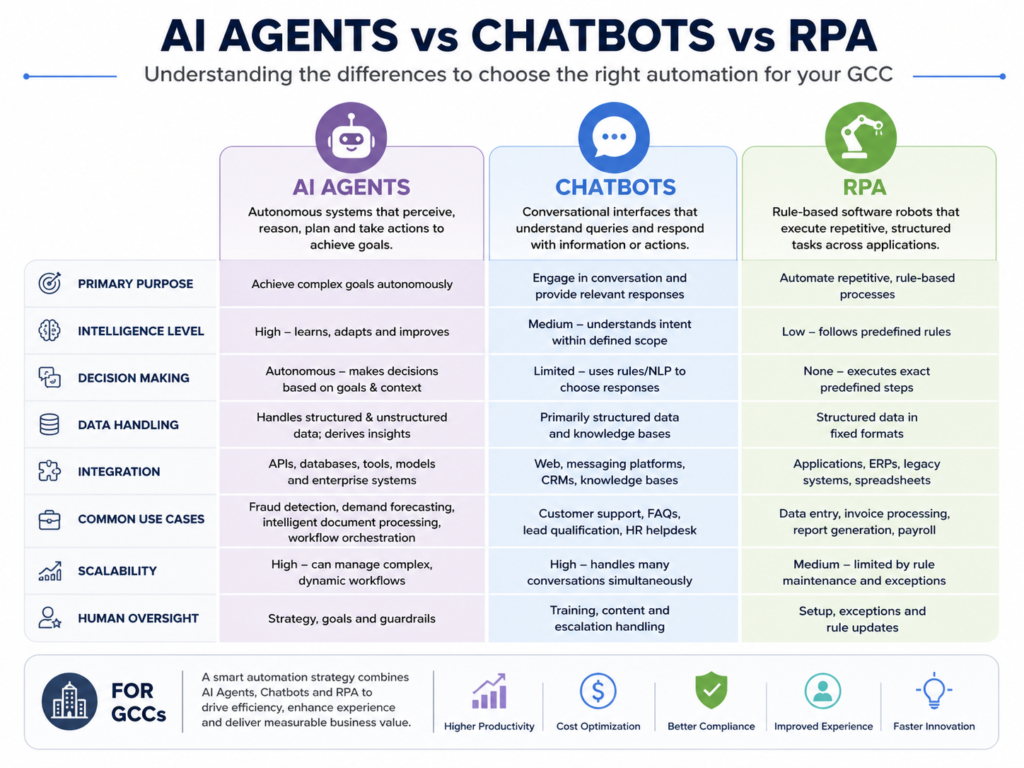
AI automation should be designed with governance from day one. That means access controls, audit logs, human approval, retention rules, and clear responsibility.
Saudi Arabia.
For Saudi finance and fintech workflows, SAMA is a key trust signal. SAMA states that financial institutions must protect customers’ personal data, preserve its security and integrity, and use it only for the purposes for which it was collected.
In practice, a Riyadh fintech should keep human approval for credit decisions, refunds, account changes, and regulated customer communications.
UAE.
In the UAE, SMEs should consider TDRA’s digital-government direction, ADGM or DIFC expectations where relevant, and enterprise controls such as role-based access.
For hosting discussions, Microsoft’s Azure region list includes UAE Central in Abu Dhabi and UAE North in Dubai.
Qatar.
For Qatar, QCB’s AI direction is important for financial firms. QCB issued Artificial Intelligence Guidelines for the financial sector, with a focus on responsible AI use and governance.
A Doha fintech or SME working with regulated data should document model use, approvals, access, vendor responsibilities, and escalation rules.
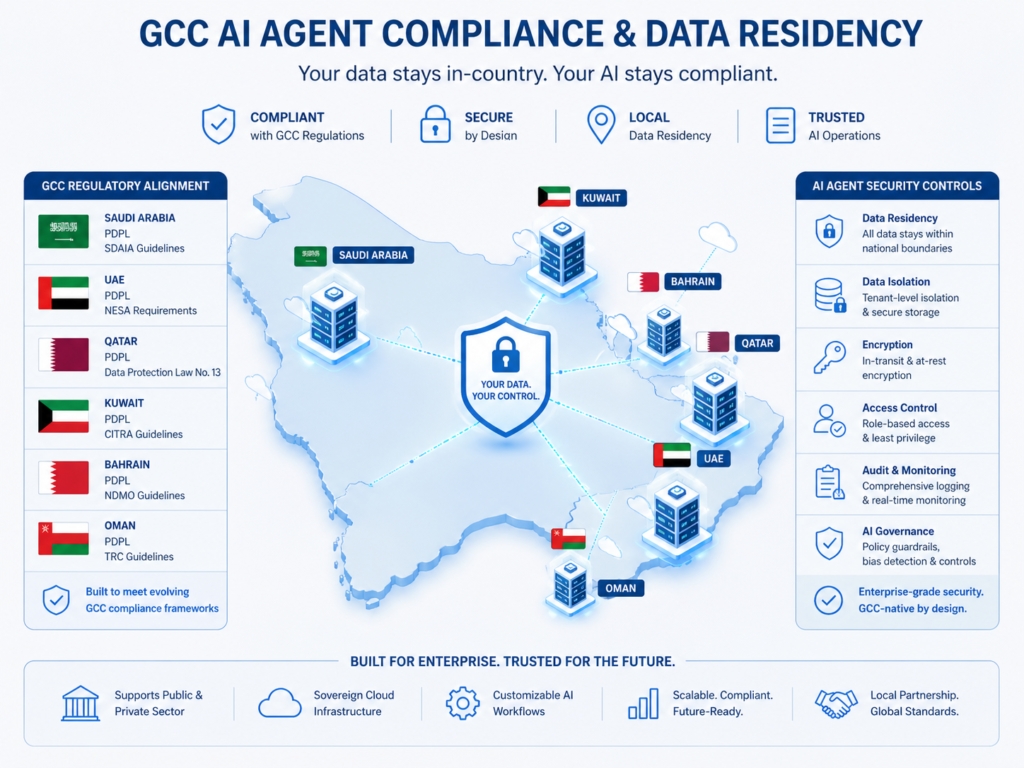
AI Agents vs Chatbots vs RPA for GCC Businesses
Choosing the right tool depends on the workflow.
| Tool | Best For | Limitation |
|---|---|---|
| Chatbot | FAQs, opening hours, simple product questions | Limited when tasks require system updates or judgment |
| RPA | Rule-based, repetitive tasks | Less flexible when documents or customer requests vary |
| AI Agent | Multi-step workflows, document understanding, tool use | Needs governance, monitoring, and human approval |
When a Chatbot Is Enough
A chatbot is enough for simple FAQs, opening hours, product questions, and low-risk website support. It is often the fastest first step for small teams.
When RPA Is Useful but Limited
RPA works well for predictable tasks, such as copying data between systems. However, it struggles when documents vary, customers ask complex questions, or decisions need context.
When AI Agents Create Stronger ROI
AI agents create stronger ROI when workflows require reasoning, document understanding, tool use, and multi-step decisions. This is where human-in-the-loop AI workflows become essential.
A Practical Implementation Roadmap
Start small. A well-designed first workflow is better than a huge AI project with unclear ownership.
Pick One High-Value Workflow
Begin with customer support, invoice processing, or sales follow-up. Choose a workflow where time saved, error reduction, and conversion impact are easy to measure.
Add Human Approval for Sensitive Actions
Finance, HR, legal, refunds, healthcare, and regulated industries should keep humans in control. An AI agent may prepare a recommendation, but a person should approve final decisions.
Measure ROI Clearly
Track manual hours saved, response time, error reduction, lead conversion, customer satisfaction, and escalation quality.
Teams can also connect results to business intelligence services for clearer reporting.
Choosing the Right AI Agent Partner in the GCC
The right partner should understand both technology and local business realities.
Look for Arabic UX and Bilingual Workflow Support
Choose a partner that understands Arabic-first journeys, English business communication, Gulf dialect sensitivity, and culturally respectful customer support.
Check Cloud Region and Data Residency Options
Ask about regional hosting options such as AWS Bahrain, AWS UAE, Azure UAE, and GCP Doha. AWS documentation lists Middle East regions in Bahrain and the UAE, each with three Availability Zones.
Ask About Integrations, Security, and Audit Logs
Your partner should support CRM, ERP, WhatsApp, email, accounting tools, permissions, logging, and role-based access.
Mak It Solutions’ Python development services are especially relevant for custom automation, integrations, and AI workflow development.
Concluding Remarks
AI agents for SMEs are becoming a practical way for Saudi, UAE, and Qatar businesses to reduce manual work, improve bilingual service, and scale operations with better control.
The safest path is to start with one clear workflow, add human approval where it matters, and measure ROI across time, cost, and service quality. Ready to explore AI agents for SMEs in the GCC? Contact Mak It Solutions to review your workflows and build a GCC-ready AI automation strategy around your business goals.( Click Here’s )
FAQs
Q : Are AI agents for SMEs suitable for Saudi businesses under Vision 2030?
A : Yes. AI agents for SMEs can support Saudi businesses by improving productivity, service quality, and digital workflows. SMEs in Riyadh, Jeddah, and Dammam can use them for sales, finance, HR, and customer support, as long as governance and human approval are built in.
Q : Can UAE SMEs use AI agents for sales and customer support?
A : Yes. UAE SMEs in Dubai, Abu Dhabi, and Sharjah can use AI agents to qualify leads, send follow-ups, answer product questions, route tickets, and update CRM records. Regulated sectors should add access controls, audit logs, and escalation rules.
Q : What AI agent workflows are useful for Doha-based SMEs?
A : Doha-based SMEs can use AI agents for invoice processing, procurement follow-ups, customer support, HR onboarding, logistics updates, and sales reporting. For financial workflows, Qatar businesses should pay close attention to QCB-related governance expectations.
Q : Do GCC SMEs need Arabic-first AI agents?
A : In many cases, yes. GCC customers often switch between Arabic and English, so service quality depends on tone, clarity, and cultural fit. Arabic-first AI agents can support natural responses while escalating emotional, legal, financial, or complaint-heavy cases to humans.
Q : How much control should humans keep over AI agent decisions?
A : Humans should keep final control over sensitive decisions. AI agents can prepare recommendations, collect documents, summarize cases, and flag risks, but people should approve refunds, hiring decisions, credit actions, legal responses, medical guidance, and regulated customer communications.