


Arabic GenAI Multi-Agent Systems for GCC Growth
Arabic GenAI Multi-Agent Systems for GCC Growth

Arabic GenAI Multi-Agent Systems for GCC Growth
Arabic GenAI multi-agent systems are becoming a practical way for GCC enterprises to automate Arabic customer service, internal workflows, compliance checks, and decision support. For organizations in Saudi Arabia, the UAE, and Qatar, the strongest results come from Arabic-first design, secure orchestration, approved knowledge sources, and human oversight.
In simple terms, these systems use several AI agents that work together instead of relying on one chatbot. One agent may understand the user’s Arabic request, another may retrieve company policy, another may check compliance, and another may escalate sensitive cases to a human reviewer.
Why Arabic GenAI Multi-Agent Systems Matter in the GCC
GCC enterprises are moving beyond basic chatbots. Today, Arabic GenAI multi-agent systems can route customer requests, summarize documents, check policies, support employees, and flag risky cases before they create problems.
For Arabic-speaking users in Riyadh, Dubai, Abu Dhabi, Doha, and Jeddah, AI must understand more than formal Arabic. It needs to handle Gulf dialects, mixed Arabic-English business phrases, right-to-left interfaces, and regulated workflows.
In practice, successful AI adoption is not just about choosing a powerful model. It depends on orchestration, retrieval-augmented generation for Arabic content, audit logs, access controls, and responsible AI governance.
What Are Arabic GenAI Multi-Agent Systems?
Arabic GenAI multi-agent systems are AI setups where multiple agents work together, with each agent focused on a specific role.
For example.
A customer support agent understands the Arabic query.
A retrieval agent searches approved company documents.
A compliance agent checks policy or regulatory risk.
A workflow agent prepares the next action.
A human escalation layer reviews sensitive cases.
This makes the system more useful for enterprise automation than a simple chatbot.
How GenAI, Arabic LLMs, and AI Agents Work Together
Arabic large language models generate natural responses. AI agents, however, help move work through real business processes.
A Riyadh fintech company, for example, may use an AI agent to read a customer request, check eligibility rules, retrieve internal policy, and prepare a draft response for review. The final decision can still stay with trained staff.
Why Multi-Agent Systems Are Different from Basic Chatbots
A chatbot usually answers a conversation. A multi-agent system coordinates tasks across tools, systems, data, approvals, and people.
That is why it is more valuable for enterprise workflows, especially when connected to custom software and SaaS development.
Why Arabic-First Design Matters for GCC Users
Arabic UX must support Modern Standard Arabic, Gulf dialects, right-to-left layouts, and Arabic-English business language.
Poor localization can quickly damage trust, especially in banking, healthcare, government, logistics, and e-commerce. A user who writes in a Saudi, Emirati, or Qatari style should not feel like the system was built only for generic English prompts.
Key GCC Use Cases for Arabic GenAI Multi-Agent Systems
Arabic AI agents can support many enterprise workflows across Saudi Arabia, the UAE, and Qatar. The best starting point is usually a high-volume process where staff already follow repeatable rules.
Saudi Use Cases.
In Saudi Arabia, Arabic AI agents can support digital service journeys, identity-related workflows, banking service requests, and internal government automation.
A Riyadh fintech startup may use AI agents to classify support tickets, summarize customer complaints, and route sensitive cases to human reviewers. For financial services, governance matters because SAMA operates a regulatory sandbox for fintech experimentation in Saudi Arabia.
UAE Use Cases.
In Dubai and Abu Dhabi, enterprises can use Arabic AI agents for onboarding, e-commerce support, payment queries, document requests, and UAE Pass-related service journeys.
UAE PASS is described as the UAE’s secure national digital identity for citizens, residents, and visitors, which makes identity-aware workflows especially relevant for digital services.
For app-heavy projects, AI workflows can also be paired with mobile app development services.
Qatar Use Cases.
In Doha, banks, SMEs, and public-facing organizations can use Arabic agents for onboarding, service triage, document support, and internal knowledge search.
Qatar Central Bank has issued an AI Guideline for the financial sector, so banking AI use cases should be planned with governance, auditability, and risk controls from the start.
Multi-Agent AI Architecture for GCC Enterprises
A strong enterprise AI setup needs more than a model and a chat window. It needs a controlled architecture that connects users, agents, data, approvals, and monitoring.
Arabic GenAI Multi-Agent Systems Architecture
A practical architecture usually includes.
User interface: Arabic web, mobile, or internal dashboard.
Orchestration layer: Routes tasks between agents.
Arabic LLM layer: Generates responses and summaries.
RAG knowledge base: Pulls answers from approved content.
Compliance and security layer: Checks policy, permissions, and risk.
Human review layer: Handles sensitive or uncertain cases.
Audit logs: Records actions for monitoring and improvement.
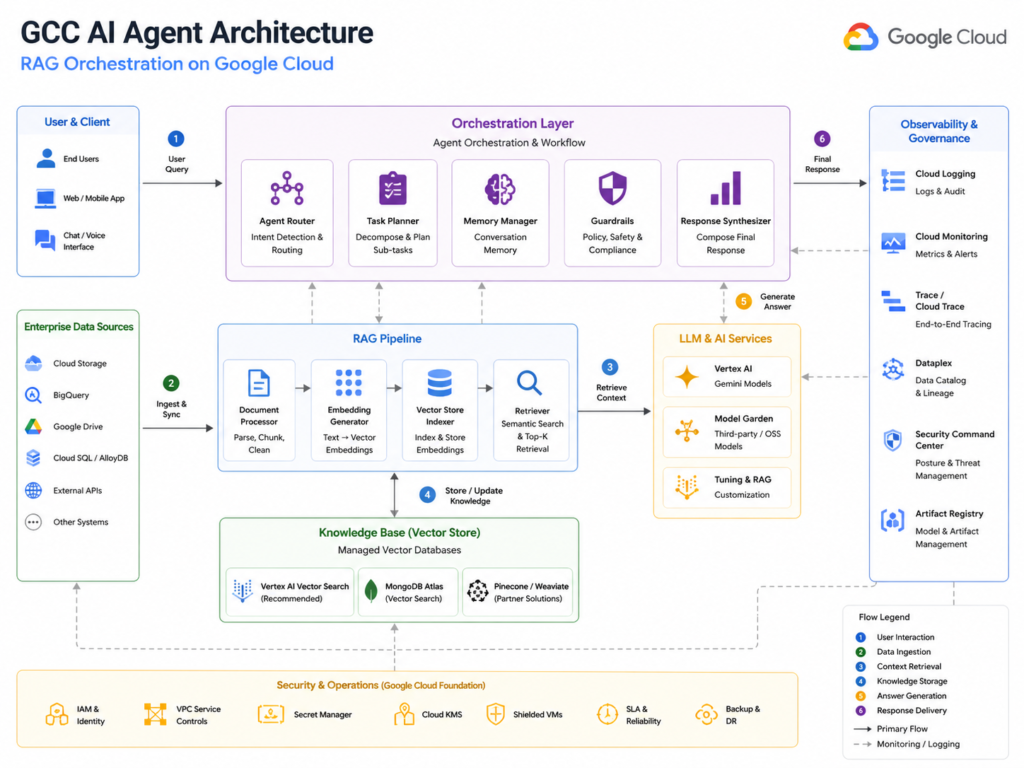
The AI Orchestration Layer
The orchestration layer decides which agent handles each task.
For example, a customer complaint may first go to a sentiment agent, then a policy agent, then a compliance agent, and finally a human reviewer if the case is sensitive.
Retrieval-Augmented Generation for Arabic Enterprise Knowledge
Retrieval-augmented generation helps ground answers in approved company content instead of relying only on model memory.
This is essential for Arabic HR policies, banking FAQs, logistics SOPs, internal IT knowledge, and government service rules. It also reduces the risk of confident but unsupported answers.
Human Escalation, Audit Logs, and Responsible AI Controls
High-risk cases should not be fully automated.
Banking, healthcare, legal, and public-sector workflows need review queues, audit trails, permission controls, and clear escalation rules. Mak It Solutions also explains this approach in its guide to human-in-the-loop AI workflows.
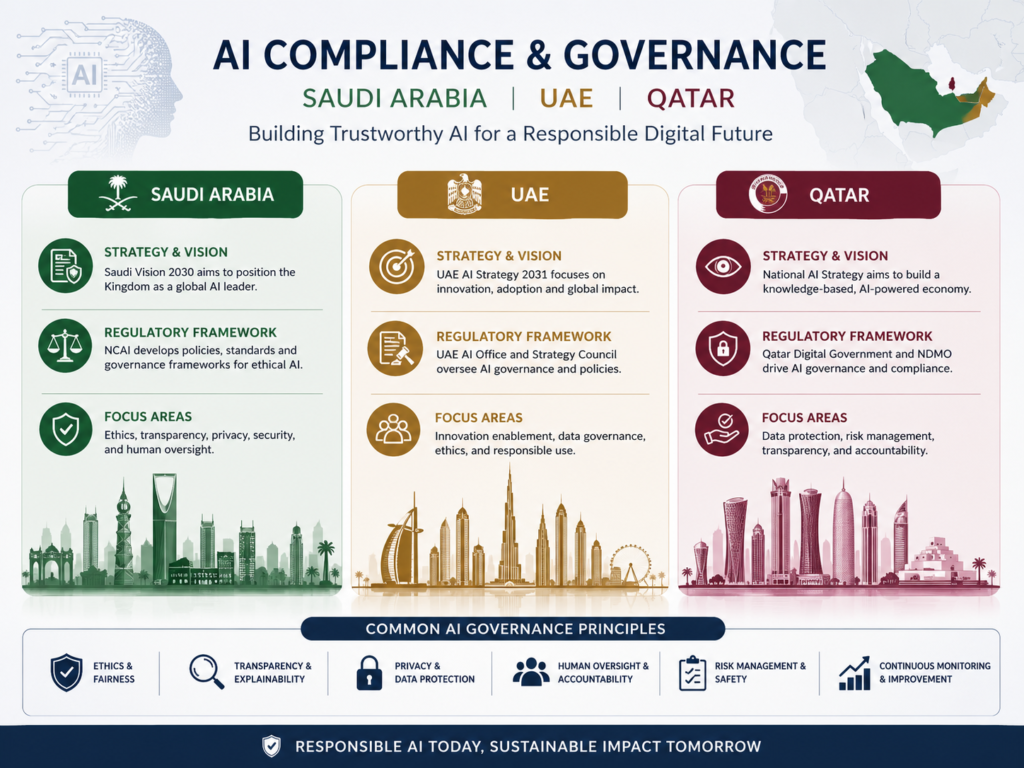
GCC Compliance, Data Residency, and AI Governance
Compliance should be part of the design from day one, not something added after the pilot works.
Saudi Compliance Signals: SDAIA, NDMO, SAMA, and PDPL Alignment
Saudi projects should consider SDAIA AI and data expectations, NDMO data governance, SAMA financial controls, and PDPL obligations.
SDAIA describes itself as Saudi Arabia’s competent authority concerned with data and AI, including big data.
UAE Compliance Signals: TDRA, DIFC, ADGM, CBUAE, and Data Protection
UAE deployments should consider TDRA digital trust expectations, DIFC and ADGM data rules, and CBUAE controls for financial services.
Cloud planning also matters. Microsoft lists UAE Central in Abu Dhabi and UAE North in Dubai, which can help UAE teams evaluate local architecture and disaster-recovery options.
Qatar Compliance Signals: QCB, MCIT, QFC, and Financial AI Governance
Qatar projects should assess QCB requirements, MCIT digital policies, and QFC expectations where relevant.
For cloud architecture, Google Cloud’s Doha region can support lower-latency and in-country planning for Qatar workloads.
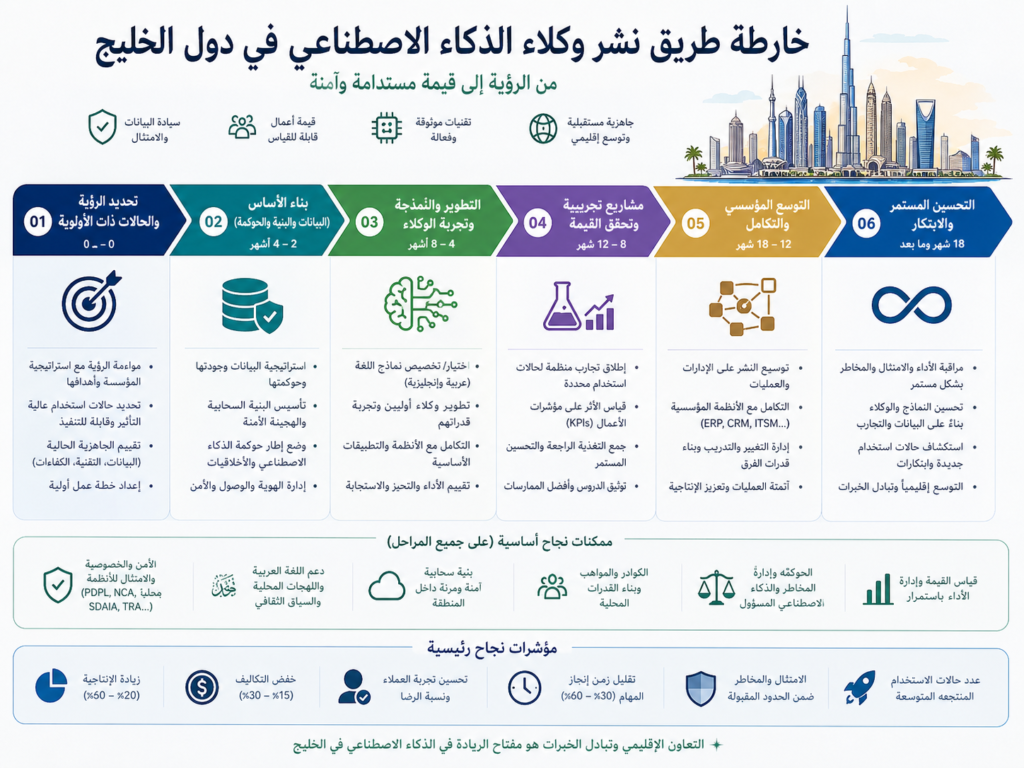
Deployment Roadmap for Arabic GenAI Multi-Agent Systems
A safe rollout should start small, prove value, and expand only after Arabic accuracy, governance, and integrations are tested.
Identify GCC Workflows Suitable for AI Agents
Start with repetitive, high-volume workflows such as.
Customer support
Policy search
Invoice triage
Employee helpdesk
Onboarding
Claims review
Document summarization
A Dubai e-commerce brand may begin with Arabic order-status automation before expanding to returns, refunds, and loyalty support.
Choose Cloud, Data Residency, and Integration Requirements
Decide where data is processed and stored.
GCC teams may compare AWS Bahrain, Azure UAE, Google Cloud Doha, or other approved options depending on latency, residency, contracts, and industry rules. Google Cloud opened its Doha region for Qatar workloads, while Azure lists UAE regions for Abu Dhabi and Dubai.
Also map integrations early.
CRM
ERP
Payment systems
Identity systems
Ticketing tools
Internal knowledge bases
Analytics dashboards
Test Arabic Accuracy, Dialects, Escalation, and Compliance Controls
Test the system with real GCC language patterns.
This should include formal Arabic, Najdi Arabic, Emirati Arabic, Qatari Arabic, Arabizi, and mixed Arabic-English queries. Teams should also validate escalation paths, hallucination handling, permission controls, audit logs, and human review workflows before launch.
Cost, Timeline, and Vendor Evaluation in Saudi, UAE, and Qatar
The cost of Arabic GenAI multi-agent systems depends on complexity, data readiness, integrations, governance needs, and the number of workflows being automated.
A simple FAQ pilot is very different from a regulated banking workflow connected to CRM, identity, payment, and compliance systems.
What Affects Cost?
Common cost drivers include.
Data quality and cleanup
Arabic knowledge-base preparation
Model selection
RAG setup
Agent orchestration
CRM, ERP, and API integrations
Security and access control
Human review workflows
Compliance documentation
Testing across dialects
Saudi vs UAE vs Qatar Deployment Considerations
Saudi projects often emphasize SAMA, SDAIA, NDMO, PDPL, and Vision 2030 alignment.
UAE projects may prioritize UAE Pass, TDRA expectations, DIFC or ADGM data rules, CBUAE considerations, and fast customer experience.
Qatar projects often focus on QCB governance, MCIT policies, QFC requirements, and Doha-based cloud planning.
How to Compare Arabic GenAI Vendors and Implementation Partners
Choose partners who understand Arabic UX, secure backend engineering, retrieval-augmented generation, AI orchestration, and GCC compliance.
If the AI system needs a user-facing app or dashboard, review their experience in front-end development, PHP web development, and React Native development.
Best Practices for Safe Arabic AI Agent Adoption in the GCC
Arabic AI agents can improve speed and service quality, but they need careful control.
Design for Arabic UX, Gulf Dialects, and Mixed Arabic-English Queries
Use Arabic-first prompts, RTL interfaces, local examples, and bilingual test sets.
A Doha SME using a Qatar-based cloud region may still need strong dialect testing for Qatari Arabic service requests. A Saudi fintech may need Najdi and formal Arabic coverage. A UAE retail brand may need Arabic-English product and payment phrases.
Use Human-in-the-Loop Review for Sensitive Workflows
Keep humans in sensitive decisions, especially in finance, healthcare, legal, and public services.
A Riyadh fintech should route credit, fraud, and complaint cases to trained reviewers. A hospital support workflow should avoid giving final medical decisions. A government-service agent should guide users without overriding approved procedures.
Monitor Hallucinations, Bias, Security, and Cross-Border Data Risk
Monitoring should continue after launch.
Review logs, update knowledge bases, restrict sensitive data access, monitor cross-border transfer risk, and measure whether the system is improving over time.
Concluding Remarks
Arabic GenAI multi-agent systems can help GCC enterprises automate faster without losing trust.
The winning approach is not just “add AI.” It combines Arabic UX, secure orchestration, approved knowledge sources, regional cloud planning, compliance alignment, and human oversight.
For businesses in Saudi Arabia, the UAE, and Qatar, Arabic GenAI multi-agent systems are becoming more than a technology upgrade. They are a smarter operating model for Arabic-first digital transformation.
Ready to explore Arabic AI agents for your GCC business? Contact Mak It Solutions to plan a secure, Arabic-first AI roadmap for Saudi, UAE, or Qatar operations. You can also explore website design services, SEO services, or contact the team for a custom GCC strategy.
FAQs
Q : Are Arabic GenAI multi-agent systems suitable for Saudi government services?
A : Yes, Arabic GenAI multi-agent systems can support Saudi government services when they are designed with strict human oversight, Arabic UX, data controls, and audit trails. They can help users navigate service information, summarize documents, and route requests. Sensitive decisions should remain governed by approved rules and human review.
Q : Can UAE companies integrate Arabic AI agents with UAE Pass?
A : Yes, UAE companies can design Arabic AI agents around UAE Pass-enabled journeys for onboarding, document requests, service access, and customer verification flows. The AI agent should not replace secure identity controls. It should guide users, explain next steps, and connect approved systems.
Q : What should Qatar banks consider before using AI agents?
A : Qatar banks should focus on QCB expectations, customer data protection, explainability, escalation, and auditability. AI can help with service triage, FAQ support, document search, and employee assistance, but high-risk financial decisions need careful governance.
Q : Do GCC enterprises need local data residency for GenAI systems?
A : Not always. However, GCC enterprises in banking, government, healthcare, and critical services should evaluate local or regional data residency seriously. The right choice depends on regulation, contracts, data sensitivity, and risk appetite.
Q : How do Arabic AI agents handle Gulf dialects and mixed Arabic-English queries?
A : Arabic AI agents handle Gulf dialects best when they are tested with real GCC language patterns. Users may write in Arabic, English, Arabizi, or mixed business phrases. Testing should include formal Arabic, Saudi, Emirati, Qatari, and common Arabic-English service requests.