


Arabic Prompt Library for GCC IT & Sales Teams
Arabic Prompt Library for GCC IT & Sales Teams
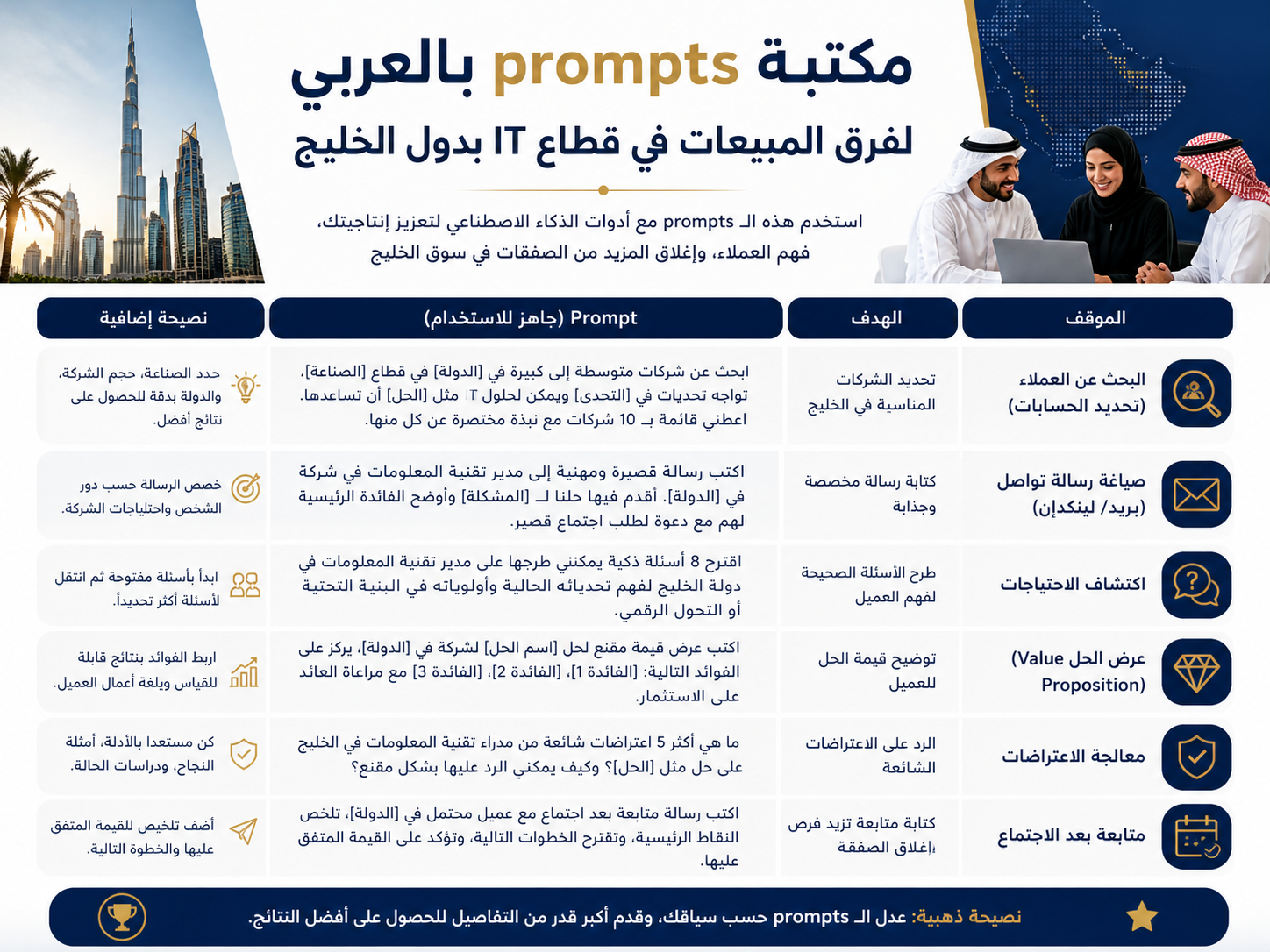
Arabic Prompt Library for GCC IT & Sales Teams
An Arabic prompt library helps GCC IT support and sales teams answer tickets, qualify leads, update CRM records, and respond to customers with more consistency. Instead of every agent writing prompts from scratch, teams use approved Arabic and bilingual templates for common workflows.
For companies in Saudi Arabia, the UAE, Qatar, and the wider GCC, the value is practical: faster replies, better Arabic customer experience, cleaner CRM data, and safer AI use.
GCC companies are already using AI across helpdesks, sales, WhatsApp, CRM, and customer experience. But many teams still rely on scattered prompts saved in chat histories, spreadsheets, or personal notes. That creates uneven Arabic tone, inconsistent answers, and unnecessary data risk.
A structured Arabic prompt library solves this by giving teams reusable prompts for ticket classification, troubleshooting, follow-ups, CRM updates, escalation notes, and customer communication.
A 2024 GCC generative AI report surveyed 140 executives across all six GCC countries, showing how seriously regional organizations are evaluating AI adoption.
What Is an Arabic Prompt Library?
An Arabic prompt library is a structured collection of approved AI prompts written for Arabic-first and Arabic-English business workflows.
It helps teams produce consistent replies, summaries, classifications, and next-step recommendations without rewriting instructions every time.
How Prompt Libraries Standardize Daily Work
A prompt library turns repeated tasks into reliable workflows.
Instead of asking each support agent to “summarize this ticket” in a different way, the team can use one approved template. The same applies to sales reps summarizing WhatsApp conversations, updating CRM fields, or drafting polite follow-ups.
For example:
| Team | Common Prompt Use | Output |
|---|---|---|
| IT Support | Classify a helpdesk ticket | Category, urgency, missing info, next step |
| Sales | Summarize a WhatsApp lead | Budget, timeline, need, decision-maker |
| CX | Draft an Arabic reply | Polite customer-ready response |
| Management | Summarize weekly cases | Trends, risks, action items |
For technical teams building these workflows into portals or internal tools, Mak It Solutions’ back-end development services can support secure integrations.
Why Arabic Prompts Matter in the GCC
Arabic customer experience in the GCC is not just translation.
Tone, formality, right-to-left formatting, Gulf-friendly wording, and bilingual handoffs all affect trust. A Saudi customer may expect polished Modern Standard Arabic. A UAE retail buyer may switch between Arabic and English in one WhatsApp thread. A Qatar enterprise client may need a formal Arabic update with clear escalation language.
Good Arabic and bilingual prompts help teams serve these customers without sounding robotic.
Why GCC Companies Need Arabic AI Prompts Now
GCC sales and support teams often handle bilingual, high-volume, time-sensitive conversations. A reusable Arabic prompt library helps teams move faster while keeping tone, terminology, and escalation rules consistent.
Saudi Teams Need Safer Prompts for Regulated Communication
Saudi companies in fintech, government, healthcare, logistics, and enterprise services need prompts that reduce unnecessary personal data exposure.
Saudi Arabia’s PDPL places obligations on controllers and requires organizational, administrative, and technical measures to protect personal data.
In practice, a Riyadh fintech support team should not paste full national IDs, card details, OTPs, or bank account information into a general AI tool. A safer prompt should tell agents to mask sensitive identifiers and use approved internal systems for verification.
UAE Businesses Need WhatsApp-Ready Sales Prompts
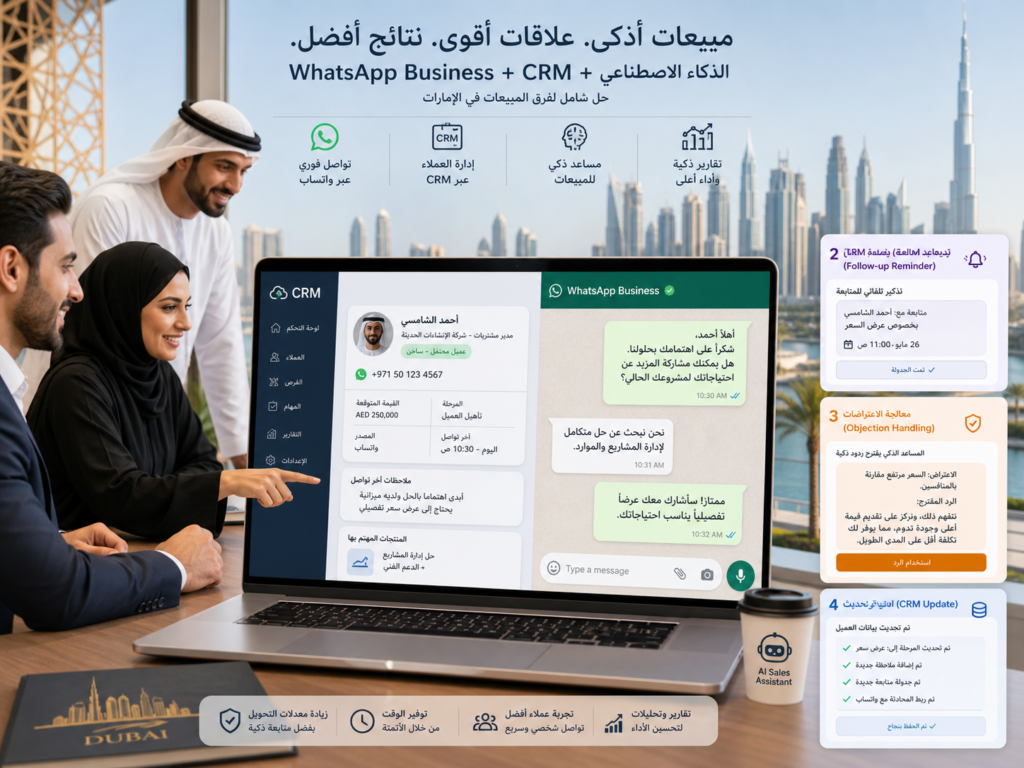
UAE companies often manage customer journeys across WhatsApp, web chat, email, CRM, and mobile apps. A Dubai retail or SaaS team may use AI prompts to qualify buyers, answer delivery questions, and summarize customer intent.
The UAE’s official portal describes the Personal Data Protection Law as a framework for protecting privacy and confidentiality of information.
For businesses building customer apps alongside WhatsApp journeys, Mak It Solutions’ mobile app development services can help align UX, security, and automation.
Qatar Companies Need Consistent Arabic Support Workflows
Qatar companies also need consistent Arabic support workflows as digital services expand across government, finance, telecom, logistics, and enterprise operations.
The U.S. International Trade Administration notes that Qatar issued its Personal Data Privacy Protection Law in 2016 and that MCIT published Qatar’s National AI Strategy in 2019.
A Doha logistics company, for example, can use Arabic chatbot scripts to classify delivery complaints, generate status updates, and escalate missing-package cases to a human supervisor.
Core IT Support Prompts Every GCC Helpdesk Should Include
A GCC-ready Arabic prompt library should include prompts for classification, troubleshooting, escalation, summarization, and customer communication.
These prompts reduce repetitive work while keeping humans in control of sensitive or unresolved cases.
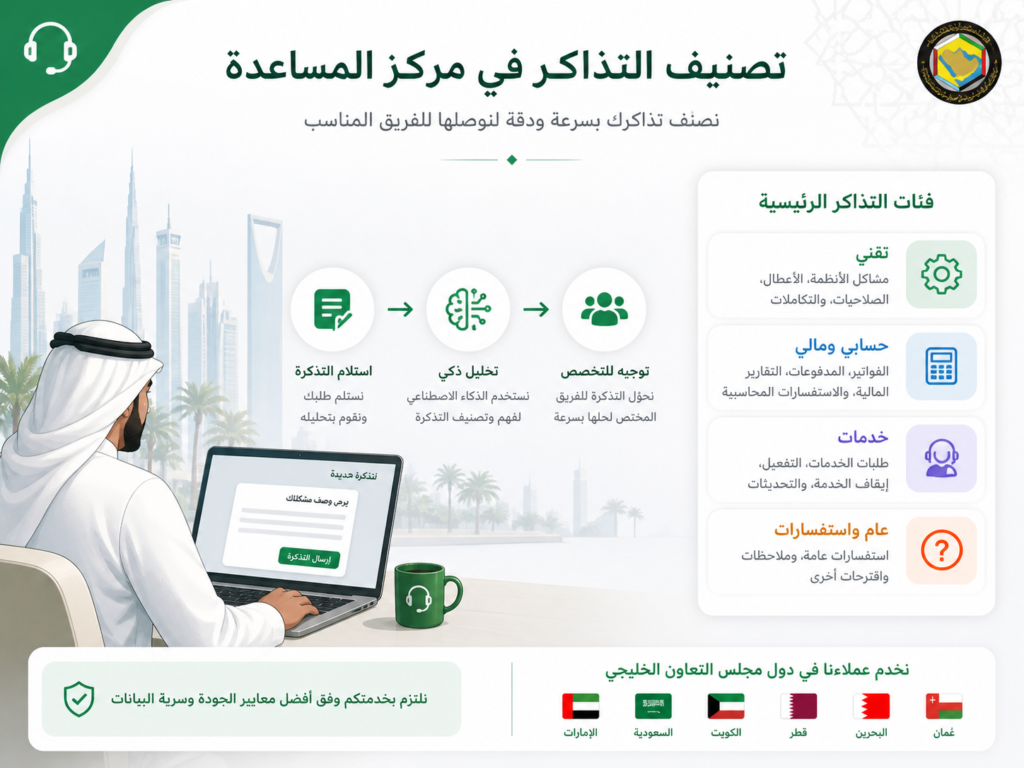
Arabic Ticket Classification Prompts
Ticket classification prompts help agents label support requests by:
Issue category
Urgency
Affected system
Customer impact
Missing information
Recommended next action
Example use cases include login issues, VPN failures, email access, CRM errors, printer problems, and mobile app bugs.
A strong prompt might ask the AI to classify the ticket, identify missing details, and draft a short Arabic reply asking for the right information.
Troubleshooting Prompts for Common Technical Issues
Troubleshooting prompts should guide agents through safe diagnostic steps.
They can produce Arabic instructions for restarting an app, checking internet connectivity, clearing cache, verifying permissions, or collecting screenshots.
For companies with customer portals or custom admin tools, PHP web development services can help build secure support flows and internal dashboards.
Escalation Prompts for Sensitive Cases
Escalation prompts should make it clear when human review is required.
Common escalation triggers include.
Payment disputes
Suspected fraud
Angry or vulnerable customers
VIP accounts
Medical or financial data
Legal complaints
Repeated failed troubleshooting
This is where human-in-the-loop design matters. Mak It Solutions’ guide to human-in-the-loop AI workflows is a useful companion for teams that want automation without losing oversight.
Core Arabic Sales Prompts for CRM and WhatsApp Teams
Arabic sales prompts help GCC teams qualify leads, personalize follow-ups, handle objections, and keep CRM records clean.
They are especially useful when prospects move between Arabic, English, WhatsApp, email, and sales calls.
Arabic Lead Qualification Prompts
Lead qualification prompts should capture
Buyer role
Company size
Budget range
Urgency
Pain point
Preferred language
Decision-maker
Next step
For SaaS teams, this helps sales reps focus on serious opportunities instead of manually reading every message thread.
Follow-Up Prompts for Saudi, UAE, and Qatar Prospects
Follow-up prompts should adapt to local tone.
A Saudi prospect may need a formal Arabic recap. A UAE buyer in Dubai may prefer a concise bilingual WhatsApp message. A Qatar enterprise client may expect a structured Arabic email with meeting notes, responsibilities, and action items.
The goal is simple: make automation feel helpful, not copied.
Objection-Handling Prompts for Bilingual Sales Teams
Objection-handling prompts help reps respond to concerns about price, timeline, integrations, security, data residency, and vendor reliability.
The prompt should ask for a respectful Arabic response, avoid pressure tactics, and include a clear next step.
For companies piloting AI agents, Mak It Solutions’ AI agents for SMEs guide offers a practical GCC cost-saving perspective.
GCC Compliance and Data Governance for AI Prompts
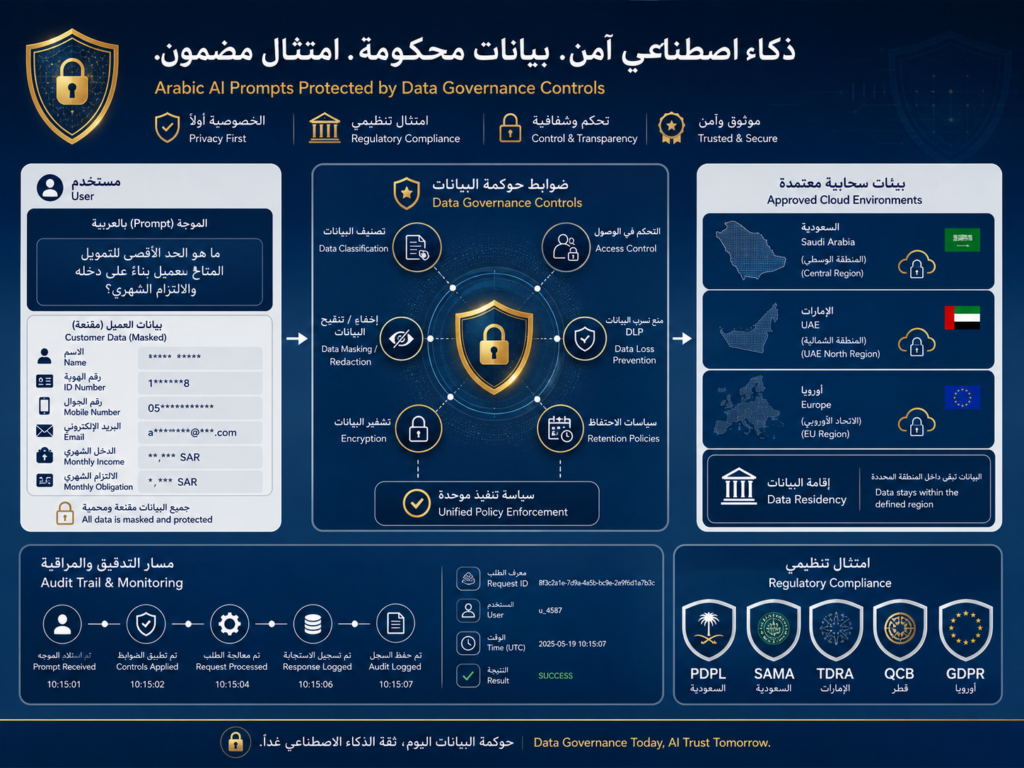
Saudi, UAE, and Qatar companies can use Arabic AI prompts more safely by applying data minimization, masking, role-based access, audit logs, and human escalation.
Teams should avoid entering unnecessary personal, financial, health, authentication, or regulated customer data into AI prompts.
Saudi Considerations.
Saudi teams should align prompt governance with PDPL, SDAIA guidance, NDMO expectations, and sector rules such as SAMA requirements for financial services.
Prompts should instruct staff to mask IDs, avoid full account numbers, and use approved systems for identity verification.
For hosting and data residency planning, Mak It Solutions’ article on Middle East cloud providers for KSA, UAE, and Qatar CIOs covers cloud strategy and residency trade-offs.
UAE Considerations.
UAE businesses should consider federal PDPL obligations plus sector and free-zone frameworks such as ADGM and DIFC.
A Dubai or Abu Dhabi company using WhatsApp Business API prompts should define what agents may enter, what must be masked, and when the conversation must move to an approved system.
The safest approach is familiar: collect less data, restrict access, document purpose, and keep audit evidence.
Qatar Considerations.
Qatar companies should consider MCIT guidance, QCB expectations for financial firms, and secure handling of customer workflows.
MCIT’s AI guidance emphasizes data protection and privacy, including responsible and secure use of personal data.
A Doha bank, for example, should keep KYC, card, and transaction details inside approved systems while using AI prompts only for sanitized summaries or draft responses.
How to Build a GCC-Ready Arabic Prompt Library
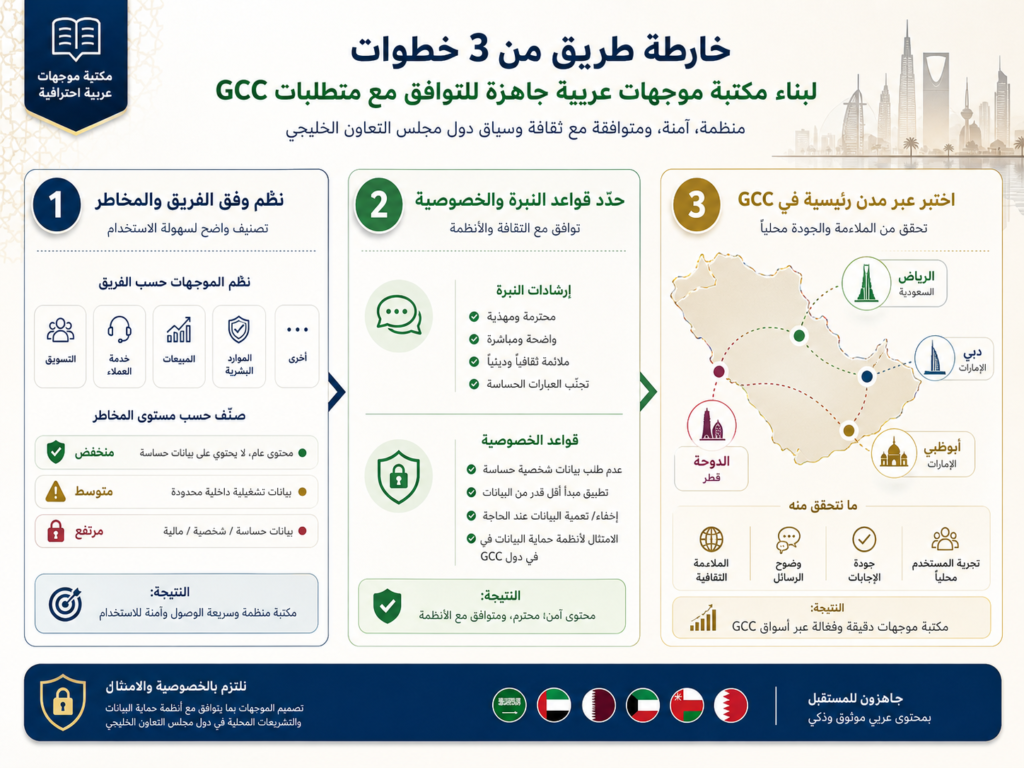
To build a GCC-ready Arabic prompt library, start small. Organize prompts by team, use case, and risk level. Then add tone rules, privacy instructions, escalation triggers, and regional testing.
Separate Prompts by Team, Use Case, and Risk
Create separate prompt groups for.
IT support
Sales
Customer experience
Compliance
Operations
Management reporting
Then label each prompt as low, medium, or high risk.
Low-risk prompts may summarize public FAQs. High-risk prompts may involve complaints, finance, identity, regulated services, or sensitive customer records.
Add Arabic Tone, Privacy, and Escalation Rules
Each prompt should define.
Arabic tone
Whether English may be used
What data must be excluded
What identifiers must be masked
When to escalate to a human
What the final output format should look like
Useful instructions include “do not request passwords,” “mask customer identifiers,” and “escalate suspected fraud.”
Test Prompts Across Riyadh, Dubai, Abu Dhabi, and Doha
Test the same prompt with real frontline users in Riyadh, Dubai, Abu Dhabi, and Doha.
Check whether the Arabic sounds natural, whether right-to-left formatting works, and whether bilingual summaries are accurate. Global companies can also compare practices with US, UK, Germany, and EU teams to keep governance consistent across regions.
Best Practices for Arabic Prompt Libraries in GCC Companies
Arabic prompt libraries work best when they are localized, governed, measured, and reviewed regularly.
The goal is not to create more prompts. The goal is to create better prompts that produce safe, useful, and consistent outcomes.
Use Modern Standard Arabic as the Default
Modern Standard Arabic is usually the safest default for business, government, banking, and formal support.
Gulf-friendly wording can be added for WhatsApp, retail, hospitality, and conversational customer experience. Avoid slang unless your brand guidelines clearly allow it.
Keep Sensitive Customer Data Out of Prompts
Prompts should not include.
Passwords
OTPs
Full payment card numbers
Bank account details
National IDs
Passport numbers
Health records
Private financial data
Unnecessary personal information
Mak It Solutions’ guide to privacy by design for IoT in Saudi, UAE, and Qatar is relevant for teams thinking about data minimization across connected systems.
Review Prompts Like Product Documentation
Prompt libraries should be reviewed like product documentation.
Assign owners, track versions, test outputs, and update prompts when regulations, products, pricing, or customer policies change.
This matters even more as AI adoption grows. Stanford HAI’s 2025 AI Index reported that business AI usage accelerated in 2024, with 78% of organizations reporting AI use, up from 55% the year before.
Concluding Remarks
An Arabic prompt library can become a practical business asset when it improves speed, quality, compliance, and customer trust.
For GCC companies, the strongest libraries combine Arabic UX, bilingual workflows, privacy controls, secure integrations, and human escalation. Start with 20–30 high-value prompts, test them with real support and sales users, and connect them to your CRM, ITSM, or helpdesk once the workflow is stable.
Mak It Solutions helps GCC and global teams design secure AI workflows, CRM integrations, dashboards, and customer-facing digital products. To build an Arabic prompt library that fits your support, sales, and compliance needs, request a scoped estimate through Mak It Solutions and start with a focused pilot.( Click Here’s )
Key Takeaways
An Arabic prompt library helps GCC IT support and sales teams standardize Arabic and bilingual AI workflows.
Saudi, UAE, and Qatar companies should use data minimization, masking, audit logs, and escalation rules before scaling AI prompts.
IT support prompts should cover classification, troubleshooting, escalation, and customer reply drafting.
Sales prompts should support lead qualification, WhatsApp follow-ups, CRM updates, and objection handling.
Modern Standard Arabic is usually the best default, with Gulf-friendly wording where brand tone allows.
Prompt libraries deliver the most value when connected to secure systems, dashboards, and human-in-the-loop review.
FAQs
Q : Can Saudi companies use an Arabic prompt library under PDPL requirements?
A : Yes, Saudi companies can use an Arabic prompt library, but they should avoid entering unnecessary personal data into AI tools. Prompts should mask customer identifiers, avoid passwords or OTPs, and escalate regulated cases to approved staff.
Q : Are Arabic sales prompts useful for UAE WhatsApp Business conversations?
A : Yes. Arabic sales prompts are useful for UAE WhatsApp Business conversations because many buyers switch between Arabic and English. A good prompt can qualify the lead, summarize intent, draft a polite follow-up, and update CRM fields.
Q : How can Qatar support teams standardize Arabic helpdesk replies?
A : Qatar support teams can standardize replies by creating approved prompt templates for classification, troubleshooting, escalation, and customer updates. Each prompt should define tone, required information, missing-data questions, and escalation triggers.
Q : Should GCC companies use Gulf Arabic or Modern Standard Arabic in prompts?
A : Most GCC companies should use Modern Standard Arabic as the default because it is professional, widely understood, and suitable for formal support, sales, and compliance communication. Gulf-friendly wording can be added for WhatsApp, retail, hospitality, and conversational CX.
Q : What customer data should GCC teams avoid entering into AI prompts?
A : Teams should avoid entering passwords, OTPs, full card numbers, bank account details, national IDs, passport numbers, health records, private financial details, and unnecessary personal information. Sensitive cases should stay inside approved CRM, ITSM, banking, or government systems.