


GenAI Vendor Procurement Checklist for Risk
GenAI Vendor Procurement Checklist for Risk
GenAI Vendor Procurement Checklist for Risk
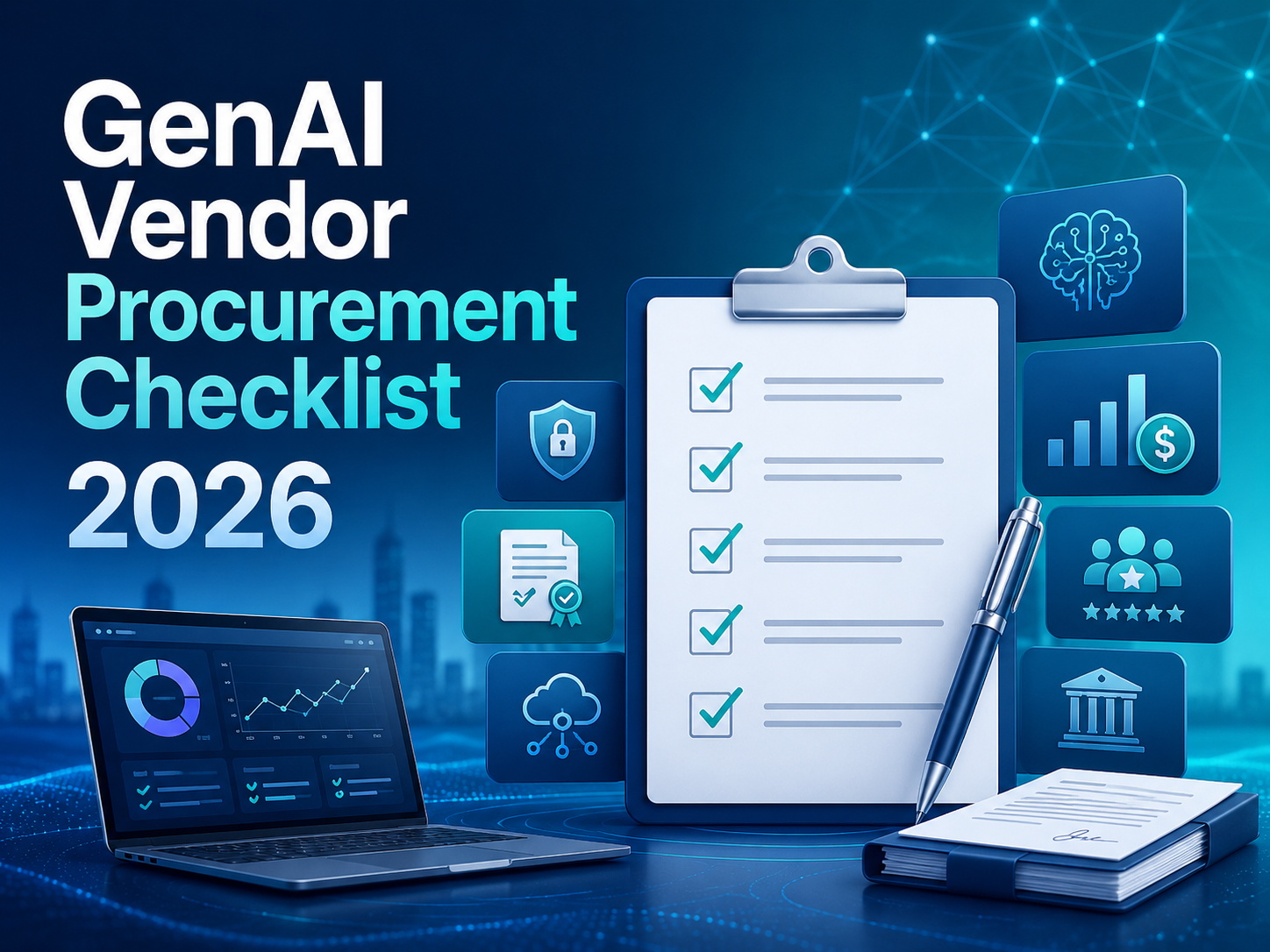
A GenAI vendor procurement checklist helps procurement, legal, IT, security, risk, and compliance teams decide whether an AI supplier is safe to approve. It checks business fit, data privacy, model training, security controls, regulatory exposure, contract terms, operational resilience, and exit risk before sensitive data or money is committed.
The short answer: before buying any GenAI tool, confirm what data the vendor receives, whether prompts or outputs are used for training, where data is stored, which sub processors are involved, what audit evidence is available, and how the tool will be governed after launch.
AI adoption is no longer experimental. McKinsey’s 2025 survey reported that 88% of organizations use AI in at least one business function, while IBM’s 2025 breach research reported a global average breach cost of $4.4 million. That combination creates a clear message: GenAI buying decisions need stronger due diligence, not faster shortcuts.
Why GenAI Procurement Needs a New Checklist
Traditional SaaS reviews often focus on uptime, access control, hosting, support, and pricing. GenAI adds new questions: What happens to prompts? Are uploaded files retained? Can outputs leak confidential logic? Does the vendor use customer data to train shared models? Who reviews risky outputs?
The biggest risk is not just that the model gives a wrong answer. The deeper risk is that your company cannot explain where sensitive data went, who accessed it, whether it trained a model, or how an unsafe output was approved.
A New York fintech may need FINRA, SEC, SOC 2, and PCI DSS evidence. A London health supplier may need UK-GDPR, ICO guidance, DPIAs, and NHS procurement checks. A Berlin or Munich financial firm may need GDPR/DSGVO, BaFin expectations, DORA readiness, and clear EU data-residency controls.
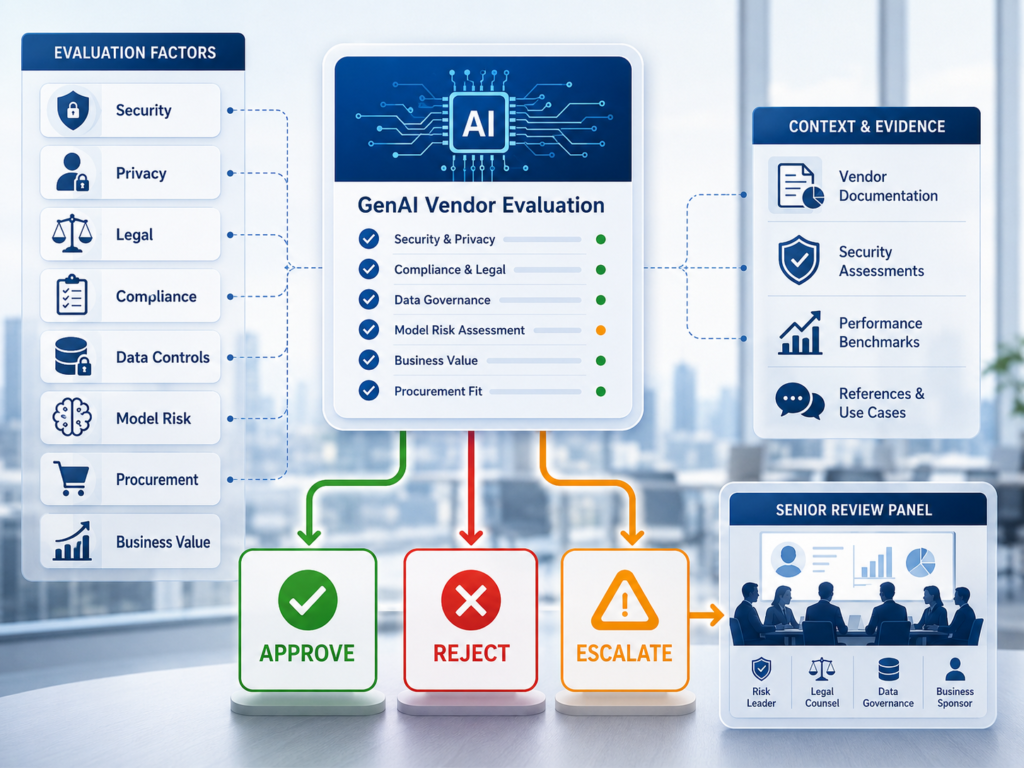
In practice, the checklist should help teams make one of four decisions: approve, reject, negotiate stronger terms, or escalate to legal, the CISO, the DPO, or the risk committee.
Teams can also use Mak It Solutions Business Intelligence Services when AI vendor decisions need dashboards, reporting, and executive-level risk visibility.
GenAI Vendor Procurement Checklist.
A strong GenAI vendor procurement checklist should cover business fit, data handling, model governance, security controls, compliance evidence, legal terms, operational maturity, and exit planning.
The goal is simple: prove that the vendor is useful, safe, governable, and replaceable before approval.
Business Fit, Use Case Alignment, and ROI
Start with the use case. Is the tool supporting internal search, software development, customer service, sales enablement, legal review, analytics, or workflow automation?
Then define measurable value. Useful ROI signals include.
Hours saved
Error reduction
Faster cycle time
Better customer satisfaction
Lower compliance workload
Revenue or productivity lift
Reduced manual review effort
A GenAI tool that works for a San Francisco marketing team may be unacceptable for a Washington DC healthcare workflow involving protected health information. Same technology, different risk profile.
Mak It Solutions AI-assisted QA guidance is a useful related resource when the GenAI use case involves software testing, release confidence, or quality automation.
Vendor Maturity and Enterprise Readiness
Review how long the vendor has operated, who owns it, how it is funded, and whether it can support enterprise procurement.
A mature GenAI vendor should be able to provide.
Security documentation
Data-processing terms
Model documentation or system cards
Uptime history
Support SLAs
Customer references
Sub processor details
Audit and compliance evidence
Also ask whether the vendor depends on Open AI, Anthropic, AWS, Microsoft Azure, Google Cloud, IBM, or another model or cloud provider. The subcontractor chain matters because your data may move through more than one processor.
Contract, SLA, Support, and Exit Plan
Your contract should clearly define uptime, support response times, breach notification, audit rights, data deletion, model-training restrictions, liability, indemnity, and termination support.
Do not approve a GenAI vendor without an exit plan. You need a practical way to export data, revoke access, delete prompts and logs, migrate workflows, and preserve audit evidence if the supplier fails, changes pricing, or becomes non-compliant.
AI Vendor Risk Assessment.
The most important procurement questions are usually about data. A vendor may have impressive demos, but weak data controls can make the tool unsuitable for enterprise use.
Ask these questions early.
What data does the vendor process?
Are prompts, outputs, files, logs, embeddings, or metadata retained?
Where is the data hosted?
Is customer data used for training or fine-tuning?
Can the customer opt out of secondary processing?
Who can access customer data?
How are deletion and retention handled?
What audit logs are available?

Data Handling.
Map every data type the vendor touches: prompts, uploaded files, outputs, embeddings, metadata, logs, admin activity, API payloads, and support tickets.
For US buyers, hosting regions may need to align with state laws, HIPAA, or customer-contract requirements. For UK and EU buyers, data residency can affect UK-GDPR, GDPR, DSGVO, and cross-border transfer analysis.
A practical data-flow review can be supported by Mak It Solutions’ [Internal link: Python Development Services] when teams need secure APIs, AI workflow logic, or audit-friendly backend integrations.
Customer Data Use for Model Training
Enterprises should ask for a written commitment that customer data, prompts, outputs, and uploaded files are not used to train or fine-tune shared models unless explicitly approved.
But “not used for training” is not enough. Also ask whether data is used for abuse monitoring, product analytics, evaluation, support debugging, human review, or product improvement.
A safe answer should explain all secondary processing, not just model training.
SOC 2, ISO 27001, Encryption, and Audit Logs
Request SOC 2 Type II, ISO 27001 certification, penetration test summaries, encryption details, SSO/SAML support, role-based access control, audit logs, vulnerability management evidence, and incident-response procedures.
For regulated sectors, ask whether the vendor can support HIPAA business associate agreements, PCI DSS scope reduction, and customer-specific audit evidence. HHS states that the HIPAA Security Rule requires administrative, physical, and technical safeguards for electronic protected health information.
Compliance Checklist for US, UK, Germany, and EU Buyers
Compliance depends on where the buyer operates, what data is processed, who is affected, and how the AI output is used.
The EU AI Act is especially important because it sets risk-based rules for AI developers and deployers. Even US and UK organizations can be affected if the AI system is used in the EU or its output affects EU users.
USA.
For US enterprises, map GenAI procurement to NIST AI RMF, SOC 2, HIPAA, PCI DSS, CCPA/CPRA, SEC, FINRA, and HHS/OCR requirements where relevant.
NIST says its AI Risk Management Framework helps organizations manage AI risks to individuals, organizations, and society.
A Seattle SaaS company may focus on SOC 2 and secure SDLC. A New York bank may prioritize FINRA, SEC, vendor resilience, and audit logs. A healthcare platform in Austin may need HIPAA safeguards, BAAs, access controls, and strict PHI handling.
UK.
UK buyers should assess UK-GDPR, ICO AI guidance, DPIAs, NHS procurement expectations, FCA rules, and data transfer mechanisms.
The ICO provides AI and data protection guidance to help organizations adopt AI while protecting people and vulnerable groups.
A London fintech using GenAI for complaints handling should document fairness, explain ability, escalation, and records retention. A Manchester health tech supplier should check NHS data protection standards, clinical safety governance, and human review before AI outputs influence care.
Germany and EU.
Germany and EU buyers should review GDPR/DSGVO, EU AI Act classification, BaFin expectations, DORA, BfDI guidance, ISO 27001, and ISO/IEC 42001.
Works council considerations may also apply when AI tools monitor, evaluate, or assist employees.
A Frankfurt bank may need BaFin and DORA alignment. A Berlin HR software company should evaluate high-risk AI Act exposure. A Munich manufacturer may require EU data residency, audit logs, and clear sub processor controls across France, Ireland, Spain, Italy, and the Netherlands.

AI Governance and Model Accountability Questions
Strong GenAI governance requires clear accountability for model behavior, human review, risk classification, documentation, testing, and escalation.
Without governance, procurement approval becomes a one-time checkbox. That is not enough for AI systems that change, learn, integrate with workflows, or influence decisions.
Provider vs Deployer Responsibilities
The provider builds or supplies the AI system. The deployer uses it in a real business process.
Under the EU AI Act, both roles may carry duties, especially for high-risk systems. Buyers should ask vendors what documentation they provide to help deployers meet their own obligations, including instructions for use, logging support, human oversight controls, monitoring guidance, and post-market updates.
Human Oversight, Explain ability, Bias Testing, and Monitoring
Human oversight should be designed before launch.
Decide.
Who reviews outputs?
What triggers escalation?
Which decisions can AI never make alone?
How are bias and harmful outputs tested?
How are overrides recorded?
Who owns ongoing monitoring?
For implementation patterns, Mak It Solutions Human-in-the-Loop AI Workflows guide can help teams design escalation paths, review queues, and audit trails.
Incident Response and Post-Launch Evidence
GenAI incidents can include data leakage, unauthorized model training, hallucinated legal or financial advice, biased outputs, unsafe recommendations, and service outages.
Require the vendor to explain incident notification timelines, root-cause analysis, customer communications, remediation steps, and evidence preservation.
Stanford HAI reported that US federal agencies introduced 59 AI-related regulations in 2024, more than double the number recorded in 2023. That shows how quickly AI governance pressure is rising.
AI Vendor Questionnaire and RFP Scorecard
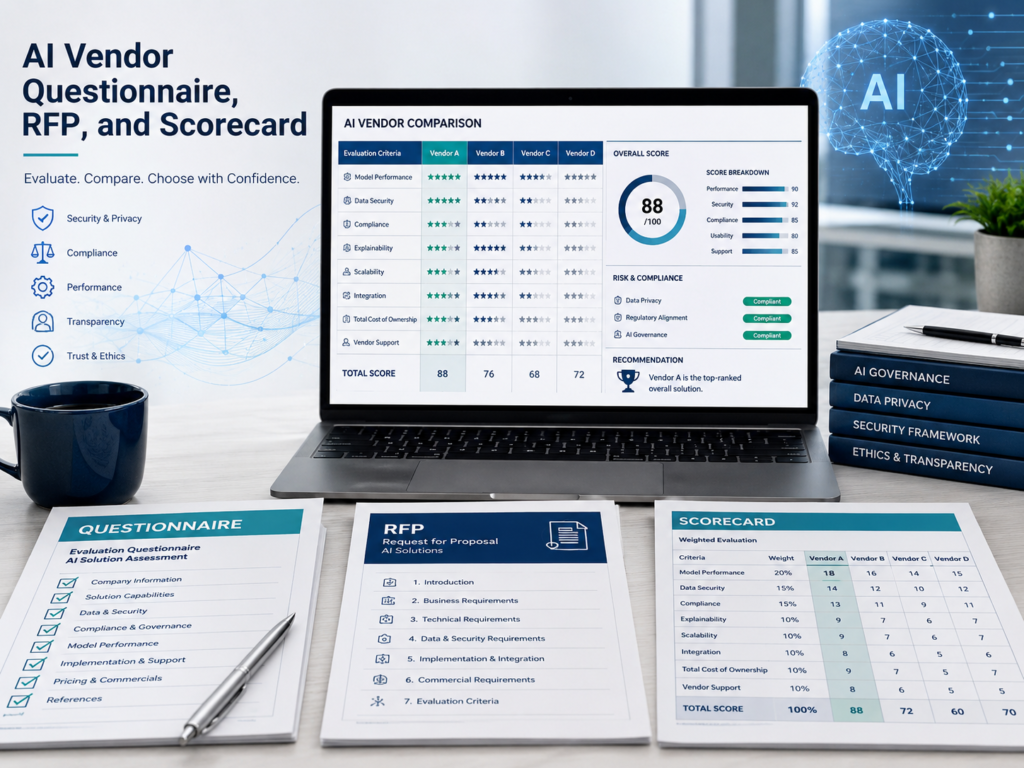
An AI vendor questionnaire should make risk visible before security, legal, or compliance approval.
Use it to test whether the vendor can prove its claims with evidence, not just sales language.
Must-Ask GenAI Vendor Questionnaire Sections
Include these sections.
Company profile and ownership
Use case fit and limitations
Data processing and retention
Model training and fine-tuning
Security controls and certifications
Compliance evidence
Sub processors and hosting regions
Human oversight and monitoring
Incident response
Pricing, SLA, support, and exit plan
Mak It Solutions’ Multi-Agent AI Architecture guide is relevant when the vendor supports autonomous agents, workflow orchestration, or tool-calling systems.
Evidence to Request Before Approval
Before security or legal approval, request.
SOC 2 Type II report
ISO 27001 certificate
Data processing agreement
Sub processors list
Penetration test summary
Vulnerability policy
Architecture diagram
Access control matrix
BCP/DR plan
Sample audit logs
For AI-specific evidence, ask for model documentation, acceptable use controls, evaluation results, red-team summaries, content safety policies, and a clear customer-data training statement.
Weighted RFP Scorecard Example
Use a weighted scorecard to compare vendors fairly.
| Category | Suggested Weight |
|---|---|
| Security and privacy | 30% |
| Compliance fit | 25% |
| Business value | 20% |
| Operational maturity | 15% |
| Cost | 10% |
High scores should require strong evidence. A vendor with weak data controls but exciting features should not outrank a safer vendor for regulated workflows.
Final Procurement Decision: Approve, Reject, or Escalate
A GenAI vendor procurement checklist should end with a clear decision.
Approve the vendor only when the use case is defined, risks are documented, evidence is reviewed, contract terms are acceptable, and owners are assigned for ongoing monitoring.
Low-Risk vs High-Risk GenAI Vendor Indicators
Low-risk vendors usually process non-sensitive data, support internal productivity, offer clear deletion controls, and avoid automated decisions about people.
High-risk vendors may process PHI, payment data, HR data, financial records, legal documents, children’s data, biometric data, customer complaints, credit decisions, hiring workflows, or regulated advice.
When to Involve Legal, CISO, DPO, or Risk Teams
Bring in legal when terms affect liability, IP, data use, or cross-border transfers.
Bring in the CISO for security architecture, certifications, access controls, and incident response.
Involve the DPO when personal data, DPIAs, GDPR, UK-GDPR, or DSGVO apply.
For AI systems touching production software, integrations, or customer-facing apps, Mak It Solutions’ Web Development Services and Mobile App Development Services can support secure implementation planning.
Final Thoughts
A strong GenAI vendor procurement checklist gives teams a practical way to buy AI tools without relying on vendor promises alone. It helps compare suppliers by evidence, data controls, compliance fit, security maturity, contract protection, and long-term operational risk.
Before approving any GenAI vendor, document the use case, score the risks, confirm how data is handled, and involve legal, security, privacy, and compliance teams when needed. The right checklist turns AI procurement into a repeatable decision process that protects the business while still allowing innovation.( Click Here’s )
FAQs
Q : What documents should a GenAI vendor provide before contract approval?
A : A GenAI vendor should provide a data processing agreement, sub processors list, SOC 2 Type II report, ISO 27001 certificate if available, security architecture summary, penetration test summary, incident response policy, privacy policy, retention schedule, and model-training statement.
For regulated buyers, also request HIPAA BAA support, PCI DSS scope details, GDPR transfer terms, DPIA support, and audit log samples.
Q : How is a GenAI vendor questionnaire different from a standard SaaS questionnaire?
A : A standard SaaS questionnaire focuses on hosting, access control, uptime, support, and security.
A GenAI vendor questionnaire goes further by asking about prompts, outputs, embeddings, model training, fine-tuning, hallucination risk, human review, explain ability, bias testing, content safety, and AI Act deployer support.
Q : Should procurement require ISO 42001 for AI vendors?
A : Procurement should consider ISO/IEC 42001 when the AI use case is high-impact, regulated, or customer-facing.
It may not be mandatory for every vendor, especially smaller or early-stage suppliers, but it is useful evidence of AI management system maturity. If the vendor lacks ISO 42001, ask for equivalent governance evidence.
Q : What red flags indicate a high-risk GenAI supplier?
A : Red flags include vague answers about model training, no deletion process, unclear hosting regions, no audit logs, weak access controls, missing sub processors, no SOC 2 or ISO evidence, broad liability disclaimers, and refusal to support DPIAs or security reviews.
Another warning sign is a vendor that claims its AI is “fully accurate” or “compliance-ready” without evidence, limitations, or human oversight guidance.
Q : How often should enterprises reassess approved AI vendors?
A : Enterprises should reassess approved AI vendors at least annually and whenever the use case, model, sub processors, hosting region, contract terms, or regulatory exposure changes.
High-risk vendors should be reviewed more often, especially if they process sensitive data or affect customers, employees, financial decisions, healthcare workflows, or regulated operations.