


AI Adoption Roadmap for Enterprise Scale
An AI adoption roadmap gives leaders a practical way to turn AI ideas into measurable business results. Instead of running scattered experiments, teams can move from discovery to production with clear use cases, governance, data controls, workflow integration, and ROI tracking.
In simple terms, an AI adoption roadmap is a phased plan for moving AI from strategy and pilots into secure, governed, measurable business use. It helps organizations decide where AI can create value, how to test it safely, and when a pilot is ready to scale.
That structure matters because AI adoption is no longer a side project. McKinsey reported that AI adoption reached 72% of surveyed organizations in early 2024, after hovering near 50% for several years. Stanford HAI later reported that 78% of organizations used AI in 2024, up from 55% the year before.
Many teams in New York, London, Berlin, Austin, and Munich already have AI pilots running. The harder question is whether those pilots can pass security review, legal review, user adoption, and executive ROI scrutiny.
Why AI Pilots Stall Before Enterprise Rollout
AI pilots usually stall because the proof of concept is built outside real business conditions. The demo works, but the data pipeline is fragile, the workflow is unclear, security has not approved access, or users do not trust the output.
A strong roadmap brings production thinking into the process early. That means defining data ownership, model evaluation, human review, cost controls, integration paths, compliance evidence, and ongoing monitoring before the pilot becomes business-critical.
For regulated organizations, Mak It Solutions’ guidance on human-in-the-loop AI workflows is especially useful because enterprise AI often needs review queues, escalation logic, and audit trails.
What Is an AI Adoption Roadmap?
An AI adoption roadmap is a business and technology plan for moving AI from early ideas into real, governed workflows. It explains what to build, why it matters, who owns it, which data is used, how risk is controlled, and how success will be measured.
The goal is not to “add AI” everywhere. The goal is to choose the right use cases, prove value safely, and create a repeatable model for scaling AI across the business.
AI Adoption Roadmap vs. AI Implementation Roadmap
An AI adoption roadmap focuses on business change: use cases, stakeholders, operating model, governance, training, and ROI.
An AI implementation roadmap focuses more on technical delivery: data pipelines, APIs, model architecture, deployment, testing, monitoring, and integrations.
Both matter. For example, a SaaS company in San Francisco may use an adoption roadmap to prioritize AI customer support, then use an implementation roadmap to connect Salesforce, Snowflake, Databricks, and Azure Open AI securely.
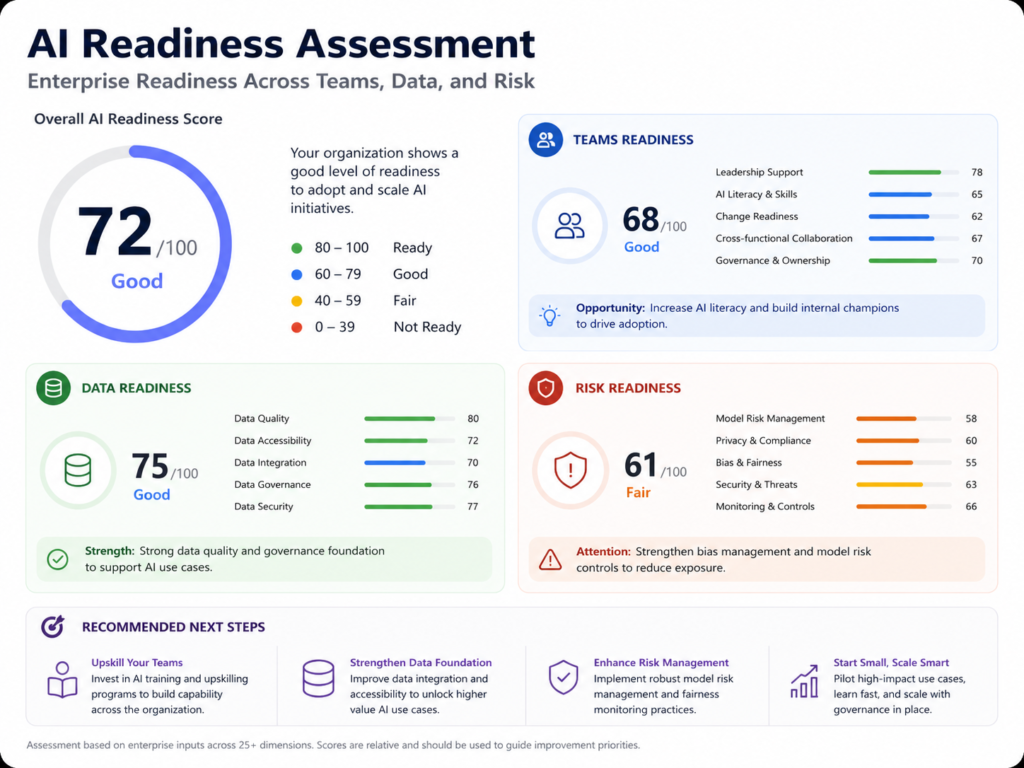
AI Readiness: Assess Strategy, Data, Teams, and Risk
AI readiness means checking whether the business has the strategy, data, skills, systems, and controls to use AI safely. Before building more pilots, leaders should understand which business units are ready and which gaps could block production.
IBM reported that 42% of enterprise-scale companies had actively deployed AI, while another 40% were still exploring or experimenting. That gap shows why readiness work matters: many organizations are interested in AI, but not all are ready to scale it.
Run an AI Readiness Assessment Across Business Units
Start by reviewing.
Business goals and priority workflows
Data availability, quality, and ownership
Process maturity and workflow complexity
Cloud and integration architecture
Security controls and access policies
Compliance exposure
User readiness and training needs
Expected ROI and operating cost
A finance team in Chicago may be ready for invoice automation. A healthcare team in Boston may need HIPAA review before any AI workflow touches protected health information. A London fintech may need FCA-aware governance before testing AI in customer communications.
Identify High-Value AI Use Cases
Good first use cases are narrow, valuable, measurable, and realistic to deploy. Strong candidates include.
Support ticket routing
Financial anomaly detection
Internal document search
Sales enablement
Claims review
Software vulnerability prioritization
Compliance evidence search
SaaS onboarding automation
For engineering and security teams, this connects naturally with AI vulnerability detection workflows, where AI helps prioritize issues while humans still verify critical fixes.
Map Stakeholders Early
Enterprise AI adoption fails when ownership is vague. The CIO may own enterprise systems, the CTO may own architecture, the CDO may own data governance, legal may own regulatory risk, and business owners may own ROI.
Create a decision map before the pilot starts. This prevents late-stage blockers when the pilot looks promising but procurement, compliance, or security cannot approve deployment.
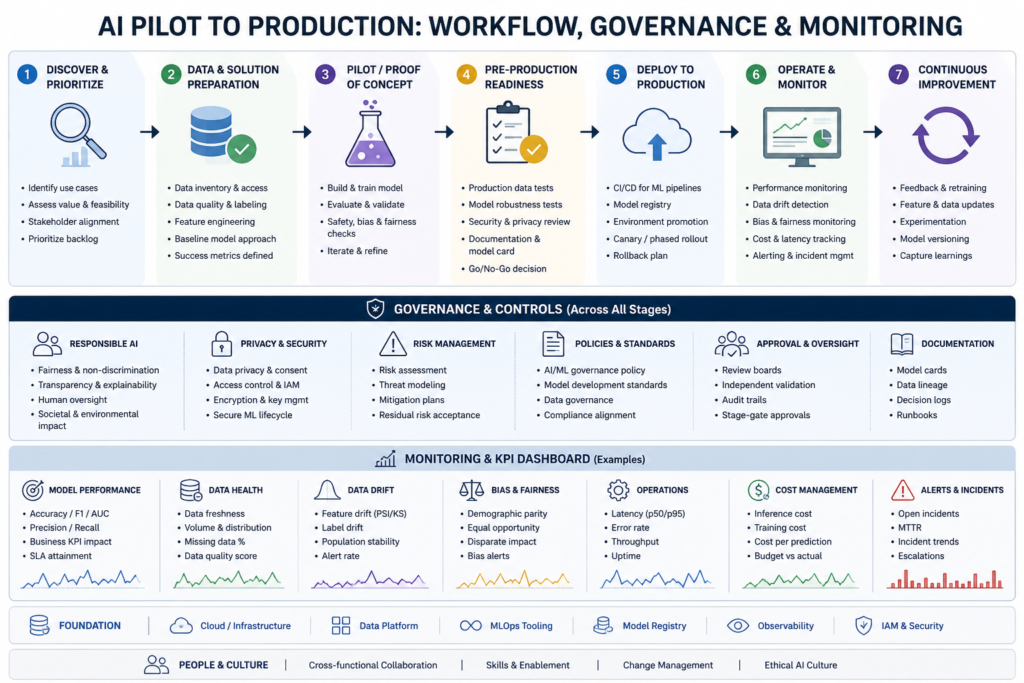
Pilot to Production: The Core AI Implementation Roadmap
A pilot proves that something can work. Production proves that it can work safely, repeatedly, and inside real business constraints.
To move an AI pilot to production, teams need to validate ROI, secure data pipelines, define governance, integrate AI into workflows, and monitor model performance after launch.
Choose the Right AI Proof of Concept
The best proof of concept is focused. Avoid starting with a vague “AI assistant for everything.” Instead, choose one workflow, such as.
Contract clause extraction
Customer support triage
Compliance evidence search
Internal knowledge retrieval
SaaS onboarding automation
Invoice review
Architecture also matters. Mak It Solutions’ guide on Domain LLM vs RAG explains when enterprises should consider retrieval-augmented generation, fine-tuning, or hybrid AI architecture.
Build a Production Readiness Checklist
Before rollout, your production checklist should cover.
Data classification
Access controls
Logging and audit trails
Model evaluation
Human review paths
Fallback processes
Cost monitoring
User training
Security testing
Compliance sign-off
Post-launch monitoring
For sensitive workloads, confidential computing may also help protect data while it is being processed. See Mak It Solutions’ article on confidential computing for sensitive cloud workloads.
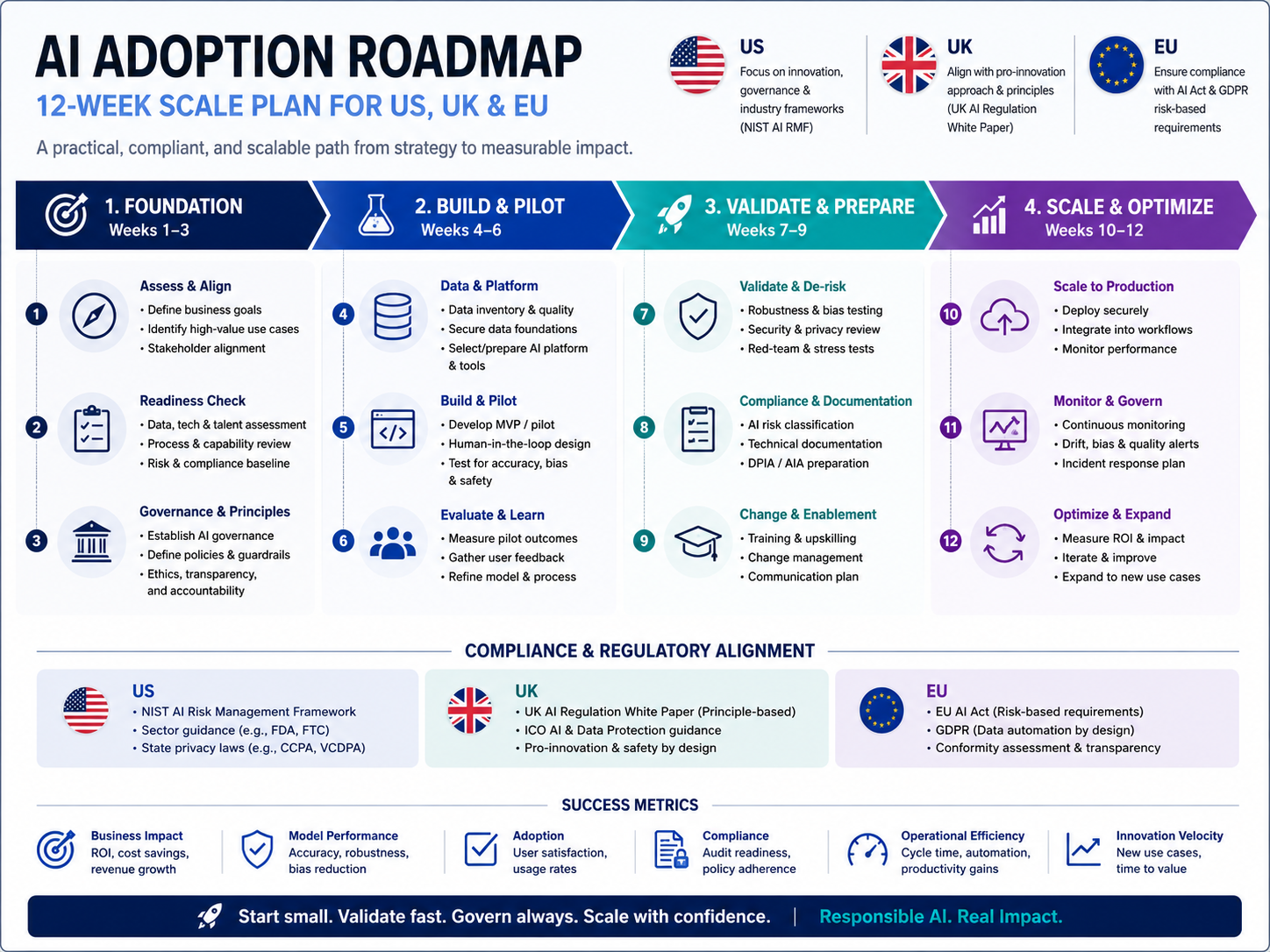
The 12-Week AI Adoption Roadmap
A 12-week AI adoption roadmap gives companies enough structure to move quickly without skipping governance. The goal is not to solve every AI opportunity in one quarter. The goal is to prove one production pathway that can scale.
Discovery, Readiness, and Use-Case Prioritization
The first phase is about clarity. Run stakeholder interviews, map workflows, review available data, assess risks, and score use cases by value, feasibility, compliance exposure, and adoption potential.
A practical scoring model may include:
| Criteria | What to Check |
|---|---|
| Business value | Does the use case reduce cost, save time, increase revenue, or improve quality? |
| Data readiness | Is the required data available, clean, secure, and usable? |
| Risk level | Could the workflow affect customers, patients, payments, legal decisions, or regulated data? |
| Workflow fit | Will users actually adopt it inside their daily process? |
| Technical feasibility | Can the system integrate with existing tools and platforms? |
By the end of week 3, leadership should agree on one priority use case, success metrics, key risks, and delivery ownership.
Prototype, Governance Design, and Workflow Testing
The second phase turns the chosen use case into a controlled prototype. Use approved data, define evaluation criteria, and test the workflow with real users instead of only technical reviewers.
Governance should be designed during the prototype stage, not after it. This includes.
Human oversight
Model boundaries
Escalation rules
Logging and retention
Bias and quality checks
Approval workflows
Security review
Vendor risk review
For applications that involve web or mobile interfaces, Mak It Solutions’ React Development Services, Next.js Development Services, and Mobile App Development Services can support production-ready user experiences.
Production Rollout, Measurement, and Scale Plan
The final phase connects the AI workflow with production systems such as ServiceNow, Salesforce, SAP, Snowflake, Databricks, AWS, Azure, or Google Cloud. Train users, monitor output quality, and measure business impact.
Do not scale only because the demo looks good. Scale when there is evidence, such as.
Reduced handling time
Better accuracy
Lower operating cost
Higher user adoption
Improved compliance evidence
Faster decision cycles
Clear risk ownership
Weeks 9–12 should also produce a scale plan. That plan should explain which use cases come next, what governance patterns can be reused, and what technical foundations need improvement.
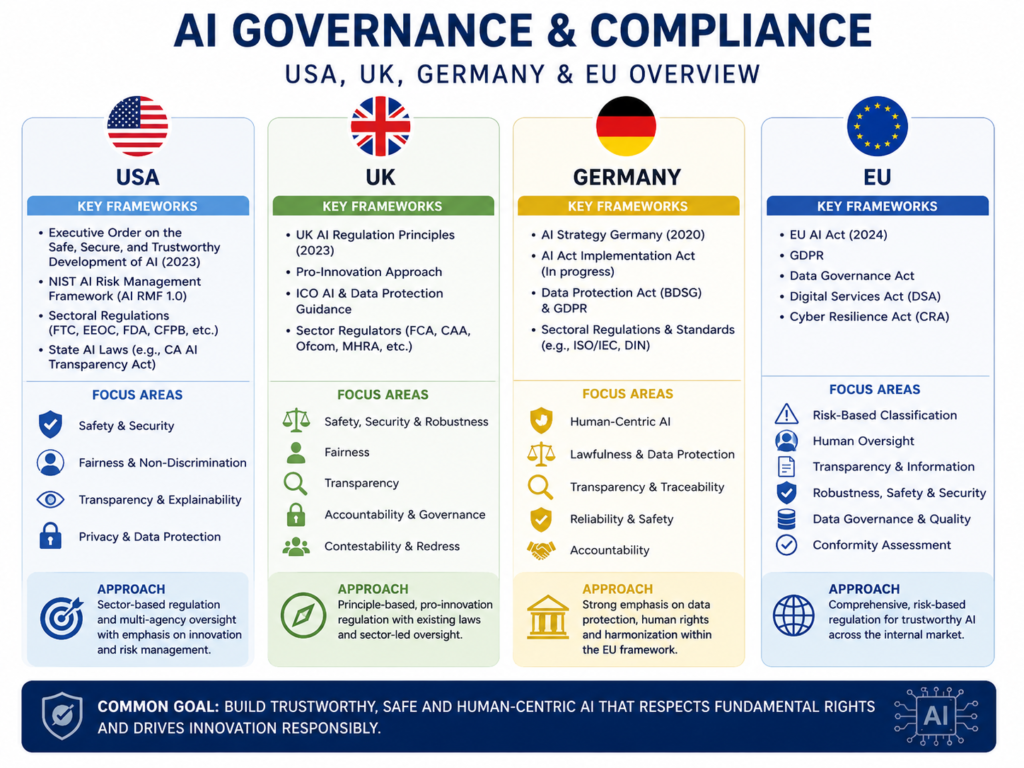
AI Governance, Risk, and Compliance by Region
AI governance should cover data privacy, security, human oversight, auditability, risk classification, and ongoing monitoring. For organizations operating across the USA, UK, Germany, and the EU, regional rules can influence architecture, hosting, vendor review, and documentation.
USA.
In the USA, AI governance often connects with SOC 2, HIPAA, PCI DSS, NIST AI RMF, FINRA expectations, and vendor risk management.
NIST describes its AI Risk Management Framework as a resource to help manage AI risks to individuals, organizations, and society. For healthcare, HHS states that the HIPAA Security Rule requires administrative, physical, and technical safeguards for electronic protected health information.
UK.
UK teams should consider UK-GDPR, ICO expectations, NHS data handling requirements, FCA oversight, Open Banking rules, and public-sector procurement standards.
In practice, a Manchester health tech startup may need data minimization, model access controls, and clear processor agreements before piloting AI with patient-related data. A London fintech may need stronger controls around customer communications, audit trails, and explain ability.
Germany and EU.
Germany and EU teams should assess GDPR/DSGVO, the EU AI Act, BaFin expectations for financial services, EBA guidance, works council involvement, and EU data residency requirements.
The European Commission describes the AI Act as a risk-based legal framework for AI. That matters for Frankfurt banks, Munich industrial companies, Berlin SaaS teams, and EU operators serving Paris, Amsterdam, Dublin, and Zurich.
Good governance is practical. It defines what AI may do, what it must not do, who reviews risky outputs, where evidence is stored, and how issues are corrected.
Measuring AI Adoption Success and ROI
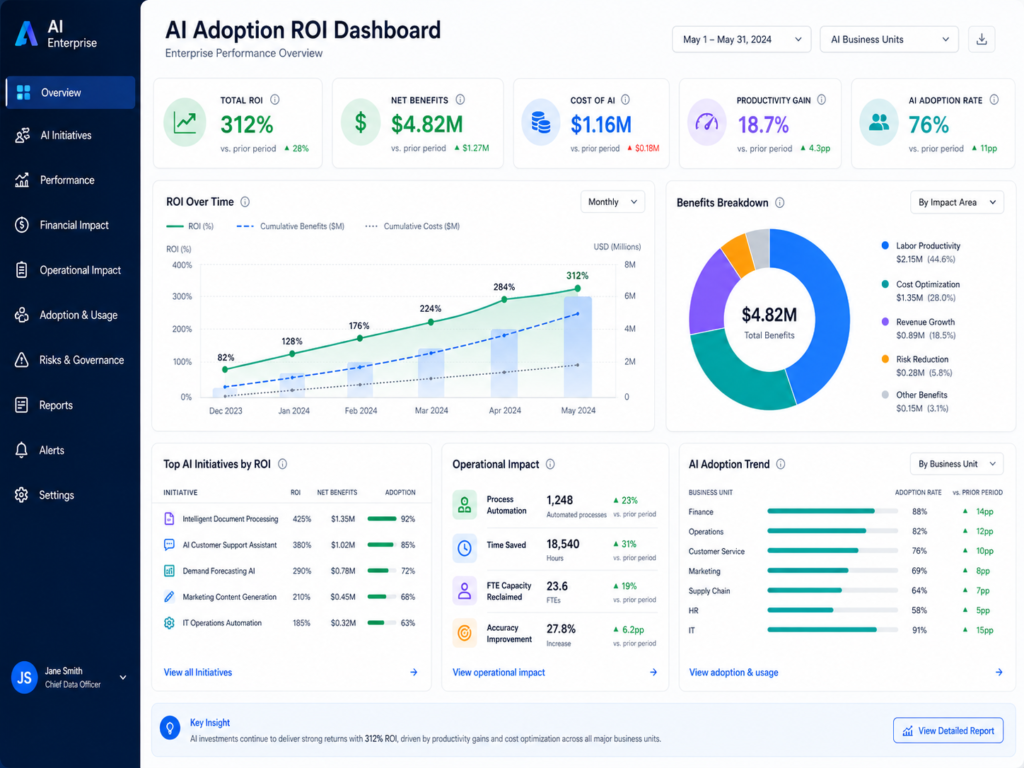
AI adoption success should be measured through business outcomes, user adoption, model quality, compliance readiness, and operating cost. A pilot is ready to scale only when it proves value and control together.
Track Adoption, Productivity, and Cost Metrics
Useful business metrics include.
Active users
Task completion rate
Time saved
Cost per workflow
Error reduction
Process throughput
User satisfaction
Escalation rate
For support teams, that may mean faster ticket resolution. For finance, it may mean fewer manual reconciliations. For compliance teams, it may mean faster evidence retrieval.
Measure Model Quality, Risk, and Trust
AI performance cannot be judged only by speed. Teams should also track.
Accuracy
Hallucination rate
Rejected outputs
Policy violations
Escalation frequency
User feedback
Audit log completeness
Data lineage
Risk exceptions
PCI SSC describes its role as developing and supporting adoption of data security standards and resources for safe payments worldwide. That kind of standard-based thinking is useful when AI touches payment, customer, or identity data.
Create an AI Operating Model
An AI operating model defines ownership after launch. It should cover model monitoring, prompt updates, retraining triggers, access reviews, incident response, vendor review, and quarterly ROI reporting.
For technical delivery, Python Development Services and Back End Development Services can support AI integrations, APIs, automation, and data workflows.
Concluding Remarks
A scalable AI adoption roadmap helps teams move from scattered experiments to governed business value. The 12-week pathway gives leaders a practical structure: assess readiness, choose a focused use case, prototype safely, design governance, roll out production, and measure ROI.
Weeks 1–3 clarify readiness and priorities. Weeks 4–8 build the prototype and governance model. Weeks 9–12 launch production, measure impact, and define the scale plan.
Planning AI adoption across the USA, UK, Germany, or the EU? Mak It Solutions can help you scope a practical roadmap, validate the right use case, and move from pilot to production with governance built in. Start with a focused consultation through Mak It Solutions and request a scoped AI adoption estimate.( Click Here’s )
FAQs
Q : How long does enterprise AI adoption usually take?
A : Enterprise AI adoption usually takes 3–12 months for the first serious production rollout, depending on data readiness, compliance, integrations, and stakeholder alignment. A focused 12-week roadmap can move one well-chosen use case from discovery to controlled production, but broader transformation takes longer.
Q : What teams should be involved in an AI adoption roadmap?
A : An AI adoption roadmap should include business owners, IT, data teams, security, legal, compliance, finance, and end users. The CIO or CTO often owns delivery, while the CDO may own data governance.
Q : What is the difference between AI governance and AI compliance?
A : AI governance is the internal system for controlling how AI is selected, built, used, monitored, and improved. AI compliance is the process of meeting specific legal, regulatory, contractual, or industry requirements such as GDPR, UK-GDPR, HIPAA, PCI DSS, SOC 2, BaFin expectations, or the EU AI Act.
Q : How do you choose the first AI use case for a business?
A : Choose the first AI use case by scoring value, feasibility, risk, data readiness, and workflow fit. The best first use case is specific, measurable, and useful enough that teams will actually adopt it.
Q : What metrics prove an AI pilot is ready for production?
A : An AI pilot is ready for production when it shows measurable business value, acceptable model quality, user adoption, stable data access, clear ownership, and approved risk controls. Useful metrics include accuracy, time saved, cost reduction, escalation rate, user satisfaction, and compliance evidence.
[…] It Solutions’ enterprise AI adoption roadmap provides a broader rollout […]
[…] Businesses exploring broader AI adoption can also review Mak It Solutions’ enterprise AI adoption roadmap. […]