


SOC vs MDR vs XDR: GCC Security Choice Guide
SOC vs MDR vs XDR: GCC Security Choice Guide
SOC vs MDR vs XDR: GCC Security Choice Guide
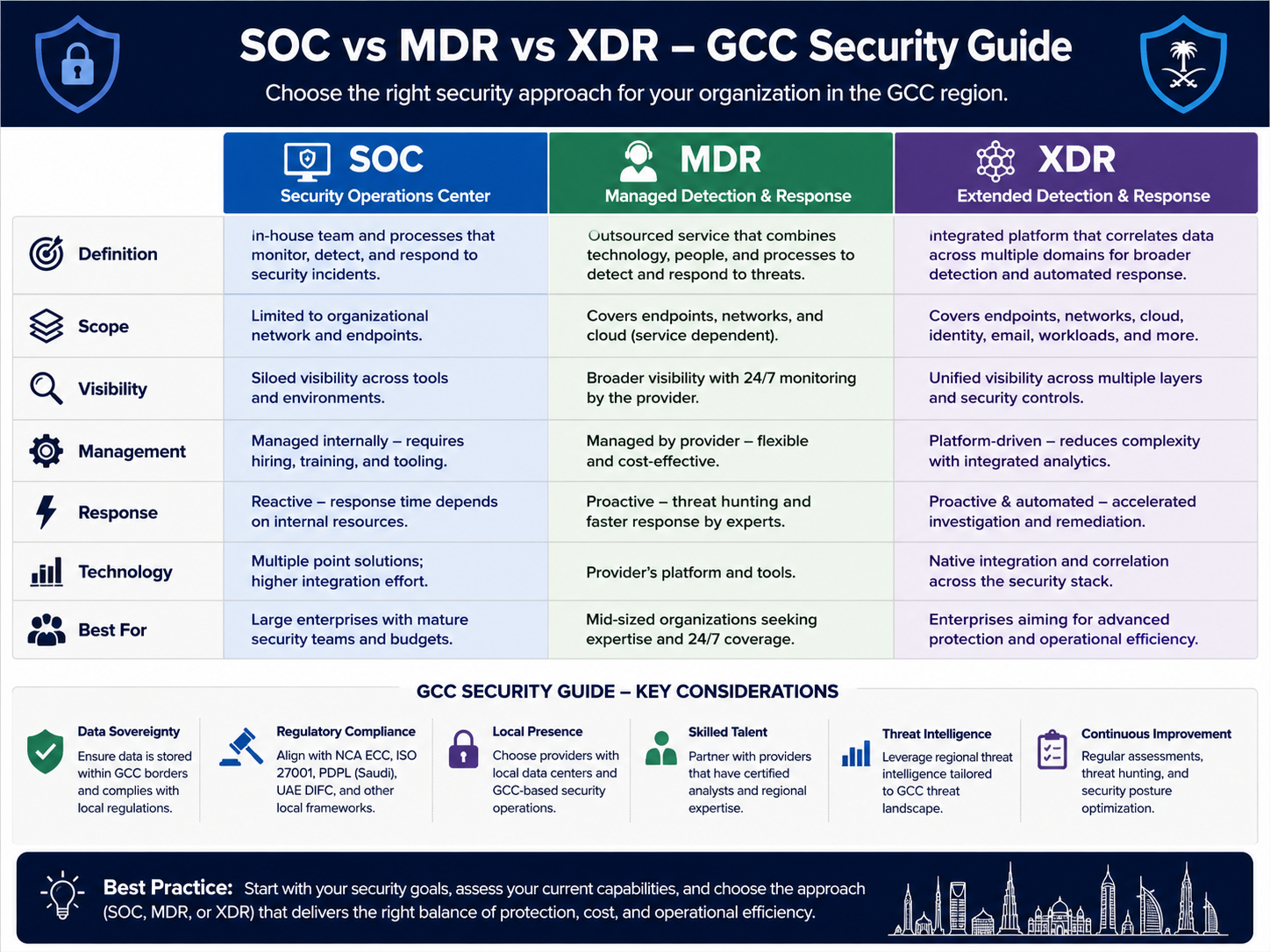
SOC vs MDR vs XDR helps GCC companies choose the right cybersecurity operating model. SOC gives control, MDR gives managed expertise, and XDR connects detection across endpoint, cloud, identity, email, and network tools.
For businesses in Saudi Arabia, the UAE, and Qatar, the right choice depends on compliance exposure, data residency, budget, internal security talent, and the need for 24/7 response.
Introduction.
Cybersecurity teams in Riyadh, Dubai, Abu Dhabi, and Doha are under serious pressure. Attacks are moving faster, cloud adoption is growing, and regulators expect stronger monitoring, evidence, and incident response.
That is why SOC vs MDR vs XDR is no longer just a technical comparison. It is a practical buying decision.
A Saudi fintech may need SAMA-ready monitoring. A Dubai e-commerce company may need faster threat detection across cloud and identity systems. A Doha SME may need visibility without hiring a large internal security team.
In practice, many GCC firms do not need to build everything in-house from day one. The smarter move is to match the operating model with business maturity, compliance needs, and available resources.
What SOC, MDR, and XDR Mean for GCC Companies
What Is a Security Operations Center?
A Security Operations Center, or SOC, is the team, process, and technology layer that monitors security events, investigates alerts, and supports incident response.
For GCC companies, SOC operations often include.
SIEM monitoring
Log collection and correlation
Alert triage
Escalation workflows
Audit evidence
Arabic or bilingual reporting
24/7 analyst coverage
SOC gives the highest level of control, but it also needs skilled people, strong governance, and continuous tuning.
What Is Managed Detection and Response?
Managed Detection and Response, or MDR, is an outsourced security service where external analysts monitor threats, investigate suspicious behavior, hunt for attacks, and guide containment.
MDR is especially useful for mid-market GCC firms that need better security maturity but cannot hire a full internal SOC team.
It gives access to specialist expertise without the cost and complexity of building everything internally.
What Is Extended Detection and Response?
Extended Detection and Response, or XDR, is a platform-led model that connects security signals from different tools.
It may bring together data from.
Endpoint devices
Cloud workloads
Identity systems
Email platforms
Network tools
SaaS applications
XDR is useful when a company already uses multiple security tools but struggles with disconnected alerts and slow investigations.
SOC vs MDR vs XDR: The Core Differences
Control, Ownership, and Team Requirements
SOC gives your business the most control. You own the process, the data flow, the tooling decisions, and the response model.
But that control comes with responsibility. You need analysts, playbooks, governance, reporting, tuning, and clear escalation paths.
MDR shifts daily monitoring and investigation to a provider. Your internal team still owns risk decisions, but the provider handles much of the operational workload.
XDR gives your team a unified detection platform. It improves visibility, but someone still needs to investigate alerts, make containment decisions, and report outcomes.
Detection Coverage and Response Speed
SOC coverage depends heavily on SIEM quality, log sources, analyst skill, and maturity of playbooks.
MDR usually improves response speed because dedicated specialists monitor threats continuously and often bring threat-hunting experience.
XDR improves detection quality by connecting signals across endpoint, cloud, identity, email, and network environments. This is especially helpful for Microsoft-heavy, hybrid, or cloud-first organizations.
Best Fit by Business Maturity
Startups in Saudi Arabia, Qatar, or the UAE often begin with MDR because it gives fast protection without heavy hiring.
Mid-market retail, logistics, and professional services firms may prefer SOC as a Service when they need reporting, monitoring, and audit trails.
Banks, government entities, and large enterprises may combine SOC, MDR, and XDR to balance control, visibility, and specialist response support.
GCC Compliance Factors: Saudi, UAE, and Qatar
Saudi Arabia.
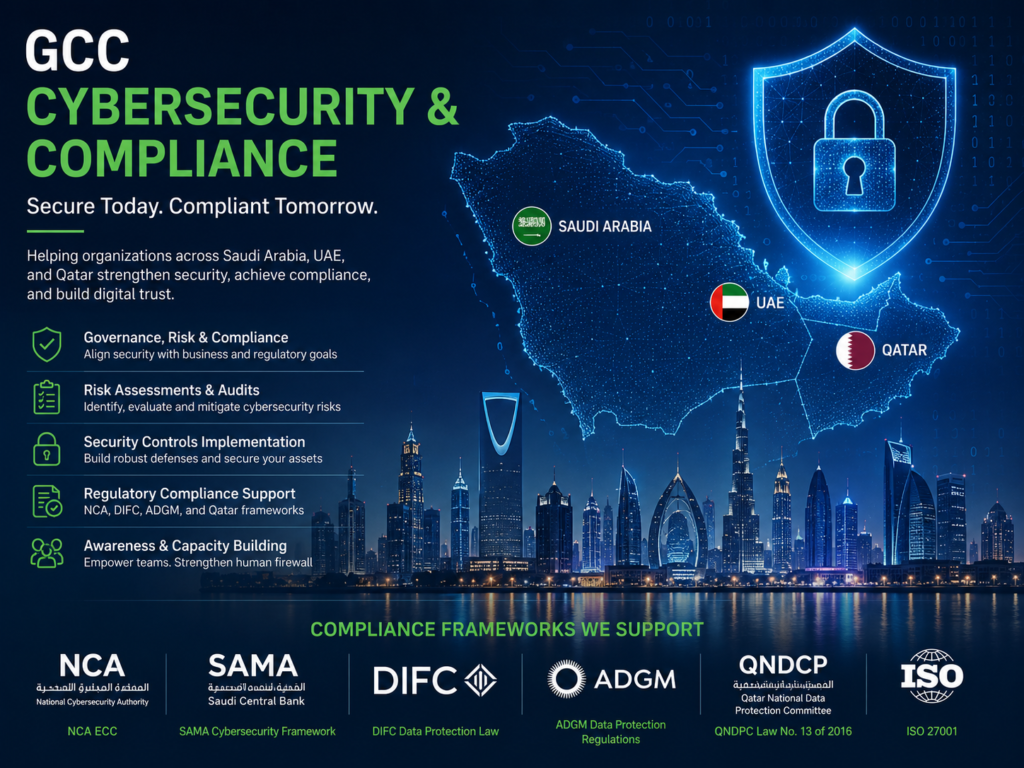
Saudi buyers should pay close attention to NCA ECC, SAMA cybersecurity expectations, NDMO data governance, cloud controls, and Arabic reporting.
For regulated firms, the question is not only “Can this tool detect threats?” It is also “Can this model produce evidence during an audit?”
A Riyadh fintech, for example, should ask whether the provider can support log retention, incident documentation, cyber maturity reviews, and Saudi data governance expectations.
UAE.
UAE companies in Dubai and Abu Dhabi should consider TDRA guidance, UAE Information Assurance expectations, ADGM and DIFC financial-service obligations, identity security, and cloud logging.
For a Dubai e-commerce company, the priority may be fast detection across cloud apps, customer-facing systems, payment flows, and user identities.
For an Abu Dhabi financial services firm, audit trails, escalation workflows, access control, and management reporting may matter just as much as detection.
Qatar.
Qatar firms should evaluate QCB technology risk expectations, Qatar NCSA alignment, Doha-based monitoring needs, and financial-sector evidence trails.
A bank or financial services operator in Doha should avoid generic alert-forwarding services. The provider should explain how it handles privileged access monitoring, cloud logs, endpoint telemetry, incident evidence, and response SLAs.
Which Option Fits Your GCC Business Best?
When to Choose SOC as a Service
Choose SOCaaS when you need local or regional monitoring, regulator-facing reports, Arabic dashboards, SIEM operations, and clear audit trails.
SOCaaS is a strong fit for compliance-heavy organizations in Riyadh, Abu Dhabi, Doha, Jeddah, and other GCC business hubs.
It works well when your company wants SOC maturity but does not want to build a fully internal operation immediately.
When to Choose MDR
Choose MDR when you lack senior SOC talent but need 24/7 detection, threat hunting, and guided response.
A Riyadh fintech following SAMA expectations can use MDR to improve maturity quickly while keeping governance and risk ownership internal.
MDR is also practical for SMEs that need better protection but cannot justify a large security team.
When to Choose XDR
Choose XDR when your environment is cloud-first, endpoint-heavy, or already using several security tools.
A Dubai e-commerce brand scaling mobile apps and cloud services may benefit from XDR because identity, endpoint, email, and cloud alerts become easier to connect.
XDR is strongest when your team can act on the alerts or when it is paired with MDR or SOCaaS.
Cost, Timeline, and Resource Comparison in GCC Markets
Typical Cost Drivers in Saudi, UAE, and Qatar
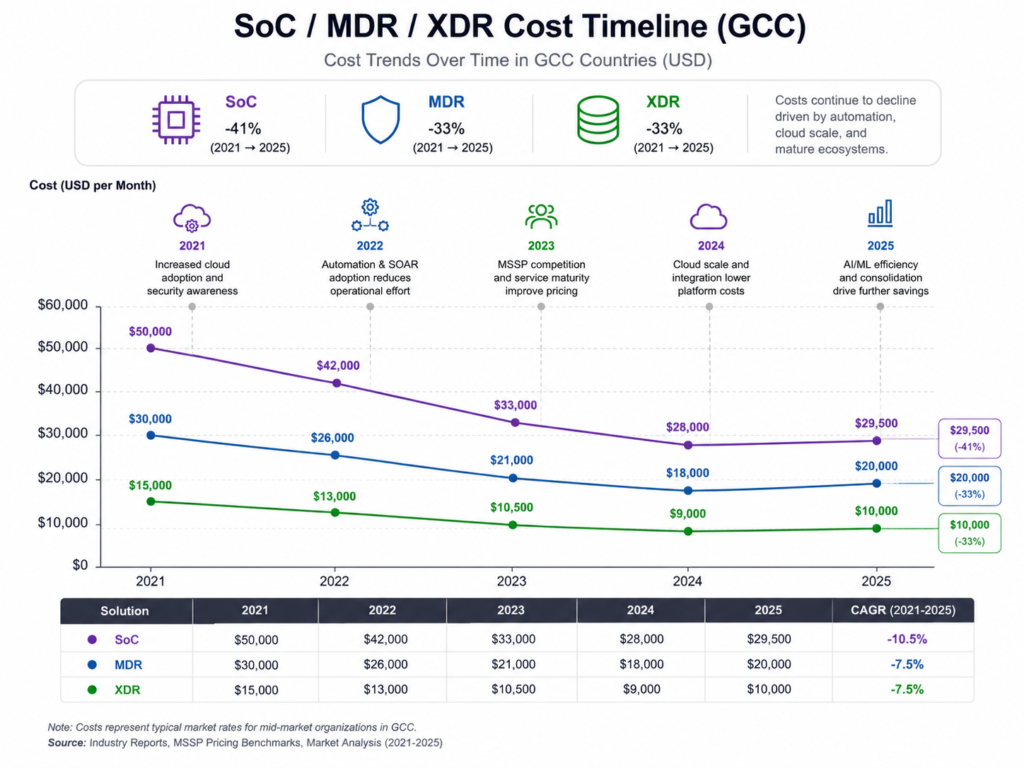
Cybersecurity costs vary widely, but the main drivers are usually clear.
Analyst coverage
SIEM licensing
Log ingestion volume
Endpoint count
Cloud telemetry
Response SLAs
Arabic or bilingual reporting
Data residency requirements
Integration complexity
Cloud region choices can also affect latency, log architecture, and data handling across Saudi Arabia, the UAE, Qatar, Bahrain, and nearby markets.
Deployment Timelines.
A full SOC buildout usually takes longer because it requires hiring, tooling, governance, runbooks, and reporting processes.
MDR is usually faster to onboard because the provider already has analysts, workflows, and detection methods in place.
XDR often sits in the middle. The platform may deploy quickly, but real value depends on integrations, tuning, and how well your team responds to incidents.
Hidden Costs GCC Buyers Should Watch
A low headline price can become expensive if the service cannot support real operational needs.
Watch for.
SIEM ingestion overages
Weak Arabic reporting
Limited regional support
Unclear response SLAs
Too many false positives
Poor compliance evidence
Slow escalation during active incidents
For regulated GCC companies, the cheapest option is rarely the safest option.
Local Examples by Industry.
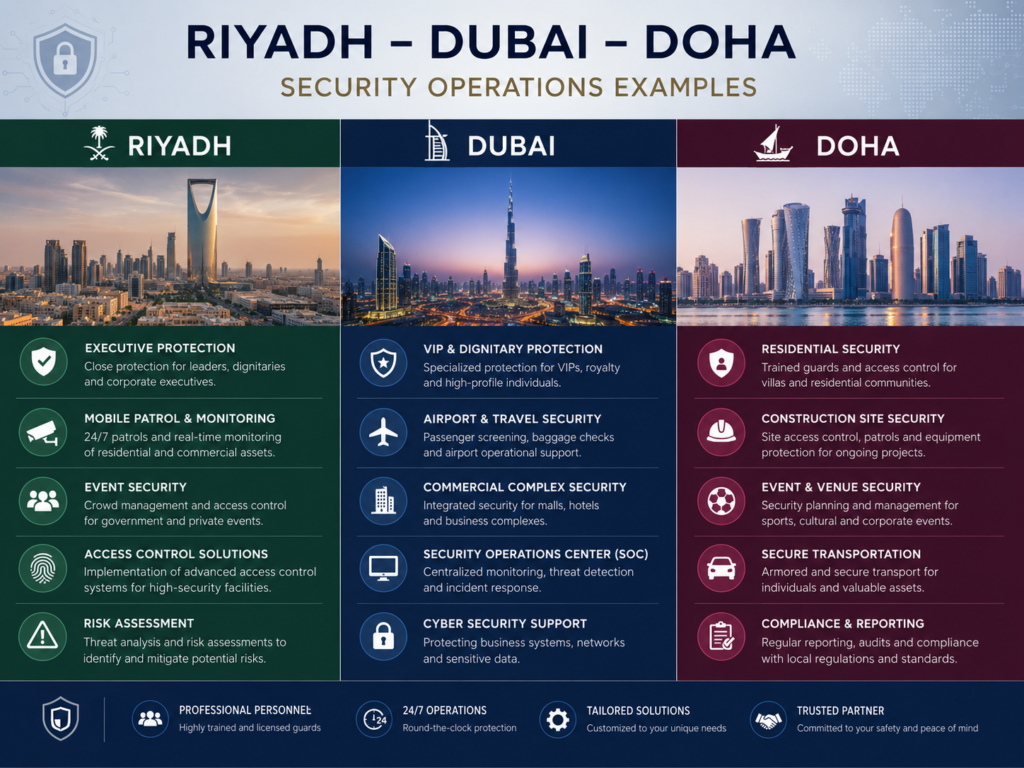
Fintech and Banking in Riyadh, Dubai, and Doha
Banks, PSPs, open banking providers, and fintech startups need strong monitoring, escalation records, and regulator-ready evidence.
This is where SOC vs MDR vs XDR becomes a board-level resilience decision, not just an IT purchase.
Government and Critical Infrastructure
Government and critical infrastructure teams often need local SOC visibility, Arabic incident reports, national cybersecurity alignment, and strict access control.
In many cases, SOCaaS or co-managed SOC models are stronger than platform-only XDR.
Retail, Logistics, and Multi-Branch Operations
Retail and logistics firms need protection across POS systems, warehouses, cloud apps, third-party APIs, and branch identities.
A Jeddah logistics company may use MDR for response support, while a Dubai retailer may use XDR to connect endpoint, cloud, and identity alerts across multiple locations.
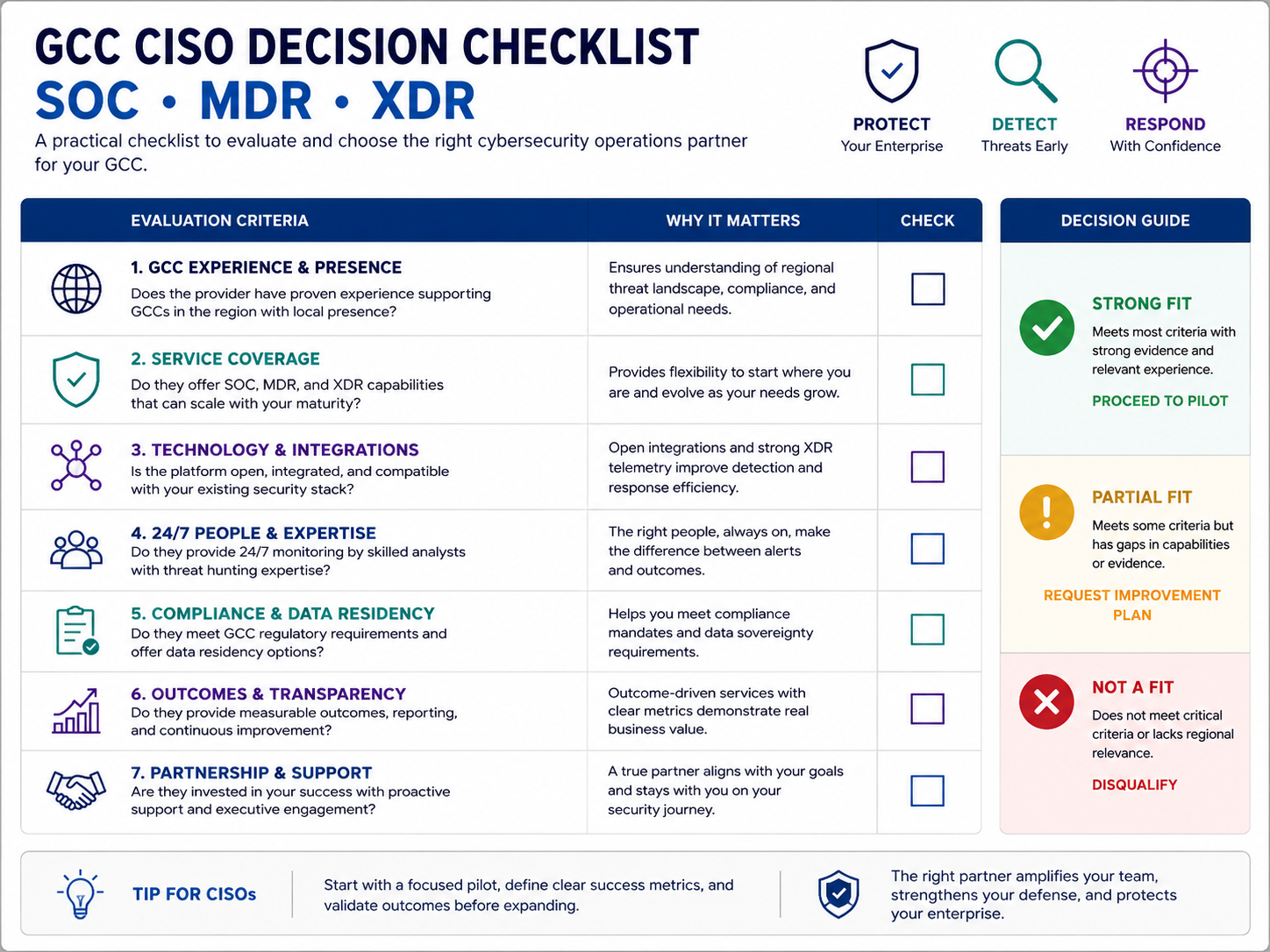
How to Choose Between SOC, MDR, and XDR in 2026
Decision Checklist for GCC CISOs and IT Leaders
Before choosing a model, ask.
Do we need regulator-ready evidence?
Do we have internal analysts?
Where must our data and logs reside?
What response SLA is acceptable?
Do we need Arabic or bilingual reporting?
Which cloud regions support our workloads?
Who will make containment decisions during an incident?
These answers will usually make the right model much clearer.
Recommended Model by Business Type
| Business Type | Best Starting Point | Why It Fits |
|---|---|---|
| Startup or SME | MDR | Fast maturity without heavy hiring |
| Mid-market regulated firm | SOCaaS | Better reporting, monitoring, and audit support |
| Cloud-first company | XDR + MDR | Strong visibility with managed response |
| Large enterprise | Co-managed SOC | Internal control with specialist support |
| Bank or government entity | SOC + MDR + XDR | Governance, evidence, visibility, and response depth |
Final Recommendation
For most mid-market GCC companies, MDR or SOCaaS is the safest starting point. Larger regulated entities should consider combining SOC governance, MDR expertise, and XDR visibility.
In simple terms, SOC vs MDR vs XDR is not about choosing the “best” acronym. It is about choosing the operating model your risk, compliance, team capacity, and business growth can actually sustain.
Need help choosing between SOC, MDR, and XDR for your GCC business?
Contact Mak It Solutions to review your security maturity, compare options, and request a custom cybersecurity strategy for Saudi Arabia, the UAE, or Qatar.( Click Here’s )
FAQs
Q : Is SOC as a Service suitable for Saudi companies under NCA expectations?
A : Yes. SOC as a Service can suit Saudi companies when it supports strong monitoring, documented escalation, incident evidence, Arabic reporting, and audit-ready documentation.
For organizations affected by NCA ECC or SAMA expectations, the provider should help map logs, alerts, and response records to compliance needs.
Q : Do UAE businesses need local SOC monitoring for TDRA-related compliance?
A : Not every UAE business needs a fully local SOC, but regulated or sensitive organizations often benefit from regional monitoring and clear incident reporting.
A Dubai e-commerce company or Abu Dhabi financial services firm should ask whether the provider can support UAE cloud environments, identity monitoring, bilingual reports, and timely escalation.
Q : What should Qatar banks ask before choosing an MDR provider?
A : Qatar banks should ask whether the MDR provider understands QCB technology risk expectations, financial-sector audits, and Doha-based operational realities.
The provider should explain how it handles incident evidence, privileged access monitoring, cloud logs, endpoint telemetry, and response SLAs.
Q : Is XDR enough for GCC companies without a managed response team?
A : XDR is powerful, but it is not always enough by itself.
It can connect endpoint, identity, cloud, email, and network signals, but someone still needs to investigate incidents, make containment decisions, and report outcomes. For companies with limited security staff, XDR works best when paired with MDR or SOCaaS.
Q : Can one provider support SOC monitoring across Saudi, UAE, and Qatar?
A : Yes, one provider can support SOC monitoring across Saudi, UAE, and Qatar if it understands regional compliance, data residency, localized reporting, and escalation culture.
For a GCC group operating in Riyadh, Dubai, and Doha, the best model is often centralized monitoring with country-specific reporting and flexible response playbooks.