


Preemptive Cybersecurity: GCC Defense Guide
Preemptive Cybersecurity: GCC Defense Guide
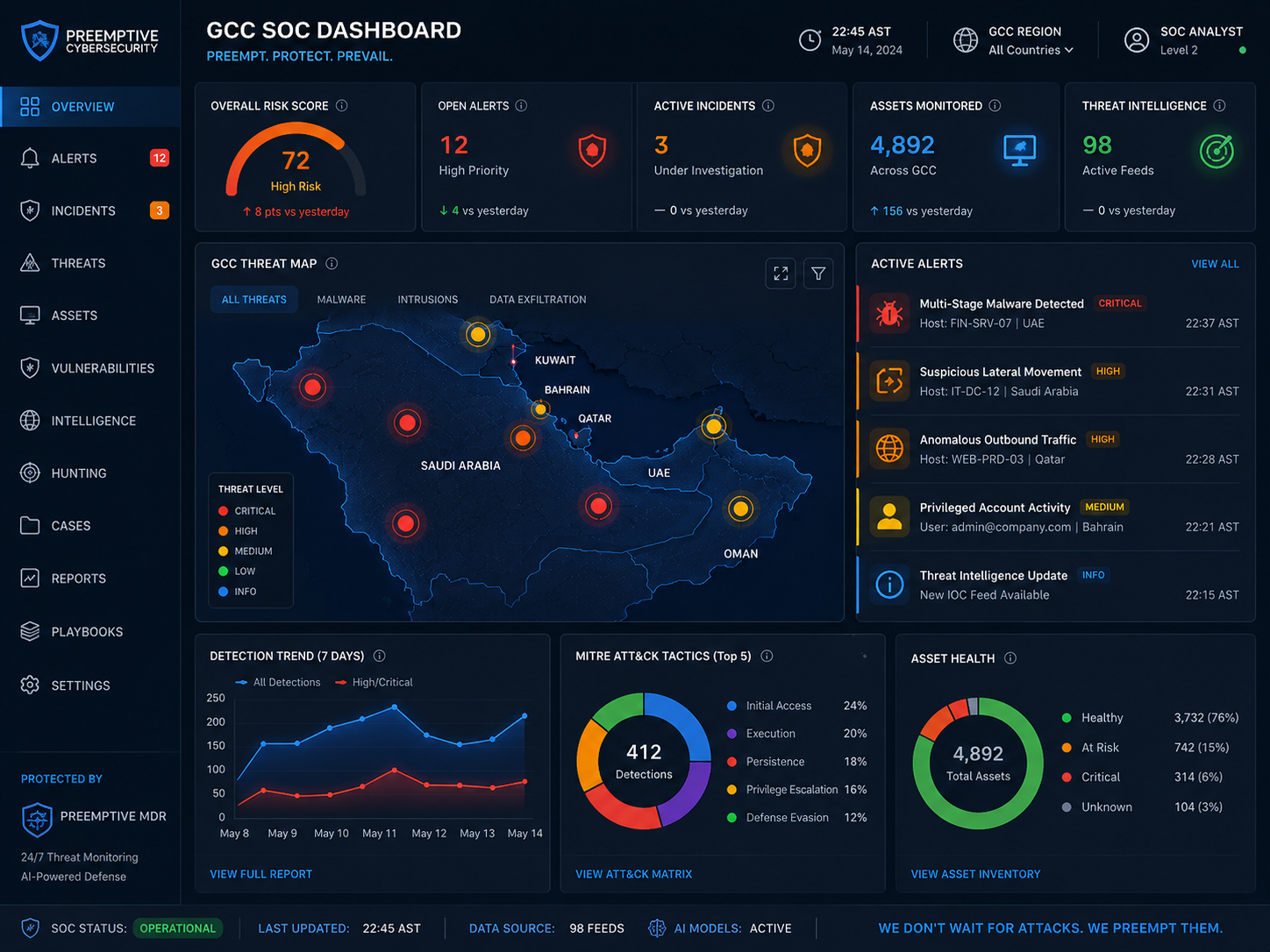
Preemptive Cybersecurity: GCC Defense Guide
Preemptive cybersecurity helps GCC companies detect, validate, and reduce cyber risks before attacks disrupt operations. For Saudi, UAE, and Qatar organizations, it supports faster threat detection, stronger compliance readiness, and more resilient digital growth.
Why GCC Companies Need Preemptive Cybersecurity Now
Cyberattacks are moving faster than traditional security teams can react. For companies in Riyadh, Dubai, Abu Dhabi, Jeddah, and Doha, the risk is no longer just malware. It now includes ransomware, cloud misconfigurations, identity abuse, AI-assisted phishing, supplier exposure, and growing regulatory pressure.
That is where preemptive cybersecurity becomes important.
Instead of waiting for alerts after damage begins, this approach helps businesses find weak points earlier. It combines AI-assisted SOC workflows, MDR, XDR, threat hunting, attack surface management, CTEM, and incident response readiness into one practical security model.
For GCC businesses, this is not only a technical upgrade. It is a business resilience strategy.
What Is Preemptive Cybersecurity?
Preemptive cybersecurity is a proactive security model that finds exposures, suspicious behavior, and attack paths before they become real incidents.
In practice, it means continuously checking.
Identity access
Endpoints
Cloud workloads
APIs
Networks
Third-party systems
Public-facing assets
A Riyadh fintech, a Dubai marketplace, or a Doha logistics platform cannot afford long detection gaps. When attackers move quickly, security teams need visibility before the damage spreads.
How It Differs from Traditional Cybersecurity
Traditional cybersecurity often focuses on blocking known threats and responding after alerts appear. Preemptive cybersecurity goes one step earlier.
It asks better questions.
Which assets are exposed?
Which identities have too much access?
Which cloud settings could be abused?
Which attack paths are most likely?
Which risks should be fixed first?
This makes cybersecurity more practical for business leaders because the focus shifts from “more alerts” to “clearer action.”
Why Early Attack Detection Matters
Early detection protects revenue, reputation, and regulator confidence.
In banking, minutes matter.
In healthcare, patient trust matters.
In government and critical infrastructure, downtime can affect public services.
For GCC enterprises, early attack detection also supports board-level cyber risk reporting. Leaders can see which risks are being reduced, not just how many alerts were generated.
Preemptive Cybersecurity, SOC, MDR, XDR, and CTEM
A strong preemptive cybersecurity program is not built from one tool. It usually brings several capabilities together.
| Capability | Role in Preemptive Cybersecurity |
|---|---|
| SOC | Monitors security activity and investigates alerts |
| MDR | Provides managed detection and response support |
| XDR | Connects threat signals across tools and environments |
| CTEM | Continuously validates exposures and prioritizes risk |
| Threat Hunting | Looks for hidden attacker behavior before obvious alerts |
| Incident Response | Prepares teams to contain and recover from attacks |
Together, these capabilities create a security model that is easier to measure, improve, and explain to executives.
Why Saudi, UAE, and Qatar Companies Are Prioritizing Early Detection
GCC companies are investing in early attack detection because digital transformation has expanded their risk surface.
More cloud systems, APIs, remote access, mobile apps, fintech platforms, and customer-facing portals mean more opportunities for attackers. At the same time, regulators expect stronger governance, monitoring, and resilience.
Saudi Arabia.
Saudi organizations are aligning cybersecurity with national digital growth, Vision 2030 programs, energy, banking, logistics, and government modernization.
The Saudi National Cybersecurity Authority says ECC 2-2024 was updated to strengthen national cybersecurity and protect information and technology assets of national entities.
For Saudi firms, preemptive cybersecurity supports.
Stronger identity and access monitoring
Better incident readiness
Continuous asset visibility
Risk-based reporting
Stronger audit evidence
This is especially important for regulated sectors, national-interest entities, and companies serving government or critical infrastructure clients.
UAE.
Dubai and Abu Dhabi businesses are scaling cloud-native services, financial platforms, e-commerce operations, and smart government systems.
The UAE Information Assurance Regulation includes management and technical security controls, which makes structured cybersecurity governance important for organizations that need trust, resilience, and audit readiness.
For UAE companies, preemptive cybersecurity can help connect SOC reporting with.
Cloud security
Identity monitoring
Incident escalation
Governance evidence
Executive risk dashboards
A Dubai e-commerce brand or Abu Dhabi financial services firm needs more than alerts. It needs clear detection, response, and recovery workflows.
Qatar.
In Qatar, Doha enterprises, banks, logistics companies, energy firms, and government suppliers are investing in stronger cyber resilience.
Qatar’s NCSA oversees cybersecurity matters, including the formulation and continuous updating of national cyber policies. Qatar’s Cybersecurity Strategy 2024–2030 also highlights resilience, regulation, the data economy, cyber culture, and trusted partnerships.
For Qatar businesses, preemptive cybersecurity supports stronger monitoring across cloud, identity, applications, endpoints, and third-party environments.
Core Components of a Preemptive Cybersecurity Strategy
A practical strategy combines visibility, validation, and response.
Proactive Threat Detection and Threat Hunting
Threat hunting looks for hidden attacker behavior before normal tools raise urgent alarms.
It uses.
Cyber threat intelligence
Identity logs
Endpoint activity
Network patterns
Cloud activity
User behavior signals
For example, unusual login behavior, privilege misuse, or suspicious lateral movement can be investigated before a ransomware attack becomes visible to the whole business.
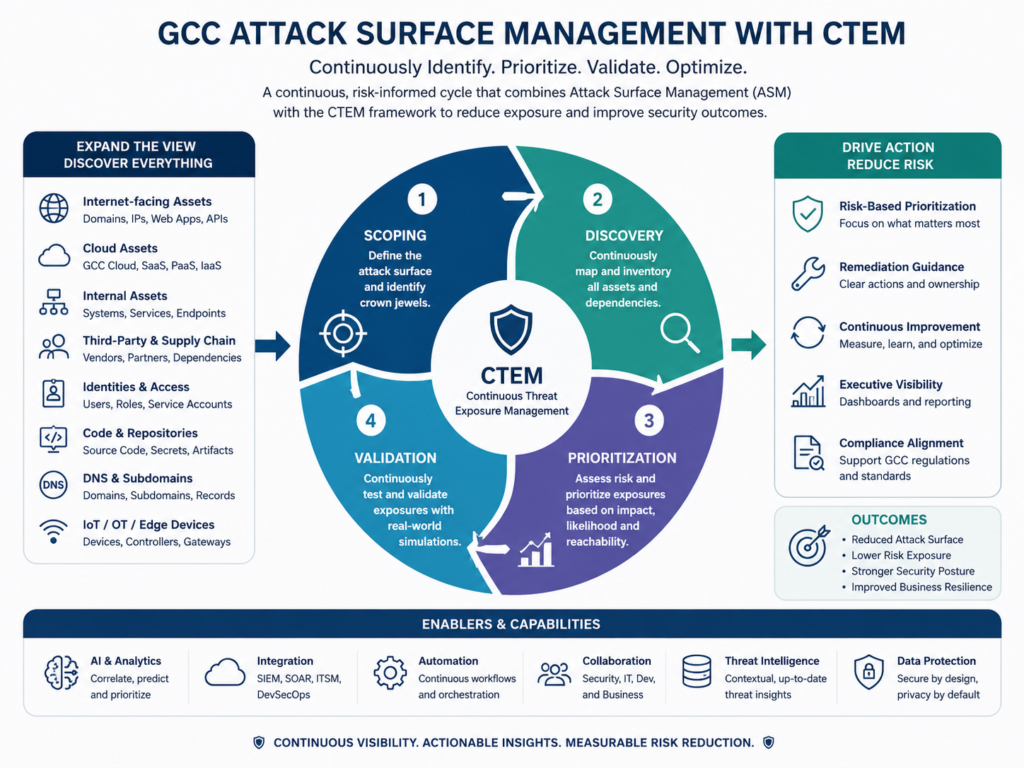
Attack Surface Management and CTEM
Attack surface management maps exposed systems, domains, cloud assets, APIs, and misconfigurations.
CTEM then helps validate which exposures are truly dangerous. This prevents teams from wasting time on low-impact issues while high-risk attack paths remain open.
In simple terms.
Discover exposed assets
Assess the risk
Validate whether attackers can exploit it
Prioritize what matters most
Remediate and measure improvement
This is especially useful for GCC companies with fast-growing cloud, mobile, and e-commerce environments.
AI-Assisted SOC Workflows and Security Analytics
AI can help SOC teams triage alerts, correlate signals, summarize incidents, and reduce noise.
But it should not replace governance.
For regulated sectors such as banking, government, healthcare, and critical infrastructure, human approval should remain part of high-risk decisions. AI can speed up analysis, but accountability still belongs to the organization.
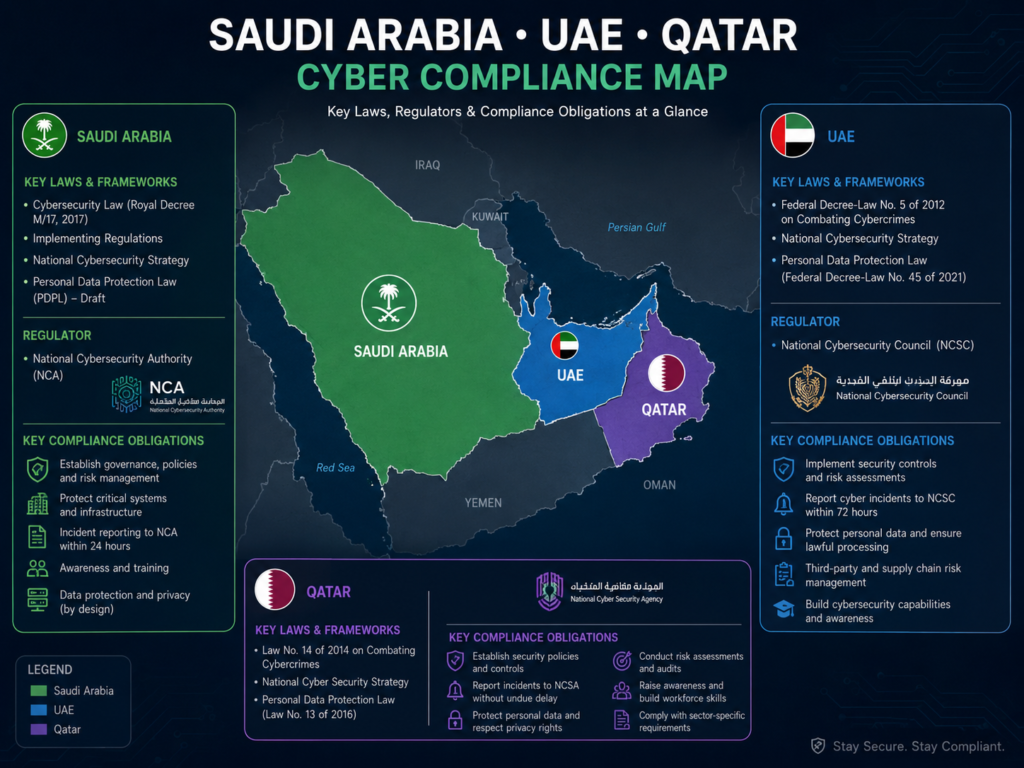
Compliance and Trust Requirements Across the GCC
Preemptive cybersecurity supports compliance by showing that risks are continuously monitored, prioritized, and remediated.
It helps security teams provide better evidence for.
Asset visibility
Access control
Monitoring
Incident response
Risk remediation
Executive reporting
Vendor and cloud governance
Saudi Compliance.
Saudi banks, fintech companies, enterprises, and government suppliers should map monitoring, identity security, incident response, and cloud controls to relevant local expectations.
For many Saudi organizations, data hosting and regional cloud planning are also part of procurement and trust conversations.
A practical approach is to connect preemptive cybersecurity metrics with business and compliance needs, such as.
Detection time
Response time
High-risk exposures closed
Identity risks reduced
Incident readiness status
Audit evidence availability
UAE Compliance.
UAE firms in Dubai, Abu Dhabi, ADGM, and DIFC should connect SOC reporting with governance, cloud security, and audit evidence.
Local and regional cloud options, including Azure UAE Central, can also support latency and data strategy where relevant.
For UAE businesses, the goal is not only to detect threats. It is to prove that cyber risk is being managed in a structured and repeatable way.
Qatar Compliance.
Qatar banks, energy companies, enterprises, and government suppliers should align monitoring with QCB expectations, NCSA resilience priorities, and Doha-based cloud strategies where relevant.
Cloud regions such as GCP Doha may support local latency and data planning, but monitoring still needs strong detection rules, identity controls, and incident response playbooks.
Business Use Cases for GCC Industries
Fintech and Banking
A Riyadh fintech can use MDR, zero trust security, and threat hunting to detect unusual login behavior before fraud spreads.
For banks and fintech companies, preemptive cybersecurity helps reduce risks around.
Account takeover
Privilege misuse
API abuse
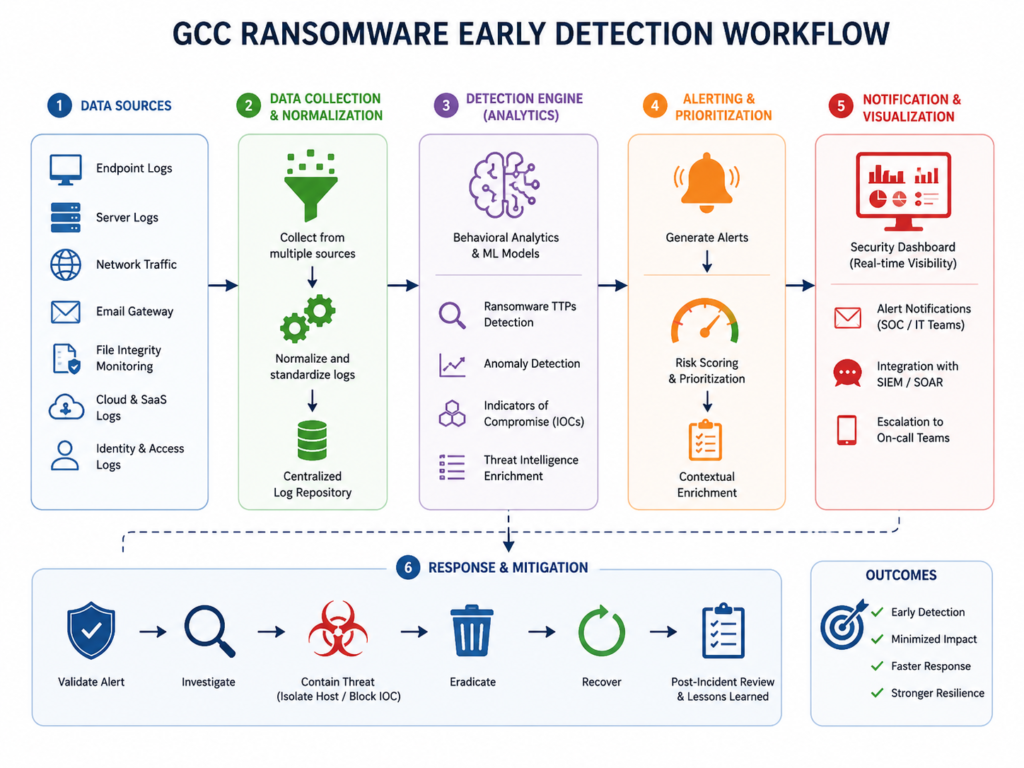
Ransomware
Data exposure
Third-party access
This also supports stronger customer trust and better risk discipline.
Government and Critical Infrastructure
A UAE government entity in Abu Dhabi can combine SOC monitoring, cloud controls, and incident playbooks to reduce service disruption risk across citizen platforms.
For critical infrastructure, preemptive cybersecurity is especially valuable because even short disruptions can have wider business or public impact.
Retail, Logistics, and Cloud Businesses
A Dubai e-commerce brand scaling mobile apps across Saudi Arabia and Qatar can use API monitoring, endpoint visibility, and attack surface management to reduce risk.
A Doha SME can use regional hosting and managed monitoring to improve resilience while keeping operations lean.
For growing businesses, the key benefit is focus. Security teams can fix the risks that matter most instead of chasing every alert.
How to Choose a Preemptive Cybersecurity Solution in the GCC
Compare MDR, XDR, SIEM, NDR, and CTEM Capabilities
Do not buy cybersecurity tools only by brand name.
Compare vendors based on.
Detection coverage
Log source support
Response speed
CTEM validation
Cloud visibility
Identity monitoring
Reporting quality
Integration with existing systems
Incident response support
The right solution should fit your business environment, not just your budget.
Check Arabic UX, Local Support, and GCC Compliance Readiness
For Arabic-speaking teams, bilingual dashboards and Arabic executive reporting can improve adoption.
Local support also matters during.
Incidents
Audits
Board reporting
Compliance reviews
Post-incident communication
In Saudi Arabia, UAE, and Qatar, cybersecurity often involves technical teams, executives, legal teams, and business owners. Clear bilingual reporting can make the whole process smoother.
Evaluate Detection Speed and Incident Response Readiness
Ask vendors direct questions.
How quickly can you detect suspicious behavior?
How do you validate exploitable exposure?
Do you provide tested incident response playbooks?
Can you support cloud, identity, endpoint, and network monitoring?
Can reports be mapped to GCC compliance needs?
Do you offer Arabic-friendly executive summaries?
A good preemptive cybersecurity partner should help you reduce risk, not just generate dashboards.
Best Practices for Building a GCC-Ready Cyber Defense Program
Start with Identity, Cloud, Endpoint, and Network Visibility
Inventory users, devices, cloud workloads, APIs, and public-facing assets.
Without visibility, preemptive cybersecurity becomes guesswork. You cannot protect what you cannot see.
Use AI Carefully for SOC Efficiency
Use AI to support analysts, not replace governance.
AI can help with.
Alert triage
Signal correlation
Incident summaries
Pattern recognition
Report drafting
But keep approval workflows, audit trails, and escalation rules clear.
Align Security Metrics with Business Priorities
Report metrics leaders understand.
Useful board-level metrics include.
Detection time
Response time
High-risk exposures closed
Ransomware readiness
Compliance gaps reduced
Critical assets monitored
Incident playbooks tested
This helps cybersecurity move from a technical cost center to a measurable resilience program.
Wrapping It Up
GCC companies in Saudi Arabia, UAE, and Qatar need earlier detection, continuous exposure validation, localized compliance mapping, Arabic-friendly workflows, and AI-assisted SOC maturity.
Preemptive cybersecurity gives leaders a clearer way to protect growth, trust, and resilience before attackers create damage.
For businesses expanding across Riyadh, Dubai, Abu Dhabi, Jeddah, and Doha, the message is simple: do not wait for the incident to prove where the gaps are. Find them early, validate them, and fix what matters most.
Mak It Solutions can help you assess detection gaps, compare MDR and CTEM readiness, and plan a GCC-focused cyber defense roadmap.
Explore our cybersecurity and IT services, visit the Mak It Solutions homepage, or contact the team to request a custom strategy for Saudi, UAE, or Qatar operations.
FAQs
Q : Is preemptive cybersecurity required for Saudi NCA ECC alignment?
A : Preemptive cybersecurity is not usually listed as one mandatory product, but its capabilities strongly support NCA ECC alignment. It helps with governance, monitoring, asset protection, access control, and incident readiness.
Q : What is the best MDR option for companies in Dubai and Abu Dhabi?
A : The best MDR option is one that understands UAE business risk, cloud environments, and regulatory expectations. Look for 24/7 monitoring, Arabic-friendly reporting, cloud security coverage, and clear incident escalation.
Q : How can Qatar businesses improve cyber threat monitoring in Doha?
A : Qatar businesses can improve monitoring by connecting endpoint, identity, cloud, network, and application logs into a managed SOC or MDR model. The goal is not more alerts; it is faster and clearer action.
Q : Do GCC companies need Arabic SOC dashboards and bilingual reporting?
A : Many GCC companies benefit from Arabic SOC dashboards and bilingual reports. Cybersecurity decisions often involve technical teams, executives, legal stakeholders, and board members, so clear communication matters.
Q : How does preemptive cybersecurity reduce ransomware risk?
A : It reduces ransomware risk by finding weak identities, exposed systems, suspicious lateral movement, and backup gaps before attackers encrypt data. Earlier detection usually means smaller business impact.