


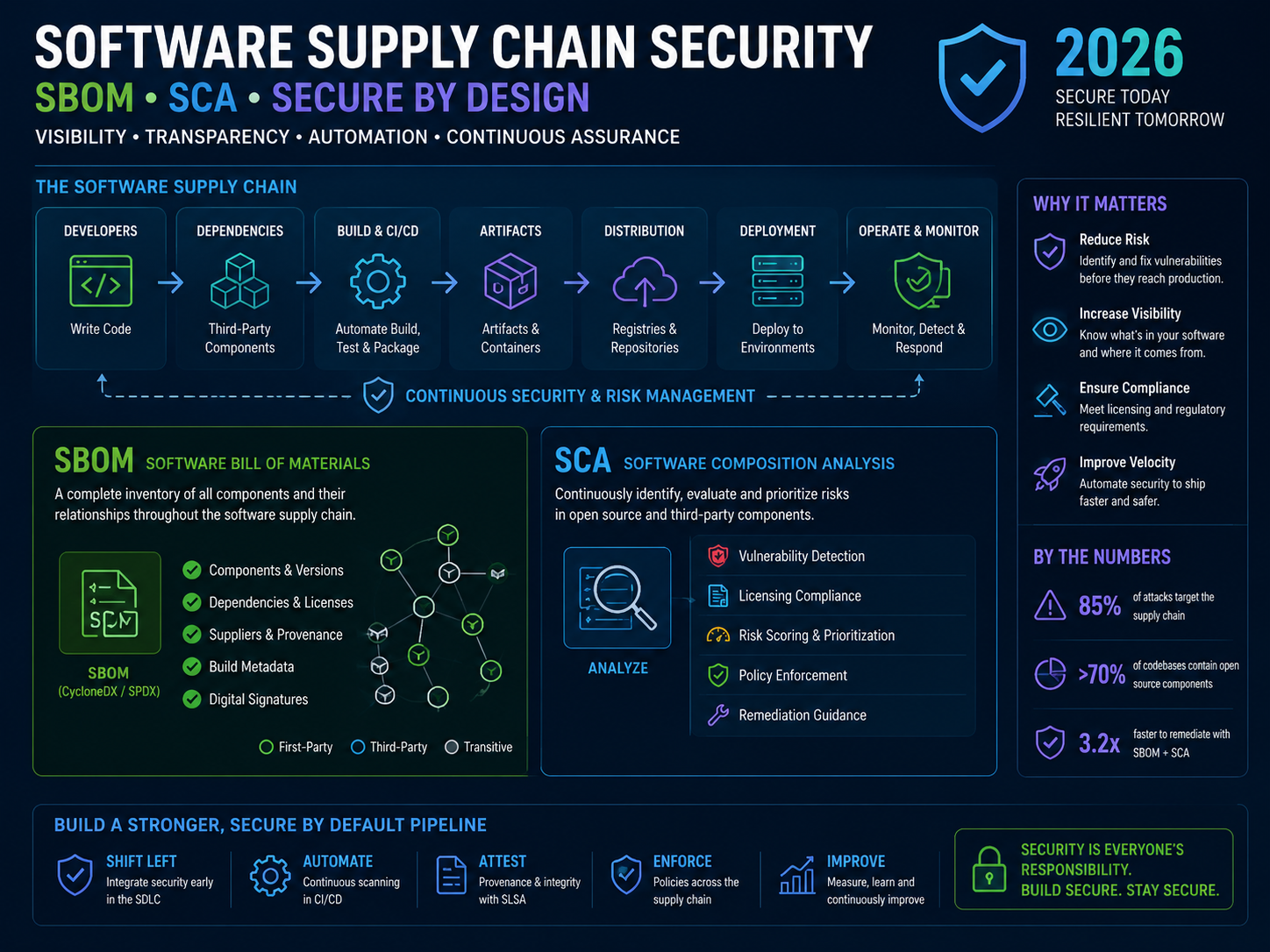
Software Supply Chain Security Guide
Software supply chain security protects the code, open-source packages, build systems, vendors, containers, and CI/CD pipelines used to create and ship software. For modern SaaS, fintech, healthcare, and enterprise platforms, it is no longer just an AppSec concern. It is now part of procurement, compliance, customer trust, and release quality.
The direct answer is simple: software supply chain security helps teams know what is inside their software, control what enters the build, and prove that risky components are detected and fixed before they reach production. Strong programs combine SBOMs, software composition analysis, dependency controls, and release gates so vulnerable or malicious code is less likely to move downstream.
A SaaS product in Austin, a fintech platform in London, or a healthcare portal serving EU customers may rely on hundreds of open-source packages, container images, APIs, GitHub Actions, and cloud services. That speed is valuable, but it creates hidden risk. One compromised dependency, abandoned package, poisoned build step, or unverified vendor component can affect every customer who depends on the final product.
What Is Software Supply Chain Security?
Software supply chain security is the practice of protecting every component, process, and third party involved in building and delivering software.
It covers.
Source code
Open-source dependencies
Container images
Package registries
CI/CD pipelines
Build systems
Cloud infrastructure
Vendor software
Release artifacts
For buyers and engineering leaders, the goal is practical: know what is inside your software, control what enters it, and respond quickly when something becomes risky.
Why Modern Apps Depend on Open-Source and Cloud Components
Modern applications move fast because teams reuse trusted building blocks. A product team may use React, Node.js, Python libraries, Java packages, container base images, cloud APIs, payment gateways, observability agents, and SaaS integrations.
That is normal. It is also why secure architecture should be part of every build. Teams planning custom platforms can align supply chain controls with back-end development services, front-end development services, and broader web development planning.
How Supply Chain Attacks Enter Software
Attackers often enter through places teams already trust.
Common paths include.
Malicious package updates
Dependency confusion
Compromised maintainer accounts
Leaked CI/CD secrets
Unsafe third-party actions
Tampered containers
Vendor software updates
Unreviewed transitive dependencies
That is why “scan before release” is not enough. Strong software supply chain security starts when code is selected, continues during build, and stays active after deployment.
Why SBOMs Are Central to Software Supply Chain Security
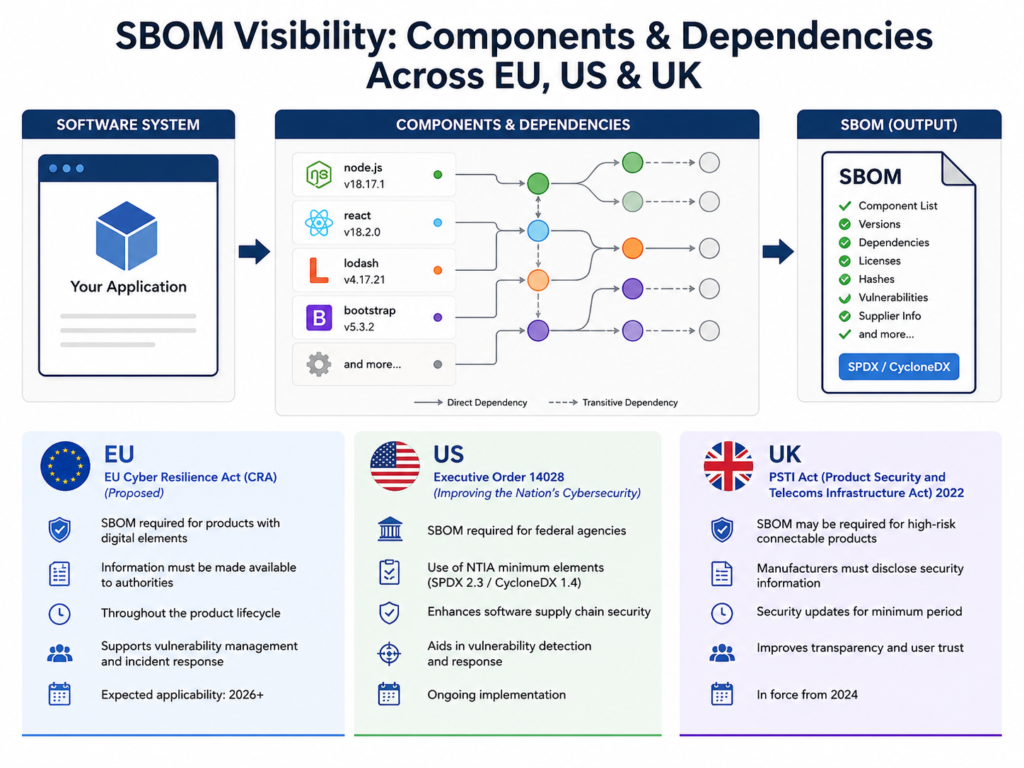
SBOMs matter because they create visibility. A software bill of materials is an inventory of the components inside an application. CISA describes an SBOM as a nested inventory of the ingredients that make up software components.
Without an SBOM, teams often lose valuable time asking, “Do we use this package anywhere?” With an SBOM, they can search affected products, versions, environments, and owners much faster.
What an SBOM Shows
A useful SBOM usually includes.
Component names
Versions
Suppliers
Package identifiers
Dependency relationships
Cryptographic hashes
License data
Mature teams also connect SBOMs to build metadata, repository ownership, deployment environments, and vulnerability feeds.
For example, a SaaS company in San Francisco may use SBOMs to check whether a vulnerable container image affects production APIs. A regulated buyer in New York may request SBOM evidence before approving a vendor for enterprise procurement.
Cyclone DX vs SPDX
Cyclone DX is often preferred by security teams because it was designed around application security, vulnerability management, and dependency relationships. SPDX is widely used for open-source license compliance and is also recognized across software supply chain workflows.
Many organizations support both. A practical approach is to generate Cyclone DX for security operations and SPDX where customers, legal teams, or procurement workflows require it.
How SBOM Management Supports Vendor Assurance
SBOM management turns static component lists into operational evidence. It helps security teams track exposure, prioritize remediation, answer customer questionnaires, and support vendor reviews.
For enterprise buyers, SBOMs are becoming a trust signal. They show that a supplier can identify what it ships, monitor known vulnerabilities, and respond when components become risky.
Dependency Controls That Reduce Open-Source Risk
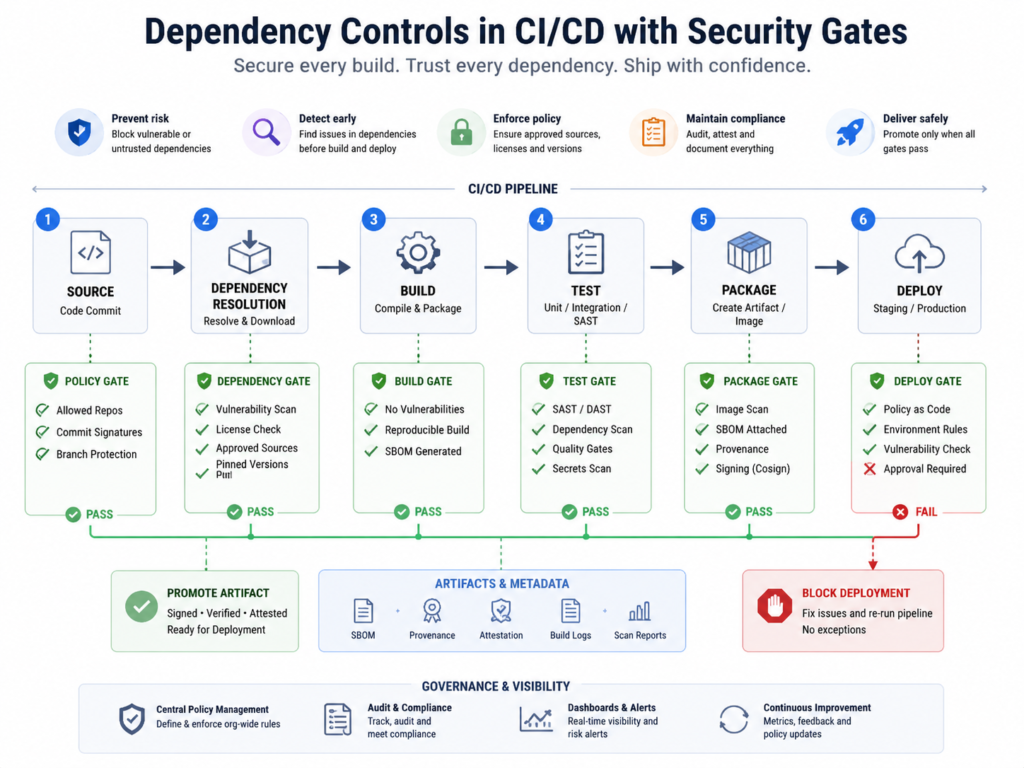
Dependency controls reduce open-source risk by limiting what packages enter development and production. They help teams prevent vulnerable, malicious, abandoned, or non-compliant packages from becoming part of the released product.
This is where security becomes practical for developers. Instead of relying only on manual review, teams define rules that guide package selection, updates, approvals, and CI/CD behavior.
Pinning, Allow lists, Provenance, and Approved Registries
Pinning locks dependencies to known versions instead of accepting unexpected updates. Allow lists define approved packages, vendors, licenses, and registries. Package provenance helps verify where a component came from and whether it was built by a trusted source.
Approved registries are especially important in larger teams. A company with engineering groups in Austin, London, and Berlin should avoid random dependency downloads from public sources when a private, monitored registry can enforce policy.
Managing Transitive Dependency Risk in CI/CD
Transitive dependencies are packages pulled in by packages your team directly installs. They are easy to miss and often create the biggest visibility gap.
CI/CD pipelines should scan direct and transitive dependencies, compare results against policy, and block releases only when the risk is meaningful. For example, a critical reachable vulnerability in an internet-facing API should trigger a stronger gate than a low-severity issue in a test-only package.
Practical Rule for Dependency Controls
Dependency controls should prevent vulnerable, malicious, abandoned, or non-compliant packages from entering production.
The best controls are strict enough to reduce risk but flexible enough to keep delivery moving. Use exceptions, expiry dates, security owner approval, and audit trails so developers can move forward without bypassing governance.
Software Composition Analysis Tools and Remediation Workflows
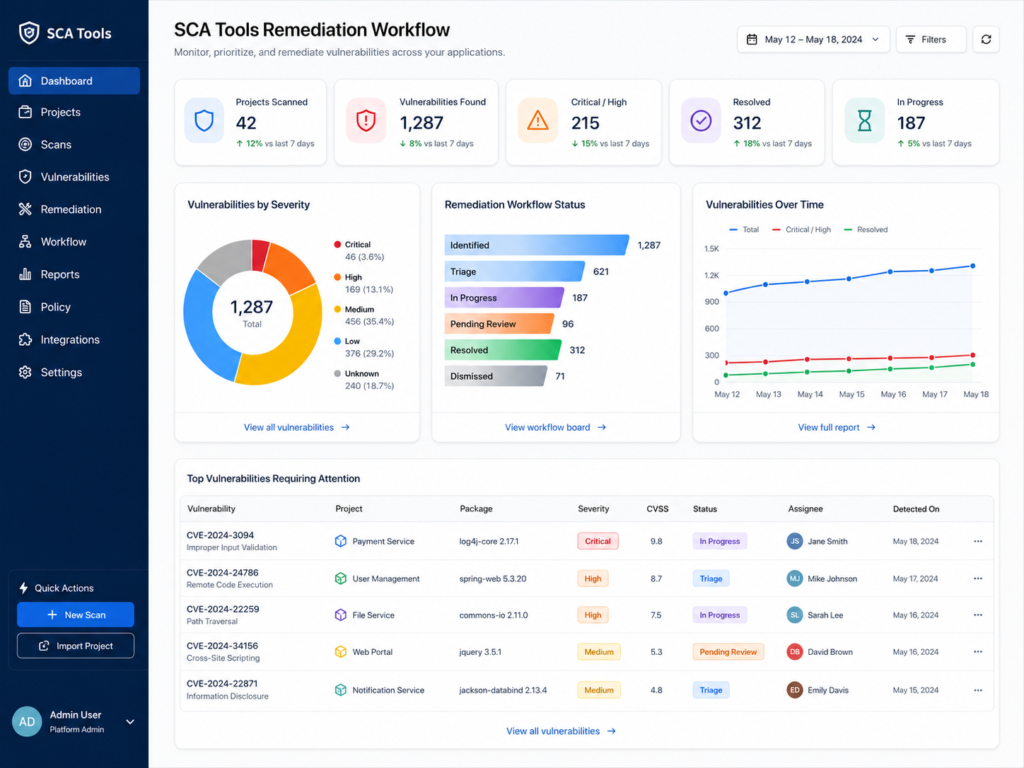
Software composition analysis tools identify open-source risks across repositories, builds, containers, and sometimes runtime environments. They help teams detect known vulnerabilities, risky licenses, malware signals, outdated packages, and policy violations.
The real value is not just detection. It is remediation workflow: who owns the issue, how urgent it is, what fix is available, and whether the fix breaks the product.
What SCA Tools Detect
SCA tools typically map packages to vulnerability databases, license records, package metadata, and dependency trees. Some also detect secrets, malicious packages, container risks, and risky build artifacts.
For product teams using mobile app development services or React Native development services, SCA should cover JavaScript packages, native libraries, SDKs, and the backend APIs that support the mobile experience.
Comparing Common SCA Platforms
There is no universal best SCA tool. The right choice depends on your repositories, package ecosystems, compliance needs, budget, and reporting requirements.
| Tool | Best Fit |
|---|---|
| Snyk | Developer-first teams that want fast pull request feedback |
| GitHub Advanced Security | Teams already standardized on GitHub |
| Black Duck | Enterprises with license, governance, and legal needs |
| Mend | Organizations needing open-source governance and remediation workflows |
| Sonatype | Repository control and package governance |
| Anchore | Container-focused environments |
| OWASP Dependency-Track | SBOM ingestion and component risk monitoring |
Developer adoption matters. A perfect dashboard that developers ignore will not reduce risk.
Reachability, Prioritization, and Fix Guidance
Reachability analysis helps determine whether vulnerable code is actually used by the application. This reduces alert fatigue and helps developers focus on exploitable paths first.
A mature workflow ranks issues by severity, exploitability, reachability, internet exposure, business criticality, and fix availability. Then it gives developers clear upgrade guidance, pull requests, and safe exception paths.
Compliance and Vendor Risk Across the USA, UK, Germany, and EU
SBOMs support compliance and vendor assurance because they help prove component visibility, vulnerability response, and secure development practices. They do not automatically prove compliance, but they make audits, procurement reviews, and customer security questionnaires much easier to handle.
For organizations selling into the USA, UK, Germany, and the wider EU, software supply chain security is now part of commercial trust.
USA.
In the USA, CISA has promoted SBOM adoption, while NIST SP 800-218 provides the Secure Software Development Framework, a set of practices for reducing software vulnerability risk.
Federal and enterprise procurement teams increasingly expect suppliers to show secure build practices, vulnerability handling, software transparency, and evidence of change control.
Healthcare vendors working with HIPAA-regulated data should align dependency risk with security safeguards. Payment platforms must consider PCI DSS expectations around secure systems and vulnerability management. SOC 2 buyers often expect evidence around access control, change management, vulnerability response, and vendor oversight.
UK.
In the UK, software suppliers serving London fintech’s, Manchester scaleups, NHS-related systems, or Open Banking ecosystems need strong evidence around security, data protection, and operational resilience.
UK-GDPR does not say every software vendor must generate an SBOM. However, the ICO states that data protection law requires personal data to be processed securely with appropriate technical and organizational measures.
For software vendors, SBOMs, SCA records, remediation SLAs, and secure CI/CD controls can support that assurance story.
Germany and EU.
Germany and the wider EU place strong emphasis on documented security, data protection, and supplier accountability. Teams selling into Berlin, Munich, Frankfurt, France, the Netherlands, Ireland, Spain, or Italy should expect questions about GDPR, DSGVO, NIS2, ENISA guidance, and the EU Cyber Resilience Act.
The EU Cyber Resilience Act defines a software bill of materials as a formal record containing details and supply chain relationships of software components. It also requires manufacturers to identify and document vulnerabilities and components, including by drawing up an SBOM in a commonly used and machine-readable format covering at least top-level dependencies.
The regulation applies from 11 December 2027, while reporting obligations for actively exploited vulnerabilities and severe incidents apply from 11 September 2026.
BaFin-regulated financial firms and German-language procurement teams may ask for precise evidence: SBOM format, vulnerability response process, data residency, cloud region choices, and supplier risk controls. That evidence is easier to provide when SBOM and SCA workflows are already part of the SDLC.
How to Build a Secure SDLC Around SBOM, SCA, and CI/CD Gates
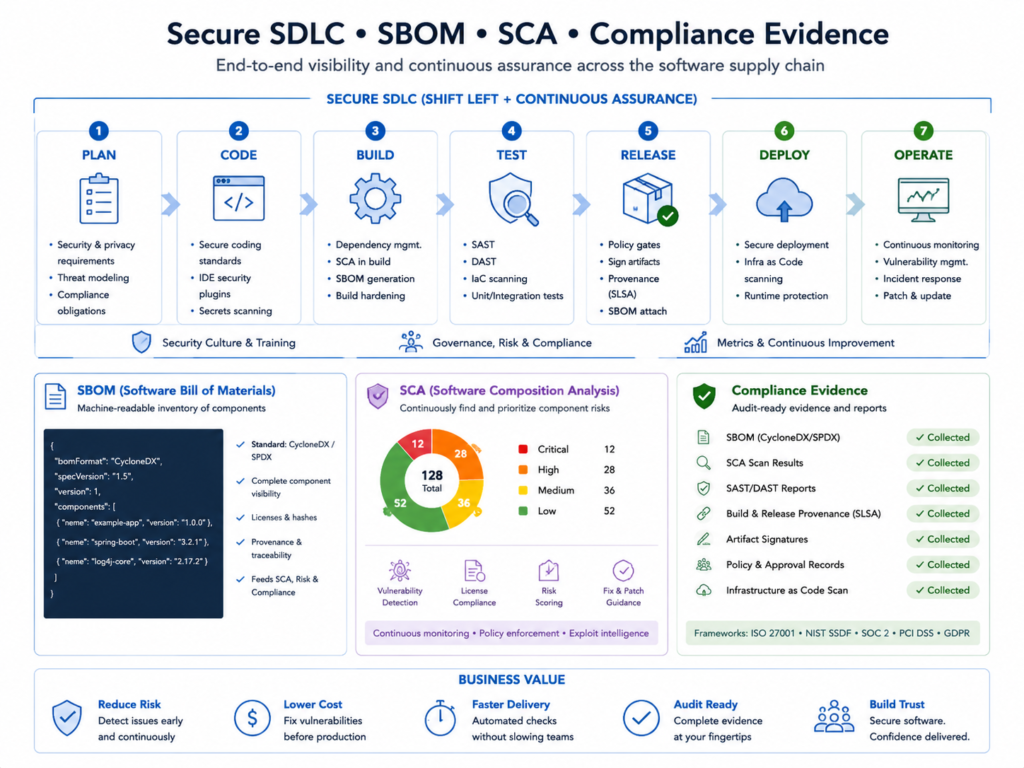
Companies can combine SBOM, SCA, dependency pinning, and policy gates by embedding them directly into the secure SDLC. The workflow should generate SBOMs, scan dependencies, enforce policies, and preserve audit evidence during every major build and release.
This is how security becomes repeatable instead of reactive.
Generate and Validate SBOMs During Build
Generate SBOMs automatically during build, not manually after release.
Validate that the SBOM includes.
Direct dependencies
Transitive dependencies
Accurate versions
Package identifiers
Build metadata
Ownership details
Store SBOMs with release artifacts. For cloud-native teams, connect this with secure deployment patterns and lessons from cloud security misconfiguration remediation.
Add SCA Scanning and CI/CD Security Gates
Run SCA scans in pull requests, nightly builds, container builds, and release pipelines.
Define policies for.
Critical vulnerabilities
Known malicious packages
Unapproved licenses
Abandoned dependencies
Unknown package sources
Unpinned production dependencies
CI/CD gates should be risk-based. A hard block makes sense for exploitable critical issues in production code. A warning or ticket may be better for low-risk findings with no reachable path.
Create Audit Evidence for Buyers and Compliance Teams
Keep evidence that buyers and auditors can understand.
Useful artifacts include.
SBOM files
SCA reports
Exception approvals
Remediation timelines
Release notes
Vendor attestations
Policy history
CI/CD gate logs
Teams building digital platforms can connect this evidence to business intelligence services for reporting dashboards across engineering, security, and compliance stakeholders.
Software Supply Chain Security Best Practices for 2026 Buyers
Software supply chain security best practices for 2026 focus on visibility, governance, automation, and evidence. Buyers should prioritize tools and partners that prevent risky components from entering production, not just tools that discover problems after release.
The best programs are practical. They help developers ship safely, give compliance teams proof, and give customers confidence.
What AppSec, DevSecOps, and Compliance Teams Should Prioritize
Start with your highest-risk applications.
Prioritize.
Internet-facing products
Regulated data workflows
Payment systems
Healthcare platforms
Financial applications
Customer-facing SaaS products
Software sold to enterprise buyers
Then implement the baseline controls: SBOM generation, SCA scanning, dependency pinning, approved registries, CI/CD gates, secure secrets handling, and vendor risk review.
Teams modernizing platforms can align this with modern web development and secure cloud architecture.
Open-Source Tools vs Enterprise Platforms
Open-source tools work well for teams with strong engineering ownership and clear internal processes. OWASP Dependency-Track, Syft, Grype, Trivy, and similar tools can provide strong visibility at low licensing cost.
Enterprise platforms make sense when you need policy management, legal reporting, executive dashboards, procurement evidence, support, and multi-team governance.
A hybrid approach is common: open-source scanners in pipelines, enterprise reporting for governance.
Concluding Remarks
Software supply chain security gives teams a practical way to reduce open-source, vendor, and CI/CD risk before it reaches customers. SBOMs, SCA tools, dependency controls, and release gates work best when they are built into everyday engineering workflows, not added as a last-minute checklist. Mak It Solutions
Need a practical view of your software supply chain security risk? Mak It Solutions can help assess your SBOM readiness, dependency controls, SCA workflow, CI/CD gates, and vendor-risk exposure across US, UK, Germany, and EU requirements.
Explore our services or contact Mak It Solutions to request a scoped estimate for your secure SDLC and software supply chain security roadmap.
Key Takeaways
Software supply chain security protects dependencies, build systems, vendors, CI/CD pipelines, and release artifacts.
SBOMs improve visibility, but they become more valuable when connected to SCA, ownership, and remediation workflows.
Dependency pinning, approved registries, provenance checks, and CI/CD gates reduce open-source package risk.
US, UK, Germany, and EU buyers increasingly expect evidence around secure development, vendor risk, and vulnerability response.
Open-source tools can work well for technical teams, while enterprise platforms help with governance, reporting, and procurement assurance.
The fastest progress usually comes from starting with high-risk apps and building repeatable evidence into the SDLC.
FAQs
Q : What is the difference between SBOM management and software composition analysis?
A : SBOM management focuses on creating, storing, sharing, and monitoring an inventory of software components. Software composition analysis scans those components for vulnerabilities, license issues, malware signals, and policy violations. In practice, they work best together: the SBOM tells you what is inside the software, while SCA helps determine whether those components are risky.
Q : Do small SaaS companies need software supply chain security controls?
A : Yes. Small SaaS companies often depend heavily on open-source packages, cloud services, APIs, and CI/CD automation. They do not need enterprise complexity on day one, but they should have a practical baseline: SCA scanning, dependency updates, package pinning, MFA for repositories, secret scanning, SBOM generation, and urgent vulnerability fixes.
Q : How often should an SBOM be updated?
A : An SBOM should be updated whenever the software changes in a meaningful way, especially during build, release, dependency updates, container image changes, and vendor component changes. For active products, that usually means every release.
Q : Can SBOMs prove compliance with GDPR, UK-GDPR, or the EU Cyber Resilience Act?
A : No. SBOMs alone do not prove full compliance. They support compliance by showing software component visibility, vulnerability response capability, and supplier control. Organizations still need secure development, vulnerability handling, documentation, risk management, and legal review.
Q : What is the fastest way to reduce transitive dependency risk?
A : Scan full dependency trees in CI/CD, prioritize reachable high-severity vulnerabilities, and enforce approved package policies. Start by identifying which transitive dependencies affect production code, then update parent packages where fixes are available. Add lockfiles, private registries, dependency review, and automated pull requests so risky packages are flagged before release.