


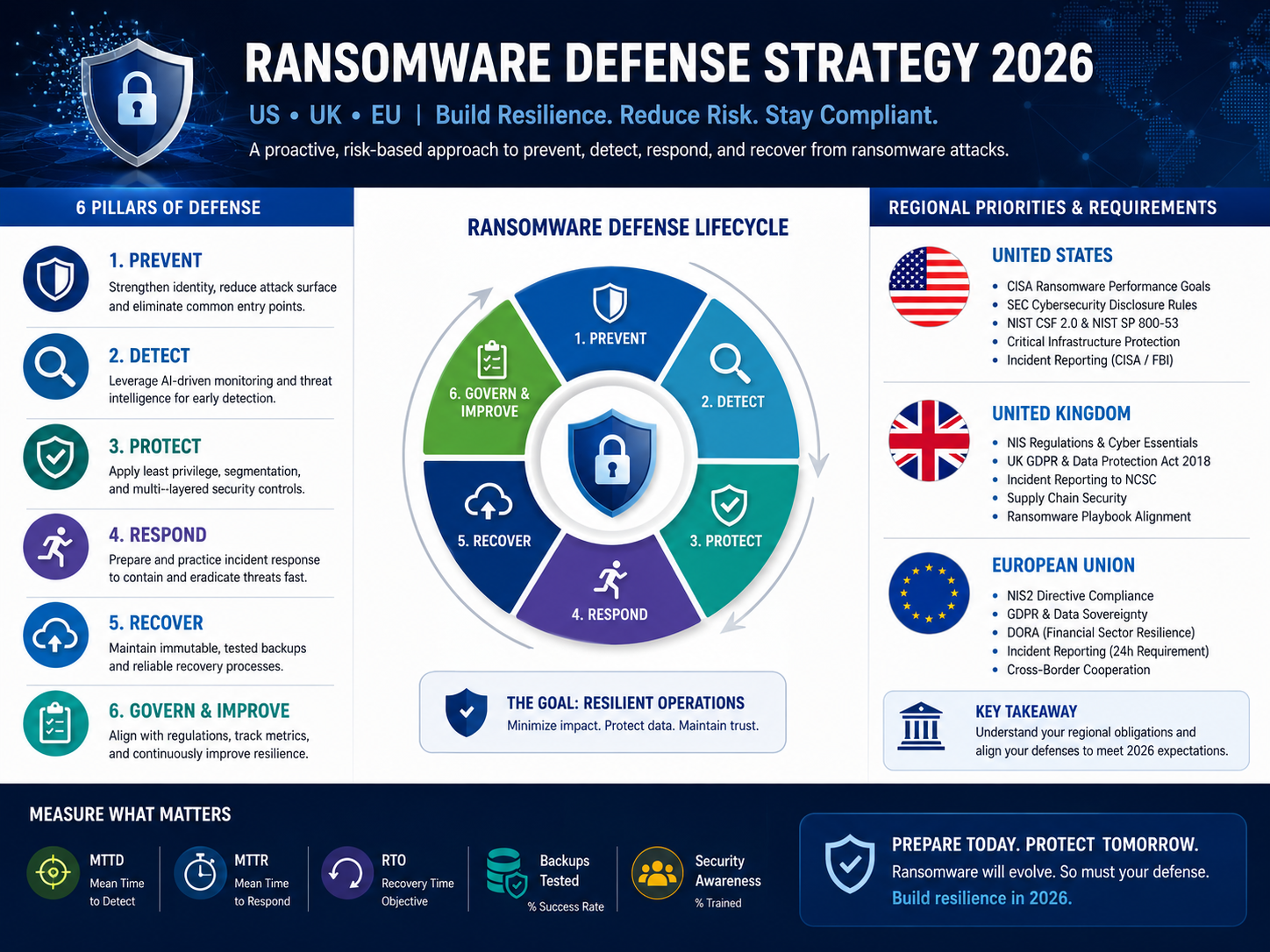
Ransomware Defense Strategy That Works
A ransomware defense strategy in 2026 needs to do more than block malware. Modern ransomware can encrypt systems, steal data, attack backups, disrupt suppliers and pressure customers or partners.
A strong ransomware defense strategy is a coordinated plan to reduce the chance of compromise, limit ransomware spread, protect recoverable backups and restore critical operations quickly. For teams in the USA, UK, Germany and the wider EU, it should connect prevention, cyber resilience, incident response and regional compliance planning into one practical operating model.
Why Ransomware Defense Needs a 2026 Reset
Ransomware is no longer just a “pay for a decryption key” problem. Many attacks now involve double or triple extortion, where criminals steal data before encryption, threaten public leaks, pressure third parties or target business continuity.
Payment trends also show why resilience matters. Chain lysis reported that ransomware payments fell from around $1.25 billion in 2023 to about $814 million in 2024, a roughly 35% drop, but ransomware disruption remained a major business risk.
That means the goal is not only “avoid paying.” The real goal is to keep the business recoverable.
For example, a New York healthcare provider, a London fintech, a Berlin manufacturer and a Dublin SaaS company may face similar ransomware tactics, but different reporting, privacy and operational requirements. CISA’s StopRansomware program, the UK NCSC’s ransomware guidance and Germany’s BSI ransomware resources are useful regional references for building a stronger plan.
What Is a Ransomware Defense Strategy?
A ransomware defense strategy is a structured plan for reducing ransomware risk before, during and after an incident. It defines the controls, teams, recovery paths and decision rights needed to keep critical services running.
A ransomware protection strategy often focuses on tools: endpoint security, email filtering, patching and backup software. A ransomware defense strategy is broader. It connects those tools with cyber resilience, business continuity, disaster recovery and executive decision-making.
For example, Mak It Solutions can support secure product design, SaaS architecture and data workflows through its custom technology services and web development capabilities, so resilience is planned into systems instead of added later.
The four core pillars
A practical ransomware defense strategy should cover.
Prevention reduce the chance of compromise with MFA, patching, secure email, endpoint protection and awareness.
Containment reduce blast radius through segmentation, least privilege and privileged access controls.
Backup resilience protect clean recovery points with immutable, offline or isolated backups.
Recovery readiness test incident response, restore workflows and crisis communications before an attack.
Build the Core Ransomware Defense Framework
A core ransomware framework turns security work into a business resilience program. Start by identifying what must keep running, who owns each system and how recovery decisions will be made.
Map critical assets, identities and business services
Begin with a map of your most important assets.
Identity platforms
Endpoints and servers
SaaS applications
Cloud workloads
Databases and APIs
Backup repositories
Admin consoles and privileged accounts
Then connect each asset to a business service such as payments, patient records, order fulfillment, analytics, claims processing or customer support.
For SaaS teams in Austin, San Francisco or Amsterdam, this mapping should include tenant data, CI/CD pipelines, API keys, production databases and cloud permissions. Mak It Solutions’ Node.js development services, Python development services and business intelligence services can support secure application and analytics architecture.
Align controls with trusted frameworks
Security controls should align with recognized guidance such as NIST CSF, ISO 27001, CISA StopRansomware, UK NCSC ransomware guidance and BSI IT-Grundschutz. This makes it easier to explain maturity to boards, auditors, insurers and regulators.
IBM’s 2025 Cost of a Data Breach reporting also shows why measurable resilience matters: the global average breach cost dropped to USD 4.44 million in 2025, down from USD 4.88 million in 2024, while average identification and containment time reached 241 days.
Boards do not need firewall rule details. They need to know whether payroll, production, e-commerce, claims processing or customer support can be restored after a destructive event.
Ransomware Backup Strategy for Recovery Resilience
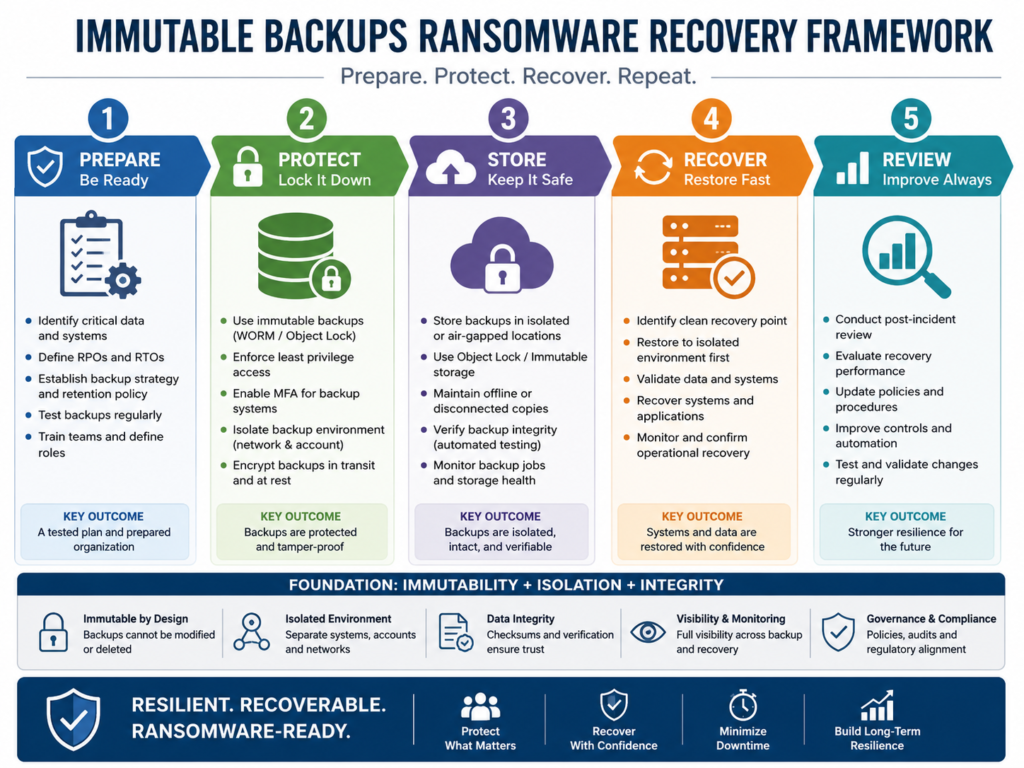
Backups are essential, but they do not stop ransomware by themselves. A ransomware backup strategy protects recovery after encryption or deletion, while other controls reduce theft, extortion and lateral movement.
Use immutable, isolated and offline backups
Immutable backups cannot be changed or deleted during a defined retention period. Air-gapped or offline recovery copies are separated from the production network, making it harder for attackers to encrypt or destroy them.
For a Chicago logistics company or Munich manufacturer, a layered backup model often works best.
Frequent operational backups for fast recovery
Immutable cloud or object storage copies
Offline recovery media for the most critical systems
Separate backup admin accounts
Regular restore testing
Germany’s BSI also highlights offline backups as an important ransomware protection measure.
Test recovery, not just backup completion
A backup report that says “successful” is not enough. Teams need to prove they can restore clean data within business requirements.
Define.
Recovery Time Objective: how quickly a system must return.
Recovery Point Objective: how much data loss is acceptable.
Clean restore point: a backup that is not encrypted, corrupted or compromised.
In practice, backups should be tested for critical systems at least quarterly and after major infrastructure or application changes. High-risk sectors such as healthcare, finance, SaaS and manufacturing may need more frequent restore checks.
Network Segmentation Ransomware Controls
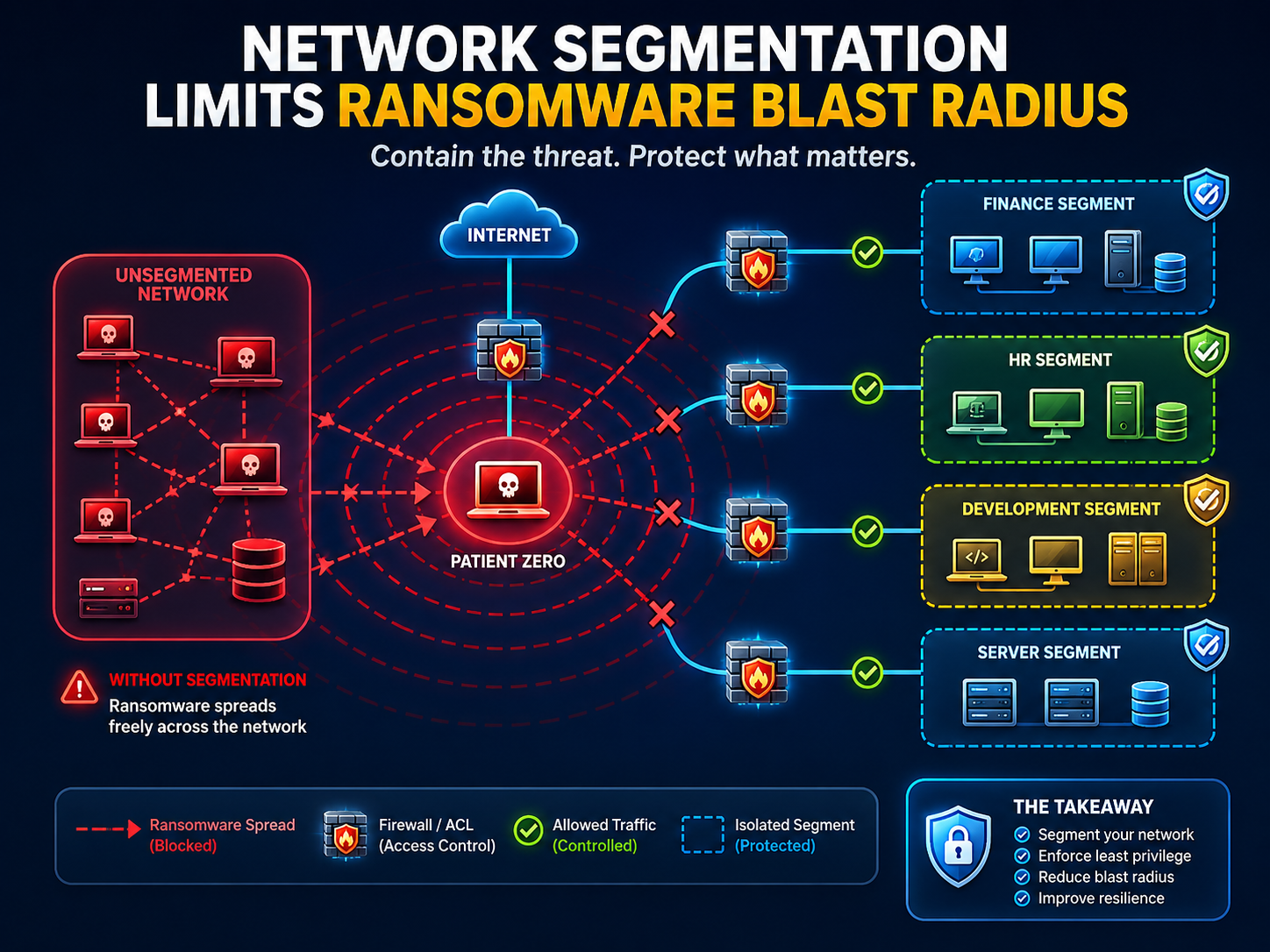
Network segmentation ransomware controls reduce the blast radius of an attack. If one endpoint, workload or account is compromised, segmentation helps prevent attackers from reaching every database, file share, backup platform and cloud admin console.
How segmentation limits lateral movement
Segmentation separates systems by trust level, function and sensitivity. A compromised workstation should not automatically reach domain controllers, production databases, backup consoles or regulated data.
In healthcare, that may mean separating clinical systems, imaging platforms and administrative networks. In finance, it may mean separating payment environments, customer data, audit logs and privileged administration.
Use zero trust and identity-based access
Zero trust assumes no user, device or workload should be trusted by default. Micro segmentation applies tighter rules between systems, while identity-based access controls what users and services can do after login.
This is where lateral movement prevention becomes practical. Instead of relying only on perimeter firewalls, teams enforce least privilege across users, APIs, service accounts and cloud roles.
For customer-facing platforms, secure architecture can also connect with mobile app development and React Native development so mobile, API and cloud layers follow the same access model.
Ransomware Incident Response Plan
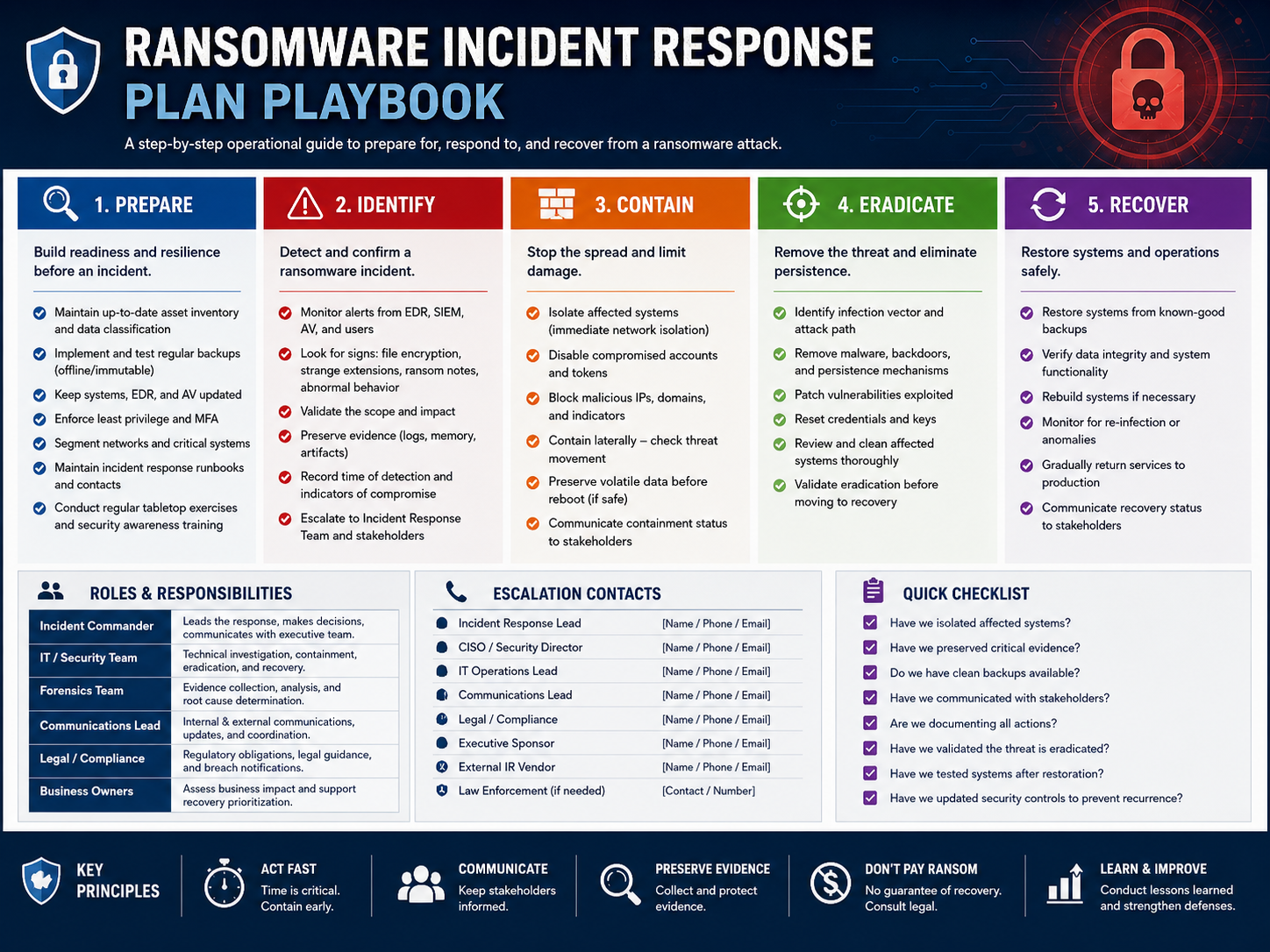
A ransomware incident response plan defines what happens before confusion spreads. It should state who acts, what gets isolated, how evidence is preserved, when recovery begins and who communicates with customers, regulators and partners.
First-hour response priorities
In the first hour, teams should focus on controlled action.
Isolate affected systems.
Disable suspicious accounts.
Preserve logs and evidence.
Activate the incident commander.
Notify legal, privacy and executive stakeholders.
Avoid unsafe restore attempts.
Stop wiping systems too early unless necessary for containment.
CISA’s ransomware response guidance also emphasizes identifying impacted systems and isolating them quickly.
Practice the playbook before a real attack
A ransomware IR playbook should include contact trees, escalation rules, legal review, forensic steps, backup validation, regulator notification triggers and executive messaging.
Tabletop exercises help teams practice difficult decisions before they are under pressure. Run scenarios for New York, Washington DC, London, Manchester, Berlin, Paris and Zurich operations, especially where customer data, regulated workloads or cross-border support teams are involved.
GEO and Compliance Considerations for USA, UK, Germany and EU
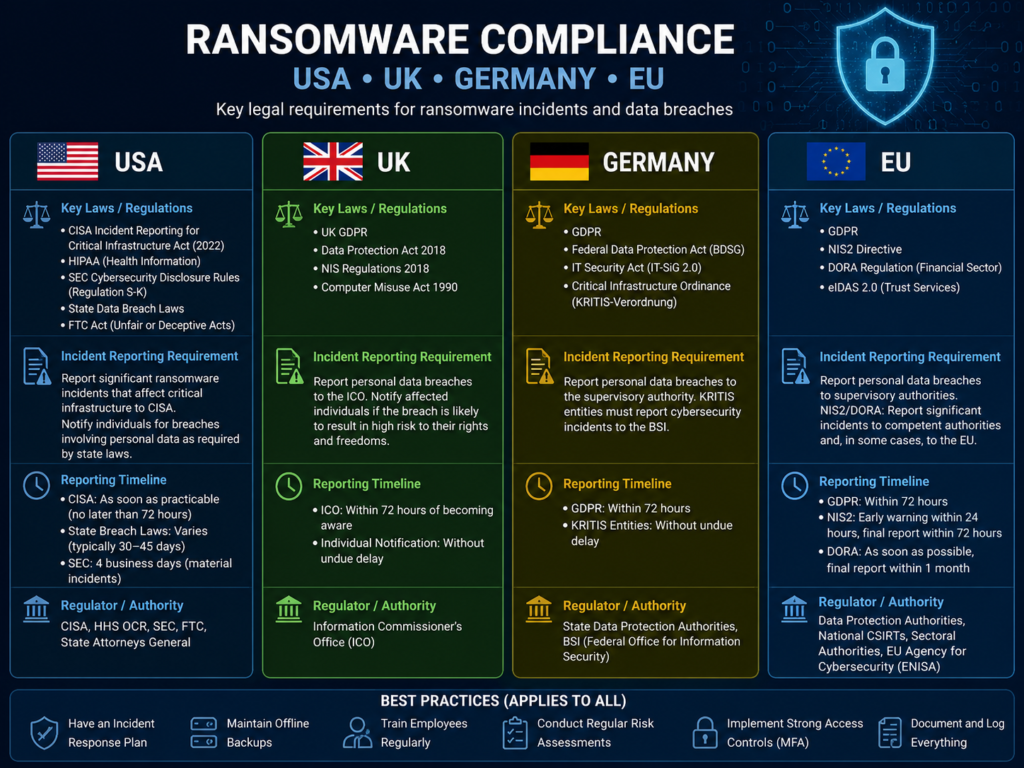
Ransomware compliance is regional. The same attack may trigger different obligations depending on where data subjects, customers, regulators, systems and service providers are located.
This section is general guidance, not legal advice. Organizations should confirm reporting duties with qualified legal and compliance teams.
USA.
US teams should consider HIPAA and HHS expectations for healthcare data, SEC cyber disclosure rules for public companies, PCI DSS for payment environments, SOC 2 evidence for SaaS vendors and state breach notification laws.
The SEC’s cybersecurity disclosure rules require public companies to disclose material cybersecurity incidents under Form 8-K Item 1.05 after determining materiality.
UK.
UK organizations should align with NCSC ransomware guidance, UK-GDPR, NHS supplier requirements and FCA expectations for regulated firms. A London fintech or Birmingham NHS supplier should build reporting and evidence collection into the ransomware incident response plan.
Germany and EU.
Germany and EU teams should consider DSGVO/GDPR, BSI guidance, BaFin expectations, NIS2 and DORA.
NIS2 establishes a cybersecurity framework across 18 critical sectors in the EU, while DORA applies to digital operational resilience in financial services from 17 January 2025.
A Berlin SaaS company, Munich manufacturer or Frankfurt financial institution should document cloud region choices, data residency, backup retention, vendor recovery dependencies and incident evidence.
How to Turn Ransomware Defense Into a Resilience Program
A ransomware defense strategy works best when it becomes a repeatable operating model, not a one-time security project.
Follow this practical sequence.
Identify critical business services and owners.
Map data, identities, cloud workloads, SaaS tools and backups.
Apply prevention controls such as MFA, patching and email security.
Segment high-value systems and restrict privileged access.
Create immutable and offline backup paths.
Test recovery, tabletop exercises and notification workflows.
Measure what matters: restore success rate, clean backup availability, segmentation coverage, privileged access reduction, incident response speed and executive decision readiness.
Concluding Remarks
A strong ransomware defense strategy gives teams a clear way to prevent attacks, contain damage, recover systems and communicate under pressure. Backups matter, but they need to work alongside segmentation, monitoring, identity security and tested incident response.
Need a clear view of your ransomware readiness? Book a scoped consultation with Mak It Solutions to review backups, segmentation, critical systems, recovery objectives and incident response planning for US, UK, Germany and EU operations.
Start with the Mak It Solutions services page or contact the team through Mak It Solutions contact.
FAQs
Q : How often should ransomware backup recovery tests be performed?
A : Critical ransomware backup recovery tests should be performed at least quarterly and after major infrastructure, application or compliance changes. High-risk teams may need more frequent restore checks for priority workloads.
Q : What is the difference between immutable backup and air-gapped backup?
A : An immutable backup cannot be changed or deleted for a defined retention period. An air-gapped backup is separated from the production network, either physically offline or logically isolated.
Q : Should ransomware response plans include legal and PR teams?
A : Yes. Ransomware response plans should include legal, privacy, compliance, PR and executive teams because ransomware can create regulatory, contractual, customer and media exposure.
Q : How does zero trust reduce ransomware lateral movement?
A : Zero trust reduces ransomware lateral movement by limiting what users, devices and workloads can access after compromise. It uses least privilege, MFA, device posture, identity-based access and segmentation.
Q : What ransomware controls do cyber insurance providers usually expect?
A : Cyber insurance providers often expect MFA, endpoint detection, secure backups, patch management, privileged access controls, incident response planning, logging, employee awareness and vulnerability management. Requirements vary by insurer, sector, revenue, region and claims history.