
MDR vs XDR vs SOC: Best Fit Guide
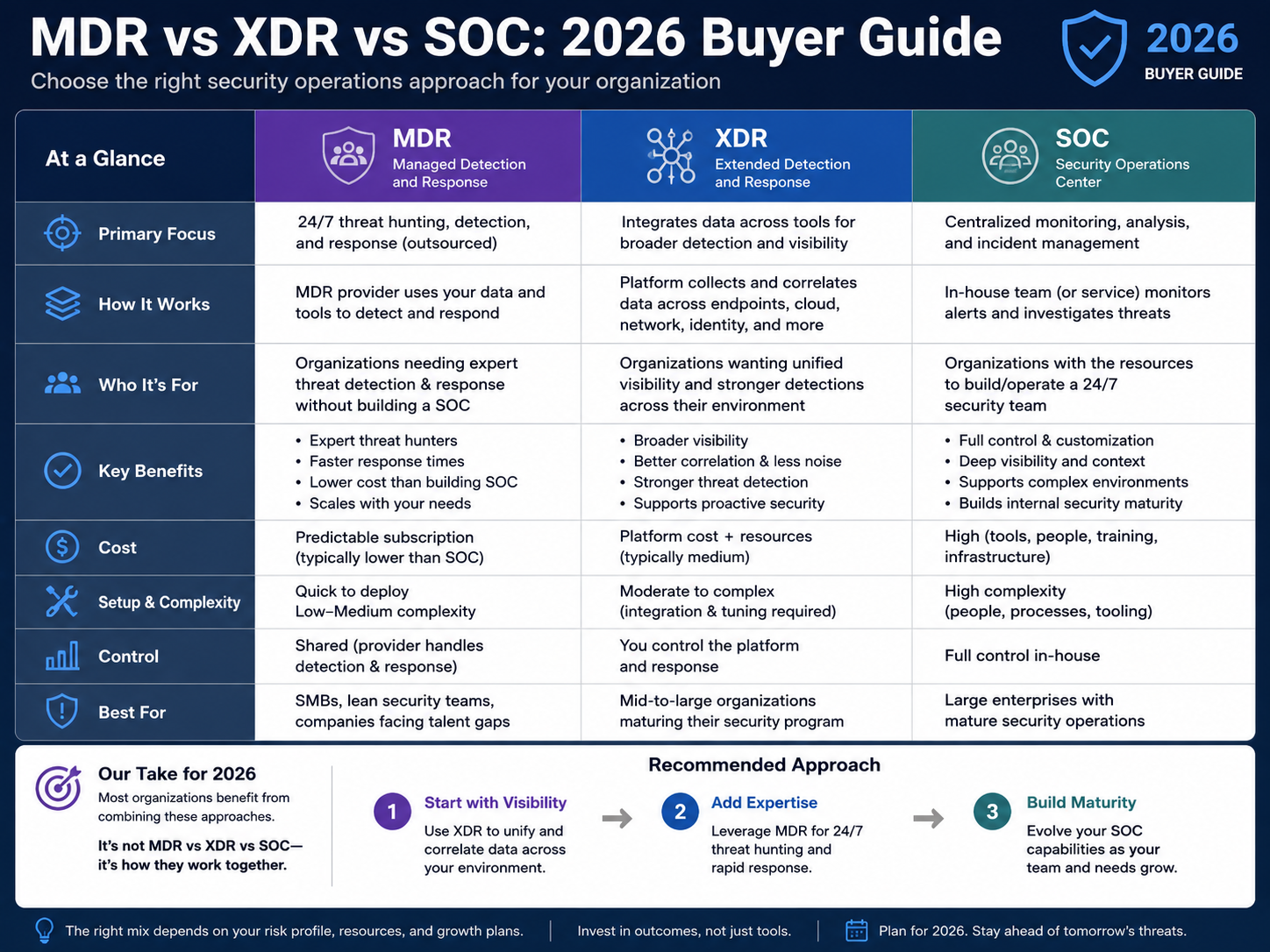
MDR vs XDR vs SOC comes down to one simple difference: MDR is a managed security service, XDR is a detection-and-response platform, and SOC is the operating model behind security monitoring and response.
For most mid-market companies, MDR is the fastest route to 24/7 threat detection without hiring a full security team. XDR works best when you already have analysts who can operate the platform. A SOC can be internal, outsourced, or hybrid, depending on your budget, compliance pressure, and security maturity.
IBM reported the global average cost of a data breach at USD 4.4 million in its 2025 report, which is one reason boards are asking sharper questions about detection, response, and cyber resilience.
MDR vs XDR vs SOC.
MDR, XDR, and SOC are often compared as if they are the same kind of solution. They are not.
| Model | What It Is | Best For | Main Limitation |
|---|---|---|---|
| MDR | Managed detection and response service | Teams needing 24/7 analyst support | Less direct control |
| XDR | Detection and response platform | Mature teams with security operators | Needs skilled users |
| SOC | Security operations function | Organizations needing full governance | Expensive to build internally |
| SOCaaS | Outsourced SOC operations | Regulated growing firms | Provider dependency |
| Hybrid SOC | Internal + external operations | Mid-market to enterprise teams | Needs clear ownership |
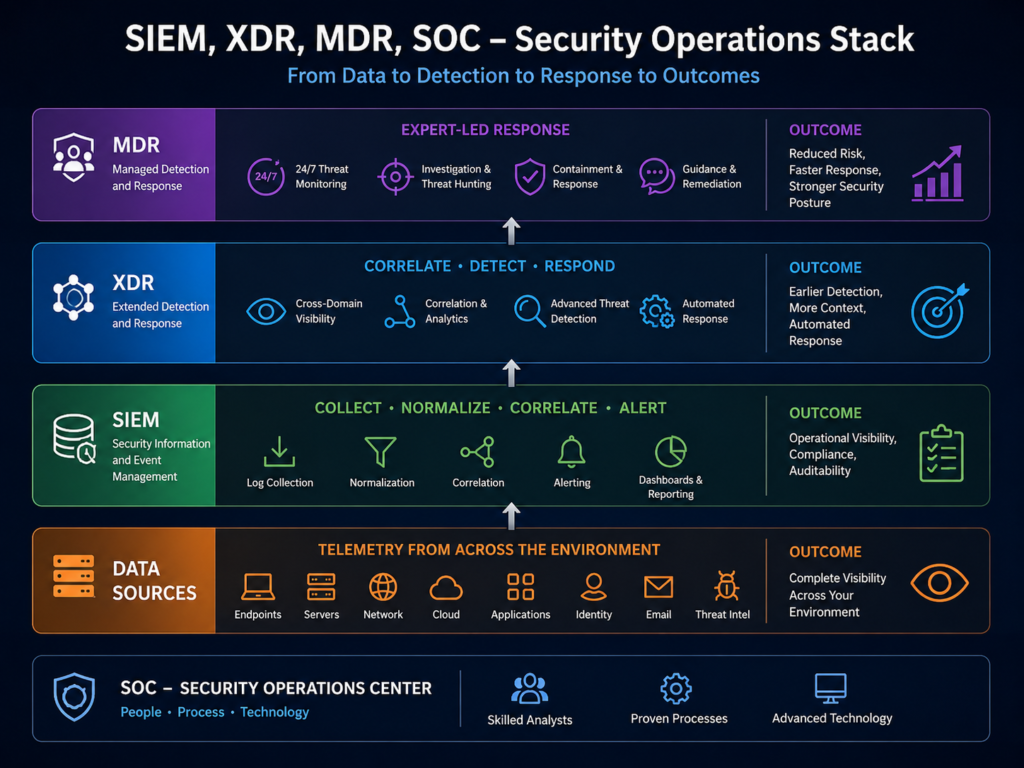
In practice, many companies use more than one. A SIEM may collect logs, XDR may correlate signals, MDR analysts may investigate alerts, and the SOC model defines escalation, reporting, and response.
What Is MDR?
MDR stands for Managed Detection and Response. It gives your company access to external security analysts who monitor threats, investigate suspicious activity, and support containment.
MDR usually includes.
24/7 monitoring
Alert triage
Threat hunting
Incident investigation
Response guidance
Escalation workflows
Compliance-friendly reporting
For a mid-sized SaaS company in Austin, London, Berlin, or Manchester, MDR can fill the gap between “we bought security tools” and “someone is actually watching and responding.”
That matters because many IT teams already manage endpoints, Microsoft 365, cloud infrastructure, identity systems, and customer security questionnaires. They do not always have the staffing to run security operations around the clock.
What Is XDR?
XDR stands for Extended Detection and Response. It connects security signals from different tools, such as endpoints, cloud workloads, identity systems, email, SaaS applications, and network controls.
The goal is to reduce alert noise and show higher-quality incidents.
XDR is useful when your team can.
Tune detections
Manage integrations
Investigate attack paths
Understand telemetry
Run response workflows
Improve detection rules over time
XDR is powerful, but it is not magic. Without skilled operators, it can become another dashboard. That is why many buyers combine XDR technology with MDR or SOCaaS support.
For companies modernizing data pipelines, dashboards, and digital operations, Mak It Solutions’ business intelligence services can also support better visibility around business and operational reporting.
What Is a SOC?
A SOC, or Security Operations Center, is not just a room full of screens. It is the people, process, and technology layer that monitors alerts, investigates incidents, coordinates response, and reports security risk.
A SOC can be.
Internal: built and staffed by your own company
Outsourced: delivered by a SOCaaS provider
Hybrid: owned internally but supported by MDR or SOCaaS
An internal SOC gives the most control, but it also needs analysts, engineers, tooling, playbooks, incident response leadership, and continuous improvement. For many mid-market firms, that is too expensive to build from scratch.
ISC2’s 2025 workforce study found that only 34% of respondents said their organizations had the right level of cybersecurity staffing, while 59% cited critical or significant skills needs.
MDR vs XDR vs SOC for Mid-Market Companies
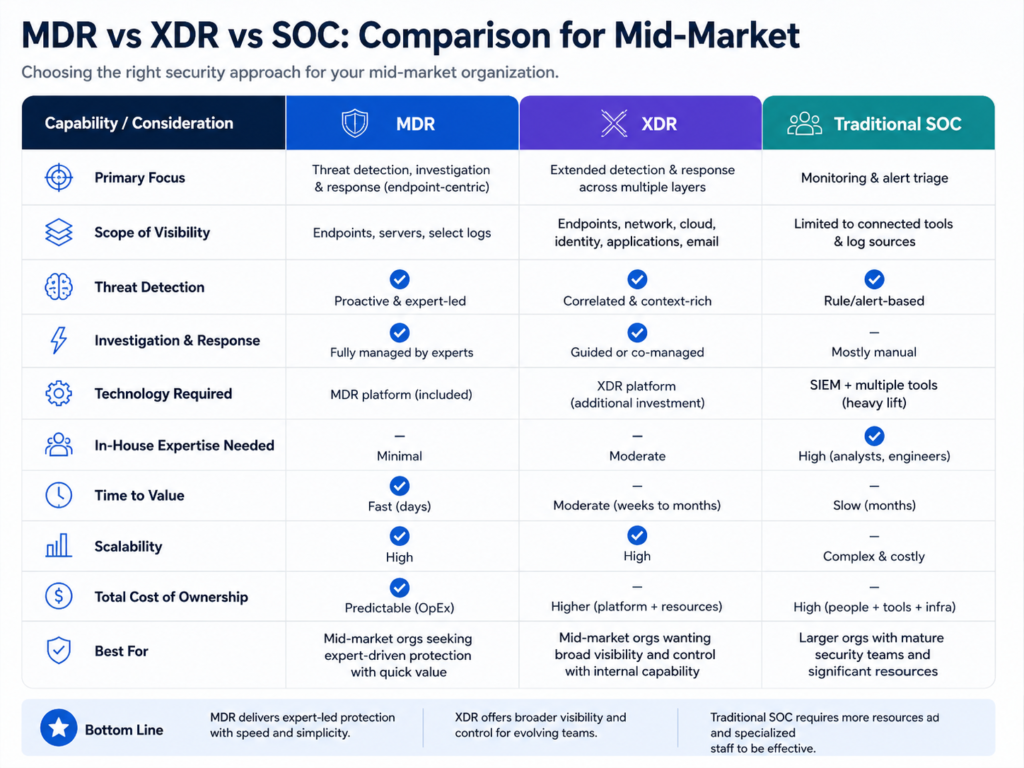
Mid-market companies usually compare MDR vs XDR vs SOC because they need stronger security operations without enterprise-level headcount.
MDR is often the first practical step. It gives lean IT teams analyst support, after-hours monitoring, and a clearer response path.
XDR makes sense when the company already has internal security capability. A team with cloud engineers, endpoint owners, identity administrators, and an incident response lead can get strong value from XDR.
SOCaaS becomes relevant when the company needs broader outsourced operations, including SIEM management, compliance reporting, vulnerability coordination, and board-level summaries.
An internal SOC usually fits larger regulated enterprises where security is strategic enough to justify full ownership.
SOCaaS vs MDR.
MDR is narrower and more response-focused. SOCaaS is broader and closer to an outsourced security operations function.
Think of MDR a
Help us detect and respond to threats.
Think of SOCaaS as
“Help us run security operations.”
Some vendors blur the terms, so buyers should compare scope carefully. Ask what is included, what costs extra, who handles escalation, and whether the provider can take containment actions during a live incident.
XDR vs SIEM.
XDR and SIEM often overlap, but they are not the same.
SIEM is mainly about log collection, storage, search, analysis, and audit evidence. XDR is more focused on connected threat detection and response across integrated tools.
A practical security stack may look like this.
SIEM stores logs and supports compliance evidence.
XDR correlates signals across tools.
MDR analysts investigate and guide response.
SOC governance defines escalation, reporting, and ownership.
For product-led companies, secure engineering also matters. Mak It Solutions supports digital delivery through mobile app development services and React Native development services, where application security and data protection should be considered early.
Regional Buyer Guidance.
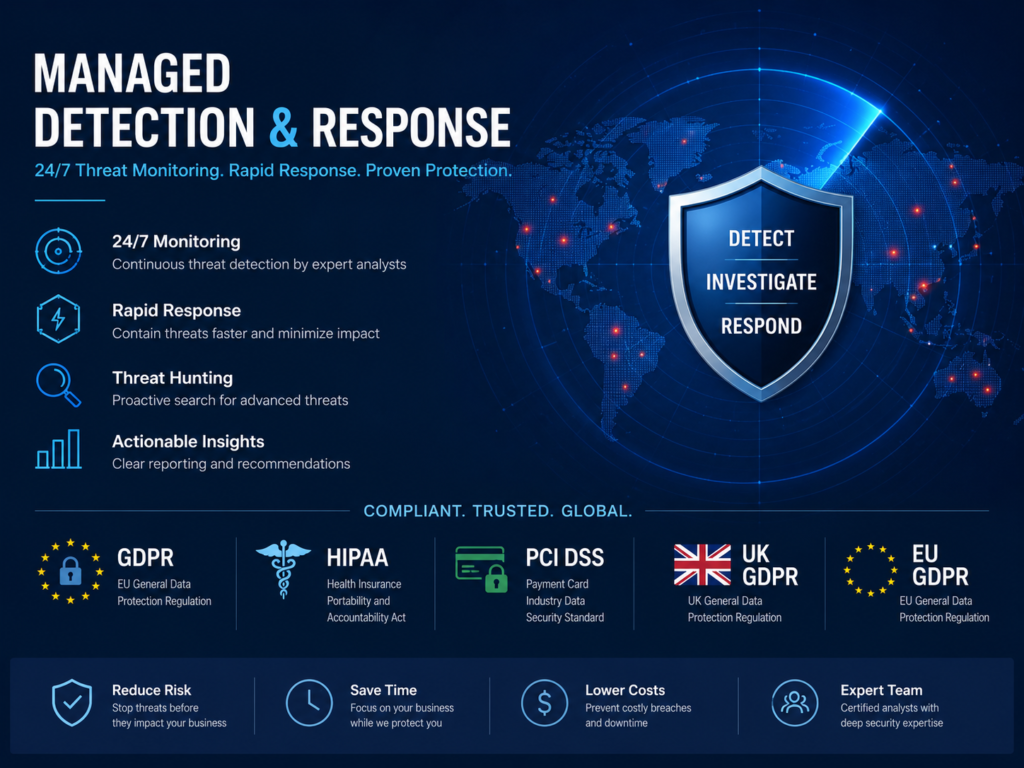
US, UK, German, and EU buyers should not choose MDR, XDR, or SOC providers based only on dashboards. Local compliance, data residency, response workflows, and reporting quality matter just as much.
USA.
US buyers in New York, Chicago, Austin, Washington DC, and San Francisco often evaluate MDR through compliance and insurance requirements.
Healthcare teams need to think about HIPAA. Payment environments need PCI DSS. SaaS companies often need SOC 2 evidence. Public companies also need to consider SEC cybersecurity disclosure rules, including material incident disclosure and cyber risk management reporting expectations.
PCI DSS defines baseline technical and operational requirements for protecting environments where payment account data is stored, processed, or transmitted.
UK.
UK buyers in London, Manchester, Leeds, Birmingham, and Edinburgh should ask how providers support UK-GDPR, FCA-regulated environments, NHS supplier expectations, and Cyber Essentials.
Cyber Essentials is a UK government-backed scheme designed to help organizations protect themselves against common online threats.
Good MDR or SOCaaS reporting should show incident timelines, alert triage, access control evidence, and remediation actions. That is useful when auditors, insurers, customers, or regulators ask what happened and how quickly the business responded.
Germany and EU.
In Germany and the wider EU, buyers should be careful with the acronym “MDR” because it can also refer to the EU Medical Device Regulation. For search and procurement, “MDR cybersecurity” or “managed detection and response” is clearer.
Buyers in Berlin, Munich, Frankfurt, Hamburg, Amsterdam, Paris, Dublin, and Zurich should ask providers about GDPR, DSGVO, BaFin expectations, NIS2, DORA, KRITIS, SEPA operations, EU data residency, and cloud sovereignty.
The European Commission describes NIS2 as a unified legal framework for cybersecurity across 18 critical sectors in the EU. DORA also creates an EU-wide oversight framework for critical ICT third-party providers in the financial sector.
How to Choose the Right MDR, XDR, or SOC Provider
Start with the operating reality, not the sales deck.
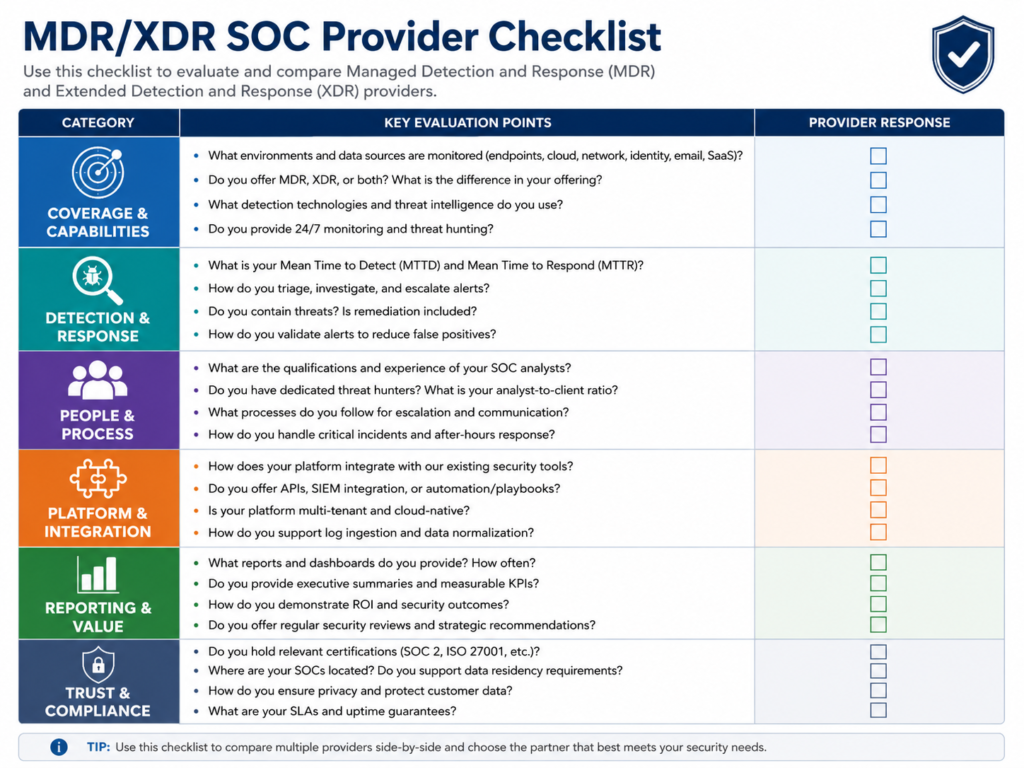
Ask these questions before buying.
Does the provider offer real 24/7 analyst monitoring?
What are the response SLAs?
Who contacts your team during a ransomware event?
Can the provider isolate endpoints or disable accounts?
Which logs and tools are included?
Does reporting support GDPR, HIPAA, PCI DSS, SOC 2, ISO 27001, NIS2, or DORA?
Where is data stored?
Is EU or UK data residency available?
Can the team support English, German, or other required languages?
Will executives receive board-level reporting?
The best provider is not always the one with the longest feature list. It is the one that fits your staffing model, risk profile, compliance needs, and response expectations.
Final Recommendation
Choose MDR if you need fast managed detection and response without building a full SOC.
Choose XDR if you already have the internal skills to operate an integrated detection platform.
Choose SOCaaS if you need broader outsourced security operations, including monitoring, reporting, governance, and escalation.
Choose a hybrid SOC if you want internal ownership with external support.
Build an internal SOC only when the budget, risk level, staffing model, and compliance requirements justify full control.
For many mid-market companies, the best path is practical: start with MDR, strengthen telemetry, add XDR where it fits, and mature toward SOCaaS or hybrid SOC as security operations become more strategic.
Need help choosing between MDR vs XDR vs SOC for your business? Mak It Solutions can help you scope requirements, map compliance needs, and plan a practical roadmap for secure digital operations across the US, UK, Germany, and EU.
Start with the Mak It Solutions contact page to request a scoped consultation.
Key Takeaways
MDR is best when you need 24/7 managed detection and response.
XDR is best when you have analysts who can operate the platform.
SOC is the operating model for security monitoring and response.
SOCaaS works well when you need outsourced security operations beyond MDR.
US buyers should consider HIPAA, PCI DSS, SOC 2, SEC disclosure expectations, and cyber insurance.
UK and EU buyers should evaluate UK-GDPR, GDPR, DSGVO, NIS2, DORA, BaFin, FCA, and data residency.
The right choice depends on staffing, compliance pressure, response expectations, and security maturity.
FAQs
Q : Is MDR better than XDR for a company without an internal security team?
A : Yes. MDR is usually better for companies without an internal security team because it includes managed analyst support. XDR can provide strong detection technology, but someone still needs to configure it, investigate alerts, and coordinate response.
Q : Can XDR replace a SOC team?
A : No. XDR can reduce alert noise and speed up investigations, but people still need to make decisions, manage escalations, communicate with leadership, and drive remediation. XDR supports a SOC, MDR provider, or internal team; it does not replace accountability.
Q : What is the difference between SOCaaS and MDR?
A : SOCaaS is broader than MDR. MDR focuses on detecting, investigating, and responding to threats, while SOCaaS may include SIEM management, compliance reporting, vulnerability coordination, governance, and board-level reporting.
Q : Do regulated companies need MDR, XDR, or both?
A : They may need either or both. A healthcare, fintech, SaaS, or payment company may use MDR for 24/7 response and XDR for unified visibility across endpoint, cloud, identity, and email telemetry.
Q : How much internal expertise do you need for XDR?
A : You need enough internal expertise to manage integrations, tune detections, interpret incidents, and coordinate remediation. Without that capability, XDR usually works better when paired with MDR, SOCaaS, or a trusted managed security partner.