
Preemptive Cybersecurity: AI Defense Guide
Preemptive Cybersecurity: AI Defense Guide

Preemptive Cybersecurity: AI Defense Guide
Preemptive cybersecurity is now a serious priority for enterprises that cannot afford to wait for attackers to make the first move. AI-assisted phishing, exposed cloud assets, identity abuse, and faster ransomware activity have made early risk detection just as important as incident response.
In simple terms, preemptive cybersecurity uses AI, exposure data, threat intelligence, and automated workflows to identify likely attack paths before damage happens. For enterprises in the US, UK, Germany, and the wider EU, it helps reduce ransomware, phishing, cloud, compliance, and AI-driven security risks earlier in the attack chain.
What Is Preemptive Cybersecurity in 2026?
Preemptive cybersecurity means finding, prioritizing, and disrupting likely attacks before they create business impact. It combines predictive threat intelligence, attack surface visibility, AI threat detection, cyber exposure management, and SOC automation.
Traditional cybersecurity asks, “What happened?”
Preemptive cybersecurity asks, “What is most likely to happen next, and how do we stop it now?”
That shift matters because many modern attacks do not begin with obvious malware. They often start with valid credentials, exposed APIs, weak MFA coverage, cloud misconfigurations, or third-party access that looks normal until it is too late.
Preemptive vs Proactive vs Reactive Cybersecurity
Reactive security responds after an event: malware execution, account compromise, data theft, or system outage.
Proactive security improves posture before incidents through patching, security training, hardening, and zero trust design.
Preemptive cybersecurity goes a step further. It uses real-time telemetry, external attack surface management, adversary intelligence, and behavioral analytics to predict attacker paths.
For example, a healthcare provider in New York may discover that an exposed remote access service, weak MFA coverage, and leaked employee credentials create a likely ransomware route. A preemptive approach would prioritize that chain before attackers exploit it.
Why AI-Driven Threats Need Earlier Intervention
AI-driven threats move quickly because attackers can automate reconnaissance, phishing personalization, malware variation, and social engineering at scale. Gartner also notes that AI is expanding enterprise attack surfaces through ungoverned employee AI use and custom-built AI agents.
That means enterprises cannot rely only on manual SOC review. Security teams need machine learning threat detection, identity analytics, and automated containment that can flag risk before lateral movement begins.
Preemptive cybersecurity is not a single tool. It is a strategy across cloud, identity, endpoint, network, application, and governance layers.
Why Enterprises Are Moving Beyond Traditional Threat Detection
Enterprises are moving beyond traditional detection because alert-heavy SOC models struggle against cloud sprawl, AI-assisted attacks, and compliance pressure.
Detection still matters. But late detection is expensive, noisy, and hard to scale.
IBM reported that the average global cost of a data breach reached USD 4.88 million in 2024, up from USD 4.45 million in 2023.
The Limits of Detect-and-Respond Security
Detect-and-respond models often assume attackers will trigger a clear alert. In practice, many attacks begin with normal-looking behavior.
Valid login activity
Trusted cloud API calls
OAuth abuse
Slow data staging
Privilege changes hidden inside routine admin work
A London fintech using Open Banking APIs may process thousands of normal authentication events every hour. Without contextual risk scoring, suspicious behavior can hide inside legitimate traffic.
That creates alert fatigue, missed escalation, and delayed containment.
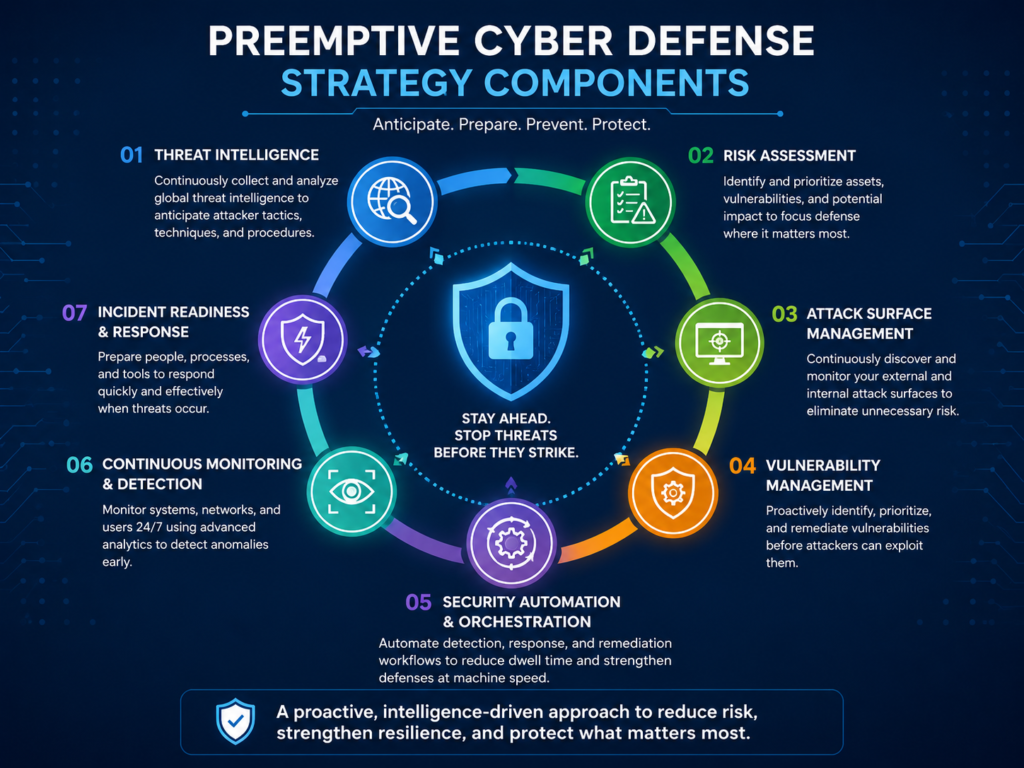
Core Components of a Preemptive Cyber Defense Strategy
A strong preemptive cyber defense strategy connects technical risk to business impact. The goal is not to chase every alert. The goal is to identify the attack paths that matter most.
Key components include.
| Component | What It Helps With |
|---|---|
| Predictive threat intelligence | Tracks attacker behavior and likely targets |
| Attack surface management | Finds exposed assets, APIs, domains, and cloud services |
| Exposure management | Prioritizes risks by exploitability and business impact |
| AI-powered SOC automation | Speeds up triage, enrichment, and response |
| Vulnerability prioritization | Focuses teams on the most dangerous weaknesses |
Mak It Solutions supports secure digital architecture across software, SaaS, cloud, analytics, and application environments. Explore the broader Mak It Solutions services for context on secure product and platform delivery.
Predictive Threat Intelligence and Attack Chain Disruption
Predictive threat intelligence maps what attackers are doing now against what your business exposes.
For example, if threat groups are targeting VPN appliances, cloud identity providers, or healthcare file-transfer tools, the SOC should not wait for compromise.
Attack chain disruption means breaking the sequence.
Reconnaissance
Initial access
Persistence
Privilege escalation
Lateral movement
Exfiltration
The earlier the chain is broken, the smaller the blast radius.
Attack Surface and Exposure Management
Attack surface management finds internet-facing assets, forgotten subdomains, exposed APIs, shadow SaaS, cloud misconfigurations, and unmanaged endpoints.
Exposure management then ranks these findings by exploitability, business criticality, identity risk, and compliance sensitivity.
For SaaS, e-commerce, and customer-facing portals, this is especially important. One exposed checkout plugin or API token can create payment, privacy, and brand risk. Mak It Solutions’ e-commerce development services are relevant when secure customer journeys and payment workflows need to be built into the product lifecycle.
How AI Helps Stop Cyberattacks Before Damage Occurs
AI helps stop cyberattacks earlier by detecting weak signals, correlating them across systems, and automating containment actions.
It is most useful when paired with zero trust, strong identity governance, reliable logging, and human analyst oversight.
Machine learning can detect early warning signs such as.
Unusual login sequences
Rare process behavior
Abnormal data access
Suspicious PowerShell activity
New cloud privilege assignments
Risky SaaS integrations
Backup access anomalies
For analytics-driven security programs, Mak It Solutions’ business intelligence services can support reporting models that make risk trends easier for leadership to understand.
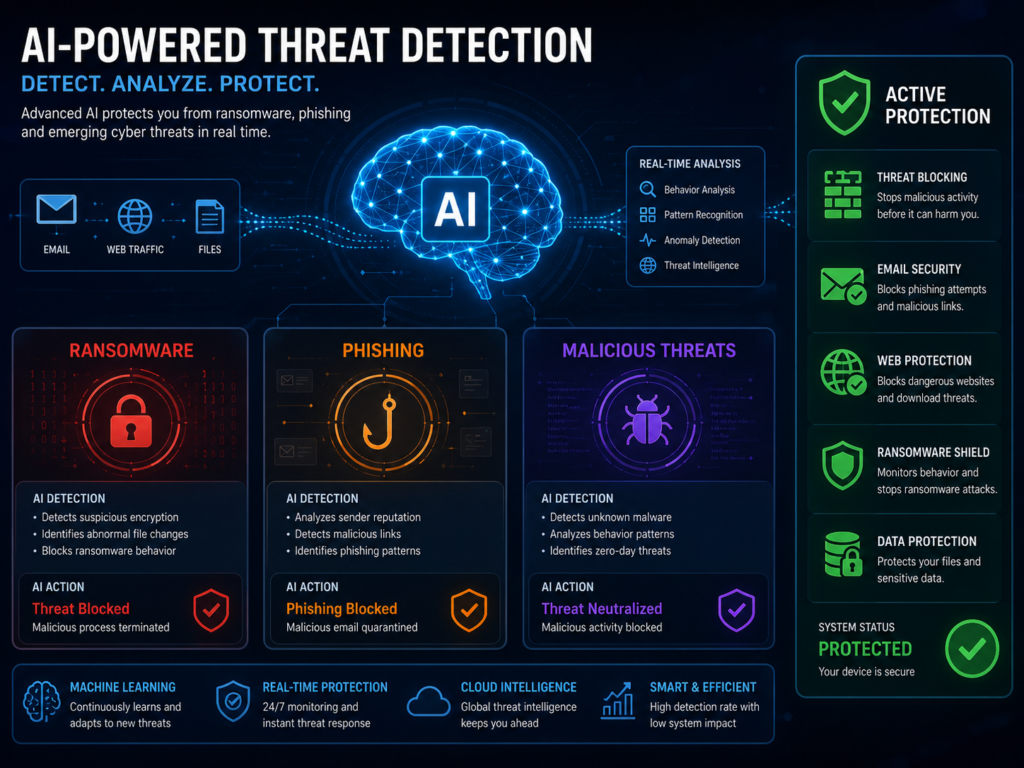
AI Threat Detection for Phishing and Ransomware Defense
AI-powered phishing prevention can inspect language patterns, sender reputation, attachment behavior, URL redirects, and user interaction risk.
Ransomware defense benefits from early detection of encryption behavior, credential theft, privilege escalation, lateral movement, and suspicious backup access.
No tool can guarantee complete prevention. In practice, the best ransomware defense combines MFA, endpoint detection, immutable backups, segmentation, patching, phishing defense, and tested incident response.
Zero Trust, Agentic AI Security, and Governance
Zero trust limits trust by default. It verifies identity, checks device posture, restricts access, segments systems, and monitors activity continuously.
Agentic AI adds a new risk layer because autonomous agents may access data, call APIs, trigger workflows, and interact with business systems.
That does not mean enterprises should avoid AI. It means they need governance: approved use cases, access control, logging, data handling rules, human review, and clear accountability.
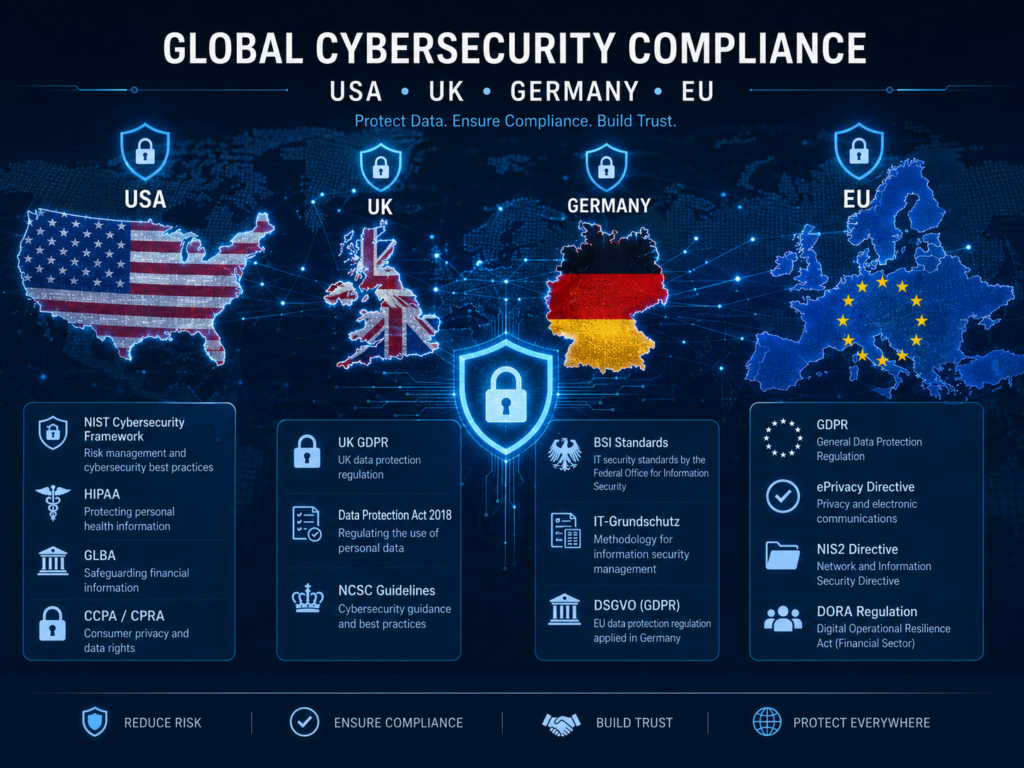
GEO Cybersecurity Requirements: USA, UK, Germany, and EU
Cybersecurity requirements differ by region, but the pattern is clear: regulators expect risk-based safeguards, incident readiness, data protection, and third-party oversight.
Preemptive cybersecurity helps enterprises show that they are managing foreseeable risks, not simply reacting after incidents.
USA.
In the USA, healthcare organizations must protect electronic protected health information under the HIPAA Security Rule, which requires administrative, physical, and technical safeguards.
Payment businesses also need to align with PCI DSS requirements for protecting payment account data.
A Washington DC healthcare vendor, New York insurer, or Austin SaaS company may also face SOC 2 audits, cyber insurance questionnaires, and CISA guidance expectations. Preemptive controls such as MFA coverage, endpoint monitoring, vulnerability prioritization, and tested incident response improve evidence quality.
UK.
UK companies must consider UK-GDPR principles such as accountability, integrity, confidentiality, and data minimization.
For London fin techs, FCA-regulated firms, Open Banking platforms, and NHS suppliers, preemptive cybersecurity supports customer trust and operational resilience.
A Manchester health tech provider, for example, should monitor exposed APIs, vendor access, privileged accounts, and patient-data workflows before an incident occurs.
Germany and EU.
Germany and the wider EU bring strong expectations around GDPR/DSGVO, data residency, resilience, vendor oversight, and sector-specific regulation.
DORA entered into application on January 17, 2025, to strengthen digital operational resilience for EU financial entities.
For BaFin-regulated firms in Frankfurt, insurers in Munich, SaaS companies in Berlin, and EU platforms operating across Paris, Amsterdam, and Dublin, preemptive cybersecurity should include vendor risk, cloud-region review, encryption, incident reporting workflows, and access governance.
Industry Use Cases for Preemptive Cybersecurity
Preemptive cybersecurity is useful wherever downtime, fraud, data theft, or regulatory failure can create serious business impact.
The strongest use cases include healthcare, financial services, critical infrastructure, enterprise cloud, and SaaS platforms.
Healthcare
Healthcare teams manage sensitive records, connected devices, third-party platforms, and urgent availability needs.
Preemptive security can detect exposed patient portals, risky admin accounts, abnormal EHR access, ransomware staging, and suspicious vendor activity.
For mobile patient experiences, secure engineering matters from day one. Mak It Solutions’ mobile app development services include security-focused practices such as encryption and secure coding.
Financial Services
Financial institutions need continuous visibility into APIs, payment systems, identity flows, vendors, and cloud workloads.
AI threat detection for BaFin-regulated financial institutions should support fraud signals, privileged access monitoring, DORA resilience planning, and PCI DSS evidence.
For cross-platform fintech apps, React Native development services can support secure mobile delivery when paired with secure APIs, authentication, and monitoring.
Critical Infrastructure and Enterprise Cloud
Critical infrastructure and enterprise cloud environments depend on shared responsibility.
AWS, Microsoft, and Google Cloud provide powerful native controls, but customers must configure identity, logging, network boundaries, encryption, and workload security correctly.
For secure automation, data pipelines, and backend tooling, Mak It Solutions’ Python development services can support business-specific workflows when security requirements are defined early.
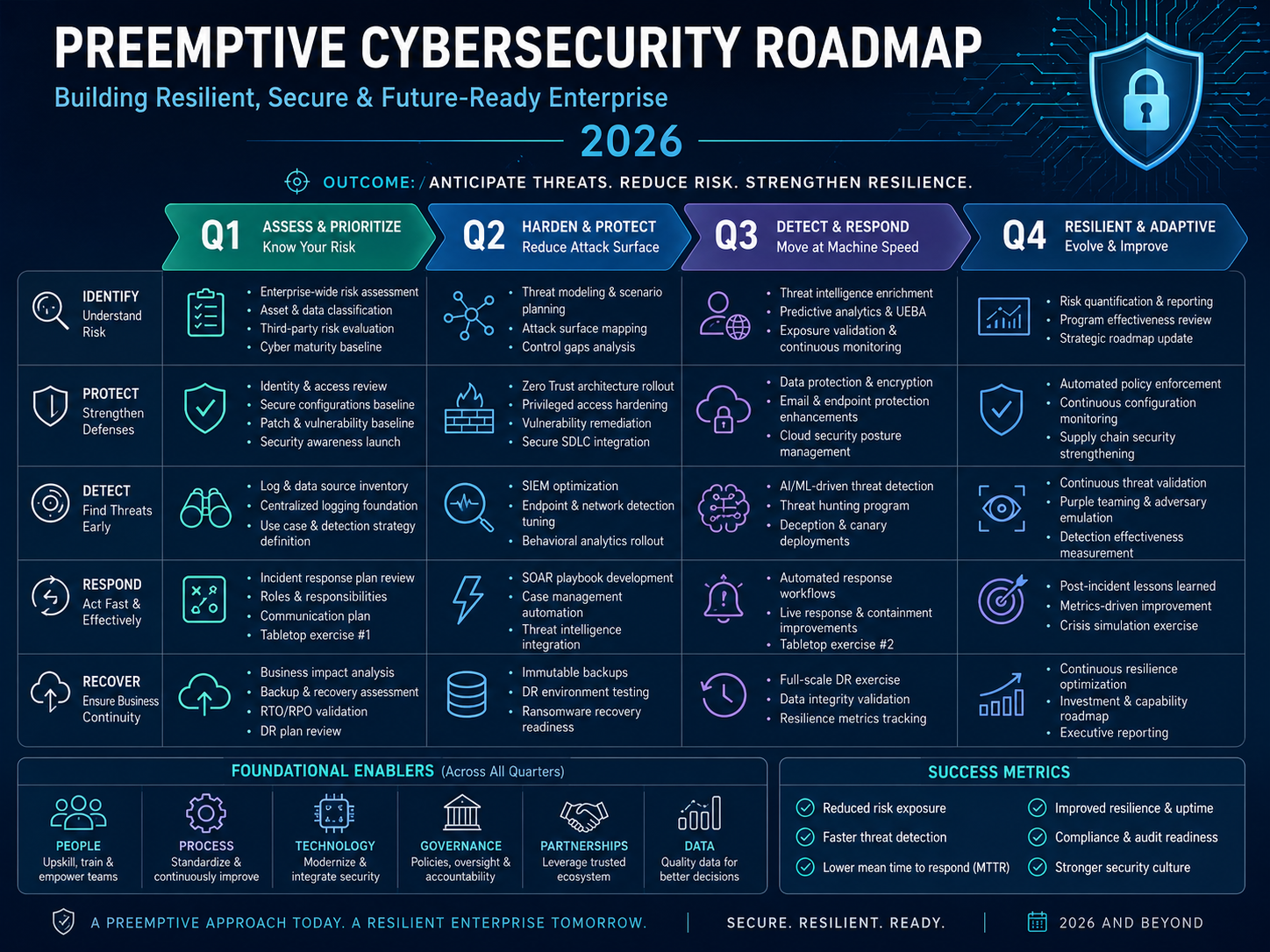
How to Build a Preemptive Cybersecurity Roadmap
A practical preemptive cybersecurity roadmap starts with visibility, then adds intelligence, automation, and governance.
Map Your Attack Surface
Create a current inventory of internet-facing systems, cloud workloads, domains, APIs, SaaS tools, privileged identities, and critical data stores.
Then classify assets by business impact. You cannot protect what you cannot see.
Add Threat Intelligence and AI SOC Automation
Connect threat intelligence to your real exposure. Add AI SOC automation for alert enrichment, correlation, deduplication, and recommended response actions.
Use human approval for high-impact actions such as disabling accounts, isolating production workloads, or blocking business-critical integrations.
Align Governance With Compliance
Map controls to GDPR, UK-GDPR, HIPAA, DORA, NIS2, PCI DSS, SOC 2, and ISO 27001.
Strong governance means evidence, access control, incident response, vendor oversight, resilience testing, and clear ownership.
Mak It Solutions has also covered adjacent enterprise security topics such as AI data leakage prevention, cybersecurity skills shortage planning, and software supply chain security.
Final Thoughts
Preemptive cybersecurity gives enterprises a better way to handle modern risk: identify likely attack paths early, prioritize what matters, and act before disruption spreads.
For cloud, SaaS, mobile, data, and enterprise software teams, the next step is not adding more noise to the SOC. It is building a roadmap that connects attack surface visibility, AI threat detection, exposure management, and compliance governance into one practical security program.
Need a practical preemptive cybersecurity roadmap for your cloud, SaaS, mobile, or data environment? Start with a focused consultation through the Mak It Solutions contact page and request a scoped estimate for your security, software, or cloud modernization project.
Key Takeaways
Preemptive cybersecurity focuses on stopping likely attacks before business impact, not just responding after alerts.
AI threat detection improves speed, correlation, phishing defense, ransomware warning, and SOC prioritization.
Exposure management connects vulnerabilities, identities, cloud assets, and business-critical systems.
US, UK, Germany, and EU organizations should align security with HIPAA, PCI DSS, UK-GDPR, GDPR, DORA, NIS2, BaFin, FCA, SOC 2, and ISO 27001 expectations.
FAQs
Q : Can preemptive cybersecurity prevent ransomware attacks?
A : Preemptive cybersecurity can reduce ransomware risk, but it cannot guarantee complete prevention. It helps by detecting exposed remote access, leaked credentials, risky privilege escalation, suspicious file activity, and backup tampering before ransomware spreads.
Q : Is preemptive cybersecurity the same as zero trust?
A : No. Zero trust is a security architecture based on continuous verification and least-privilege access. Preemptive cybersecurity is broader because it includes zero trust, predictive threat intelligence, exposure management, AI threat detection, and SOC automation.
Q : What types of companies need AI threat detection most?
A : AI threat detection is most useful for companies with large data volumes, complex cloud environments, regulated workflows, or high attack pressure. Healthcare providers, fintech firms, SaaS platforms, e-commerce companies, banks, insurers, and critical infrastructure operators are strong examples.
Q : How does exposure management support cyber insurance readiness?
A : Exposure management helps show insurers that the company understands and prioritizes its highest-risk assets. It can support evidence around MFA coverage, patch prioritization, attack surface reduction, endpoint monitoring, backup protection, and incident response maturity.
Q : What compliance risks should EU companies consider when using AI cybersecurity tools?
A : EU companies should review GDPR/DSGVO obligations, data residency, vendor processing terms, model transparency, access controls, retention rules, and cross-border data transfers. BaFin-regulated and DORA-covered financial entities should also assess third-party ICT risk, incident response, resilience testing, and audit evidence.
[…] approach also fits broader preemptive cybersecurity planning: address difficult future risks while architecture and procurement choices are still […]