
Software Supply Chain Security in UAE & KSA
Software Supply Chain Security in UAE & KSA
Software Supply Chain Security in UAE & KSA
Software supply chain security is now a serious business requirement for companies in Saudi Arabia, the UAE, and Qatar. If your software depends on open-source packages, vendor APIs, cloud services, SaaS tools, containers, or outsourced development teams, your security risk is not limited to your own code.
In simple terms, software supply chain security helps GCC firms understand what is inside their applications, where vulnerable dependencies exist, which vendors introduce risk, and whether their CI/CD pipelines can be trusted before deployment. It supports safer procurement, better audit evidence, and faster response when a critical vulnerability appears.
Why GCC Companies Can’t Ignore Software Supply Chain Security
GCC companies are building digital products faster than ever. Riyadh fintechs, Dubai SaaS startups, Abu Dhabi enterprises, and Doha banks all rely on third-party code to move quickly.
That speed brings value, but it also creates hidden exposure.
A single compromised package, unsafe vendor SDK, leaked CI/CD token, or vulnerable container image can affect the whole application. Traditional cybersecurity still matters, but it does not always show what is happening inside the software build process.
That is where software supply chain security comes in.
It helps teams answer practical questions.
Which open-source packages are inside this app?
Are any dependencies vulnerable or outdated?
Can we prove what was included in this release?
Has vendor-delivered code been reviewed?
Are our build and deployment pipelines protected?
NIST’s Secure Software Development Framework recommends integrating secure development practices into the SDLC instead of treating security as a late-stage checklist.
What Is Software Supply Chain Security?
Software supply chain security protects everything used to build, test, package, deploy, and run software.
That includes.
Source code
Open-source libraries
Package managers such as npm, Maven, and PyPI
Container images
CI/CD workflows
Build tools
SaaS integrations
Third-party APIs
Vendor-delivered modules
Cloud infrastructure dependencies
In practice, it is about knowing what you use, checking whether it is safe, controlling who can change it, and proving that every release is trustworthy.
Software Supply Chain Security vs. Traditional Cybersecurity
Traditional cybersecurity focuses on areas such as networks, endpoints, firewalls, identity, and access controls.
Software supply chain security goes deeper into the software creation process. It focuses on dependency risk, SBOMs, license exposure, package versions, build integrity, release gates, and vendor code.
Both are important. But they solve different problems.
A firewall will not tell you that your application contains a vulnerable open-source library. An endpoint tool will not prove that a third-party package was safe when it entered your build pipeline.
SBOM Basics for GCC Compliance and Procurement
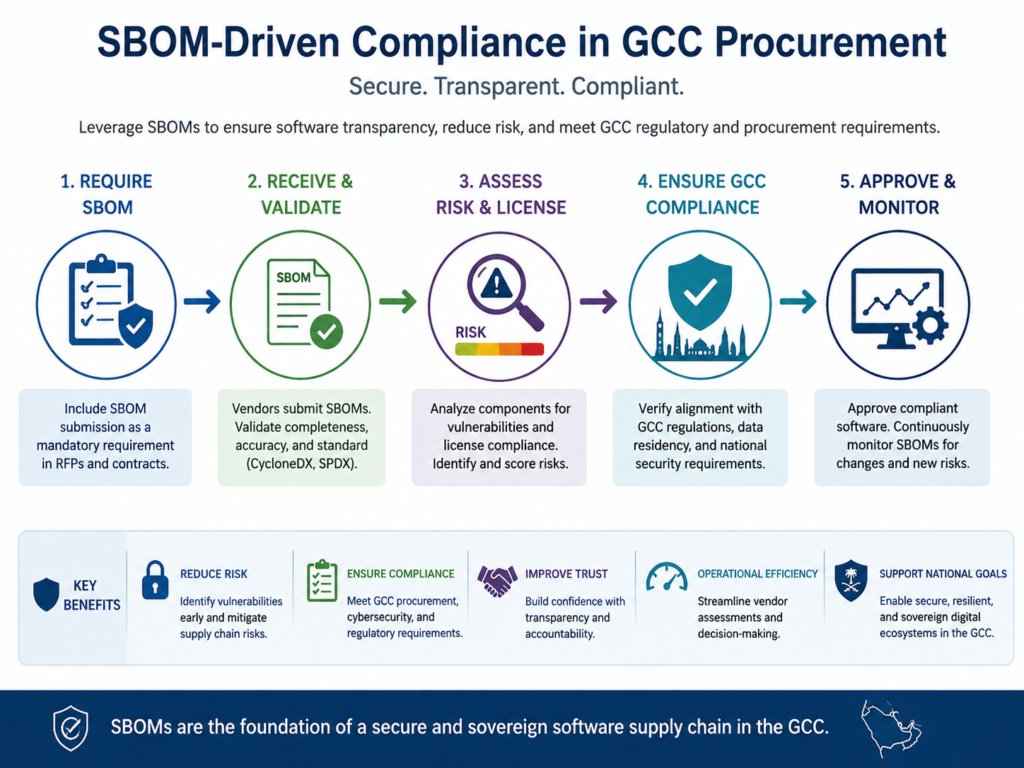
An SBOM, or Software Bill of Materials, is a structured inventory of the components inside an application.
For GCC procurement and security teams, it answers a simple question: what exactly are we buying, deploying, and trusting?
What an SBOM Usually Includes
A useful SBOM usually includes.
Component names
Version numbers
Suppliers
Licenses
Dependency relationships
Vulnerability visibility
Distribution and access controls
The NTIA’s SBOM minimum-elements guidance highlights data fields, automation support, and operational practices such as frequency, depth, distribution, and access control.
Why GCC Buyers Ask for SBOMs
Procurement teams ask for SBOMs because they reduce uncertainty.
A Saudi bank, Abu Dhabi enterprise, or Qatar payment provider may need to review vendor software before signing a contract. An SBOM gives them a cleaner view of open-source exposure, license risk, and vulnerable components.
It also helps CISOs respond faster when a major CVE affects a widely used library.
Instead of asking, “Are we affected?” for days, teams can check their inventory and act quickly.
Common SBOM Formats
Two common SBOM formats are.
| Format | Best Use |
|---|---|
| Cyclone DX | Security, dependency tracking, vulnerability management |
| SPDX | Licensing, compliance, open-source governance |
For regulated GCC businesses, machine-readable SBOMs are far better than manual spreadsheets. They make evidence repeatable, searchable, and easier to share with security, procurement, and compliance teams.
Dependency Scanning and SCA for DevSecOps Teams
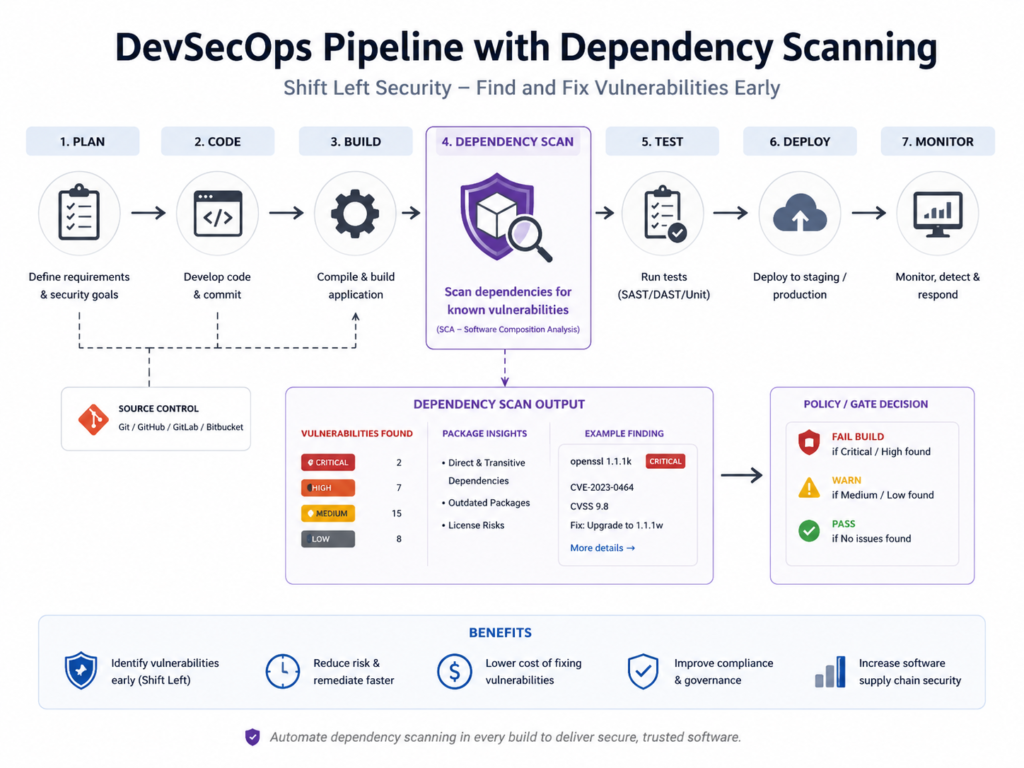
Dependency scanning checks whether the software packages in your application contain known vulnerabilities.
For DevSecOps teams working across English technical documentation and local GCC compliance needs, it turns hidden package risk into visible action.
How Dependency Scanning Works
Dependency scanning compares your package names and versions against vulnerability data such as CVEs, CVSS severity scores, and sometimes exploit likelihood signals.
It can scan.
npm and Yarn packages
Maven dependencies
PyPI packages
GitHub workflows
Docker images
Container registries
Kubernetes workloads
For teams working on backend web development or Next.js development, scanning should sit close to everyday engineering work, not outside it.
SCA vs. Dependency Scanning
Dependency scanning mainly identifies vulnerable packages.
Software Composition Analysis, or SCA, is broader. It can include.
Open-source component inventory
License risk
Policy enforcement
Remediation tracking
Security reporting
Audit evidence
Vendor software review
A mature software supply chain security program usually needs both.
Where to Add Scanning in the CI/CD Pipeline
Scanning should happen across the delivery lifecycle, not only before launch.
Good checkpoints include.
Code commit
Pull request
Build stage
Container image creation
Release gate
Production monitoring
This helps developers catch issues early, before vulnerable code reaches customers.
GCC Compliance Signals: Saudi Arabia, UAE, and Qatar
GCC companies do not only need security tools. They need evidence that buyers, regulators, and enterprise clients can understand.
Saudi Arabia.
For Saudi financial firms, software supply chain security should support SAMA-aligned cybersecurity maturity, supplier governance, and audit readiness. SAMA’s Cyber Security Framework requires banks operating in the Kingdom to comply and assess cybersecurity maturity against framework requirements.
For Riyadh fintechs and Saudi government software projects, SBOMs, CVE management, vendor reviews, and secure SDLC controls can help create stronger evidence before production access is granted.
UAE.
In the UAE, software teams often need to satisfy enterprise procurement, cloud governance, identity controls, and sector-specific expectations.
Dubai startups, DIFC fintech firms, and Abu Dhabi ADGM-regulated businesses should connect SBOMs, dependency scanning, vendor due diligence, and secure deployment workflows to their broader risk program.
For UAE Pass integrations, payment flows, or customer-facing apps, third-party dependency risk should be reviewed before go-live.
Qatar.
Qatar financial institutions and payment service providers should treat third-party software risk as part of operational resilience.
QCB publishes information-security and technology-risk resources, including regulations for payment service providers and technology-risk instructions. Its payment service provider regulation also expects documented security controls and resources dedicated to verifying and remediating risks.
For Doha banks and fintech platforms, every vendor API, SaaS tool, SDK, and container image should have an owner, a review process, and a clear vulnerability-response path.
Key Use Cases for GCC Industries
Fintech and Banking Applications
Saudi fintech apps, UAE payment platforms, and Qatar banking systems rely heavily on APIs, SDKs, and vendor libraries.
SBOMs and SCA help prove that open banking, wallet, lending, and payment code is reviewed before release.
This is not just a developer concern. It affects compliance, customer trust, and enterprise onboarding.
Government and Critical Infrastructure Software
Government platforms in Saudi Arabia, UAE digital services, and Qatar national systems need secure supplier onboarding.
For teams building public-sector portals, PHP web development and front-end development should include package governance from day one.
A secure portal is not only about the interface. It is also about the code, packages, APIs, and deployment chain behind it.
Retail, Logistics, and Cloud-Native Platforms
Dubai e-commerce brands, Riyadh logistics firms, and Doha SMEs often depend on POS plugins, warehouse APIs, mobile apps, and cloud-native platforms.
Mak It Solutions’ e-commerce development and mobile app development services can support secure, scalable customer-facing systems.
For these businesses, software supply chain security reduces the risk of checkout downtime, customer-data exposure, and vendor-related disruption.
How to Build a GCC-Ready Software Supply Chain Security Program
Create an Open-Source Component Inventory
Start by generating SBOMs for applications, containers, APIs, and vendor-delivered software.
This gives your team a single view of what exists inside your software.
For a Doha SME, Riyadh fintech, or Dubai SaaS company, this inventory becomes the foundation for vulnerability response, procurement review, and compliance reporting.
Add Automated Dependency and Container Scanning
Next, add SCA tools, GitHub or GitLab security scanning, open-source vulnerability scanning, and Docker image scanning.
A Dubai e-commerce brand, for example, can scan every pull request before deploying checkout updates. A Saudi fintech can block releases if a critical dependency risk appears before production.
Automation matters because manual checks are too slow for modern release cycles.
Define Remediation SLAs and Vendor Requirements
Not every vulnerability needs the same response. Define risk-based remediation timelines for critical, high, medium, and low vulnerabilities.
You should also set vendor requirements for:
SBOM submission
License review
Critical CVE disclosure
Secure development practices
Patch communication
Access to security evidence
This helps procurement, legal, security, and engineering teams work from the same playbook.
Protect the CI/CD Pipeline
Your CI/CD pipeline is part of your software supply chain.
Protect it with:
Strong identity and access controls
Secret scanning
Signed commits where practical
Protected branches
Build approval gates
Least-privilege tokens
Audit logs
Separation between development and production access
A compromised build pipeline can quietly turn trusted software into unsafe software.
Report Risk in Business Language
Executives do not always need the raw CVE details first.
They need to understand.
Customer impact
Compliance exposure
Downtime risk
Vendor risk
Data sensitivity
Fix priority
Business owner
Instead of only saying “critical CVE,” explain what system is affected, what could happen, who owns the fix, and when it will be resolved.
Best Practices for Arabic-Speaking GCC Teams
Make Security Workflows Bilingual
Many GCC teams operate in both Arabic and English.
Use Arabic summaries for executives and English technical details for engineers when needed. This keeps security communication clear without losing technical accuracy.
Bilingual workflows can help teams in Riyadh, Jeddah, Dubai, Abu Dhabi, and Doha act faster during vulnerability response.
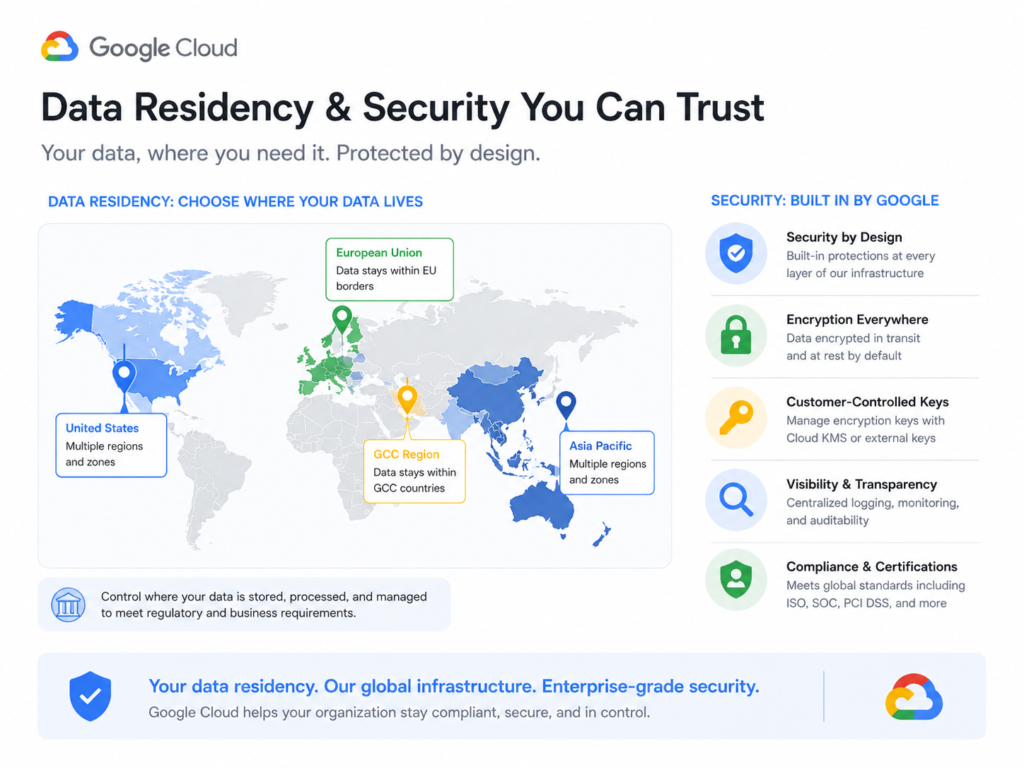
Align Cloud Hosting With Data Residency Expectations
Cloud hosting decisions should match business, performance, and regulatory needs.
AWS lists Middle East regions in Bahrain and the UAE. For GCC firms, cloud-region selection should be paired with backup planning, access control, encryption, vendor review, and incident-response readiness.
Do not treat cloud location as a checkbox. Treat it as part of the wider software trust model.
Keep Procurement, Security, and Engineering Connected
Software supply chain security fails when every team works separately.
Procurement asks vendors for documents. Security reviews risk. Engineers fix packages. Legal reviews contracts. Leadership asks for evidence.
A good program connects all of them.
The goal is not more paperwork. The goal is faster, safer decisions.
Concluding Remarks
Software supply chain security gives GCC firms a practical way to prove trust before customers, regulators, or attackers ask hard questions.
For Saudi, UAE, and Qatar businesses, the strongest approach combines SBOMs, dependency scanning, SCA, vendor-risk controls, CI/CD governance, cloud-aware planning, and compliance-ready reporting.
Whether you are a Saudi fintech, UAE SaaS company, Qatar bank, logistics provider, or e-commerce brand, the principle is simple: know what is inside your software, monitor it continuously, and fix risk before it reaches production.
Need a practical software supply chain security plan for your GCC business?
Contact Mak It Solutions to review your applications, dependencies, CI/CD workflows, cloud setup, and vendor risk. You can explore our services or talk to our team for a custom Saudi, UAE, or Qatar strategy.
FAQs
Q : Is software supply chain security important for Saudi fintech companies?
A : Yes. Saudi fintech companies handle sensitive financial data, payment flows, APIs, and third-party integrations. Software supply chain security helps them review open-source packages, vendor SDKs, containers, and build pipelines before release.
Q : Do UAE startups need an SBOM before selling to enterprise clients?
A : Not always at the first sales call, but many enterprise buyers now expect software transparency. An SBOM helps UAE startups answer questions about open-source risk, vulnerable dependencies, licenses, hosting, and vendor assurance.
Q : How can Qatar banks reduce third-party software risk?
A : Qatar banks can reduce third-party software risk by requesting vendor SBOMs, scanning delivered code and containers, reviewing open-source licenses, and tracking critical CVEs with clear remediation timelines.
Q : What dependency scanning tools are useful for Dubai software teams?
A : Dubai software teams can use dependency scanning built into GitHub, GitLab, container registries, SCA platforms, and CI/CD tools. The right option depends on the stack, reporting needs, and compliance requirements.
Q : How often should GCC companies scan open-source dependencies?
A : GCC companies should scan dependencies continuously during pull requests, builds, releases, and production monitoring. New CVEs can appear after deployment, so one-time checks are not enough.