


Best GCC edge computing use cases in desert environments
Best GCC edge computing use cases in desert environments
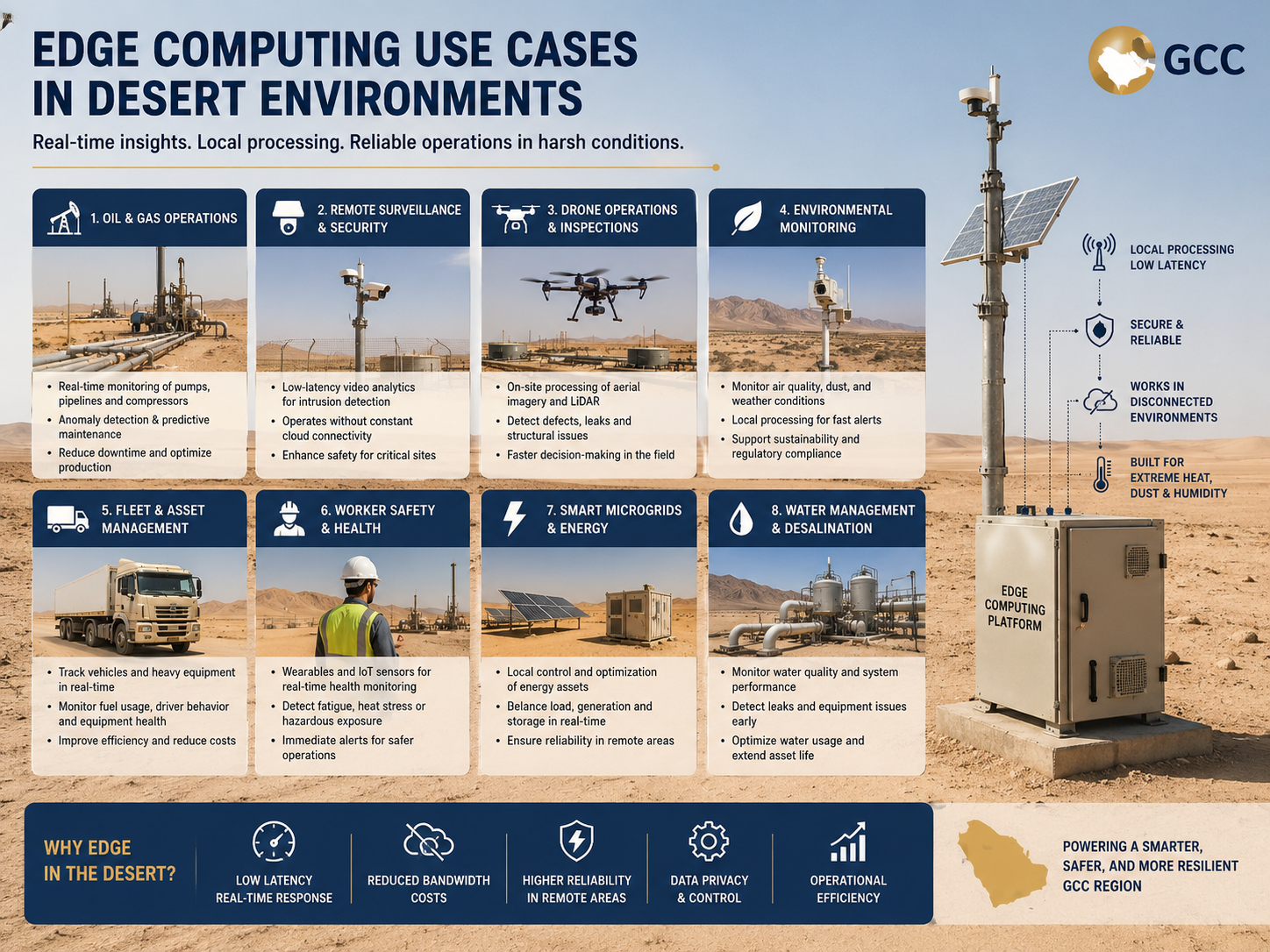
Best GCC edge computing use cases in desert environments
Edge computing use cases in desert environments help GCC enterprises process data close to sensors, cameras, vehicles, and industrial assets instead of depending only on distant cloud systems. In Saudi Arabia, the UAE, and Qatar, this can improve latency, uptime, safety, and data control for oilfields, smart cities, ports, utilities, logistics yards, and sovereign data projects.
Desert operations are different. Heat, dust, sandstorms, remote sites, weak connectivity, and real-time safety needs can make cloud-only systems harder to rely on.
That is why edge computing is becoming a practical resilience strategy for Saudi oilfields, UAE logistics hubs, Qatar utilities, and smart-city infrastructure in Riyadh, Dubai, Abu Dhabi, Doha, Jeddah, and Lusail.
For GCC leaders, edge is not just a technology upgrade. It keeps essential processing near field assets, reduces cloud dependency, supports private 5G, and helps sensitive data stay under tighter local control.
What Are Edge Computing Use Cases in Desert Environments?
Edge computing use cases in desert environments are practical ways to process data near the place where it is created, such as.
Cameras
IoT sensors
Industrial machines
Vehicles
Gateways
Control systems
Field devices
Instead of sending every signal to the cloud, edge systems process urgent data locally and send only useful insights, alerts, or summaries upstream.
Edge Computing vs Cloud Computing in GCC Operations
Cloud is still important. It works well for storage, dashboards, reporting, backups, and large-scale analytics.
Edge is better when decisions must happen immediately.
For example, a pipeline pressure alert in Dammam or a traffic incident in Dubai should not wait for a faraway server to respond. Mak It Solutions can connect edge and cloud models with business intelligence solutions and secure application workflows.
Why Desert Environments Need a Different Edge Strategy
Desert operations face extreme heat, dust, vibration, limited maintenance windows, and remote connectivity gaps.
A normal office server may fail outdoors. A ruggedized edge gateway, on the other hand, can keep low-latency IoT processing active near pumps, cameras, substations, solar farms, logistics yards, and construction sites.
In practice, GCC edge projects should consider hardware durability as seriously as software performance.
Where GCC Buyers Should Start
Start with three simple questions.
Does the workload need instant action?
Would downtime create safety, revenue, or compliance risk?
Is the data sensitive or locally regulated?
If the answer is yes, edge may be a strong fit before sending filtered data to the cloud.
Best Industrial Edge Computing Use Cases for Saudi Oilfields and Utilities
Saudi Arabia is one of the strongest markets for edge computing use cases in desert environments, especially across oil, gas, mining, power, and water infrastructure.
Pipeline Monitoring and Remote Asset Intelligence
Edge gateways can monitor vibration, pressure, valve status, flow rates, and leak indicators across remote Saudi pipeline networks.
Instead of sending every signal to the cloud, the edge device filters noise, detects anomalies, and alerts operators faster. This can help field teams respond before a small issue becomes a costly shutdown.
Predictive Maintenance for Energy, Mining, and Utility Sites
In industrial hubs such as Jubail and Dammam, edge AI inference can identify early machine failure from vibration, heat, or acoustic patterns.
A utility site can use this data to schedule repairs before equipment breaks. That means fewer emergency truck rolls, better uptime, and more predictable maintenance planning.
Private 5G Edge for Remote Industrial Sites
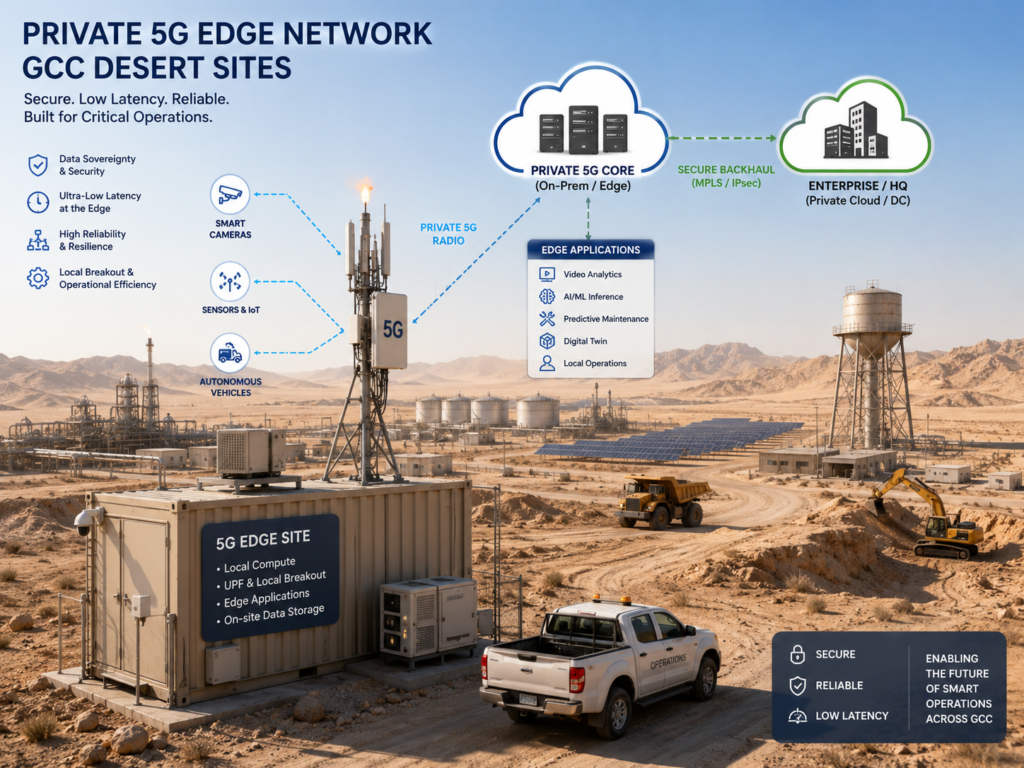
Private 5G edge networks can help industrial sites connect sensors, drones, robots, vehicles, and safety systems with low latency.
For regulated or critical workloads, GCC organizations also need to think carefully about cybersecurity controls, cloud usage, and data governance. This is where edge architecture can support risk-aware designs by keeping sensitive processing closer to the operational site.
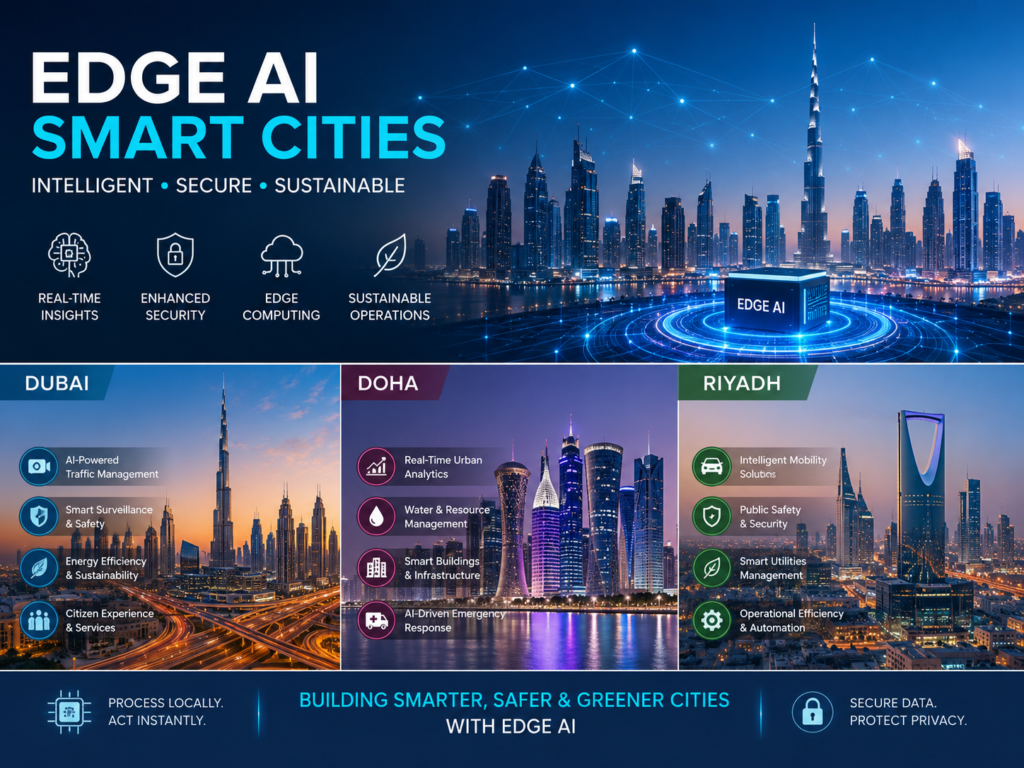
Edge AI for Smart Cities in Dubai, Riyadh, and Doha
Smart-city programs generate huge volumes of data from cameras, road sensors, parking systems, public spaces, buildings, and transport networks.
Sending all of that data to the cloud can become expensive and slow. Edge AI solves part of the problem by processing video and sensor data locally.
Traffic Management and Public Safety Video Analytics
Edge AI can detect.
Collisions
Congestion
Wrong-way driving
Crowding
Unsafe behavior
Road or infrastructure incidents
Riyadh can use it for faster incident response. Dubai can reduce video backhaul costs. Doha can support event safety and public-space monitoring with lower latency.
Smart Parking, Crowd Management, and Event Infrastructure
A Dubai retail district can use edge cameras for real-time parking occupancy. A Doha event venue can analyze crowd density locally. A Riyadh municipality can combine edge alerts with mobile app development for field-team dispatch.
This is where edge becomes more than infrastructure. It becomes part of the daily operating workflow.
Arabic UX Dashboards for City Operations Teams
For Arabic-speaking teams, edge platforms should support bilingual alerts, right-to-left dashboards, and clear escalation flows.
A dashboard that is technically powerful but hard for field teams to use will slow response times. That is why front-end development and operational UX matter as much as hardware.
Rugged Edge Computing for Harsh GCC Field Conditions
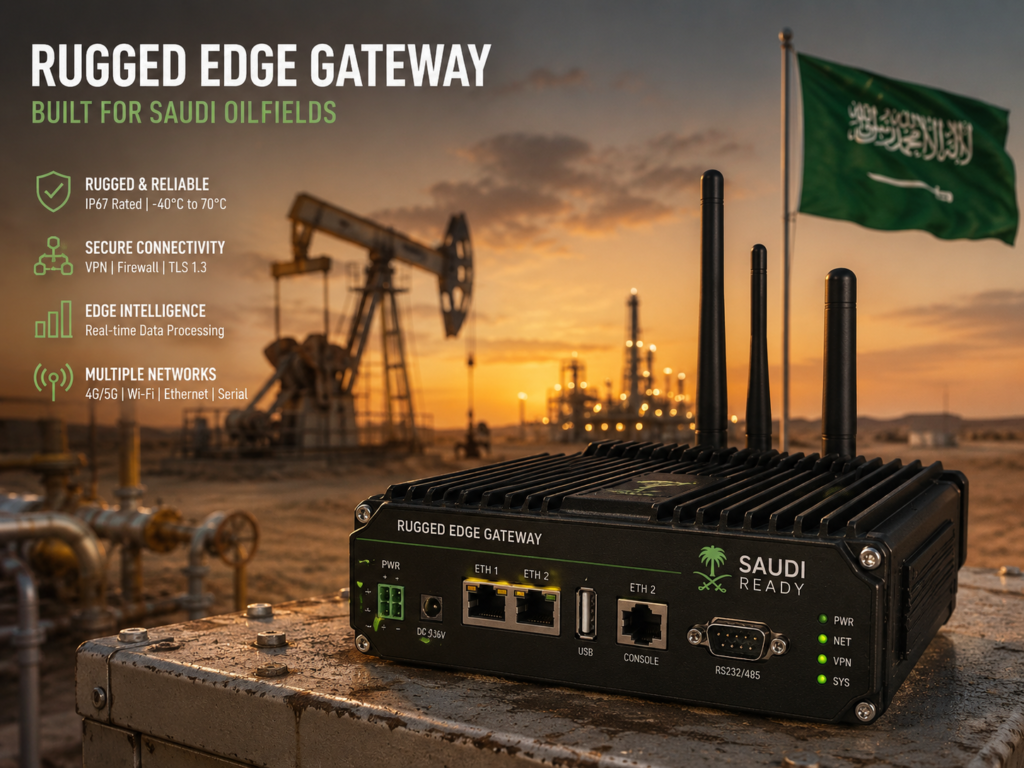
Outdoor GCC sites need equipment that can survive tough conditions. In desert deployments, reliability often matters more than raw compute power.
Ruggedized Edge Gateways for Heat, Dust, and Vibration
Rugged edge devices are built for outdoor and industrial conditions.
They are useful near.
Roads
Ports
Pipelines
Solar farms
Substations
Construction zones
Logistics yards
Utility sites
A strong rugged edge setup can reduce downtime, protect local processing, and keep essential workloads running even when connectivity is unstable.
Solar-Powered and Low-Maintenance Edge Sites
Remote desert sites may have limited power and cooling. Solar-assisted edge nodes, efficient chips, local storage, and remote patching can reduce technician visits.
This is especially useful for assets that are difficult or costly to access regularly.
Outdoor Edge AI for UAE Logistics, Qatar Utilities, and Saudi Infrastructure
A UAE logistics yard can use edge AI for container movement, fleet visibility, and cold-chain alerts.
Qatar utilities can monitor faults near Doha or Lusail.
Saudi infrastructure teams can process drone and sensor data locally before syncing only important insights to the cloud.
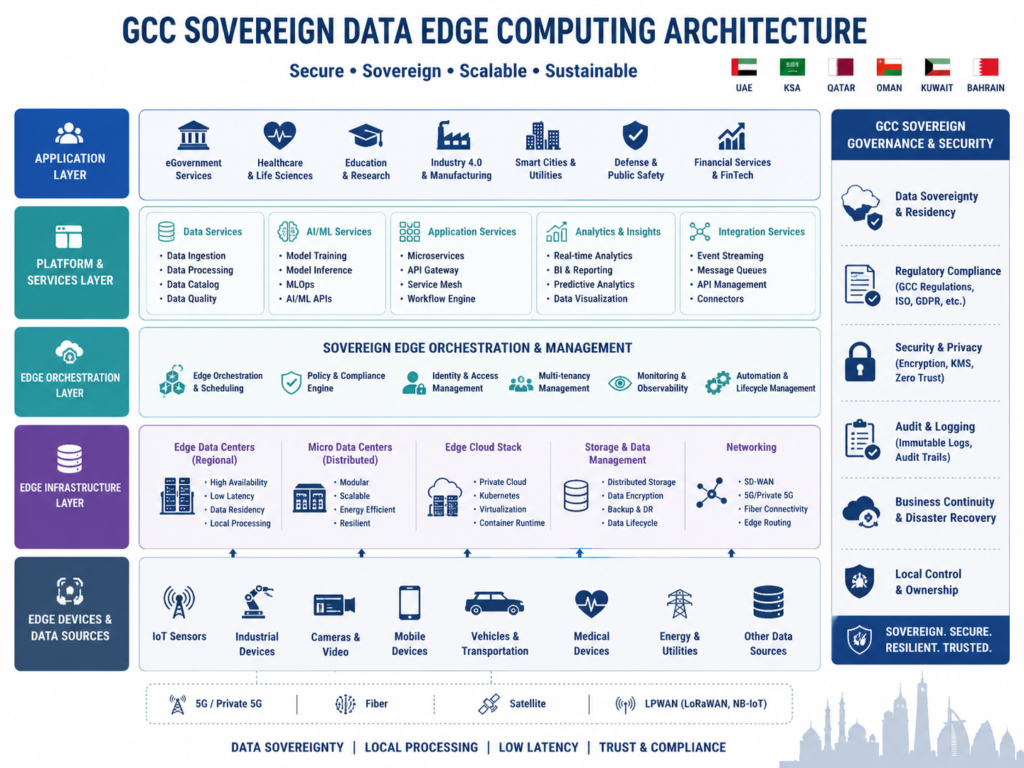
Compliance, Sovereign Data, and Local Processing in the GCC
Data governance is a major reason GCC enterprises are taking edge computing seriously.
Edge does not remove the need for cloud. But it can help organizations decide what data stays local, what gets anonymized, what moves to cloud, and what requires encryption or strict access control.
Saudi Data Residency and NDMO-Aware Edge Architecture
Saudi teams should consider NDMO, SDAIA, DGA, SAMA, and sector-specific rules when designing where data is processed.
For regulated workloads, data localization architecture can help decide.
What stays on site
What moves to local cloud
What can be shared with regional systems
What must be encrypted
What needs tighter identity and access controls
UAE Compliance Signals.
In the UAE, organizations should consider TDRA expectations, ADGM and DIFC requirements, UAE Pass integrations, and Digital Dubai ecosystem needs where relevant.
For Dubai and Abu Dhabi firms, edge can support faster local processing while keeping sensitive data flows more controlled.
Qatar Compliance Signals.
Qatar buyers should consider QCB, MCIT Qatar, and local cloud options when planning edge and cloud architecture.
For utilities, financial services, government-related platforms, and smart-city projects, edge plus local cloud can support both performance and data-control goals.
How to Choose the Right Edge Computing Use Case in the GCC
The best edge projects start with a clear business case, not hardware shopping.
Compare Business Impact, Latency, Connectivity, and Security
Rank each use case by.
Downtime cost
Safety impact
Latency sensitivity
Connectivity limits
Data sensitivity
Regulatory risk
Maintenance difficulty
Good pilot candidates include oilfield monitoring, utility fault detection, smart parking, logistics visibility, and public safety analytics.
Build Around Private 5G, Cloud, and Edge AI Together
A strong GCC edge architecture usually combines several layers.
Edge handles instant decisions. Private 5G connects local assets. Cloud stores history and supports broader analytics. Dashboards help teams understand trends and take action.
Regional cloud options may include AWS Bahrain, Azure UAE Central, Azure Qatar Central, and Google Cloud Doha, depending on the project, sector, and compliance requirements.
Start With One High-Value Pilot
Do not start with a region-wide rollout.
Start with one measurable site and one clear outcome.
A Riyadh fintech can test edge logging for regulated workflows. A Dubai e-commerce brand can improve real-time delivery visibility with e-commerce systems. A Doha SME can combine local cloud and edge for better data residency and faster operational response.
Once the pilot proves value, the model can be scaled across cities, plants, branches, yards, or field sites.
Final Thoughts
The strongest edge computing use cases in desert environments include oilfield monitoring, smart-city video analytics, utilities, ports, logistics, public safety, and field automation.
For GCC enterprises, edge is not just faster computing. It supports uptime, safer operations, lower bandwidth use, Arabic-first adoption, and stronger data control.
Before scaling, identify one asset, one risk, and one measurable business outcome. Then build the pilot with clear data rules, rugged hardware, secure apps, and cloud integration.
Mak It Solutions can help your team assess edge computing use cases in desert environments and design a practical GCC strategy for Saudi Arabia, the UAE, and Qatar. Book a consultation, explore technology services, or request a custom roadmap for edge AI, cloud, compliance, mobile apps, and Arabic-first dashboards.( Click Here’s )
FAQs
Q : Is edge computing useful for Saudi oil and gas operations?
A : Yes. Edge computing is useful for Saudi oil and gas operations because many assets sit in remote, high-heat, and connectivity-challenged environments. Edge gateways can process vibration, pressure, leak, and equipment data near pipelines, pumps, and valves instead of waiting for cloud response.
Q : What edge computing use cases work best for Dubai smart-city projects?
A : Dubai smart-city projects can benefit from traffic analytics, public safety video processing, smart parking, logistics yard monitoring, and energy optimization. Edge AI can detect incidents locally and send only useful alerts, which reduces bandwidth and supports faster city response.
Q : Can Qatar utilities use edge AI for real-time monitoring?
A : Yes. Qatar utilities can use edge AI to monitor substations, water systems, energy assets, and field equipment in real time. Local processing can help detect faults, voltage changes, abnormal heat, or service interruptions before they affect customers.
Q : Do GCC companies need rugged edge gateways for outdoor sites?
A : Often, yes. Outdoor GCC sites face heat, sand, dust, vibration, unstable power, and limited technician access. Rugged edge gateways help keep critical edge computing use cases in desert environments stable and easier to manage.
Q : How does edge computing support Arabic UX for field teams?
A : Edge computing supports Arabic UX by delivering fast local alerts and dashboards that match GCC field-team workflows. This can include Arabic labels, bilingual reports, right-to-left screens, voice-friendly alerts, and mobile escalation flows.
[…] twins and simulation can help teams test these behaviours before live deployment. GCC edge-computing architectures can also reduce dependence on constant cloud connectivity when robots need to make fast decisions […]