


Data Localization Architecture Patterns in GCC
Data Localization Architecture Patterns in GCC

Data Localization Architecture Patterns in GCC
GCC businesses are moving more workloads to the cloud, but regulated data cannot be treated like ordinary application traffic. Data localization architecture patterns help teams decide where sensitive data, backups, logs, encryption keys, and support access should live.
For Saudi Arabia, UAE, and Qatar teams, the safest approach usually combines local data storage, local key management, tokenization, audit logging, and country-specific cloud design. The goal is not just to host data nearby. The goal is to prove who controls it, who can access it, and how it is protected.
For a Riyadh fintech, Dubai e-commerce brand, Doha healthcare platform, or Abu Dhabi government vendor, the real question is not only: Where is the server? It is also.
Where are logs stored?
Where are backups replicated?
Who controls encryption keys?
Can offshore support teams access production data?
Can regulated data leave the country through analytics, APIs, or SaaS tools?
This is where architecture becomes a compliance tool, not just an IT decision.
What Are Data Localization Architecture Patterns?
Data localization architecture patterns are repeatable technical designs that help businesses keep regulated data within approved countries or boundaries while still using modern cloud, APIs, analytics, mobile apps, and SaaS platforms.
They give CTOs, CISOs, product owners, and compliance teams a practical way to design systems around local data rules, sector expectations, and enterprise buyer requirements.
Data Localization vs Data Residency vs Data Sovereignty
These terms are often used together, but they do not mean exactly the same thing.
| Term | What It Means |
|---|---|
| Data localization | Certain data must stay inside a specific country or approved boundary. |
| Data residency | Focuses on where data is stored or processed. |
| Data sovereignty | Goes deeper into jurisdiction, operator access, encryption-key control, and legal authority. |
In practice, a GCC business may need all three. A server in-country helps, but it does not solve everything if backups, logs, support access, or encryption keys are still managed elsewhere.
Why GCC Cloud Teams Need Architecture Patterns, Not Just Legal Advice
Legal advice explains what may be required. Architecture shows how to build for it.
A compliance memo will not automatically tell your engineering team how to design databases, APIs, logs, backups, dashboards, SaaS integrations, or support consoles. That is why data localization architecture patterns matter.
For example, custom web development, mobile app development, and secure platform engineering can all support compliance when they are designed around data classification, access control, and auditability from the start.
Common GCC Workloads That Trigger Localization Concerns
Localization reviews are common for.
Fintech apps
Healthcare records
Government portals
Payment systems
Loyalty programs
Logistics tracking platforms
Enterprise SaaS products
Customer identity systems
AI, analytics, and reporting tools
The risk often appears in hidden places. A customer database may be local, but logs, screenshots, support tickets, marketing exports, or AI prompts may still expose regulated data.
Core Data Localization Architecture Patterns for GCC Apps
The strongest data localization architecture patterns are usually layered. One control is rarely enough.
In-Country Primary Database Pattern
This pattern keeps sensitive customer, financial, health, or government data inside the relevant country, such as KSA, UAE, or Qatar.
Application services can remain modular, but regulated databases stay local. For example, a Saudi payments app may host customer identity and transaction records in Riyadh while using global services only for non-sensitive monitoring or performance data.
This pattern works well when the main risk is raw regulated data leaving the approved boundary.
Tokenization + Global App Layer Pattern
Tokenization replaces sensitive values with tokens.
A Dubai SaaS platform, for example, can run a global app layer while keeping raw customer records in a UAE-based token vault or lookup service. Global systems see pseudonymized IDs instead of regulated personal data.
This pattern is useful for analytics, customer support, and multi-region applications. Still, tokenization must be designed carefully. If offshore systems can easily re-identify users, the risk has not really been reduced.
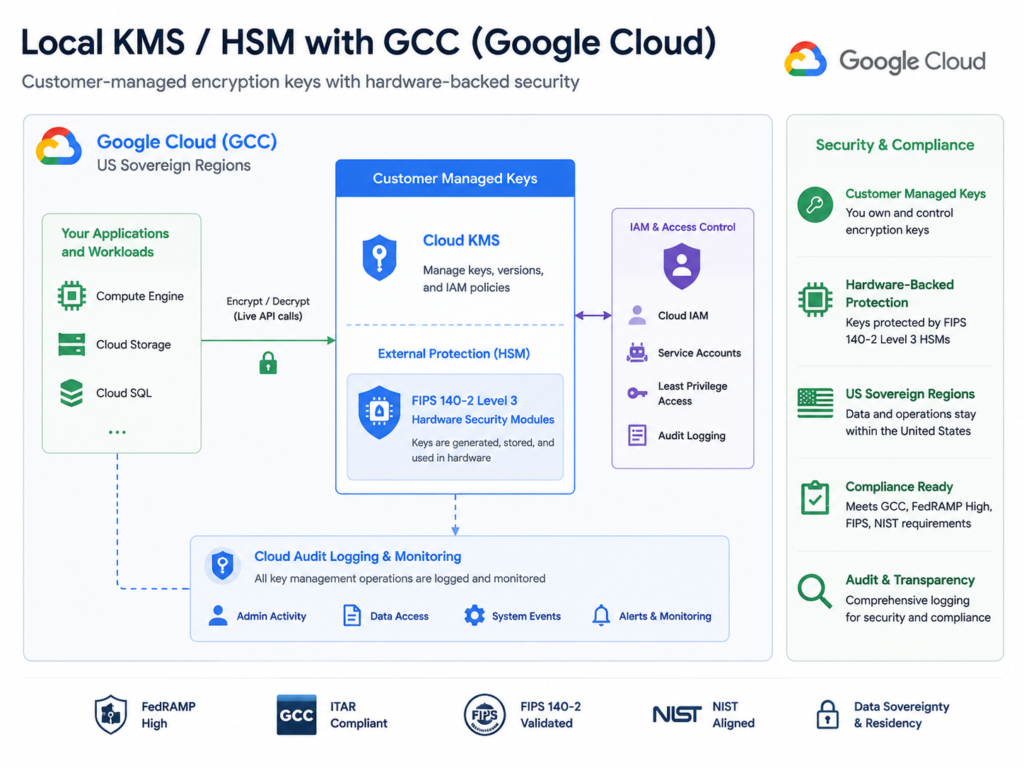
Local KMS/HSM and Encryption-Key Custody Pattern
Local key management is critical for GCC workloads.
For Riyadh, Dubai, Abu Dhabi, and Doha deployments, encryption keys should be locally controlled, rotated, monitored, and protected through KMS or HSM options where appropriate.
This supports.
Privileged-access control
Stronger audit trails
Separation of duties
Better buyer confidence
Reduced exposure during vendor or support reviews
Key custody is one of the clearest ways to show that data control is more than a hosting-location claim.
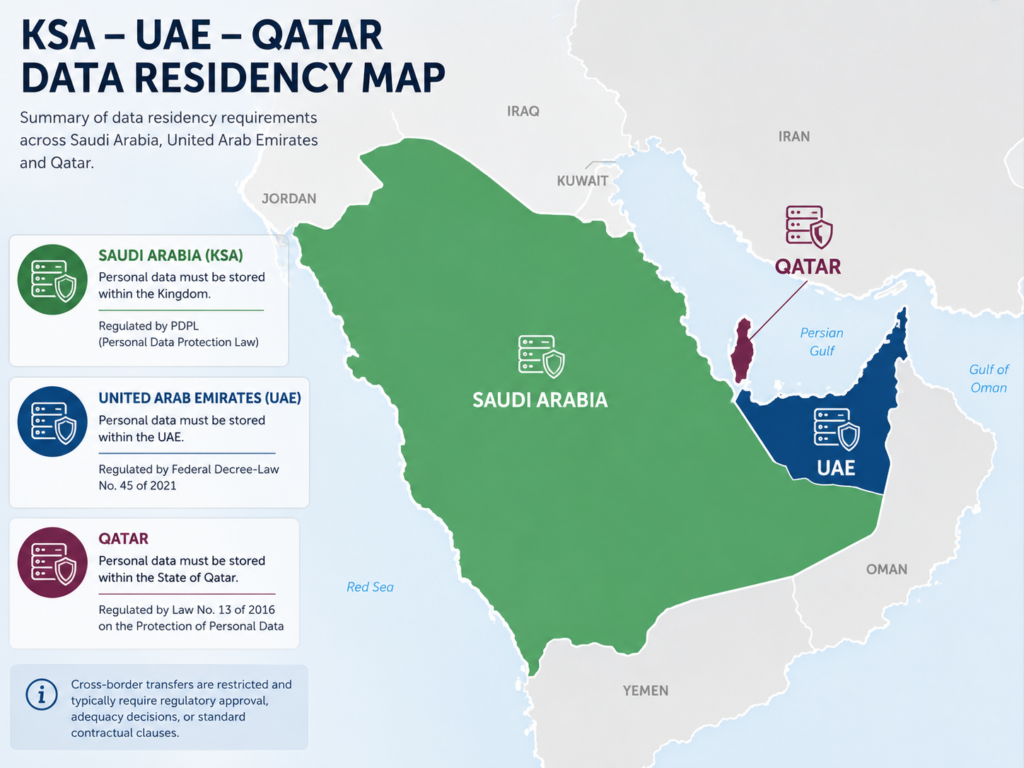
Saudi, UAE, and Qatar Data Residency Considerations
Saudi Arabia.
Saudi teams should assess cloud region selection, government-data classification, outsourcing controls, cybersecurity requirements, and local hosting.
For financial institutions, SAMA’s cloud computing control section says member organizations should define, implement, monitor, and periodically evaluate cybersecurity controls for hybrid and public cloud services.
In practice, Saudi fintech and enterprise teams should be ready to show.
Where regulated data is stored
Who can access cloud environments
How cloud risks are monitored
Where logs and backups are retained
How incidents and vendor access are governed
UAE.
UAE financial services, government platforms, and free-zone businesses should consider TDRA, CBUAE, ADGM, DIFC, Dubai, and Abu Dhabi requirements based on their sector and customer type.
AWS opened its Middle East UAE Region in 2022, allowing customers to deploy workloads and store data in the UAE.
For UAE businesses, this supports data residency planning, but architecture still matters. A UAE-hosted database does not automatically protect data if backups, admin panels, BI exports, or vendor support routes expose customer information outside approved controls.
Qatar.
Qatar businesses should evaluate QCB-regulated workloads, healthcare data, government platforms, and Doha hosting needs.
Google Cloud lists Doha, Qatar under Assured Workloads locations, including Qatar Data Boundary availability.
For Qatar healthcare, finance-linked platforms, and public-sector vendors, this can support local data boundary design. The safer model usually includes local storage, strict access control, local audit logs, local backup policy, and controlled encryption keys.
Compliance Controls Every GCC Architecture Should Include
Start With Data Classification
Before choosing a cloud region, classify the data.
Separate.
Personal data
Financial records
Health data
Government information
Metadata
Logs
Backups
Analytics datasets
Support tickets
AI prompts and outputs
Without classification, data localization architecture patterns become guesswork.
Control Cross-Border Transfer and Support Access
Cross-border exposure often comes from everyday tools, not just databases.
Watch for
Offshore support access
SaaS admin panels
Observability platforms
Error logs
API integrations
AI tools
CRM exports
Incident-response workflows
Contracts and systems should clearly define who can access what, from where, under which approval process, and with what audit trail.
Keep Backups, DR, and Audit Logs Aligned
Backups, disaster recovery replicas, SIEM logs, immutable storage, and audit evidence should follow the same residency logic as production data.
If regulated production data must remain in the UAE, KSA, or Qatar, backup copies and log archives should not quietly move elsewhere.
Mak It Solutions’ business intelligence services can support governed reporting without exposing raw regulated datasets unnecessarily.
Sovereign Cloud, Hybrid Cloud, and Multi-Country GCC SaaS
Sovereign Cloud Pattern for Regulated Workloads
Sovereign cloud is useful for banking, government, defense-adjacent, healthcare, and identity workloads where access, jurisdiction, and auditability matter.
Google Cloud explains that Assured Workloads control packages can include controls for data residency, data sovereignty, personnel access, and related compliance boundaries.
This pattern is strongest when the business needs more than local hosting. It needs evidence of operational control.
Hybrid Cloud / Private Cloud Pattern
Hybrid cloud lets companies keep sensitive systems on local infrastructure while using cloud for customer apps, analytics, AI, or scale.
This is often realistic for legacy banks, government vendors, healthcare groups, and large family businesses in Riyadh, Jeddah, Abu Dhabi, Dubai, or Doha.
A practical hybrid setup may keep core databases local while moving front-end apps, non-sensitive reporting, or DevOps pipelines to cloud environments with strict access controls.
Multi-Country SaaS Pattern for KSA, UAE, and Qatar
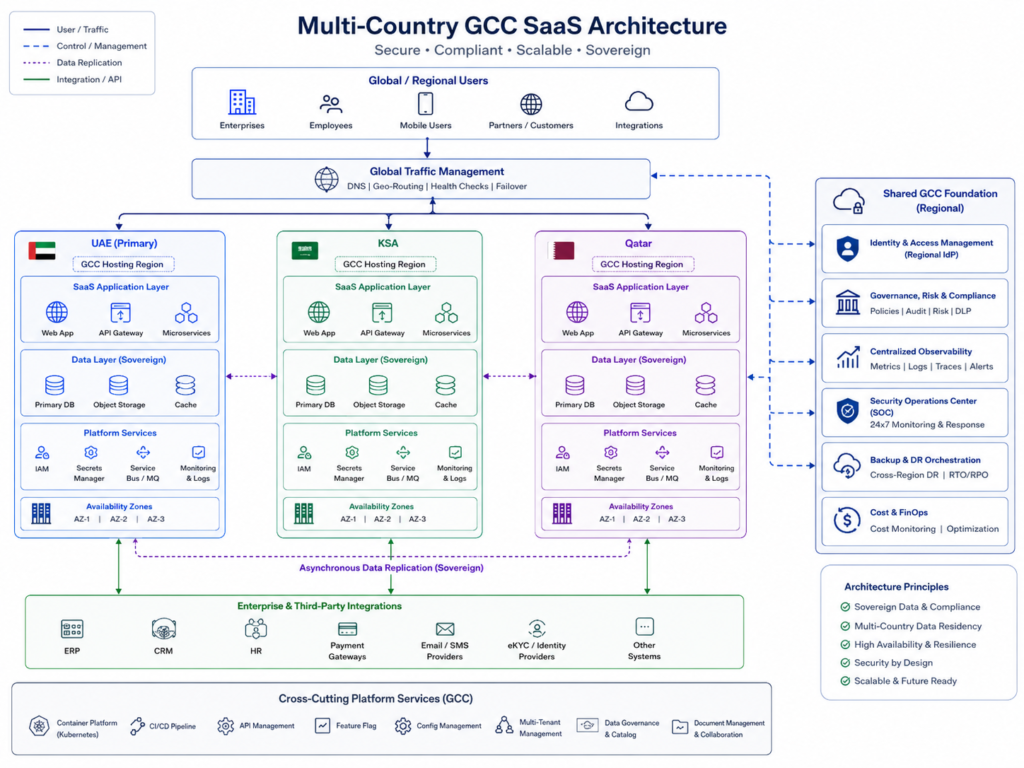
A GCC SaaS platform serving Saudi Arabia, UAE, and Qatar may need separate country-level architecture.
A strong setup can include.
Tenant isolation
Country-specific databases
Regional control planes
Local KMS or HSM controls
Separate audit logs
Controlled analytics pipelines
Country-specific retention policies
This helps SaaS providers serve multiple GCC markets without mixing regulated datasets in ways that create compliance risk.
How to Choose the Right Pattern for Your GCC Business
Match the Pattern to Your Sector
A Riyadh fintech should prioritize SAMA-ready controls, cloud-risk evidence, local data governance, and incident-response documentation.
A UAE government app may need sovereign hosting, Arabic consent flows, clear audit trails, and strict vendor-access policies.
A Doha healthcare app should keep patient data, medical history, appointment records, and sensitive files inside an approved Qatar boundary.
A logistics platform may split shipment tracking APIs from customer identity data so operational data can scale without exposing regulated personal information.
Balance Cost, Latency, and Operational Complexity
Local hosting can improve trust, but it may increase cost.
Multi-country SaaS improves compliance separation, but it adds engineering complexity.
Sovereign cloud strengthens control, but it may reduce service choice.
Latency between Riyadh, Dubai, Abu Dhabi, and Doha should be tested before launch, especially for mobile apps, payment flows, dashboards, and customer-facing portals.
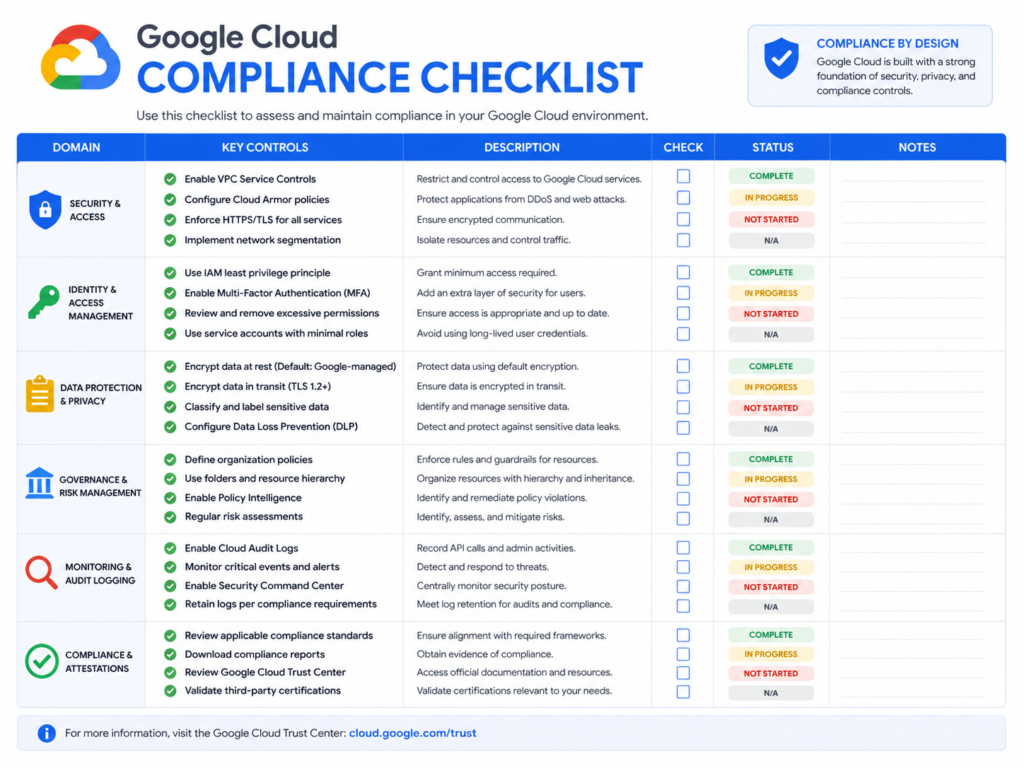
GCC Architecture Checklist Before Deployment
Use this checklist before production.
Map all data flows.
Classify regulated data.
Select approved KSA, UAE, or Qatar regions.
Define KMS/HSM ownership.
Keep backups and logs local where needed.
Document support access.
Build Arabic consent and notification flows.
Prepare regulator-ready evidence.
This is where compliance becomes operational. The team should be able to show diagrams, policies, logs, and access evidence instead of relying on verbal assurances.
Best Practices for GCC-Ready Data Localization Architecture
Design for Compliance, Not Just Hosting Location
A server in-country is not enough.
Strong data localization architecture patterns include databases, encryption keys, people, logs, backups, metadata, APIs, SaaS tools, and vendor access.
For deeper security planning, connect this work with zero-trust planning for GCC SMEs and software supply chain security.
Build Arabic UX and Consent Flows Into the System
Arabic UX is not only translation.
Consent screens, privacy notices, SMS alerts, support journeys, and data-access requests should feel natural for Arabic-speaking users in Saudi Arabia, UAE, and Qatar.
For regulated platforms, this also helps reduce confusion during onboarding, consent collection, and customer support.
Keep Evidence Ready for Regulators and Enterprise Buyers
Keep your evidence organized.
That includes.
Architecture diagrams
Data-flow maps
Access logs
Vendor controls
DR test results
Retention policies
Encryption-key ownership records
Support-access approvals
For customer-facing systems, e-commerce development and React Native development should be designed around privacy from day one.
Concluding Remarks
Data localization in the GCC is no longer just a hosting question. It is an architecture question.
The right data localization architecture patterns help Saudi, UAE, and Qatar businesses control sensitive data, reduce cross-border exposure, prepare for audits, and build trust with enterprise buyers.
Planning cloud in the GCC is easier when compliance, architecture, and user experience are designed together. Contact Mak It Solutions to book a consultation, explore services, or request a custom Saudi, UAE, and Qatar data localization strategy. ( Click Here’s )
FAQs
Q : What are data localization architecture patterns?
A : Data localization architecture patterns are technical designs that help businesses keep regulated data inside approved countries or boundaries. They cover databases, backups, logs, encryption keys, support access, analytics, and SaaS integrations.
Q : Do Saudi fintech apps need to host customer data inside KSA?
A : Saudi fintech apps should treat customer identity, account, transaction, and risk data as highly sensitive. Many teams choose local or tightly controlled hosting because regulated environments need clear cybersecurity governance, outsourcing controls, monitoring, and cloud-risk evidence.
Q : Can UAE companies use global cloud regions for analytics if customer data stays local?
A : Yes, but only with the right controls. A common UAE pattern keeps raw personal data local, then sends tokenized, aggregated, or anonymized datasets to analytics platforms.
Q : What is the safest architecture for Qatar healthcare data residency?
A : For Qatar healthcare platforms, the safest model usually includes an in-country primary database, strict role-based access, local backups, local audit logs, and encryption keys controlled inside the approved boundary.
Q: Is tokenization enough for GCC data localization compliance?
A : No. Tokenization helps reduce exposure, but GCC compliance also depends on raw data location, key custody, audit logs, backups, support access, vendor controls, and cross-border transfer governance.