

Cloud Misconfiguration Fixes for Safer Clouds
Cloud Misconfiguration Fixes for Safer Clouds
Cloud Misconfiguration Fixes for Safer Clouds
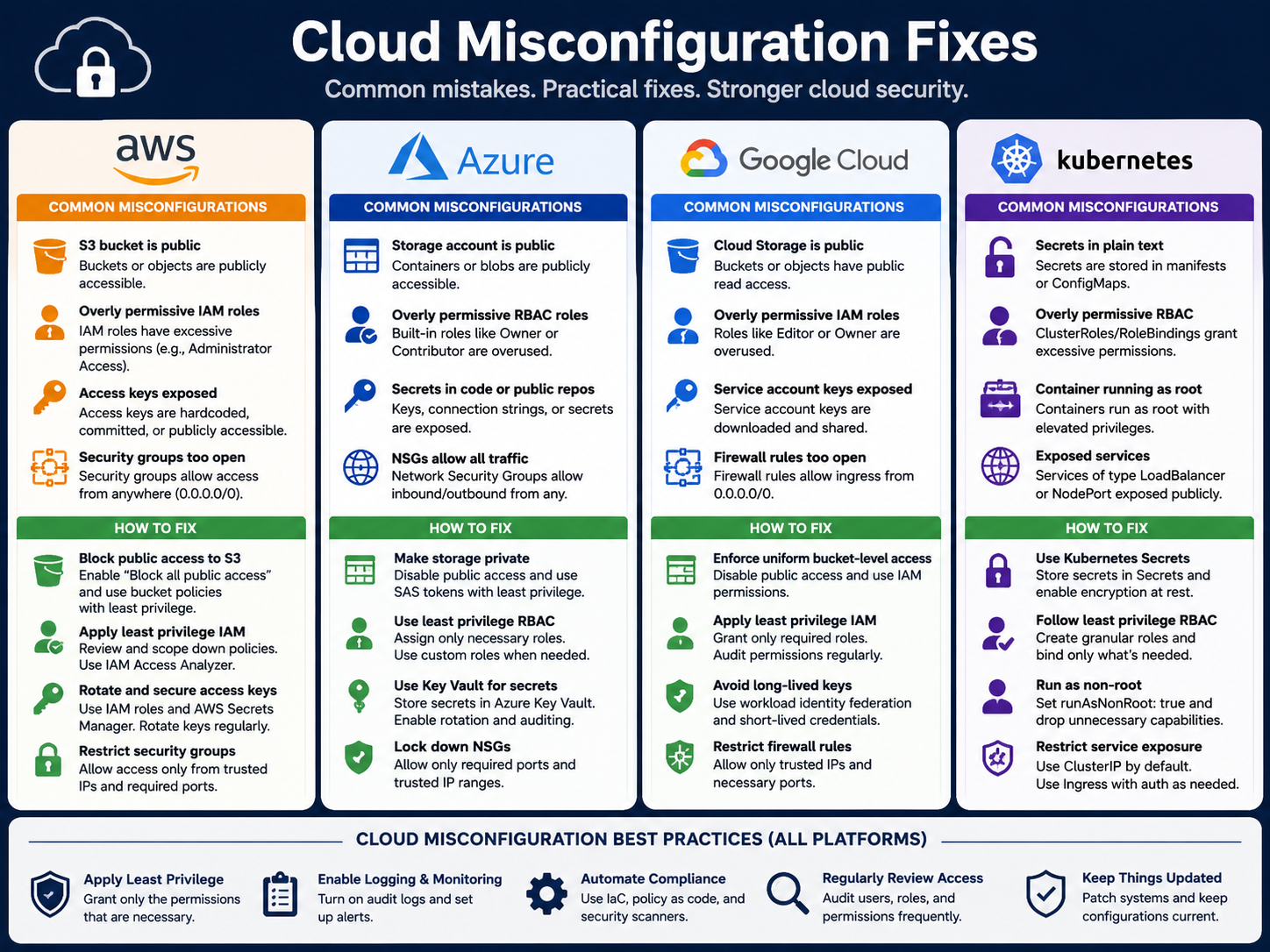
Cloud misconfiguration fixes protect your cloud environment by correcting risky identity, storage, network, logging, database and policy settings across AWS, Azure, GCP and Kubernetes. The quickest wins are simple but powerful: enforce least privilege, block public storage, close exposed admin ports, require MFA, enable audit logs and add automated policy checks before deployment.
That matters because one small setting can create a large breach path. A public bucket, an overpowered IAM role, a disabled log source or an exposed Kubernetes API server can put sensitive data at risk before the team even sees the alert.
IBM’s 2025 Cost of a Data Breach Report put the global average breach cost at USD 4.44 million, while Check Point’s 2025 cloud reporting found that 65% of organizations experienced a cloud security incident in the past year. Wiz research also found that classic issues such as misconfigurations, exposed secrets and weak exposure management remained major cloud breach drivers in 2025.
Why Cloud Misconfiguration Fixes Matter
Cloud breaches rarely start with one dramatic failure. More often, normal engineering speed outruns governance.
A San Francisco SaaS team opens a security group for testing. A London fintech leaves an old service account active. A Berlin healthcare platform stores regulated data in the wrong region. Each change may look small on its own, but attackers only need one weak path.
The fastest way to reduce exposure is to fix public access, privileged identities, internet-facing admin ports and missing logs first. Then use policy-as-code and cloud security posture management to stop the same mistakes from coming back.
This checklist covers practical remediation across.
AWS IAM, S3, Security Groups and CloudTrail
Microsoft Entra ID, Azure Blob Storage, NSGs and Defender for Cloud
GCP IAM, Cloud Storage, firewall rules and audit logs
Kubernetes RBAC and API server exposure
What Are Cloud Security Misconfigurations?
A cloud misconfiguration is an unsafe setting in a cloud resource. It may expose data, identities, workloads or networks to access the business never intended.
Common examples include.
Excessive permissions
Public storage buckets or containers
Exposed databases
Open inbound ports
Disabled audit logging
Hardcoded or unmanaged credentials
Overprivileged service accounts
Unrestricted Kubernetes API access
Cloud misconfigurations become dangerous because cloud services are internet-connected, API-driven and frequently changed by many teams.
Why Misconfigurations Keep Happening
Most cloud providers secure the platform, but customers still configure identity, data access, networks and workloads under the shared responsibility model.
Problems usually come from drift. A temporary exception becomes permanent. A manual console change bypasses code review. A rushed deployment leaves a risky default in place.
In practice, the fix is not only technical cleanup. It is ownership, evidence and prevention.
Top Cloud Misconfiguration Fixes by Risk Area
Start where the blast radius is highest: identity, storage and network exposure. These areas create the most direct paths to data loss and lateral movement.
Fix Excessive IAM Permissions
Fix 1.
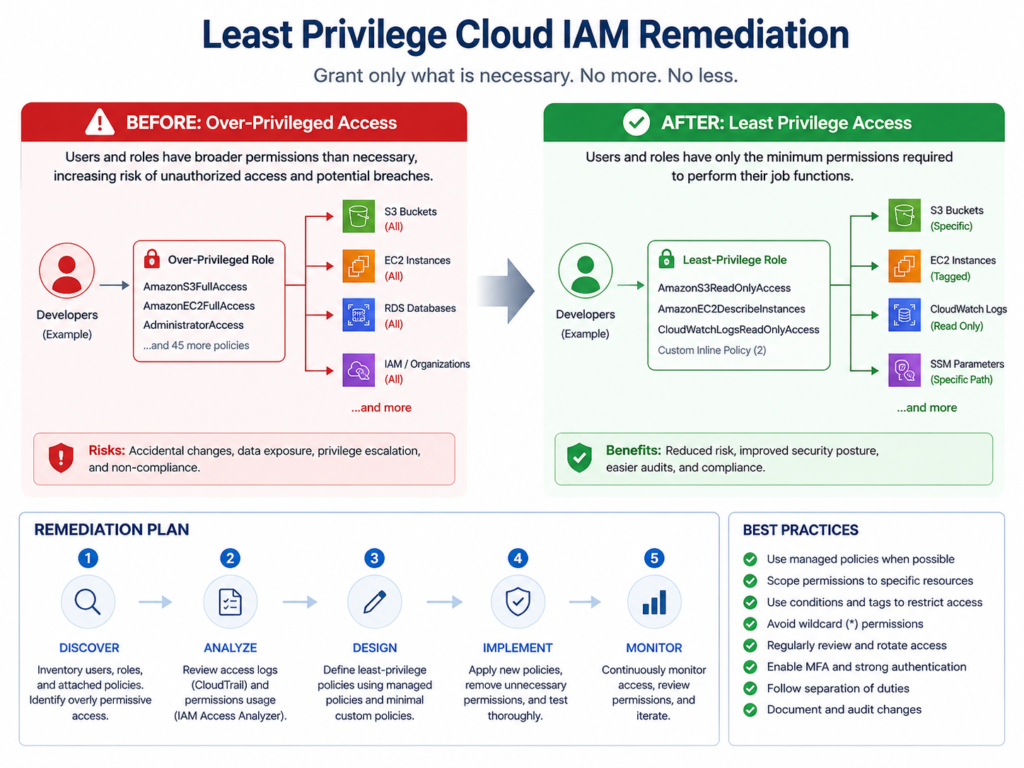
Replace wildcard permissions with task-based roles.
Fix 2.
Review unused privileges with tools such as AWS IAM Access Analyzer, Azure role assignment reviews and GCP IAM recommendations. AWS IAM Access Analyzer can review CloudTrail activity and generate policy templates based on permissions actually used.
Avoid broad roles such as admin, owner or editor unless they are truly required. Production access should be specific, time-bound and reviewed.
Remove Public Storage Exposure
Fix 3.
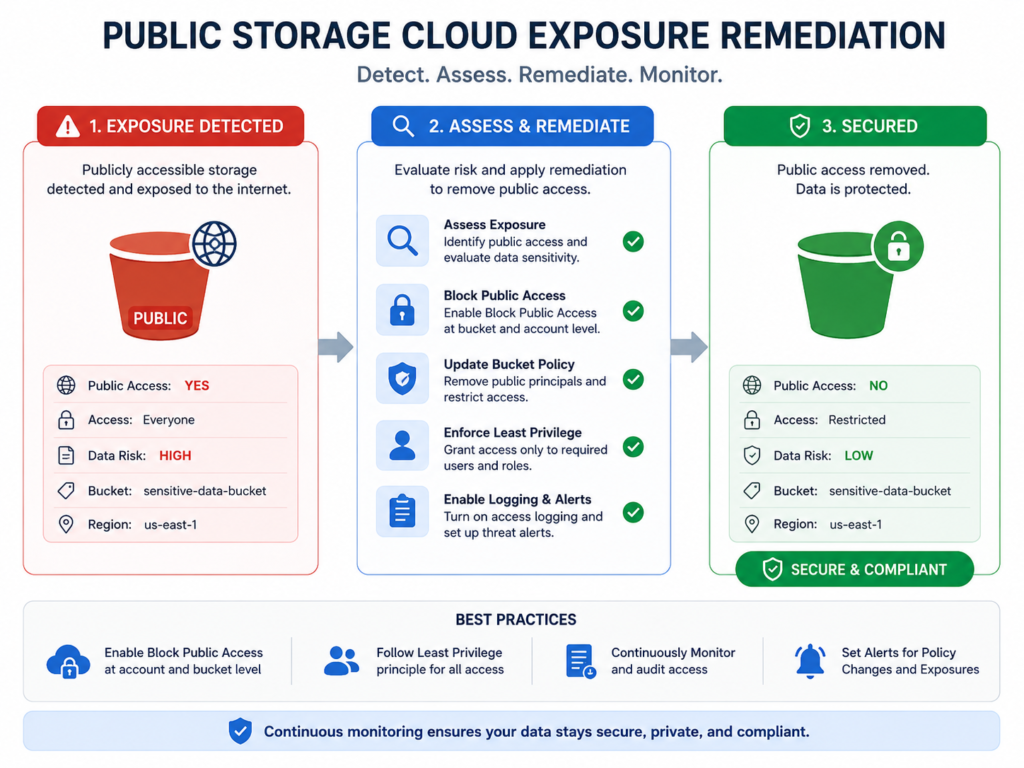
Block public access by default on Amazon S3, Azure Blob containers and GCP Cloud Storage buckets.
Fix 4.
Require approval for any public object, website bucket or external sharing rule.
Public storage is one of the easiest issues for attackers and researchers to discover. Anything containing customer data, logs, backups, source files or exports should be private unless there is a clear business reason.
Restrict Open Security Groups and Firewalls
Fix 5.
Remove access to SSH, RDP, databases and admin interfaces.
Fix 6.
Use VPN, private endpoints, bastion hosts, identity-aware access or zero trust access instead of broad inbound rules.
A good rule: if a management service is exposed to the public internet, treat it as urgent.
Identity, Access and Credential Misconfiguration Fixes
Identity mistakes turn small cloud issues into major incidents. If attackers gain privileged access, they can move across accounts, projects, subscriptions and clusters quickly.
Enforce MFA and Conditional Access
Fix 7.
Enforce MFA for root, global admin and privileged engineering accounts.
Fix 8.
Use Microsoft Entra Conditional Access for risk, device and location-based checks. Microsoft describes Conditional Access as its Zero Trust policy engine for using signals and enforcing organizational access decisions.
Admin access should never depend on a password alone.
Rotate Exposed Cloud Credentials
Fix 9.
Rotate keys found in GitHub, CI/CD logs, container images, ticketing systems or chat tools.
Fix 10.
Move secrets into AWS Secrets Manager, Azure Key Vault, Google Secret Manager or another managed vault.
Hardcoded credentials are not just developer hygiene problems. They can become direct access paths into production.
Review Privilege Escalation Paths
Fix 11.
Review privilege escalation paths, inherited roles and service accounts monthly.
Fix 12.
Use just-in-time admin access for production, especially for regulated teams in New York finance, Manchester healthcare, Munich SaaS and Amsterdam data platforms.
For GCP, service accounts deserve special attention. Google Cloud recommends limiting service account privileges and protecting service accounts against security threats.
Storage, Network and Database Exposure Fixes
The cloud misconfigurations most likely to cause data exposure are public storage, open databases, exposed credentials and unrestricted inbound access.
Fix these before lower-risk posture findings.
Block Public Buckets and Containers
Fix 13.
Enforce encryption, private defaults and bucket-level ownership controls.
Fix 14.
Add alerts when storage permissions, ACLs or bucket policies change.
Storage controls should be checked continuously, not only during audits. One accidental change can expose sensitive data in minutes.
Lock Down Databases and Admin Services
Fix 15.
Remove internet exposure from PostgreSQL, MySQL, MongoDB, Redis, Elasticsearch, RDP and SSH.
Fix 16.
Restrict Kubernetes API access and apply Kubernetes RBAC carefully. Kubernetes documents RBAC as a method for regulating access based on user roles and API authorization decisions.
A practical priority rule: anything public, privileged or tied to regulated data should be reviewed first.
Cloud Misconfiguration Remediation Checklist for AWS, Azure and GCP
To prevent cloud misconfigurations in AWS, Azure and GCP, enforce secure baselines, scan continuously, block unsafe deployments and collect audit evidence.
Native cloud tools are useful, but multi-cloud teams also need consistent ownership and workflow discipline.
AWS Remediation Checklist
Fix 17.
Review IAM admins, cross-account roles and unused access keys.
Fix 18.
Block public S3 access, tighten security groups and enable CloudTrail across accounts.
For AWS teams, the first review should usually cover IAM, S3, security groups, CloudTrail, KMS encryption and cross-account trust relationships.
Azure Remediation Checklist
Fix 19.
Review Microsoft Entra ID privileged roles, Conditional Access exclusions and stale guest users.
Fix 20.
Restrict Network Security Groups, private-link sensitive services and use Microsoft Defender for Cloud recommendations.
In Azure, watch for broad owner roles, unmanaged guest access, overly permissive NSGs and storage accounts with weak public access settings.
GCP Remediation Checklist
Fix 21: Remove broad project-level permissions and protect service accounts.
Pay close attention to project-level editor access, default service accounts, firewall rules, public buckets and audit log coverage.
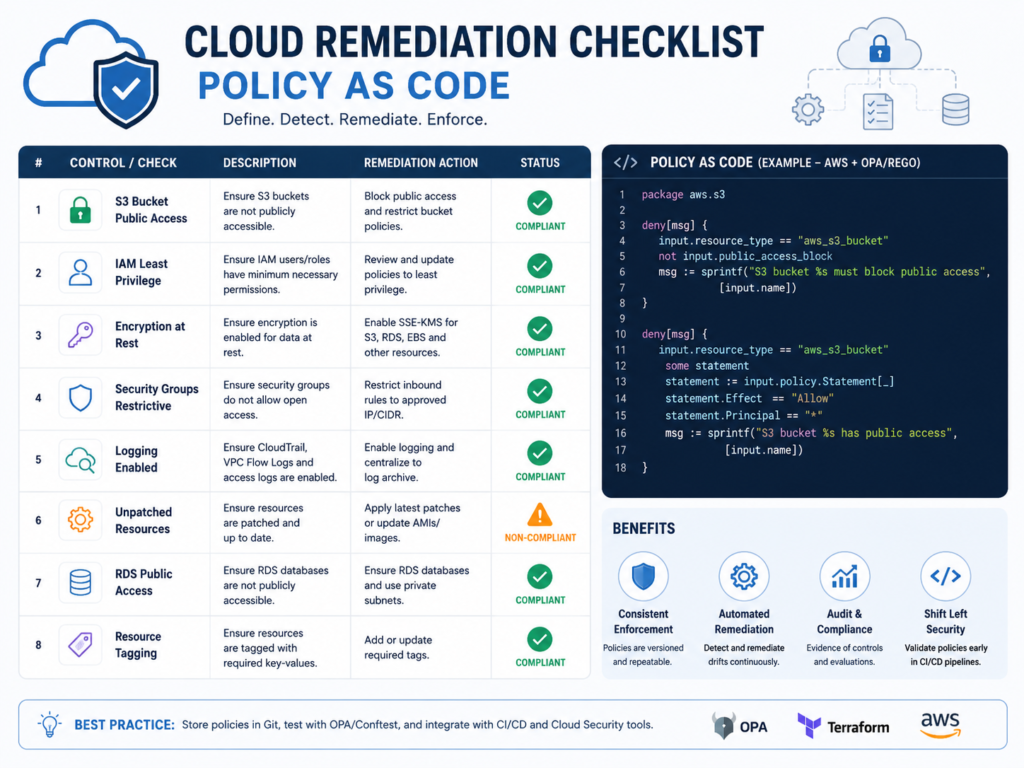
Compliance, CSPM and Policy-as-Code Controls
Compliance-driven remediation works best when technical fixes map to control evidence. CSPM, CNAPP and policy-as-code help teams prove that remediation is continuous, not just a one-time cleanup.
Map Fixes to Security Frameworks
Fix 22.
Map each fix to CIS Benchmarks, CSA Cloud Controls Matrix, ISO 27001, ISO 27017, PCI DSS, SOC 2 or customer-specific controls.
PCI DSS v4.0.1 was published as a limited revision in June 2024, with no additional or deleted requirements from v4.0.
Use CSPM and CNAPP with Ownership
Fix 23.
Use CSPM to detect drift and CNAPP to connect misconfigurations with identities, workloads, vulnerabilities and attack paths.
Tools are useful only when findings have owners, due dates and context. Otherwise, they become another dashboard full of noise.
Automate Prevention with Policy-as-Code
Fix 24.
Use policy-as-code in Terraform, Open Policy Agent, Checkov or cloud-native policy tools.
Fix 25.
Block unsafe merges before production, especially public storage, admin ports and missing encryption.
The goal is simple: stop risky changes before they become production incidents.
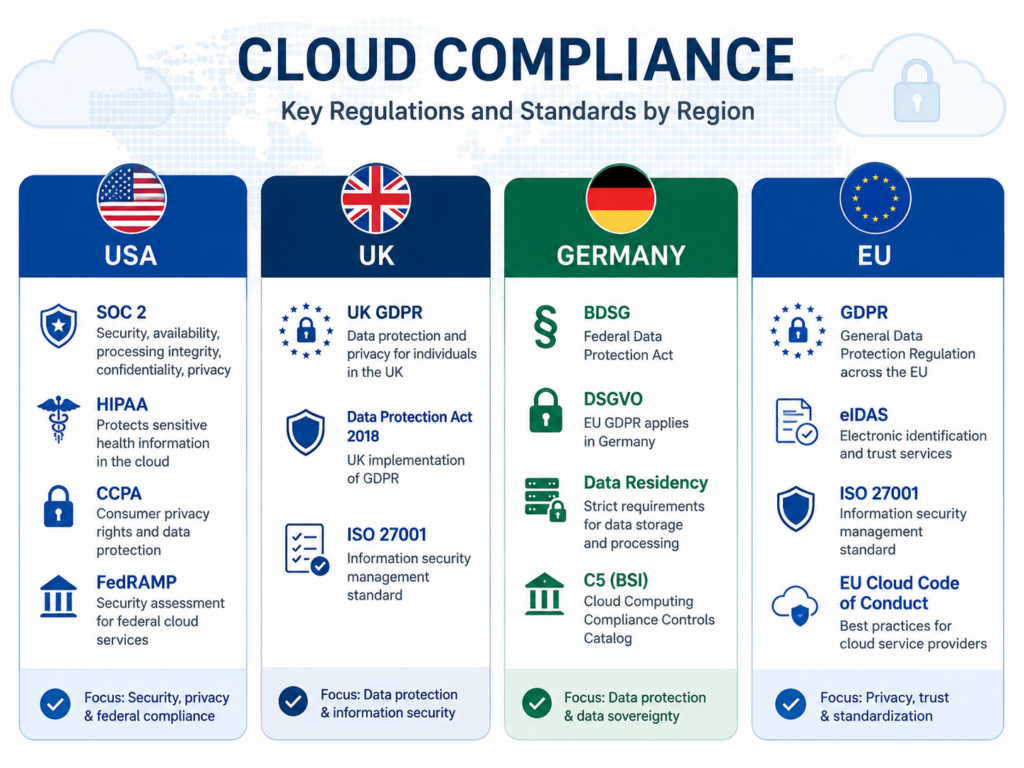
GEO Compliance Considerations for USA, UK, Germany and EU
The technical fixes are similar across regions, but compliance evidence changes by market. Documentation, data residency, regulator expectations and audit language all matter.
USA.
US healthcare teams should align cloud remediation with the HIPAA Security Rule, which requires administrative, physical and technical safeguards for electronic protected health information.
A New York healthcare platform or Seattle SaaS vendor should preserve evidence for access reviews, encryption, logging, incident response and vendor risk management.
UK.
UK teams in London, Manchester or Birmingham should document appropriate technical and organisational measures under UK GDPR. The ICO says secure processing requires risk analysis, organizational policies and physical and technical measures.
NHS suppliers and FCA-regulated firms should keep clean evidence of access control, data handling, supplier risk and incident response reviews.
Germany and EU.
Germany and EU teams should consider GDPR/DSGVO, BaFin, NIS2, EBA outsourcing expectations and data residency.
The European Commission says NIS2 establishes a unified cybersecurity framework across 18 critical sectors in the EU.
Teams in Frankfurt, Berlin, Munich, Dublin, Paris and Amsterdam should verify cloud region placement, admin access paths, outsourced cloud evidence and incident reporting workflows.
Outlook
Cloud misconfiguration fixes are not a one-off cleanup. Strong teams turn remediation into repeatable governance across cloud hardening, least privilege access, logging, evidence and CI/CD guardrails.
Start with public exposure, privileged access, credentials, databases and logging. Then expand into CSPM, CNAPP and automated control mapping. Mak It Solutions
Use this checklist to prioritize the first 25 fixes, then validate them with evidence. For deeper support, connect cloud posture work with Mak It Solutions’ cloud security misconfiguration guidance, business intelligence reporting and secure engineering support.
Mak It Solutions can help cloud, DevSecOps and compliance teams turn noisy findings into a prioritized remediation plan. Book a scoped consultation through the Mak It Solutions contact page to assess AWS, Azure, GCP and Kubernetes exposure, compliance evidence and the fastest fixes for your environment.
Key Takeaways
Fix IAM, public storage, open ports and exposed databases before lower-risk posture noise.
AWS, Azure, GCP and Kubernetes need different controls, but the governance discipline is the same.
CSPM and CNAPP work best when findings are tied to business context and ownership.
USA, UK, Germany and EU teams should preserve remediation evidence for HIPAA, UK GDPR, GDPR/DSGVO, PCI DSS, SOC 2, BaFin and NIS2 reviews.
Policy-as-code helps prevent repeat cloud misconfigurations before deployment.
FAQs
Q: How often should cloud misconfiguration checks be performed?
A : Cloud misconfiguration checks should run continuously for critical controls and at least monthly for formal posture reviews. High-change teams using Terraform, Kubernetes, CI/CD and multiple cloud accounts should scan on every pull request and after deployment.
Q : Which cloud misconfiguration should be fixed first?
A : Fix anything that is public, privileged or tied to sensitive data first. In practice, that means public S3 buckets or Blob containers, exposed databases, open SSH/RDP, admin accounts without MFA and overly broad IAM roles.
Q : Can cloud misconfiguration fixes reduce audit findings?
A : Yes. Cloud misconfiguration fixes can reduce audit findings when they are mapped to control evidence. Least privilege supports access reviews, logging supports monitoring requirements, encryption supports data protection controls and restricted inbound access supports network segmentation.
Q : Do CSPM tools automatically fix cloud misconfigurations?
A : Some CSPM tools can auto-remediate selected issues, but teams should use automation carefully. Low-risk fixes such as tagging, alerts or known policy violations may be automated, while high-impact IAM or network changes usually need owner approval, testing and rollback planning.
Q : What evidence should teams collect after remediation?
A : Collect before-and-after configuration exports, ticket IDs, owner approvals, timestamps, affected resources, risk ratings, test results and audit logs. Compliance teams should also record why exceptions remain open and when they will be reviewed again.
[…] Supporting architecture can use secure back-end development and API integration, while cloud teams should continually address cloud configuration risks. […]
[…] Cloud permissions can compound that exposure, so organizations should also address the IAM weaknesses covered in Mak It Solutions’ cloud misconfiguration remediation guide. […]