


Cyber Incident Response Checklist for IT Leaders
Cyber Incident Response Checklist for IT Leaders
Cyber Incident Response Checklist for IT Leaders
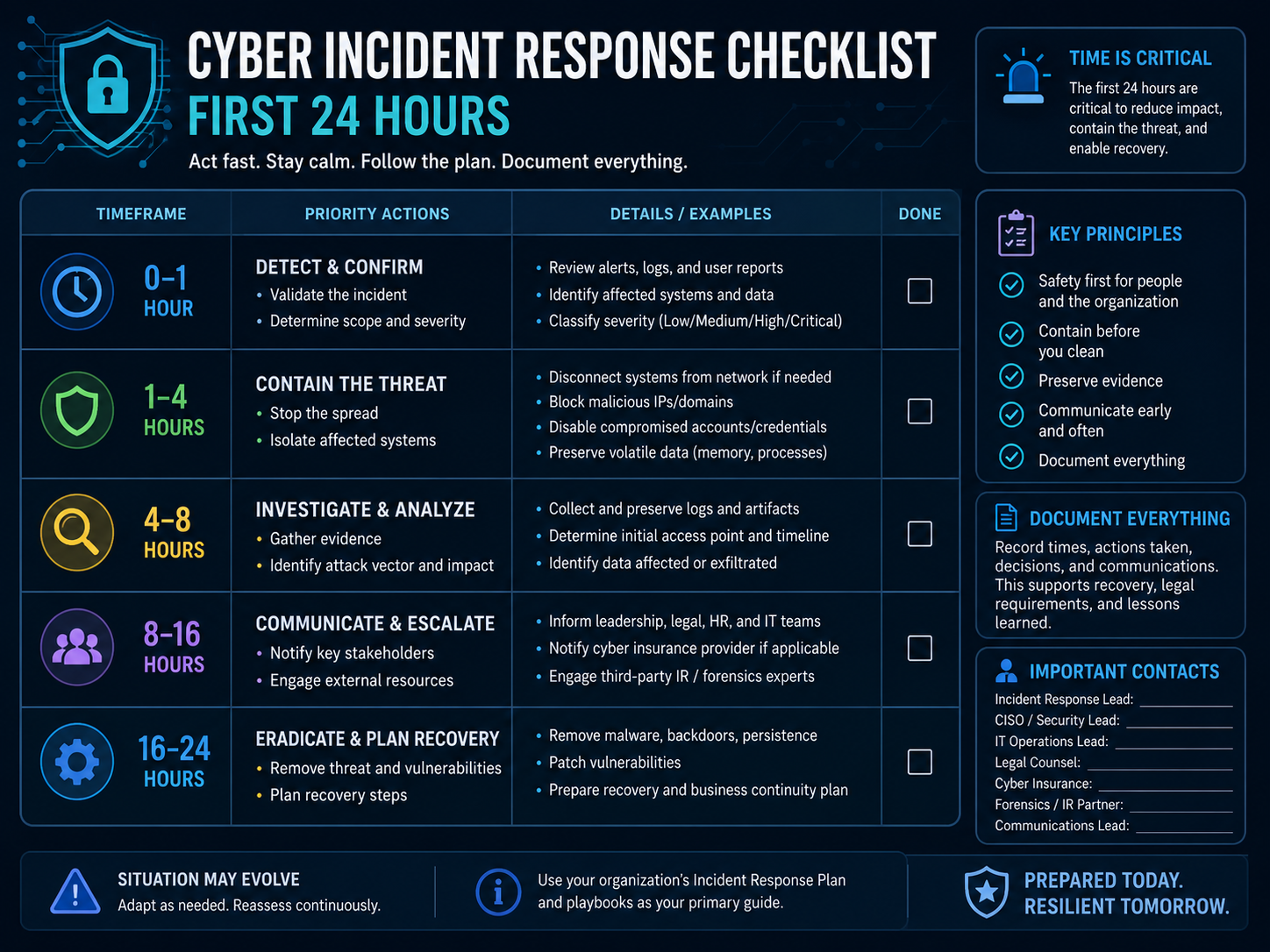
A cyber incident response checklist gives IT, security, legal, compliance, and leadership teams a clear sequence of actions when a breach, ransomware alert, account takeover, or data exposure happens. In the first 24 hours, the goal is simple: confirm the incident, contain the threat, preserve evidence, document decisions, and prepare legal or regulatory next steps.
A good checklist does not replace judgment. It gives your team a shared path when pressure is high and details are still incomplete. This guide is written for organizations operating across the USA, UK, Germany, and wider EU, where breach response may involve NIST, CISA, ICO, GDPR/DSGVO, HIPAA, PCI DSS, NIS2, DORA, cyber insurance, and customer communication requirements.
This is operational guidance, not legal advice. For reportable breaches, regulated data, ransomware, extortion, or cross-border incidents, involve qualified legal counsel early.
What Is a Cyber Incident Response Checklist?
A cyber incident response checklist is a step-by-step action guide for detecting, triaging, containing, documenting, and recovering from a security incident.
It helps teams avoid scattered Slack messages, rushed assumptions, and missing evidence. More importantly, it makes ownership clear. The SOC validates signals. IT isolates systems. Legal reviews notification risk. Executives approve business decisions. Communications teams prepare controlled updates.
Who Needs This Checklist?
This checklist is not only for security engineers.
It should be used by.
IT operations and SOC analysts
CISOs, CIOs, CTOs, and incident commanders
Legal, privacy, compliance, and risk teams
HR, finance, PR, and customer support leaders
Cyber insurance contacts and external forensic partners
Cloud, SaaS, mobile, and data platform owners
In practice, the lead team may vary by incident. A SaaS company in San Francisco may start with identity and cloud logs. A fintech in London may need faster customer communication discipline. A German financial firm in Frankfurt may need to factor in GDPR/DSGVO, BaFin, NIS2, and DORA documentation.
Checklist vs Incident Response Plan vs Playbook
These terms are related, but they are not the same.
| Asset | Purpose | When it is used |
|---|---|---|
| Incident response checklist | Short action guide | During a live incident |
| Incident response plan | Governance document with roles, policies, contacts, and escalation rules | Before, during, and after incidents |
| Incident playbook | Scenario-specific instructions | For ransomware, Microsoft 365 compromise, AWS key leakage, insider threat, or payment-card exposure |
A checklist helps teams move fast. A plan defines how decisions are made. A playbook gives deeper technical steps for specific attack types.
First 24 Hours Cyber Incident Response Checklist
The first 24 hours should focus on five priorities: confirm, contain, preserve, communicate, and decide.
NIST SP 800-61 Rev. 3, finalized in 2025, connects incident response with broader cybersecurity risk management and NIST Cybersecurity Framework 2.0 outcomes, including preparation, detection, response, and recovery.
| Timeframe | Main goal | Key actions |
|---|---|---|
| Hour 0–2 | Confirm and organize | Validate the alert, assign an incident commander, classify severity, open a secure response channel |
| Hour 2–8 | Contain and preserve | Isolate affected systems, disable compromised access, export logs, preserve forensic evidence |
| Hour 8–24 | Escalate and decide | Brief leadership, involve legal, assess notification duties, prepare internal and external updates |
Confirm the Incident and Assign Roles
Start with verification. Do not assume every alert is a confirmed breach, but do not dismiss it too quickly either.
Confirm whether the event appears to involve.
Malware or ransomware
Credential compromise
Unauthorized access
Data exfiltration
Cloud or SaaS misconfiguration
Insider activity
Payment-card exposure
False positive or benign activity
Assign an incident commander immediately. Open a dedicated secure channel. Record the incident start time. Create a decision log. Freeze auto-cleanup where needed so evidence is not destroyed before review.
Severity should be based on affected systems, data type, user impact, geography, business interruption, and regulatory exposure.
Contain the Threat and Preserve Evidence
Containment should happen quickly, but not recklessly. Rebuilding systems too early can erase evidence.
Preserve.
SIEM logs
EDR alerts
Endpoint images
Cloud audit logs
SaaS access logs
Firewall and VPN logs
Identity provider logs
Email headers
Malware samples
Ransom notes
Backup status
Chain-of-custody notes
Containment may include isolating endpoints, disabling compromised accounts, rotating API keys, revoking OAuth grants, blocking command-and-control traffic, forcing MFA resets, pausing risky integrations, and restricting privileged access.
For AWS, Microsoft Azure, Google Cloud, Microsoft 365, Okta, Entra ID, Google Workspace, EDR, SIEM, MDR, CRM, and CI/CD tools, export logs early and protect them from alteration.
Escalate, Communicate, and Prepare Notifications
By hour 8, leadership should understand what is known, what is suspected, what is contained, and what decisions are pending.
Legal counsel should assess privilege, breach notification thresholds, cyber insurance requirements, law-enforcement coordination, contractual notices, regulator timelines, and customer communication risk.
Do not speculate in internal or external updates. A useful holding statement should cover.
What is known so far
What is still being investigated
What containment steps have been taken
Whether customers or employees need action
When the next update is expected
Incident Response Plan Template.
An incident response plan template should be ready before a breach happens. During a real incident, teams should not be searching for vendor contacts, debating severity definitions, or deciding who can approve customer notices.
A practical IR plan should include.
Purpose and scope
Incident categories
Severity levels
Escalation paths
Contact list
Legal review points
Evidence preservation steps
Communications rules
Vendor and cyber insurance contacts
Backup and recovery procedures
Post-incident review process
Cloud and SaaS sections are now essential. Modern incidents often involve identity providers, object storage, API tokens, CI/CD pipelines, CRM exports, app telemetry, or mobile backends.
Mak It Solutions’ business intelligence services can also support dashboards for incident metrics, recovery tracking, and post-incident reporting.
Incident Roles Matrix
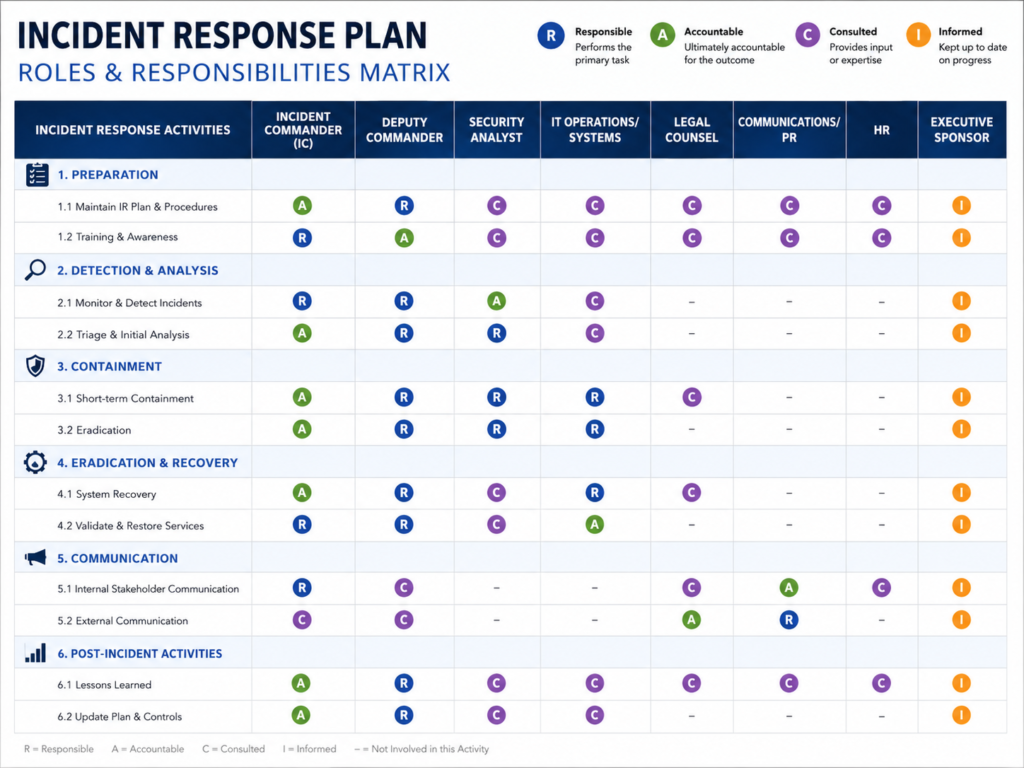
Clear ownership prevents delay.
| Role | Main responsibility |
|---|---|
| Incident commander | Coordinates the response and owns the timeline |
| SOC | Validates alerts and investigates signals |
| IT operations | Contains systems and supports recovery |
| Legal/privacy | Reviews notification and privilege issues |
| Compliance | Maps regulator, contract, and audit duties |
| PR/comms | Prepares internal and external messaging |
| HR | Handles employee-related incidents |
| Finance | Tracks cost, insurance, and fraud risk |
| Vendors | Support EDR, MDR, cloud, forensic, or recovery tasks |
| Executives | Approve major business decisions |
For mobile-first organizations, the response plan should also cover app telemetry, crash logs, API abuse, push notification misuse, and app-store communication flows. This can align with secure mobile app development services.
Data Breach Response Checklist for GDPR, UK GDPR, HIPAA, and PCI DSS
A data breach response checklist should help teams assess whether personal data, protected health information, payment data, financial systems, or regulated services are involved.
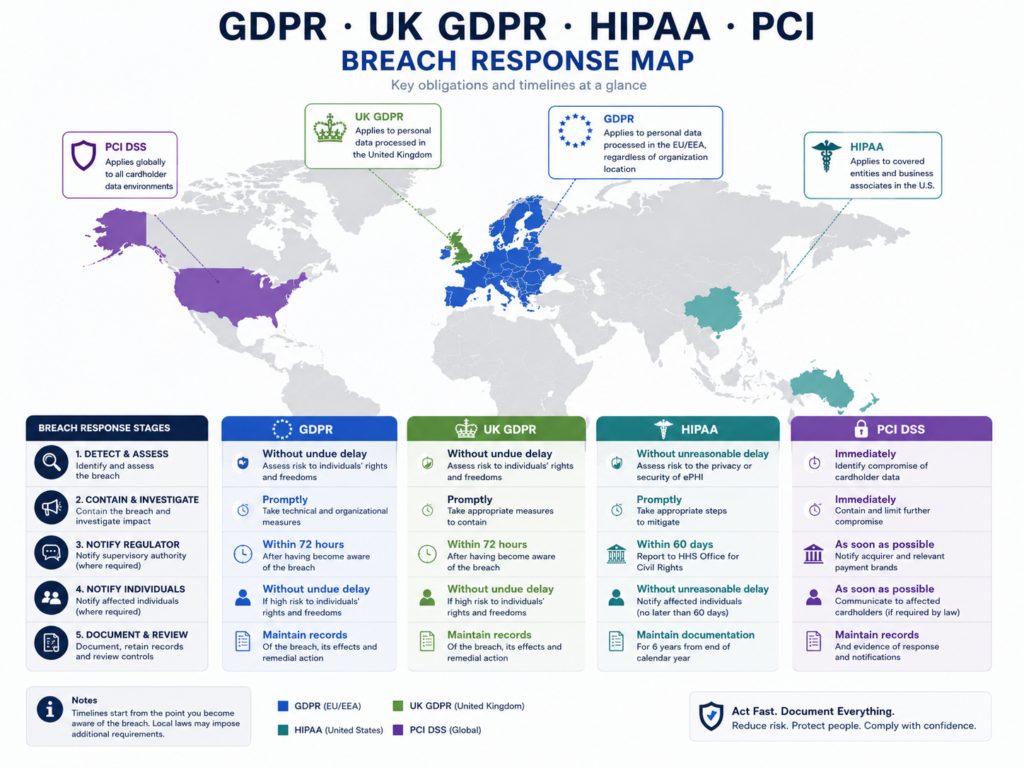
Under GDPR guidance, personal data breach notification can require action within 72 hours after the controller becomes aware of the breach, unless the breach is unlikely to result in risk to individuals. The UK ICO also advises organizations to start a breach log even if they later decide the incident is not reportable.
GDPR/DSGVO and UK GDPR
For GDPR, DSGVO, and UK GDPR workflows, record.
Time the organization became aware
Affected systems and data categories
Affected data subjects
Likely risk to individuals
Mitigation already taken
Processor/controller duties
DPO or legal review
Supervisory authority decision
Individual notification decision
For UK organizations, the ICO says reportable personal data breaches must be reported without undue delay and within 72 hours.
USA Breach Response.
In the USA, breach response depends on sector, state, data type, contract terms, and regulator expectations.
HIPAA covered entities must notify affected individuals without unreasonable delay and no later than 60 days after discovering a breach of unsecured protected health information. HHS also has separate rules for media notice, Secretary notice, and business associate notification.
A healthcare company in Washington DC should preserve PHI evidence, involve privacy counsel, and assess HHS OCR obligations. A New York financial services firm may also need to consider state cybersecurity rules, customer contracts, FBI/IC3 reporting, and CISA coordination.
PCI DSS, NIS2, and DORA
Payment environments need PCI DSS-aligned evidence and documentation where cardholder data may be exposed. PCI SSC describes PCI Security Standards as technical and operational requirements designed to protect cardholder data.
For EU organizations in scope of NIS2, significant incidents may involve a 24-hour early warning, 72-hour incident notification, and final report no later than one month later.
For financial entities under DORA, the regulation entered into application on January 17, 2025. EU delegated rules also define timelines for initial, intermediate, and final reporting of major ICT-related incidents, including initial notification as early as possible and no later than 24 hours from awareness in defined circumstances.
Ransomware Response Checklist for High-Severity Incidents
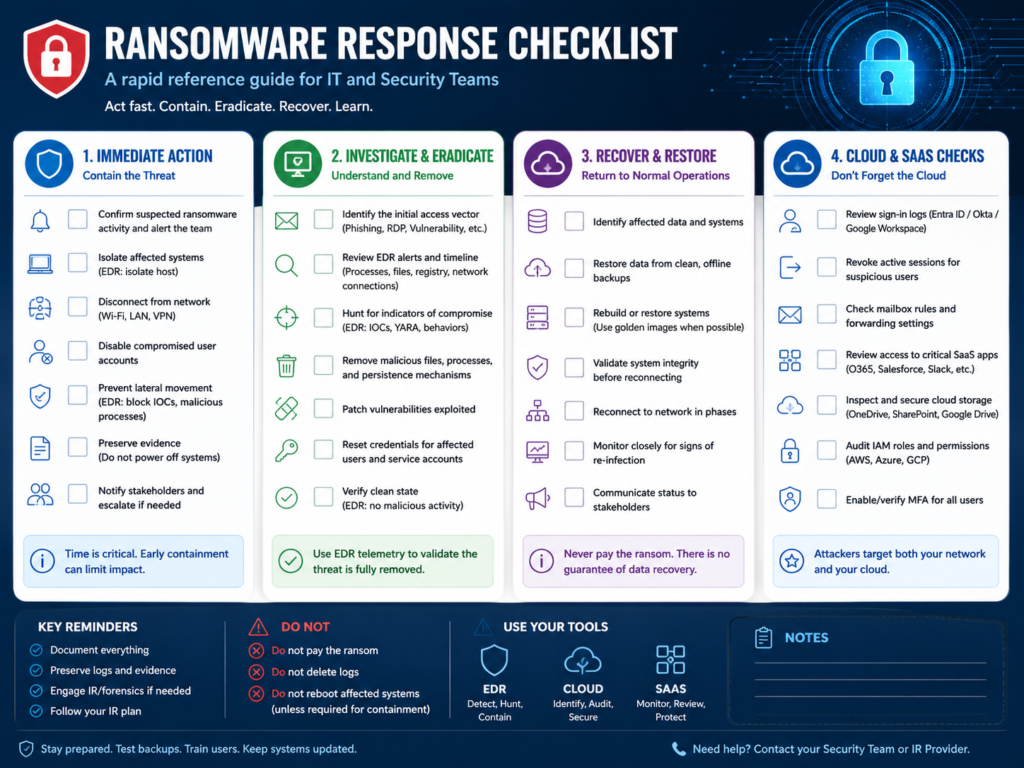
A ransomware response checklist should prioritize containment, identity security, backup protection, evidence preservation, and legal decision-making.
CISA’s Stop Ransomware guidance includes prevention and response resources for organizations dealing with ransomware and data extortion risk.
How to Contain Ransomware in the First 24 Hours
Start by identifying affected systems and isolating them from the network. CISA advises organizations hit by ransomware to determine impacted systems and immediately isolate them.
Key actions include.
Disconnect infected endpoints from the network
Disable compromised accounts
Suspend risky VPN access
Rotate privileged credentials
Block suspicious IPs and domains
Preserve encrypted files and ransom notes
Protect backups from compromised identities
Review EDR alerts and lateral movement
Export cloud and SaaS audit logs
Coordinate with forensic responders before wiping systems
Do not treat ransomware as only a backup problem. Many modern incidents involve data theft, extortion, identity compromise, and public leakage threats.
Recovery Priorities.
Recovery should usually start with identity. If Active Directory, Entra ID, Okta, or privileged access management is compromised, restoring servers before securing identity can lead to reinfection.
Validate backups before restore. Check immutable storage. Review EDR telemetry. Confirm admin accounts. Inspect SaaS audit trails. Rebuild from clean images where needed.
Verizon’s 2025 DBIR reported ransomware was present in 44% of reviewed breaches, while Sophos’ 2025 ransomware research reported an average recovery cost of about $1.5M.
Ransom Payment, Legal, Insurance, and Law Enforcement
Do not make ransom decisions in an IT-only meeting.
Include executives, legal counsel, cyber insurance, forensic specialists, and law enforcement where appropriate. Payment may not guarantee recovery, may create sanctions risk, and may not stop stolen data from being leaked.
Document every decision: who approved it, what alternatives were considered, what evidence was available, and what business risk was accepted.
GEO-Specific Incident Response Guidance: USA, UK, Germany, and EU
A cyber incident response checklist should include local add-ons. Regulators, reporting portals, evidence expectations, and customer communication norms differ by region.
USA Cyber Incident Response Checklist
For USA teams in New York, Washington DC, Austin, or San Francisco, align the checklist with.
NIST SP 800-61 Rev. 3
NIST Cybersecurity Framework 2.0
CISA guidance
FBI/IC3 reporting
HIPAA/HHS OCR where applicable
PCI DSS for payment data
SOC 2 customer and auditor expectations
State breach notification laws
Cyber insurance reporting duties
IBM’s 2025 Cost of a Data Breach Report placed the global average breach cost at $4.4M, a 9% decrease from the previous year, with faster identification and containment cited as a driver.
UK Cyber Incident Response Checklist
For UK organizations in London, Manchester, Birmingham, or Edinburgh, include.
ICO breach assessment
UK GDPR documentation
NCSC guidance
NHS DSPT considerations for healthcare suppliers
Open Banking dependencies for financial APIs
Customer and media communication review
The UK GDPR breach log should record awareness time, facts known, people affected, risk assessment, containment actions, ICO decision, and individual notification decision.
Germany and EU Cyber Incident Response Checklist
For Germany and EU operations in Berlin, Frankfurt, Munich, Dublin, Amsterdam, or Paris, map the checklist to:
GDPR/DSGVO
National supervisory authorities
BSI resources in Germany
BaFin for regulated financial entities
ENISA threat intelligence
National CSIRTs
NIS2 duties
DORA for financial entities and ICT third-party risk
ENISA’s Threat Landscape 2025 analyzed 4,875 incidents from July 1, 2024 to June 30, 2025, showing why EU organizations need evidence-ready incident handling and reliable documentation.
Post-Incident Review.
A post-incident review should improve the security program without turning into a blame session.
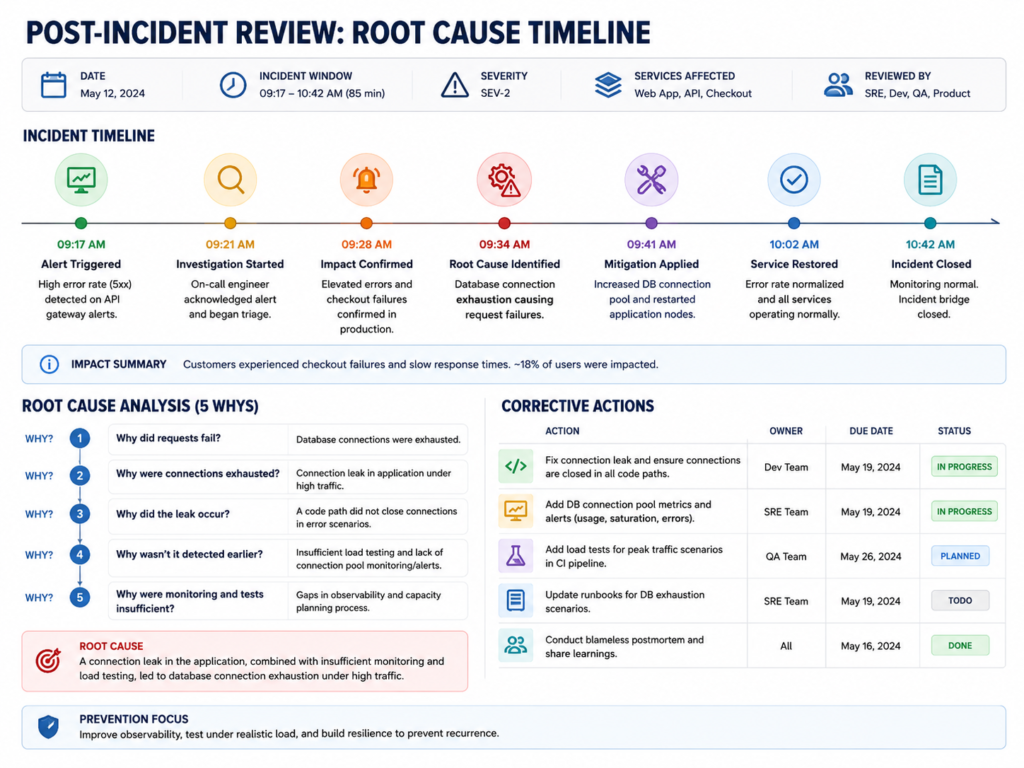
Build a clean timeline from first suspicious activity to full recovery. Include alert times, missed signals, user reports, containment actions, privilege changes, communications, customer impact, legal decisions, and regulator decisions.
Then identify control gaps.
Weak MFA
Exposed RDP or VPN
Stale API keys
Poor logging
Slow patching
Incomplete EDR coverage
Excessive SaaS permissions
Untested backups
Weak vendor access controls
Missing data classification
Update the incident response plan, cyber incident response checklist, and playbooks after every major incident or tabletop exercise.
Final Thoughts
The worst time to build a cyber incident response checklist is during a live breach.
Use this guide as a starting point, then tailor it to your systems, regulators, contracts, vendors, and team structure. For secure delivery, cloud-aware architecture, dashboards, and operational readiness, explore Mak It Solutions services or start a scoped conversation through the contact page.
Key Takeaways
A cyber incident response checklist helps teams act quickly without losing evidence, missing legal steps, or duplicating work.
The first 24 hours should focus on triage, containment, forensic preservation, leadership escalation, and controlled communication.
GDPR, UK GDPR, HIPAA, PCI DSS, NIS2, DORA, cyber insurance, and sector rules should be mapped before an incident starts.
Ransomware response must prioritize identity security, backup protection, EDR review, cloud and SaaS logs, and legal decision-making.
USA, UK, Germany, and EU teams need localized response add-ons for reporting channels, regulators, and documentation standards.
FAQs
Q : What is the difference between an incident response checklist and an incident response plan?
A : An incident response checklist is a short, action-focused guide used during a live incident. An incident response plan is broader and defines roles, severity levels, policies, communication rules, legal workflows, vendors, and recovery governance.
Q : What should be done first after a cyber incident?
A : First, validate the alert, assign an incident commander, open a secure response channel, classify severity, and start a timeline. Do not wipe systems or delete evidence before logs and key artifacts are preserved.
Q : What evidence should IT teams preserve after a suspected breach?
A : Preserve SIEM logs, EDR alerts, endpoint images, firewall logs, VPN logs, cloud audit logs, SaaS access logs, identity provider records, email headers, malware samples, ransom notes, backup status, and chain-of-custody notes.
Q : Do small businesses need a cyber incident response checklist?
A : Yes. Small businesses often need a checklist because they may not have a full SOC, legal department, or internal forensic team. A simple checklist helps them isolate systems, call vendors, preserve logs, notify stakeholders, and document decisions.
Q : How often should a cyber incident response checklist be tested?
A : Review it at least annually and after major system changes, cloud migrations, security incidents, mergers, or regulatory updates. Higher-risk organizations should test it more often through tabletop exercises or simulated incidents.
[…] failure and recovery procedures as carefully as the migration itself. Mak It Solutions’ Cyber Incident Response Checklist offers a useful model for structured operational […]