


FinOps for AI: Control Spend and Scale Smarter
FinOps for AI: Control Spend and Scale Smarter
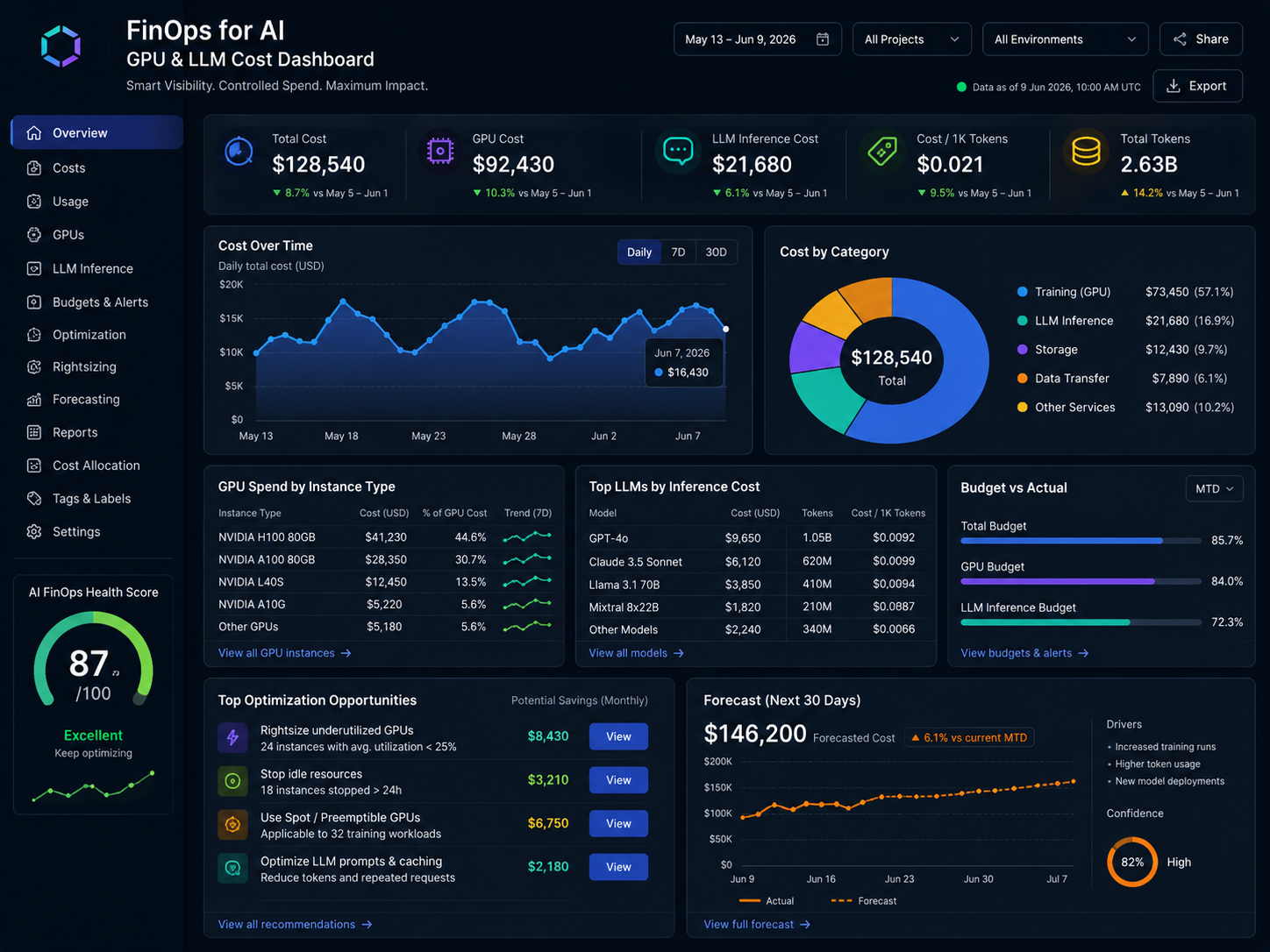
FinOps for AI: Control Spend and Scale Smarter
FinOps for AI helps organisations measure and optimise spending on GPUs, cloud infrastructure, model APIs and LLM tokens. More importantly, it connects that technical consumption to business outcomes such as cost per customer, completed workflow, transaction or successful AI response.
That connection matters because AI costs rarely behave like conventional cloud workloads. A single product may generate expenses across GPU clusters, managed AI services, model API calls, storage, observability, data transfers and autonomous-agent tool usage. Without workload-level visibility, teams can see the bill rising but struggle to explain where the money went—or whether it created measurable value.
The 2025 State of FinOps report found that approximately 63% of respondents were managing AI spending, compared with roughly 31% a year earlier. AI financial management is quickly moving from an emerging concern to a core operating discipline.
What Is FinOps for AI?
FinOps for AI is a cross-functional practice for measuring, allocating, forecasting and optimising expenditure across GPUs, model APIs, cloud platforms and LLM tokens.
It extends traditional cloud financial management by connecting infrastructure consumption with product performance, customer value and commercial outcomes.
FinOps for AI vs Traditional Cloud FinOps
Traditional FinOps focuses heavily on virtual machines, storage, networking, licensing and cloud commitments. Those areas still matter, but AI introduces additional cost drivers.
Training and fine-tuning runs
GPU and accelerator utilisation
Model-serving infrastructure
Input and output token consumption
Prompt and context length
Inference volume
Tool calls and autonomous-agent loops
Model quality, latency and retry rates
A provider-level spending total is therefore not enough. Teams need to understand which model, customer, workflow, product or environment generated the expense.
Who Should Own AI Cost Management?
AI cost management should not belong to finance alone.
Responsibility is usually shared across engineering, platform operations, data science, product, finance, procurement, security and compliance teams. FinOps practitioners act as the bridge between these groups, translating technical consumption into commercial decisions.
In practice, the strongest programmes establish clear ownership for every major model, workload and AI product. When no one owns a workload, optimisation decisions are delayed and unexpected costs are easier to ignore.
The Core Operating Model
A practical AI FinOps model follows three connected activities:
Inform.
Make spending, utilization and ownership visible.
Optimize.
Identify technical and commercial efficiency opportunities.
Operate.
Apply budgets, alerts, policies and accountability continuously.
Organizations building custom allocation or monitoring systems can combine business intelligence services with scalable Python development to create workload-level reporting.
How Should Companies Measure and Govern AI Spend?
Companies should measure AI costs at four levels: infrastructure, model, workload and business outcome.
Useful metrics include.
GPU utilization rate
Idle GPU hours
Cost per input and output token
Cost per inference
Cost per successful response
Cost per processed document
Cost per customer or transaction
Budget variance by product, team or environment
Retry, failure and tool-call costs
Revenue or value generated per AI workflow
The goal is not simply to reduce the cloud bill. It is to understand whether each unit of AI consumption produces an acceptable result.
Build Reliable Allocation, Show back and Chargeback
AI expenditure should be allocated by business unit, customer, model, product, project and environment.
Consistent metadata across AWS, Microsoft Azure, Google Cloud and Kubernetes makes this possible. Tags, labels and workload identifiers should follow the same naming rules across platforms.
Many organizations begin with show back, which gives teams visibility into their usage without transferring the expense to departmental budgets. Formal chargeback becomes more practical once ownership data, shared-cost rules and dispute processes are reliable.
Forecast AI Budgets More Accurately
One-time training jobs should be forecast separately from recurring inference workloads.
Forecasting assumptions may need to account for.
Product launches
Customer growth
Longer prompts and context windows
Increased output length
Model pricing changes
Retry rates
Agent iterations and tool calls
New GPU requirements
Seasonal traffic
Monthly cloud invoices arrive too late to prevent many cost overruns. Real-time thresholds, quotas and anomaly alerts can identify unusual behavior before it becomes a major budget problem.
Measure Cost per Outcome, Not Only Cost per Model
The cheapest model is not automatically the most economical.
A lower-cost model may produce weaker answers, trigger more retries, increase support work or reduce conversion. A more expensive model may deliver a lower cost per successful outcome when its quality and reliability are better.
Teams should compare the full economic result, including latency, accuracy, human review, failed requests and customer impact.
A central dashboard developed through backend engineering can combine cloud billing data, application telemetry and business KPIs in one view.
How Can Enterprises Reduce GPU and Compute Costs?
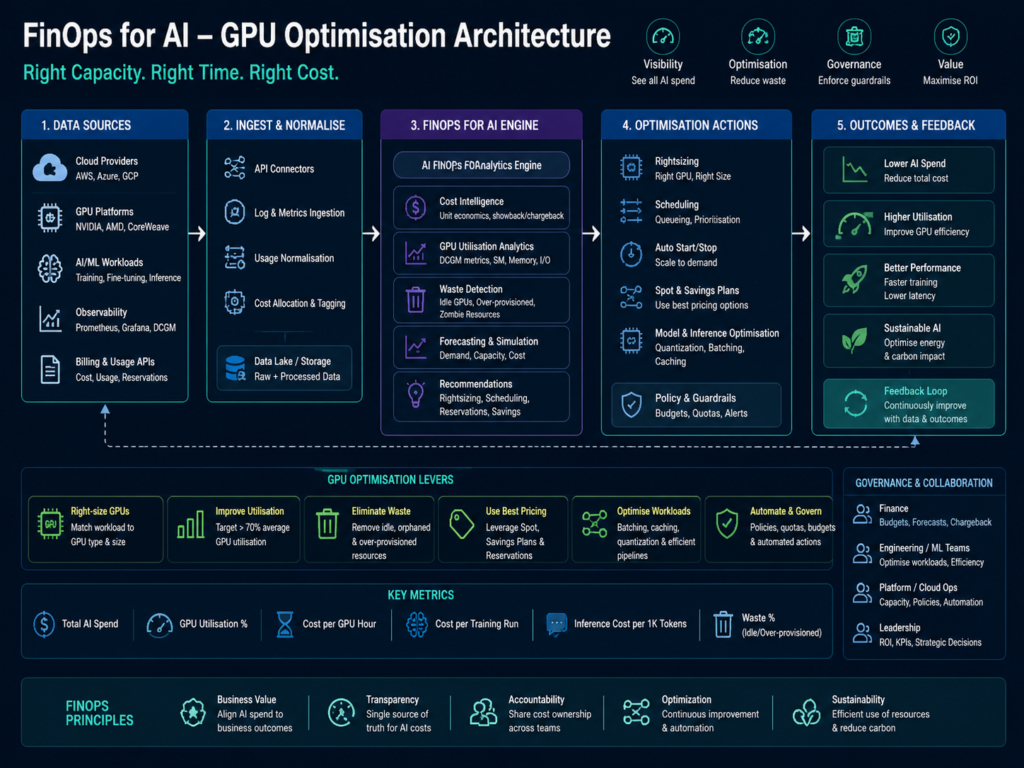
Enterprises can reduce GPU spending by improving utilization, matching accelerators to workload requirements and eliminating idle capacity.
Expensive GPUs often run below their potential because environments remain active outside working hours, workloads queue inefficiently or teams reserve premium hardware for jobs that do not require it.
The International Energy Agency reported that data centers consumed approximately 415 TWh of electricity in 2024, representing around 1.5% of global electricity demand. Improving infrastructure efficiency can therefore support both cost control and sustainability goals.
Improve GPU Utilization
Track both compute and memory utilization rather than relying on infrastructure uptime alone.
Important signals include.
Compute utilisation
Memory utilisation
Queue time
Idle hours
Jobs completed per GPU hour
Training throughput
Inference throughput
Failed and interrupted jobs
Development, testing and temporary environments should use scale-to-zero policies where operationally appropriate. Premium accelerators should not remain continuously active when no useful workload is running.
Right-Size Accelerators and Schedule Workloads
Match the GPU type and memory profile to the actual workload.
Large training runs, fine-tuning, batch processing and real-time inference have different requirements. Not every workload needs an H100 or A100 accelerator.
Batching, autoscaling and shared Kubernetes clusters can increase throughput. NVIDIA Multi-Instance GPU can also partition supported hardware into isolated compute and memory instances, allowing multiple workloads to share an accelerator more efficiently.
Balance Spot Capacity and Commitments
Spot capacity can reduce costs for fault-tolerant and interruptible jobs. Reserved capacity or longer-term commitments may suit stable, predictable demand.
AWS advertises Spot discounts of up to approximately 90%, while Google Cloud promotes savings of up to roughly 91%. Actual availability, interruption risk and savings vary by region, workload and instance type.
Commitments should be evaluated carefully. Model architecture, demand patterns and GPU generations can change quickly, leaving an organization locked into capacity it no longer needs.
Custom workload scheduling and governance services can be implemented through Node.js development or other cloud-native technologies.
How Can Teams Improve LLM Unit Economics?
LLM cost optimization aims to reduce the expense of each useful AI interaction without damaging quality, reliability or customer experience.
The most effective techniques usually include model routing, prompt compression, caching, smaller models, request batching and limits on agent behavior.
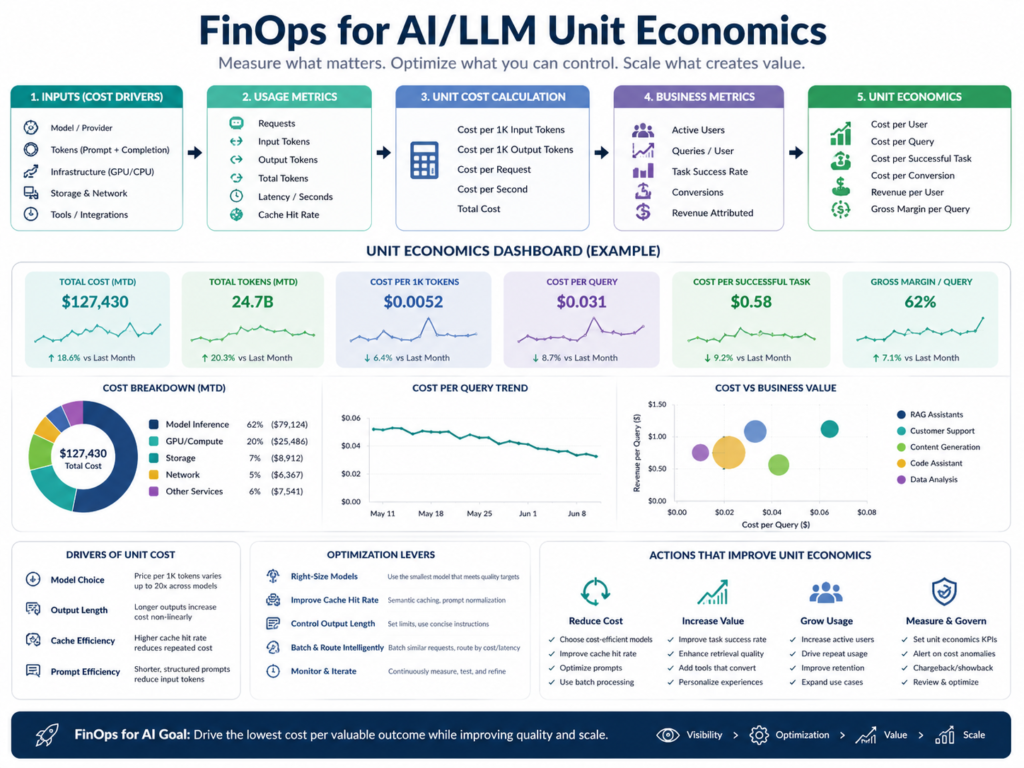
Calculate Cost per Inference
A practical calculation is:
Cost per inference = input-token cost + output-token cost + infrastructure cost + tool-call cost.
This figure can then be multiplied by the number of requests required for a customer, transaction or completed workflow.
For cross-provider comparisons, teams can also calculate costs per one million tokens. However, token pricing should never be evaluated without considering answer quality, context limits, latency and failure rates.
Use Model Routing and Smaller Models
Routine classification, extraction, summarization and support requests may not require the most capable model available.
A model-routing layer can send straightforward requests to a smaller model while reserving premium models for complex, regulated or high-value tasks.
This approach works best when teams monitor both savings and output quality. Routing rules should be tested against real user queries rather than synthetic examples alone.
Apply Prompt and Response Caching
Prompt caching can reduce repeated processing when the same instructions or context appear across many requests. Response caching may help when users repeatedly ask identical or near-identical questions.
Shorter prompts and carefully managed context windows can also reduce token usage. The aim is not to remove useful context, but to avoid repeatedly sending information the model does not need.
Stanford HAI reported that the cost of querying a model performing around GPT-3.5 level fell more than 280-fold between November 2022 and October 2024. Model costs may continue changing rapidly, so routing and procurement decisions should be reviewed regularly.
Control Agent Loops and Tool Calls
Autonomous agents can create unpredictable spending when they repeatedly plan, call tools, retry failed actions or invoke additional models.
Useful guardrails include.
Maximum iteration limits
Per-workflow token ceilings
Tool-call budgets
Timeout rules
Retry limits
Approval requirements for high-cost actions
Automated termination of recursive behaviour
These controls should stop waste as it happens rather than waiting for the monthly bill.
Mak It Solutions’ wider software and technology services can support API integration, observability dashboards and automated governance controls.
How Does Multi-Cloud AI Cost Management Work?
Multi-cloud AI cost management converts different provider billing formats into a shared view of GPUs, tokens, models, storage and business outcomes.
The objective is not simply to locate the lowest advertised GPU price. It is to compare the full unit economics of running a workload across different platforms.
Compare AWS, Azure and Google Cloud Fairly
A useful comparison should include.
Accelerator availability
On-demand and committed pricing
Managed AI service charges
Storage
Logging and monitoring
Networking
Cross-region transfers
Support plans
Data residency
Engineering and migration effort
A nominally cheaper GPU may produce a higher total cost when utilization is poor or data must move between regions.
Normalize Costs Across Providers
Create a shared taxonomy for provider, region, currency, model, environment, owner and workload.
Usage can then be converted into standard units such as.
GPU hours
One million tokens
Successful requests
Processed documents
Completed workflows
Cost per customer
This makes comparisons more meaningful and reduces dependence on provider-specific billing terminology.
What to Look for in AI FinOps Tools
An AI FinOps platform should provide more than a polished summary dashboard.
Priorities tools that support.
GPU-level allocation
Token and model monitoring
Forecasting
Anomaly detection
Kubernetes integration
Custom business metrics
Showback and chargeback
Automated guardrails
Multi-cloud reporting
Security and access controls
Fresh, actionable data
Review web and platform development capabilities when a packaged platform must be integrated with internal portals, approval systems or operational workflows.
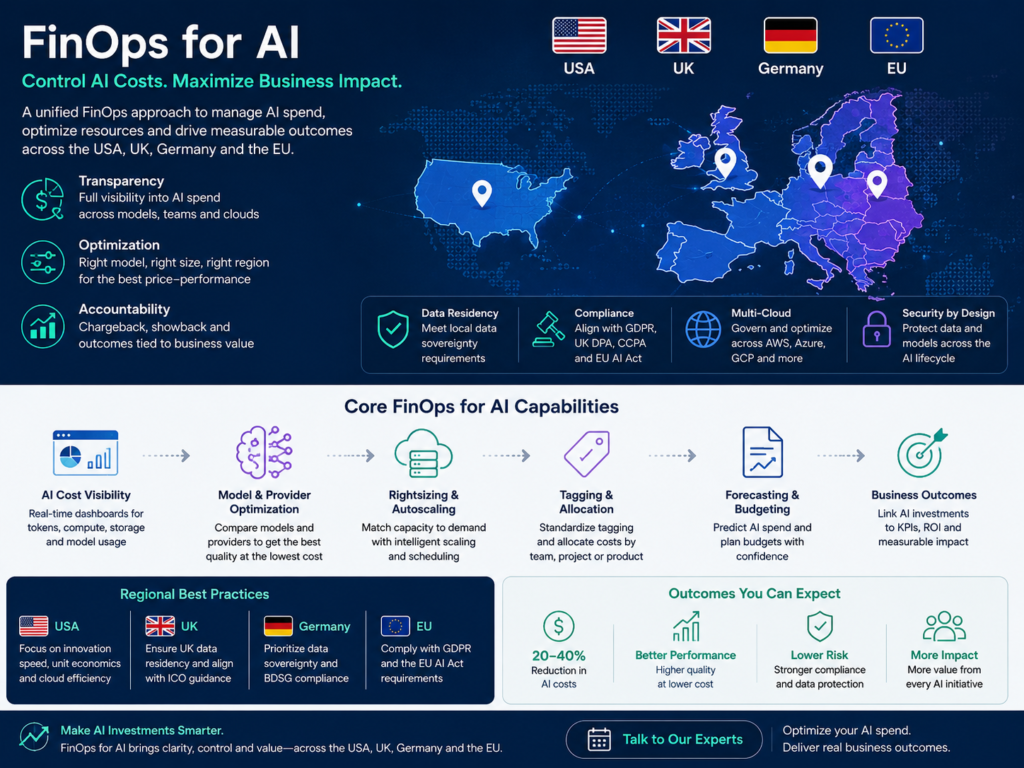
FinOps for AI Across the USA, UK, Germany and EU
Regional AI cost programmes must balance financial efficiency with privacy, security, procurement and data-residency requirements.
The cheapest region may not be commercially suitable when sensitive information, regulated decisions or international transfers are involved.
USA.
A healthcare platform serving New York or San Francisco may need HIPAA safeguards. Payment-related systems may also need PCI DSS controls.
Architectures based around Ashburn and Northern Virginia should consider regional concentration, transfer costs and commitment risk. The US Department of Health and Human Services provides guidance on HIPAA protections for identifiable health information.
UK.
UK organisations should forecast in GBP and assess UK GDPR, Data Protection Act obligations and international data transfers.
NHS projects and FCA-regulated financial services may require stronger auditability, data minimisation and supplier governance. The Information Commissioner’s Office maintains dedicated guidance covering AI and data protection.
Germany and the EU.
FinOps für KI should combine KI-Kostenmanagement and GPU-Kostenoptimierung with GDPR or DSGVO requirements, DORA, BaFin expectations and the EU AI Act.
Frankfurt, Berlin, Amsterdam, Dublin, Paris and Stockholm may differ in pricing, service availability, data sovereignty and procurement requirements.
The EU AI Act is Regulation (EU) 2024/1689. Cost optimization decisions should therefore be reviewed alongside risk classification, documentation, transparency and governance obligations.
A Practical FinOps for AI Implementation Roadmap
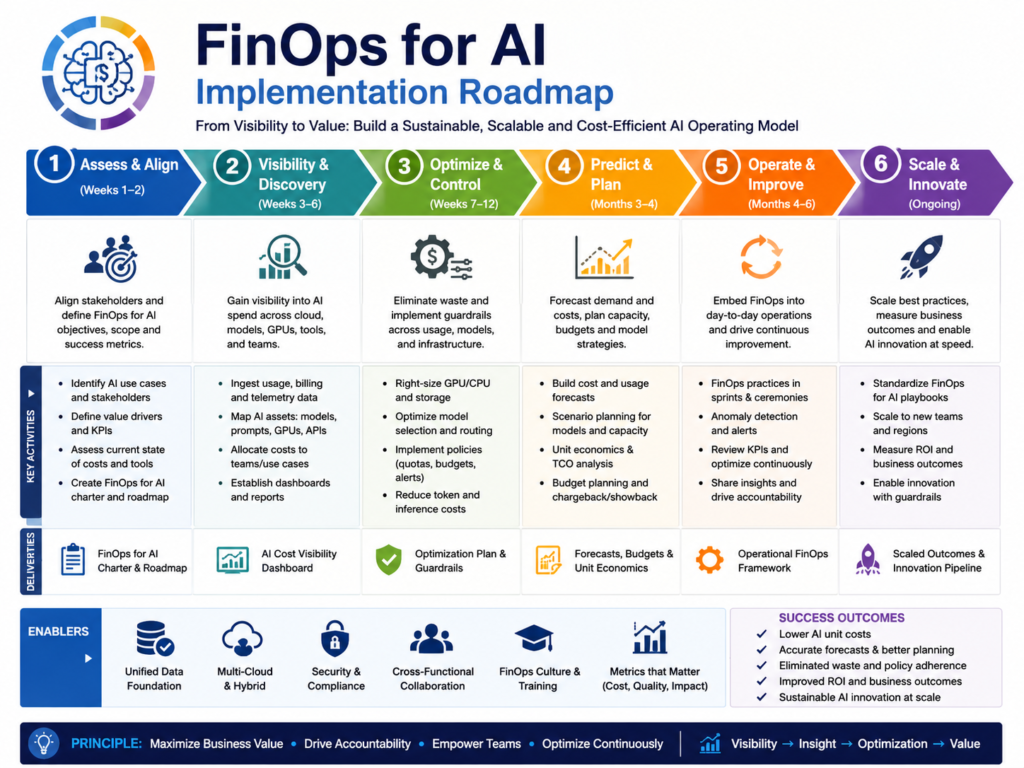
A successful FinOps for AI programme starts with visibility, introduces financial and technical guardrails, and then scales proven optimization practices.
Automated chargeback should not be introduced before workload ownership and allocation data are trustworthy.
Establish Visibility and Baselines
Inventory:
Models and model APIs
Cloud accounts
GPU clusters
Managed AI services
Kubernetes environments
Storage and data pipelines
Monitoring and observability platforms
Assign an owner to each major workload. Introduce tagging standards and establish baseline metrics for GPU utilisation, token volume, inference costs and total AI spending.
Set Budgets and Guardrails
Create budgets by product, environment and business unit.
Define cost-per-outcome targets, anomaly thresholds, quotas, routing policies and automated shutdown controls. Guardrails should cover both infrastructure usage and model behavior.
Optimize, Benchmark and Scale
Rank opportunities by potential savings, implementation effort and operational risk.
Benchmark models, GPUs, providers and regions. Scale improvements that preserve accuracy, compliance, reliability and customer experience.
Learn more about Mak It Solutions and its work delivering custom digital platforms for international organizations.
Final Thoughts
AI costs become manageable when infrastructure data, token consumption and business outcomes are visible within one operating model.
A well-designed FinOps for AI programme helps teams reduce waste, forecast demand, improve unit economics and make better decisions about models, providers and regions.
Contact Mak It Solutions to request a scoped AI cost assessment, multi-cloud architecture review or FinOps implementation estimate.
Key Takeaways
Measure AI spending by GPU, model, workload, customer and business outcome.
Improve accelerator utilization before purchasing additional capacity.
Use model routing, caching and smaller models to improve LLM unit economics.
Apply real-time limits to agent loops, retries and tool calls.
Separate training forecasts from recurring inference budgets.
Include HIPAA, UK GDPR, GDPR or DSGVO, DORA and regional residency in cost decisions.
Select AI FinOps tools based on allocation accuracy, automation and actionable unit metrics.
FAQs
Q : Which workloads should be prioritised during a FinOps for AI assessment?
A : Start with workloads that combine high spending, weak allocation and unpredictable demand. Common priorities include large training jobs, underutilized GPU clusters, high-volume inference, document-processing pipelines and autonomous agents.
Q : How often should AI cost forecasts be updated?
A : Production inference forecasts should normally be reviewed weekly or monthly, with more frequent monitoring during launches or rapid adoption. Recalculate projections whenever traffic, model pricing, context length, GPU requirements or agent behavior changes materially.
Q : Can FinOps for AI improve sustainability?
A : Yes. Higher GPU utilization, scale-to-zero policies, efficient models and shorter inference paths can reduce both cloud spending and wasted energy. Teams should still track energy or carbon indicators separately because not every financial saving produces the same environmental benefit.
Q : When should an enterprise use show back instead of chargeback?
A : Show back is appropriate when allocation data is new, incomplete or not fully trusted. Chargeback becomes more suitable after ownership rules, tagging standards, shared-cost allocation and dispute processes are mature.
Q : What data is needed to evaluate an AI FinOps platform?
A : A useful assessment may include cloud billing exports, GPU telemetry, Kubernetes labels, model API logs, token counts, environment tags, customer identifiers and business-outcome data. A proof of concept should demonstrate allocation, forecasting and anomaly detection using real organizational workloads.