
Multi-Cloud Strategy: When It Actually Pays Off
Multi-Cloud Strategy: When It Actually Pays Off
Multi-Cloud Strategy: When It Actually Pays Off
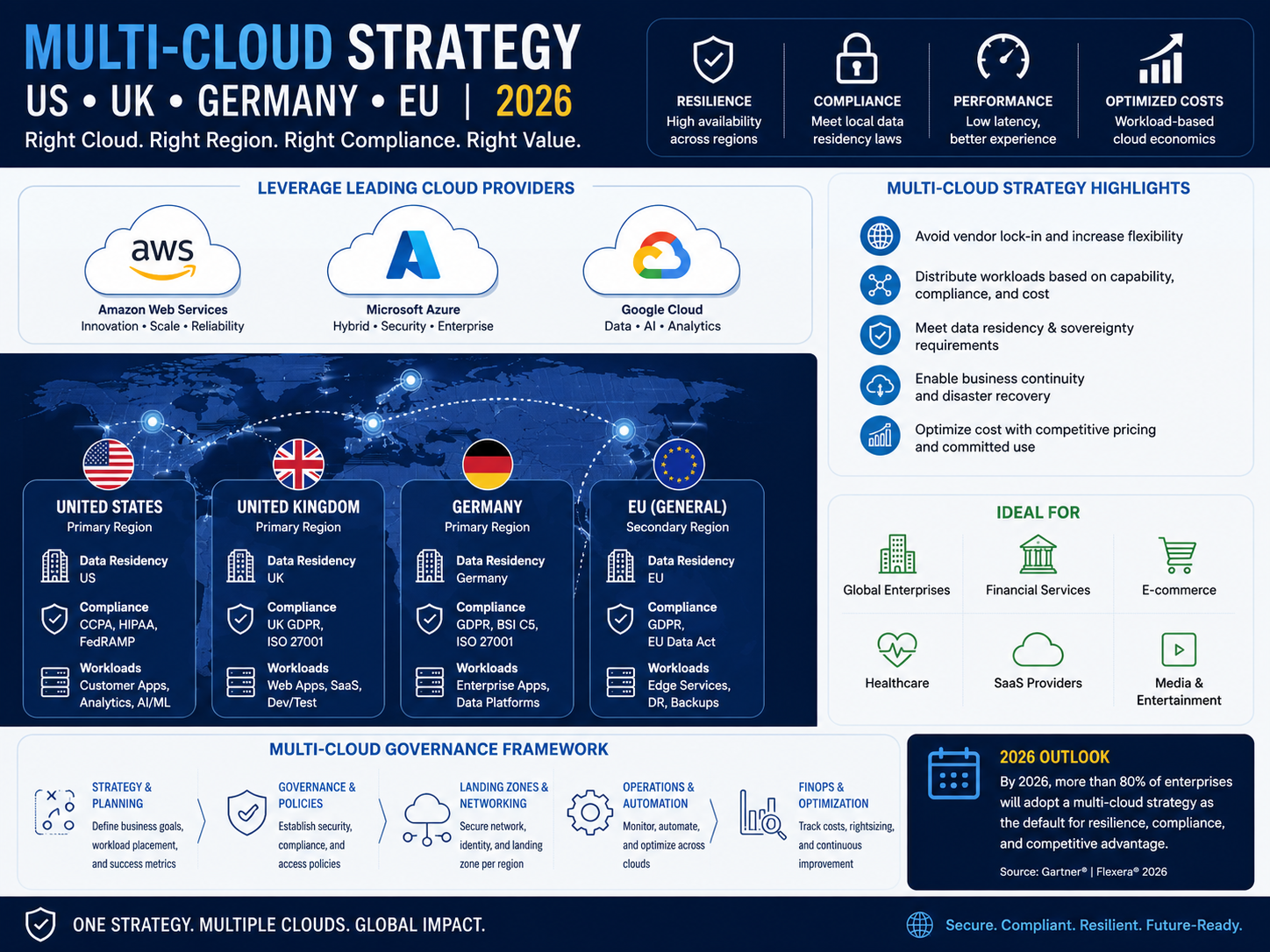
A multi-cloud strategy can improve resilience, unlock specialist services, and meet geographic or regulatory requirements. It can also leave teams managing duplicated tools, fragmented security controls, and cloud bills that are harder to explain.
The practical answer is simple: multi-cloud pays off when every provider solves a defined business, technical, resilience, or compliance problem. Without that purpose, a second cloud usually creates more operational overhead than strategic value.
Flexera’s 2024 research found that 89% of surveyed organizations used a multi-cloud model, although 73% used hybrid cloud and only 14% used multiple public clouds. That distinction matters: being present in several environments does not automatically mean an organization has a deliberate multi-cloud operating model.
What Is a Multi-Cloud Strategy?
A multi-cloud strategy is the deliberate use of services from two or more cloud providers under one coordinated operating model.
It is not simply the accidental presence of AWS, Microsoft Azure, Google Cloud, IBM Cloud, or regional cloud accounts across different departments. A genuine strategy defines why each provider is used, which workloads belong there, who owns them, and how security, cost, recovery, and compliance will be managed.
Multi-Cloud vs Hybrid Cloud vs Single Cloud
A single-cloud model places most workloads with one strategic provider.
A hybrid-cloud model connects public cloud services with private infrastructure or on-premises systems.
A multi-cloud model uses more than one cloud provider and may also include private infrastructure.
For example, a New York SaaS company might run its customer platform on AWS while using Google Cloud for a specialist analytics service. A London enterprise may combine Azure with an existing data center. A manufacturer in Munich could use a European provider for sensitive workloads while retaining a hyperscale for global applications.
For a provider-level comparison, see Mak It Solutions’ AWS, Azure, and Google Cloud guide.
The Business Problems Multi-Cloud Should Solve
A second provider should solve a specific problem, such as.
Reducing concentration risk
Supporting demanding recovery objectives
Meeting customer procurement requirements
Expanding into a region with better local coverage
Satisfying data-residency or sovereignty commitments
Accessing a differentiated AI, database, analytics, or security service
Global cloud infrastructure spending reached approximately $90.9 billion in the first quarter of 2025, representing year-over-year growth of about 21%. As cloud investment rises, poor workload-placement decisions can have a significant financial and operational impact.
Why “Using Several Clouds” Is Not a Strategy
Cloud sprawl often begins quietly. One development team opens a separate account. An acquisition brings another provider. A proof of concept becomes permanent. Before long, the organization has multiple clouds but no shared identity, tagging, security, cost, or recovery model.
A real multi-cloud strategy defines.
Workload-placement rules
Approved services and regions
Architecture and security standards
Cost ownership and allocation
Recovery responsibilities
Contractual and technical exit requirements
Without those controls, multi-cloud becomes an inventory problem rather than a business advantage.
When Is a Multi-Cloud Strategy Worth It?
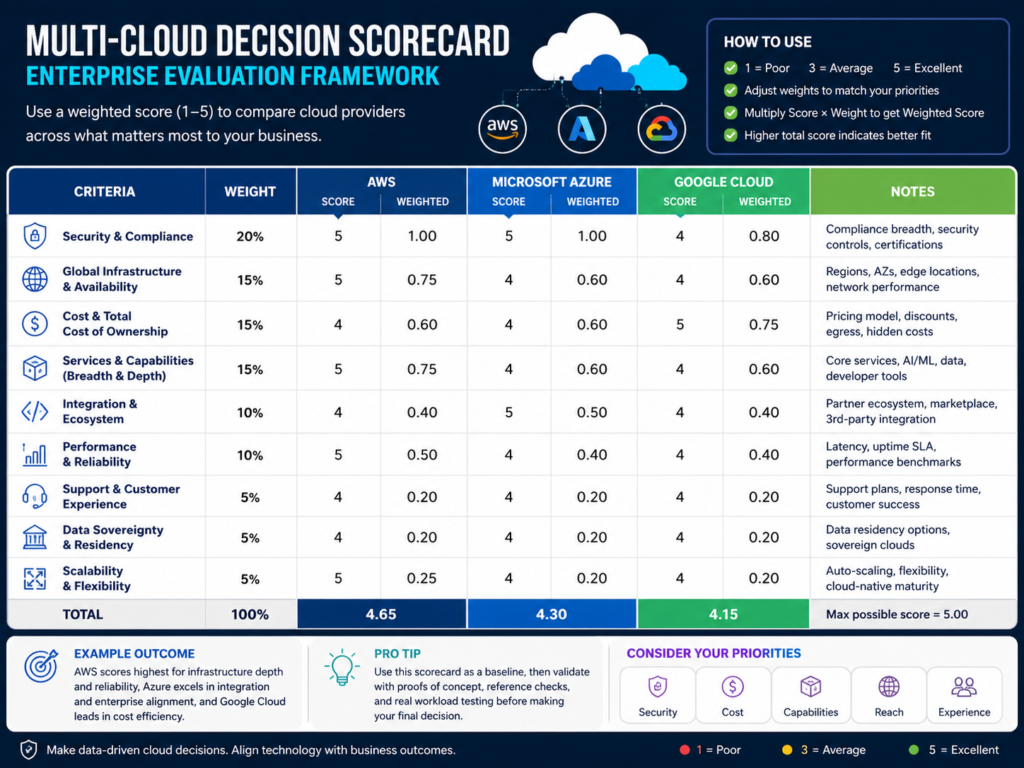
A multi-cloud strategy is usually worth considering when a second provider materially improves resilience, satisfies a regulatory or contractual requirement, expands geographic reach, or delivers a capability the primary provider cannot match economically.
The expected benefit must exceed the additional cost of engineering, security, networking, support, governance, and skills.
Resilience, Geographic Reach, and Specialist Capabilities
Provider diversity can strengthen resilience, but only when the architecture is designed for failure.
Placing application components across two providers does not automatically create continuity. Identity systems, DNS, networking, data replication, secrets, deployment pipelines, and operational access must also survive an outage.
For critical workloads, teams should define.
Recovery time objectives
Recovery point objectives
Failover ownership
Data-replication behaviour
Degraded-mode operations
Testing frequency
Multi-cloud can also support geographic expansion. One provider may offer stronger regional availability, commercial partnerships, latency, or managed services in a target market. That is a valid business case when the advantage is measurable.
Regulatory, Sovereignty, and Customer Requirements
Regulatory requirements differ by workload, sector, customer, and legal entity.
A US healthcare platform may need controls that support HIPAA obligations. Payment environments must address PCI DSS. UK financial firms may need to map FCA and PRA outsourcing and operational-resilience expectations. German and EU organizations may need to consider GDPR, DORA, NIS2, BSI C5, BaFin requirements, and contractual data-residency commitments.
DORA became applicable to covered EU financial entities in January 2025, while EU member states were required to transpose NIS2 by October 2024. The EU AI Act entered into force in August 2024, with many remaining provisions scheduled to apply from August 2026, subject to exceptions and subsequent amendments.
Regulation should not be treated as a blanket justification for multi-cloud. The organization must identify the exact requirement, the affected data and workload, and why the proposed provider arrangement addresses it.
Multi-Cloud vs Single Cloud.
Choose multi-cloud when the second provider delivers measurable value in at least one of these areas.
| Decision area | Multi-cloud may be justified when… |
|---|---|
| Revenue | A customer or market opportunity depends on a specific provider or region |
| Resilience | Concentration risk exceeds the organization’s accepted tolerance |
| Compliance | A workload has a documented regulatory or contractual requirement |
| Geography | The primary provider cannot meet latency, residency, or availability needs |
| Technology | A differentiated managed service creates clear value |
| Exit readiness | The organization needs a tested alternative for a critical workload |
Remain primarily single-cloud when the organization lacks platform-engineering capacity, cross-cloud security ownership, mature FinOps practices, or a clear reason for the additional provider.
The Hidden Complexity Tax of Multi-Cloud
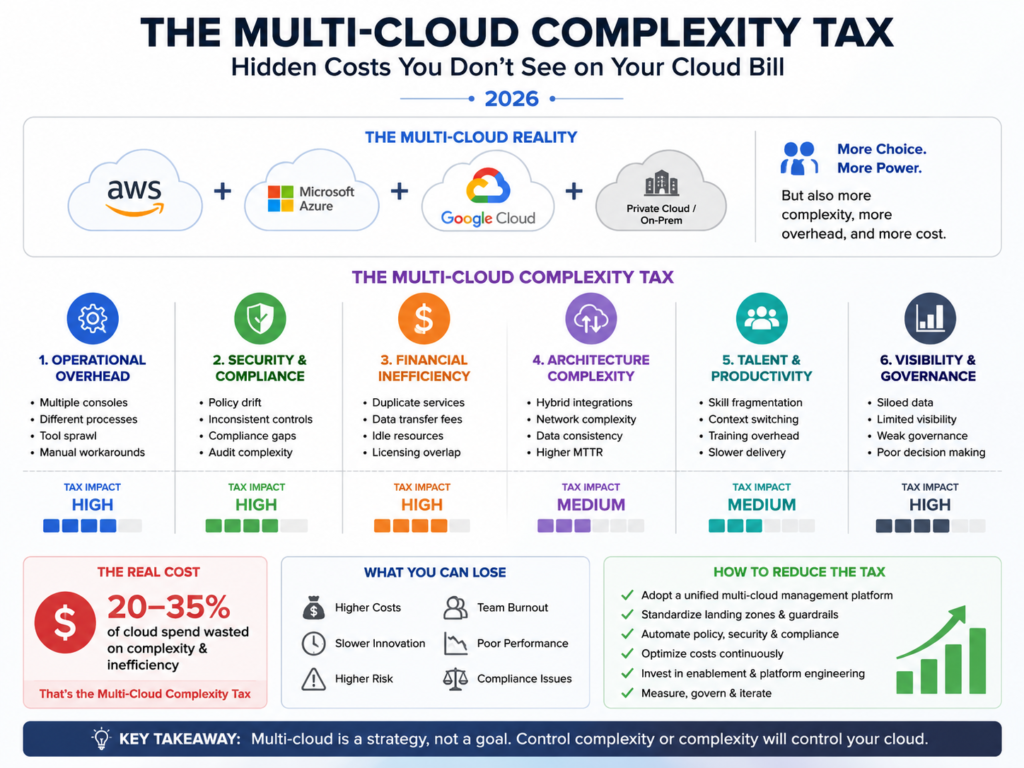
The multi-cloud complexity tax is the extra cost of maintaining separate skills, policies, identities, integrations, contracts, support processes, and engineering workflows across providers.
This cost rarely appears in a simple infrastructure-price comparison.
Duplicated Skills, IAM Systems, and Workflows
AWS, Azure, Google Cloud, and regional providers use different permission models, APIs, networking concepts, service limits, and troubleshooting processes.
Teams may need.
Provider-specific landing zones
Separate infrastructure modules
Additional certifications and training
Multiple deployment pipelines
Different incident-response playbooks
Native troubleshooting expertise for each platform
Identity federation can create a common workforce-access layer, but engineers still need to understand each provider’s native identity and access-management behavior.
Terraform and other infrastructure-as-code tools can improve consistency. They do not erase architectural differences, and overly generic modules can hide provider-specific risks.
Fragmented Billing, Egress Fees, and FinOps Blind Spots
Every provider presents pricing, discounts, commitments, tags, and billing exports differently. Moving data between providers can also introduce egress charges, latency, and additional failure points.
FinOps creates shared accountability between engineering, finance, and business teams. A dashboard alone, however, cannot repair inconsistent tagging, unclear ownership, or missing unit-cost definitions.
Mak It Solutions’ FinOps cloud cost optimisation guide and multi-cloud cost optimisation framework explain how to connect cloud spending with workload value.
Observability, Security, and Support Overlap
Multi-cloud teams often pay for overlapping.
SIEM and security-monitoring tools
Vulnerability scanners
Cloud security posture platforms
Backup services
Observability products
Support contracts
Network-security controls
During a 24/7 incident, responders may also need to coordinate several providers with different severity definitions, support tiers, and escalation routes.
A central control plane can reduce fragmentation, but it should not become another poorly supported abstraction that hides the native telemetry engineers need during an outage.
How to Design a Manageable Multi-Cloud Architecture
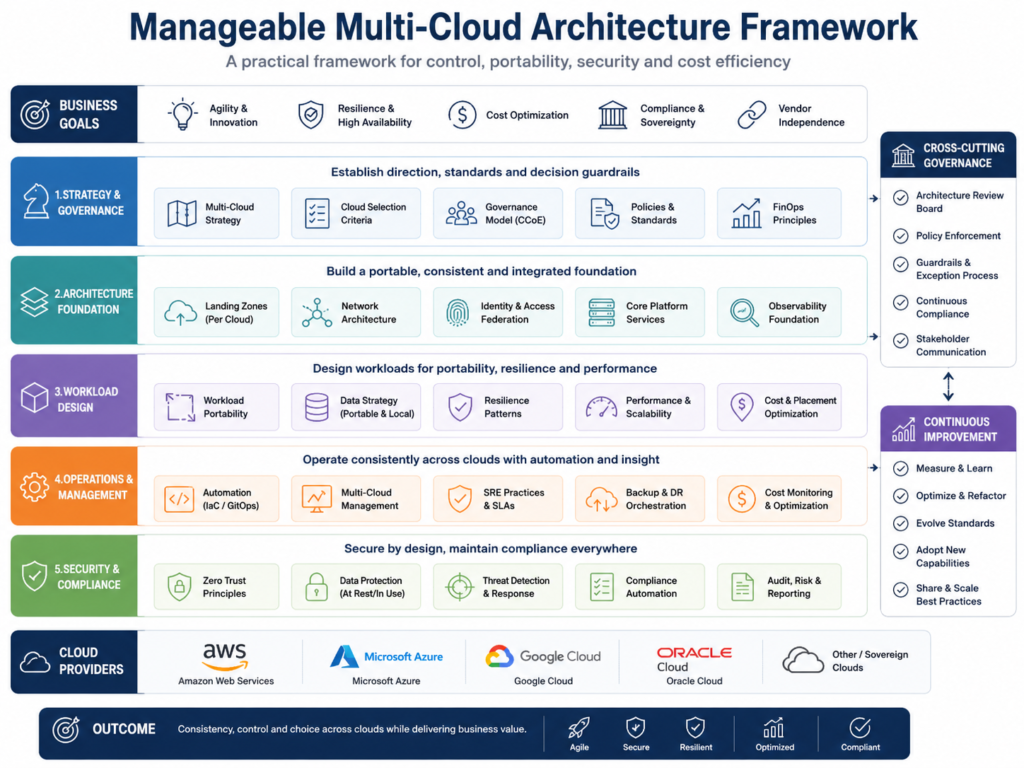
A manageable multi-cloud architecture standardizes governance, evidence, and developer workflows while preserving provider-specific services where they create measurable value.
Assign Every Workload a Clear Provider Rationale
Document why each workload belongs on its selected provider.
The rationale may involve.
Latency
Customer location
Compliance
Recovery
Pricing
Data sovereignty
Access to a differentiated managed service
Review that decision periodically. A valid placement decision in 2026 may no longer make sense after a pricing change, new provider region, regulatory update, acquisition, or application redesign.
Standardize Landing Zones, Identity, Networking, and Policy
Define common minimum standards for.
Account and subscription structures
Identity federation
Privileged access
Encryption
Logging and audit evidence
Network connectivity
Resource tagging
Backup and recovery
Policy as code
Cost ownership
Services such as AWS Organizations, AWS Control Tower, Microsoft Entra ID, Azure Arc, and Google Cloud management tools can support parts of this model.
The goal is consistent ownership and evidence not forcing every provider into an identical technical design.
Mak It Solutions’ guide to cloud misconfiguration prevention provides additional security guardrails.
Use Portability Selectively
Universal portability sounds attractive but is expensive to build and maintain.
Kubernetes can standardize container deployment, but it does not automatically make proprietary databases, identity services, data models, managed queues, or operating processes portable.
Priorities.
Portable and recoverable data
Documented dependencies
Rebuildable infrastructure
Tested backups
Open interfaces where practical
Realistic migration and exit procedures
Read when Kubernetes is worth the complexity before treating it as a universal abstraction layer.
Multi-Cloud Governance, Security, and Compliance
Effective multi-cloud governance creates shared policies for ownership, tagging, identity, cost, security, recovery, and audit evidence while allowing necessary provider-specific implementation.
Centralis Policy Without Forcing Identical Designs
Create one governance framework covering.
Workload ownership
Approved regions and services
Data classification
Cost allocation
Logging and retention
Encryption
Recovery objectives
Exceptions and risk acceptance
Implementation can vary where provider capabilities differ. The control objective should remain consistent even when the technical mechanism is not.
The UK Competition and Markets Authority’s final cloud-services market investigation identified barriers affecting switching and multi-cloud adoption. It reported that fewer than 1% of customers switch provider in a typical year and found significant barriers to competition, particularly in infrastructure as a service.
Build Cross-Cloud Identity, Security, and Audit Controls
Use central workforce identity, strong authentication, least privilege, short-lived credentials, and clearly assigned security ownership.
Aggregate critical telemetry, but retain access to detailed native logs. Security teams should be able to trace one user, transaction, or incident across multiple providers without manually reconstructing the evidence from unrelated systems.
In practice, a control is only useful when someone owns it, tests it, and can produce evidence that it works.
Map Compliance by Region and Workload
A HIPAA-regulated workload in the USA, an NHS-related service in Manchester, and a financial platform overseen in Frankfurt will not have identical obligations.
Map requirements according to.
Data type
Legal entity
Customer contract
Industry
Processing location
Workload criticality
Relevant frameworks may include HIPAA, SOC 2, FedRAMP, GLBA, PCI DSS, and NIST guidance in the USA; UK GDPR, the Data Protection Act 2018, FCA or PRA expectations, and the NHS Data Security and Protection Toolkit in the UK; and GDPR, DORA, NIS2, BSI C5, and the EU AI Act in Germany and the wider EU.
Multi-Cloud Resilience, Vendor Lock-In, and Sovereign Cloud
Multi-cloud can reduce dependence on a single supplier, but it does not automatically remove lock-in.
Applications may remain dependent on proprietary databases, identity services, APIs, data formats, and operational processes even when an organization buys services from several providers.
Provider Diversity Is Not the Same as Portability
These capabilities are different.
Provider diversity: purchasing services from more than one provider
Workload portability: being able to move an application elsewhere
Exit readiness: having the contracts, data, expertise, procedures, and budget required to leave
Running one proprietary application on AWS and another on Azure creates provider diversity. It does not make either application portable.
Cloud Exit Planning and Operational Resilience
A practical exit plan should identify.
Data-export methods
Replacement services
Contractual timelines
Software and identity dependencies
Required skills
Migration and egress costs
Acceptable downtime
Validation and rollback procedures
Test the assumptions behind the plan. An untested architecture diagram is not evidence of exit readiness.
For more detail, see Mak It Solutions’ cloud repatriation strategy, which compares optimisation, migration, hybrid architecture, and repatriation.
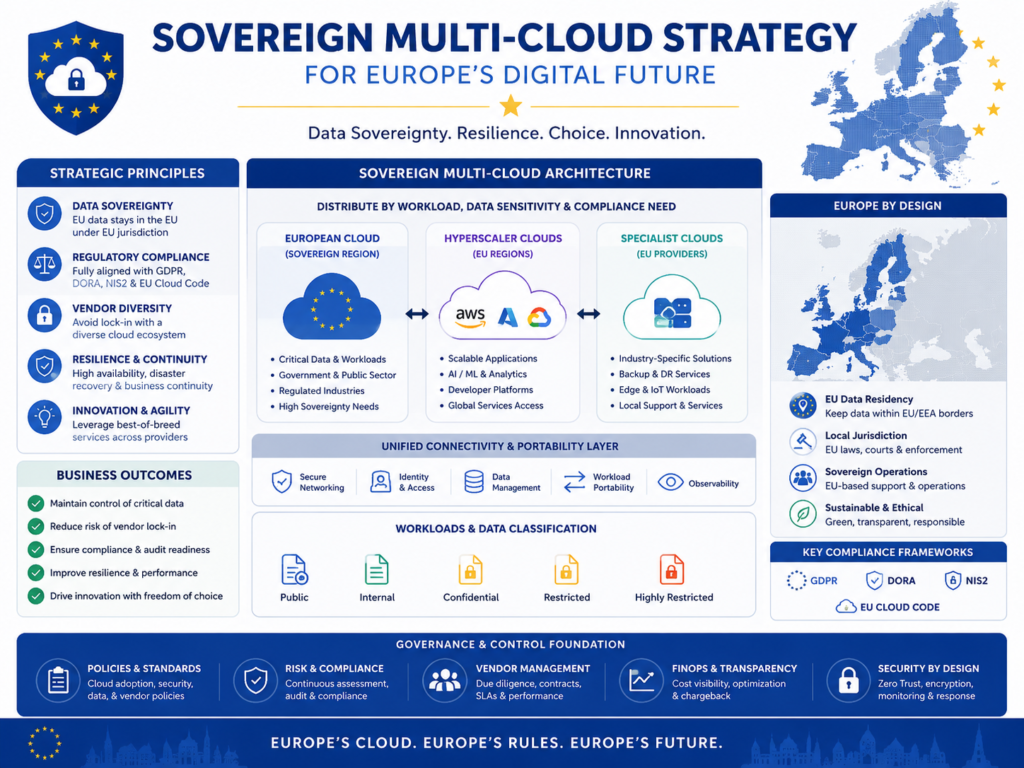
Sovereign Multi-Cloud Strategies for Germany and the EU
European organizations may combine hyperscale’s with regional providers such as IONOS, OVHcloud, or STACKIT to meet specific sovereignty, procurement, or customer requirements.
T-Systems and SAP ecosystems, Sovereign Cloud Stack initiatives, and Gaia-X-related projects may also influence architecture decisions.
A Berlin public-sector project or Munich industrial platform may priorities EU data residency and operational control while retaining global cloud services for less sensitive workloads.
The important point is accountability. Using a European provider does not remove the organization’s responsibility for lawful processing, access control, retention, international transfers, and incident management.
A Practical Multi-Cloud Strategy Framework
Organization’s should approve multi-cloud workload by workload, calculate total operating cost, assign accountable owners, and test governance before scaling.
Define the Workload-Level Business Case
Identify the customer, revenue, regulatory, resilience, geographic, or technical requirement.
Set measurable success criteria and document why the primary provider cannot meet the requirement adequately.
A weak justification is: “We want to avoid lock-in.”
A stronger justification is: “This customer-facing workload must meet a documented recovery target that our current architecture cannot satisfy within the accepted concentration-risk limit.”
Calculate Cost, Skills, and Governance Readiness
Include more than infrastructure pricing.
Calculate the expected cost of:
Platform engineering
Training and certifications
Security tooling
Support plans
Observability
Connectivity
Data transfer and egress
Duplicated environments
Compliance assessments
Incident response
Exit testing
Confirm ownership for architecture, security, data, compliance, FinOps, support, and recovery.
Pilot, Measure, and Scale Proven Patterns
Start with one bounded workload.
Test.
Deployment
Identity and access
Cost allocation
Observability
Recovery
Support escalation
Security evidence
Data export
Exit procedures
Scale only after the pilot demonstrates measurable business value and manageable operations.
Final Thoughts
A multi-cloud strategy is the right choice only when it delivers clear business value through improved resilience, compliance, geographic flexibility, or technical capabilities. If those benefits are not required, optimizing a single cloud environment is often the simpler and more cost-effective approach.
Mak It Solutions can help you evaluate whether a multi-cloud strategy aligns with your business goals or would introduce unnecessary complexity. Our readiness assessment covers architecture, security, compliance, FinOps, operational skills, and long-term planning to support informed cloud decisions. Contact our team to arrange an architecture review and discuss the best path forward.( Click Here’s )
Explore our technology and development services or contact the team to arrange an architecture review.
Key Takeaways
Multi-cloud should solve a measurable workload-level problem, not serve as a branding exercise.
The largest hidden costs often come from duplicated skills, IAM, governance, observability, support, and data transfer.
Standardize controls and developer workflows without removing valuable provider-specific capabilities.
Map compliance by workload, region, customer, and legal entity.
Provider diversity does not equal application portability or exit readiness.
Pilot one justified pattern before expanding the operating model.
FAQs
Q : How many cloud providers should an enterprise use?
A : Use the smallest number of providers required to meet genuine business, technical, resilience, or regulatory needs. Two strategic providers may be sufficient. Adding a third without a distinct workload rationale usually increases cost and governance effort faster than it increases value.
Q : Which workloads should remain on the primary cloud?
A : Workloads that depend heavily on the primary provider’s managed databases, identity services, analytics tools, or existing operational expertise should usually remain there unless migration produces a measurable benefit.
Q : Can FinOps tools provide one cost view across multiple clouds?
A : FinOps platforms can aggregate billing and usage data across providers. Teams still need consistent tagging, allocation rules, ownership, and unit-cost definitions. A unified dashboard cannot compensate for incomplete metadata.
Q : What skills are required to operate multi-cloud?
A : A mature team usually needs cloud architecture, provider-native engineering, IAM, networking, security, infrastructure as code, observability, FinOps, compliance, platform engineering, and incident-response capability.
Q : How often should a cloud exit plan be tested?
A : Critical exit and recovery procedures should be reviewed at least annually and after major architectural, contractual, or regulatory changes. Higher-impact workloads may require more frequent exercises based on their recovery and risk requirements.