


Disaster Recovery Architecture: Build for Resilience
Disaster Recovery Architecture: Build for Resilience
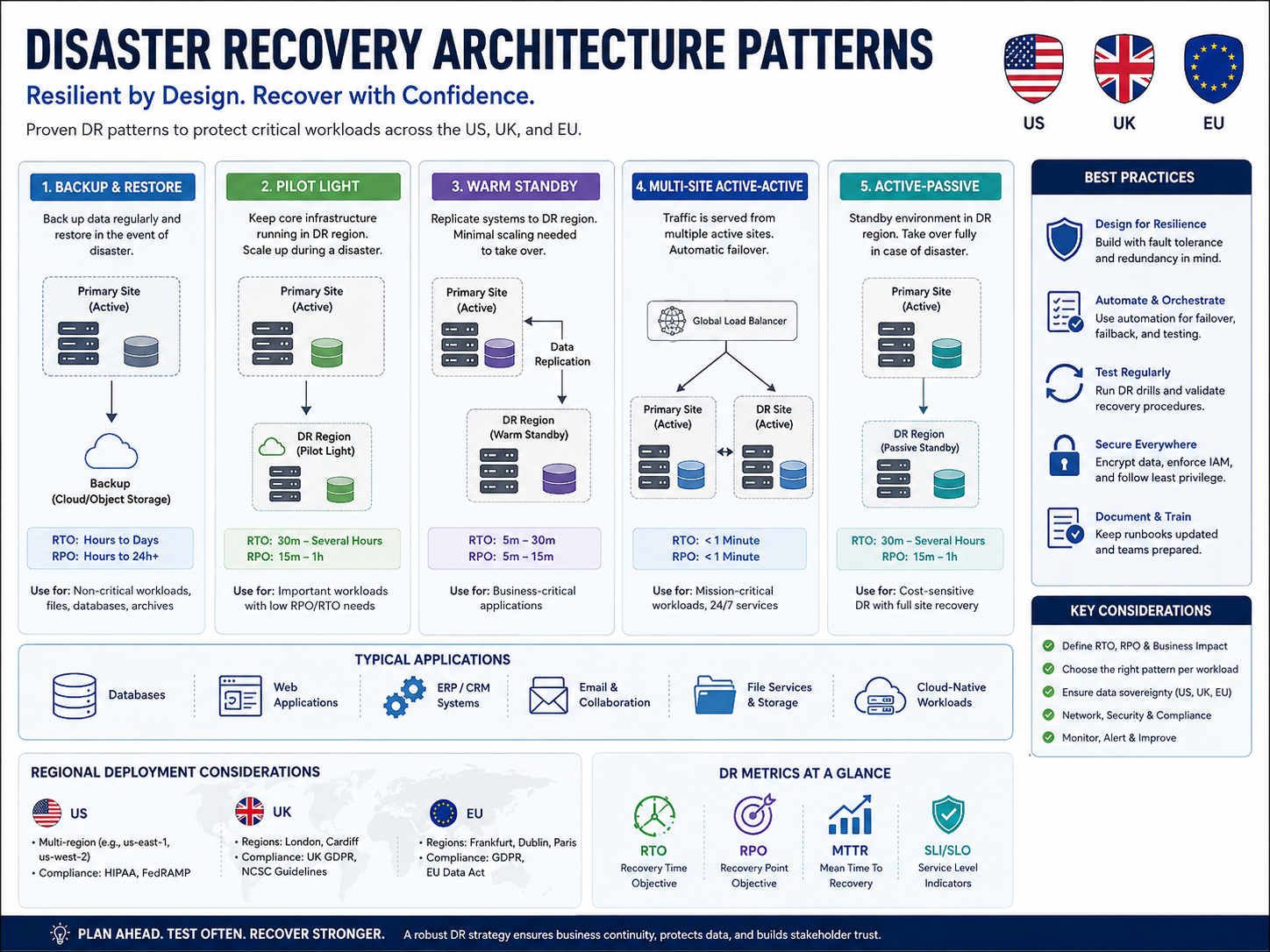
Disaster Recovery Architecture: Build for Resilience
A strong disaster recovery architecture does more than keep a backup somewhere outside production. It gives your organization a practical way to restore applications, infrastructure, data, access, and customer-facing services when a serious outage takes the primary environment offline.
In practical terms, most organizations choose from four core DR patterns: backup and restore, pilot light, warm standby, and active-active. The right option depends on how quickly a workload must return, how much data loss is acceptable, regulatory requirements, operational complexity, and the cost of maintaining recovery capacity. AWS documents the same four recovery strategies in its disaster recovery guidance.
Cloud dependence has also made recovery planning harder to ignore. Gartner forecast worldwide public-cloud end-user spending at $675.4 billion in 2024, illustrating the scale of infrastructure and applications now dependent on cloud environments.
What Is Disaster Recovery Architecture?
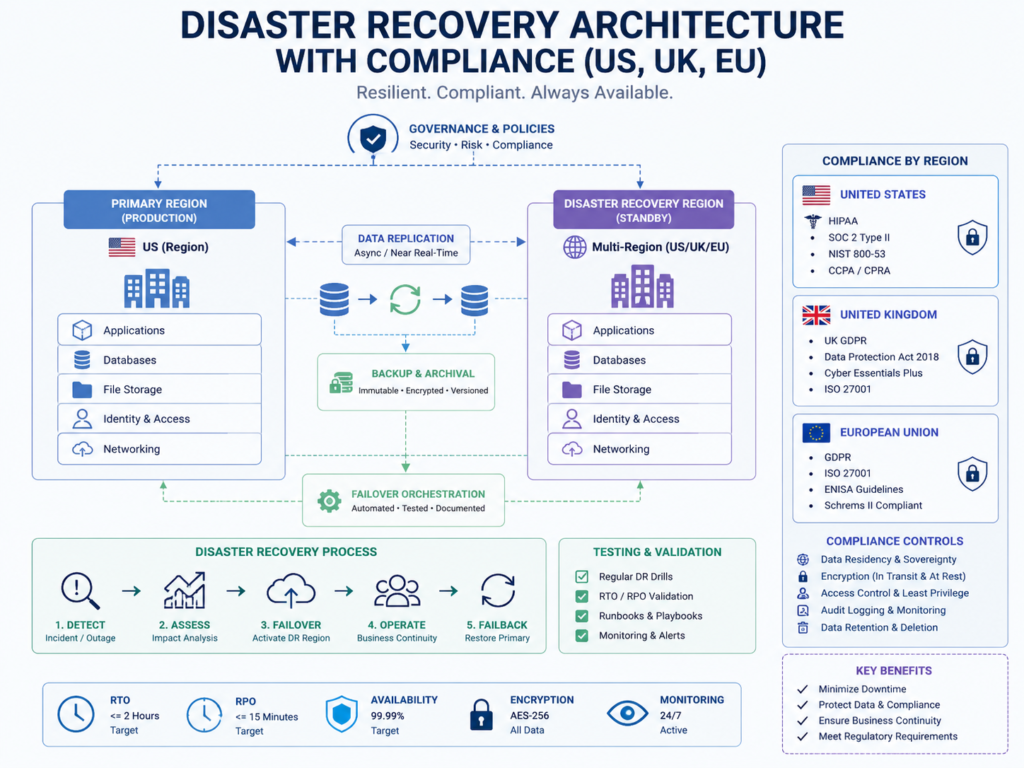
A disaster recovery architecture is the technical design used to restore applications, infrastructure, networking, and data after a major disruption while meeting predetermined recovery objectives.
It defines more than what gets backed up. A complete architecture answers practical questions such as.
Where will workloads recover?
How will data reach the recovery environment?
How will users and traffic be redirected?
Which services and dependencies must start first?
Who can authorize failover?
How will the organization return to the primary environment?
That last point matters. A recovery environment that cannot safely fail back to production is only half a DR solution.
Disaster Recovery vs Backup vs High Availability
Backup, disaster recovery, and high availability solve different problems.
Backup protects copies of data so information can be restored after corruption, deletion, ransomware, or another incident.
Disaster recovery restores the complete technology service after a major failure.
High availability is designed to keep a service running through smaller infrastructure failures without requiring a full disaster-recovery event.
For example, a database snapshot alone is not a complete DR solution for a SaaS platform. The recovered database may still depend on application servers, secrets, APIs, DNS, authentication, networking, monitoring, certificates, and external integrations.
Teams building resilient APIs should therefore consider recovery requirements during back-end architecture and development, rather than adding DR as an infrastructure task after launch.
Core Components of a Recoverable Architecture
The exact components vary by workload, but a mature architecture commonly includes.
Secondary regions or recovery sites
Immutable or protected backups
Cross-region data replication
Compute and storage capacity
Network connectivity and routing
DNS or traffic-management failover
Identity and access services
Infrastructure as code
Secrets and credentials
CI/CD resources
Monitoring and alerting
Recovery runbooks
Tested failback procedures
The key is dependency awareness. Restoring the database means little if the identity provider, DNS configuration, certificates, or administrator access required to operate it are unavailable.
Business Continuity and Disaster Recovery (BCDR)
Business continuity and disaster recovery are closely related, but they are not identical.
Business continuity focuses on keeping essential organizational functions operating during disruption. Disaster recovery focuses on restoring the technology those functions depend on.
A healthcare supplier in London, for example, may need application recovery alongside staff procedures, supplier escalation paths, customer communication, temporary operating processes, and evidence that continuity controls have actually been tested.
4 Disaster Recovery Architecture Patterns Compared
The four common disaster recovery architecture patterns are backup and restore, pilot light, warm standby, and multi-site active-active.
As you move toward active-active, recovery can become faster and potential data loss can decrease. The trade-off is higher infrastructure cost, greater architectural complexity, more monitoring, and more demanding testing.
Backup and Restore vs Pilot Light
Backup and restore has the smallest secondary infrastructure footprint.
Data and configuration are protected, but much of the application environment may need to be rebuilt or provisioned after an incident. It is usually the least expensive option, but recovery can take considerably longer.
This approach often makes sense for.
Development environments
Internal reporting applications
Archival systems
Low-priority workloads
Pilot light keeps the most critical components—often databases and essential services—available in the recovery environment while the remaining application infrastructure is started or scaled during failover.
Because part of the environment is already running, pilot light can recover faster than a basic backup-and-restore design.
For a low-priority internal application, backup and restore may be perfectly reasonable. A revenue-generating SaaS platform may need the faster recovery offered by pilot light.
Warm Standby vs Active-Active Disaster Recovery
Warm standby maintains a reduced but functional version of the production environment.
During a disaster, the recovery environment scales up and begins handling production traffic. This gives organizations faster recovery without necessarily paying for two equally sized production environments at all times.
An Austin SaaS company, for example, might keep a smaller standby application tier running continuously and scale it only when the primary region fails.
Active-active disaster recovery goes further. Two or more locations actively serve workloads during normal operations.
This can be appropriate for platforms where even a brief outage has serious consequences, including.
High-volume payment systems
Large e-commerce platforms
Critical healthcare applications
Financial infrastructure
Globally used SaaS products
A high-volume retailer using e-commerce development infrastructure might justify active-active protection for checkout and payment services while allowing less critical functions to recover more slowly.
DR Pattern Decision Matrix.
| DR Pattern | Secondary Capacity | Relative Cost | Typical Recovery Speed | Data-Loss Exposure | Complexity | Best Fit |
|---|---|---|---|---|---|---|
| Backup & restore | Minimal | Low | Hours | Higher | Low | Internal or low-priority apps |
| Pilot light | Critical core only | Low–Medium | Tens of minutes | Moderate–Low | Medium | Important SaaS workloads |
| Warm standby | Reduced live stack | Medium–High | Minutes | Low | Medium–High | Revenue or regulated systems |
| Active-active | Full active capacity | Highest | Near-immediate | Lowest potential | High | Mission-critical platforms |
The least expensive pattern is not always the most economical one.
IBM’s 2024 Cost of a Data Breach research reported a global average breach cost of $4.88 million. While a data breach and a regional infrastructure failure are different events, the figure highlights how expensive business disruption and recovery can become when critical systems are unavailable.
How RTO and RPO Shape Disaster Recovery Design
RTO defines how quickly a workload must return after disruption. RPO defines how much recent data the organization can afford to lose.
These two objectives directly influence replication frequency, automation, standby capacity, database design, backup strategy, and ultimately the appropriate disaster recovery architecture.
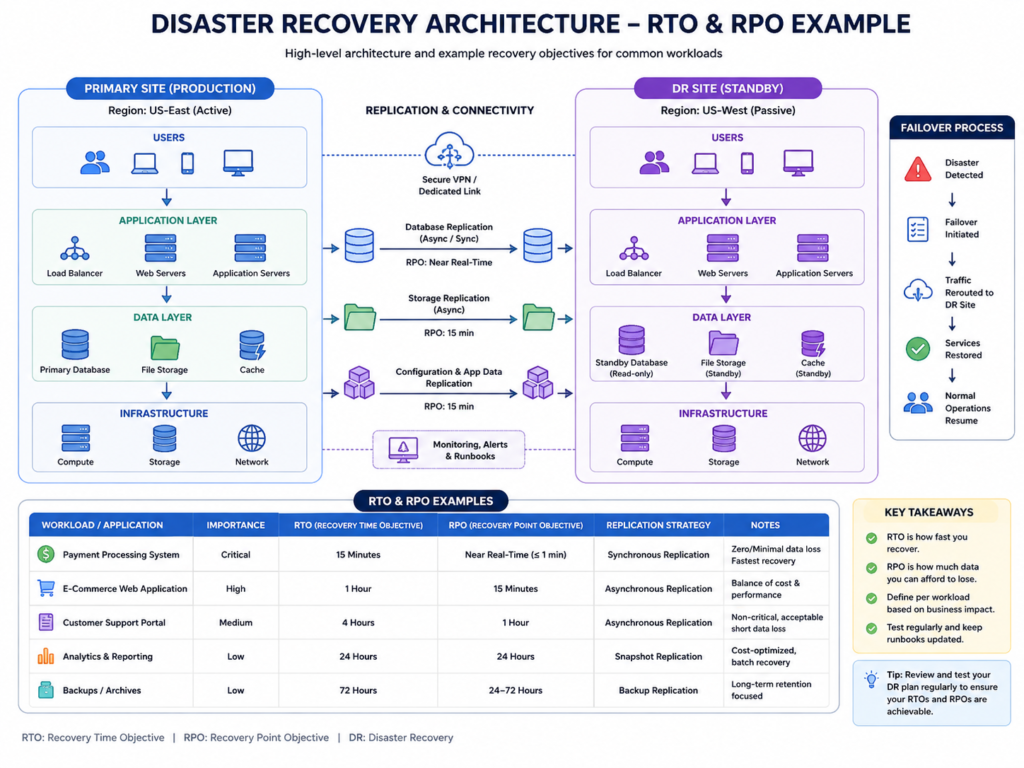
RTO vs RPO With Practical Architecture Examples
Consider a SaaS administration portal with a two-hour RTO and a 30-minute RPO.
The organization is saying.
The service should be operational within two hours of the disruption.
The recovered environment should not normally lose more than 30 minutes of recent data.
An e-commerce payment system may require much tighter objectives. A healthcare application may also need faster recovery because extended unavailability can disrupt essential operations.
A financial transaction platform may require an extremely small RPO because losing committed transactions could create reconciliation, customer, and regulatory problems.
A simple way to remember the distinction is:
RTO = time to restore.
RPO = acceptable data-loss window.
Map Workload Criticality to Recovery Targets
Not every workload deserves the same DR tier.
A practical model is to separate applications according to business impact:
Mission-critical.
Active-active or high-capacity warm standby may be justified.
Business-critical.
Warm standby or pilot light may offer the right balance.
Lower priority.
Backup and restore may be sufficient.
Organizations using business intelligence services should make the same distinction between operational data pipelines that directly affect business processes and dashboards that can tolerate longer recovery windows.
Balance Recovery Objectives Against DR Cost
Tighter recovery objectives usually require.
More frequent replication
More continuously available capacity
Greater automation
Better observability
More sophisticated networking
More frequent recovery testing
That additional resilience has a cost.
Gartner forecast worldwide public-cloud end-user spending at $723.4 billion for 2025, up from its stated 2024 baseline, reinforcing why cloud cost management and workload prioritization matter alongside resilience.
The objective should not automatically be “zero downtime everywhere.”
A better goal is to invest the resilience budget where downtime and data loss create the greatest business impact.
Cloud and Multi-Region Disaster Recovery Architecture
A multi-region disaster recovery architecture does not always require two identical production environments.
Organizations can continuously replicate critical data while keeping compute resources at reduced capacity, or provision selected components only when a recovery event occurs.
This flexibility is one reason cloud platforms can support several DR tiers within the same application estate.
AWS, Azure and Google Cloud DR Pattern Mapping
Cloud providers use different product names, but the underlying architectural ideas overlap.
AWS documents backup and restore, pilot light, warm standby, and multi-site active-active strategies.
Azure provides regional replication, traffic-management, backup, failover, and failback capabilities across services.
Google Cloud similarly provides multi-region architecture options, backups, snapshots, templates, managed compute, and data-recovery building blocks.
The important decision is not which provider uses which label. It is whether the selected architecture can meet your actual RTO, RPO, compliance, and operational requirements.
For related regional planning considerations, see Mak It Solutions’ cloud disaster recovery guidance.
Cross-Region Replication, DNS and Data Consistency
Copying data to another region is only one part of multi-region recovery.
Architects also need to consider:
Synchronous vs asynchronous replication
Replication lag
Point-in-time recovery
DNS failover
Traffic routing
Database promotion
Split-brain scenarios
Data consistency
Network dependencies
Recovery-region capacity
Asynchronous replication deserves particular attention because recent writes may not have reached the recovery region when an outage occurs. That gap becomes part of the workload’s effective RPO.
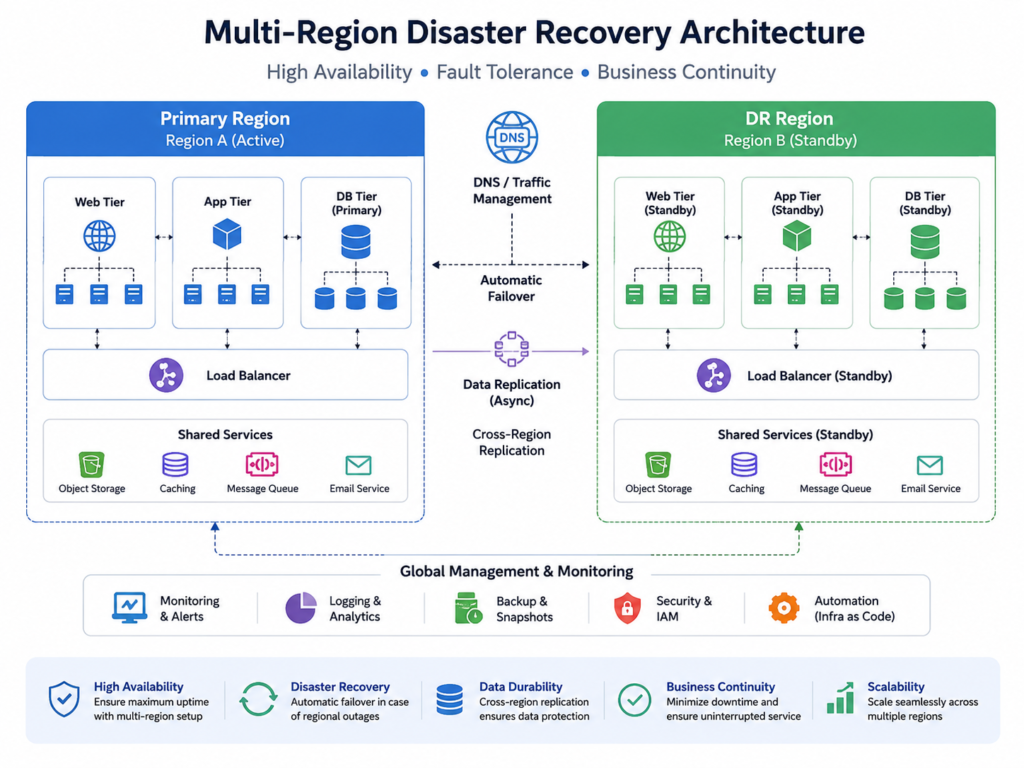
Multi-Region SaaS Without Doubling Every Cost
You do not need to duplicate every component at full production capacity.
Instead, tier the architecture.
Critical databases can remain continuously replicated. Application services can operate at reduced standby capacity. Infrastructure as code can provision additional resources when needed.
Reserve full active-active designs for functions where an outage creates unacceptable business impact.
Organizations operating under strict regional or contractual data-location requirements should also compare DR options against wider sovereign-cloud considerations.
Disaster Recovery Testing, Failover and Failback
A DR plan is credible only when the complete recovery workflow has been tested.
It is not enough to confirm that backups exist.
Applications, data, access controls, networking, dependencies, integrations, available capacity, communication procedures, and failback all need to work together within approved recovery objectives.
What a DR Test Must Validate
A realistic DR exercise should test.
Backup restoration
Replication health
Application startup
Credentials and privileged access
Certificates and secrets
DNS and routing
Network connectivity
Third-party integrations
Data integrity
Security controls
Application performance
Business acceptance
Failback readiness
Actual timings matter.
If a workload has an approved 30-minute RTO but a recovery rehearsal takes 95 minutes, the architecture is not meeting its stated objective regardless of how successful the individual technical steps appeared.
Automating Failover and Recovery Runbooks
Infrastructure as code and recovery orchestration can reduce manual work, configuration drift, and rushed decision-making during an incident.
A useful runbook should identify.
When recovery should be activated
Who can authorize it
Dependency startup order
Automation commands
Manual overrides
Validation checks
Communication owners
Monitoring requirements
Escalation paths
Failback procedures
Security controls must survive the recovery process as well.
Restoring a service by bypassing least-privilege controls or reusing compromised administrator credentials can turn a recovery event into another security problem. Mak It Solutions’ zero-trust guidance provides additional context for protecting access around recovery environments.
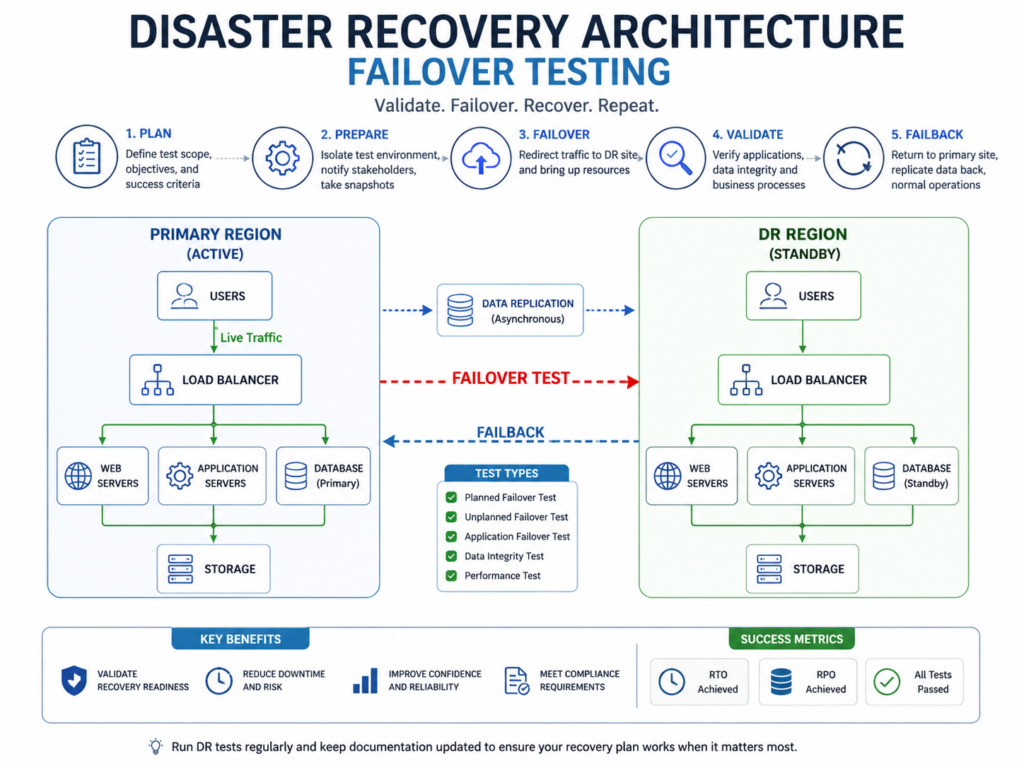
Failback After the Primary Region Recovers
Disaster recovery does not end when traffic reaches the secondary environment.
Before returning to the original production region, teams may need to synchronize changed data, resolve conflicting writes, restore replication in the correct direction, validate capacity, confirm dependencies, and perform a controlled cutback.
Failback deserves the same design attention as failover.
A poorly managed return to production can cause a second outage after the original incident has already been resolved.
DR Compliance and Data Residency in the US, UK and EU
Compliance can affect where recovery data is stored, how it is encrypted, which organizations can access it, how transfers are governed, and what evidence must be retained.
The applicable requirements depend on the workload, organization, contracts, sector, data category, and jurisdiction. Simply selecting a cloud region in a particular country does not automatically make a DR architecture compliant.
United States.
US organizations may recover workloads across regions such as Northern Virginia, Ohio, or Oregon, but regulated information requires additional controls.
Healthcare organizations subject to HIPAA need contingency arrangements for protecting and restoring electronic protected health information.
Payment environments should align their recovery processes with relevant PCI DSS responsibilities, while organizations using SOC 2 reports should ensure that continuity and recovery controls match their documented commitments and operating procedures.
The practical lesson is straightforward: compliance requirements should shape DR architecture before deployment, not appear as an audit task afterward.
UK.
Organizations in London, Manchester, or elsewhere in the UK that process personal information need to consider UK GDPR requirements when a disaster recovery strategy involves international data transfers.
Recovery architecture should therefore identify.
Where primary data resides
Where replicas and backups reside
Who can access recovery copies
Which processors are involved
What happens during cross-border failover
NHS organizations and suppliers may also need to align their recovery processes with applicable healthcare security, continuity, procurement, and contractual requirements.
Germany and EU.
For German organizations, a Disaster Recovery Architektur should connect Wiederherstellungszeit (RTO), Wiederherstellungspunkt (RPO), Hochverfügbarkeit, DSGVO obligations, and Datenresidenz.
Financial entities within the scope of the EU’s Digital Operational Resilience Act also face requirements around ICT business continuity, backup, restoration, recovery, resilience testing, and operational risk management. Regulation (EU) 2022/2554, known as DORA, has applied since 17 January 2025.
A Frankfurt-based financial platform, for example, may choose approved EU recovery locations such as another German region, Dublin, or Paris rather than automatically transferring regulated information outside its required governance boundary.
The architecture must follow the organization’s actual legal and contractual requirements rather than assuming that “multi-region” automatically means “compliant.”
How to Choose the Right Disaster Recovery Architecture
Choose a disaster recovery architecture by starting with business impact, not cloud products.
First determine which workloads matter most, how quickly they must return, how much recent data can be lost, which dependencies are required, which regulations apply, and how much recovery capacity the business can realistically maintain.
Only then should you select the technical pattern.
Architecture Selection Checklist
Evaluate each workload against.
Business impact and criticality
RTO
RPO
Application dependencies
Third-party services
Data residency requirements
Regulatory and contractual obligations
Cloud, hybrid, and on-premises topology
Region-wide outage scenarios
Ransomware and destructive-event scenarios
Identity and credential recovery
Internal operational skills
Testing requirements
Recovery capacity
Budget
For broader implementation support, Mak It Solutions’ services portfolio covers software, mobile, e-commerce, analytics, and other digital environments where resilience may need to be built directly into application architecture.
Common DR Architecture Mistakes to Avoid
Common mistakes include.
Assuming backups equal disaster recovery
Leaving hidden single-region dependencies
Forgetting DNS or identity systems
Storing runbooks somewhere unavailable during an outage
Under-provisioning recovery capacity
Ignoring cloud control-plane dependencies
Overengineering active-active environments
Failing to protect administrator access
Testing failover but never failback
Treating all workloads as equally critical
Customer-facing applications also deserve dependency mapping.
Businesses relying on a mobile application estate need to include APIs, authentication, push services, databases, payment integrations, and other services supporting the mobile experience.
When to Build Internally vs Use DRaaS or Specialists
An internal approach makes sense when your team already has strong capabilities across cloud architecture, networking, databases, automation, security, compliance, and around-the-clock operations.
Disaster Recovery as a Service (DRaaS) or specialist support may be more practical when.
Environments span several technologies
Internal recovery expertise is limited
Audit evidence is important
Recovery testing needs to be frequent
Automation is difficult to build internally
Operational ownership is unclear
A useful test is simple.
Who can successfully recover the business during an overnight regional outage when the normal production environment and some of its supporting services are unavailable?
If the answer is unclear, the DR design probably needs more work.
Final Thoughts
The best disaster recovery architecture is not automatically the most expensive or technically sophisticated pattern.
It is the architecture that can reliably restore the right workloads within their approved RTO and RPO while keeping cost, compliance, security, and operational complexity under control.
For some systems, that means backup and restore. For others, pilot light or warm standby provides a stronger balance. Only workloads where even a short interruption creates unacceptable impact may justify active-active operations.
Not sure whether your current recovery design can actually meet its targets during a regional outage?
Explore Mak It Solutions or request a scoped architecture review to assess workload criticality, dependencies, recovery regions, compliance constraints, and testing gaps before investing in additional standby infrastructure.( Click Here’s )
Key Takeaways
Disaster recovery architecture should be selected according to business impact, RTO, RPO, compliance, dependencies, and cost—not technology preference.
Backup and restore minimizes standby cost but normally results in slower recovery.
Pilot light and warm standby progressively reduce recovery time by maintaining more infrastructure in the recovery environment.
Active-active can provide extremely fast recovery but introduces greater cost and operational complexity.
Multi-region DR does not require duplicating every production resource at full capacity.
US, UK, German, and EU deployments need to account for applicable privacy, sector, transfer, resilience, and audit requirements.
Backups alone do not prove recoverability.
A DR architecture becomes credible only after successful failover and failback testing.
FAQs
Q : How often should a disaster recovery architecture be tested?
A : Testing frequency should reflect workload risk and business criticality. Critical services generally need more frequent exercises, and recovery should also be retested after significant infrastructure, identity, networking, database, or application changes.
The exercise should validate actual RTO and RPO performance, application dependencies, access, data integrity, failover, and failback not merely confirm that a backup can be restored.
Q : Can disaster recovery use a different cloud provider than production?
A : Yes. Production can run on one provider while recovery uses another cloud, private infrastructure, colocation, or an on-premises environment.
However, multi-cloud DR introduces additional complexity around networking, identity, tooling, skills, data transfer, automation, observability, and application portability. Organizations should compare those costs with a simpler cross-region strategy inside a single cloud.
Q : Does cross-region replication satisfy GDPR data residency requirements?
A : Not automatically.
Replication explains how data is copied, not whether the resulting architecture complies with GDPR or other applicable rules. Compliance depends on where replicas are stored, what personal information is involved, which processors can access it, contractual safeguards, and whether an international transfer occurs.
Q : What dependencies are commonly missed in a DR plan?
A : Frequently overlooked dependencies include DNS, identity providers, certificates, secrets, CI/CD systems, API gateways, network routes, monitoring tools, payment services, third-party integrations, licensing systems, and administrator access.
A dependency map should therefore be part of every disaster recovery architecture review.
Q : When is active-active disaster recovery worth the cost?
A : Active-active is most appropriate when even a short interruption would create unacceptable financial, safety, customer, operational, or regulatory impact.
For many ordinary business applications, warm standby provides a more practical balance between recovery speed and cost.