
Arabic English Website SEO: GCC Structure Guide
Arabic English Website SEO: GCC Structure Guide
Arabic English Website SEO: GCC Structure Guide
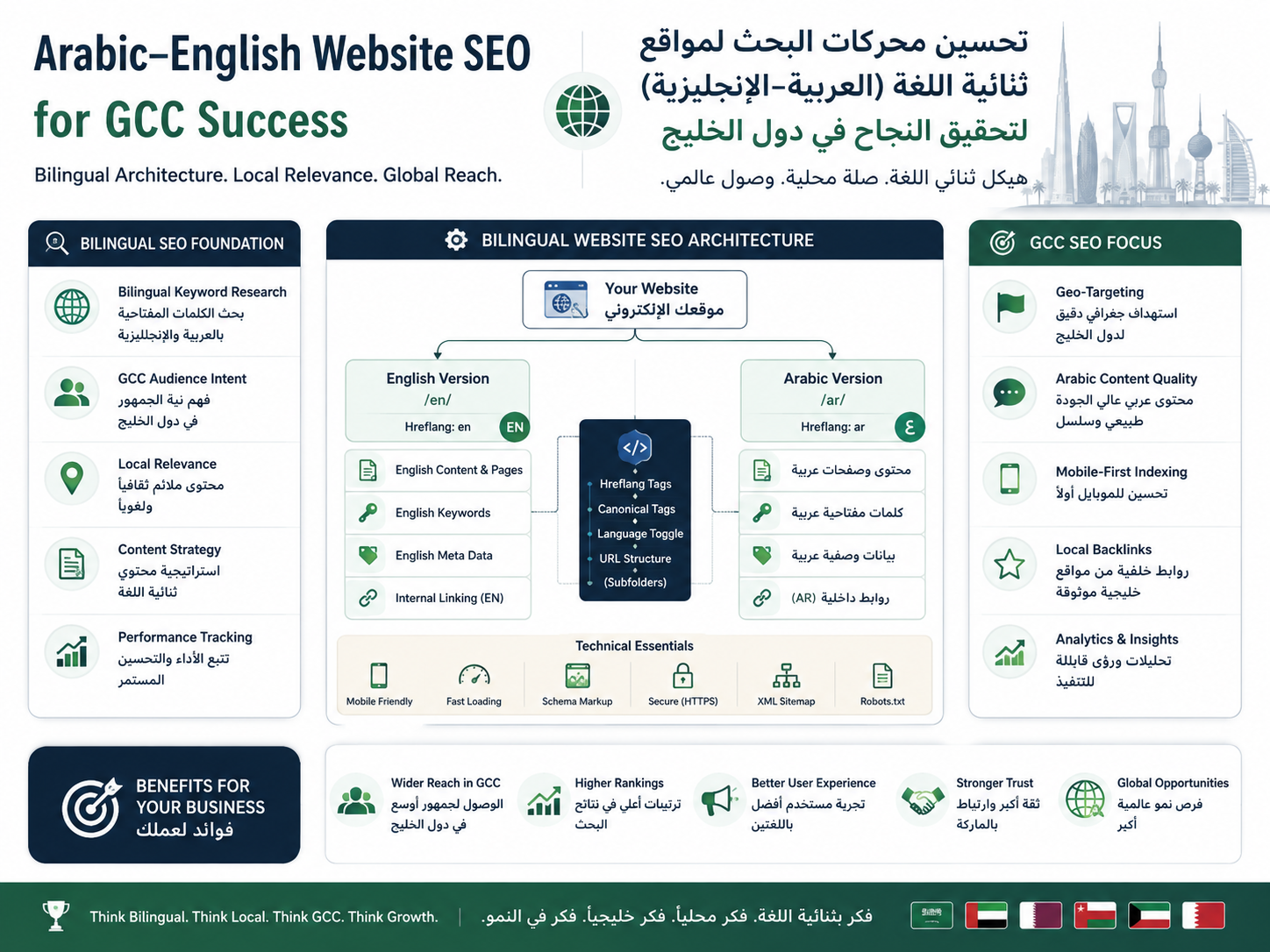
Arabic English website SEO works best when Arabic and English content lives on separate, crawlable URLs, uses accurate hreflang, and has self-referencing canonicals. For Saudi Arabia, the UAE, and Qatar, country-specific versions make sense only when regulations, offers, terminology, pricing, or customer journeys genuinely differ.
A bilingual website can read perfectly in both languages and still send mixed signals to search engines. The issue is usually not translation quality. It is the architecture behind the content.
For businesses serving Riyadh, Jeddah, Dubai, Abu Dhabi, Doha, or the wider GCC, effective Arabic English website SEO connects technical SEO with real localization. That means giving search engines clear signals while making the Arabic and English experience equally useful for people.
For implementation support, Mak It Solutions’ SEO services cover technical and on-page optimization for multilingual websites.
What Is Arabic English Website SEO in the GCC?
Arabic English SEO is the process of helping search engines understand which Arabic and English pages belong together, which audiences they serve, and which version should appear for a particular searcher.
It goes beyond translating English copy into Arabic.
A properly localized GCC website may also need.
RTL-friendly Arabic layouts
Natural Arabic terminology rather than literal translation
Consistent language navigation
Localized calls to action
Market-specific offers or compliance information
Correct hreflang and canonical implementation
A strong bilingual experience also depends on the site itself. Professional web design services can help maintain responsive Arabic and English interfaces without treating one language as an afterthought.
Multilingual SEO vs International SEO
The terms are related, but they are not identical.
Multilingual SEO primarily targets different languages. A GCC website with shared content might therefore use one English version and one Arabic version.
International SEO can go further by targeting individual countries or regions. A business with genuinely different Saudi, UAE, and Qatar offerings may need separate country-language pages.
The key word is genuinely. Creating a new page only to swap one city name for another rarely creates meaningful localization.
Why One Dynamically Changing URL Can Cause Problems
Avoid serving completely different Arabic and English content from the same URL based only on browser language, IP address, or automatic redirects.
Google recommends using separate URLs for language versions and making alternative versions accessible to both users and crawlers. Forced redirects can make those alternatives harder to discover.
See Google Search Central’s guidance on managing multi-regional and multilingual sites.
What Is the Best URL Structure for Arabic English Website SEO?
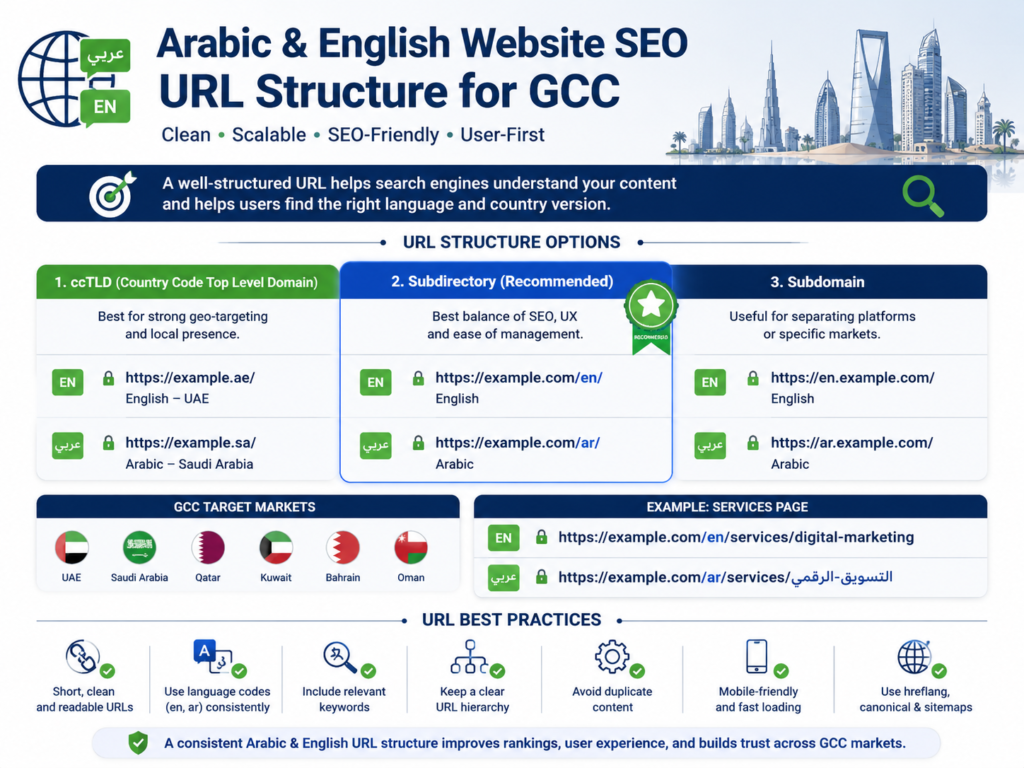
For many Arabic English website SEO projects in the GCC, a straightforward language-folder structure is the cleanest place to begin
This keeps both languages under the same primary domain, centralizes authority, and is usually easier to manage than creating separate properties.
Businesses planning a broader digital build can also review Mak It Solutions’ technology services.
When and Are Enough
Use shared English and Arabic folders when the same products, services, pricing logic, and customer journey apply across your GCC audience.
A regional software company, for example, may not need separate Saudi and UAE versions if customers in both markets receive essentially the same service and information.
In that case, additional country pages can create more maintenance work without improving the user experience.
When Saudi, UAE, and Qatar Need Separate URLs
Country-language URLs become more useful when localization affects the substance of the page.
Consider this level of localization when markets differ in areas such as.
Regulatory requirements
Products or service availability
Pricing or currencies
Payment options
Legal messaging
Arabic terminology
Contact or sales processes
Country-specific customer needs
Do not create separate versions simply because a brand wants landing pages containing “Riyadh,” “Dubai,” and “Doha.”
Subfolders, Subdomains, or Country Domains?
For centralized GCC brands, subfolders are often the simplest structure.
Subdomains can still be appropriate when teams, platforms, or operations need stronger separation. Country-specific domains may suit businesses operating as substantially independent entities in each market.
There is no universal structure that fits every company. The right choice depends on how different the underlying business experience actually is.
How Should Hreflang Work for Arabic and English Pages?
Correct hreflang helps Google connect equivalent localized pages and show the version most relevant to a searcher.
For Arabic English website SEO, each equivalent page should identify itself and its corresponding alternatives.
Google also expects reciprocal relationships between localized pages. If the English page references the Arabic version, the Arabic version should reference the English page as well.
Google’s localized versions documentation explains the supported implementation in detail.
Should You Use and or Country-Specific Hreflang?
Use generic language targeting such as and when the same content serves users across multiple GCC markets.
Use country-language combinations such as and their English equivalents when those pages genuinely target specific countries.
The URL structure and hreflang setup should reflect the actual content strategy rather than creating regional variants purely for SEO.
Reciprocal and Self-Referencing Hreflang
A basic shared-language implementation can look like this
The equivalent Arabic page should contain the same relationship set.
Consistency matters. Missing return links, incorrect codes, or annotations pointing to the wrong URLs can weaken the signal you are trying to create.
When to Use X – default
X – default is useful when you need a fallback page for visitors who do not match the language or regional versions you have specified.
A global homepage or country-and-language selector is a common use case.
How Do Canonicals, Sitemaps, and Hreflang Work Together?
Hreflang and canonical tags solve different problems.
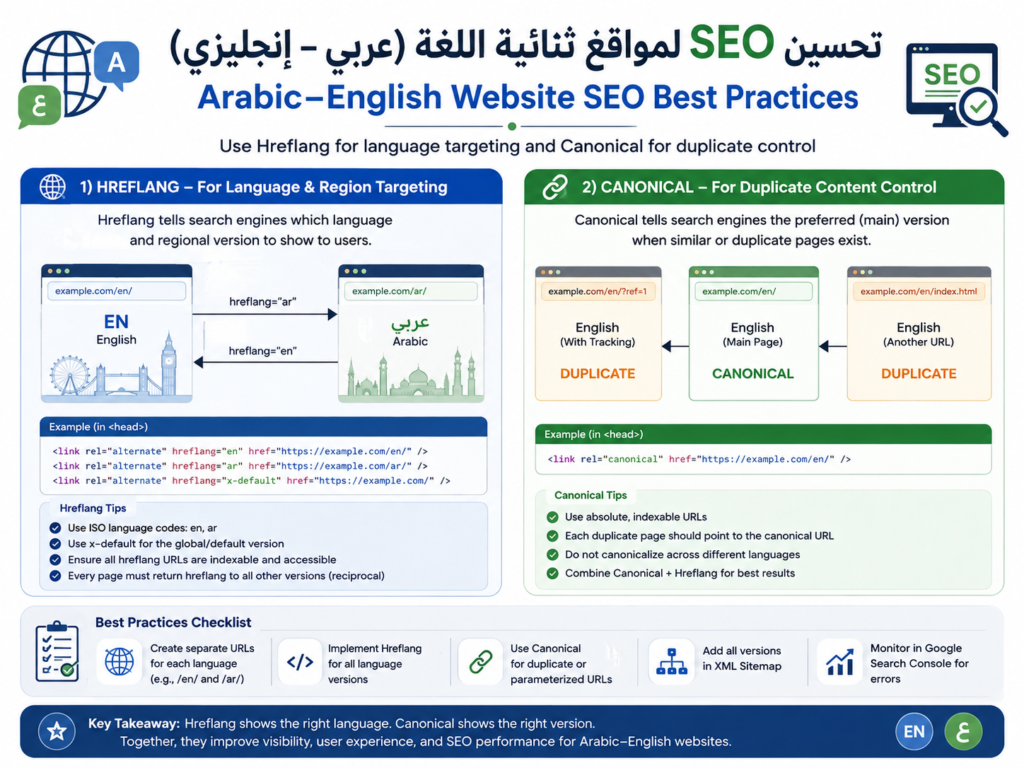
Hreflang explains the relationship between localized alternatives. Canonical tags tell search engines which URL should be treated as the preferred version of a particular page.
Those signals should work together rather than contradict each other.
Self-Canonicalize Arabic and English Pages
If both language versions are legitimate pages intended for indexing, each should normally canonicalize to itself.
Avoid automatically canonicalizing the Arabic page to the English page just because the topics are equivalent. Doing so can undermine the purpose of maintaining an independently indexable Arabic version.
HTML vs XML Sitemap Hreflang
Google supports hreflang through HTML, HTTP headers, or XML sitemaps.
You do not gain an SEO advantage simply by choosing the most technically complicated option. Use the method your development and SEO teams can maintain accurately over time.
Reliability is more valuable than unnecessary complexity.
Make Language Navigation Crawlable
Your Arabic-English switcher should use normal crawlable links that connect equivalent pages.
Avoid depending entirely on automatic IP or browser-language redirects.
For more complex bilingual interfaces, strong front-end development can help keep navigation, responsive behavior, and RTL/LTR experiences consistent.
When Does GCC Localization Need Country-Specific Content?
Country targeting should follow business reality.
Saudi Arabia, the UAE, and Qatar may share many commercial similarities, but regulations, terminology, payment expectations, offers, and customer journeys can still differ by market.
Those differences are what justify deeper localization.
Saudi Arabia.
A fintech company serving Riyadh, for example, may need Saudi-specific onboarding language, Arabic terminology, and regulatory information.
The Saudi Central Bank oversees the Kingdom’s financial sector, making country-specific content particularly relevant when a service falls within regulated financial activities.
In such cases and can represent a real user difference rather than an SEO tactic.
UAE.
A company serving Dubai or Abu Dhabi may need UAE-specific commercial information, legal messaging, offers, or customer flows.
For digital businesses, the UAE Telecommunications and Digital Government Regulatory Authority is one example of a country-specific authority that may matter depending on the service.
An online retailer may also need a localized storefront, payment experience, and Arabic interface. Mak It Solutions’ e-commerce development services support those types of digital journeys.
Qatar.
A Doha-based fintech or SME does not automatically need and pages.
They become more useful when Qatar-specific payment requirements, regulations, offers, terminology, or service processes make the content meaningfully different.
For financial businesses, the Qatar Central Bank is an important country-specific source for relevant regulatory information.
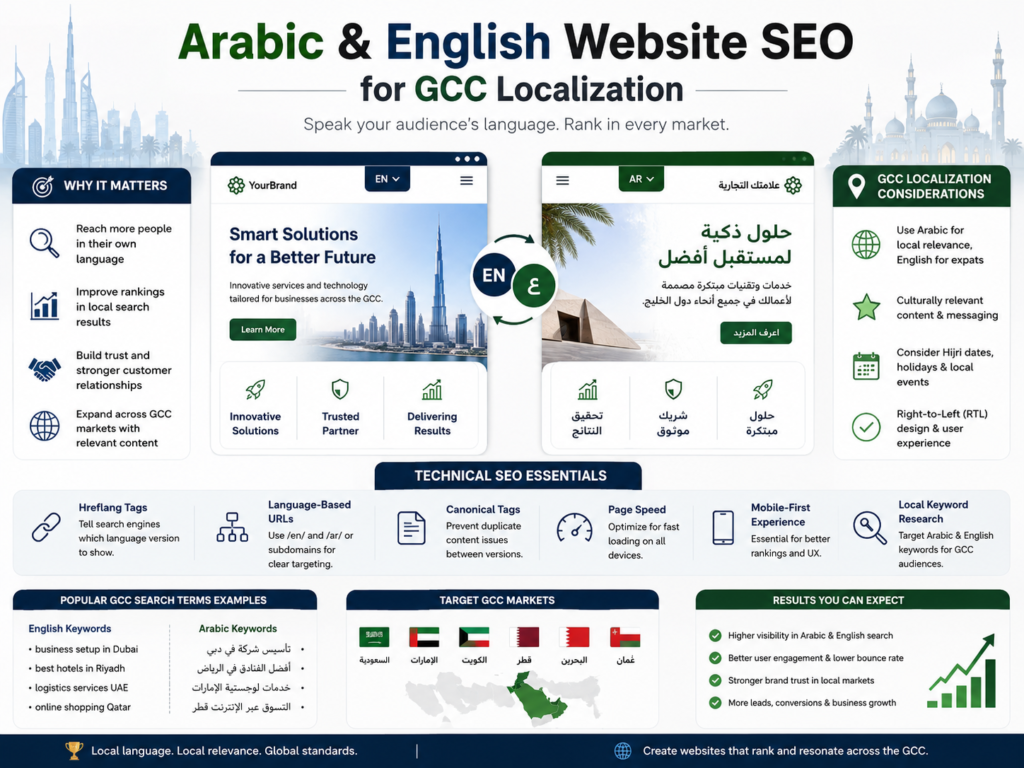
Common Arabic-English SEO Mistakes GCC Websites Make
Creating Thin Saudi, UAE, and Qatar Variants
Replacing “Riyadh” with “Dubai” or “Doha” is not meaningful localization.
A country page should give the visitor something genuinely different: local requirements, pricing, services, support details, regulations, terminology, or another market-specific benefit.
Canonicalizing Arabic Pages to English
Arabic content intended to appear in search should generally remain a standalone localized page.
Connecting Arabic and English versions through hreflang is different from declaring the English version canonical for both.
Using Incorrect Hreflang Codes
Check language-country order carefully and make sure every destination works.
Also verify.
Self-referencing annotations
Reciprocal return links
Correct localized URLs
Matching canonical signals
No unnecessary redirects
Small implementation mistakes can make an otherwise sensible multilingual architecture much harder for search engines to interpret.
Treating Translation as Localization
Literal translation can produce technically correct Arabic that still feels unnatural.
Review Arabic navigation, headings, forms, CTAs, terminology, and RTL rendering from the user’s perspective. Localization should make the experience feel intentional, not copied from the English site.
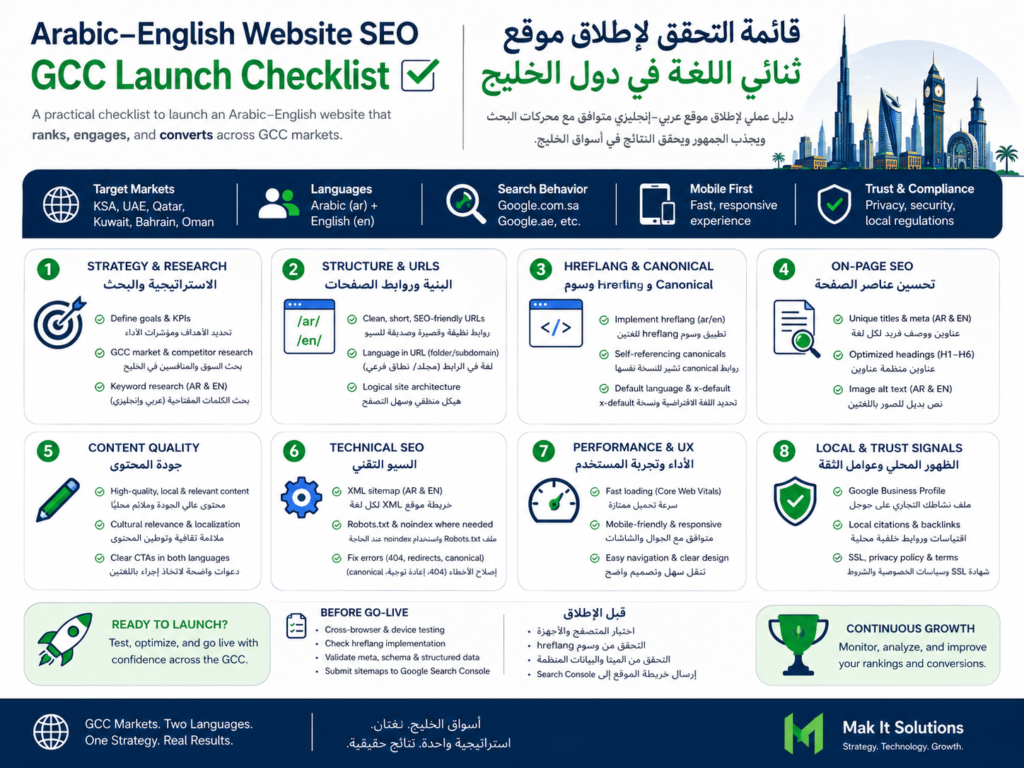
Arabic English Website SEO Checklist for GCC Launches
Choose the Right Architecture
Decide whether shared and folders are enough or whether Saudi Arabia, the UAE, or Qatar genuinely needs a country-specific experience.
Map Equivalent Pages Before Launch
Keep a clear mapping of every Arabic and English equivalent, including.
Final URLs
Canonical URLs
Hreflang annotations
Redirects
Language-switcher destinations
This is easier to fix before launch than after hundreds of localized URLs have gone live.
Validate Arabic UX
Test the actual Arabic experience across desktop and mobile.
Check RTL rendering, menus, buttons, forms, currencies, CTAs, spacing, and regional terminology.
If your customer journey continues into an app, mobile app development should follow the same localization principles.
Keep SEO and Marketing Aligned
Technical localization cannot compensate for weak content, and localized copy cannot compensate for confusing architecture.
Treat SEO, Arabic UX, content, and digital marketing as parts of the same GCC growth strategy.
Concluding Remarks
The strongest Arabic English website SEO strategy usually starts simple: separate and URLs, clear hreflang relationships, self-referencing canonicals, and a genuinely usable Arabic experience.
Add Saudi, UAE, or Qatar versions only when the market changes what the customer actually sees or needs.
That approach keeps your architecture cleaner, reduces thin duplication, and gives both users and search engines clearer signals.
Need help planning or restructuring a bilingual GCC website? Contact Mak It Solutions to discuss an Arabic English website SEO strategy for Saudi Arabia, the UAE, Qatar, or the wider GCC.
FAQs
Q : What is the best URL structure for an Arabic and English website?
A : For most bilingual GCC websites, separate subfolders such as and are a clean and manageable option. If Saudi Arabia, the UAE, or Qatar has genuinely different services, regulations, pricing, or content, country-specific structures such as or may be more appropriate.
Q : Does hreflang help Arabic pages rank better in Google?
A : Hreflang does not directly improve rankings. Its main purpose is to help Google understand the relationship between Arabic, English, and country-specific versions so it can show the most relevant page to the right audience.
Q : Can Arabic and English pages have the same content?
A : They can cover the same topic, but the Arabic version should be properly localized rather than translated word for word. Headings, calls to action, terminology, layout, and user intent may need adjustment to create a natural Arabic experience.
Q : Should Arabic and English pages target the same SEO keywords?
A : Not always. Arabic-speaking and English-speaking users may search for the same service using different phrases, terminology, and levels of detail. Keyword research should therefore be carried out separately for Arabic and English instead of simply translating English keywords.
Q : How do I know if Saudi Arabia, UAE, and Qatar need separate SEO pages?
A : Create separate country pages when users in each market receive meaningfully different information, such as local regulations, prices, payment options, products, terminology, or service processes. If the same content serves all three markets, a shared Arabic and English structure is usually cleaner and easier to maintain.