
Google AI Overviews Optimization for GCC Brands
Google AI Overviews Optimization for GCC Brands
Google AI Overviews Optimization for GCC Brands
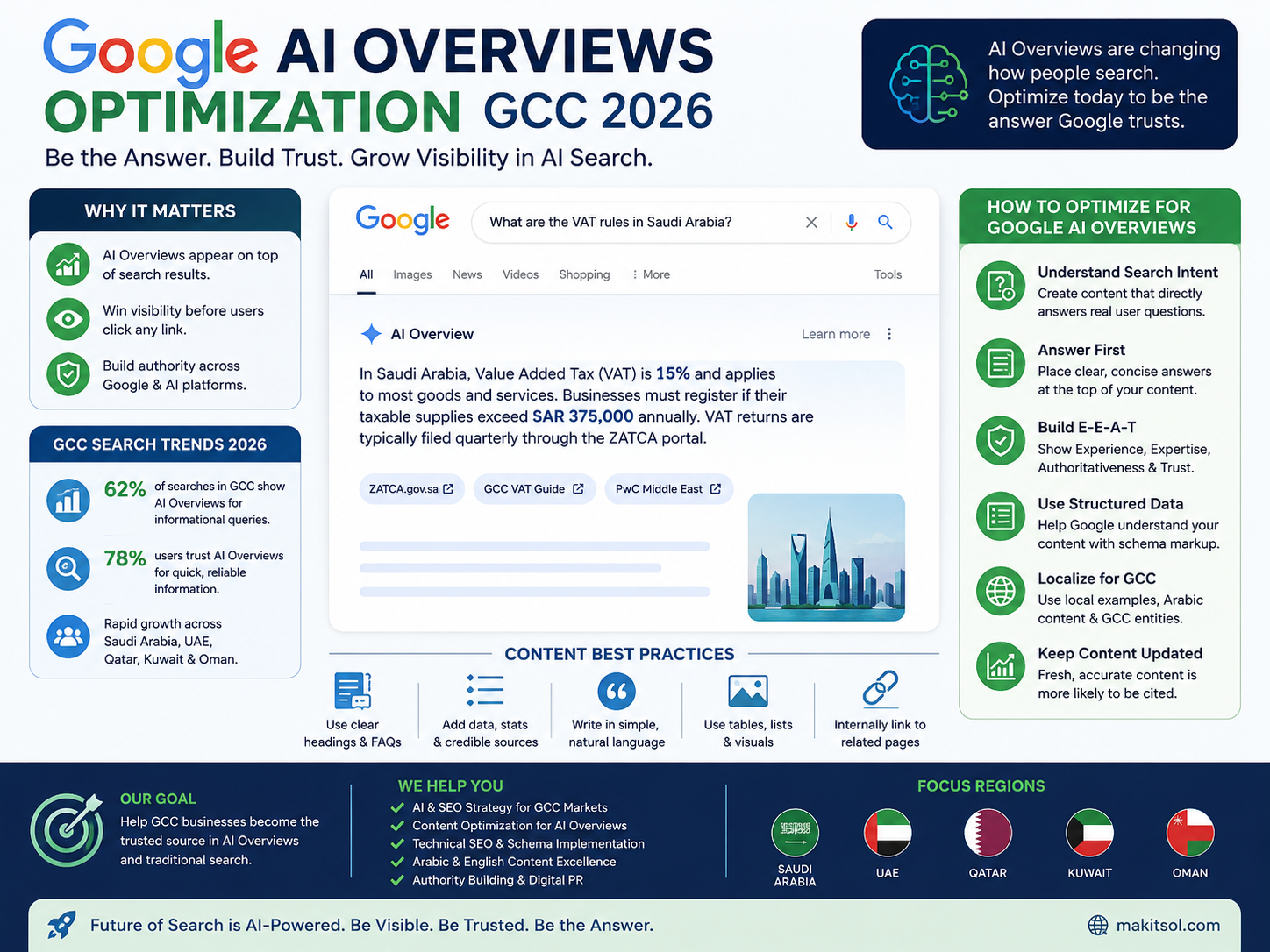
Google AI Overviews optimization is not about replacing SEO with a new set of tricks. For GCC businesses, the practical goal is to make content easier for Google to discover, understand, trust, and surface in generative search—while adding credible Saudi, UAE, and Qatar context that generic global content often lacks.
Google’s 2026 guidance reinforces this point: established SEO practices remain relevant to AI Overviews and AI Mode, with an emphasis on technical accessibility, useful content, originality, and reliable information rather than unsupported “GEO hacks.”
For companies in Riyadh, Dubai, Abu Dhabi, and Doha, that creates a straightforward opportunity: keep the SEO foundations strong, then improve answer clarity, evidence, entity signals, localization, and measurement.
What Is Google AI Overviews Optimization?
Google AI Overviews optimization is the process of improving a website so its content is useful and understandable within Google’s generative Search experiences, including AI Overviews and AI Mode.
It overlaps heavily with traditional SEO. Google itself describes optimization for generative Search as an extension of SEO rather than a completely separate discipline.
How AI Overviews Change the Search Experience
Traditional search results encourage users to open several links and investigate a topic themselves. Generative experiences can provide an AI-generated response supported by links to relevant web resources.
That makes rankings important, but it also puts more pressure on content clarity, originality, trust, and the ability to answer specific questions well.
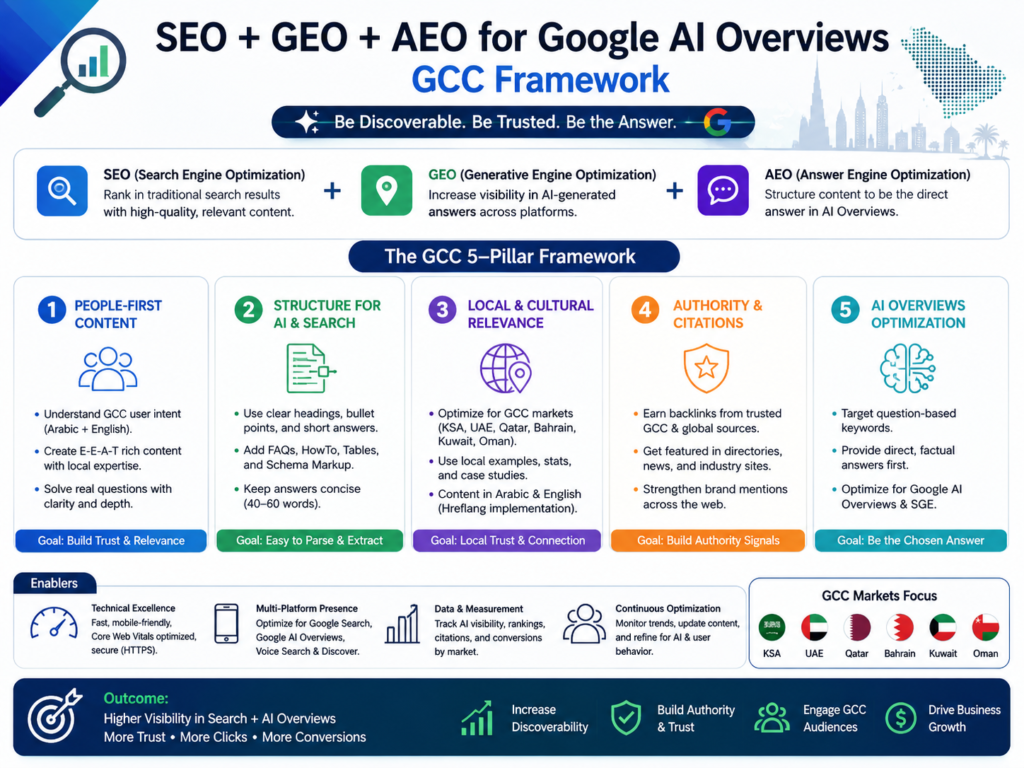
Where SEO, AEO, and GEO Overlap
SEO, AEO, and GEO describe slightly different priorities, but they should not be treated as isolated strategies.
Google’s current guidance is clear that foundational SEO still matters for generative Search. Crawlability, useful pages, internal linking, technical quality, and people-first content remain central.
For businesses that need to strengthen those fundamentals first, Mak It Solutions’ SEO services can support the technical and content foundation behind a broader AI-search strategy.
Why This Matters in Riyadh, Dubai, and Doha
A Riyadh fintech competing for high-trust financial queries has different content requirements from a Dubai e-commerce company serving multilingual buyers or a Doha B2B company building regional authority.
Simply inserting city or country names into generic copy is not meaningful localization. The page needs to show that the business understands the market, terminology, regulations, buyer questions, and operating environment.
Make Content Easier for AI to Understand
Lead Important Sections With Direct Answers
When a section is built around a clear question, answer it immediately.
Avoid forcing readers to move through several paragraphs of background before reaching the point. Start with a concise, self-contained answer, then expand with explanation, examples, evidence, and limitations.
This improves the page for human readers first. It also gives search systems a clearer passage to interpret when trying to understand what the page says.
Organize Content Around Questions and Subtopics
Repeating the same keyword in every heading is not a modern content strategy.
Build each page around the connected questions a genuine buyer or decision-maker needs answered. For example, a topic cluster around AI search might naturally connect.
Google AI Overviews optimization
Technical SEO
Content strategy
Entity clarity
Digital PR and authority
Analytics
Conversion tracking
Mak It Solutions’ digital marketing resources can sit naturally within that broader topic structure.
Keep Arabic and English Entity Information Consistent
Bilingual GCC websites should tell the same factual story in both languages.
Company names, locations, services, leadership information, credentials, product terminology, and contact details should remain consistent even when the wording is localized for Arabic or English readers.
The goal is not identical translation. It is consistent identity with market-appropriate language.
Strengthen Evidence, Authority, and Originality
Replace Commodity Content With Original GCC Insight
Generic definitions are easy to reproduce. Original expertise is harder to replace.
Instead of publishing another broad explanation of “fintech SEO” or “AI marketing,” add material that comes from the organization itself, such as.
Expert commentary
Common customer questions
Internal processes
Screenshots or demonstrations
Original comparisons
First-party benchmarks where available
Market-specific implementation considerations
For example, a Riyadh fintech could explain how its editorial review process handles regulated financial claims rather than publishing another generic definition of financial-services SEO.
Google’s current guidance specifically emphasizes helpful, reliable, people-first content and encourages content that offers value beyond easily reproduced information.
Support Important Claims With Authoritative Sources
The more sensitive the claim, the stronger the evidence should be.
For Saudi financial-services content, that may mean referencing the Saudi Central Bank when discussing requirements that fall within its remit. SAMA has issued instructions emphasizing protection of customers’ personal data by supervised financial institutions.
Likewise, UAE or Qatar content should use the relevant local regulator when the subject genuinely requires it.
The important word is relevant. Adding regulator names merely to create SEO associations does not improve a weak article.
For teams dealing with broader AI accountability questions, Mak It Solutions‘ AI governance guide for GCC SMEs is a useful related resource.
Make Author and Organization Identity Clear
Readers should be able to understand who created the content and why they should trust it.
Where appropriate, include.
A genuine author or editorial team
Relevant expertise
Company information
Editorial responsibility
Geographic operating context
Clear service and contact information
Do not manufacture biographies, credentials, or first-hand experience simply to make a page appear more authoritative.
Trust signals work best when they reflect reality.
Build Stronger GCC Topic and Entity Signals
Connect Related Pages Into a Clear Topic Cluster
A strong article should not sit alone.
Use contextual internal links to connect supporting resources so users—and search systems—can understand how topics relate to one another.
Useful destinations may include.
AI Governance Policy for GCC SMEs
Internal links should help the reader continue the journey. They should not be inserted simply to increase link counts.
Localize Examples for Saudi Arabia, UAE, and Qatar
Good localization changes the usefulness of the page.
A Saudi fintech discussing customer-data practices can refer to applicable Saudi requirements instead of relying only on international examples.
A Dubai e-commerce company may need to think about Arabic and English buying journeys, mobile-first product discovery, regional terminology, and location-specific landing pages.
A Doha technology business discussing infrastructure can consider locally available cloud options. Google Cloud operates a Doha region, giving organizations in Qatar access to locally located Google Cloud infrastructure.
These are useful local signals because they change the substance of the content not because the words “Saudi Arabia,” “UAE,” or “Qatar” appear more often.
Protect the SEO Foundations AI Search Still Needs
AI-search visibility cannot compensate for a site that Google struggles to crawl, index, or understand.
Maintain Crawlability and Indexing
Keep the technical basics healthy.
Logical site architecture
Accessible page content
Descriptive navigation
Sensible internal linking
Indexable important pages
Correct canonicalization
Appropriate robots controls
Google continues to position these foundational SEO practices as relevant to visibility across Search, including its generative experiences.
Keep Structured Data Accurate
Structured data should describe information that genuinely exists on the page.
Google advises site owners to keep structured data consistent with visible content. Adding markup simply because it sounds “AI optimized” is not a substitute for useful information.
Depending on the page, appropriate schema may include Organization, Person, Product, Article, or other supported types.
Ignore Unsupported GEO Hacks
GCC marketers should be cautious when a tactic is presented as a secret shortcut into AI Overviews.
Google says publishers do not need special AI-specific files or markup such as to appear in its generative Search experiences. It also warns against pursuing artificial or inauthentic mentions simply to influence visibility.
Focus on making the website genuinely useful and technically accessible instead.
Measure AI Visibility Beyond Rankings
Traditional rankings still matter, but they no longer tell the whole story.
Use Search Console for Generative AI Performance
Google Search Console now provides a Generative AI performance report covering impressions associated with AI Overviews and AI Mode.
That gives SEO teams a more direct way to understand how content is being discovered through Google’s generative Search experiences.
Combine that information with established performance metrics such as.
Search impressions
Clicks
Landing-page performance
Branded search demand
Leads
Sales opportunities
Conversion performance
Monitor How Your Brand Is Represented
Reporting tools only show part of the picture.
Periodically review commercially important searches and ask.
Does the company appear in relevant generative results?
Which competing brands or publishers are cited?
Are products and services represented accurately?
Are outdated claims appearing?
Which sources seem to shape the answer?
Which important questions does your own content still fail to answer?
This is less about chasing every AI-generated mention and more about identifying content and reputation gaps.
Connect AI Visibility to GCC Business Outcomes
Being mentioned by an AI result is not a commercial strategy on its own.
A Saudi, UAE, or Qatar business ultimately needs to know whether stronger search visibility contributes to qualified enquiries, demos, opportunities, sales, or other meaningful outcomes.
Where attribution becomes complex, business intelligence services can help connect marketing visibility with wider commercial reporting.
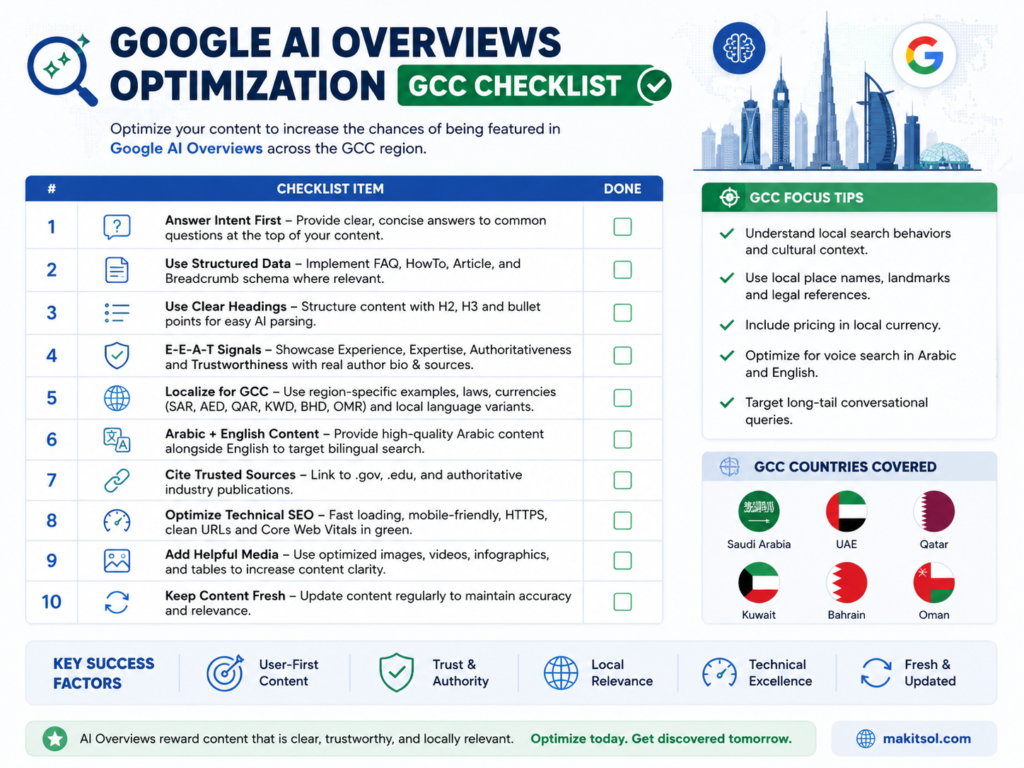
GCC Google AI Overviews Optimization Checklist
Content Readiness
Put clear answers near important question-based headings.
Add original GCC examples, expert insight, or first-party evidence.
Support material or regulated claims with appropriate primary sources.
Entity and Regional Readiness
Keep Arabic and English business information consistent.
Show genuine Saudi, UAE, or Qatar context where relevant.
Make authorship, expertise, and company identity easy to verify.
Technical and Measurement Readiness
Check crawlability, indexing, structured data, and internal links.
Monitor generative-search visibility alongside leads, conversions, and Search Console performance.
To Sum Up
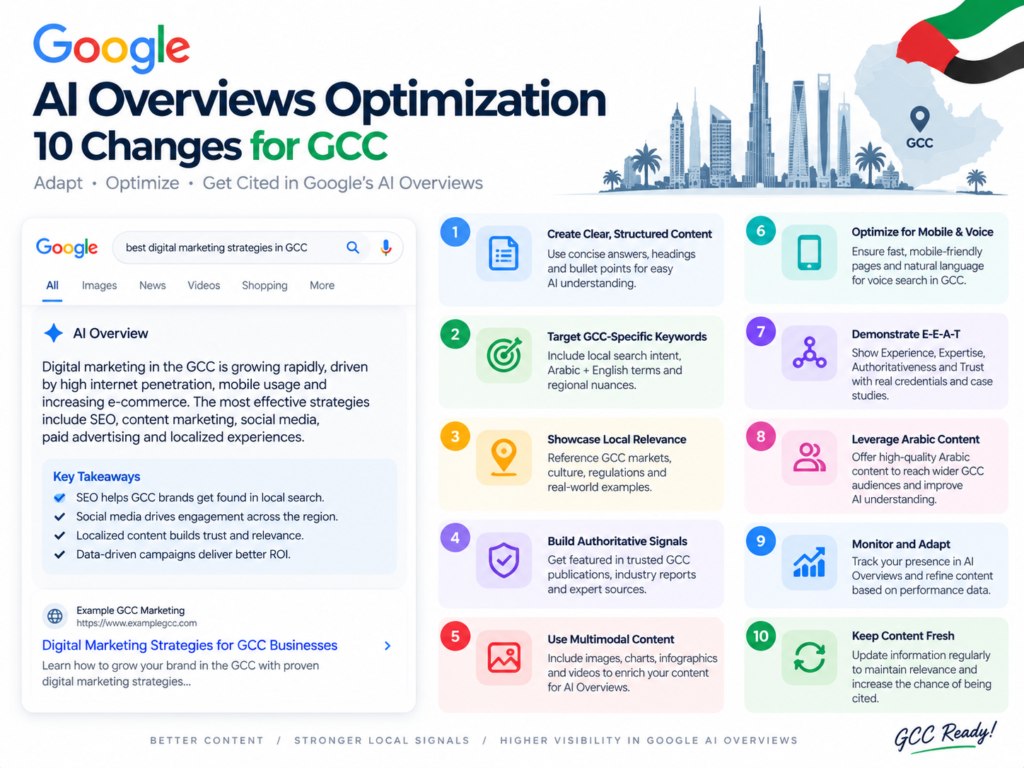
Google AI Overviews optimization in 2026 is best treated as an evolution of good SEO not a replacement for it.
For GCC brands, the strongest approach combines technically sound pages, direct answers, original expertise, trustworthy evidence, clear entity information, thoughtful Arabic-English localization, and measurement tied to actual business outcomes.
Saudi, UAE, and Qatar companies do not need to chase every new GEO tactic. They need content that is genuinely easier to understand, verify, and trust.
If you want to assess how well your current website is prepared for generative Search, contact Mak It Solutions for a tailored Google AI Overviews optimization and content-readiness review.
FAQs
Q : Do Saudi businesses need separate GEO strategies for Arabic and English?
A : Not completely separate strategies. The core identity of the company—services, locations, expertise, products, and credentials should stay consistent, while terminology, examples, search intent, and language can be localized for each audience.
For regulated industries, translated claims should also preserve their original meaning and remain aligned with applicable local requirements.
Q : Can UAE companies optimize one page for AI Overviews and traditional SEO?
A : Yes. A useful page can support both traditional search visibility and generative Search visibility.
Google’s guidance continues to treat foundational SEO as relevant to AI Overviews and AI Mode, so UAE companies should focus on search intent, clear answers, useful evidence, strong internal linking, technical accessibility, and genuinely relevant local context rather than building artificial “AI SEO” pages.
Q : Should Qatar businesses cite QCB or other local authorities?
A : Yes when the authority directly supports the subject being discussed.
A Doha financial-services company may need Qatar Central Bank sources for relevant regulatory claims, while an unrelated software article should not insert QCB references merely for entity association. Authority works best when it verifies something the reader genuinely needs to know.
Q : Does a Dubai business need special schema for Google AI Overviews?
A : No special “AI Overview schema” is required.
Google says sites do not need new AI-specific markup or machine-readable files to participate in its generative Search experiences. Use normal structured data where appropriate, and make sure it accurately reflects visible page content.
Q : How often should GCC brands update AI-search content?
A : There is no universal publishing interval.
Update important pages when regulations, products, evidence, market conditions, customer questions, or search intent materially change. Meaningful improvements are more valuable than changing a date or rewriting a few sentences simply to make a page appear fresh.