


Arabic AEO: Smarter AI Visibility for GCC Brands
Arabic AEO: Smarter AI Visibility for GCC Brands
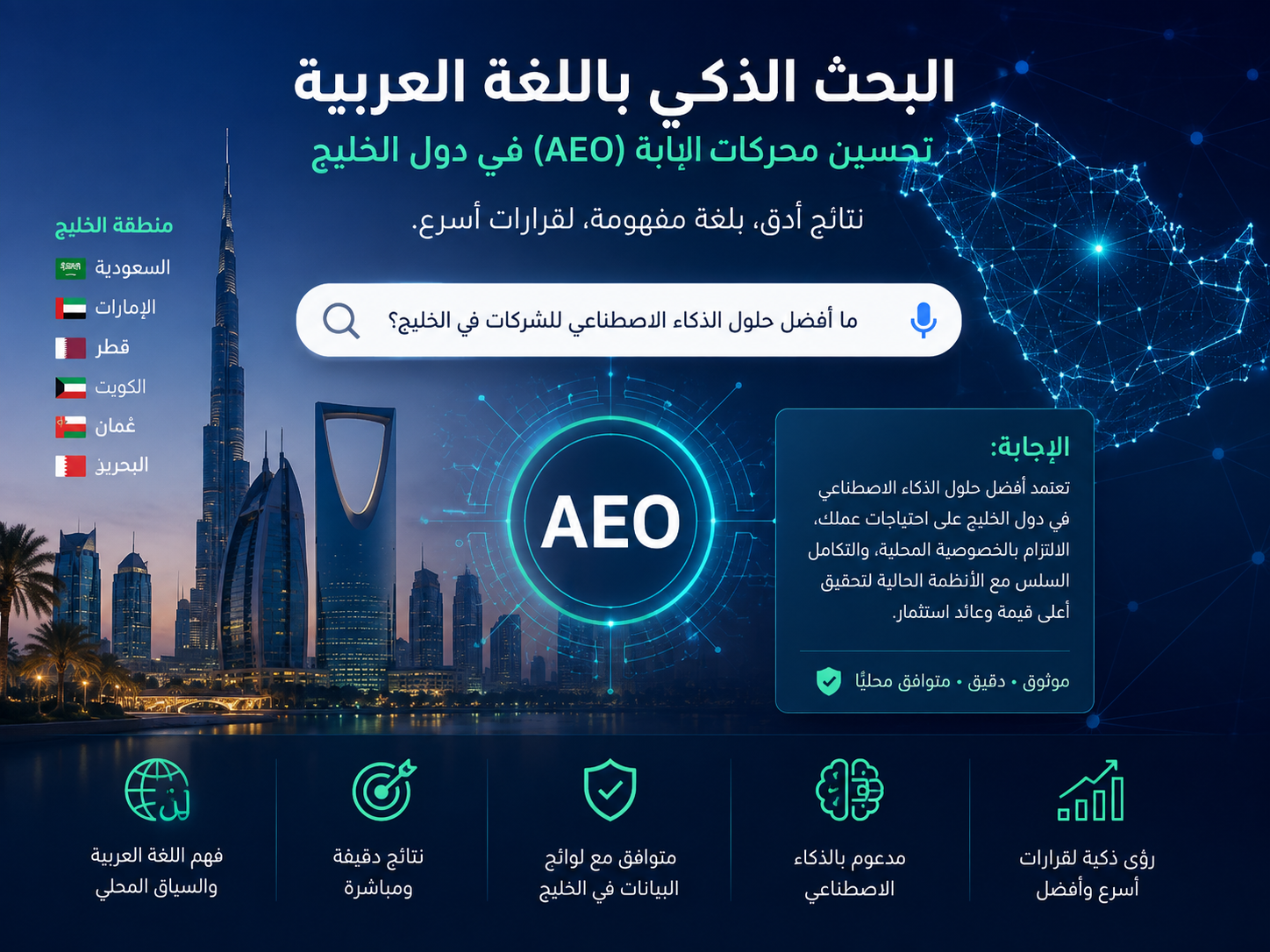
Arabic AEO: Smarter AI Visibility for GCC Brands
Arabic AEO helps brands structure Arabic and bilingual content so search engines and AI systems can quickly understand the question, extract a clear answer, recognize trusted entities, and connect the information to the right GCC market.
For businesses in Saudi Arabia, the UAE, and Qatar, effective Arabic AEO is not about chasing “AI citation hacks.” It combines solid SEO, answer-first writing, accurate regional context, consistent bilingual entities, and trustworthy sources.
What Is Arabic AEO?
Arabic AEO is the process of optimizing Arabic content for answer engines and AI-powered search experiences while maintaining traditional SEO best practices.
The goal is simple: make important information easy to find, understand, verify, and reuse.
Traditional SEO remains essential. Pages still need to be crawlable, technically sound, relevant to search intent, and supported by a sensible internal-link structure. Arabic AEO adds another layer by making individual sections easier for AI systems to interpret on their own.
For GCC businesses, this usually means combining technical SEO services with clearer content architecture and stronger regional signals.
Arabic AEO vs Traditional Arabic SEO
Traditional Arabic SEO typically focuses on.
Search intent and keywords
Crawlability and indexing
Internal and external links
Page experience
Organic rankings
Arabic AEO keeps those foundations but places additional emphasis on.
Question-based headings
Direct answers
Clearly identified entities
Evidence from credible sources
Self-contained sections
Consistent Arabic and English information
A broader digital marketing strategy can then connect that search visibility with acquisition, conversion, and customer retention.
How Arabic AEO Connects With GEO and AI Search
AEO, GEO, and AI search optimization overlap heavily.
All three encourage brands to publish content that machines can interpret without making the page less useful for people. In practice, that means replacing vague introductory copy with precise answers, supporting important claims, and clearly identifying people, organizations, locations, products, and regulations.
The objective is not to write for robots.
It is to make good human content easier for machines to understand.
Why Answer-First Content Matters for GCC Brands
Imagine three users.
A fintech customer in Riyadh wants to understand a SAMA-related requirement.
A shopper in Dubai wants to know whether a retailer delivers to their area.
A business owner in Doha wants to check eligibility for a particular service.
None of them wants to read several paragraphs before reaching the answer.
Neither do answer engines.
A strong Arabic AEO page gives the useful answer first, then provides evidence, conditions, examples, and deeper context.
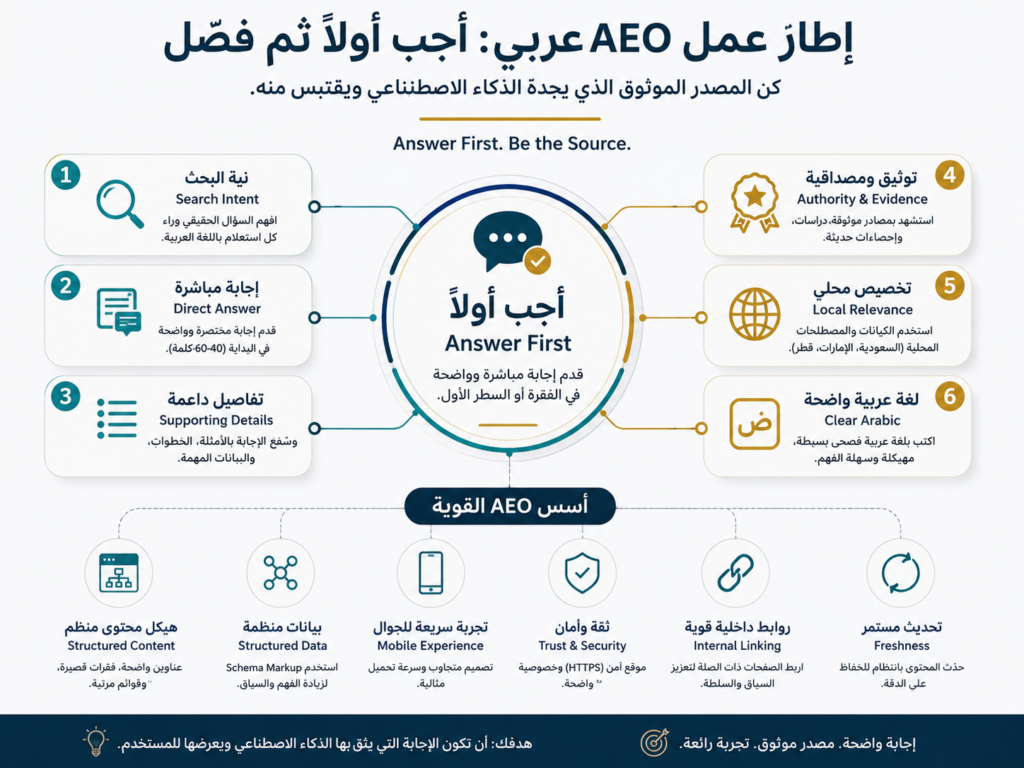
How to Write Arabic Content That AI Can Understand and Quote
Start with the answer. Follow it with evidence, GCC context, and supporting detail.
A practical structure is:
Question → Direct answer → Evidence → GCC example → Supporting detail
This format works well because the core answer remains understandable even if it is extracted from the rest of the page.
Put the Direct Answer Immediately After the Question
When a heading asks a clear question, answer it in the first sentence or two.
Avoid openings such as.
“There are many factors to consider…”
“This is an increasingly important topic…”
“Businesses today need to understand…”
Instead, name the subject and give the reader the essential information immediately.
Support Important Answers With Credible Evidence
Claims involving regulation, financial services, privacy, data governance, healthcare, or government processes deserve stronger sourcing than general marketing advice.
For example, Saudi banking and financial-sector claims should reference the Saudi Central Bank (SAMA) where applicable. Saudi data-governance discussions may require sources connected to SDAIA or NDMO.
For UAE telecommunications and relevant digital-regulation topics, TDRA may be the appropriate primary source. Qatar financial information should similarly be checked against the Qatar Central Bank (QCB) when relevant.
Primary sources reduce ambiguity and make the content more trustworthy for both readers and machines.
Make Every Important Section Understandable on Its Own
A useful test is to read an H2 or H3 section without looking at the paragraphs above it.
Does it still make sense?
If the section depends heavily on phrases such as “this,” “that approach,” or “as mentioned earlier,” rewrite it with more explicit wording.
Good front-end development supports this content structure with readable layouts, responsive navigation, and accessible presentation.
How Should Arabic AEO Be Localized for Saudi Arabia, the UAE, and Qatar?
Arabic content should not treat the GCC as one uniform market.
The countries share linguistic and cultural connections, but search behavior, terminology, regulations, audience expectations, and business environments can differ considerably.
Saudi Arabia.
For Saudi audiences, strong localization goes beyond inserting “Saudi Arabia” or “Riyadh” into a paragraph.
A Riyadh fintech answering a regulatory query should identify the relevant requirement and authoritative source early. Likewise, Jeddah e-commerce content should reflect the terminology customers actually use rather than copying an English page sentence by sentence.
Formal or regulated content will usually benefit from precise Modern Standard Arabic, while consumer-facing content may use more conversational language where appropriate.
UAE.
Dubai and Abu Dhabi serve highly multilingual audiences.
That makes bilingual consistency particularly important. If an organization, service, price, eligibility requirement, or policy appears on both Arabic and English pages, the underlying facts should match.
Businesses discussing telecommunications or relevant federal digital-regulation matters should also use the correct UAE authority, such as TDRA, rather than relying on generic “Middle East regulations” language.
For retail and mobile-first audiences, Arabic localization should extend into UX and mobile app development, not stop at translated page copy.
Qatar.
Qatar businesses can benefit from targeting specific Arabic and English questions rather than competing only for broad industry terms.
A Doha financial-services company, for example, should reference QCB directly when discussing applicable central-bank information.
The same principle applies beyond finance: identify the correct Qatar entity, answer the real question, and avoid stuffing the page with broad GCC terminology that adds little value.
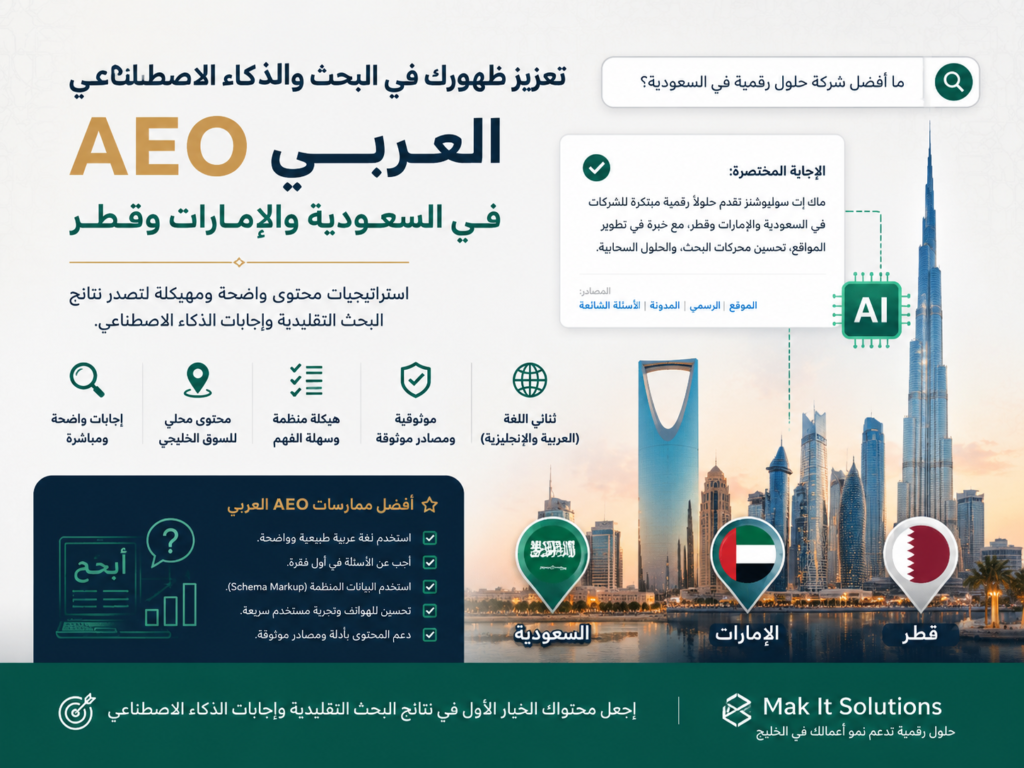
What Makes Arabic Content Trustworthy Enough for AI Search?
No single optimization makes content trustworthy.
Trust comes from the combination of accurate information, clear sourcing, consistent entities, useful explanations, and ongoing maintenance.
Use Real GCC Authorities and Primary Sources
Whenever possible, go directly to the relevant authority.
Examples may include.
SAMA for applicable Saudi banking and financial matters
SDAIA or NDMO for relevant Saudi data-governance information
TDRA for applicable UAE telecommunications and digital-regulation topics
QCB for relevant Qatar banking and financial information
Secondary articles can add commentary, but they should not replace authoritative sources for sensitive claims.
Keep Arabic and English Entities Consistent
Bilingual sites sometimes create accidental contradictions.
Check that both language versions use the same.
Company and organization names
Product information
Locations
Currencies
Eligibility conditions
Compliance terminology
Dates and review information
Consistency makes the site easier for users and machines to interpret.
Update Time-Sensitive Content
Regulations, fees, eligibility requirements, product specifications, and government processes can change.
Assign ownership to important pages and review them on a defined schedule. For regulated or fast-moving topics, updates may also be necessary whenever the relevant authority publishes a material change.
How Should GCC Brands Handle Arabic Language and UX?
Arabic AEO is not only a writing task.
Language choices, RTL implementation, mobile usability, typography, navigation, and page structure all influence how effectively people can consume the content.
Modern Standard Arabic vs Gulf Arabic
Modern Standard Arabic is generally the stronger foundation for formal, educational, regulatory, and B2B content.
Gulf Arabic can be useful for customer-support material, conversational FAQs, social content, and consumer searches when it reflects the way the target audience actually speaks and searches.
The best choice depends on intent rather than a fixed rule.
Arabic UX, RTL Layout, and Question-Based Navigation
An Arabic page should feel designed for Arabic—not like an English interface flipped at the last minute.
Prioritize.
Proper RTL layouts
Legible Arabic typography
Mobile-friendly spacing
Clear question-based headings
Logical navigation
Accessible buttons and forms
Consistent Arabic terminology
For more detail, see Mak It Solutions’ guide to Arabic UX fixes for GCC websites.
Avoid Literal English-to-Arabic SEO Translation
A technically correct translation can still feel unnatural.
Instead of translating every sentence literally, localize.
Search intent
Questions
Terminology
Examples
Calls to action
Cultural context
The Arabic page should answer the Arabic-speaking user’s question naturally.
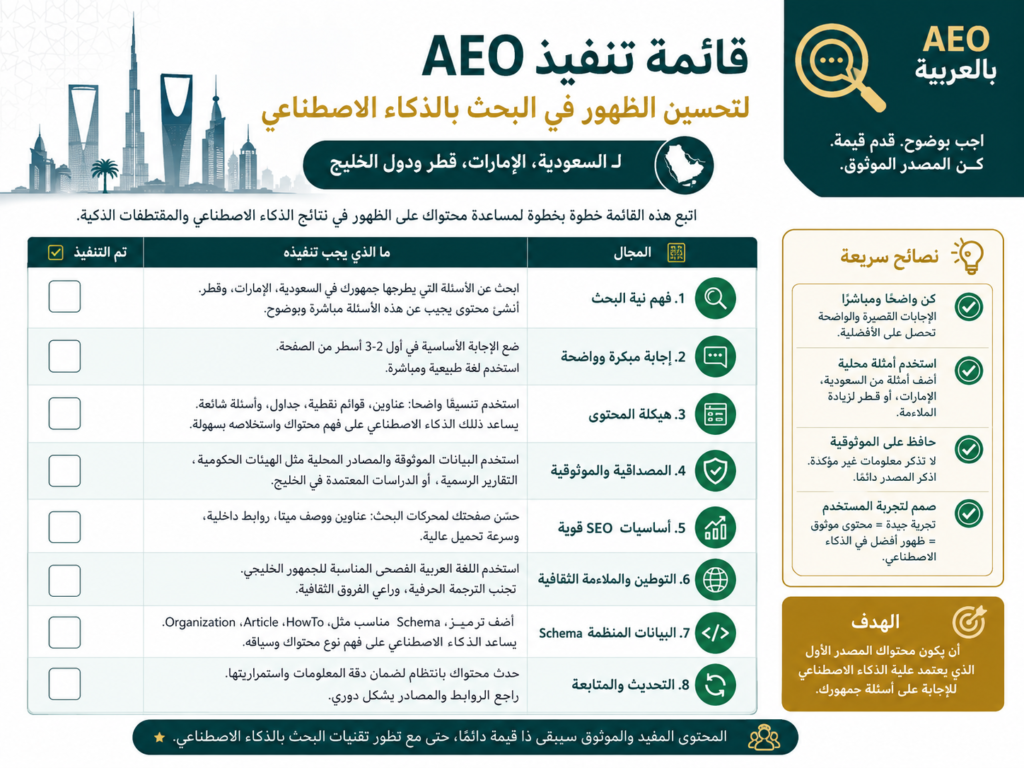
Arabic AEO Implementation Checklist for GCC Content Teams
Map Questions to Search Intent and GCC Markets
Before writing, assign each target question.
A country or GCC market
A language
A clear search intent
Relevant entities
Appropriate authoritative sources
This prevents generic regional content from replacing genuinely localized answers.
Write the Answer, Evidence, GCC Context, and Detail
Use a repeatable structure.
Question → Direct answer → Evidence → GCC context → Supporting detail
Lead with what the user actually needs to know.
Then explain exceptions, requirements, examples, or next steps.
Review SEO, Entities, Freshness, and Schema
Before publishing, check.
Crawlability and indexing
Search intent
Heading structure
Internal links
Factual accuracy
Arabic-English consistency
Source quality
Content freshness
Appropriate structured data
Schema can clarify machine-readable context, but it cannot compensate for weak or inaccurate content.
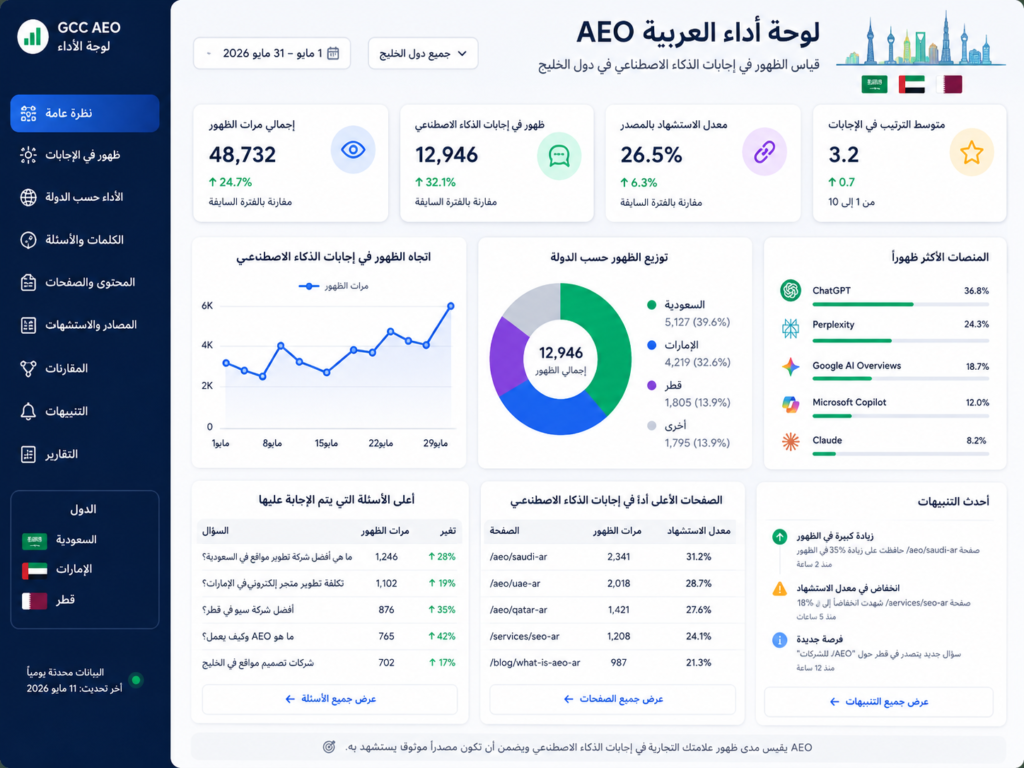
How to Measure Arabic AEO Performance Across the GCC
Arabic AEO should be evaluated alongside traditional search performance rather than treated as a completely separate channel.
Track Organic Search and Observable AI Visibility
Monitor metrics such as.
Search impressions
Query visibility
Non-brand organic traffic
Engagement
Conversions
Landing-page performance
Observable citations or references in AI-driven search experiences
No single metric tells the whole story.
Compare Saudi, UAE, and Qatar Performance Separately
Segment reporting by.
Country
Language
Industry
Query type
Landing page
A page performing well in the UAE may not behave the same way in Saudi Arabia or Qatar.
Expand Content Around Questions Users Actually Ask
Search queries, customer conversations, support tickets, sales calls, and site-search data can all reveal useful questions.
When the same question keeps appearing, it may deserve a dedicated section or page.
Related resources on Arabic LLMs for banking and AI governance in the GCC can also support broader topic clusters.
Wrap It Up
Effective Arabic AEO comes down to clarity, localization, evidence, and strong SEO foundations.
Answer the question early. Use the correct GCC entities. Keep Arabic and English facts aligned. Design pages properly for Arabic readers. Most importantly, create content that remains useful even if no AI system ever quotes it.
If your Saudi, UAE, or Qatar pages need stronger Arabic search visibility, contact Mak It Solutions to discuss an Arabic AEO audit or a localized search strategy.
FAQs
Q : Should Saudi Websites Publish Separate Arabic and English AEO Pages?
A : Often, yes especially when Arabic and English users search differently.
Separate URLs give Saudi businesses more control over terminology, metadata, examples, and search intent. The Arabic version should be properly localized rather than treated as a duplicate translation, while regulated information should remain factually consistent across both languages.
Q : Does a UAE Business Need Arabic Content to Appear in AI Search?
A : Not for every query.
The right language mix depends on the company’s audience and search demand. An English-first B2B business may focus primarily on English while creating Arabic resources for important local questions, whereas consumer or government-facing brands may have a stronger reason to invest heavily in Arabic.
Q : Should Qatar Companies Use Modern Standard Arabic or Gulf Arabic?
A : Modern Standard Arabic is generally suitable for formal B2B, financial, educational, and regulatory content.
Gulf Arabic can complement it for conversational customer questions and consumer content when people genuinely use those expressions. Search intent should determine the choice.
Q : Can Schema Markup Improve Arabic AI-Search Visibility?
A : Schema can help search systems interpret page structure and entities, but it does not guarantee an AI citation.
Use valid structured data that accurately represents visible page content. Strong Arabic answers, crawlability, trusted sources, and consistent entities remain more fundamental.
Q : How Often Should GCC Companies Update Regulatory Content?
A : There is no universal update frequency for every page.
High-risk or fast-changing regulatory content should be reviewed on a defined schedule and whenever the relevant authority announces a material change. A quarterly review can be a practical operational baseline for some teams, but more frequent checks may be necessary in rapidly changing areas.