


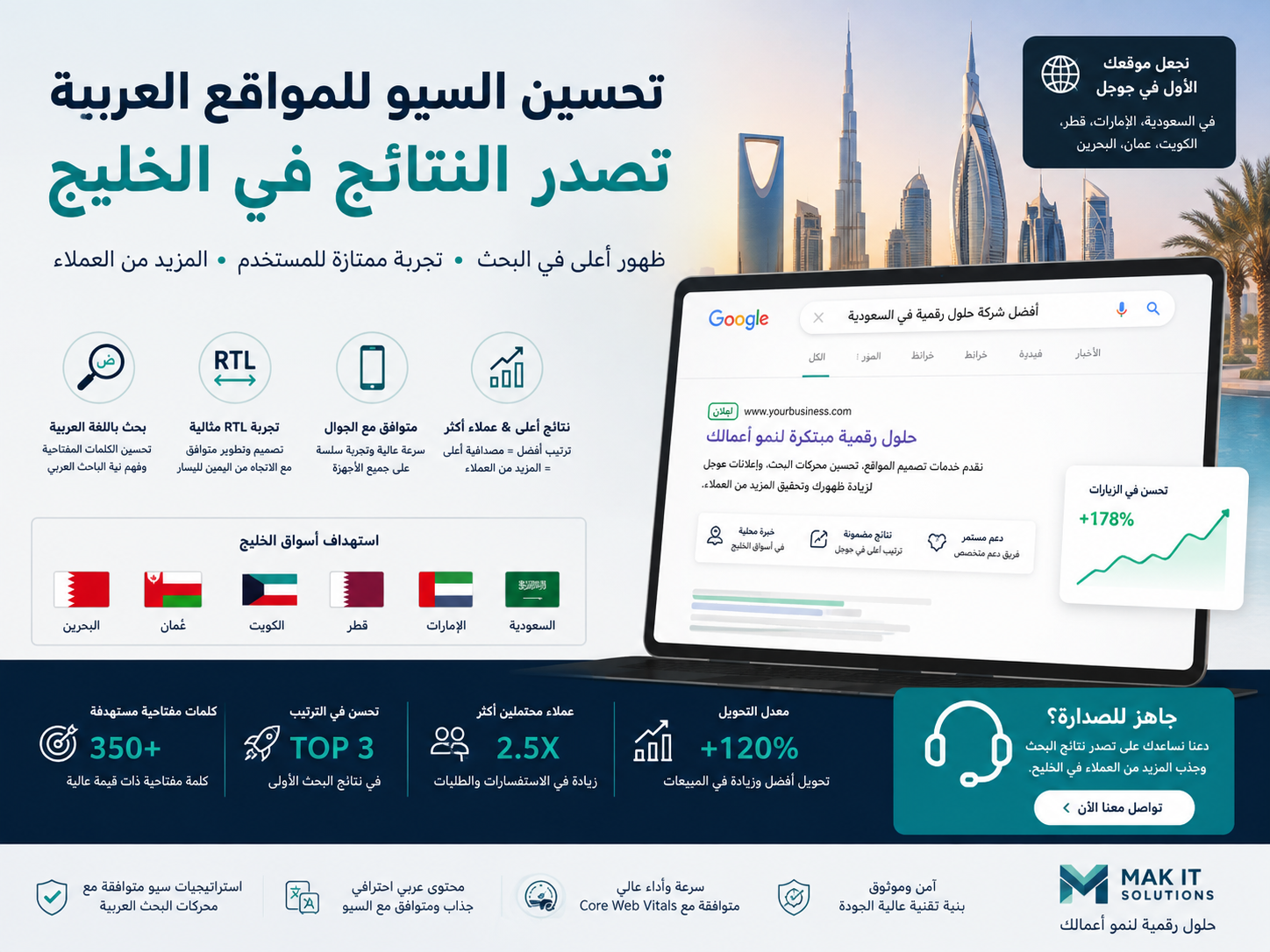
Arabic SEO & RTL UX: Win More GCC Leads
Strong Arabic SEO can bring a business more visibility in Riyadh, Dubai, or Doha. But rankings alone do not create leads. If the Arabic page still feels like an English website that has simply been flipped from left to right, visitors may leave before they enquire, sign up, or buy.
In practical terms, Arabic SEO helps GCC businesses appear for relevant Arabic searches, while good RTL UX helps turn that traffic into trust and conversions. RTL design itself is not a standalone Google ranking factor, but mobile usability, technical performance, localization, and Core Web Vitals all contribute to a stronger search and user experience through the broader page-experience ecosystem.
The Gap Between Rankings and Leads
Search visibility only gets the visitor through the door.
Once someone reaches the page, they still judge whether the website feels clear, credible, and easy to use. Navigation, Arabic typography, forms, calls to action, mobile layouts, and language switching can all influence whether that visit becomes a qualified lead.
For GCC businesses, the real goal is not simply to rank an Arabic page. It is to connect search visibility with an experience that feels natural to Arabic-speaking users.
Saudi Arabia, UAE, and Qatar Need Different UX Thinking
There is no single GCC user journey.
Saudi websites often benefit from stronger Arabic-first experiences. UAE businesses commonly serve multilingual audiences who move between Arabic and English. Qatar combines sophisticated bilingual commercial and government digital environments, where accessibility and clarity deserve particular attention.
That is why regional localization should go beyond translating the same page for every market.
What Arabic SEO and RTL UX Mean in the GCC
Arabic SEO Goes Beyond Translating English Pages
Effective Arabic SEO starts with how people actually search.
That means researching Arabic keywords directly rather than translating an English keyword list word for word. It also means creating localized metadata, matching country-specific intent, building useful internal links, and maintaining a technically sound bilingual architecture.
Businesses can combine these foundations with Mak It Solutions’ SEO services rather than depending on automated translation as a complete localization strategy.
Arabic search behavior can vary by market, terminology, dialect, industry, and level of English usage. A phrase that works naturally in Dubai may not be the strongest choice for an Arabic-first campaign in Riyadh.
What Makes RTL UX Different From Standard Web Design?
Right-to-left design affects much more than text alignment.
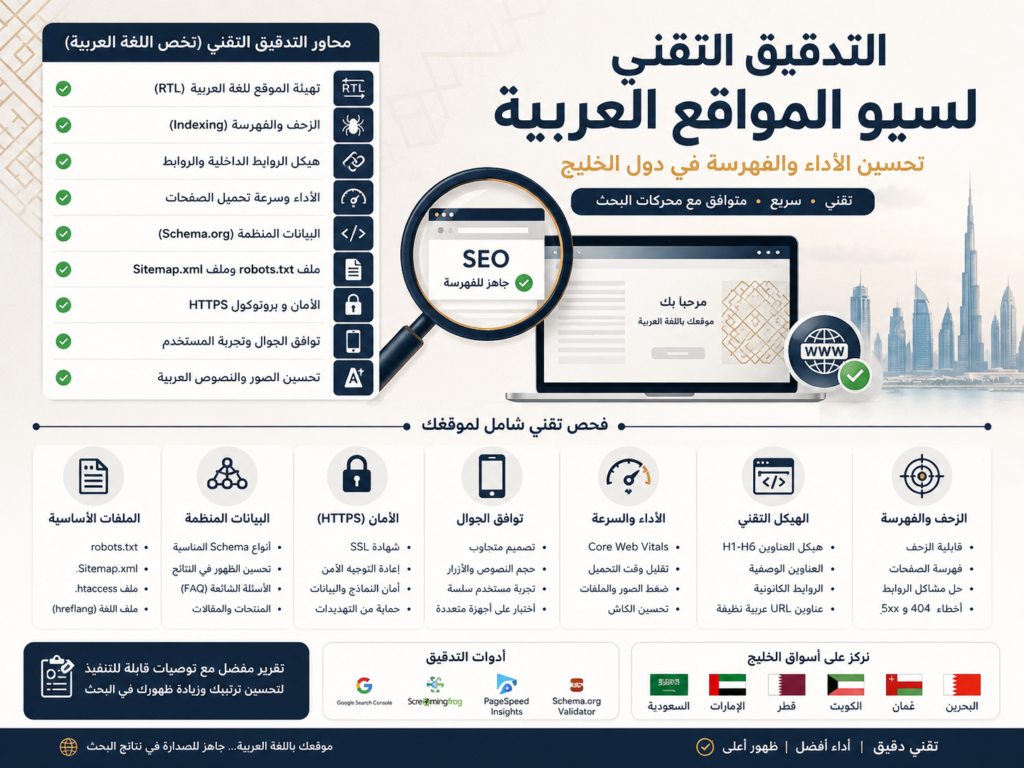
A well-built RTL website needs to consider.
Navigation and menu direction
Arabic typography and line spacing
CTA placement
Form labels and validation messages
Phone and number fields
Icons and directional elements
Mixed Arabic-English text
Mobile interaction
Language switching
Simply mirroring an English landing page rarely creates a natural Arabic UX design. Web design built around usability matters just as much as visual direction.
Arabic-First vs Bilingual User Journeys
Different GCC markets may require different approaches.
A Riyadh fintech could prioritize Arabic-first onboarding and support content. A Dubai retailer may need seamless switching between Arabic and English without losing page context. A Doha service provider may need both languages to offer equally complete information and conversion paths.
The right approach depends on who the user is, what they are trying to do, and which market the page serves.
How Arabic SEO and RTL UX Affect Search Performance
Does RTL UX Directly Improve Google Rankings?
Not by itself.
Google does not identify strong RTL design as an independent ranking boost. However, Google confirms that Core Web Vitals are used by its ranking systems, while broader page-experience improvements can make websites more satisfying for visitors.
The practical takeaway is simple: do not redesign an RTL website because you expect a direct ranking bonus. Improve it because technical quality, usability, accessibility, and conversion experience all support a healthier website.
Core Web Vitals, Mobile UX, and Arabic Pages
Arabic implementations can expose performance problems that were less obvious on the English version.
Custom Arabic fonts may affect loading. Responsive menus can shift when direction changes. Dynamic bilingual components may introduce layout instability. Forms can behave differently once mixed RTL and LTR content is involved.
Test Arabic pages on real mobile layouts after introducing new fonts, navigation elements, forms, banners, or localized assets.
Technical RTL Errors That Can Hurt Search Performance
Several technical problems can weaken an otherwise strong Arabic website.
Check.
Correct dir implementation
Crawlable Arabic and English URLs
Canonical tags
Arabic metadata
Internal linking
Duplicate or near-duplicate localized pages
Language selectors
hreflang implementation
Mobile rendering
Where deeper fixes are required, Mak It Solutions’ web development services can support the technical side of bilingual website architecture.
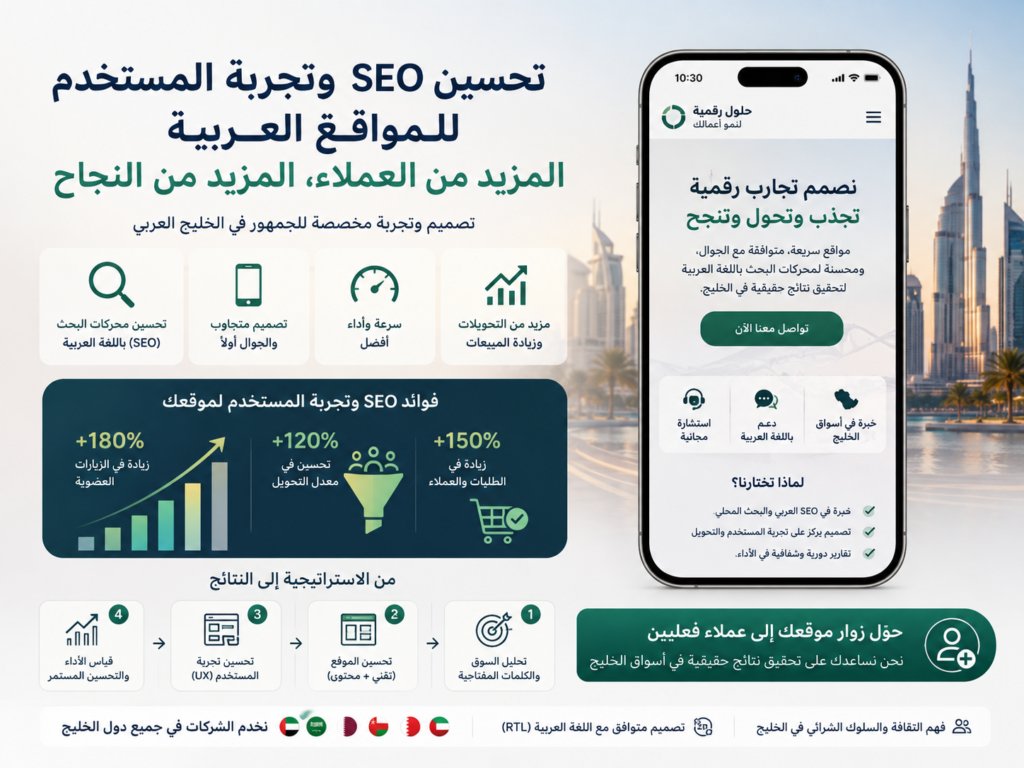
Why Poor Arabic UX Can Reduce GCC Leads
Ranking Well Does Not Guarantee Conversion
Arabic SEO may win the click, but the visitor still has to trust the page.
If the interface looks unfinished, the Arabic terminology feels unnatural, or the conversion journey becomes confusing, users have little reason to continue.
This is especially important on pages where visitors need to submit personal information, request a quotation, open an account, book a service, or make a payment.
Forms, Navigation, and CTAs Are High-Risk RTL Touchpoints
Forms often reveal RTL problems quickly.
Watch for Arabic labels sitting beside LTR input behavior, validation messages appearing in the wrong place, awkward phone-number fields, confusing button positions, or navigation that has been visually mirrored without considering user expectations.
These issues can create unnecessary friction in fintech onboarding, logistics enquiries, lead-generation forms, and e-commerce checkout experiences.
A form can technically function and still feel difficult to use.
Arabic Localization Builds Trust Beyond Literal Translation
Localization is not only about language.
It includes terminology, currency presentation, typography, content hierarchy, tone, and local expectations. Even when Saudi Arabia, UAE, and Qatar share Arabic-language audiences, users do not necessarily expect identical digital experiences.
A Saudi retail campaign, for example, should not automatically copy the same bilingual journey designed around a Dubai audience.
Arabic SEO and RTL UX Priorities: Saudi vs UAE vs Qatar
Saudi Arabia Prioritize Arabic-First Journeys
For users in Riyadh, Jeddah, and other Saudi markets, prioritize clear Arabic readability, mobile usability, accessibility, and straightforward conversion journeys.
Saudi Arabia’s Digital Government Authority provides useful context through its Digital Experience Maturity Index. It can help teams understand broader expectations around digital service quality, although it should not be treated as a commercial Google ranking framework.
For commercial websites, the important lesson is to treat Arabic as a complete user experience rather than a secondary version of the English site.
UAE Build Genuine Arabic-English Parity
Dubai and Abu Dhabi businesses often serve highly multilingual audiences.
Arabic and English versions should therefore feel equally complete. Users should not discover that important services, product details, support information, or conversion options disappear when they change languages.
The UAE Design System emphasizes reusable, accessible digital components and references WCAG 2.2 for federal government experiences.
A Dubai commerce brand can also align mobile app development with its bilingual website experience so language and usability remain consistent across devices.
Qatar Focus on Accessible, Clear Bilingual Journeys
Doha businesses can take useful cues from Qatar’s focus on digital inclusion.
MCIT supports digital transformation initiatives, while Mada publishes accessibility resources in Arabic and English for developers and content teams (Ministry of Communications).
For commercial websites, the broader principle is valuable: Arabic content should not only exist. It should be readable, usable, accessible, and easy to act on.
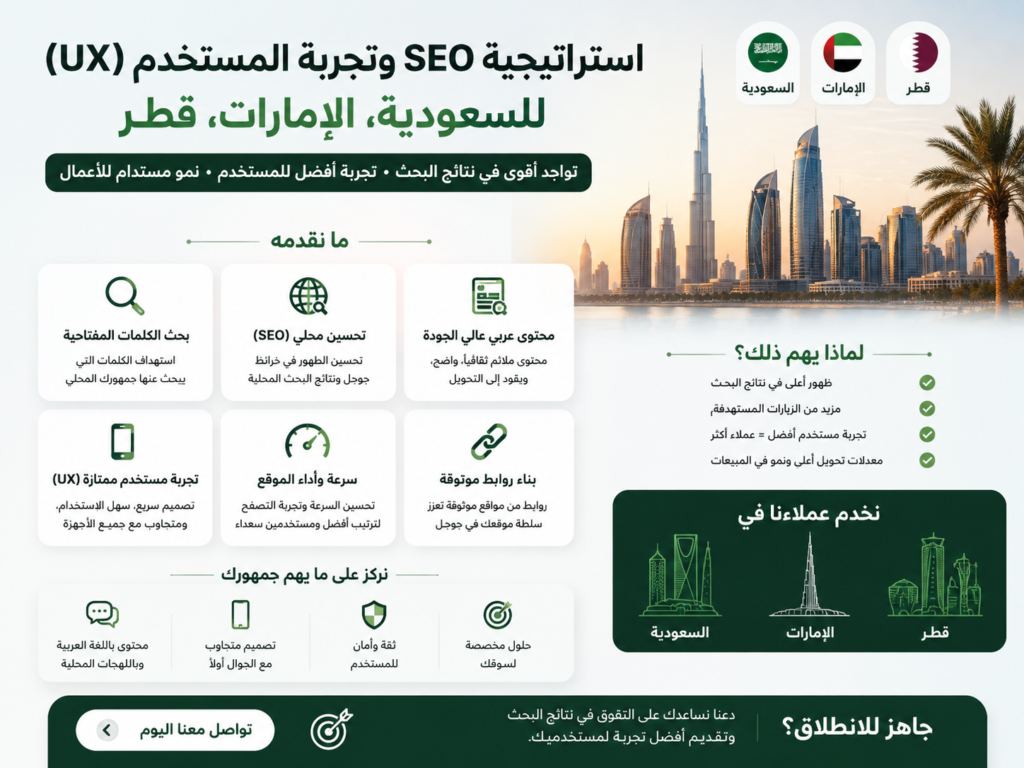
Technical, Trust, and Compliance Checks for GCC Websites
Build the Arabic-English SEO Architecture Correctly
A strong bilingual website needs a structure that search engines and users can both understand.
Use consistent localized URLs, crawlable language selectors, correct canonicals, useful internal links, localized metadata, and appropriate hreflang implementation.
Avoid treating machine translation as a full localization workflow. Translation can help produce a starting point, but search intent, terminology, usability, and market relevance still need human review.
Treat Accessibility as Part of Digital Quality
Saudi DGA resources, the UAE Design System, Qatar’s MCIT, and Mada can provide useful regional references when teams are improving accessibility and digital experience.
However, government frameworks should not automatically be presented as legal or technical requirements for every private-sector website. Applicability depends on the organization, sector, service, and jurisdiction.
Regulated Sectors Need Extra Local Review
Financial services, fintech, healthcare, and other regulated sectors require additional care.
A Riyadh fintech may need to review applicable Saudi Central Bank requirements. Businesses operating in Qatar or Abu Dhabi financial environments may need to consider the relevant local regulatory frameworks as well.
Cloud and hosting choices can also involve regional infrastructure, sector rules, and data-governance requirements. Providers including AWS, Microsoft Azure, and Google Cloud operate infrastructure within or near GCC markets, but availability and regulatory suitability should always be checked against current requirements (AWS Documentation).
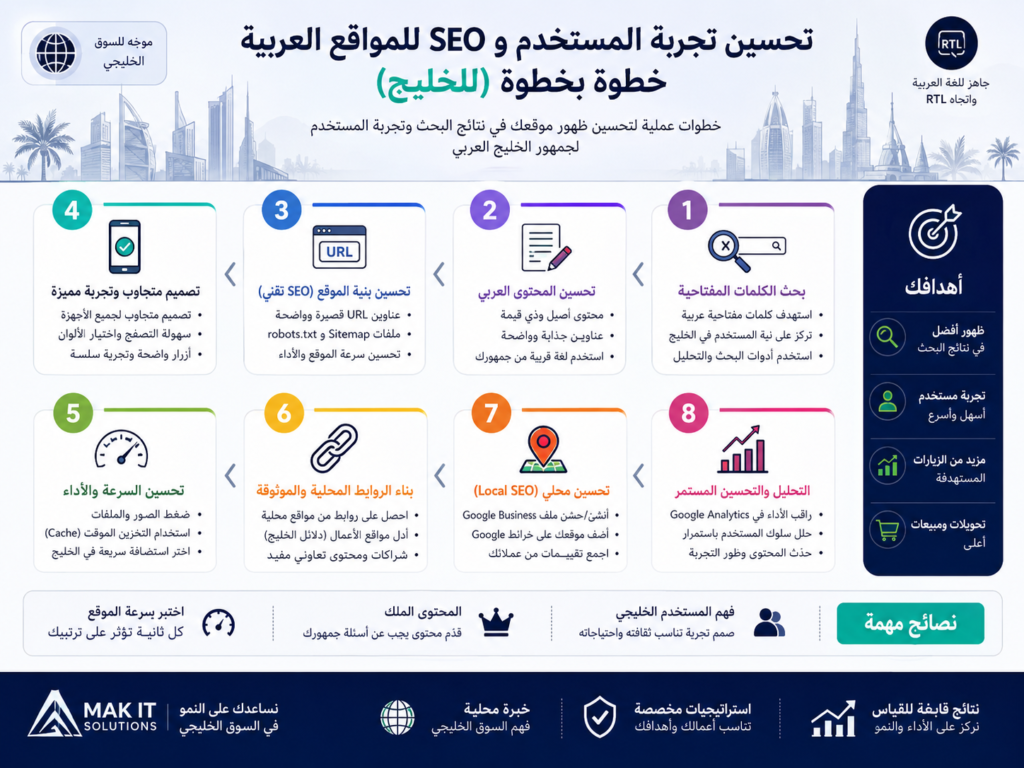
How to Improve Arabic SEO and RTL UX Step by Step
Audit Your Arabic-English Search Architecture
Review localized URLs, indexing, metadata, canonical tags, internal links, crawlability, and hreflang.
Confirm that search engines can discover and understand both language versions without unnecessary duplication.
Test the RTL Experience on Mobile
Review menus, typography, forms, CTAs, navigation, and language switching on common mobile layouts.
Do not rely only on desktop screenshots. Many usability problems become obvious only when the Arabic interface is used on a smaller screen.
Measure Performance
Check Core Web Vitals and investigate loading, interaction, or layout problems.
Pay particular attention to Arabic font files, dynamic content, navigation components, banners, and mixed RTL/LTR elements.
Remove Conversion Friction
Improve Arabic copy, form labels, validation, checkout steps, CTA positioning, and mobile interactions.
For larger acquisition programmes, these improvements can be connected with a broader digital marketing strategy.
Test Saudi, UAE, and Qatar Separately
Do not assume that one Arabic experience will perform equally well across every GCC market.
Review terminology, language preference, content depth, navigation behavior, and conversion expectations by country.
Measure Business Impact
Track more than rankings.
Useful signals include organic visibility, engagement, form completion, conversion rate, qualified leads, and mobile performance. For organizations working with larger datasets, business intelligence solutions can help connect marketing performance with wider business outcomes.
Concluding Remarks
Arabic SEO gets the right GCC audience to your website. Strong RTL UX gives that audience a reason to stay, trust the page, and take the next action.
The strongest GCC websites combine technically correct bilingual architecture with genuinely localized Arabic experiences. They also test performance, accessibility, forms, navigation, and conversion journeys by market instead of treating Saudi Arabia, UAE, and Qatar as one identical audience.
If your website already ranks but Arabic visitors are not converting, the problem may be happening after the click.
Want to find where your Arabic website is losing visibility or leads? Contact Mak It Solutions to discuss a tailored Saudi Arabia, UAE, or Qatar Arabic SEO and RTL UX strategy.
FAQs
Q : Is Arabic SEO different from English SEO in Saudi Arabia?
A : Yes. The core SEO principles are similar, but Saudi Arabic SEO requires Arabic keyword research, appropriate terminology, localized metadata, and an experience that feels natural to Arabic-speaking users.
Search phrases are not always direct translations of English queries, so keyword research should be carried out with Arabic search intent in mind. Mobile readability and Arabic-first journeys are also important considerations.
Q : Should UAE businesses use separate URLs for Arabic and English pages?
A : Separate crawlable URLs are usually a clean approach when Arabic and English pages contain equivalent localized content.
They make hreflang , canonical management, internal linking, and analytics easier to manage than experiences that depend entirely on cookies or client-side language switching. The Arabic version should also offer genuine content parity rather than a reduced copy of the English site.
Q : What RTL design mistakes can hurt e-commerce conversions in Qatar?
A : Common issues include incorrectly mirrored navigation, LTR behavior inside Arabic forms, weak mobile typography, confusing CTA placement, misplaced validation messages, and inconsistent Arabic-English terminology.
These problems create friction when shoppers need to enter personal, payment, or delivery information. Testing the checkout with Arabic-speaking users can reveal issues that basic visual QA may miss.
Q : Do GCC websites need hreflang for Arabic and English content?
A : Hreflangis useful when a website maintains separate Arabic and English URLs or different language-country versions.
It helps search engines understand which localized page is intended for each audience. It should be implemented consistently alongside correct canonicals, crawlable URLs, and genuinely localized content.
Q : Which Core Web Vitals should Arabic websites monitor?
A : Arabic websites should monitor Google’s Core Web Vitals, including Largest Content ful Paint, Interaction to Next Paint, and Cumulative Layout Shift (Google for Developers).
Arabic fonts, dynamic menus, banners, and mixed RTL/LTR components can all affect real-world performance when poorly implemented. Strong scores do not guarantee top rankings, so performance improvements should be combined with relevant content, sound technical SEO, mobile testing, and conversion measurement.
[…] SEO for IT Companies Works in GCC […]